
Monica Bergquist’s Abstract Paintings Flow Between Nature, Science & Memory
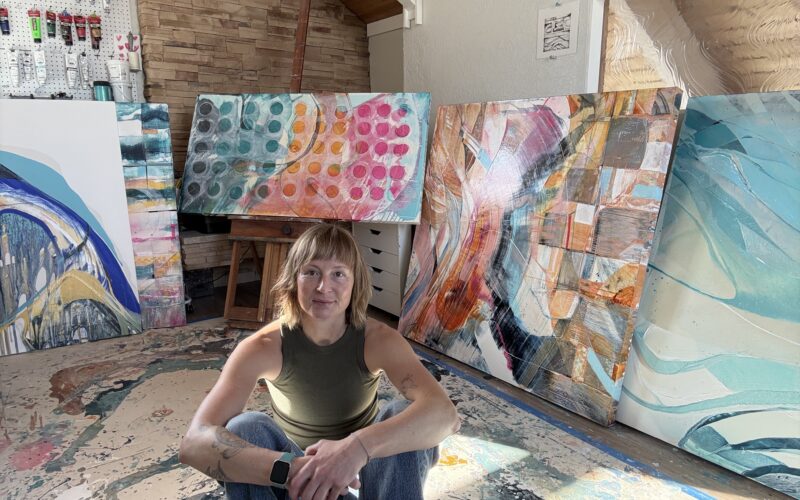
At Arts to Hearts Project, our 100 Emerging Artists of 2026 is full of artists who found their voice in unexpected places, gathered from every corner of the world and every stage of a creative life. Some found it early, some found it after everything else fell away.
Monica Bergquist found hers in the middle of loss, returning to painting after twenty years and discovering a whole new way of seeing, one where rivers, cells, and galaxies all seem to speak the same language. The moment we saw it, we knew.
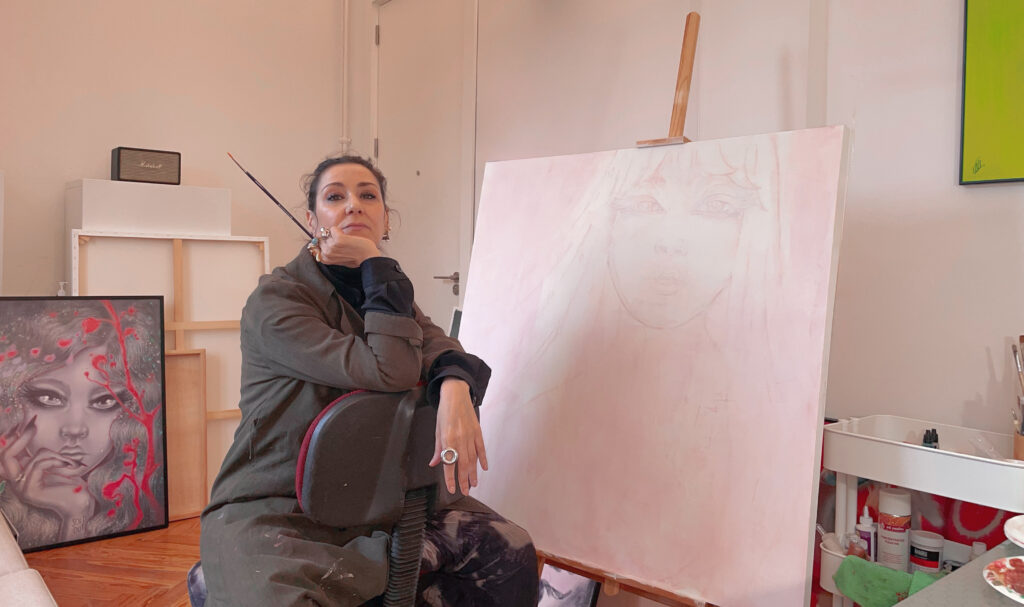
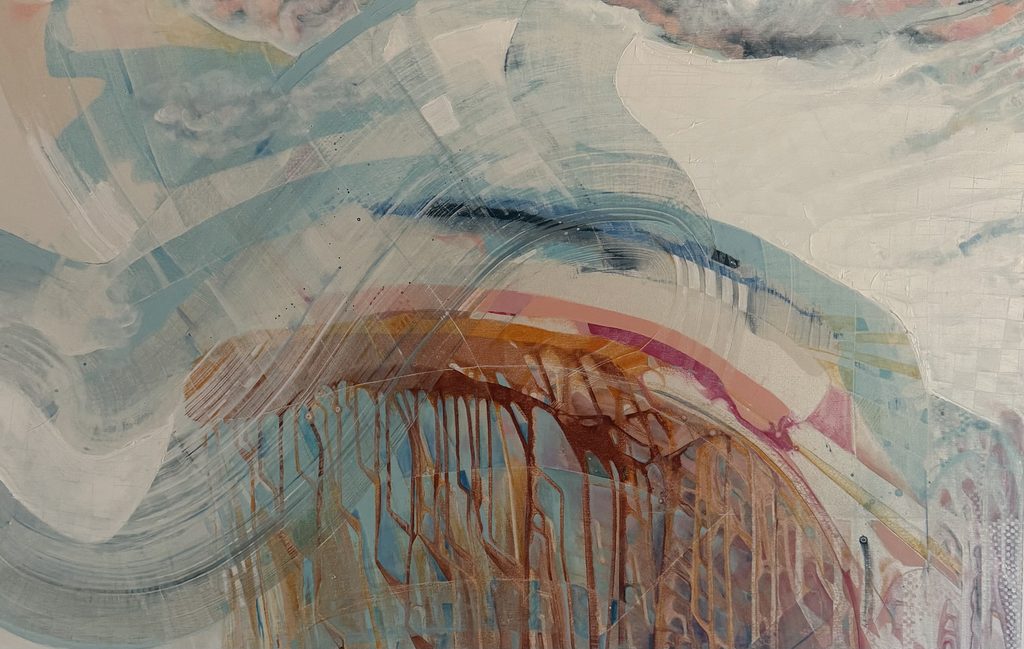
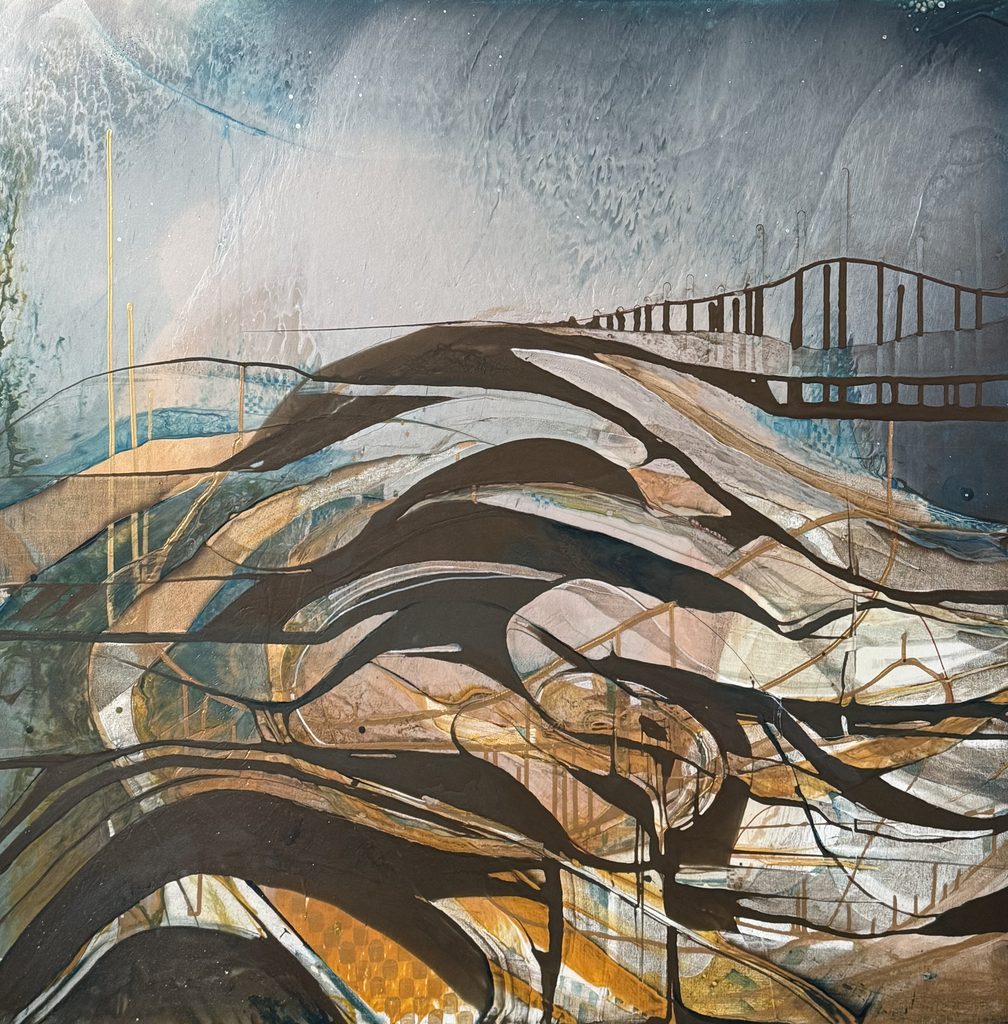
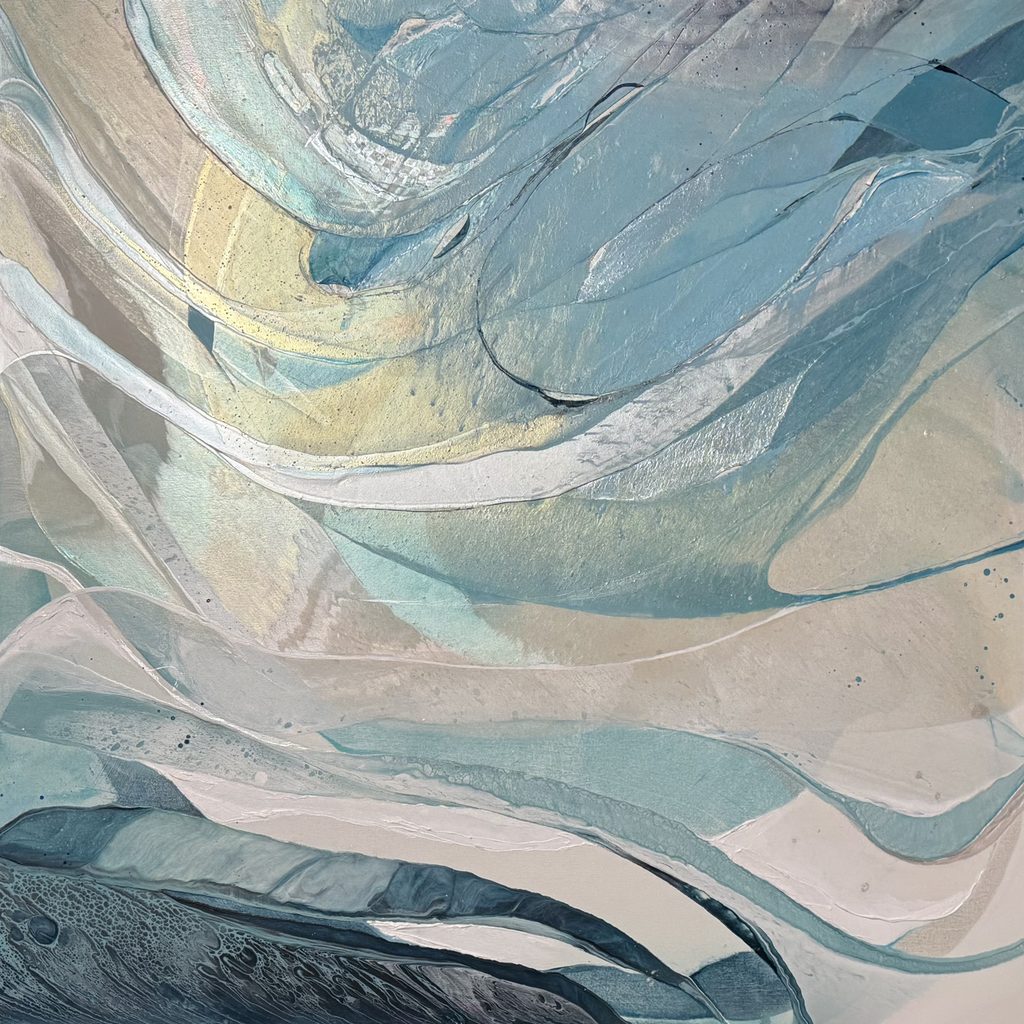
Monica is an abstract artist based in Montana. She lives close to open land, rivers, and mountains, and you can feel all of that in her work. She paints with mixed media, and the first thing that pulls you in is the surface itself. These are not flat, neat pictures. They are built up and broken down, layer over layer, until they feel less like paintings and more like something that grew on its own.
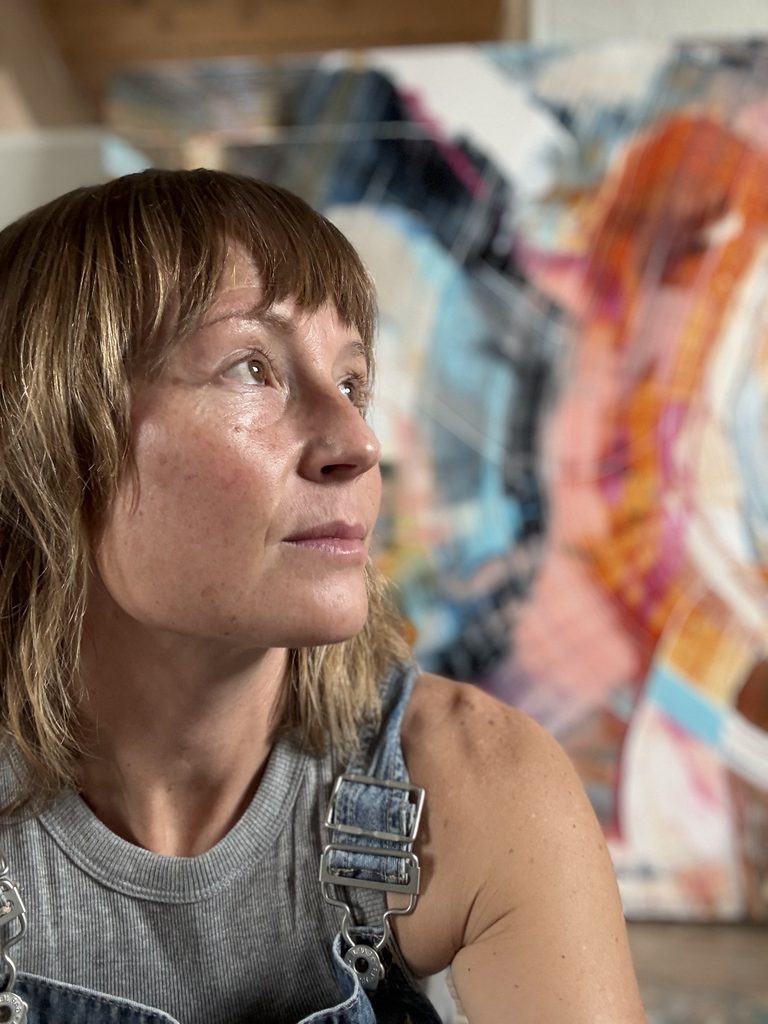
That look is not an accident, and yet a lot of it is. Monica works almost like a force of nature herself. She starts by pouring thin paint and letting it run, guiding it into shapes that copy the way water moves earth around. Then she works against that softness.
She carves into thick paint with sharp tools, sprays and splatters, draws into it with charcoal, and sometimes puts the paint on so thick that the top dries and cracks while the layers underneath are still wet. Every mark is a choice, but the final look always belongs partly to chemistry, physics, and time.
She calls herself the “steward” of each painting instead of its boss, and that one word tells you a lot. She is not trying to control every inch. She gets things moving and then reacts to what the paint does, leaving room for the accidents and surprises she could never have planned.
She often lays a clean, straight grid over the wild, flowing shapes underneath, so the finished piece feels like a talk between order and chaos. For her, the accident and the plan are not enemies. They need each other.
It helps to know that Monica is also a scientist. Along with her training in Fine Arts, she has a degree in Nutritional Science and works as a Registered Dietitian, and she sees these two sides of herself as partners, not opposites. Science looks for the patterns.
Art is happy to sit with everything that cannot be fully explained. Her paintings live right in that space, which is why they can look like a river seen from high above one moment and something alive under a microscope the next. She is glad to let you decide which one you are seeing.
What holds it all together is a simple belief that beauty comes from disruption, not perfection. She is drawn to the cracks, the scars, and the places where something breaks or changes direction, because that is so often where the truth is.
Maybe that makes sense for someone who found her own way back to art through loss, after twenty years away, in the middle of a busy life. Whatever the reason, you can feel it in the work. A deep acceptance that the messy, layered, unpredictable path is the real one, and that it holds its own kind of beauty.
Now let’s hear from Monica about her return to art, her love of chance, and why imperfection is where the beauty lives.
Q1. Monica, can you take us back to the beginning of your journey and what brought you back to painting?
After grieving the loss of my mom, my soul needed to create. It became both an escape and a way to move through my grief, a practice that grounded me and deepened my connection to the present. The idea that humans are nothing more than a slow, complex biochemical reaction has always felt incomplete to me. We carry something that cannot be measured or quantified. Whether we call it consciousness, spirit, love, or simply the essence of being alive, there is a depth within us that exists beyond chemistry alone.
Creating became my way of listening to that mystery and finding my way and purpose through loss
Q2. What first drew you to exploring nature through systems rather than scenery?
I find it fascinating that the same patterns appear throughout nature, almost as if they are clues to how creation works. The branches of a tree resemble the arteries in the human body, and rivers with their smaller streams create the same kind of branching pattern when viewed from above. These similarities seem too meaningful to dismiss as mere coincidence.
It doesn’t feel like a choice between order and chaos. Instead, complexity seems to give rise to self-organization, with similar patterns recurring throughout life and nature while still allowing for meaningful variation. These patterns hint at a deeper order connecting the natural world. Art extends this idea further, revealing how the same underlying patterns can be expressed through creativity, imagination, and human experience.
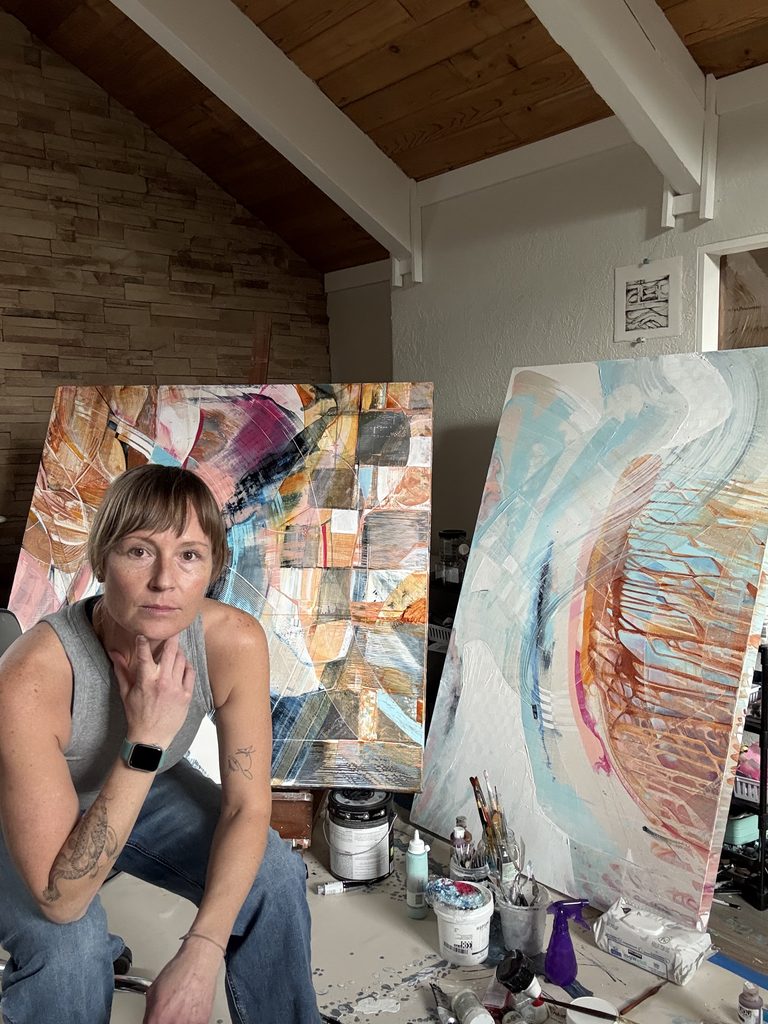
Q3. What fascinates you about letting paint behave according to its own rules?
I love experimenting with paints of different densities and watching what happens as they interact. Some absorb the properties of others, creating patterns that resemble fractals, cells, and branching forms. In this way, I collaborate with natural processes while leaving room for the mystery of art, the moments that cannot be planned or controlled. In the same way, each painting becomes its own living system, shaped by both intention and chance.
Q4. How has studying nutritional science shaped the way you understand painting?
“You are what you eat.” We’ve all heard that saying, and there is truth in it. Our physical, mental, and emotional well-being is shaped by the food, information, media, and energy we absorb every day.
In my art, although very colorful, I choose to surround myself with natural processes, science, beauty, and the possibility of discovery.
Allowing space for something unexpected reminds me that I am alive. It reminds me that growth, transformation, and creativity all begin with what we take in and how we respond to it.
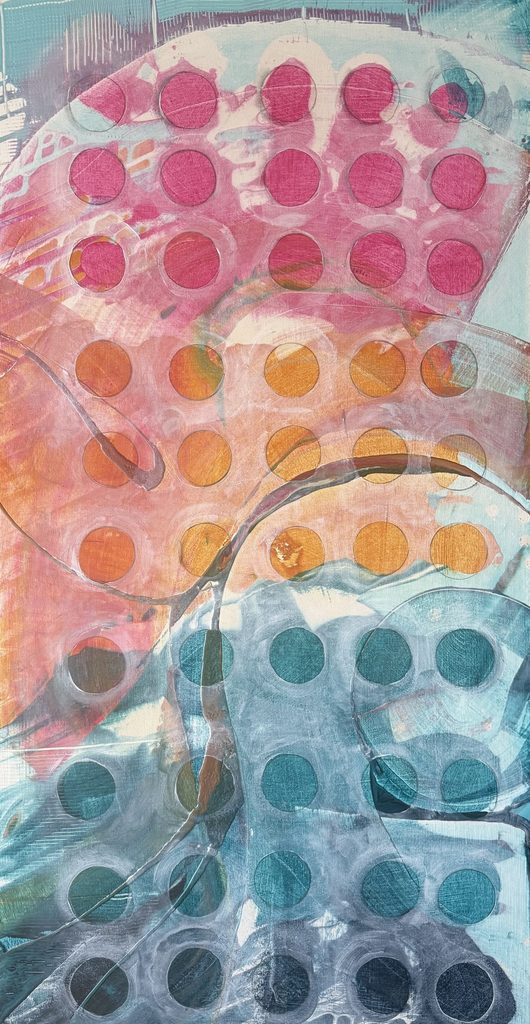
Q5. What inspired you to incorporate river water directly into your Flow paintings?
To deepen the connection between the work and its source of inspiration, I collected water from local rivers alongside friends and family and incorporated it into the paint itself. This gesture grounds each piece in a specific place while embedding traces of shared experience, memory, and relationship within the work. The paintings become more than representations of rivers. They become physical records of connection, to landscape, community, and time. Simultaneously, and purposefully, leaving a basic topographical representation of that river in the painting separates the emotion and human from the imagery.
My process mirrors the movement of water.
Beginning with mapped river paths and intuitive gestures, I built surfaces through layering, subtraction, and revelation. Paint is applied, obscured, removed, and rediscovered. As forms emerge and recede, the paintings evolve much like a river’s course, shaped by accumulation, erosion, and chance. These repeated actions become meditations on transformation, memory, and the passage of time. What remains visible and what disappears are equally important, reflecting the ways experiences leave traces within us. The series is also deeply informed by my experience of parenthood.
Rivers give and take, nurture and reshape, much like the role of a parent. As an artist, I am drawn to spontaneity, intuition, and the beauty of natural irregularities. As a mother, I depend on structure, routine, and stability. These identities often feel at odds, yet they continually inform one another. Flow reflects this ongoing negotiation between freedom of movement and containment, chaos and order, unpredictability and grace.
Q6. What has being a “steward” of your paintings taught you about creativity?
I leave room for chemistry, physics, and time to introduce unplanned elements into my work. This approach helps me stay present during making, as each decision shapes the painting’s evolving system as a whole. There is intention, but also space for the unexpected to emerge, something that can feel like a kind of magic. I can become fully absorbed in this process when I allow it to unfold.
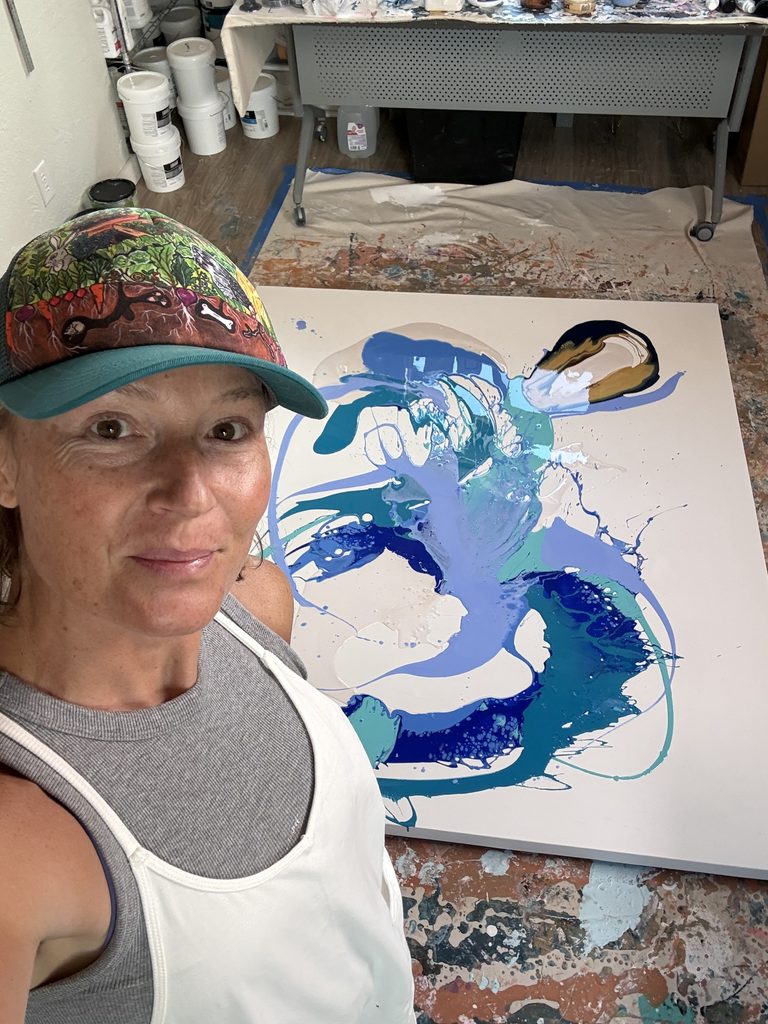
Q7. What do grids and organic forms allow you to explore together?
Grids and checkerboards often represent duality to me, the tension between open space and development, and the choices humans make between what we consider good and evil. These structured patterns form a visual language of contradiction and balance, all held within a complex system.
Checkerboard patterns emerged thousands of years ago and have symbolized duality, cosmic balance, and structured harmony across cultures. What better abstract form could there be for questioning how our universe is structured, or how order and chaos coexist within it? Checkerboards juxtaposed with organic forms evoke a tension between humans and nature, suggesting they are not separate forces but part of the same system.
Q8. Do you intentionally leave your landscapes open to different interpretations?
I leave interpretation open to the viewer, whether they read the work through a micro- or macrocosmic lens. I am drawn to the feeling of being small within a vast world, while also noticing how similar patterns repeat across scales, from the body to systems to the Earth seen from above. My two most recent series use topographical mapping and organizational systems within the composition, rivers in Flow, and mountains and cities in Range. Across this work, I return to the idea that the perceived disconnect between humans and land is constructed rather than inherent, and that we remain part of the same interconnected system.
Q9. What has working between science and art taught you about creativity?
I see both scientists and artists as observers, recognizing patterns others may not immediately notice, and both rely on creativity and problem-solving to push the boundaries of current understanding.
Science often approaches questions as problems with answers to be discovered, while art accepts and works within the possibility that some things may remain unknowable from our limited perspective. For me, in painting especially, there is room for emotions and experiences that don’t translate easily into words or clear definitions. Yet a painting can still evoke a shared, almost universal response.
Art can carry feelings that are real and meaningful even when they resist precise categories or purely logical structures.
I am drawn to the idea that something greater can emerge through artistic practice, including forms of understanding that sit outside of what can be fully explained through science.
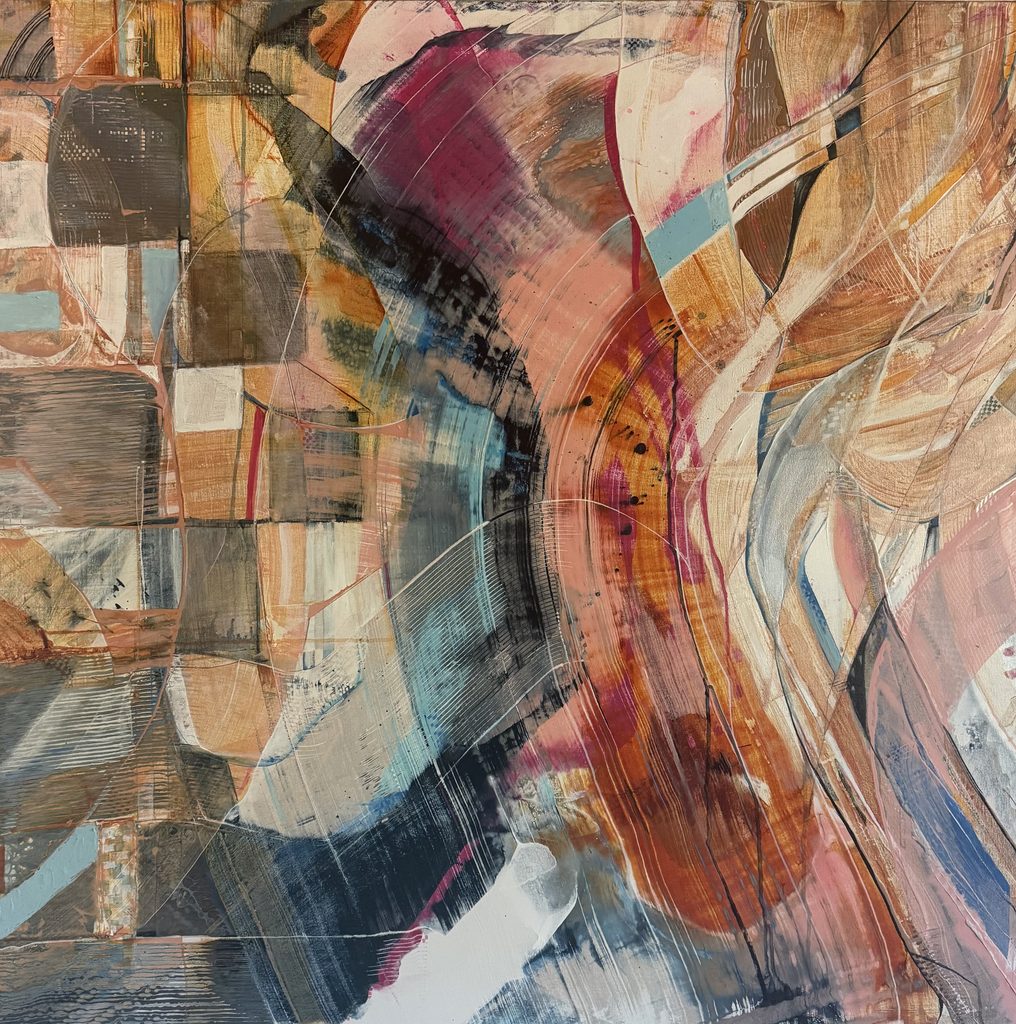
Q10. How have unexpected turns in your process changed the way you think about imperfection?
Within my practice, moments that don’t unfold as planned still hold their own truth, revealing presence and acceptance within the journey itself. Each fork in the road can feel intentional, shaping direction in meaningful ways. This calls for ongoing experimentation and an openness to creativity.
Layering becomes a central approach, reflecting life’s structure more accurately than simplicity or resolution. Complexities build upon complexities, mirroring lived experience.
“Imperfect perfection” carries its own form of beauty, grounded in acceptance and transformation rather than resolve.
Q11. Why is it important to you that abstraction remains open-ended?
Abstraction offers the most coherent language for openness to evolution. If paintings functioned like punctuation, abstract work depicts question marks, expressionistic work, maybe an ellipsis, representational work as a period, and surrealist work feels a bit like an exclamation point. Years spent studying science reinforce the sense that increased knowledge often expands uncertainty rather than resolving it.
Representational painting, when it states exactly what it depicts without storytelling, can feel like a closed statement rather than an ongoing exchange. Abstract work, by contrast, sustains a dialogue by refusing to settle into a single answer. Its openness draws the viewer into interpretation, reflection, and self-inquiry. Meaning emerges through sustained attention rather than immediate recognition. Over time, the work can shift alongside the viewer, changing as perception and lived experience evolve. In that sense, the painting grows alongside the viewer.
Q12. How do you define success now, beyond creating the perfect painting?
I emphasize process, movement, chance and improvisation over total control of depiction, but once the gestural art process feels finished, I lean into brushwork to pull things together compositionally. The joy of showing up consistently, enjoying the process, accepting what is with deep thought, and improving to the best of our abilities feels like a winning motto for art and life.
The painting becomes a record of my process: opening, responding, thinking, then structuring. Over and over again.
Q13. What do you hope viewers take away from your work?
For me, the work comes from a process of exploration rather than explanation, and intention with space for magic and the unknown. A realistic belief in self-organization. It’s less about conveying a fixed message and more about creating a space where perception can shift, where complexity can be felt rather than resolved, and where each individual can meet it in their own way. That feels purposeful.
Q14. What has your journey taught you about creative timing?
Looking back, it’s hard to realize I stopped creating for practical reasons, but I’m genuinely proud that I’m finding my way back to it. Financial stability is important, but so is listening to what feels aligned with my purpose. I know I’m lucky to have the chance to return to this path, and I’m trying to hold that perspective with gratitude. I trust the creative timing.
Q15. What would you say to artists who feel it’s too late to begin again?
It’s never too late to begin again. Many artists find their voice later in life, and what matters most is showing up for yourself, whenever it works. As the proverb says, “The best time to plant a tree was twenty years ago. The second best time is now.
Talking with Monica left us thinking about second chances. About the parts of our lives we quietly set aside, and whether it is ever really too late to pick them back up.
Monica’s whole way of working goes the other way. She gets the paint moving and then steps back. She lets it pour and crack and do its own thing, and she trusts that something beautiful will come from the parts she did not plan. Spend a little time with her work and this starts to feel like more than a painting method. It feels like a way of living.
Most of us are taught that perfect is the goal, that a smooth, tidy, controlled life is the one to aim for. Monica’s paintings gently disagree. They say the cracks and the wrong turns and the accidents are not mistakes. They are where the real beauty is.
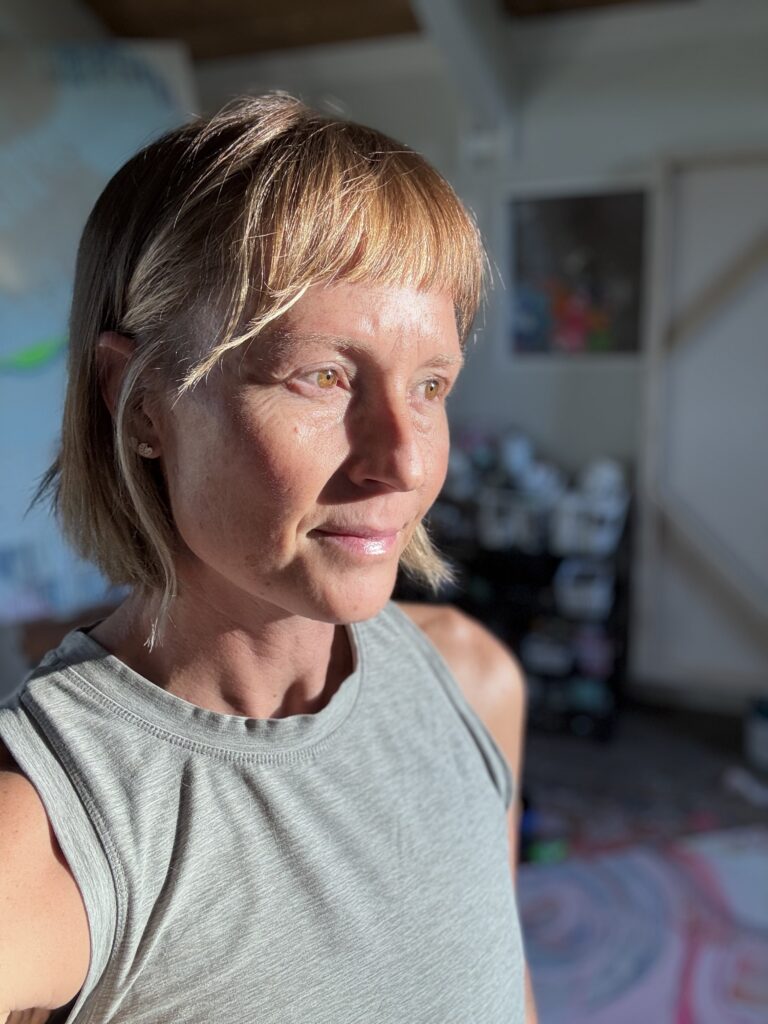
And there is something else in her story that we think a lot of people need to hear. It is never too late to start again. Monica stepped away from art for twenty years, and she came back after loss, in the middle of a full and busy life, and she is making some of her best work right now.
The world loves to tell us there is a right time for everything, and that once it passes, the door is closed. Her journey says the opposite. As the old saying she loves goes, the best time to plant a tree was twenty years ago, and the second best time is today.
For art lovers and collectors, Monica’s work brings something rare into a room. A painting that can look like a river from a plane one moment and a living cell under a microscope the next. Layer upon layer of pour and scratch and grid, holding science and feeling in the same frame, and quietly reminding you that we were never really separate from nature at all. Live with one, and it keeps showing you new things, changing a little each time you look, the way the best things in life tend to.
Follow Monica Bergquist through the links below and see her work for yourself.
The surface is never just a surface. Our Big Book of Mixed Media Artists 2026 is now open for submissions, and we are looking for artists who treat their materials as partners, not just tools, layering and combining until the surface itself becomes part of the story.
However you build your work, if something real happens between the layers, we want to see it. Materials, geography, and career stage do not matter. Every artist we feature once took a breath and submitted. This could be your edition.