

Adham Badawy Connects Heritage, Imagination, and Everyday Life Through Painting
At Arts to Hearts, we have built everything we do around one belief that artists deserve to be seen. Not just the ones with the longest CVs or the most obvious platforms, but the ones doing something genuinely alive, something rooted in a specific experience of the world that no one else could have made in quite the same way.
We love those artists. We seek them out. And when we find them, we want nothing more than to bring them to the people who need to discover them. Today that artist is Adham Badawy. And before you dive into his conversation, let us tell you a little about who he is.
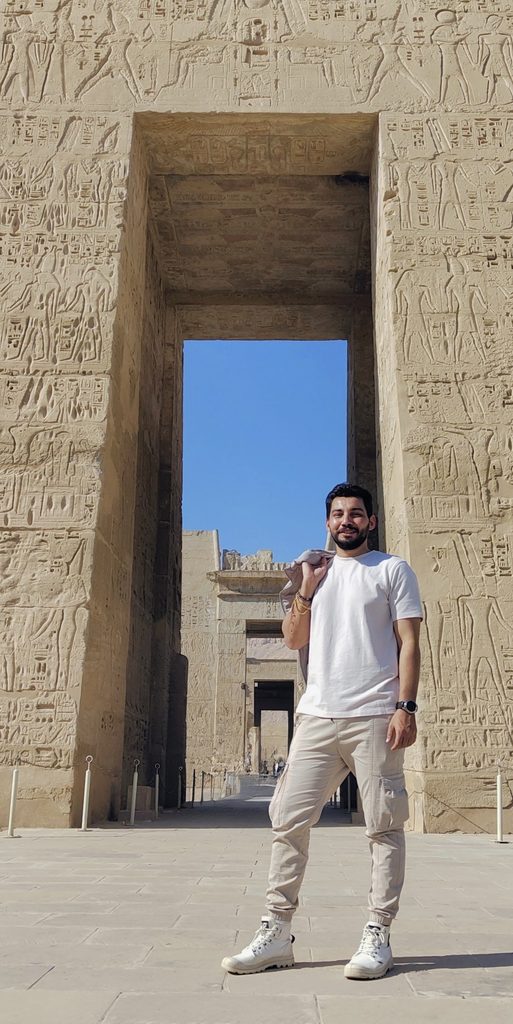
Adham was born in Sohag and studied Fine Arts in Luxor both in Upper Egypt, one of the oldest and most historically layered regions on earth. Growing up surrounded by ancient temples, stone formations bearing traces of centuries, and faces on tomb walls that resembled his own, he absorbed a visual language before he ever formally learned one.
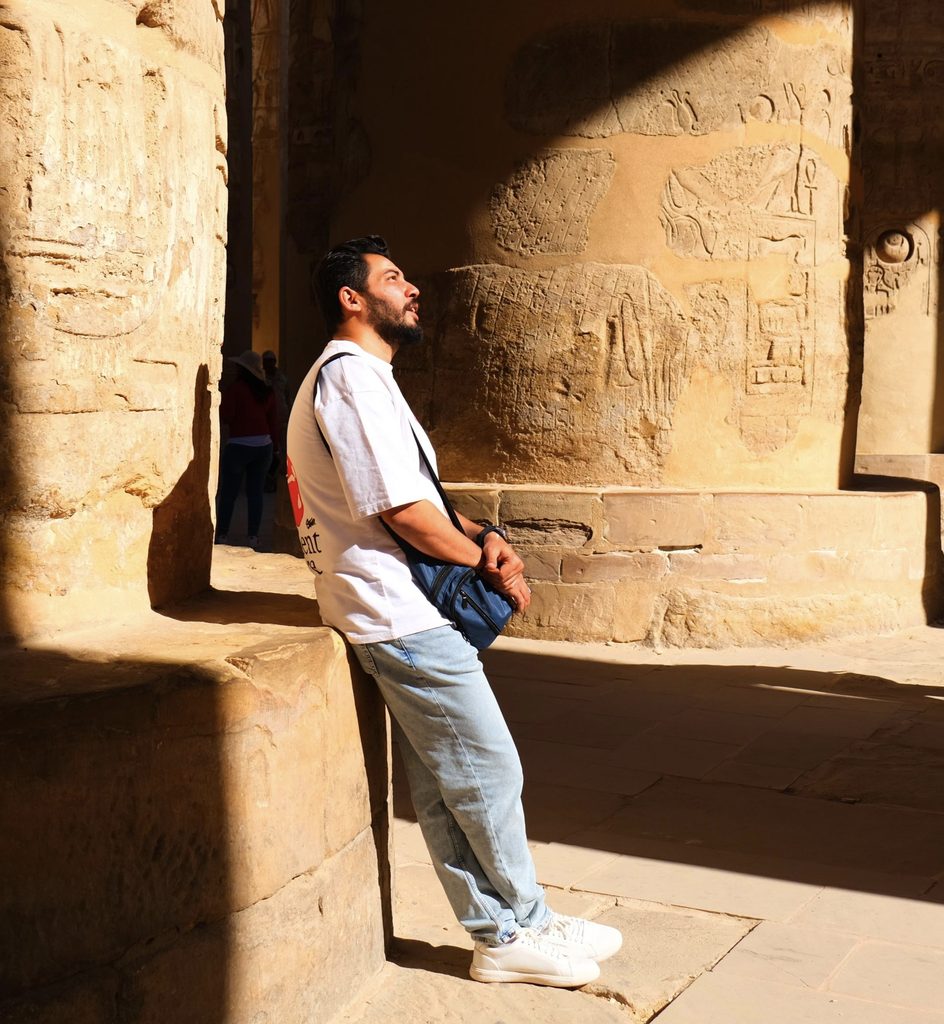
His father was an artist his first teacher, his first inspiration and the memory of sitting behind him as a child, watching his hand move, watching him pause before adding something new, is still present in everything Adham makes today.
He later moved to Cairo, joined the Ministry of Culture, and worked in exhibition coordination and museum management giving him a perspective on the art world that most painters never develop. He has gone on to show widely and present solo exhibitions that have established him as one of the most thoughtful and visually joyful painters working in Egypt today.
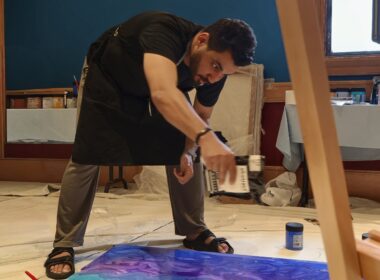
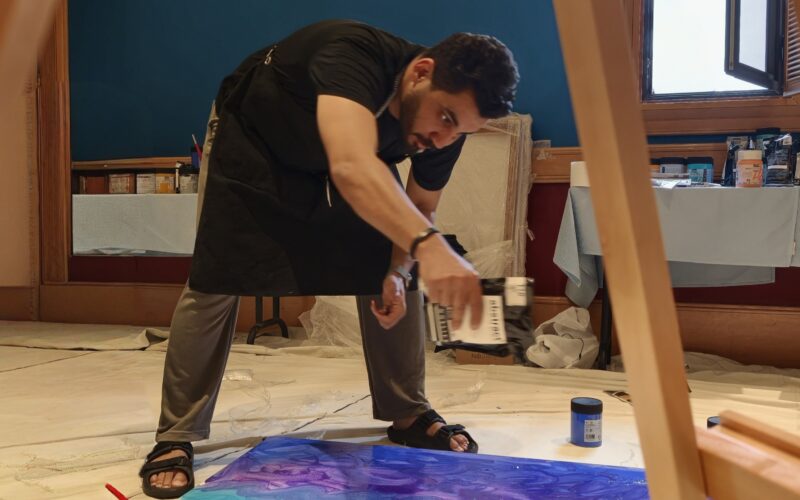
His primary medium is oil a choice that is as much philosophical as practical. He describes oil as patient with him, giving him the time and freedom to reconsider colours, reshape ideas, and enter into a genuine dialogue with the material as it dries and evolves.
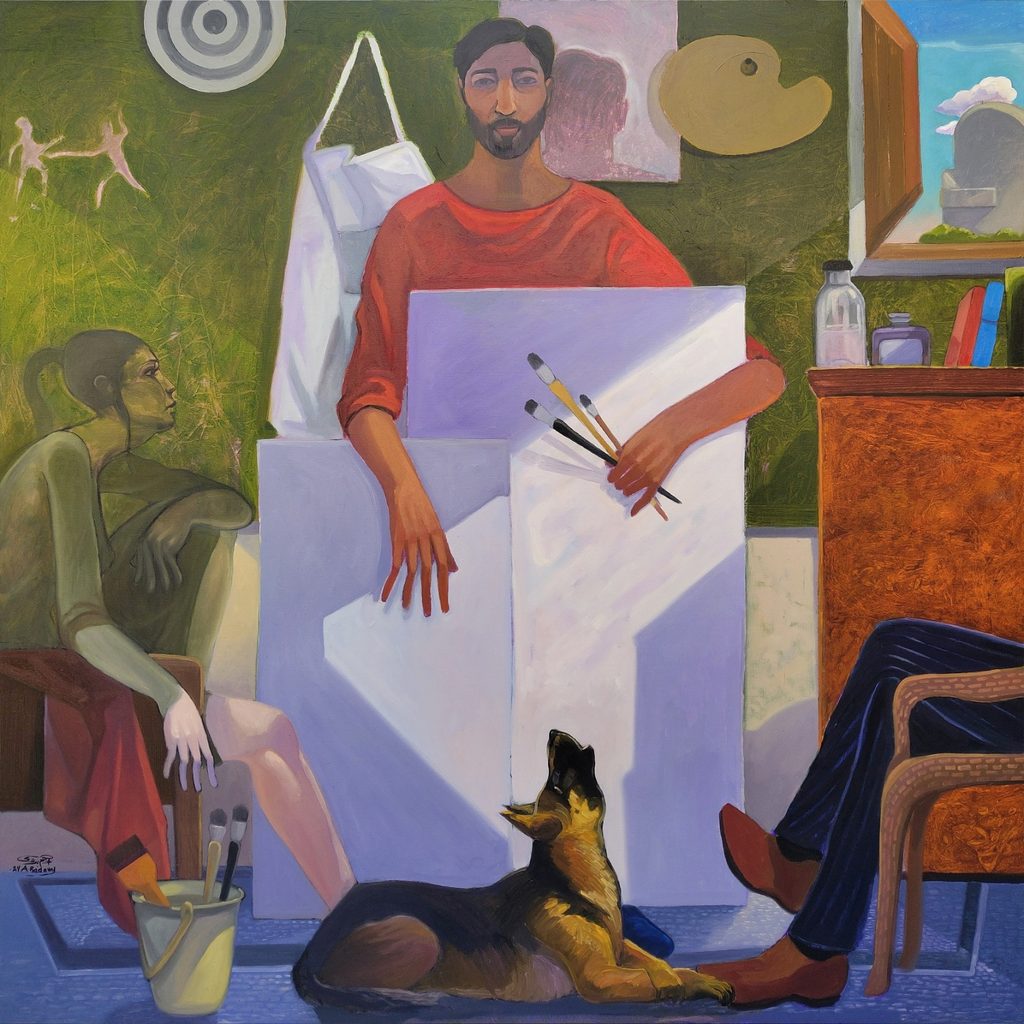
His paintings combine expressive, saturated colour with sharp, confident lines a visual tension that reflects the contrasts he grew up with. The intensity of Upper Egyptian sunlight against green fields. The stillness of ancient stone against the relentless energy of Cairo. Softness and structure holding each other in the same composition.
His work is joyful unmistakably, generously joyful but the joy carries weight. It carries history, symbolism, mythology, and a deeply considered engagement with what it means to be Egyptian in the contemporary world. His figures move through compositions that feel both ancient and completely of this moment. His colours celebrate. And underneath all of that brightness, his ideas quietly ask something of the viewer.
He works from impulse rather than plan capturing ideas in voice notes and writing before they escape, going directly to canvas with an initial feeling and allowing the painting to unfold through discovery. And the results are compositions that carry that particular aliveness of something that was genuinely found rather than merely executed.
Let’s get to know Adham through our conversation with him and discover a practice rooted in one of the oldest visual cultures in the world and speaking directly to right now.
Q1. Adham, you were born in Sohag and studied Fine Arts in Luxor. How did growing up in Upper Egypt shape your early understanding of art?
Early Roots: Place, Memory, and My Father Growing up in Sohag and studying in Luxor, both in Upper Egypt, played a fundamental role in shaping my artistic identity. This region is deeply rooted in history, heritage, myths, and social traditions, where the past remains present in everyday life and collective memory. As a child, I was surrounded by ancient Egyptian temples, myths carved into their walls, and massive rock formations bearing traces of successive eras.
I was fascinated by the intense sunlight transforming these surfaces from sunrise to sunset, as shifting light and elongated shadows seemed to reveal stories hidden within the stone. In contrast, green fields stretched across the landscape, while the surrounding mountains stood like fathers or grandfathers, connecting the land to the ancient structures that embody our identity and collective memory.
These contrasts between stone and nature, permanence and change, light and shadow, profoundly shaped my visual awareness. My connection to this heritage also grew through everyday customs, traditions, and inherited stories. Although generations change, essential elements of collective memory endure, passed from parents to children and continually renewed.
Even the resemblance between our facial features and those depicted on ancient temple and tomb walls can evoke a connection with our ancestors. We recognize these similarities, smile at them, and share their names and nicknames, as though reclaiming fragments of their stories.
For me, memory is not merely a record of the past, but a living presence that shapes how we understand ourselves and the world.
The relationship between personal and collective memory, inherited narratives, and contemporary experience remains central to my artistic practice. Alongside the influence of place, my father played a fundamental role in shaping my artistic awareness.
As an artist, he was my first inspiration and teacher. I remember sitting behind him as a child, watching him paint, observing the movements of his hand, the way he held his brush, and his thoughtful pauses before adding something new. These moments became part of my visual memory and continue to accompany me in my practice.
My father encouraged my artistic inclination from an early age, guiding me while giving me the freedom to discover my own path and develop an independent voice.
Rather than simply repeating what I learned from him, I was encouraged to build upon that foundation and form my own vision.
Even today, we continue to discuss my work and exchange ideas, extending the artistic dialogue that began when I was a child watching him paint. The child who once imitated his brushstrokes has become an artist exploring his own path, while our dialogue continues to evolve. The place where I grew up, the cultural memory it nurtured, and my first encounter with art through my father have become intertwined foundations of my artistic vision.
They are not simply memories of the past, but living influences that continue to transform themselves through my work. Through stories and myths, memory and imagination, heritage and personal experience, I explore my relationship with place, identity, and time, continually reinterpreting what I have inherited, experienced, and continue to discover.
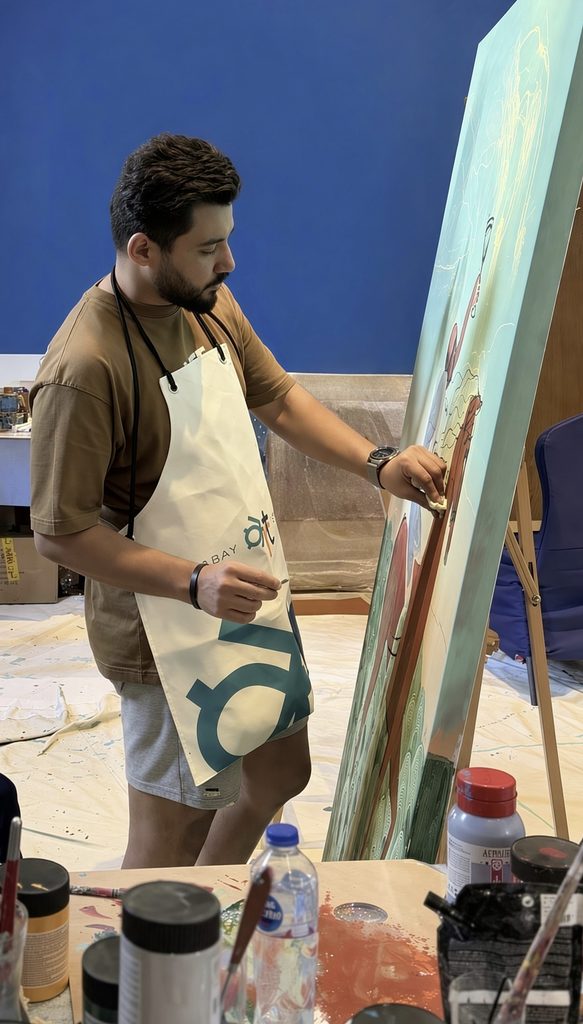
Q2. You have worked as both an artist and an art administrator. How has working behind the scenes influenced your own practice?
After graduating, I moved to Cairo, where I joined the Ministry of Culture following my involvement in independent cultural initiatives, working in temporary exhibitions and museum management. Seeking to understand art’s cultural and educational role and find my place within the art scene, this experience broadened my perspective beyond personal memories and heritage, deepening my engagement with local and international artistic developments.
Q3. Your paintings combine expressive colours with sharp lines. What draws you to this contrast?
The natural environment in which I grew up fundamentally shaped my visual language. My early fascination with light and shadow, and the colors of palm leaves, their vivid red fruit, and the Nile’s blue, nurtured my sensitivity to color, contrast, and the physical experience of light.
Moving to Cairo introduced me to a more intense visual world of dazzling lights and enormous billboards, expanding my perception of color and contrast.
The dialogue between nature’s tranquility and the city’s energy continues to shape my paintings, where light and shadow, softness and sharpness, and warm and cool colors express my thoughts and feelings.
Q4. Your work often feels joyful, even when exploring serious themes. What role does joy play in your paintings?
I seek to create a sense of joy in my work, even when it carries dramatic or satirical undertones. I try to balance expressing my own critical perspective with preserving a sense of hope, allowing viewers to smile and enjoy the vibrancy of color.
I believe art begins with beauty, magic, and joy a space for escape, dreams, and pleasure while also carrying ideas, cultural meanings, and the power to inspire awareness and reflect society.
Humor and satire are deeply rooted in our culture. Even in times of crisis, we find ways to laugh and hold on to hope. I see my work as part of this shared spirit, inviting us to enjoy, reflect, and criticize without losing our faith in joy and hope, even in the most difficult moments.
Q5. In Maqamat El Karma, you explore unconditional love, balance, and inner purity. What did karma mean to you in this series?
For me, karma was not merely a spiritual concept of retribution, but a way to reflect on our relationships with ourselves, others, and the world around us. In “Maqamat Karma”, I sought to explore the need for justice and balance, not only among human beings, but also in our relationship with all forms of existence, from animals and plants to inanimate matter, free from the excessive desire to possess or control.
I approached karma as a balance between opposing forces: desire and letting go, strength and vulnerability, attachment and freedom. Unconditional love and inner purity became central to this exploration, not as ideals of perfection, but as ways of understanding ourselves and connecting with others without possession or control.
Ultimately, the series reflects my belief that every action leaves an imprint, and that we are part of an interconnected world. True balance begins when we recognize our responsibility toward all that surrounds us, and see the world not as something to possess, but as something with which we share our existence.
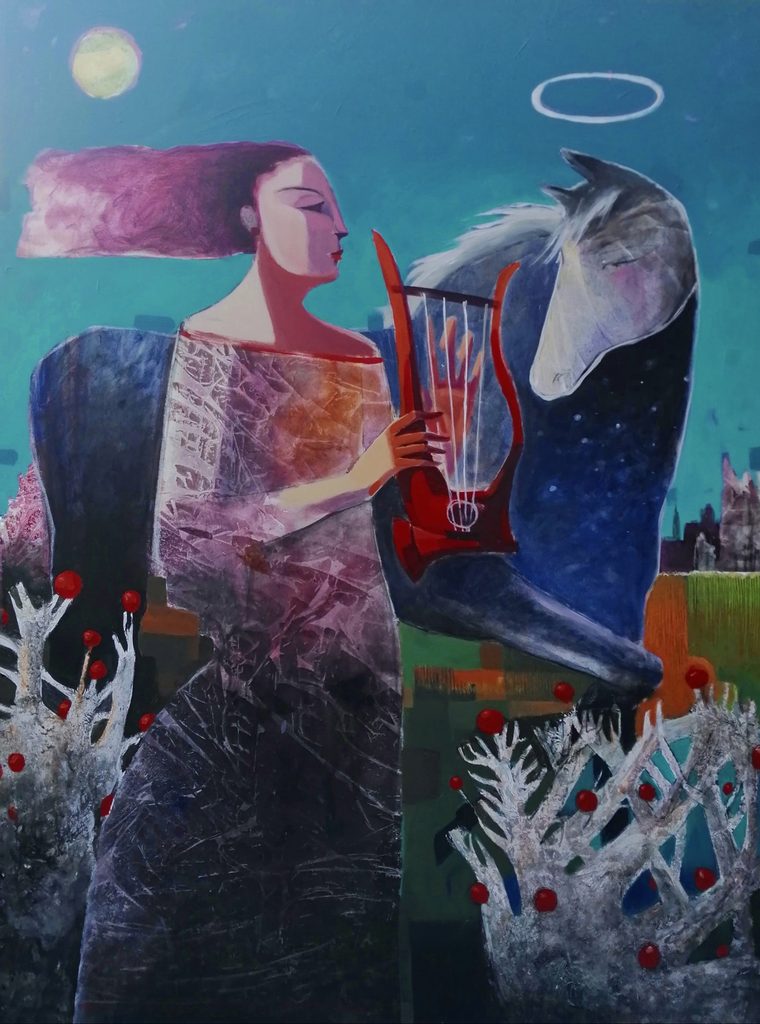
Q6. Suspended Dreams and Pandora’s Box explore different psychological themes. What were you hoping to communicate through these exhibitions?
In my exhibition Suspended Dreams, the circus became a metaphor for life. Beyond the joy of performances, I explored what happens behind the curtain, where performers return to their private struggles and unfulfilled dreams. These works reflect on how appearances can conceal complex inner worlds, and how greater awareness and understanding can help us build deeper connections and live in greater harmony.
Although perfection may remain unattainable, the effort to approach it still matters. In Pandora’s Box, I drew on the ancient Greek myth to explore guilt and victimhood, good and evil, and the fragile hope that preserves balance amid their conflict. Rather than portraying Pandora simply as a guilty figure, I saw her as a protagonist caught in a fate she may not have chosen, bearing responsibility for consequences beyond her control.
Through her story, I questioned how perceptions of women have evolved from reverence for their life-giving power to their diminishing place in narratives shaped by male authority. For me, the myth extends beyond the evils released into the world; it raises questions about how blame is assigned, how narratives define victim and culprit, and who has the power to tell the story. Hope, in this context, is not a guarantee of good triumphing over evil, but the possibility of restoring balance and reconsidering our relationship with ourselves and the world around us.
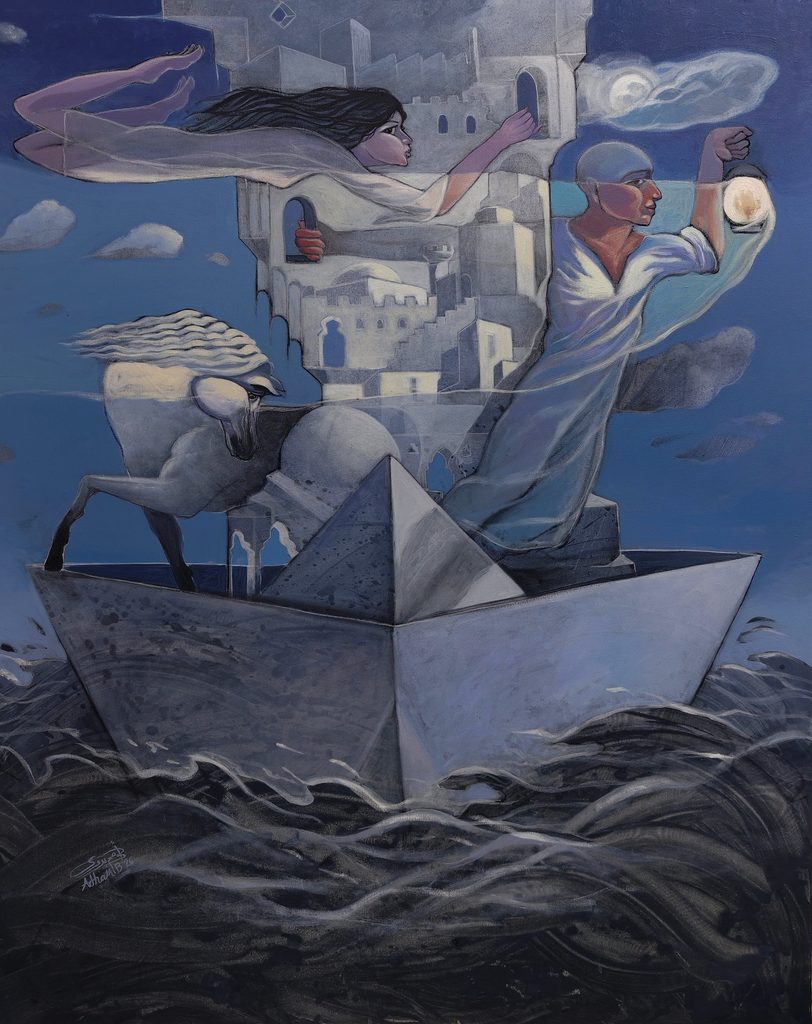
Q7. In What Light Guides, two figures travel across a dark sea towards the moon. What inspired this scene, and what does the journey represent to you?
“What Light Guides” It is the first ray of light that points us toward the path leading to what we have long dreamed of; that moment when we realize our journey has begun, and stand at the point of departure, eagerly anticipating what lies beyond the horizon. It is the first familiar station from which we set sail toward the unknown, guided by that distant light and trusting that it will lead us to our destination, no matter how long the journey may be or how obscured the way ahead becomes.
It is my journey, and the journey of everyone who has dreamed and prepared themselves to discover their own world and draw closer to what they were born to pursue. It is a voyage in which we sail carrying our memories, the anticipation of a beloved yet to come, and the images of our homeland and home, of walls and alleyways, and of all that we have acquired and grown accustomed to through habit and experience.
We carry all of this with us as we move forward, driven by a passion that gives our journey meaning and illuminates the darkness of the way, step by step, as we strive toward that distant light—toward the future and the goal, where the destination we have long dreamed of reaching awaits us.
Q8. You work primarily with oil but also use acrylics. How does each medium shape your approach to painting?
Oil is my primary medium, not only for its artistic possibilities, but for the open-ended dialogue that unfolds between the material and me.
Its slow drying process gives me the time and freedom to reconsider colours, reshape ideas, and explore dimensions beyond my initial intentions. At times, I feel as though the oil itself is patient with me, allowing me the space to express what lies within me until I reach a sense of fulfilment.
Unlike acrylic, which often allows for a more direct and spontaneous engagement with colour, oil invites a more gradual, reciprocal process in which the material itself participates in shaping the work. Through this dialogue, I discover not only the painting, but also something of myself.
Q9. Your ideas can come from music, stories, and films. How do you balance your initial inspiration with experimentation on the canvas?
Ideas for my paintings may arise spontaneously or be inspired by a song, a short story, or a film. I record them in writing or in voice notes, especially when I cannot capture them through quick sketches.
I rarely prepare preliminary drawings, as I prefer to respond directly to the artistic impulse on the canvas, exploring its possibilities through colour and composition. The painting then unfolds as a process of discovery and storytelling.
For me, inspiration is a kind of unexpected revelation tied to a particular moment. I feel compelled to seize it while it is still alive, before it loses its initial intensity. I enjoy experimenting with different materials and artistic media, as each experience reveals new possibilities within me and expands my expressive skills, making my visual storytelling more flexible.
I don’t believe every aspect of a painting needs to be planned in advance. I may begin with an initial idea or feeling, but I leave room for experimentation to reveal unexpected possibilities and lead me in directions I hadn’t originally imagined.
Q10. The Youth Salon marked an important step in your career. How did this opportunity shape your journey as an artist?
In fact, the Youth Salon marked the beginning of my professional artistic career. It was through this platform that I took my first steps toward connecting with art galleries, opening up new opportunities to exhibit my work and reach a wider audience.
It also paved the way for my first solo exhibition, marking an important turning point in the development of my artistic practice and allowing me to move beyond participating in art events toward presenting my work and artistic vision more independently and with greater clarity.
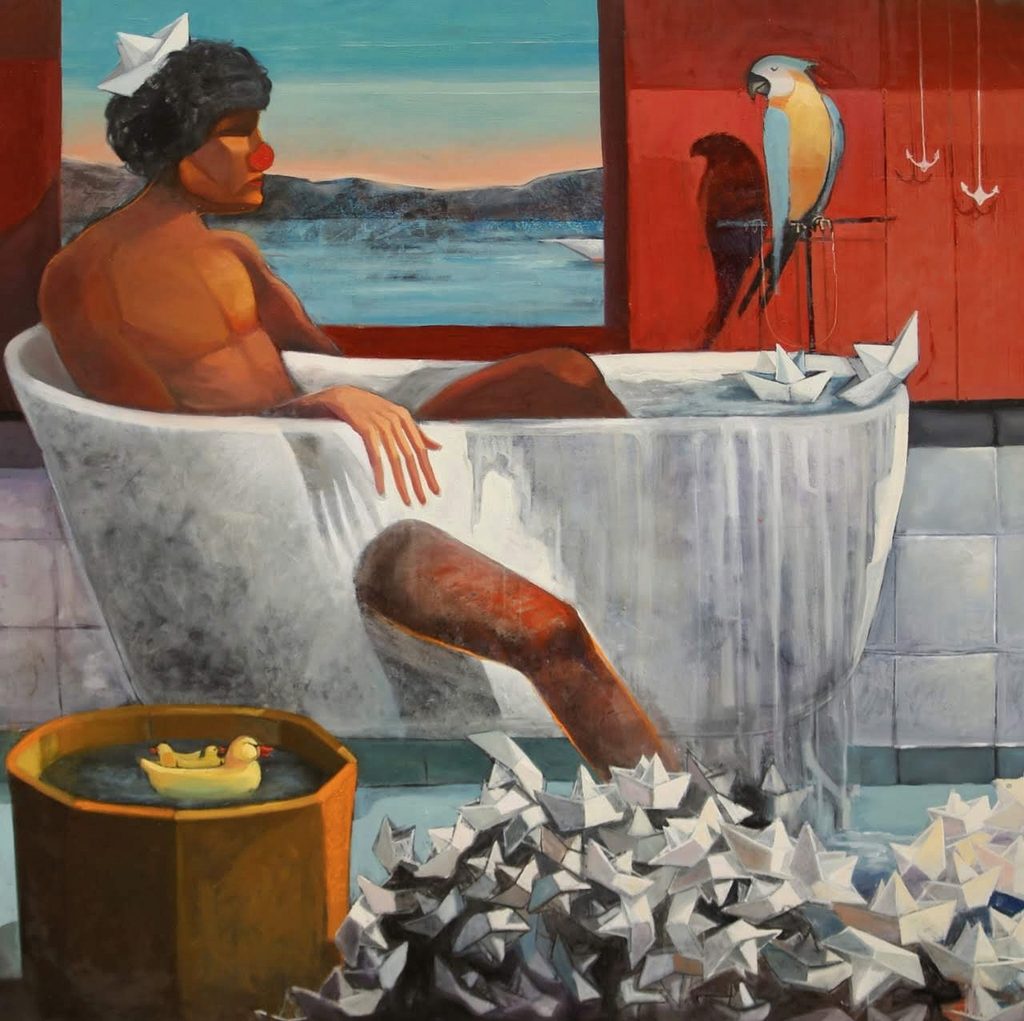
Q11. Egyptian heritage remains central to your work. How do you bring your cultural identity into a contemporary visual language for international audiences?
My Egyptian identity and cultural background are undoubtedly the language through which I express my art, and they are what enable me to connect with audiences on an international level.
My Egyptian identity is rich in symbols with profound meanings and a philosophy of their own, symbols that are recognised worldwide and embody a rich cultural and civilisational heritage.
It also offers a wide range of visual elements that I can draw upon, whether through spoken language or through the vocabulary of visual art. For me, this identity is the fundamental driving force behind my work and the truest reflection of how I understand and express what I seek to communicate through my art.
Q12. You prefer viewers to discover their own meanings in your paintings rather than knowing the personal stories behind them. Why is this openness important to you?
I usually prefer not to reveal the personal story behind my work, allowing viewers to experience it freely through their own feelings and experiences. It brings me great joy when someone tells me that a painting has touched something within them or resonated with a personal experience, as though an invisible bond has formed between them and the work, without the need for explanation.
For me, this is when the work truly fulfils its purpose: reaching people sincerely and finding something of its own spirit within them. It opens a dialogue beyond the canvas, through which I discover new interpretations and perspectives I may not have considered while creating it. I find great happiness in seeing my work acquire a new life through the eyes of others, with meanings that continue to evolve through their experiences.
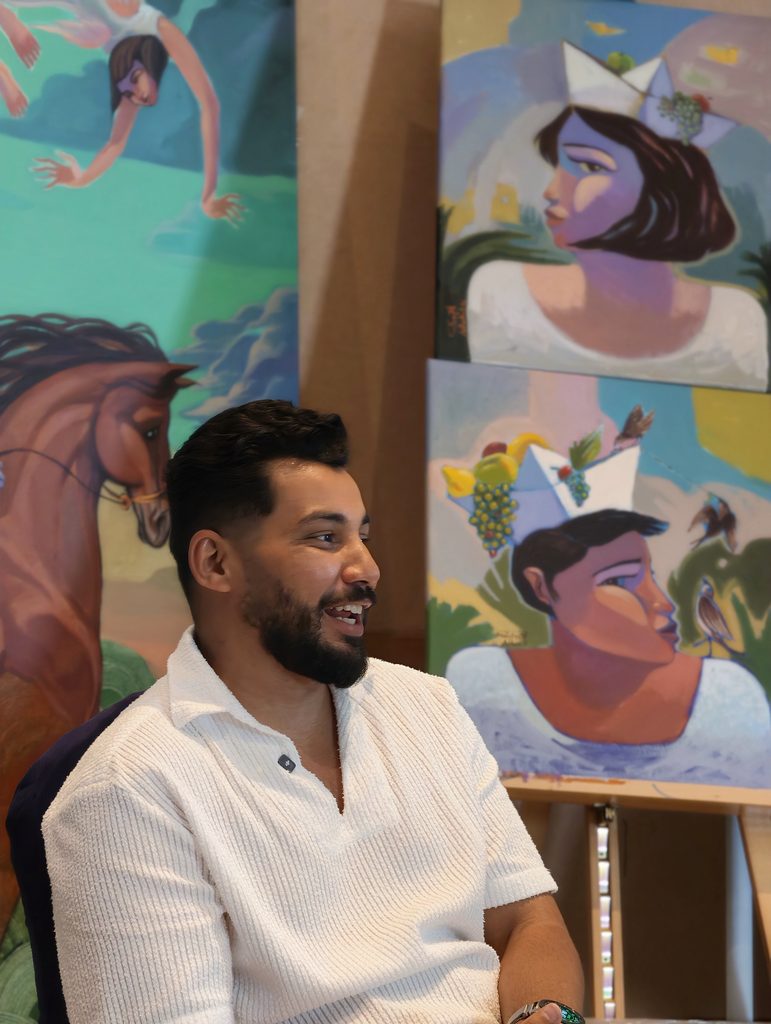
Q13. How has translating your personal experiences and emotions into paintings changed the way you understand yourself?
Translating my experiences, emotions, and convictions into images—even when deeply personal—brings me into a dialogue with myself, where emotion and reason intertwine and inner debates unfold repeatedly. Through this process, ideas take shape, perspectives become clearer, and convictions may deepen or be reconsidered. Visual expression is not merely a way of conveying an idea, but an opportunity to examine and confront it anew. I believe our most honest conversations are those we have with ourselves, and I feel fortunate to have art as a means of giving this inner dialogue a visible form.
For me, art is first a mirror held up to its maker, before becoming an expression of a perspective shared with others.
Q14. What advice would you give young artists who want to honour their cultural roots while developing an artistic voice of their own?
My advice to young artists is to give themselves the freedom to discover who they are, embrace the influences around them, and allow each experience to shape their perspective and convictions. They should remain curious, keep questioning, and avoid comparing their journeys with others, as each person has a unique way of experiencing and expressing the world.
Above all, they should enjoy the process, remain committed to learning and developing their skills, and trust that their own artistic voice will emerge naturally over time.

Wrapping up our conversation with Adham, we found ourselves thinking about something that the contemporary art world does not always make room for the artist who brings genuine civilisational depth to a contemporary canvas. Not as a theme or a reference point, but as a living, breathing inheritance that shapes every compositional decision, every colour relationship, every symbolic choice.
That is an extraordinarily difficult thing to sustain without it becoming either superficial or inaccessible. And Adham does neither. His paintings are joyful and immediate and visually generous the kind that pull you in before you have consciously decided to look.
And once you are inside them, you realise that the brightness is carrying something. Ideas about memory and identity and mythology and what it means to carry five thousand years of visual culture into a painting made right now. That layering of pleasure and meaning, of the ancient and the contemporary is what gives his work its particular authority.
There is also something worth saying about what he represents in the broader landscape of international contemporary art. The art world has a complicated relationship with non-Western practices oscillating between genuine curiosity and the tendency to frame them primarily through the lens of cultural identity rather than pure artistic merit. Adham’s work resists that reduction completely.
Yes, his Egyptian identity is central to what he makes. But it is central the way Bacon’s psychological intensity or Matisse’s relationship with colour was central as the deepest source of a visual language, not as the subject matter to be explained. His paintings earn their place in any international conversation about contemporary figurative painting on purely artistic grounds.
For collectors who collect with that kind of discernment who recognise the difference between work that references a culture and work that genuinely emerges from one Adham’s paintings are exactly that. The kind that carries real weight. The kind that keep giving.
Follow Adham Badawy through the links below and see his work for yourself.