

How Lucille Dweck’s contemporary figurative art earned her a place at the National Portrait Gallery

At Arts to Hearts Project, for our Magazine Issue 12 with the theme This Is Me, we were looking for artists whose response to that theme felt genuinely true rather than performed. Among the many submissions we received, Lucille Dweck’s work did something to us that was hard to name at first.
It did not excite us or challenge us or provoke us the way some work does. It calmed us. We looked at her paintings and something inside us settled down. And in a world as noisy as ours that felt like exactly the right response to This Is Me. Lucille is one of our selected artists for this issue.
She paints solitary figures in nature, seascapes, lovers, and quiet scenes where the drama is not in what is happening but in the quality of attention behind it. The figures feel present in a way that goes beyond just being well painted.
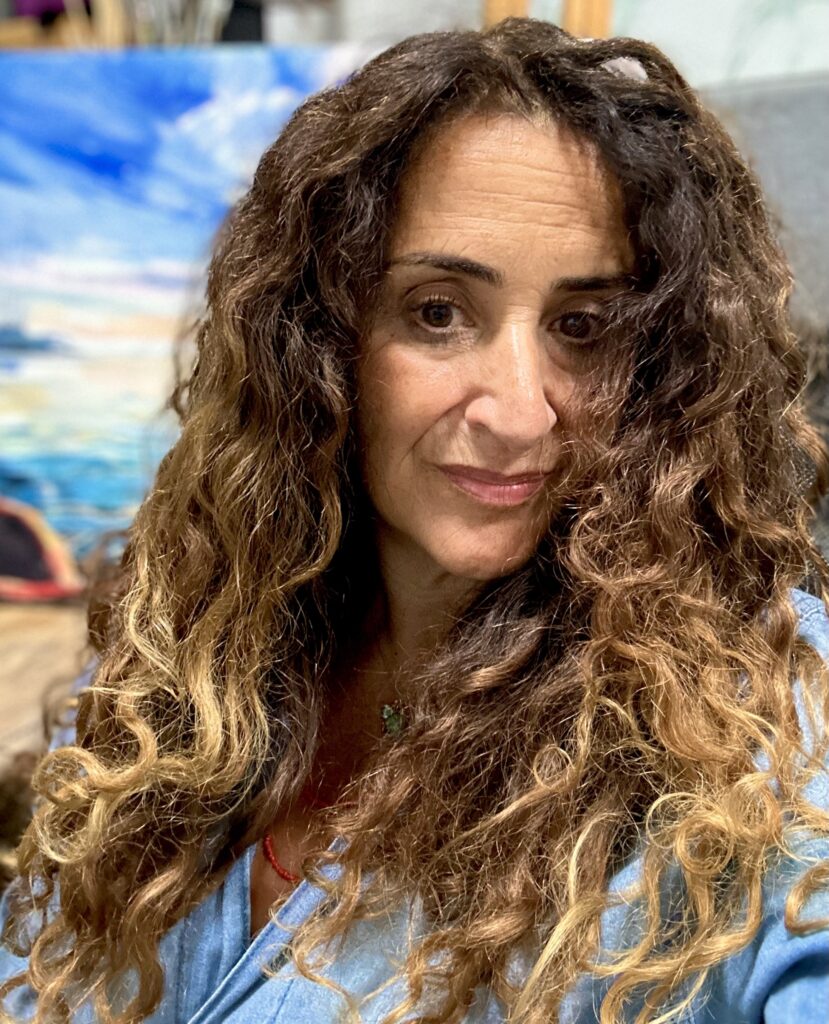
They feel like they are actually standing in that light, breathing that air, existing in that moment fully. And the stillness around them does not feel like emptiness. It feels like the most important part of the painting.
Lucille started drawing seriously as a child and went through art school focused on figurative work and the life model. But her path to where she is now was not a straight line at all. There were years where painting fell away and something else took its place.
What that something else was and how it eventually fed back into her art and completely changed what her paintings could hold is a story that unfolds beautifully during the interview. There is a specific moment she describes, a turning point that split her practice into a clear before and after, that we found really powerful.
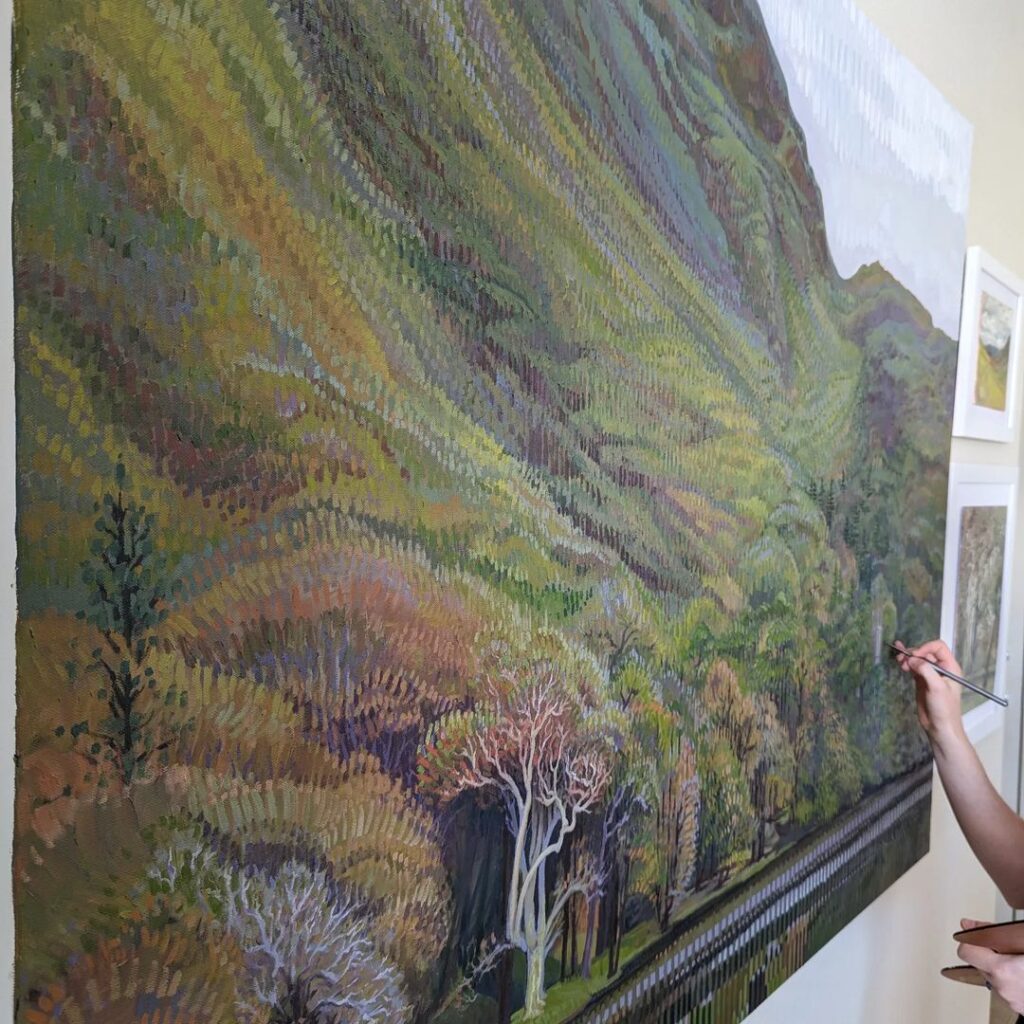
She works large but with tiny brushes. That combination tells you everything about how she thinks. Big enough to immerse you. Detailed enough to reward the closest possible looking. The surfaces are built through hours of sustained focused attention and you can feel every one of those hours when you stand in front of the finished painting.
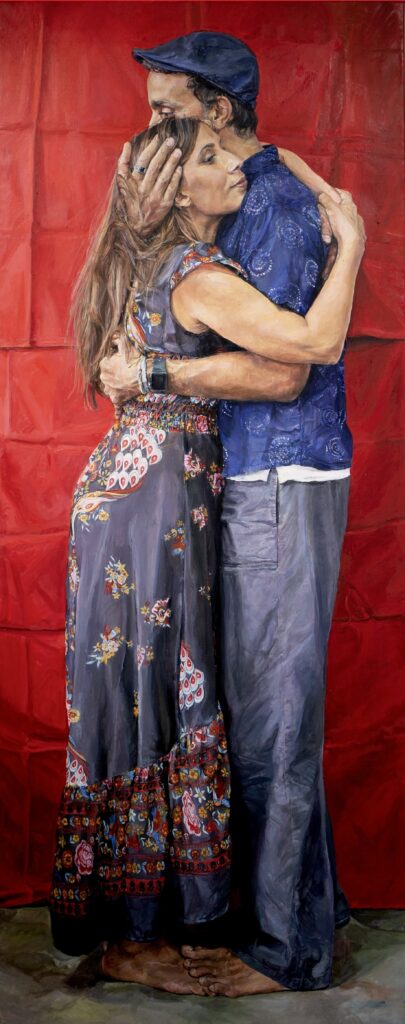
Her colour sits in this delicate space between vibrancy and gentleness that she navigates intuitively. And her Lovers series carries a personal backstory that gives those intimate quiet paintings a weight and a vulnerability that makes them feel like more than just beautiful images of two people together.
She works mostly at night. She guards her solitude carefully. And she has a daily practice of sitting with herself and doing nothing that she considers as important as the painting itself. This Is Me for Lucille means arriving at a stillness that took a whole life of searching and interruption and return to finally reach.
Now let’s hear from Lucille in her own words about the turning point that changed everything, what stillness actually looks like on a canvas, and why doing nothing became the most important part of her practice.
Q1. Lucille, can you take us back to the beginning how did you arrive at the quiet, minimal style of your work?
I have always loved making art. My brother remembers that, before I was five, I was unusually excited by the promise of being taught to draw. By the age of ten, I was making portraits in school that closely resembled the children I was drawing—I had an early facility for observation and likeness. At art school, I spent most of my time working from the life model, something I found endlessly absorbing. After graduating, I continued to paint, though often without the benefit of a sitter.
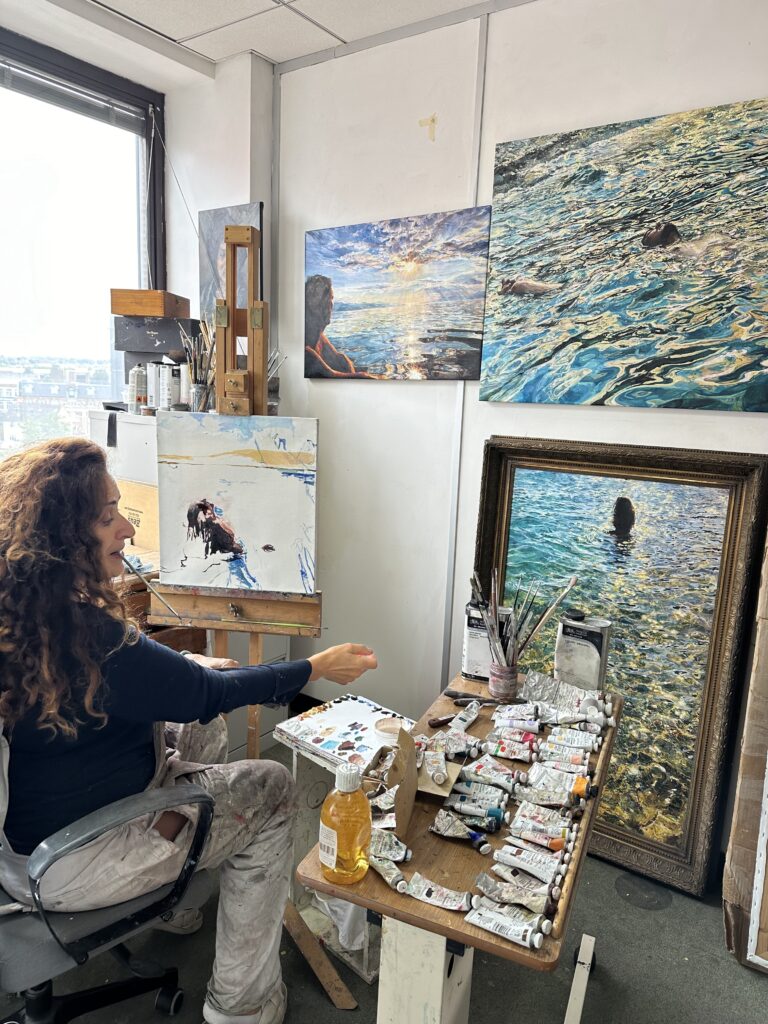
When my son was born, the long, uninterrupted stretches of time painting requires became harder to sustain, and my output slowed significantly. During that period, I turned to teaching yoga and developed a deeper meditation practice, which in some way filled the space painting had occupied. A turning point came on a retreat with a radical teacher who challenged my understanding of yoga teaching and gave me a personal practice. When I returned home, I stopped teaching altogether.
I began painting again with renewed focus, setting myself the discipline of completing one painting each month. Alongside this, a clearer intention emerged: to share something of the quiet, expansive stillness I had come to know. The image of a solitary figure in nature became the vehicle through which I could express this experience.
Q2. Your paintings feel like moments of stillnesswhat kind of experience do you hope they create for the viewer?
I begin my paintings with photography, which I value as a powerful way of capturing a moment. When developing a theme, I work from photographs I have taken, editing, distorting, and combining them until the image holds what I am looking for. From there, the process of painting begins.
My paintings are made slowly, through sustained, focused looking and careful mark-making. I tend to work on large canvases using very small brushes, a method that allows a sense of stillness and depth to emerge—qualities I associate strongly with painting.
The worlds I create are precise and intentional.
They move between moments in nature, which suggest a connection to a vast inner stillness, and portraits that speak of humanity, relationships, and the love that underlies them.
Q3. Looking across your work, do you see it as a series of connected conversations, or do those connections emerge over time?
My paintings emerge from what occupies my thoughts and what stirs my attention. As I work on one, the next begins to take shape, so that each painting flows into another, carried by the current of a developing theme.
I often hold one or two works in mind at any given time, waiting quietly as the present painting resolves itself. When a theme begins to lose its energy, something new appears an idea that brings a sense of excitement and renewal. Yet this does not mark an ending. Earlier themes continue to live on, returning in different forms, asking to be seen again.
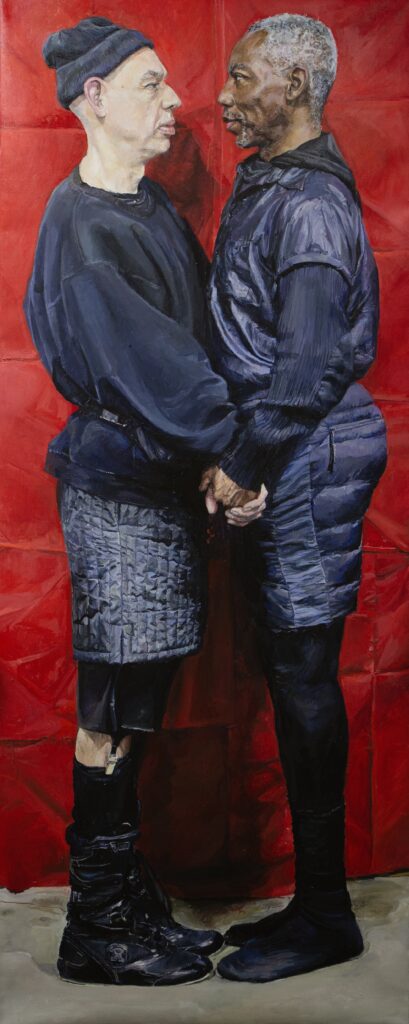
Q4. The figures in your paintings often feel alone, yet not lonely how do you approach creating that kind of quiet presence?
I often place a figure within my work as a point of connection for the viewer. In the paintings set in nature, this presence becomes a quiet invitation to remember moments when, immersed with the natural world, one moves beyond identity, beyond thought and personal concerns, into something more essential. It is a place that is always there: open, unbounded, and fundamental to our existence. Far from loneliness, it holds a sense of fullness—an expansiveness within apparent emptiness, rich without needing anything at all.
Q5. Your paintings often hint at stories without fully revealing them how do you keep that sense of mystery open for the viewer?
I am naturally drawn to stories, but I am not specifically telling a story in my paintings , more sharing a feeling, something that resonates with me. As a painting is an expression of all that I am while i make it ,I feel a painting especially one that has taken a lot of time to be worked on expresses many layers and depths. Often unbeknownst to the artist.
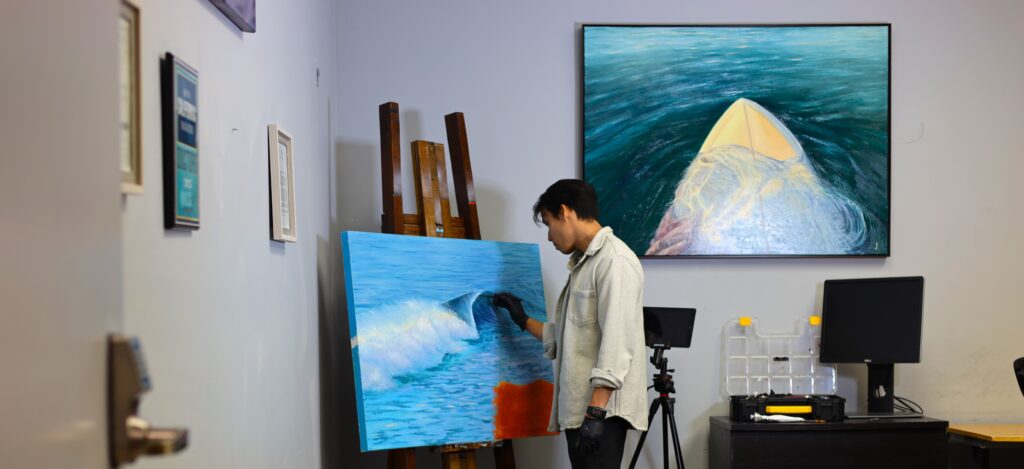
Q6. Your seascapes feel deeply immersive what is it about water that continues to inspire your work?
Years ago, while on holiday in Greece, I found myself looking out over a vast expanse of still water from a small monastery on a hilltop. Something in me was deeply moved. As we are made mostly of water, it felt as though this part of myself was quietly responding.
Since then, I have come to associate calm water with a meditative state—perhaps even with something approaching the divine. In the presence of sun and water, I feel most open: reflective, unburdened, and free. It is this feeling I am drawn to share—a gentle, healing movement towards trust, and a sense of offering the fullest part of oneself.
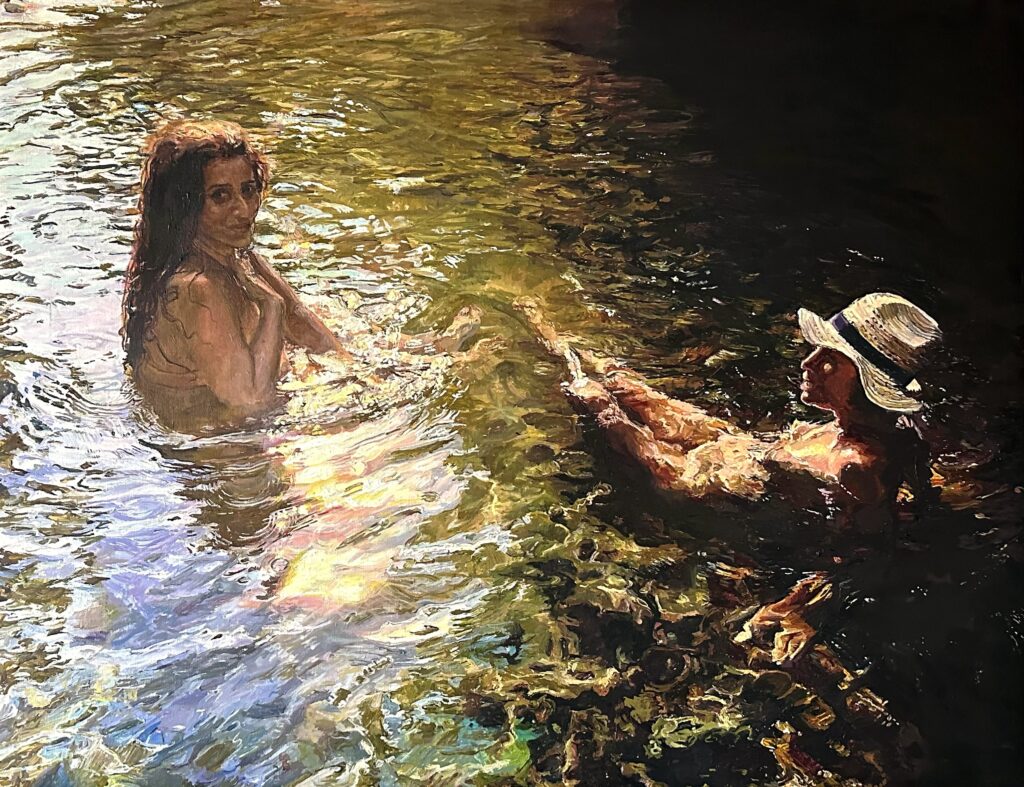
Q7. Colour feels very gentle and intentional in your work, how do you know when a painting needs more, and when it needs less?
There is, for me, a fine balance in colour—between the garish and the washed out. I seek a kind of vibrancy that remains sensitive, alive without becoming overwhelming. The process of painting is not linear. When I work, I become absorbed, often losing any sense of time. As the painting emerges from this state, I move beyond a fixed sense of myself, guided instead by a quiet, reflective attunement that shapes both how I look and how I paint.
Colour is central to this. It carries the capacity to express joy, but must be held with care: too harsh, and it feels almost violent; too muted, and it falls flat. In painting, all of my sensitivities come into play—not through conscious control, but instinctively, as part of the act itself.
Q8. In your Lovers paintings, how do you capture intimacy without becoming too literal or narrative?
The theme of lovers returns to my work again and again. In earlier paintings, they emerged from a period of personal upheaval. After leaving my husband and entering a new relationship that was still uncertain, I began to paint lovers—often myself with my partner at the time. In that moment, it carried something close to wish fulfilment, but also something more essential.
Everything in my life felt in flux. I was staying with generous friends, with little financial stability, and I found myself holding onto the one thing that felt most vital, and perhaps universal: love itself. Returning to this theme now, from a place of greater personal security, I find myself drawn to its deeper implications.
I want to speak about the importance of love and shared humanity in a world that often feels unsettled and fragmented. In these works, I consciously include diversity and people who might be marginalised or discriminated against, placing them within intimate, loving portraits. In doing so, I hope to affirm a simple but necessary truth: our shared humanity.
Q9. When a painting begins, what usually comes first the image, the feeling, or the atmosphere?
I usually begin with photography, starting with a general sense of the atmosphere or feeling I want to explore, though this is never fixed. Over time, and with some distance from the initial images, I am better able to see what holds together and what does not. The image, the feeling, and the atmosphere all need to align, but my recognition of this is largely intuitive—a kind of gut response.
When the elements begin to come into relation, or when I can sense the possibility of that happening, I move into editing. I adjust light, colour, and contrast until something clicks again. At this stage there are often several possibilities, which I leave aside for a while before returning to them. Then, instinctively, I know which image to take forward.
From there, I outline the composition on the canvas, though this is never fixed. It continues to shift and evolve as I paint. Once the surface is fully covered, I step back and reassess—subduing certain areas, lifting others, continually adjusting the balance. In this way, image, feeling, and atmosphere are constantly being re-evaluated and refined throughout the process.
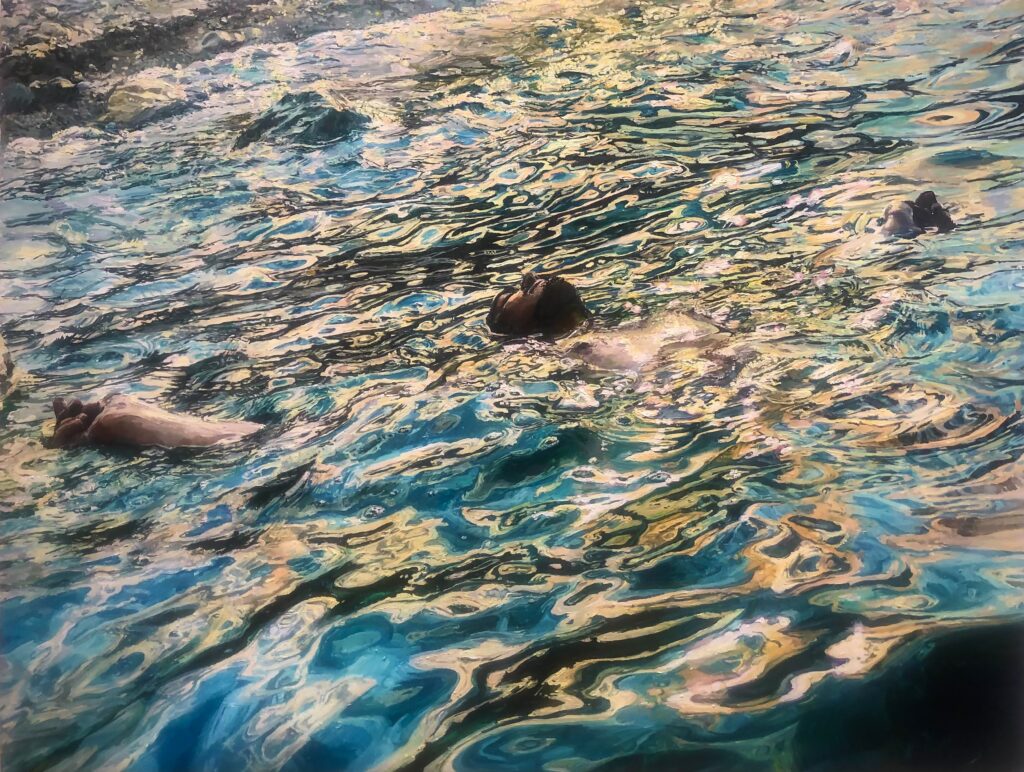
Q10. As your work reaches more people, how do you stay connected to that quiet, personal space where your work begins?
For me, painting emerges only from that space of solitude. It is a necessarily solitary practice, one that I can only truly enter alone. I spend long hours in the studio by myself, without conversation, often declining social invitations in order to stay with the work. There is a discipline in this withdrawal, a way of protecting the focus the painting requires.
Perhaps this is also why I tend to work most productively at night, when the world quiets and distractions fall away, allowing a necessary stillness to settle and open out in front of me. I also spend quiet time with myself each day, doing nothing in particular, as a kind of practice. It allows me to hear myself more clearly, to settle, and to become more aligned with what I experience as nature’s intention for me. It is a simple discipline, but an important one—a way of returning to stillness so that when I do begin to work, I am coming from a more attentive and receptive place.
Q11. Do you measure success more through recognition, or through something internal like connection, clarity, or growth in your work?
Recognition is always a seductive force, especially for someone like me who grew up not feeling fully heard. The real question is how this plays into the internal challenges I set myself as an artist. The extent to which I meet those challenges inevitably shapes the work that follows.
I often push myself toward things I consider almost too difficult, drawing on an innate competitive drive to move myself forward. Much of this happens internally, in a continual process with myself. In honesty, I don’t fully know how much I am influenced by recognition. Perhaps when one is drawn toward subjects that are perceived as more “successful,” it may become easier to feel inspired or confident when ideas are externally supported.
Q12. What would you say to artists drawn to a quieter way of working but worried it might go unnoticed?
My paintings have developed from my time at art school, where I worked from the life model—an approach that was, at the time, both unfashionable and largely out of favour. I don’t believe one consciously chooses the way one paints. I did try, at various points, to make more abstract or gestural work,
but it left me feeling disconnected and unabsorbed. For me, it is not the artist’s task to be preoccupied with how they are perceived. Rather, the work needs to be allowed to emerge in a way that is natural to one’s own perception and attention. In that continuity, depth develops.
With time, that way of working becomes more distinct, more clearly voiced—less about fitting into external expectations and more about following an internal direction. It gradually forms something unique, shaped by sustained attention, personal interest, and an internal sense of navigation.
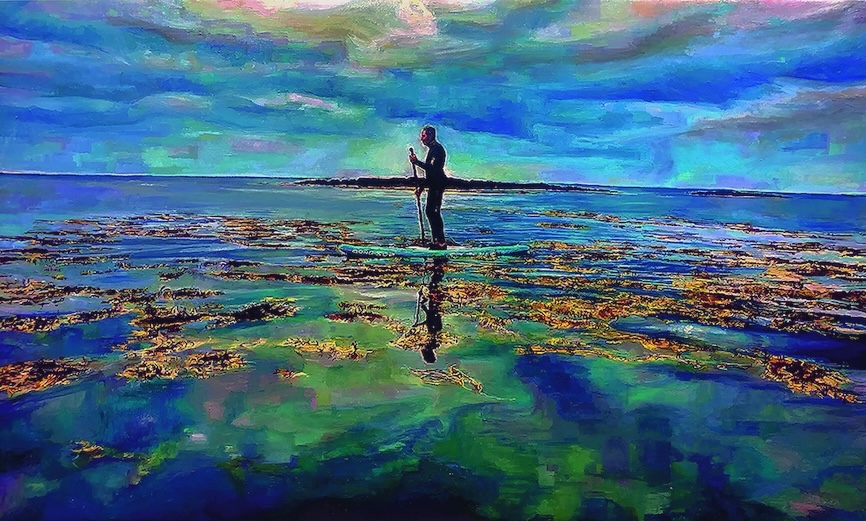
As our conversation with Lucille came to a close, we sat with something that felt important on a level that goes beyond art. The idea that doing nothing is a practice. That sitting quietly with yourself each day without agenda or activity is not laziness but preparation. That the stillness you bring to a canvas has to come from somewhere and if you do not cultivate it in your daily life it will not be there when you need it.
Most of us fill every minute. We check phones and answer emails and scroll and plan and move from one task to the next without any pause between them. And then we wonder why our creative work feels rushed or thin or disconnected from whatever it was we were actually trying to say.
Lucille does not work that way. She has built her entire life around protecting the quiet that her paintings need. She turns down social invitations. She works at night when the world is asleep. She sits alone during the day doing nothing on purpose. And the paintings that come from that discipline are so still and so full that standing in front of one of them feels like being given permission to stop for a minute and just breathe.
We think more of us need that permission right now. Not just artists. Everyone. The permission to slow down. To not fill every silence with noise. To let a moment exist without immediately documenting it or reacting to it or turning it into something productive. Lucille’s paintings offer that permission without saying a word. They just hold a space that is calm and open and full and they invite you to step into it for as long as you need.
For anyone thinking about living with Lucille’s work, her paintings bring a specific quality into a room that is hard to find anywhere else. They bring genuine stillness. Not the decorative kind that looks calm in a photograph but the kind you actually feel when you are standing in front of it at the end of a long day.
The large scale and the incredibly fine brushwork create a surface that rewards close looking and keeps revealing subtlety the longer you stay with it. And because the paintings come from a real daily practice of silence and attention, that practice lives inside the surface. You do not just see the stillness. You feel it settle into the room around you.
Follow Lucille Dweck through the links below and give yourself permission to be still for a minute.