






10 Ocean Paintings That Changed How Artists Saw the Sea
The ocean has always been more than a subject in art. Long before cameras could capture crashing waves or satellite images could reveal the vastness of the world’s waters, artists turned to the sea as a source of inspiration, mystery, and meaning. They painted it not only for its beauty but for what it represented: power, uncertainty, adventure, faith, loss, and hope.
Unlike mountains or forests, the ocean is constantly changing. It can appear calm and inviting one moment and overwhelming the next. Its shifting nature has made it one of the most challenging and compelling subjects for artists across centuries. For some, the sea became a symbol of humanity’s small place within the natural world. For others, it was a stage for stories of survival, exploration, and transformation. Whether rendered through the dramatic storms of Romanticism or the luminous brushstrokes of Impressionism, ocean paintings have often reflected the concerns and dreams of the societies that produced them.
What makes these works so enduring is that they rarely depict water alone. Behind every wave is a larger story. A fisherman lost in fog becomes a meditation on uncertainty. A ship sailing toward dismantlement becomes a reflection on progress and change. A lone figure standing before the horizon transforms into a question about existence itself. Through the ocean, artists have explored some of humanity’s most universal experiences.
10 Ocean Paintings in this list span different countries, artistic movements, and centuries, yet they share a common fascination with the sea’s ability to inspire awe. From the towering wave of Hokusai to the sunlit shores of Sorolla, these works reveal how artists have repeatedly returned to the ocean in search of something larger than themselves.
Some of these paintings changed the course of art history. Others captured emotions so powerfully that they continue to resonate generations later. Together, they tell a story not just about the sea, but about the people who have stood before it, feared it, depended on it, and found meaning within its endless horizon.
1. The Great Wave off Kanagawa (1831) – Katsushika Hokusai
The Wave That Changed Art History

Few images in art history are as instantly recognizable as The Great Wave off Kanagawa. Created by Japanese artist Katsushika Hokusai in 1831, the work has become far more than a famous seascape. It is a global icon that continues to influence artists, designers, and visual culture nearly two centuries after it was first printed.
At first glance, the composition appears straightforward: a towering wave rises above three boats while the snow-capped peak of Mount Fuji sits quietly in the distance. Yet the drama lies in the contrast. The wave seems almost alive, curling its claw-like crest toward the fishermen below, while Mount Fuji remains still and unmoved. Hokusai transforms a fleeting moment on the sea into a timeless confrontation between human vulnerability and the overwhelming power of nature.
One of the most persistent myths surrounding the work is that it depicts a tsunami. In reality, scholars generally identify the wave as a powerful rogue or storm wave rather than a tsunami. This distinction matters because Hokusai was less interested in documenting a specific event than in capturing the emotional experience of facing the sea’s unpredictable force.
The print was created as part of Hokusai’s celebrated series, Thirty-Six Views of Mount Fuji, which explored Japan’s most revered mountain from different perspectives. Here, however, Mount Fuji is almost overshadowed by the wave itself. The composition cleverly guides the eye from the turbulent foreground to the calm horizon, creating a sense of movement that feels remarkably modern even today.
Beyond its artistic brilliance, The Great Wave off Kanagawa played a crucial role in shaping Western art. When Japanese prints began reaching Europe in the nineteenth century, artists such as Vincent van Gogh, Claude Monet, and Edgar Degas admired their bold compositions and unconventional perspectives. The influence of Hokusai’s wave can be traced throughout Impressionism and Post-Impressionism, making it one of the most influential images ever created.
More than a picture of the ocean, The Great Wave off Kanagawa is a meditation on nature’s power, humanity’s fragility, and the enduring ability of art to transcend borders and generations. It remains the standard against which all ocean imagery is measured.
2. The Monk by the Sea (1810) – Caspar David Friedrich
Standing Alone Before Infinity
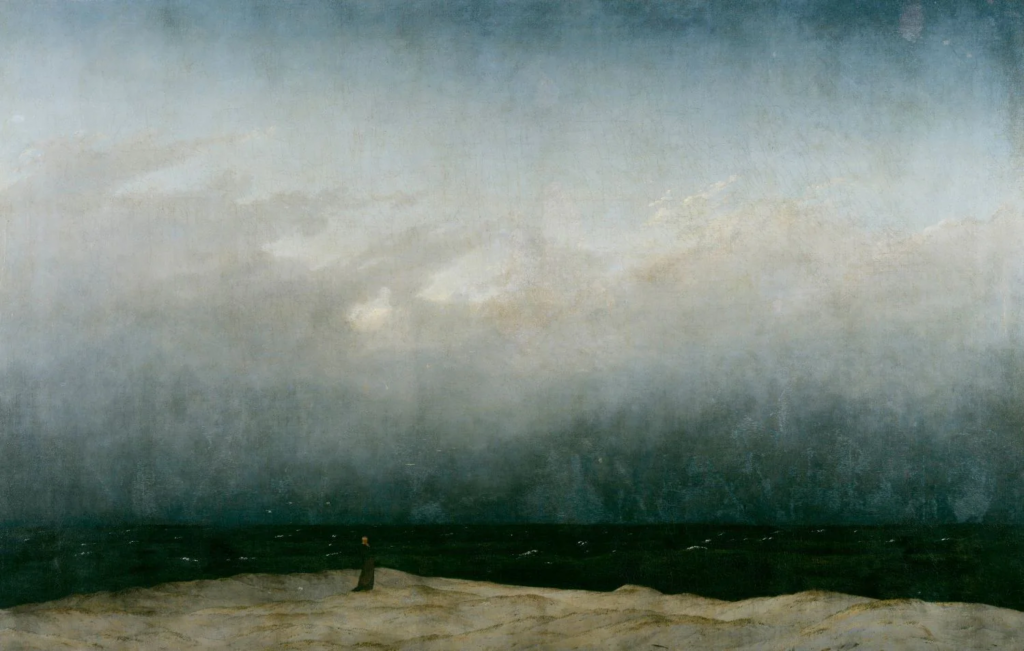
At first glance, The Monk by the Sea seems almost empty. There is no dramatic shipwreck, no crashing waves, and no bustling harbor to hold the viewer’s attention. Instead, German Romantic painter Caspar David Friedrich presents a solitary monk standing before a vast expanse of sea and sky. Yet this quiet painting remains one of the most profound ocean images ever created.
When it was first exhibited in 1810, audiences were unsettled by its simplicity. Unlike traditional landscapes that guided viewers through detailed scenery, Friedrich stripped away nearly everything. The horizon cuts across the canvas, dividing the painting into bands of earth, sea, and sky. The monk himself is tiny, almost insignificant against the immense forces of nature surrounding him. The result is a composition that feels startlingly modern, even more than two hundred years later.
Friedrich was a leading figure of Romanticism, a movement that valued emotion, spirituality, and the sublime power of nature. For Romantic artists, nature was not merely a backdrop but a force capable of inspiring awe, fear, and reflection. In The Monk by the Sea, the ocean becomes a space for contemplation. The monk is not simply looking at the water; he appears to be confronting existence itself.
The painting invites viewers to imagine what lies beyond the visible horizon. Is the monk seeking answers, comfort, or understanding? Friedrich never provides a clear answer, which is precisely why the work continues to resonate. Every viewer brings their own thoughts and emotions to the scene.
Art historians often describe this painting as one of the earliest examples of psychological landscape painting. Rather than depicting a specific place, Friedrich creates an emotional experience. The vast sky, muted colors, and overwhelming emptiness mirror feelings of solitude, wonder, and even uncertainty. It is a reminder that the ocean has long served as a symbol for the unknown.
More than two centuries after it was painted, The Monk by the Sea still feels remarkably relevant. In an age filled with constant noise and distraction, Friedrich’s lone figure offers something rare: a moment of stillness. Standing before the endless sea, the monk reminds us that some of life’s most important questions cannot be answered, they can only be contemplated.
3. The Storm on the Sea of Galilee (1633) – Rembrandt van Rijn
Faith, Fear, and a Missing Masterpiece

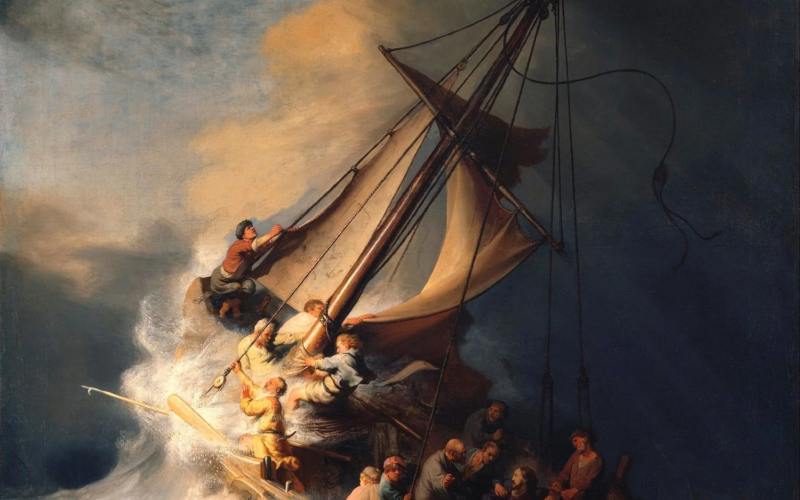
Some ocean paintings captivate viewers because of their beauty. Others endure because of the stories they tell. The Storm on the Sea of Galilee belongs firmly in the latter category. Painted in 1633 by Dutch master Rembrandt van Rijn, it is both a dramatic seascape and one of the most famous missing artworks in the world.
The painting illustrates a moment from the Gospel of Mark in which Jesus Christ calms a violent storm while crossing the Sea of Galilee with his disciples. Rembrandt captures the scene at its most chaotic. A powerful wave crashes against the fishing vessel, tilting it sharply as terrified sailors struggle to keep control. Some cling desperately to ropes, others attempt to steady the mast, and a few look toward Christ for salvation. The viewer is placed almost inside the boat, experiencing the storm alongside its passengers.
What makes the painting so compelling is Rembrandt’s extraordinary understanding of human emotion. Every figure reacts differently to the unfolding disaster. Fear, desperation, determination, and hope coexist within a single composition. Even amid the chaos, Christ remains calm, becoming the visual and emotional anchor of the scene.
This work is particularly significant because it is Rembrandt’s only known seascape. While he painted countless portraits, biblical scenes, and historical subjects, he never again returned to the ocean in this way. The rarity of the painting only adds to its importance within his body of work.
Its story took a dramatic turn in 1990 when it was stolen from the Isabella Stewart Gardner Museum during one of the largest unsolved art heists in history. Disguised as police officers, thieves entered the museum and removed thirteen artworks, including Rembrandt’s masterpiece. More than three decades later, the painting has never been recovered.
Today, The Storm on the Sea of Galilee survives largely through reproductions and photographs, yet its impact remains undiminished. Beyond its status as a lost treasure, the painting continues to resonate because it captures a timeless human experience: the feeling of being overwhelmed by forces beyond our control and searching for something steady amid the storm.
4. The Fighting Temeraire (1839) – J. M. W. Turner
A Farewell to the Age of Sail
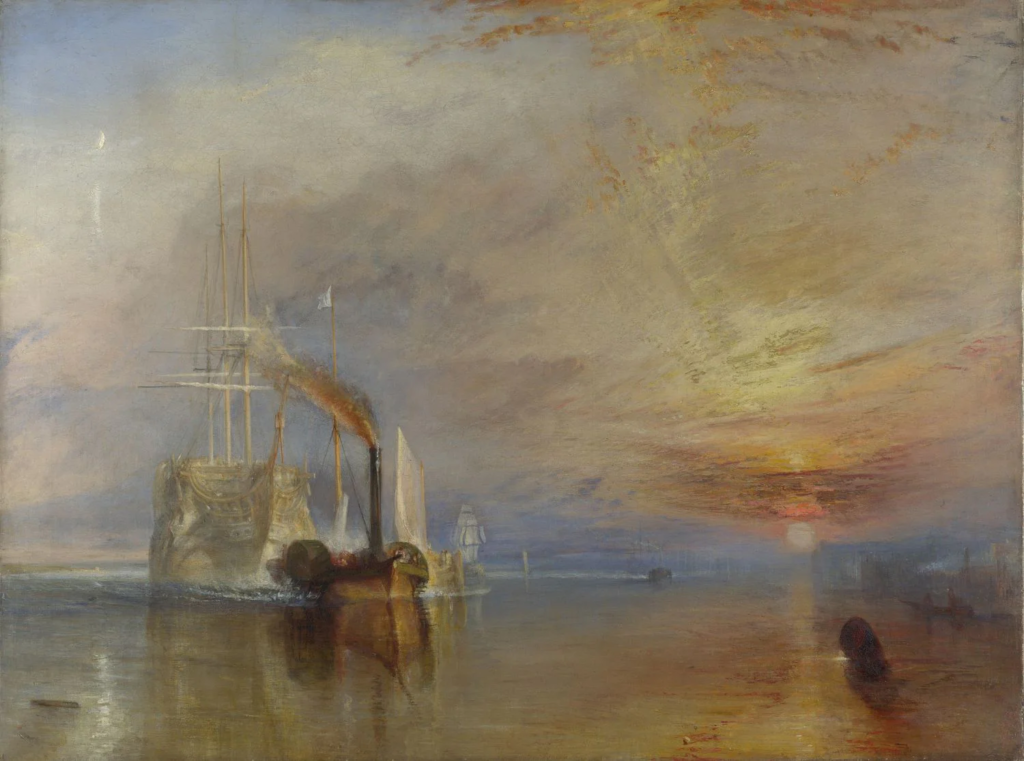
In 1838, crowds gathered along the River Thames to watch a legendary warship make its final journey. Once celebrated as a hero of the Battle of Trafalgar, the HMS Temeraire was no longer sailing toward victory. Instead, it was being towed to a shipyard where it would be dismantled and sold for scrap. For many, it marked the end of an era. For artist J. M. W. Turner, it became the inspiration for one of the most emotional seascapes in art history.
At the center of The Fighting Temeraire, the great ship appears almost spectral. Painted in luminous whites and soft golds, it drifts quietly across the water as a small steam-powered tugboat pulls it toward its fate. The contrast is impossible to ignore. The majestic sailing vessel, once a symbol of Britain’s naval strength, is overshadowed by a dark industrial machine belching smoke into the sky. Turner transforms a historical event into a visual confrontation between the past and the future.
The timing of the painting was significant. Britain was in the midst of rapid industrialization. Steam engines were reshaping transportation, manufacturing, and daily life. Technologies that once seemed revolutionary were quickly becoming obsolete. The Temeraire became a symbol not only of a retired ship but of an entire world disappearing before people’s eyes.
What makes the painting so enduring is its emotional complexity. Turner does not condemn progress, nor does he celebrate it outright. Instead, he captures the bittersweet reality of change. The glowing sunset behind the ship feels symbolic, casting the scene in the warm light of memory. It is a farewell, but not a tragic one. The ship’s achievements remain, even as its physical form vanishes.
More than a maritime painting, The Fighting Temeraire is a reflection on what happens when history moves forward. Every generation experiences moments when familiar ways of life begin to fade. Turner understood that progress often comes with a sense of loss, and in this remarkable work, he gave that feeling a lasting image.
5. The Ninth Wave (1850) – Ivan Aivazovsky
Hope After the Storm

For centuries, sailors shared a chilling belief about the sea. According to maritime folklore, waves arrive in a sequence, each one larger than the last, and the ninth wave is the most powerful of them all. It is the wave that tests endurance, overturns ships, and separates survival from disaster. Whether the legend was true mattered less than what it represented: humanity’s fear of nature at its most unpredictable. That idea became the foundation of The Ninth Wave, the masterpiece that secured Ivan Aivazovsky’s reputation as one of history’s greatest painters of the sea.
At first glance, the painting appears to depict the aftermath of catastrophe. A violent storm has passed, leaving a group of shipwreck survivors clinging desperately to broken pieces of a mast. The ocean around them remains restless, and another immense wave seems ready to rise. Yet what makes the painting remarkable is that it does not focus on despair. Instead, Aivazovsky fills the scene with light.
The dawn breaks across the horizon in shades of gold, pink, and amber, transforming what could have been a tragedy into something unexpectedly hopeful. The survivors may be exhausted and vulnerable, but they are still alive. The sunlight suggests that the worst of the storm has already passed. In Aivazovsky’s hands, the sea becomes both a force of destruction and a source of renewal.
Born in the port city of Feodosia on the Black Sea, Aivazovsky spent much of his life observing water. Unlike many artists who painted landscapes from direct observation, he often relied on memory to recreate the ocean’s moods. This allowed him to capture not just the appearance of waves but their emotional impact. The sea in The Ninth Wave feels alive, constantly shifting between danger and beauty.
More than 170 years after it was painted, the work remains one of the most beloved seascapes in art history. Its enduring appeal lies in its message: even after life’s most overwhelming storms, there is always the possibility of light on the horizon. Few paintings capture resilience so powerfully, or so beautifully, as The Ninth Wave.
6. Impression, Sunrise (1872) – Claude Monet
The Painting That Accidentally Named an Art Movement
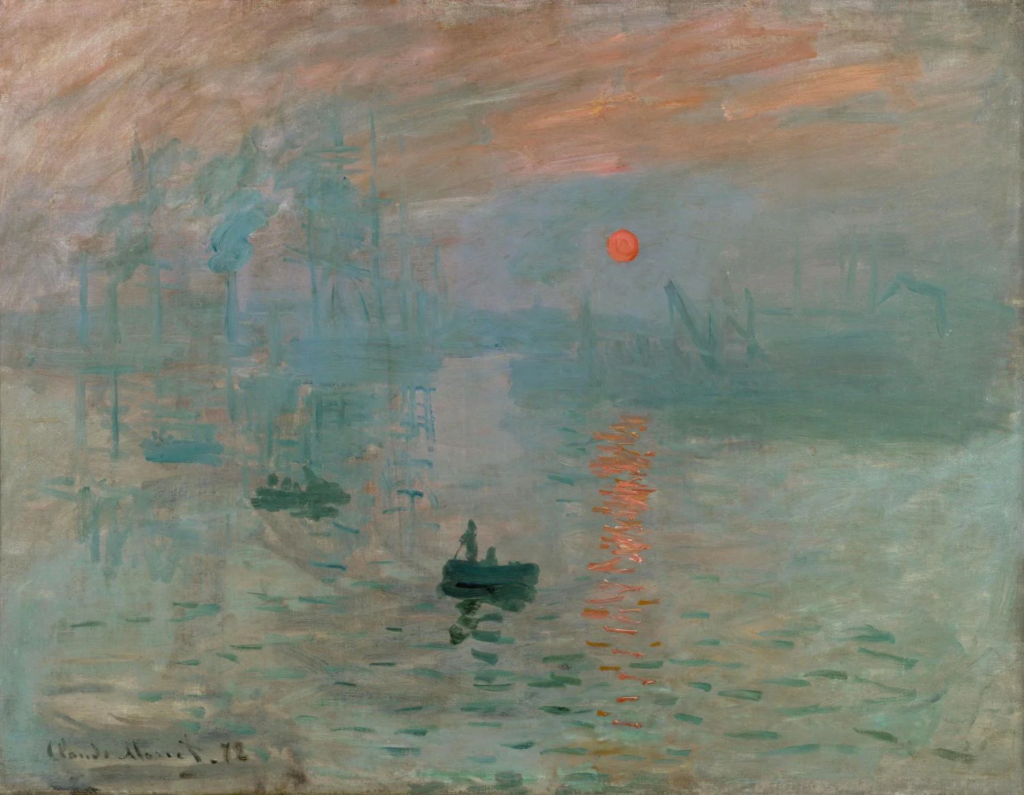
When Impression, Sunrise was first exhibited in Paris in 1874, it was not met with admiration. Instead, it became the target of ridicule. One critic, mocking the loose brushwork and unfinished appearance of the painting, dismissed it as merely an “impression” rather than a completed work of art. The remark was intended as an insult. Instead, it gave a name to one of the most influential movements in modern art: Impressionism.
Painted by Claude Monet, the work depicts the harbor of Le Havre, the artist’s hometown in northern France. At first glance, the scene appears almost indistinct. Boats emerge from a misty blue-gray atmosphere, while smoke from industrial ships dissolves into the morning sky. Near the center of the composition, a vivid orange sun hovers above the water, its reflection creating a striking contrast against the cool palette surrounding it.
What made the painting revolutionary was Monet’s refusal to prioritize detail. Academic painters of the nineteenth century were expected to create polished, highly finished works that accurately described their subjects. Monet was interested in something different. Rather than painting every boat and building with precision, he sought to capture a fleeting moment, the sensation of witnessing sunrise through fog and shifting light.
The harbor itself was significant. France was rapidly industrializing, and Le Havre had become a bustling center of trade and commerce. Yet Monet avoids turning the scene into a documentary record. Instead, he focuses on atmosphere, allowing light and color to become the true subjects of the painting.
Today, it is difficult to imagine that this work was once considered controversial. Its loose brushstrokes and emphasis on perception helped redefine what painting could be. More than a beautiful view of the sea, Impression, Sunrise marked a turning point in art history. It challenged centuries of artistic tradition and encouraged future artists to paint not simply what they saw, but what they experienced. Few ocean paintings have left such a lasting mark on the course of modern art.
7. The Fog Warning (1885) – Winslow Homer
A Race Against Time

The most unsettling part of The Fog Warning is not the sea itself. It is the look of realization.
In the painting, a lone fisherman sits in a small dory, surrounded by the open Atlantic. His boat is heavy with a successful catch, the result of hours of labor. But his attention is fixed elsewhere. In the distance, barely visible through a thickening fog, is the schooner that brought him out to sea. The gap between the two vessels is growing, and with it comes a question that changes everything: can he make it back before the fog swallows the horizon?
Painted by American artist Winslow Homer in 1885, The Fog Warning captures a moment suspended between hope and uncertainty. Unlike many dramatic seascapes filled with crashing waves and violent storms, Homer’s tension comes from restraint. The ocean appears relatively calm, yet the danger feels immediate. The fisherman is alone, and nature is quietly shifting against him.
Homer developed a deep fascination with maritime life after spending years along the rugged coast of Maine. He observed fishermen closely, understanding both the physical demands of their work and the risks they accepted each time they ventured into the water. In The Fog Warning, he strips away any romantic notions of life at sea. Fishing is not portrayed as an adventure but as a livelihood balanced precariously against forces beyond human control.
What makes the painting so compelling is its ambiguity. Homer never reveals what happens next. The fisherman may reach the ship safely, or he may not. That uncertainty is central to the work’s power. Viewers are left to imagine the outcome, becoming participants in the story rather than passive observers.
More than a century later, The Fog Warning remains one of the most celebrated American seascapes because it speaks to a universal experience. Everyone has faced moments when success and danger arrive together, when a hard-earned reward suddenly carries unexpected risks. Homer understood that some of life’s greatest dramas unfold not in chaos, but in quiet moments when everything hangs in the balance.
8. The Gulf Stream (1899) – Winslow Homer
Alone in the Middle of Nowhere

A damaged boat. A man stranded at sea. Sharks circling beneath the waves. A distant ship disappearing on the horizon.
Few paintings create tension as immediately as The Gulf Stream. Painted in 1899 by Winslow Homer, the work places viewers in a situation that feels almost unbearably precarious. There is no rescue in sight, no reassuring narrative, and no obvious resolution. Instead, Homer presents a scene suspended between survival and catastrophe.
At the center of the painting sits a Black man aboard a small, dismasted fishing boat drifting through the turbulent waters of the Gulf Stream. The vessel has clearly suffered damage, and the ocean around it offers little comfort. Sharks cut through the water in ominous circles while storm clouds gather in the distance. Even the horizon feels uncertain. A ship can be seen far away, but whether it represents hope or simply another unreachable object remains unclear.
Unlike traditional maritime paintings that celebrate heroic sailors conquering nature, Homer focuses on vulnerability. The man does not appear panicked. He sits quietly, almost stoically, as if accepting the enormity of his circumstances. This emotional restraint makes the scene even more powerful. The painting becomes less about physical danger and more about the psychological experience of confronting forces beyond one’s control.
Art historians have long debated the meaning of the work. Some interpret it as a meditation on mortality and human resilience. Others view it through the lens of race, colonial history, and the realities faced by Black people in the Atlantic world at the turn of the twentieth century. Part of the painting’s enduring fascination lies in its openness to interpretation. Homer offers no definitive answers.
What remains undeniable is the emotional impact of the image. The ocean here is neither romantic nor picturesque. It is vast, indifferent, and impossible to negotiate with. Yet the lone figure endures, refusing to surrender to fear.
More than a dramatic seascape, The Gulf Stream is a portrait of human perseverance. It reminds us that courage is not always loud or heroic. Sometimes it is simply the decision to remain steady when the horizon offers no certainty at all.
9. Snow Storm: Steam-Boat off a Harbour’s Mouth (1842) – J. M. W. Turner
The Painting That Looks Like a Storm Feels

Legend has it that J. M. W. Turner once had himself tied to the mast of a ship during a storm so he could experience the sea’s fury firsthand. Whether the story is true remains debated, but anyone standing before Snow Storm: Steam-Boat off a Harbour’s Mouth might find it easy to believe. Few artists have ever painted weather with such intensity.
Created in 1842, the painting plunges viewers directly into the chaos of a raging storm. There is no stable vantage point, no calm horizon, and barely a clear distinction between sea and sky. Instead, wind, water, snow, and smoke seem to spiral together into a vortex of movement. Somewhere within the turmoil, a steamship struggles to maintain its course, nearly swallowed by the forces surrounding it.
For audiences accustomed to traditional landscape painting, Turner’s work was shocking. Many nineteenth-century viewers found it difficult to understand, criticizing its loose forms and apparent lack of detail. Yet what critics saw as unfinished, later generations recognized as groundbreaking. Turner was less interested in accurately describing a storm than in capturing the sensation of being caught inside one.
The painting emerged during a period when steam-powered technology was transforming transportation. Like The Fighting Temeraire, it reflects a world in transition. Here, however, modern machinery is not confidently conquering nature. The steamship appears fragile and vulnerable, reminding viewers that technological progress does not eliminate humanity’s dependence on the natural world.
What makes the work so remarkable is its modernity. Decades before abstraction emerged as a major artistic movement, Turner was already pushing painting beyond straightforward representation. The swirling composition, energetic brushwork, and emphasis on atmosphere feel surprisingly contemporary, influencing generations of artists who followed.
More than a depiction of rough weather, Snow Storm is an exploration of nature’s overwhelming power. It captures that rare moment when human control begins to dissolve and instinct takes over. Looking at the painting today, you do not simply observe the storm from a distance, you feel as though you have been pulled directly into its path, carried along by the wind and waves themselves.
10. Walk on the Beach (1909) – Joaquín Sorolla
Sunlight, Sea Breeze, and a Perfect Summer Day

Not every great ocean painting is about danger, survival, or the overwhelming power of nature. Sometimes, the sea offers something far simpler: joy.
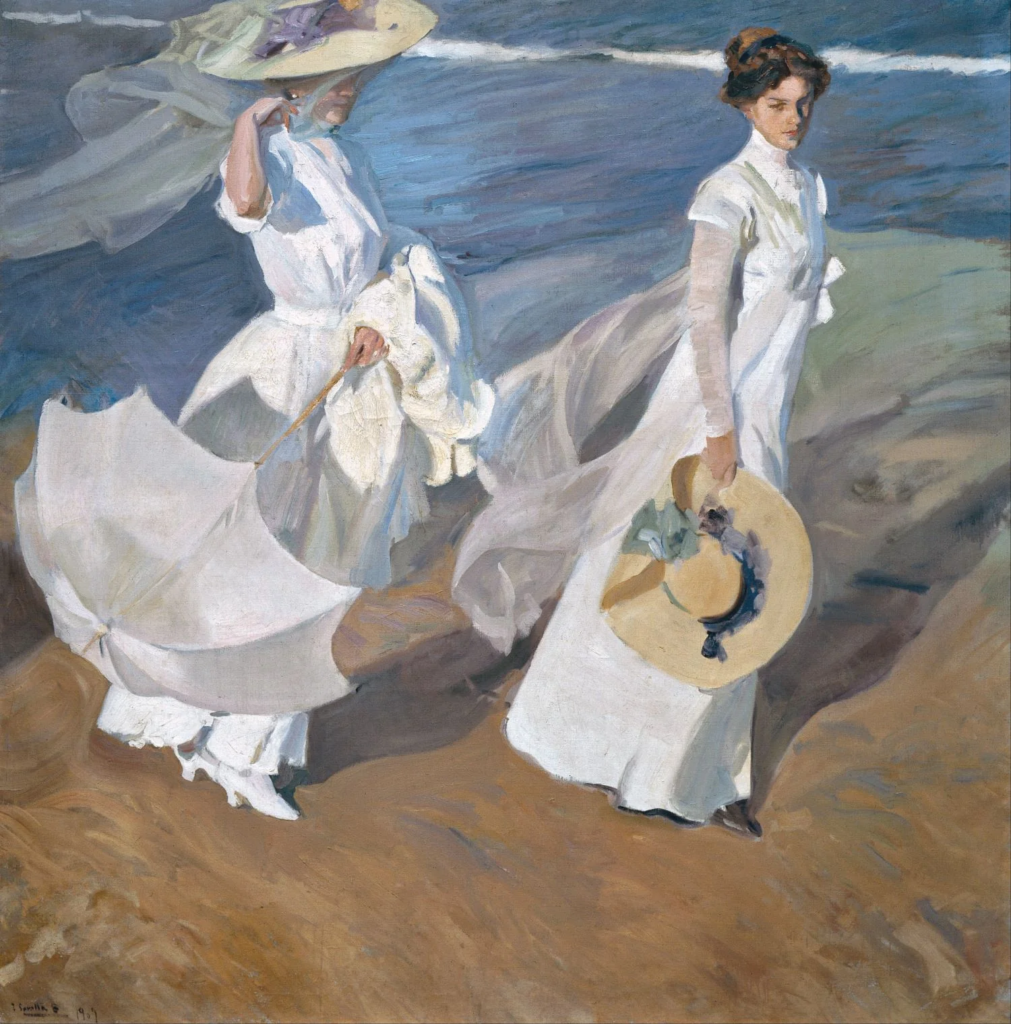
That sense of effortless happiness radiates through Walk on the Beach, one of the most beloved works by Spanish painter Joaquín Sorolla. Created in 1909, the painting depicts two women—Sorolla’s wife, Clotilde, and their daughter María, walking along the shoreline in Valencia. There is no dramatic narrative unfolding here, no approaching storm or shipwreck. Instead, the painting captures a fleeting moment of everyday life transformed into something timeless.
What immediately draws viewers in is Sorolla’s extraordinary command of light. Often called the “Master of Light,” he had a remarkable ability to paint sunlight not as a static element but as a living presence within a composition. In Walk on the Beach, sunlight dances across flowing white dresses, reflects off the wet sand, and shimmers across the gentle waves. The entire scene feels illuminated from within.
The painting was created during a period when Sorolla was at the height of his career. While many artists of the era were exploring modern urban life, Sorolla repeatedly returned to the Mediterranean coast that had shaped his childhood. The sea became one of his favorite subjects, not as a symbol of danger or mystery, but as a source of beauty, leisure, and connection.
Part of the painting’s charm lies in its sense of movement. The women’s dresses billow in the coastal wind, their shadows stretch across the sand, and the shoreline curves naturally through the composition. Everything feels spontaneous, as though the scene has been captured in a single passing moment.
As the final painting on this list, Walk on the Beach offers a fitting conclusion to centuries of artists interpreting the ocean. Throughout art history, the sea has been portrayed as terrifying, sublime, spiritual, and unpredictable. Sorolla reminds us that it can also be peaceful. His painting celebrates one of the simplest pleasures in life: walking beside the water, feeling the breeze, and enjoying a moment that asks nothing of us except to be present.
After all the storms, shipwrecks, and struggles depicted by the artists before him, Sorolla leaves us with something equally powerful, a reminder that the ocean can inspire wonder not only through its might, but through its beauty.
Across centuries and cultures, artists have returned to the ocean for the same reason people continue to stand at its edge today: it has a way of making us feel both small and connected to something much larger than ourselves.
The paintings in this list prove that the sea has never been just a backdrop. For Katsushika Hokusai, it became a symbol of nature’s overwhelming power. For Caspar David Friedrich, it was a space for contemplation and spiritual reflection. Rembrandt van Rijn used it to explore faith, while J. M. W. Turner saw in its waters a way to reflect on change, technology, and the passing of time. Artists like Winslow Homer revealed the realities of survival at sea, while Joaquín Sorolla captured its quieter pleasures through sunlight, movement, and everyday life.
What makes these works so remarkable is their ability to transform a familiar subject into something deeply personal and universal at the same time. The ocean can represent fear, freedom, isolation, resilience, mystery, or hope, often all within a single image. Its meaning changes depending on who is looking at it, which may be why it has remained one of art history’s most enduring subjects.
From towering waves and violent storms to peaceful shores and glowing horizons, these paintings remind us that the sea is never just water. It is a mirror for human emotion, a witness to history, and an endless source of artistic inspiration.
From Hokusai’s towering wave to Sorolla’s sunlit shore, which ocean scene would you most like to experience in person?
Art has always helped us see the world—and ourselves—from new perspectives. For readers looking to explore more stories where art intersects with identity, culture, and lived experience, our roundup of 7 Art Books to Read This Pride Month offers a thoughtful next read.