




What Motherhood Looks Like Through the Eyes of Artists

Motherhood has appeared in art for centuries, but never in just one form. Across paintings, sculptures, and portraits, artists have returned again and again to mothers not only as symbols of tenderness and care, but as figures shaped by grief, memory, protection, identity, longing, and emotional endurance.
For much of art history, motherhood was idealized through sacred Madonnas and serene domestic scenes where mothers appeared endlessly graceful, patient, and composed. But as art evolved, so did the ways artists began seeing them. Mothers became more human, more vulnerable, and far more emotionally complex. Some artists painted motherhood through softness and intimacy, while others explored exhaustion, loss, fear, or the invisible labor of caregiving itself.
This Mother’s Day, these artworks offer a reminder that motherhood has never existed as one singular experience in art. Instead, it has been constantly reimagined across generations, cultures, and artistic movements. From Louise Bourgeois’s monumental spider sculpture Maman to Frida Kahlo’s deeply personal reflections on family and inheritance, these works reveal motherhood not as an ideal, but as something layered, emotional, and deeply human.
Together, they show how artists have long used mothers as emotional anchors through which they explored love, vulnerability, memory, identity, and the people who shape our understanding of the world long before we have words for it.
Louise Bourgeois’ Maman and the Monumental Weight of Motherhood
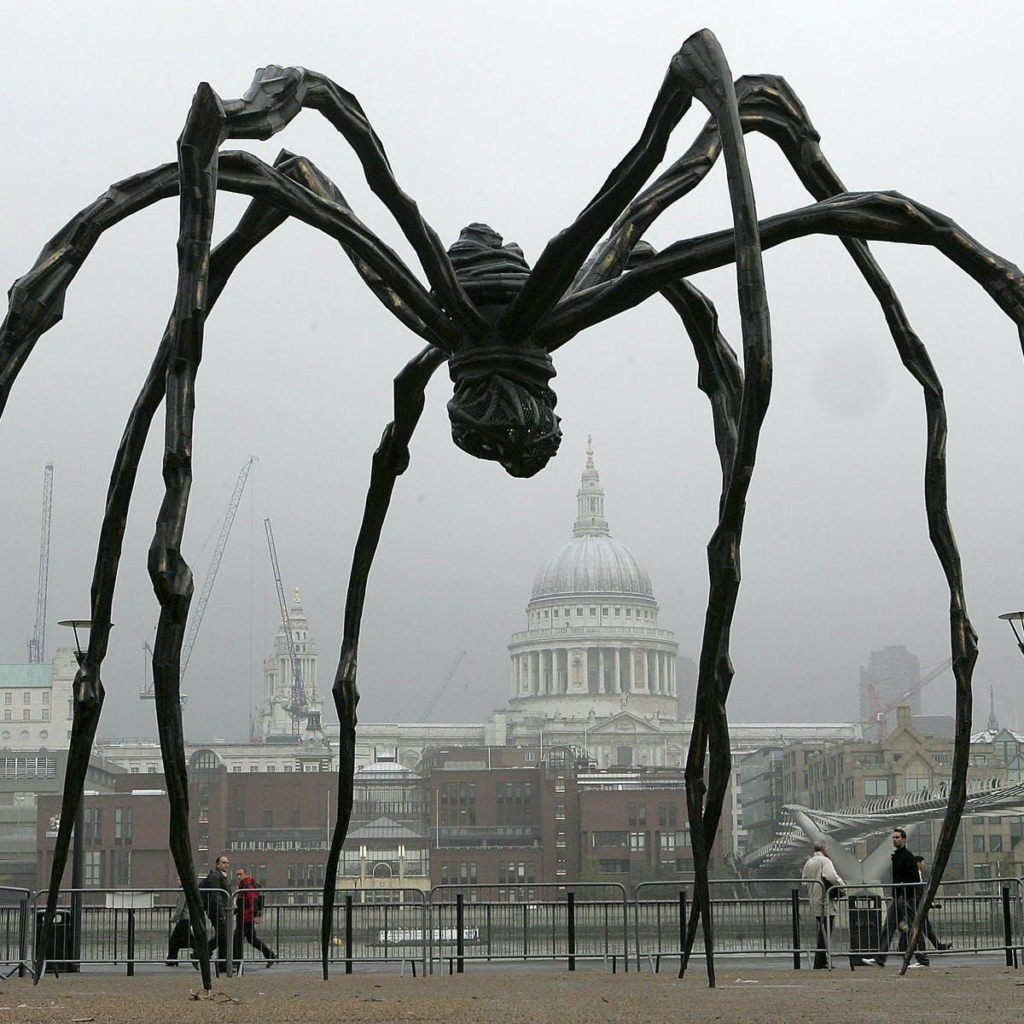
Few artworks capture the emotional complexity of motherhood as powerfully as Louise Bourgeois’s Maman (1999). Towering over viewers with its long bronze legs and suspended body, the giant spider is both unsettling and strangely protective, transforming motherhood into something far more layered than tenderness alone.
At first glance, the sculpture feels intimidating. The spider looms over the space like a creature from a nightmare, fragile yet immense, delicate yet threatening. But for Bourgeois, the spider was never a symbol of fear. It was a portrait of her mother.
Her mother worked as a tapestry restorer, patiently repairing damaged fabrics for the family business, and Bourgeois often described her as intelligent, methodical, soothing, and quietly resilient. Like a spider weaving and repairing its web, motherhood here becomes an act of constant labor: invisible, repetitive, protective, and deeply creative. Beneath the sculpture’s body hangs a sac filled with marble eggs, turning the spider into both guardian and creator.
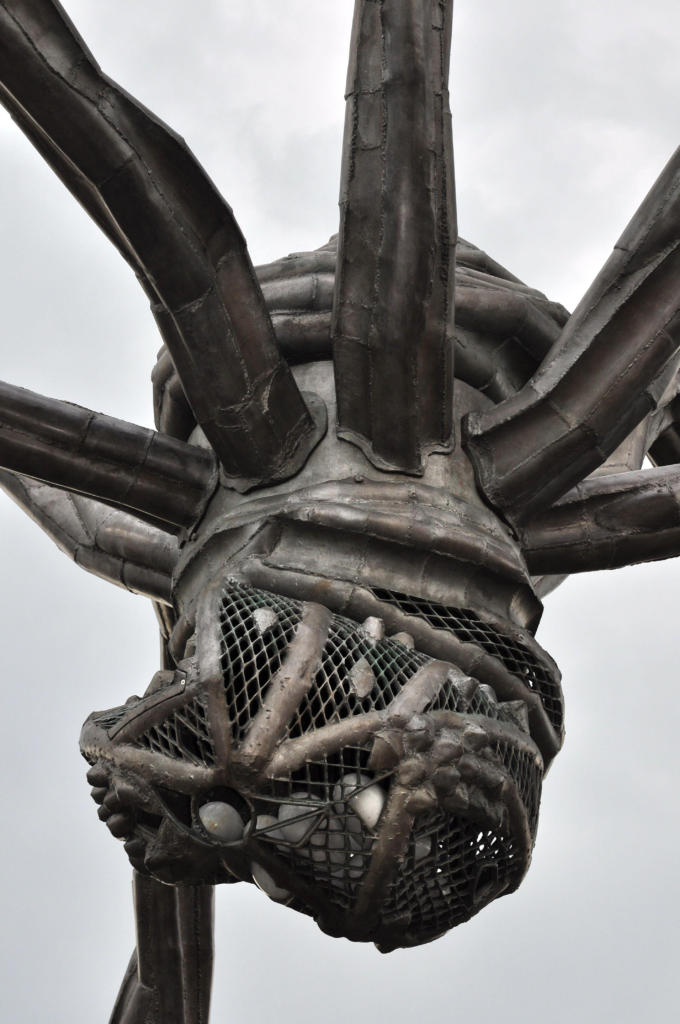
What makes Maman so unforgettable is the way it resists idealization. Bourgeois does not portray motherhood as soft perfection or sentimental devotion. Instead, she reveals it as something enormous, emotionally complicated, and almost architectural, built from care, memory, endurance, and survival.
In many ways, Maman feels like the perfect beginning for any conversation about motherhood in art because it reminds us that mothers are rarely just symbols of comfort. They are often the structures that hold entire worlds together.
From Sacred Ideal to Human Emotion: Leonardo da Vinci’s Madonna of the Carnation
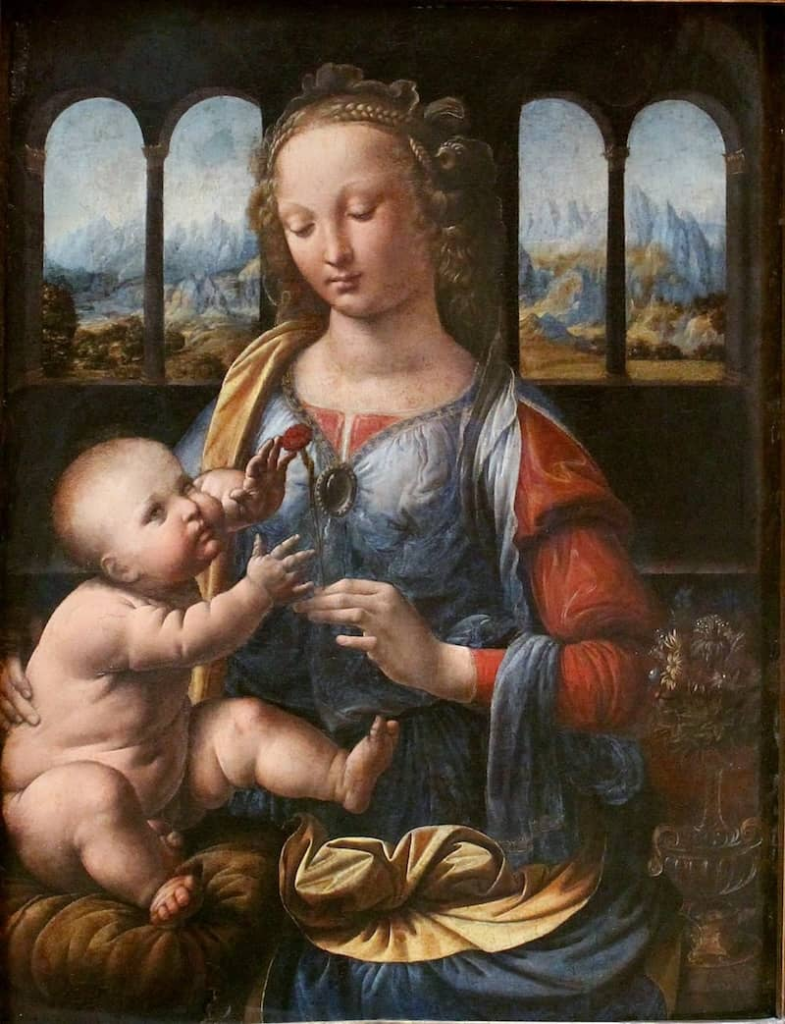
Long before artists began painting motherhood as emotionally messy, vulnerable, or deeply personal, Western art often imagined mothers through the sacred image of the Madonna and Child. One of the earliest and most enduring examples is Leonardo da Vinci’s Madonna of the Carnation (c.1473), a painting that reflects how motherhood was once elevated into something almost divine.
In the artwork, the Virgin Mary sits calmly beside the infant Jesus, holding a red carnation while the child reaches toward it with curiosity. The scene is serene and carefully composed, bathed in soft light and delicate detail. Mary’s flowing garments, graceful posture, and tranquil expression transform her into an ideal rather than an ordinary woman.
For centuries, paintings like these shaped how motherhood was visually understood in art. Mothers were portrayed as pure, patient, nurturing, and endlessly composed, less as individuals with inner lives and more as symbols of devotion and sacrifice. The emotional realities of exhaustion, grief, frustration, or identity rarely entered the frame.
And yet, there is still something deeply moving about Leonardo’s painting. The tenderness between mother and child feels intimate despite its perfection. The small gesture of the infant reaching toward the flower introduces a fleeting moment of connection that makes the scene feel human beneath its sacred surface.
Looking back now, Madonna of the Carnation feels less like a complete portrait of motherhood and more like the beginning of a long artistic conversation, one that later artists would challenge, complicate, and reimagine across generations.
Pablo Picasso’s Mother and Child and the Tenderness Hidden Inside Despair
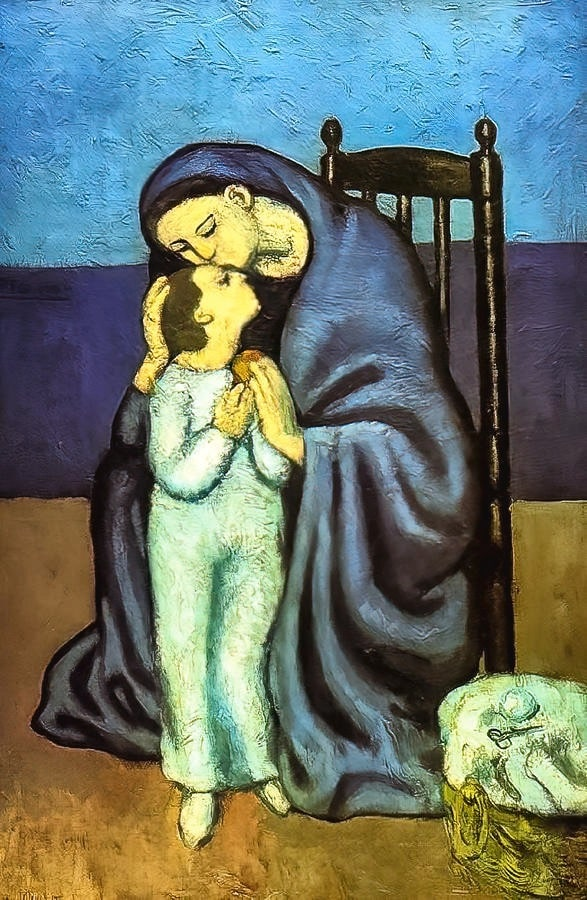
During his Blue Period, Pablo Picasso filled his canvases with loneliness, poverty, grief, and emotional isolation. Painted in 1901, Mother and Child carries all the melancholy that defined this period, yet within its muted blue tones lies one of art’s quietest portrayals of maternal devotion.
The painting shows a mother seated on the ground, holding her child close against an almost empty background. There is little warmth in the setting itself. The cool monochromatic palette creates an atmosphere of emotional heaviness, making the figures feel suspended in silence. But despite the bleakness surrounding them, the mother’s embrace becomes the emotional center of the work.
Unlike the serene Madonnas of Renaissance art, Picasso’s mother is not idealized or elevated into sainthood. She appears weary, vulnerable, and painfully human. Motherhood here is not presented as perfection but as survival. The tenderness in the painting comes not from beauty or symbolism, but from the quiet determination to protect and comfort in the midst of hardship.
What makes the artwork especially powerful is the contrast between despair and care. Picasso paints poverty without stripping the figures of dignity, allowing the mother’s closeness to her child to become an act of emotional resistance against loneliness and instability.
In many ways, Mother and Child marks a shift in how motherhood began appearing in modern art. The mother is no longer just a sacred figure to admire from a distance. She becomes a real person carrying exhaustion, uncertainty, and love all at once, making the painting feel heartbreakingly intimate more than a century later.
Gustav Klimt’s Mother and Child and the Intimacy of Maternal Tenderness
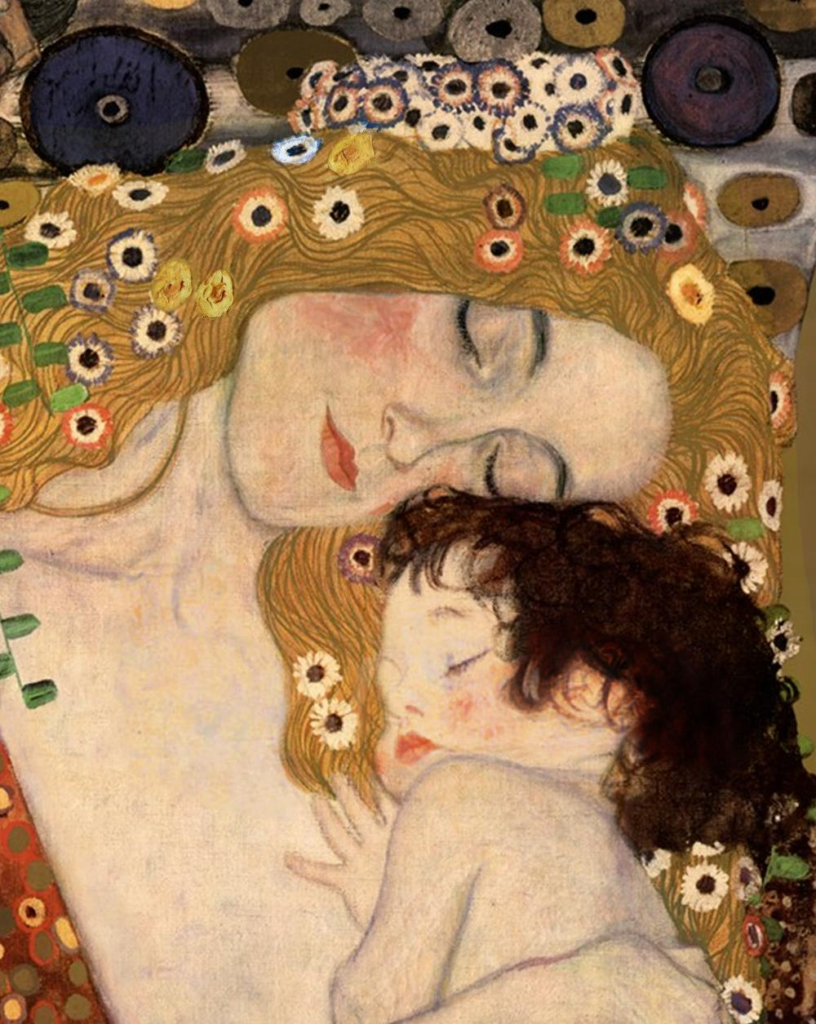
Where many modern artists explored motherhood through grief, struggle, or emotional tension, Gustav Klimt approached it with softness and intimacy. His 1905 work Mother and Child, part of The Three Ages of Woman, transforms maternal affection into something dreamlike, sensual, and deeply protective.
The painting centers on a sleeping mother cradling her child in an embrace so close that their bodies almost dissolve into one another. Wrapped in flowing patterns and warm tones, the figures appear suspended in a private world untouched by time. Klimt’s signature decorative style, filled with gold hues, floral motifs, and delicate textures, gives the work an almost sacred stillness.
But unlike earlier religious depictions of motherhood, Klimt’s painting feels profoundly human. There is no grandeur or theatrical symbolism dominating the scene. Instead, the emotional power lies in physical closeness, the mother’s closed eyes, the child’s relaxed body, the quiet rhythm of shared comfort. The painting captures a fleeting moment of complete trust and safety, something universally recognizable even outside the context of motherhood itself.
At the same time, Klimt’s work reflects how motherhood has often been linked to ideas of femininity, beauty, and emotional softness in art history. The mother becomes both caregiver and symbol, embodying tenderness in its purest visual form.
Placed alongside darker or more psychologically complex depictions of motherhood, Mother and Child offers balance within the larger story of maternal representation in art. It reminds us that while artists have often questioned, complicated, or reimagined motherhood, they have also continued returning to its quieter moments of closeness, warmth, and unconditional care.
Käthe Kollwitz’s Woman with Dead Child and the Devastation of Maternal Grief
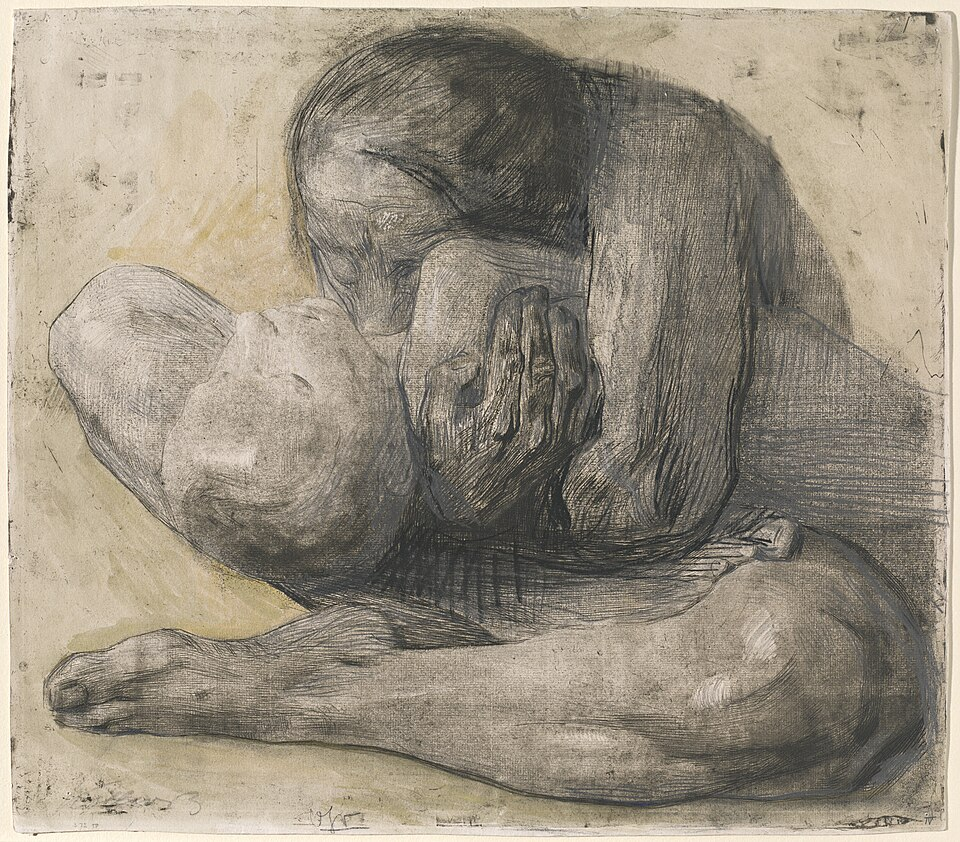
Few artists have portrayed grief with the raw emotional intensity of Käthe Kollwitz. In Woman with Dead Child (1903), motherhood is stripped entirely of idealization and transformed into something deeply physical, desperate, and painfully human.
The artwork shows a mother clutching the lifeless body of her child against her chest, her body curled protectively around him as though refusing to let go. There is no decorative background, no symbolic softness, no attempt to romanticize suffering. Instead, Kollwitz focuses entirely on the emotional weight of loss. The figures almost merge together, creating an image that feels less like a portrait and more like an expression of grief itself.
What makes the work so devastating is its intensity. The mother’s embrace does not feel gentle or serene. It feels instinctive, almost animalistic, as if love and mourning have become inseparable. Kollwitz understood this kind of pain intimately. Years later, she would lose her own son during the First World War, and themes of death, mourning, and maternal suffering would continue to shape much of her work.
For centuries, art history celebrated motherhood through images of harmony, purity, and devotion, but Woman with Dead Child confronts a reality those idealized depictions often ignored: the possibility of unbearable loss. Kollwitz forces viewers to look directly at grief rather than soften it into symbolism.
Even today, the artwork remains difficult to look at for long, which is precisely what gives it its power. It reminds us that motherhood in art is not only about creation and care, but also about vulnerability, fear, and the unimaginable depth of attachment between a mother and her child.
Salvador Dalí’s The Enigma of Desire and the Persistence of Memory
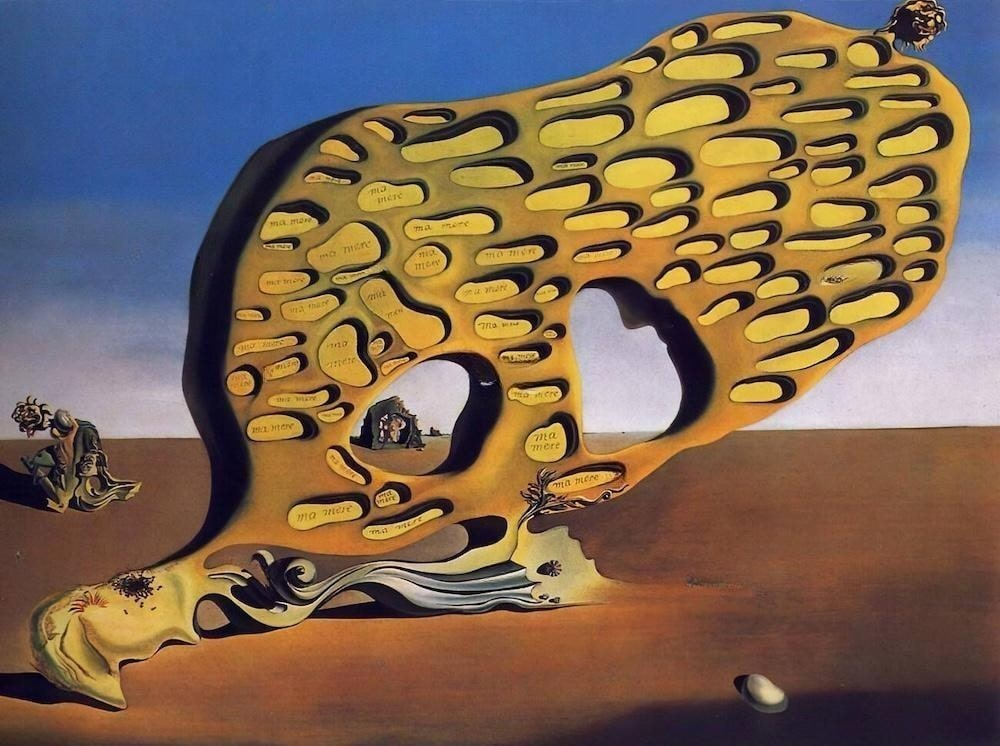
By the time Salvador Dalí painted The Enigma of Desire, or My Mother, My Mother, My Mother in 1929, his mother had already been dead for years. Yet her presence continued to haunt his imagination, resurfacing not through realism or portraiture, but through the strange and dreamlike language of Surrealism.
The painting is filled with distorted organic forms, hollow spaces, and repeated inscriptions of the words ma mère, “my mother” – carved obsessively across the surface of the work. At the lower edge of the painting, Dalí’s sleeping profile appears almost hidden within the landscape, suggesting that the scene unfolds somewhere between dream, memory, and subconscious longing.
Unlike traditional depictions of motherhood, there is no comforting maternal figure physically present here. Instead, motherhood becomes psychological. The mother exists as absence, desire, and emotional residue, something impossible to fully recover yet impossible to forget. The repeated text transforms the painting into an act of fixation, as though Dalí is trying to hold onto a memory that continues slipping away from him.
The work also reflects the Surrealists’ fascination with Sigmund Freud and the unconscious mind, where childhood relationships and hidden desires shaped emotional life far more deeply than logic could explain. For Dalí, the figure of the mother becomes inseparable from grief, identity, and emotional dependency.
What makes The Enigma of Desire so powerful within the history of motherhood in art is that it moves beyond literal representation entirely. Motherhood here is not shown through touch or care, but through longing itself, revealing how deeply maternal relationships can continue shaping artists long after they are gone.
Frida Kahlo’s My Grandparents, My Parents, and I and the Idea of Inherited Identity
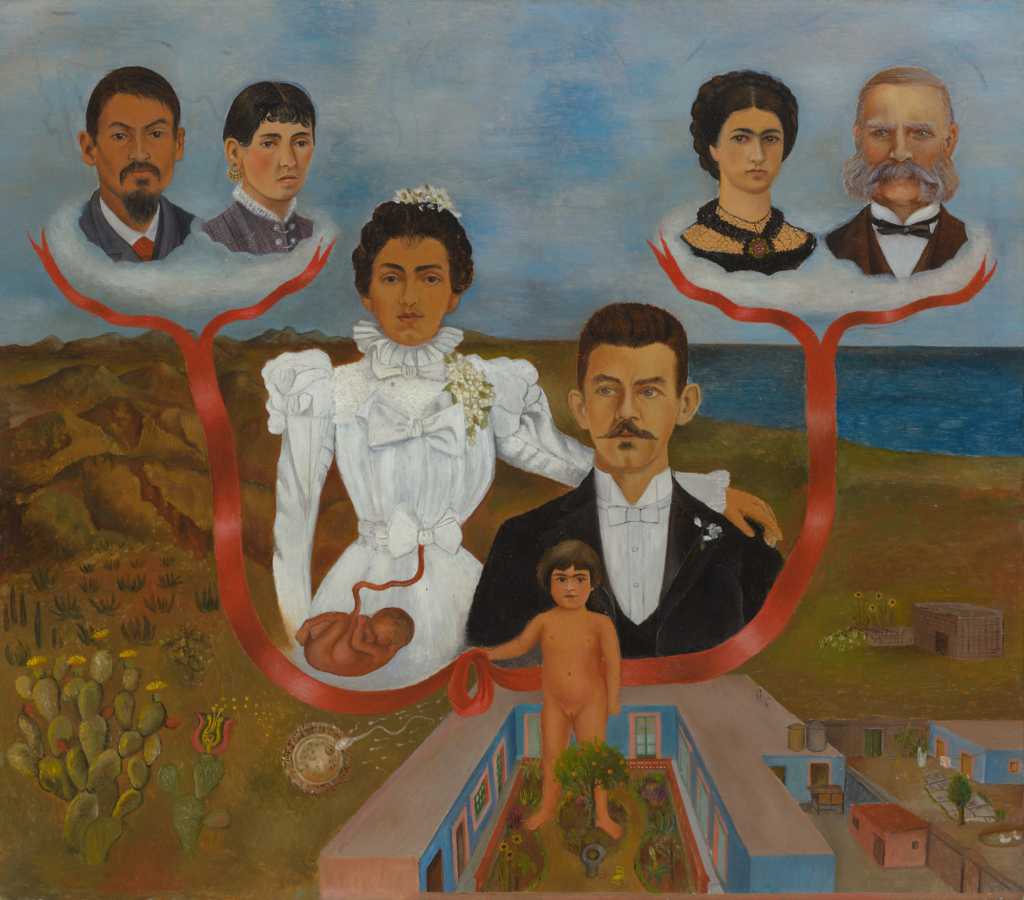
In Frida Kahlo’s My Grandparents, My Parents, and I (1936), motherhood is not portrayed through a single intimate moment between mother and child. Instead, Kahlo transforms family itself into a visual map of memory, ancestry, and emotional inheritance.
The painting places a young Kahlo at the center of a dreamlike family tree, standing in the courtyard of her childhood home while holding red ribbons that connect her to her parents and grandparents floating above her. Blending realism with surreal symbolism, Kahlo traces the complicated network of relationships that shaped her identity long before she became an artist herself.
What makes the work especially striking is the way motherhood becomes part of a larger story about lineage and belonging. Kahlo presents her mother not as an isolated figure of nurturing, but as someone connected to generations before and after her. The maternal line becomes inseparable from ideas of culture, memory, heritage, and the body itself.
Like much of Kahlo’s work, the painting also reflects her lifelong fascination with identity and self-construction. She often used personal experiences, family histories, and physical pain to build symbolic visual worlds where autobiography and imagination blurred together. Here, motherhood becomes something inherited emotionally as much as biologically, passed through generations in ways both visible and invisible.
Placed alongside more traditional depictions of mothers and children, My Grandparents, My Parents, and I expands the conversation around motherhood beyond care alone. Kahlo reminds us that mothers do not simply shape childhood memories; they also shape the histories, identities, and emotional legacies that continue living within us long after childhood ends.
Cecile Walton’s Romance and the Reality Behind Domestic Motherhood
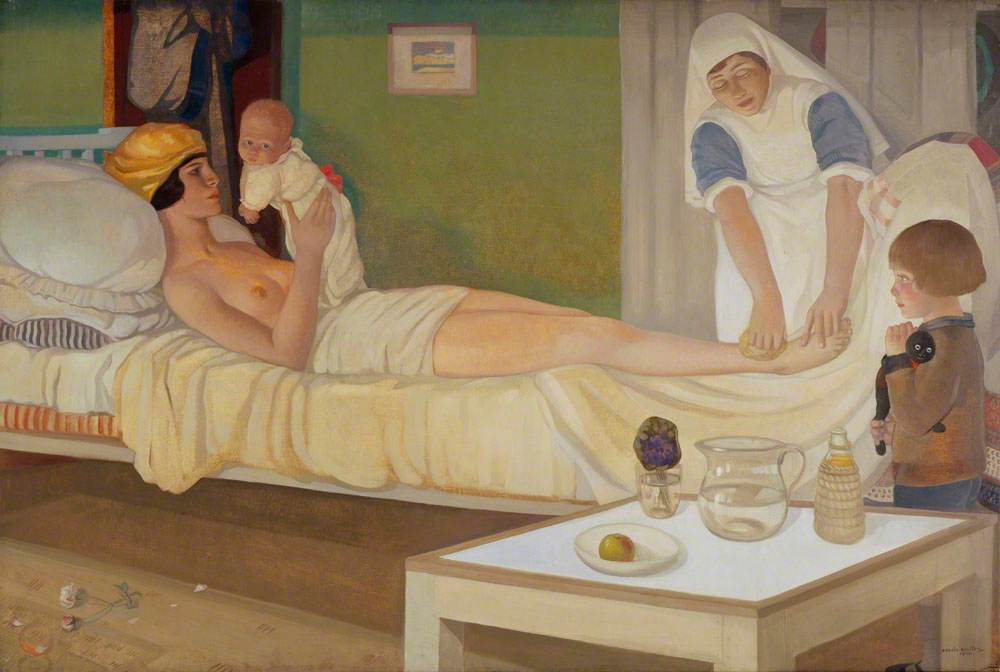
At first glance, Cecile Walton’s Romance (1920) appears gentle and intimate, capturing a quiet moment between a mother and her children inside the home. But beneath its warmth lies something more subtle: a quiet resistance to the idealized fantasy of motherhood that dominated much of art history.
The painting is a self-portrait of Walton with her two young sons, Edward and Gavril. Rather than presenting herself as a flawless maternal figure, Walton creates a scene that feels personal, lived-in, and emotionally real. She holds her newborn child toward his older brother with an almost observational calm, allowing the interaction between the children to become the emotional focus of the work.
Even the title, Romance, carries a sense of irony. Walton seems aware of how motherhood and domestic life had long been romanticized in art, often depicted as soft, graceful, and endlessly fulfilling. Her painting gently disrupts that tradition by replacing theatrical sentimentality with ordinary intimacy. The scene does not feel staged or symbolic; it feels like a fleeting moment from daily life.
What makes the work especially compelling is that it comes from the perspective of a woman artist depicting her own experience of motherhood rather than imagining it from the outside. That shift changes the emotional tone entirely. Walton paints motherhood not as an abstract ideal, but as something immediate, complex, and deeply woven into the rhythms of everyday life.
In many ways, Romance marks an important turning point in the history of motherhood in art. The mother is no longer simply a symbol to be admired. She becomes a person inside the story herself.
Egon Schiele’s Mother with Two Children II and the Fragility of Motherhood
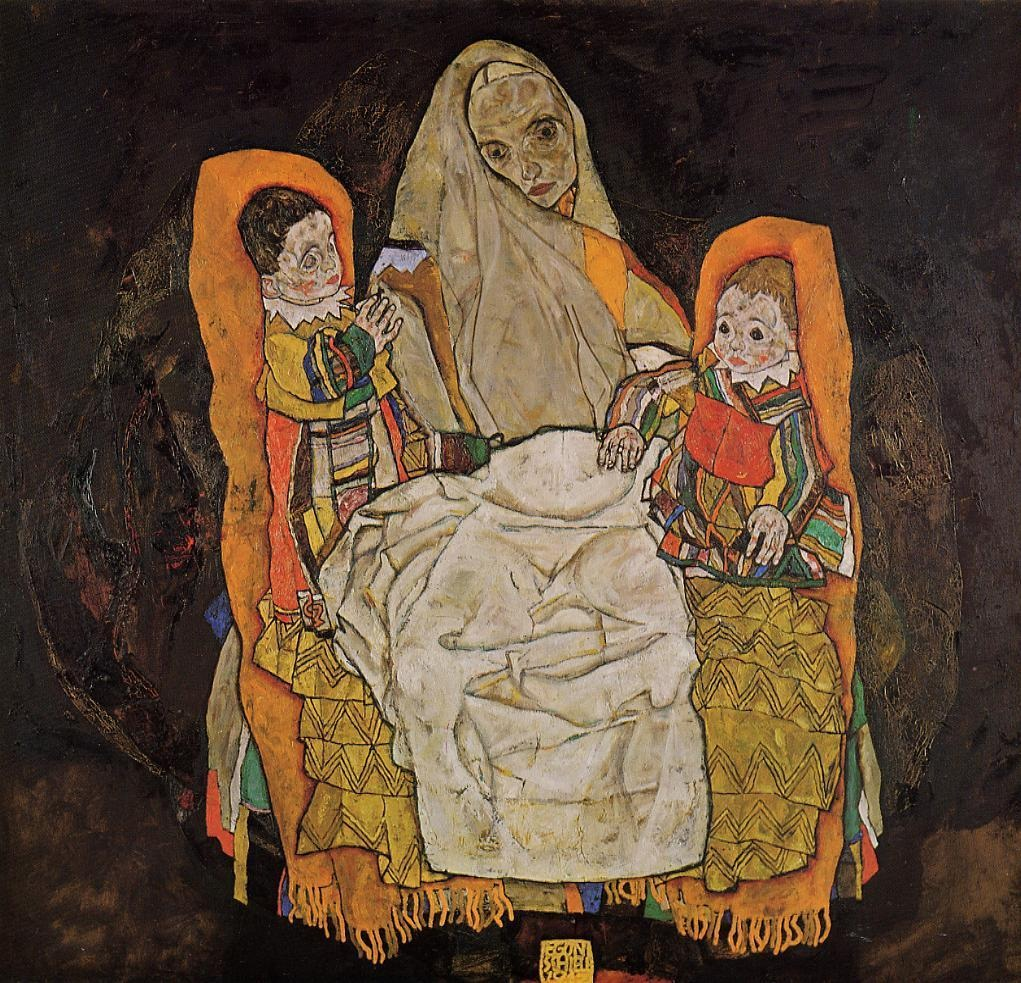
Few artists painted human emotion with the same intensity as Egon Schiele. In Mother with Two Children II (1915), Schiele moves far away from the serene and idealized mothers of earlier art history, presenting motherhood instead as something fragile, exhausted, and emotionally exposed.
The mother sits tightly wrapped around her children, holding them close within the compressed space of the composition. At first glance, the arrangement recalls traditional religious images of the Madonna and Child, but Schiele disrupts that familiar tenderness almost immediately. The figures appear tense rather than peaceful. Their angular bodies, hollow expressions, and muted palette create an atmosphere of emotional unease rather than comfort.
What makes the painting so striking is the way Schiele captures vulnerability without romanticizing it. The mother does not appear calm or spiritually elevated. She looks burdened, protective, and deeply human, as though motherhood exists here alongside fatigue and uncertainty rather than above them. Even the children seem fragile within her grasp, emphasizing the precariousness of care itself.
Created during the years of the First World War, the painting also carries the emotional weight of a world marked by instability and anxiety. Like many Expressionist artists of the time, Schiele was less interested in physical beauty than in exposing psychological truth. Motherhood becomes another emotional state to examine honestly, stripped of decorative softness.
Placed alongside more tender depictions of maternal love, Mother with Two Children II feels almost unsettling, which is precisely why it remains so powerful. It reminds us that motherhood is not always experienced as serenity. Sometimes it is experienced as vulnerability, responsibility, and the quiet fear of protecting what matters most.
Lucian Freud’s The Painter’s Mother IV and the Intimacy of Watching Someone Age
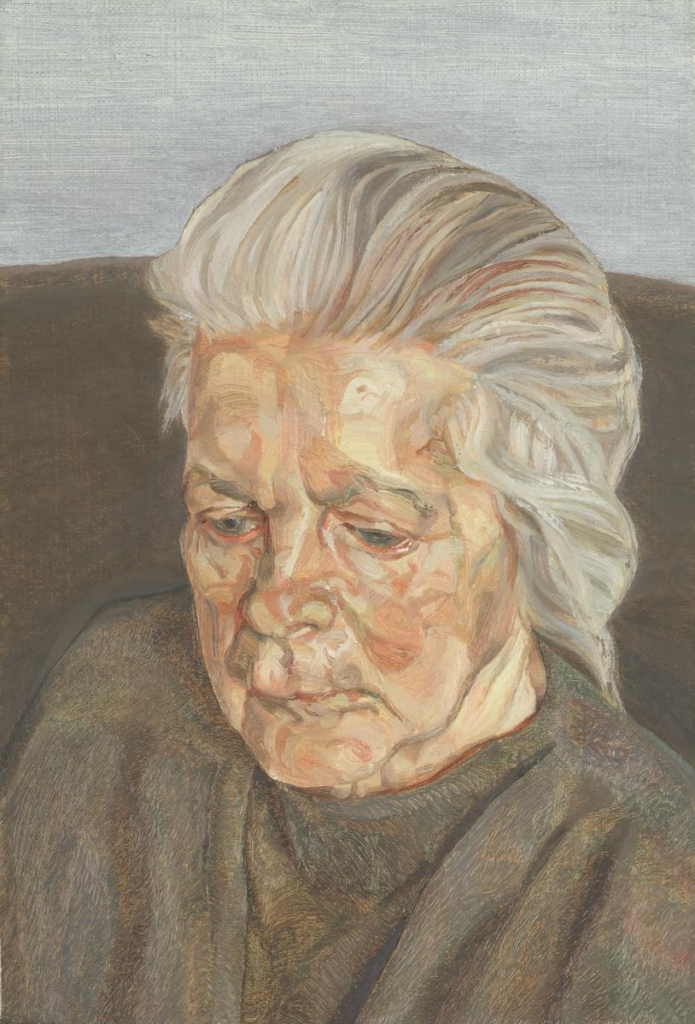
Over the course of more than a decade, Lucian Freud repeatedly painted his mother, Lucie Freud, turning her into one of the most emotionally significant figures in his work. In The Painter’s Mother IV (1973), motherhood is no longer represented through youth, care, or idealized devotion, but through aging, sadness, and the quiet intimacy of observation.
The portrait was painted after the death of Freud’s father, a loss that deeply affected Lucie and led to periods of depression. Seated alone with her eyes cast downward, she appears emotionally distant, almost withdrawn into herself. Freud’s muted palette of greys and browns intensifies the atmosphere of heaviness surrounding the painting, while his careful attention to texture makes every crease of skin and fold of fabric feel painfully real.
What makes the portrait so moving is its restraint. Freud does not dramatize his mother’s grief or attempt to sentimentalize her vulnerability. Instead, he paints her with a kind of patient honesty, allowing her sadness to exist quietly within the frame. The result feels deeply intimate, as though the act of painting becomes a way of staying close to someone slowly retreating inward.
Unlike traditional portraits that freeze subjects in idealized beauty, Freud’s work embraces emotional and physical reality. His mother is not transformed into a symbol of motherhood; she remains unmistakably human. That humanity is what gives the painting its emotional force.
In many ways, The Painter’s Mother IV reflects one of the most profound shifts in modern art’s portrayal of mothers. The mother is no longer only someone who nurtures others. She becomes someone who herself can be fragile, grieving, aging, and in need of care.
J. S. Dyson’s The Foster Mother and the Idea of Care Beyond Blood Ties
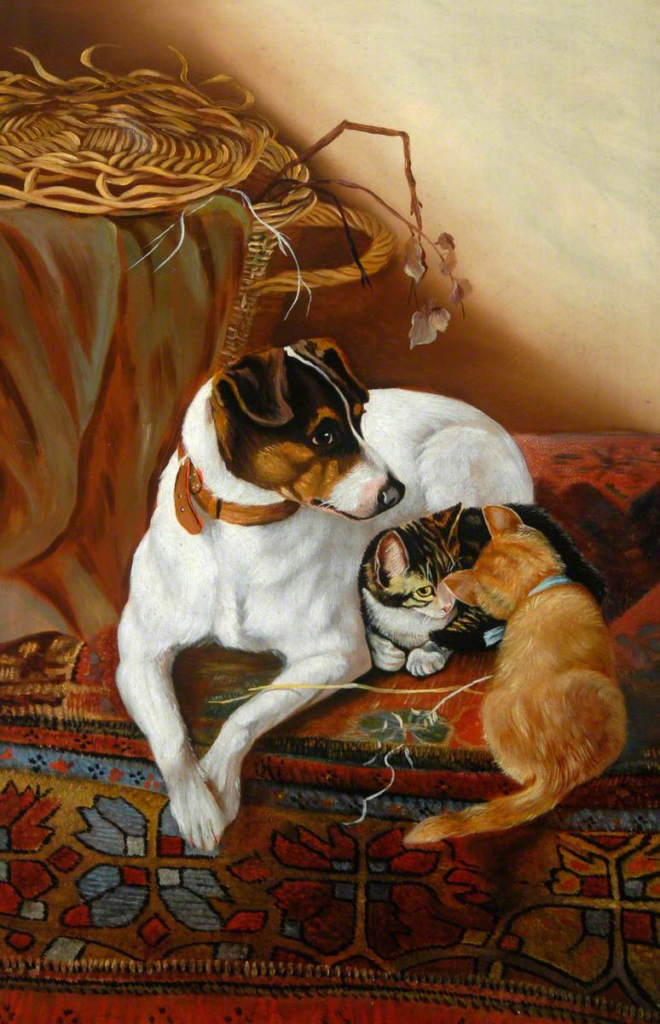
Among the many artworks that explore motherhood through biological relationships, J. S. Dyson’s The Foster Mother (1894) offers something unexpectedly tender: the idea that motherhood can also exist through acts of care, protection, and emotional nurturing rather than blood alone.
The painting depicts a dog gently surrounded by a litter of kittens, creating a scene that feels both unusual and deeply familiar. There is a quiet softness in the way the animals rest together, protected within the warmth of the foster mother’s presence. While the work carries a sense of charm, it also touches on something emotionally universal about caregiving itself.
Unlike the grand religious Madonnas or psychologically charged modern portraits seen throughout art history, The Foster Mother approaches motherhood with simplicity. There is no dramatic symbolism or emotional intensity dominating the composition. Instead, Dyson focuses on instinctive compassion, the natural impulse to shelter, comfort, and raise another living being, even when no biological connection exists.
That idea feels especially meaningful today, when conversations around motherhood and family have expanded far beyond traditional definitions. The painting quietly acknowledges forms of care that often remain invisible: adoptive motherhood, chosen family, fostering, and the emotional labor involved in nurturing others.
Placed near the end of a conversation about motherhood in art, The Foster Mother softens the emotional tone while broadening the meaning of motherhood itself. It reminds us that maternal love has never belonged to one fixed image or structure alone. Sometimes, motherhood is simply the act of choosing to care for another life as though it were your own.
Aliza Nisenbaum’s Susan, Aarti, Keerthana and Princess, Sunday in Brooklyn and the Expanding Image of Modern Motherhood
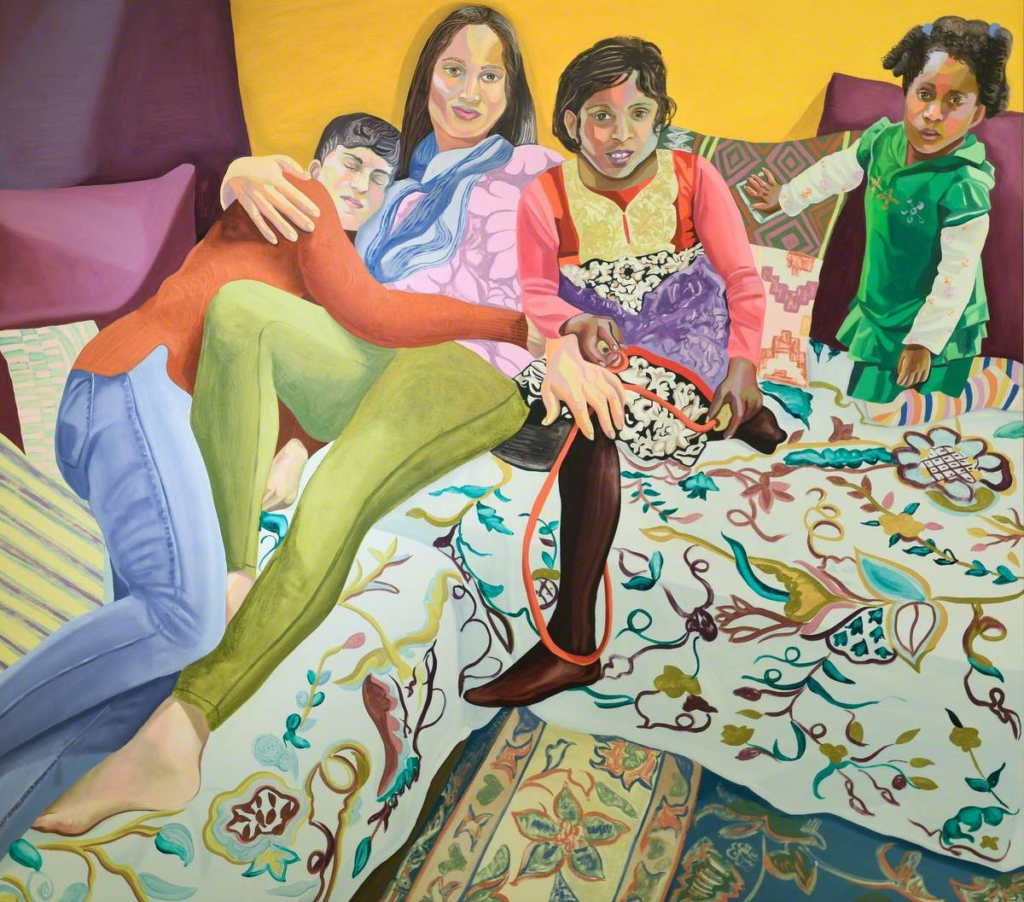
In Aliza Nisenbaum’s Susan, Aarti, Keerthana and Princess, Sunday in Brooklyn (2018), motherhood is portrayed not through symbolism or idealization, but through the warmth of contemporary family life. The painting offers a vision of motherhood that feels deeply modern, intimate, multicultural, and shaped by care rather than convention.
The portrait shows a two-mother family gathered together inside their Brooklyn apartment. Surrounded by patterned fabrics, soft light, and vivid color, the family appears relaxed and emotionally connected, their closeness becoming the emotional center of the composition. Unlike historical depictions that often reduced mothers to symbolic roles, Nisenbaum paints each figure as fully individual, allowing personality and presence to emerge naturally within the domestic space.
What makes the work especially significant is the way it quietly expands traditional representations of motherhood in art. For centuries, maternal imagery largely revolved around rigid ideas of family, gender, and domestic life. Nisenbaum challenges those expectations simply by portraying another reality: queer motherhood, interracial family, and chosen forms of belonging that have always existed but were rarely centered in art history.
At the same time, the painting retains a timeless sense of tenderness. The gestures between family members, the shared physical closeness, and the calm atmosphere all echo emotional qualities seen in maternal artworks across generations. Love, care, and protection remain present, even as the structure of family itself evolves.
Placed at the end of this journey through motherhood in art, Nisenbaum’s painting feels especially hopeful. It suggests that while the image of motherhood continues to change, the emotional need for connection, care, and belonging remains universal across time.
(images will be added here)
Looking across these artworks, one thing becomes clear: motherhood in art has never belonged to a single image. It has been painted as sacred and ordinary, comforting and overwhelming, joyful and devastating, sometimes all at once.
Artists across centuries have used mothers not only as subjects, but as emotional landscapes through which they explored grief, protection, intimacy, identity, tenderness, and human connection itself. Some works celebrate care and closeness, while others reveal exhaustion, vulnerability, or the quiet loneliness that can exist within caregiving. Together, they challenge the idea that motherhood can ever be reduced to one perfect or universal experience.
What makes these artworks continue to resonate is their honesty. Whether through the monumental strength of Louise Bourgeois’s Maman, the emotional fragility of Lucian Freud’s portraits of his mother, or the tenderness found in contemporary depictions of family and care, each artwork captures a different way of understanding what it means to nurture, remember, protect, or love another person.
This Mother’s Day, these artworks remind us that motherhood has always been far more layered, emotional, and human than any single image could ever fully contain.
What is the most beautiful memory you share with your mother?
This Mother’s Day, these artworks remind us that motherhood has always been far more layered, emotional, and human than any single image could ever fully contain.
If you enjoyed reading this, you may also like our feature on women artists who continue to shape and inspire the art world today: 10 Women Artists Who Inspire Us