

The Woman Who Painted Abstract Art for the Future

At the center of the Guggenheim Museum, beneath the curve of its spiraling rotunda, enormous paintings bloom in soft pinks, cosmic blues, radiant golds, and impossible geometries. Circles divide into smaller circles. Swans dissolve into symbols. Spirals unfold like maps of another dimension. The canvases feel strangely contemporary, as though they belong to an artist shaped by the digital age, quantum theory, or speculative futurism. Yet these paintings were created more than a century ago by Hilma af Klint – the woman who painted abstract art for the future.
But these paintings were not made yesterday.
They were painted more than a century ago by a Swedish artist named Hilma af Klint, a woman who began creating abstract art in 1906, years before Wassily Kandinsky, Piet Mondrian, or Kazimir Malevich would come to define modern abstraction.
For decades, almost nobody saw them.
Hilma af Klint believed the world was not ready for her work. She instructed that her paintings remain hidden until at least twenty years after her death, convinced that future audiences might understand what her own century could not. When she died in 1944, she left behind more than a thousand paintings, diagrams, and notebooks filled with symbols, spiritual theories, and visions of invisible worlds.
What emerged from that hidden archive would eventually force art history to reconsider one of its most foundational stories: who invented abstract art, and why the future sometimes arrives long before anyone knows how to see it.
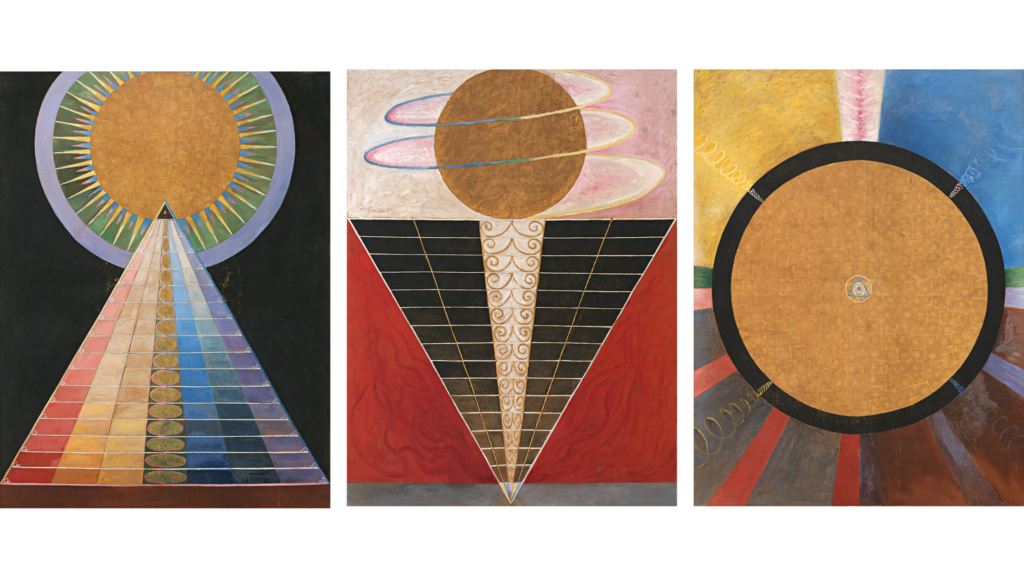
Hilma af Klint did not paint landscapes or portraits in the traditional sense. She painted energies. Systems. Transformations. Her monumental series Paintings for the Temple imagined art as something spiritual rather than decorative, a language capable of revealing realities beyond the visible world.
And perhaps that is why her work feels so startling today.
Not ahead of its time.
But waiting for the right time.
The Artist History Forgot
In the early years of the twentieth century, the art world was still deeply attached to the visible. Painting was expected to document reality, portraits, landscapes, still lifes, scenes from mythology or religion. Even the artists pushing against tradition were still tethered, in some way, to recognizable forms. Modernism was beginning to crack open old rules, but abstraction as we understand it had not yet fully arrived.
Or at least, that is the version of history most people were taught.
Long before abstract art became associated with the explosive experiments of Kandinsky or the strict geometry of Mondrian, Hilma af Klint was already painting enormous compositions untethered from the physical world. In 1906, she began creating works filled with spirals, symbols, cellular forms, floating diagrams, and radiant color systems that seemed to emerge from somewhere beyond ordinary perception.
They did not resemble anything else being made at the time.
And perhaps more importantly, they were never intended to.
Unlike many avant-garde artists of the era, af Klint was not interested in breaking artistic rules simply for innovation’s sake. She was attempting something stranger and far more ambitious: translating invisible structures into visual form. Her paintings were not abstractions of reality. They were attempts to move beyond it entirely.
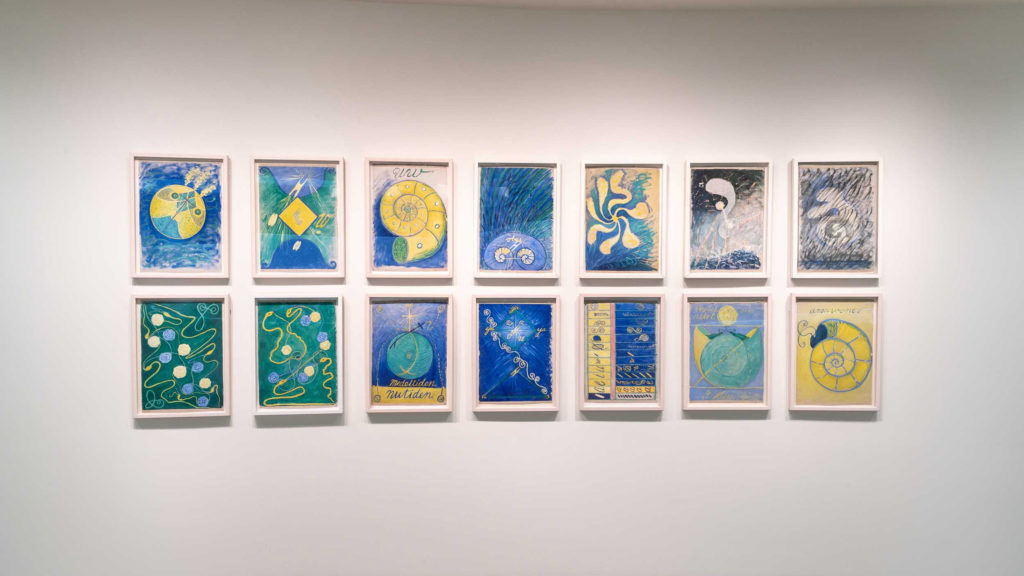
This becomes especially visible in works like Primordial Chaos, where thin lines, organic curves, and symbolic letters drift across the canvas like fragments of a spiritual language still being invented. The paintings feel scientific and mystical at once, part botanical study, part cosmic blueprint. Looking at them now, it is difficult to believe they were created before the First World War.
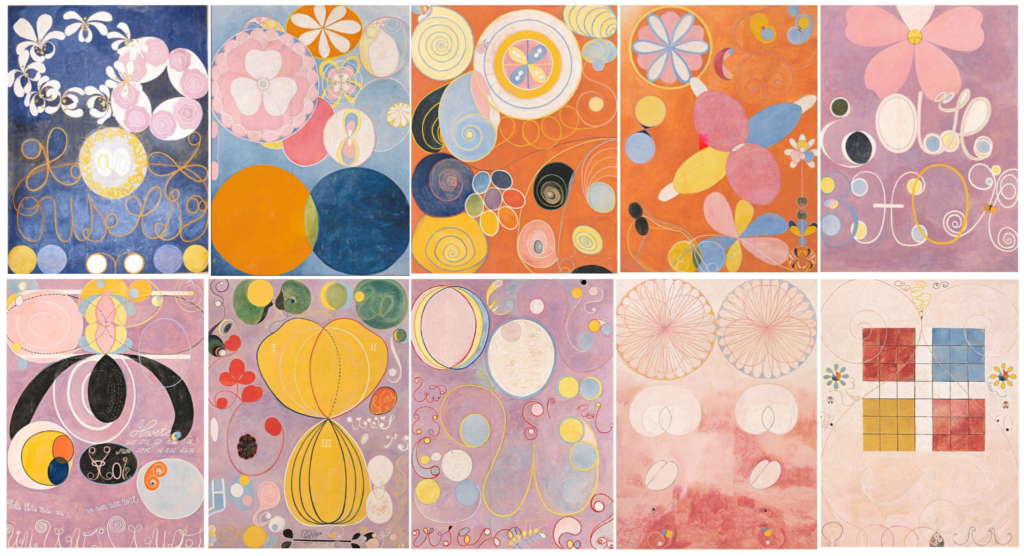
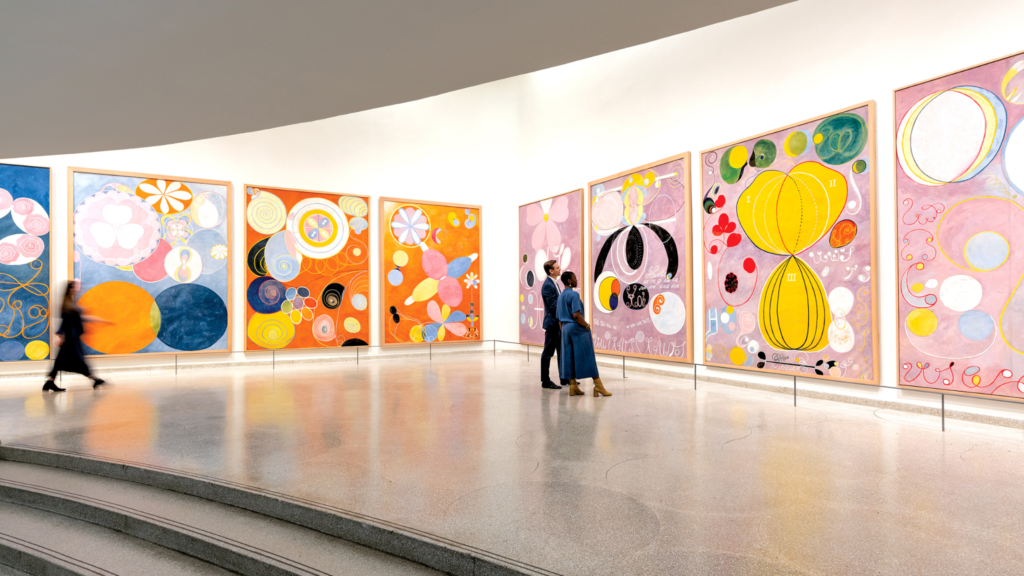
Then there is The Ten Largest, perhaps among her most overwhelming achievements. Towering in scale and saturated with soft oranges, violets, pinks, and blues, the paintings abandon traditional perspective altogether. Instead, the canvases pulse with circles, petals, letters, and biomorphic forms that seem to represent growth, consciousness, aging, and transformation. Even today, standing before them feels less like viewing paintings and more like entering an atmosphere.
Yet while male modernists were being absorbed into the official narrative of art history, Hilma af Klint remained largely invisible.
Part of that silence was structural. Women artists across Europe were routinely excluded from serious institutional recognition, no matter how innovative their work may have been. But af Klint’s disappearance from history also came from the nature of the work itself. Her paintings were intensely spiritual, symbolic, and deeply personal, qualities that sat uneasily within the rigid frameworks through which modern art was later categorized and understood.
For decades, the story of abstraction was written without her.
And hidden away in a Stockholm archive was an artist who had already imagined an entirely different future for painting.
The Spiritual World She Painted From
To understand Hilma af Klint’s paintings, it is not enough to look at them only through the history of modern art. They emerged from another world entirely, one shaped by mysticism, séances, spiritual philosophy, science, religion, and the growing belief that reality extended far beyond what the human eye could see.
At the end of the nineteenth century, Europe was gripped by a fascination with the invisible. Spiritualism spread across intellectual circles. Séances became social rituals among artists and thinkers. Theosophy attempted to connect religion, philosophy, science, and the universe into a single spiritual framework. Invisible energies, hidden dimensions, and higher consciousness were no longer fringe ideas; they became part of the cultural atmosphere of the time.
Hilma af Klint absorbed all of it.
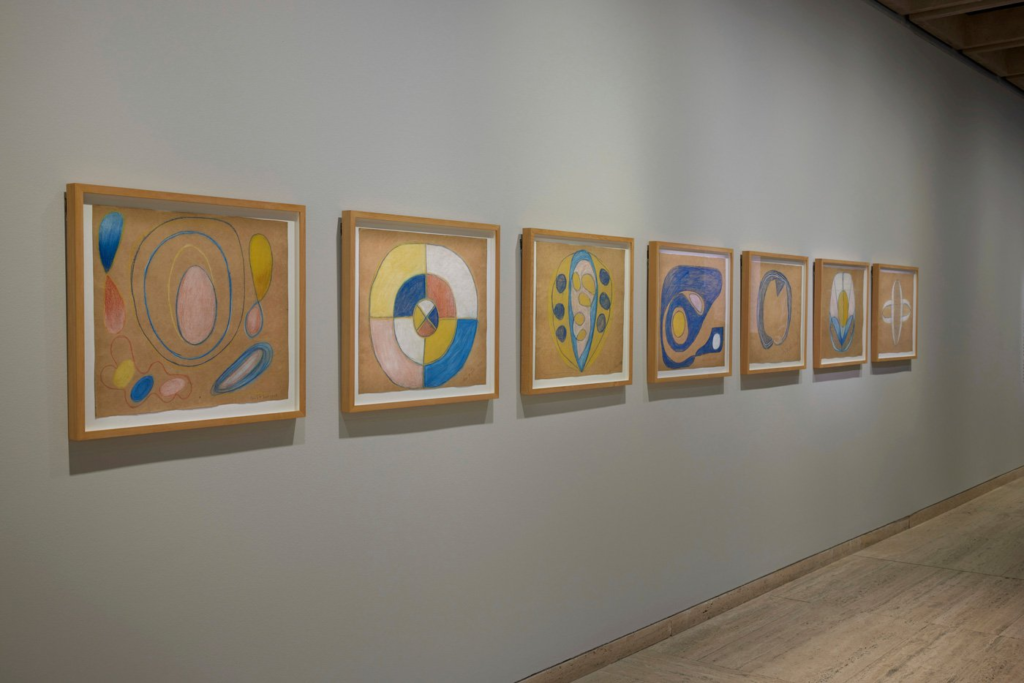
In 1896, she formed a spiritual group known as The Five, made up entirely of women. Together, they held séances, practiced automatic drawing, and believed they could communicate with higher spiritual entities they called the “High Masters.” During these sessions, af Klint claimed she received instructions for paintings that would eventually become some of the most radical works in modern art.
This detail has often made critics uncomfortable. Art history tends to prefer rational revolutions, movements explained through technique, theory, or formal innovation. But af Klint approached painting differently. She did not see herself purely as an inventor of images. She believed she was translating messages, systems, and spiritual structures that already existed beyond the visible world.
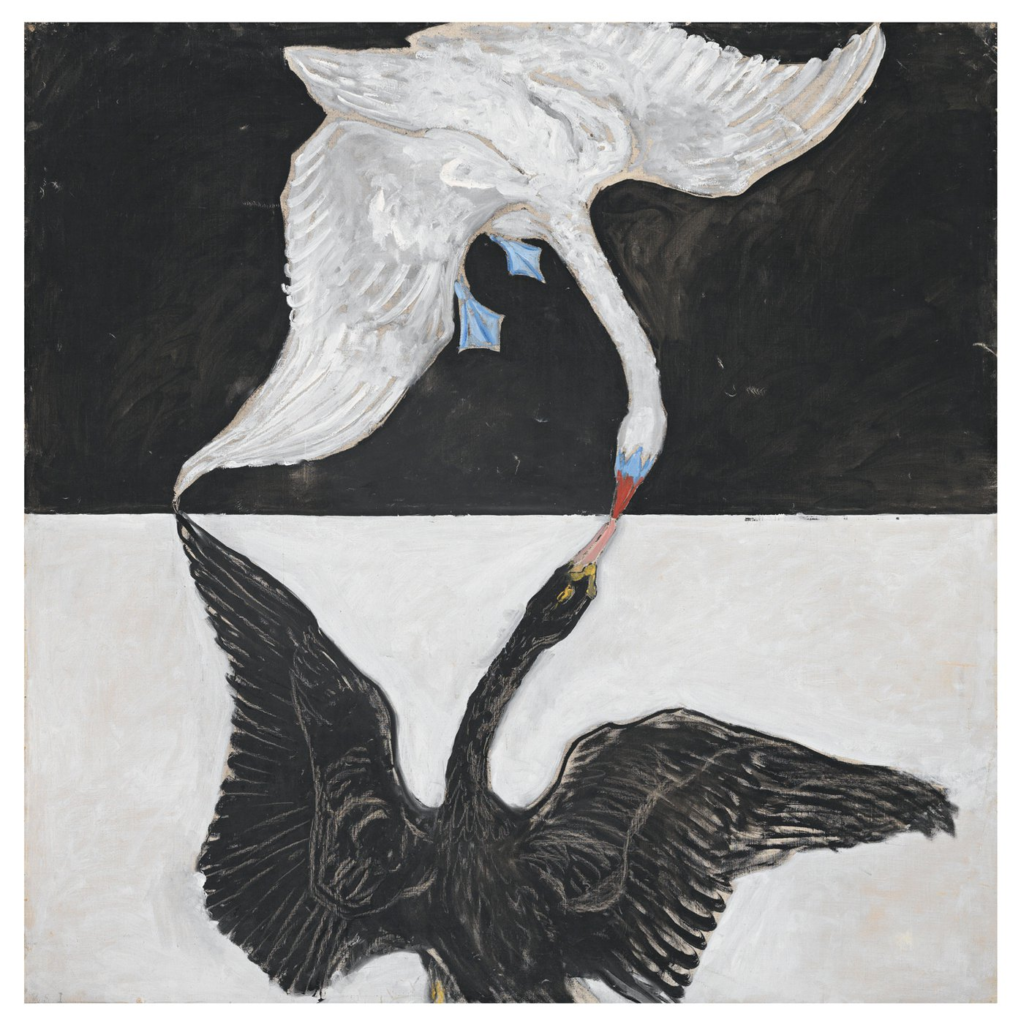
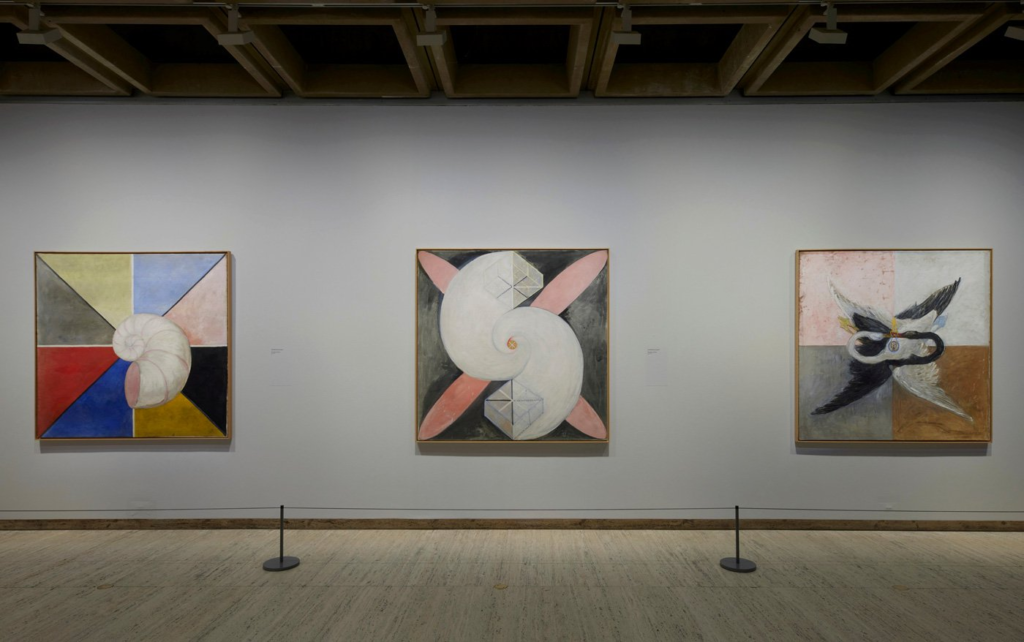
That belief pulses through works like The Swan series. At first glance, the paintings appear deceptively simple: black and white swans mirrored against one another, circles divided into opposing halves, geometric forms balanced in perfect symmetry. But the further one looks, the stranger the paintings become. Dualities repeat everywhere, darkness and light, masculine and feminine, science and spirituality, life and transcendence. The swan becomes less an animal than a symbolic vessel for transformation itself.
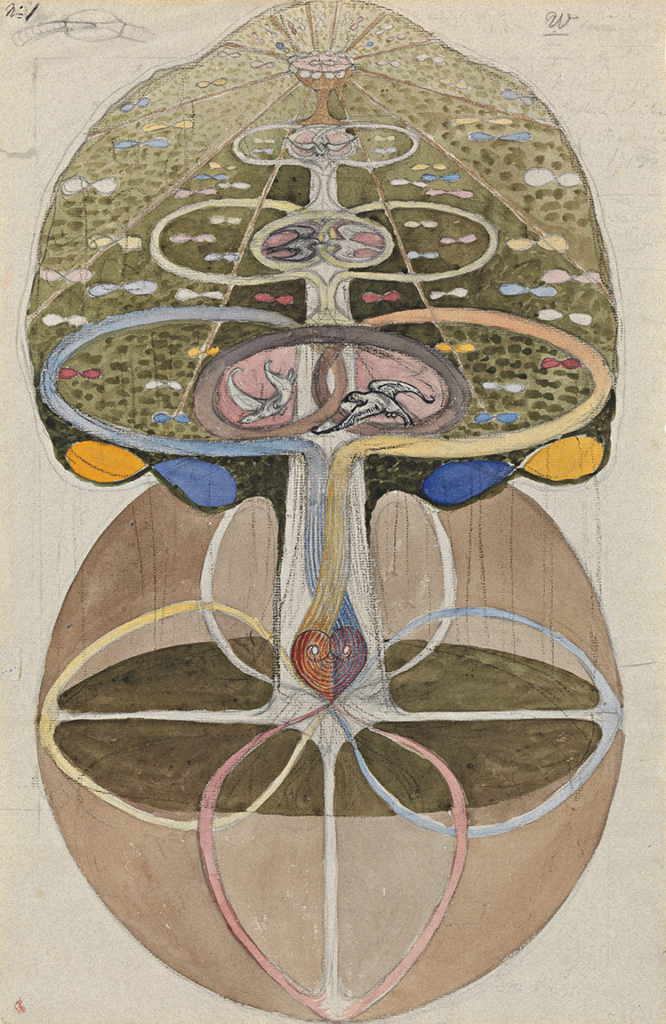
In, Tree of Knowledge, organic forms twist upward like living diagrams. The painting feels suspended between biology and cosmology, as though af Klint were trying to visualize the architecture of thought itself. Across many of her works, spirals recur obsessively, symbols of growth, evolution, ascension, and spiritual movement. Nothing is static. Everything appears to be unfolding.
What makes these paintings remarkable is not simply that they arrived before abstract art became historically recognized. It is that they still resist easy categorization now. They do not fully belong to Symbolism, Surrealism, abstraction, or religious art. They exist somewhere between systems: scientific and mystical, controlled and intuitive, ancient and futuristic all at once.
Even today, standing before her paintings can feel strangely disorienting. Not because they seem old, but because they do not. Their floating geometries and coded symbols resemble contemporary visual languages, digital diagrams, cosmic maps, and speculative design systems, despite being created more than a hundred years ago.
Hilma af Klint was not painting the visible world.
She was painting what she believed existed underneath it.
The Paintings for the Temple
In 1906, during one of her spiritual sessions, Hilma af Klint claimed she received an extraordinary commission, not from a collector, patron, or institution, but from what she described as a higher spiritual force. She was instructed to create a body of work for a temple that did not yet exist.
The result would consume nearly a decade of her life.
Known collectively as Paintings for the Temple, the project eventually grew into 193 works unlike anything being created in Europe at the time. Monumental in scale and astonishing in ambition, the series was conceived not as decoration, but as a spiritual system, a visual language intended to guide viewers toward higher consciousness and deeper understanding.
Af Klint imagined these paintings displayed inside a spiral-shaped temple where visitors would ascend gradually through the works, moving physically and spiritually at the same time. The idea feels almost impossible to separate now from the Solomon R. Guggenheim Museum decades later, where her paintings would eventually be exhibited inside Frank Lloyd Wright’s spiraling rotunda, as though the architecture had been waiting for them all along.
At the center of the series stands The Ten Largest, perhaps the most emotionally overwhelming works af Klint ever created. Painted in 1907 when the artist was in her forties, the canvases are enormous, nearly ten feet tall and vibrate with blooming forms, looping lines, floating letters, and translucent colors that seem to hover between dream and diagram.
Each painting represents a stage of human life: childhood, youth, adulthood, and old age. But there is nothing literal about them. Instead of bodies or scenes, af Klint visualizes existence itself as movement and energy. Pink petals expand into spirals. Orange forms pulse against lavender backgrounds. Shapes multiply like cells under a microscope. Looking at the paintings feels less like reading symbolism and more like stepping into consciousness while it is still forming.
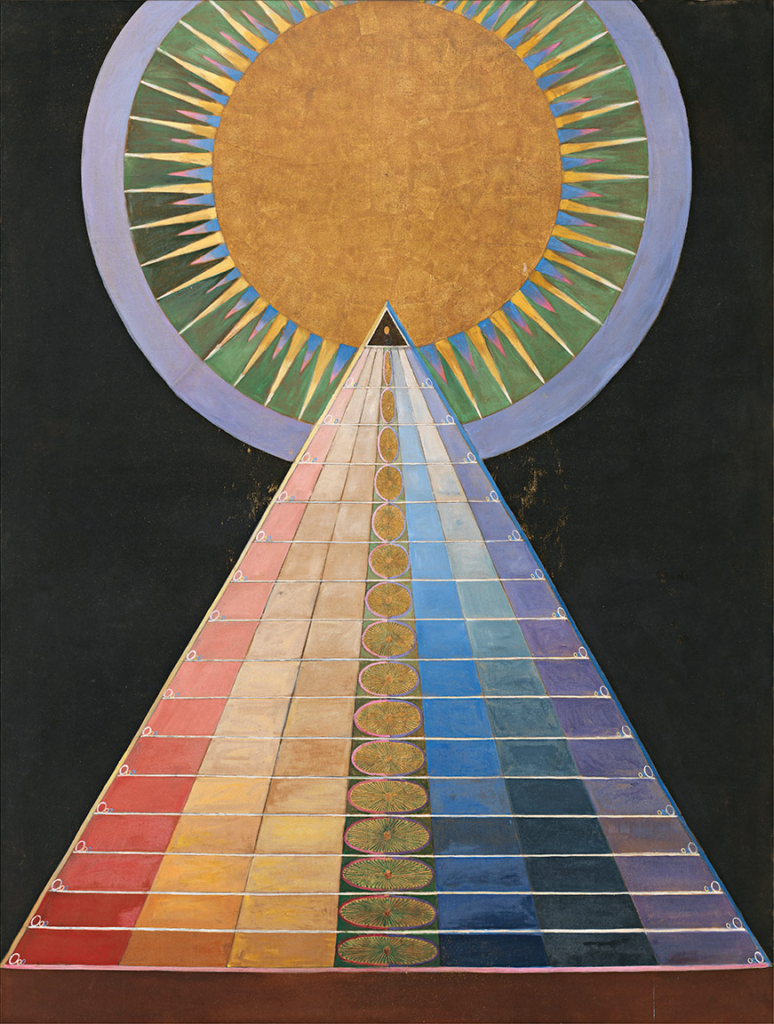
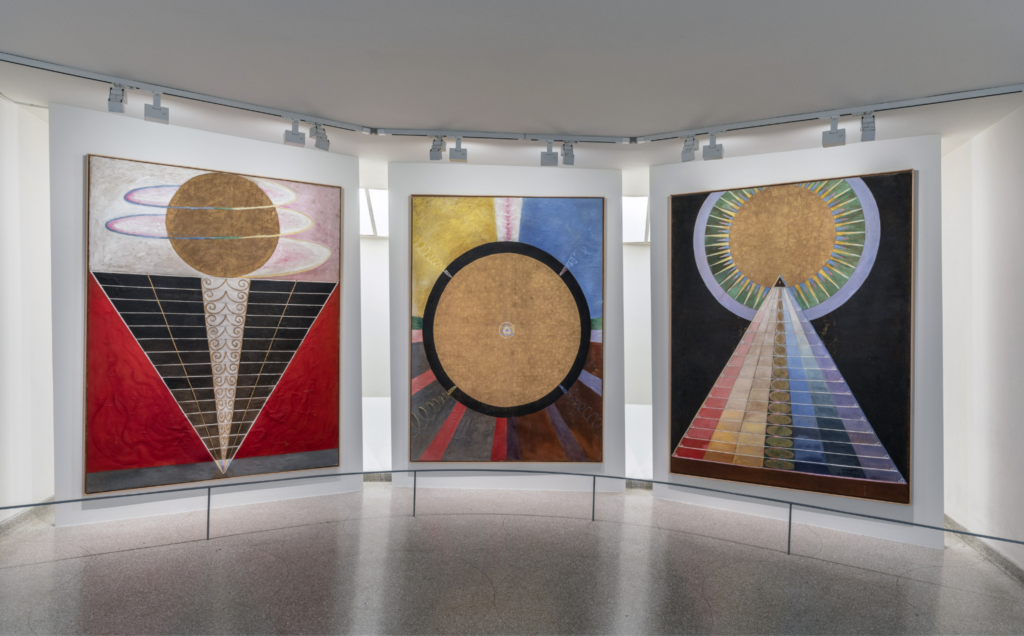
Nearby within the same spiritual universe are the Altarpieces, among the most architecturally striking works in the series. In Altarpiece No. 1, geometric triangles rise upward through concentric circles and fields of gold, black, and violet. The composition feels ceremonial, almost sacred, yet impossibly modern. It resembles a portal as much as a painting, a structure designed for ascension rather than observation.
Again and again, af Klint returned to recurring visual codes:
spirals, swans, seeds, flowers, suns, divided circles, mirrored forms. These symbols were not decorative motifs. They formed an interconnected system through which she attempted to map spiritual evolution, duality, balance, and the unseen structures linking human existence to the cosmos.
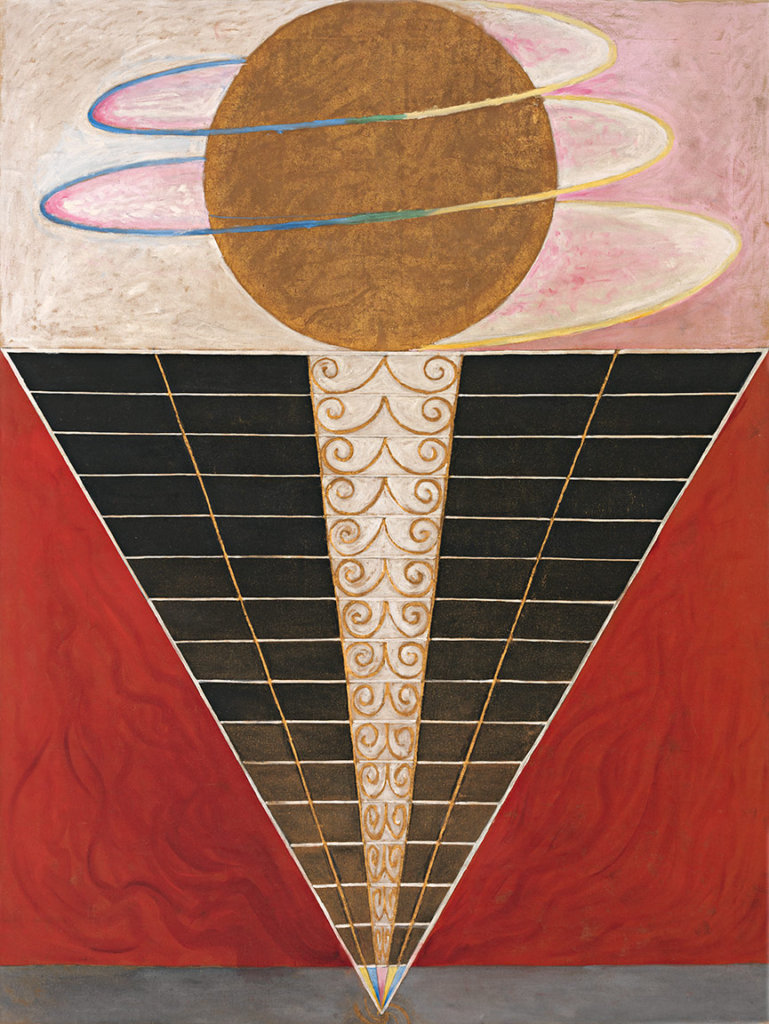
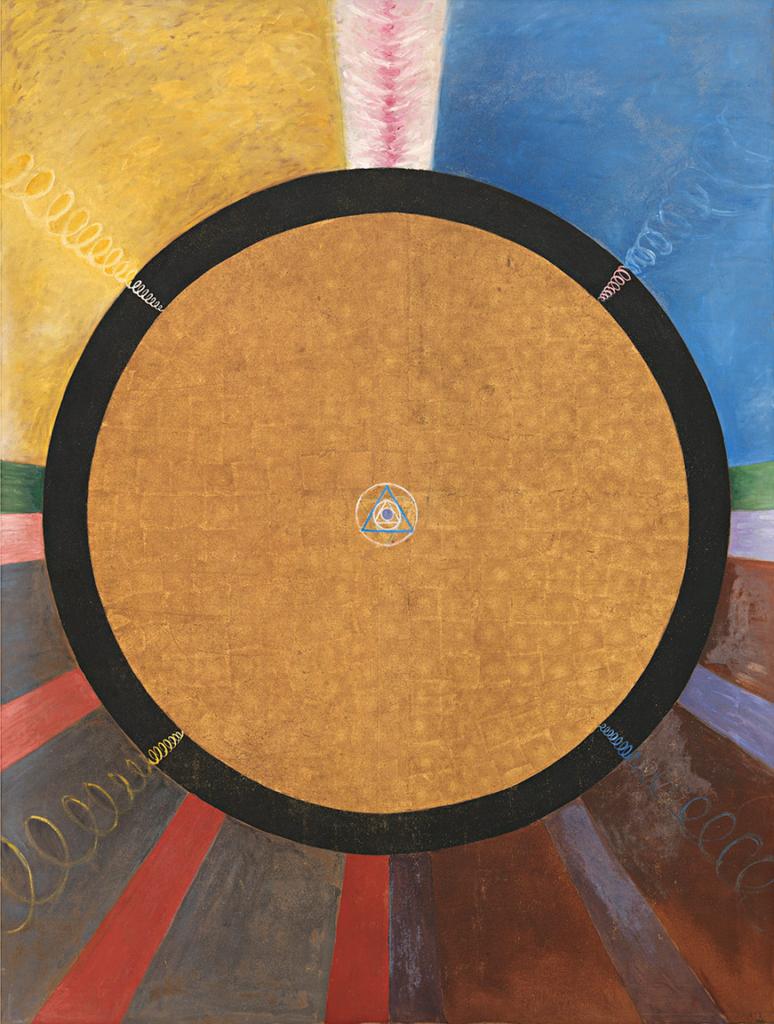
What makes Paintings for the Temple so astonishing is not only their scale or originality, but their certainty. Af Klint painted with the conviction of someone documenting knowledge rather than inventing fantasy. There is very little hesitation in the work. The paintings feel purposeful, almost inevitable, as though she believed the images already existed somewhere and she had merely been chosen to reveal them.
And perhaps that is why the series still feels difficult to fully explain.
The paintings do not ask to be understood immediately.
They ask to be entered.
Why She Hid the Paintings From the World
For all the scale and confidence of Hilma af Klint’s work, almost none of it was shown publicly during her lifetime.
She exhibited conventional paintings occasionally and maintained a professional career as a trained artist, but the vast spiritual universe she was constructing in private remained largely unseen. The most radical works, the abstractions, diagrams, symbols, and monumental canvases that would later transform modern art history, stayed hidden inside her studio, stacked away from public view like messages waiting for a future recipient.
Before her death in 1944, af Klint left behind a strict instruction: her paintings were not to be shown for at least twenty years.
The decision has become one of the most haunting details in her story. It suggests an artist who understood, with startling clarity, just how distant her work was from the world around her. Whether she feared ridicule, misunderstanding, or outright dismissal is impossible to fully know. But again and again, her notebooks reveal someone deeply aware that her paintings belonged to a different intellectual and spiritual climate than the one she inhabited.
And perhaps she was right.
Early twentieth-century Europe had little space for work like hers. Even abstraction itself was still struggling for legitimacy, often dismissed as incomprehensible or dangerous. For a woman artist creating spiritually charged, nonrepresentational paintings outside the dominant artistic circles of Paris and Germany, recognition would have been even more unlikely.
But af Klint’s isolation was not only cultural, it was philosophical.
Much of modern art history was later shaped around ideas of artistic individualism and formal innovation: the heroic avant-garde artist breaking conventions through originality alone. Af Klint’s worldview complicated that narrative entirely. She did not always describe the paintings as expressions of personal genius. Instead, she often wrote about guidance, transmission, and receiving knowledge from forces beyond herself.
That made her difficult to categorize.
Too mystical for strict modernism.
Too abstract for traditional spiritual art.
Too early for the history that came after her.
And so the paintings remained silent.
For decades, more than a thousand works and hundreds of notebooks stayed carefully preserved by her family, hidden from the larger art world. During that time, the official story of abstraction continued solidifying without her name in it. Kandinsky, Mondrian, and Malevich became permanent fixtures in museums, textbooks, and academic histories while af Klint’s vast archive waited in darkness.
There is something almost eerie about that delay now.
Because the paintings themselves seem obsessed with time, evolution, transformation, spiritual progression, unseen futures. Again and again, af Klint painted spirals that moved upward, forms that expanded outward, symbols caught in states of becoming rather than completion.
It is difficult not to wonder whether she imagined her work traveling forward beyond her own lifetime.
Not hidden out of fear alone.
But preserved with the hope that someday, somewhere, the world would finally know how to read it.
When the Future Finally Arrived
When Hilma af Klint died in 1944, she left behind more than 1,000 paintings and an enormous collection of notebooks filled with sketches, symbols, spiritual observations, and meticulous diagrams. The archive was unlike anything else in twentieth-century art, not only because of its scale, but because it seemed to emerge from an entirely different timeline.
And for decades, almost nobody saw it.
The paintings remained largely untouched by the mainstream art world throughout the mid-century period when modernism hardened into official history. Museums canonized the familiar pioneers of abstraction. Movements were organized neatly into timelines and manifestos. Entire generations learned that abstract art began with a handful of male artists in the early twentieth century.
Meanwhile, hidden in Stockholm, was a woman who had already painted vast nonrepresentational worlds years earlier.
It was not until the 1980s that Hilma af Klint’s work began slowly entering public consciousness through exhibitions focused on spiritual and abstract art. Even then, the response was cautious. Her paintings unsettled traditional art historical categories. Critics struggled to decide where to place her. Was she a mystic? An outsider artist? A spiritual medium? A proto-modernist?
The question itself revealed the problem.
Hilma af Klint did not fit neatly into the story art history had already written.
But once the paintings began appearing publicly, their power became impossible to ignore. Viewers encountered works that felt startlingly contemporary despite having been created decades earlier. The colors seemed alive. The geometry felt futuristic. The symbolism appeared strangely relevant in a world increasingly fascinated by psychology, consciousness, systems, energy, and the unseen structures shaping human existence.
Then came the exhibition that changed everything.
In 2018, the Solomon R. Guggenheim Museum in New York opened Hilma af Klint: Paintings for the Future, a retrospective that would become one of the museum’s most visited exhibitions ever. Visitors moved upward through Frank Lloyd Wright’s spiraling rotunda surrounded by af Klint’s monumental paintings, a setting so uncannily aligned with her original vision for a spiral temple that it felt almost prophetic.
The exhibition did more than introduce audiences to a forgotten artist.
It destabilized one of modern art’s foundational myths.
Suddenly, the accepted timeline of abstraction no longer felt complete. Scholars, critics, and museums began reassessing long-standing assumptions about who shaped modernism, whose contributions had been minimized, and how many other histories remained hidden beneath official narratives.
Yet what made audiences connect so deeply with af Klint’s work was not only historical correction.
It was the feeling of encountering paintings that still seemed ahead of us.
Even now, her work resists full explanation. The symbols remain partially coded. The spiritual systems remain open-ended. Her paintings continue to oscillate between science and mysticism, order and intuition, revelation and secrecy.
Perhaps that is why they feel so contemporary.
Hilma af Klint was never simply painting abstraction.
She was painting the possibility that there are realities we still do not fully understand.
Why Hilma af Klint Feels So Modern Now
There is something strangely difficult about placing Hilma af Klint in the past.
Even after learning the dates, even after seeing “1906” attached to the paintings, the mind resists it. Her work feels too contemporary, too visually aligned with the language of the present. The floating geometries resemble digital interfaces. Her diagrams evoke scientific mapping systems, microscopic organisms, celestial charts, psychological blueprints. The paintings seem to exist somewhere between art, data, spirituality, and speculative design.
More than a century later, the world may finally have the visual vocabulary to meet her where she was.
That shift matters.
When af Klint was painting, Western culture was still largely divided between science and spirituality, logic and mysticism, material reality and invisible belief systems. Her work refused those separations entirely. She moved fluidly between botanical observation, sacred symbolism, mathematics, religion, philosophy, and esoteric thought, treating them not as contradictions but as interconnected languages attempting to explain the same mysteries.
Today, that way of thinking feels unexpectedly familiar.
Contemporary culture is once again fascinated by consciousness, invisible systems, cosmic imagery, psychology, energy, ritual, and the search for meaning beyond purely material explanations of existence. Artists, designers, filmmakers, and even technology companies increasingly rely on abstract visual systems that resemble the symbolic structures af Klint painted decades earlier.
And perhaps this is why younger audiences often respond to her work so emotionally.
The paintings do not feel trapped in history.
They feel alive inside the present.
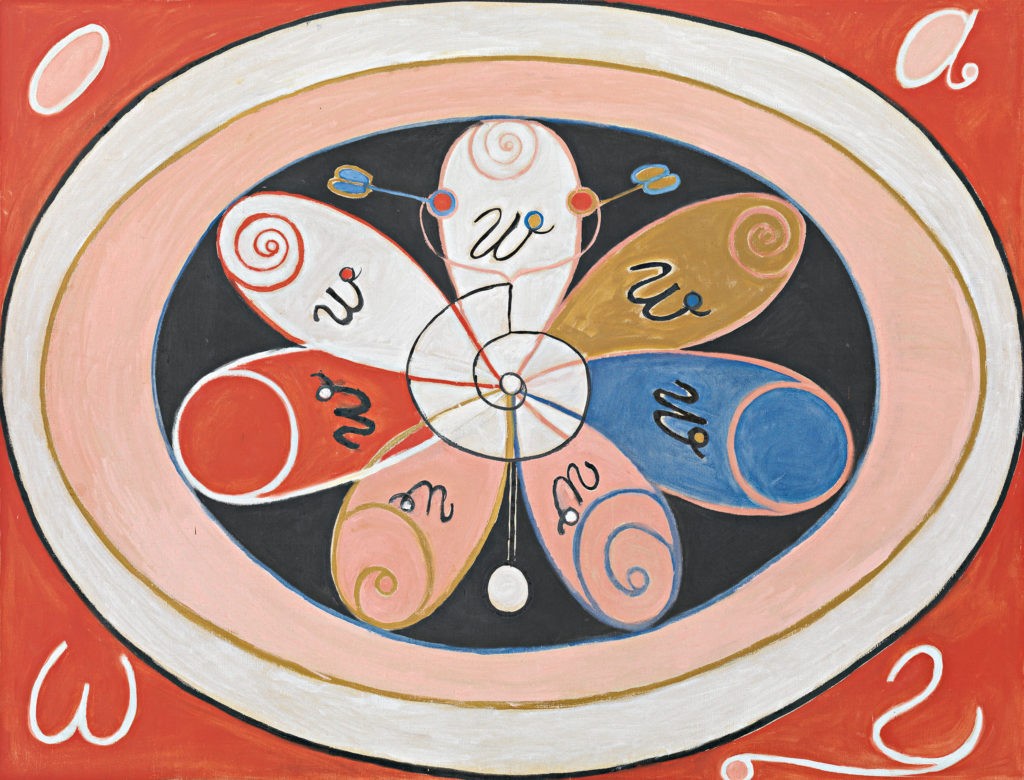
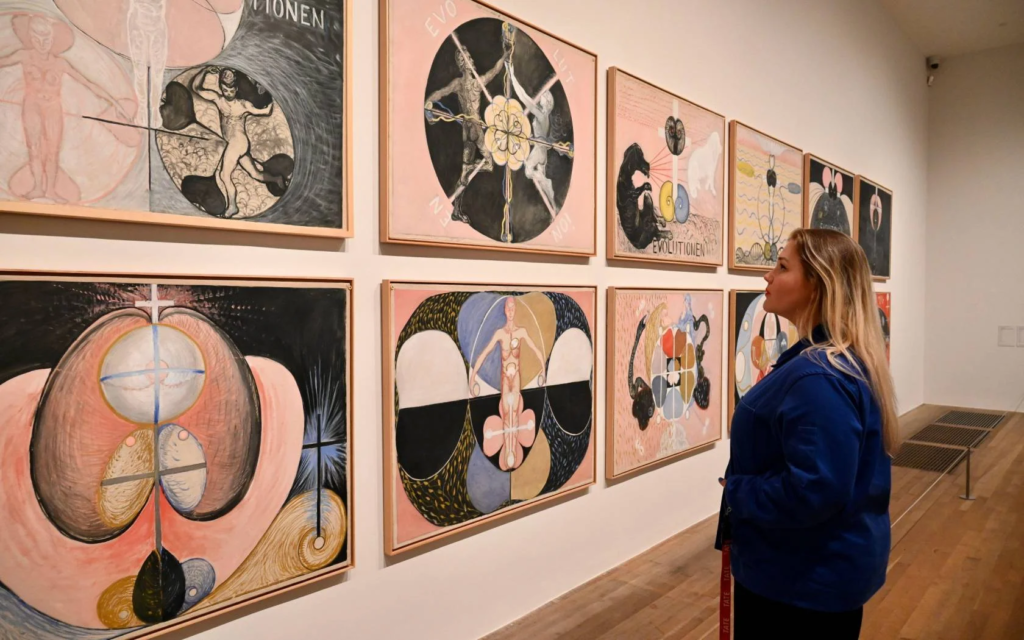
Works like Evolution and Group X, No. 1, Altarpiece continue to radiate an unsettling sense of possibility. Their spirals and geometric ascensions seem less interested in certainty than transformation itself. Nothing in af Klint’s universe is fixed. Forms evolve constantly. Boundaries dissolve. Opposites merge into one another. Human existence appears as part of a larger cosmic cycle still unfolding beyond comprehension.
Even the scale of her paintings contributes to this feeling. Standing before them is physical, immersive, almost architectural. The viewer does not simply observe the work from a distance; they enter into its symbolic atmosphere. That experience feels remarkably aligned with how contemporary audiences engage with installation art and immersive exhibitions today.
But perhaps the most modern thing about Hilma af Klint is not her style.
It is her relationship with time.
In an era obsessed with immediate visibility, instant recognition, and relentless exposure, af Klint created thousands of works she believed the world might not understand during her lifetime. There is something almost unimaginable about that patience now, the willingness to make ambitious, uncompromising work without the promise of validation.
She trusted the future more than the present.
And against all odds, the future eventually answered back.
Works like Evolution and Group X, No. 1, Altarpiece continue to radiate an unsettling sense of possibility. Their spirals and geometric ascensions seem less interested in certainty than transformation itself. Nothing in af Klint’s universe is fixed. Forms evolve constantly. Boundaries dissolve. Opposites merge into one another. Human existence appears as part of a larger cosmic cycle still unfolding beyond comprehension.
Hilma af Klint spent years painting a future she would never live to see.
Inside her studio, far from the centers of European modernism, she created vast spiritual landscapes filled with spirals, coded symbols, evolving forms, and invisible architectures. She imagined paintings as portals rather than objects, tools capable of revealing realities hidden beneath ordinary perception. And while the twentieth century rushed forward building its official story of modern art, her work remained sealed away in silence.
For decades, history moved on without her.
But the paintings endured.
Today, standing before works like The Ten Largest or the luminous Altarpieces, it becomes difficult to think of Hilma af Klint simply as a “forgotten artist” rediscovered by museums. The scale of her vision feels much larger than that. Her work does not merely revise the timeline of abstraction; it challenges the way artistic progress itself is understood. It asks whether some ideas arrive too early for the cultures meant to receive them and whether art sometimes requires time itself to become legible.
There is something deeply moving about that possibility.
Hilma af Klint never saw crowded retrospectives dedicated to her work. She never watched thousands of viewers ascend the spiral halls of the Guggenheim surrounded by paintings she once believed humanity was not ready to understand. She never witnessed the art world slowly rewriting its histories around the questions her work forced into view.
And yet, in many ways, she seemed to anticipate all of it.
Not with certainty, but with faith.
Faith that somewhere in the future, someone would look at these strange, radiant paintings and finally see what she had seen all along.
Perhaps that is why her work still feels so powerful now.
The paintings do not feel trapped in the past.
They feel as though they have been waiting for us.
And maybe that is the strangest part of Hilma af Klint’s story, not that she painted the future, but that the future eventually learned how to see her.
What do you think: was Hilma af Klint truly ahead of her time, or was the world simply too slow to understand her?
Many of Hilma af Klint’s works found their audience through museums that helped reshape her legacy. If you’re inspired to discover more extraordinary cultural spaces, explore our list of the world’s most beautiful must-see museums: most beautiful must-see museums