




How Do You Paint Something That Never Stops Moving? 7 Famous Dance Paintings

Dance is one of the most beautiful forms of human expression, and one of the most fleeting. A leap lasts only a second, a twirl disappears as quickly as it begins, and the rhythm that fills a room fades the moment the music stops. Unlike sculpture or architecture, dance leaves behind no physical trace. It exists only in motion, making it one of the greatest challenges any artist can attempt to capture. That’s precisely why famous dance paintings continue to fascinate us, they preserve moments that were never meant to stand still.
Yet for centuries, painters have embraced that challenge. Armed with nothing more than pigment, brush, and canvas, they have found remarkable ways to make movement feel alive. A swirl of fabric, the curve of an outstretched arm, the space between two joined hands, or the dramatic play of light across a stage can suggest an entire performance. The greatest dance paintings don’t simply show people dancing, they allow us to imagine the music, feel the rhythm, and step into the emotion of the moment.
Across cultures, dance has carried many meanings. It has been a joyful celebration in the streets of Paris, a demanding discipline inside ballet studios, a symbol of national pride in Mexico, an expression of divine love in India, and a path to spiritual transcendence in Sufi traditions. Artists have turned these fleeting moments into enduring masterpieces, preserving not just choreography but the stories, beliefs, and communities that gave those dances meaning.
The seven famous dance paintings in this list span more than four centuries and several continents, yet they share a common achievement: each captures something that should have been impossible to preserve. Together, they prove that while a dance may end, great art has the power to keep it moving forever.
1. The Dance (1910) — Henri Matisse

What does pure joy look like? Henri Matisse answered that question with five dancing figures, three bold colors, and one of the most celebrated paintings of the twentieth century. The Dance is strikingly simple, yet impossible to forget. Five nude figures join hands in a circle, moving across a rolling green hill beneath a brilliant blue sky. There are no elaborate details or dramatic setting, only rhythm, movement, and human connection.
Painted in 1910 for Russian collector Sergei Shchukin, The Dance marked a defining moment in modern art. Matisse abandoned realism in favor of expressive color and simplified forms, believing that emotion mattered more than perfect representation. The vivid red-orange bodies stand out against the blue and green landscape, creating a visual rhythm that almost feels musical. Look closely, and you’ll notice one pair of hands nearly touching but not quite meeting, adding a subtle sense of movement and anticipation, as though the dance is continuing beyond the canvas.
Inspired by the universal tradition of circle dances, Matisse transformed an everyday act into a timeless symbol of freedom, unity, and shared humanity. More than a century later, The Dance remains one of art history’s most powerful reminders that movement doesn’t need realism to feel alive, it simply needs emotion.
2. The Dance Class (1874) — Edgar Degas

The magic of ballet doesn’t begin under the spotlight, it begins in the rehearsal studio. That quiet, often overlooked world fascinated Edgar Degas more than the performance itself. Rather than painting polished productions, he captured the discipline, exhaustion, and fleeting moments that audiences rarely witnessed.
In The Dance Class, a group of young ballerinas gathers around the renowned ballet master Jules Perrot after what appears to be a long rehearsal. While one dancer practices her steps, others stretch, adjust their costumes, chat, or simply rest. These unscripted moments make the painting feel remarkably modern, as if we’ve stepped into the room unnoticed. Degas’ unusual composition, with figures scattered naturally across the canvas, creates the impression of a candid snapshot rather than a staged scene.
Painted in 1874, the work reflects Degas’ lifelong fascination with movement and the Paris Opéra Ballet. He visited rehearsals frequently, studying posture, balance, and gesture with almost scientific precision. Yet his paintings were never just technical studies. They reveal the physical effort hidden behind every graceful performance, reminding viewers that elegance is earned through relentless practice.
Today, The Dance Class remains one of the defining images of ballet in Western art. More than a painting of dancers, it is a tribute to dedication, the countless unseen hours that transform hard work into effortless beauty on stage.
3. Dance at Le Moulin de la Galette (1876) — Pierre-Auguste Renoir

Long before dance clubs and music festivals, there was the Moulin de la Galette, a lively open-air dance garden in the heart of Montmartre where Parisians gathered to escape the routines of everyday life. It was a place filled with music, laughter, conversation, and spontaneous dancing, and no artist captured its vibrant spirit quite like Pierre-Auguste Renoir.
Painted in 1876, Dance at Le Moulin de la Galette is considered one of the greatest masterpieces of Impressionism. Rather than focusing on a single dancer, Renoir immerses viewers in an entire afternoon of celebration. Couples sway beneath the dappled sunlight filtering through the trees, friends gather around café tables, and every corner of the canvas seems alive with movement. His loose brushstrokes and shimmering light create the impression that the scene is unfolding in real time, inviting us to become part of the crowd.
More than a depiction of dance, the painting celebrates the simple pleasures of modern life. Renoir was fascinated by ordinary people enjoying extraordinary moments, and here he transforms a neighborhood gathering into something timeless. Every smiling face, flowing dress, and graceful turn reflects the optimism of Paris during the late nineteenth century.
Nearly 150 years later, Dance at Le Moulin de la Galette still feels wonderfully alive, reminding us that sometimes the most memorable dances happen not on grand stages, but among friends beneath an open sky.
4. El Jaleo (1882) — John Singer Sargent

Some paintings ask to be admired. El Jaleo demands to be experienced. Even in complete silence, you can almost hear the rhythmic clapping, the strum of guitars, and the sharp stomp of a flamenco dancer commanding the room.
Inspired by his travels through southern Spain, John Singer Sargent painted El Jaleo after witnessing the passion and theatricality of Spanish dance. At the center of the composition, a flamenco performer takes the spotlight, her white dress dramatically illuminated against a shadowy interior. Musicians and spectators line the background, encouraging her performance with music and applause, while her elongated shadow stretches across the wall, becoming almost as expressive as the dancer herself.
What makes this painting so captivating is Sargent’s masterful use of light and movement. Broad, energetic brushstrokes make the swirling fabric appear almost weightless, while the stark contrast between light and darkness heightens the drama. Rather than depicting a single dance step, Sargent captures the emotion and intensity that define flamenco, its pride, passion, and raw energy.
Today, El Jaleo is regarded as one of the most compelling representations of Spanish culture in nineteenth-century art. More than a performance, it captures the electricity of a moment when music, movement, and emotion become impossible to separate, leaving viewers feeling as though they’ve witnessed the dance firsthand.
5. Dance of Tehuantepec (1928) — Diego Rivera
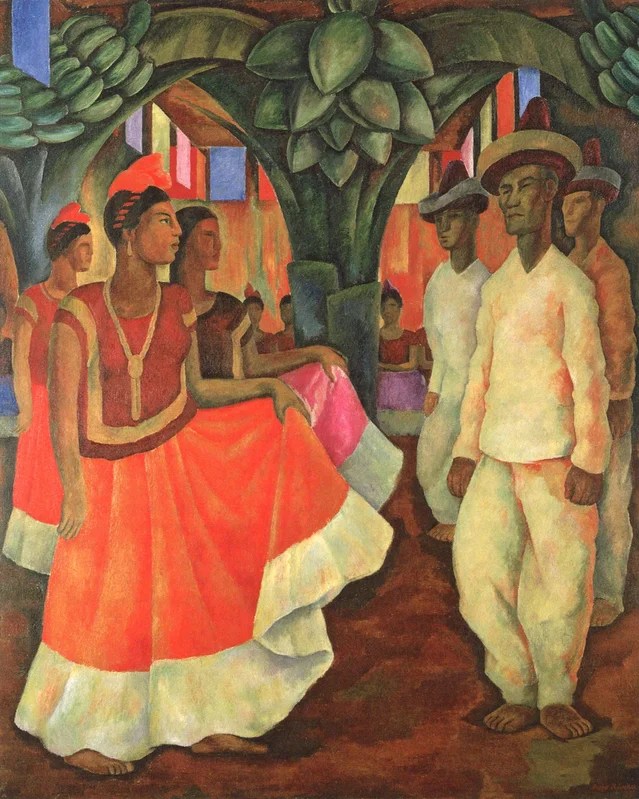
For Diego Rivera, dance was more than entertainment, it was a celebration of identity. In Dance of Tehuantepec, he transforms a traditional Mexican folk dance into a powerful tribute to the people, customs, and cultural pride of Oaxaca. Rather than focusing on individual performers, Rivera presents dance as something shared, passed down through generations, and deeply woven into everyday life.
Painted in 1928, the monumental canvas depicts the Zandunga, a beloved dance from the Isthmus of Tehuantepec in southern Mexico. Women dressed in richly embroidered huipiles dance alongside men in crisp white cotton clothing and wide-brimmed straw hats, surrounded by lush banana trees. The vibrant oranges, greens, and whites create a striking visual harmony, while the carefully arranged figures give the scene a sense of rhythm without relying on dramatic movement.
Unlike the fluid energy of Impressionist paintings, Rivera’s dancers appear grounded and monumental. Their solid forms reflect his belief that ordinary people were the true heroes of Mexican history. Every costume, gesture, and expression celebrates local traditions with dignity and pride.
More than a colorful festival scene, Dance of Tehuantepec captures the soul of a community. Rivera reminds us that dance is not only an art form, it is a living expression of heritage, memory, and the enduring spirit of a people.
6. Dance of Love (Rasa Lila) (c. 1840) — Indian Miniature Painting
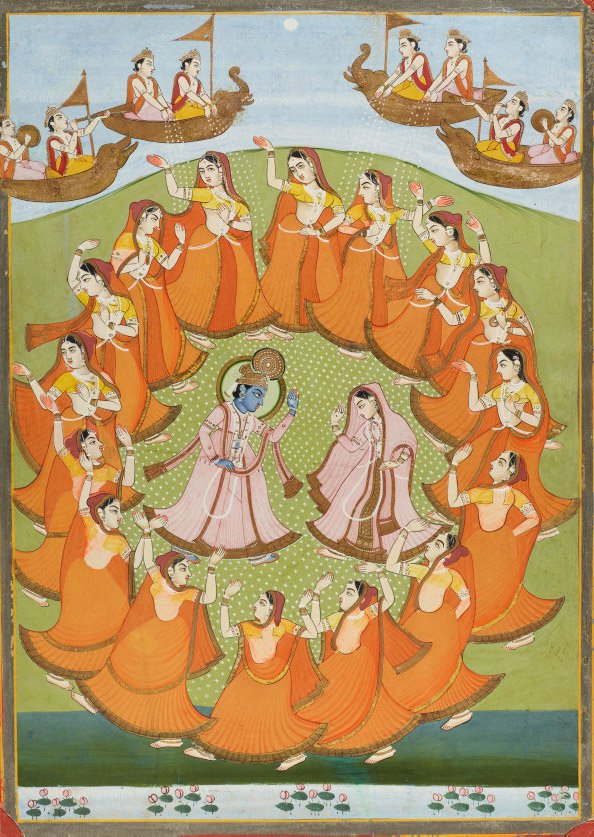
Not every dance is performed for an audience. Some are believed to transcend time itself. The Rasa Lila, often translated as the “Dance of Divine Love,” is one of the most celebrated stories in Hindu tradition, where dance becomes an expression of devotion rather than performance.
This nineteenth-century Indian miniature painting depicts Lord Krishna, instantly recognizable by his blue skin, dancing with Radha, his eternal companion, while surrounded by the gopis, the milkmaids who were irresistibly drawn to the sound of his flute. According to Hindu mythology, this sacred dance unfolded on a single moonlit night that stretched into eternity, symbolizing the boundless nature of divine love. Every graceful pose and carefully arranged figure reflects harmony, balance, and spiritual connection rather than theatrical spectacle.
Unlike many Western depictions of dance that emphasize realism and movement, Indian miniature paintings rely on symbolism, vibrant colors, and intricate details to convey emotion. Here, every element, from the circular composition to the luminous garments, invites viewers into a world where the physical and the divine exist together.
More than a beautiful work of art, Dance of Love (Rasa Lila) reminds us that dance has long been a sacred language. In this timeless scene, movement becomes prayer, music becomes devotion, and every step is an act of love shared between humanity and the divine.
7. Sufi Dance (1523–1524) — Shaykhzada

Some dances aren’t meant to entertain, they’re meant to transform. Long before dance became a theatrical performance, it served as a path to spiritual awakening in many cultures. Few artworks capture this idea as beautifully as Sufi Dance, a sixteenth-century Persian miniature by Shaykhzada.
Created between 1523 and 1524 for an illuminated manuscript of the Persian poet Hafiz, the painting depicts a gathering of whirling dervishes performing the Sama, a sacred ritual practiced within Sufism. At the center, dancers spin gracefully with outstretched arms, their flowing robes echoing the circular motion of their bodies. Around them, musicians play flutes and tambourines while other participants kneel, collapse, or gaze upward in moments of profound spiritual ecstasy. Every figure tells a different story, revealing the emotional and physical intensity of the ritual.
Unlike dance performed for an audience, the Sama is an inward journey. Each turn symbolizes the soul’s search for union with the divine, making movement itself an act of meditation. Shaykhzada captures this invisible experience through delicate brushwork, balanced composition, and expressive gestures that guide the viewer’s eye across the page.
As the oldest work on this list, Sufi Dance offers a powerful reminder that dance has always been more than movement. Across centuries and cultures, it has served as celebration, storytelling, and, perhaps most profoundly, a bridge between the earthly and the spiritual.
Every dance eventually comes to an end. The music fades, the performers leave the stage, and the moment becomes a memory. Yet these artists achieved something extraordinary, they found a way to preserve movement in a medium that never moves. Through bold colors, expressive brushstrokes, and masterful composition, they transformed fleeting performances into timeless works of art that continue to captivate viewers centuries later.
From the joyful circle of Henri Matisse’s The Dance to the spiritual devotion of Shaykhzada’s Sufi Dance, these masterpieces remind us that dance is much more than choreography. It is celebration, discipline, identity, love, faith, and human connection, all expressed without words.
Perhaps that’s why these paintings continue to resonate today. Even in complete silence, they invite us to imagine the music, feel the rhythm, and step into the story they tell.
Which dance would you choose to be part of?
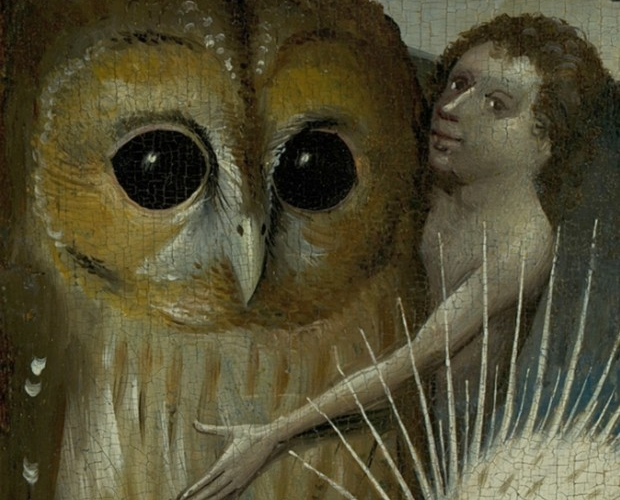
Before you go, here’s another art mystery worth exploring. Discover why owls appear again and again in the surreal world of Hieronymus Bosch—and what they may have meant. Read the article here: https://artstoheartsproject.com/hieronymus-boschs-owls/