





The Secret Life of Hieronymus Bosch’s Owls
At first, you probably won’t notice them.
Your eyes will be drawn to the monsters, the impossible creatures, the surreal landscapes, and the scenes of heaven, temptation, and hell that have made Hieronymus Bosch one of history’s most fascinating artists. But look a little longer, and another figure begins to emerge from the chaos. An owl peers out from the hollow of a tree. Another watches from the heart of paradise. One hides among a crowd surrounding Christ, while another quietly overlooks humanity’s descent into greed.
Once you spot Hieronymus Bosch’s owls, they’re everywhere.
Unlike the mythical beasts and grotesque hybrids that fill his paintings, these birds are rendered with striking realism, making them feel oddly out of place, and perhaps even more unsettling. During Bosch’s lifetime in the late fifteenth and early sixteenth centuries, owls carried meanings far more complicated than the modern symbol of wisdom. They could represent spiritual blindness, secrecy, temptation, hidden knowledge, or even the lurking presence of evil. Bosch embraced that ambiguity, weaving owls into his works so subtly that they often reveal themselves only to the most attentive viewers.
Whether they serve as silent witnesses, moral warnings, or symbols of mysteries that can never fully be explained, Bosch’s owls continue to captivate art historians more than five centuries later. Their unblinking eyes seem to follow every scene, and every viewer, inviting us to question not only what we’re looking at, but what they might be looking at in return.
In these five remarkable works, we’ll trace the haunting journey of Bosch’s most mysterious recurring character and explore why these quiet birds remain some of the most unforgettable figures in the history of art.
1. The Garden of Earthly Delights (c. 1490–1510): The Owl Hidden at the Center of Paradise

Few paintings invite as much scrutiny as The Garden of Earthly Delights. At first glance, Hieronymus Bosch’s monumental triptych seems to celebrate an impossible world filled with oversized fruit, fantastical animals, and countless human figures indulging in earthly pleasures. But look more closely, and a quieter, stranger presence begins to emerge. Hidden among the chaos are several owls, still, observant, and impossible to ignore once you’ve spotted them. Rather than blending into the landscape, they seem to watch both the people inside the painting and us standing outside it.
The most striking owl appears inside the Fountain of Life in the left panel, a place that represents Eden before humanity’s fall. Its placement has puzzled historians for centuries. Why would a creature so often linked to darkness occupy the very heart of paradise? In medieval Christian symbolism, owls were far more ambiguous than they are today. While classical traditions associated them with wisdom, Bosch’s contemporaries frequently viewed them as creatures of the night, symbols of spiritual blindness, temptation, hidden evil, or those who preferred darkness over divine light. Positioned within Eden itself, the owl suggests that the seeds of humanity’s downfall may have been present long before Adam and Eve took the forbidden fruit.

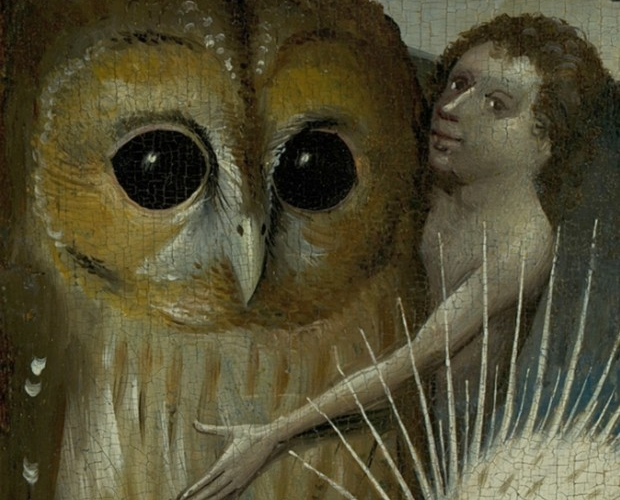
Bosch doesn’t stop there. Another owl appears embraced by a human figure in the central panel, while yet another perches atop a curious egg-like structure amid scenes of indulgence and excess. These repeated appearances create a visual thread running through the painting, connecting innocence, temptation, and moral decay. Unlike the humans around them, who are distracted by pleasure, curiosity, or desire, the owls remain eerily calm. They never participate. They simply observe.
That silent gaze is what makes Bosch’s owls so unsettling. They don’t behave like ordinary birds hidden in a landscape; they feel like deliberate witnesses placed throughout the composition. Their realism makes them even more uncanny. Surrounded by impossible creatures and surreal inventions, the owls look almost ordinary, as though they belong to our world rather than Bosch’s imagination. Perhaps that’s precisely why they draw the eye. In a painting where nearly everything is fantastical, the most mysterious figures are the ones that seem entirely real.
More than five centuries later, scholars still debate exactly what these owls were meant to signify. Were they warnings against sin? Symbols of hidden knowledge? Emblems of spiritual blindness? Or did Bosch intentionally leave their meaning unresolved? Whatever the answer, The Garden of Earthly Delights proves one thing: once you notice Bosch’s owls, the painting is never quite the same again. Suddenly, paradise no longer feels entirely safe, it feels watched.
2. The Haywain Triptych (c. 1512–1516): The Only Creature That Notices Humanity’s Greed

If The Garden of Earthly Delights introduces Bosch’s owls as mysterious observers, The Haywain Triptych reveals what they may have been watching all along. At the center of the painting, an enormous wagon piled high with hay rolls across the landscape as crowds of people scramble, fight, steal, and even kill to claim a handful of it. The hay itself symbolizes worldly possessions, temporary riches that everyone desperately chases despite their inevitable worthlessness. Kings, peasants, clergy, and merchants are all caught in the same frantic pursuit, blinded by greed as the wagon moves steadily toward Hell.
Amid this whirlwind of human obsession sits an owl.
Perched quietly within the haystack, it doesn’t compete for the treasure surrounding it. It doesn’t flee the chaos or interfere with it. Instead, it simply watches. The placement is so subtle that many viewers overlook it on their first encounter with the painting. Yet once found, the owl becomes impossible to ignore. It transforms from a hidden detail into one of the work’s most unsettling presences.
Bosch was a master of visual irony, and this tiny bird may be one of his sharpest observations. While nearly every human figure in the painting is consumed by earthly desire, the owl remains detached, almost as if it understands the futility of the spectacle unfolding below. Nearby, an angel prays earnestly atop the haywain, appealing to heaven, while Christ appears high above the scene, witnessing humanity’s moral collapse. Most of the figures are too distracted to notice either. The owl, however, seems perfectly aware.
Its role has sparked countless interpretations. Some scholars view it as a symbol of spiritual blindness, suggesting that it belongs among the sinners whose desires have clouded their judgment. Others argue that Bosch uses the owl as a silent moral witness, exposing humanity’s inability to recognize its own folly. Rather than offering a clear answer, Bosch leaves the bird suspended between these possibilities, inviting viewers to question whether it represents wisdom, corruption, or something even more elusive.
What makes this owl especially memorable is its composure. In a painting overflowing with movement, conflict, and noise, it remains utterly still. That stillness creates tension. It feels less like an animal inhabiting the landscape and more like a patient observer recording every selfish act without passing judgment.
Perhaps that is Bosch’s greatest trick. The owl never points a finger, never warns the figures rushing toward their downfall, and never attempts to change the course of events. It simply watches as humanity destroys itself. And in doing so, it quietly asks the uncomfortable question at the heart of The Haywain: if someone can clearly see where greed leads, why does no one choose a different path?
3. Ecce Homo (c. 1475–1485): The Silent Witness to Christ’s Suffering

Among all of Hieronymus Bosch’s hidden owls, the one in Ecce Homo is perhaps the easiest to miss, and that may be exactly the point. The painting depicts one of the most emotionally charged moments in Christian tradition: Christ, crowned with thorns and presented before the crowd before his crucifixion. Faces press together in anger, curiosity, and mockery as the scene unfolds. Every eye appears fixed on Christ. Every voice seems to join the deafening crowd.
Almost every eye.
Tucked inside a small arched opening in the brick wall beside the scene is an owl, peering quietly from the shadows. It doesn’t call attention to itself, nor does Bosch offer any visual clues that it deserves special notice. Many viewers spend years admiring the painting without ever spotting it. Yet once discovered, the owl changes the emotional rhythm of the composition. It becomes another spectator, one who watches with an unsettling calm while the rest of humanity loses itself in noise and judgment.
Its location is no accident. Hidden in darkness yet facing outward, the owl seems to occupy a space between the painting and the viewer. Unlike the crowd, it does not jeer or condemn. Unlike Christ, it does not suffer. It simply observes. The effect is strangely intimate, almost as though Bosch has placed a silent witness there to ensure that nothing escapes notice, not the cruelty of the mob, nor the choices of the individuals within it.
For audiences in Bosch’s time, the owl would likely have carried associations far removed from today’s image of wisdom. Medieval viewers often linked the bird with spiritual darkness, deception, or those who turned away from divine truth. Seen through that lens, the owl’s presence adds another layer to the painting. It becomes a reminder that blindness is not always physical. The people surrounding Christ believe they understand what they are witnessing, yet many fail to recognize the very figure they claim to judge.
What makes this tiny detail so remarkable is Bosch’s restraint. There are no fantastical monsters, grotesque hybrids, or impossible landscapes competing for attention here. The owl doesn’t dominate the composition, it lingers at its edge, rewarding only the most attentive viewers. Its power lies in its quietness. Bosch trusted that the smallest details could carry the deepest meanings, and nowhere is that more evident than in this nearly hidden bird.
Perhaps that’s why the owl feels so haunting. It doesn’t simply witness Christ’s suffering—it witnesses ours as well. Every viewer who eventually notices it becomes part of the same exchange of glances, caught between observing the painting and realizing that, somehow, the painting has been observing them all along.
4. The Trees Have Ears and the Field Has Eyes (c. 1500): When an Owl Becomes a Warning

Not all of Hieronymus Bosch’s owls are hidden inside sprawling visions of heaven and hell. In one of his most enigmatic drawings, The Trees Have Ears and the Field Has Eyes, the owl steps into the spotlight, and the result is more unsettling than any demon Bosch ever painted.
At first glance, the drawing feels almost surreal. A pair of enormous ears rises from the trunks of trees, while watchful eyes emerge from the landscape itself. At the center of this strange world sits a large owl nestled inside the hollow of a dead tree, staring directly outward. Unlike Bosch’s paintings, where the bird is often tucked away as a detail, here it becomes impossible to ignore. It is the visual anchor of an image built entirely around the unsettling idea of being watched.
The title comes from an old Dutch proverb, suggesting that secrets are never as hidden as we believe. Bosch reinforces that idea with a Latin inscription above the drawing: “Poor is the mind that always uses the invention of others and invents nothing itself.” Together, the words and imagery encourage viewers to think carefully about perception, originality, and the consequences of carelessness. The owl, positioned within the hollow of a lifeless tree, becomes the silent guardian of these ideas, observing without speaking, knowing without revealing.
Its setting is just as significant as the bird itself. The dead tree creates an atmosphere of decay, while the exaggerated ears and eyes transform the landscape into something almost sentient. Nature no longer feels passive; it listens, watches, and remembers. In this uncanny environment, the owl appears less like an ordinary bird and more like a keeper of hidden truths. Whether it represents wisdom, secrecy, or moral judgment remains deliberately uncertain, but its unwavering gaze suggests that nothing escapes its notice.
What makes this drawing particularly fascinating is how little Bosch relies on spectacle. There are no scenes of torment, no armies of monsters, and no elaborate religious narratives. Instead, he creates unease through suggestion alone. The impossible ears, the watchful eyes, and the motionless owl work together to evoke a feeling that lingers long after you’ve looked away. It’s psychological rather than dramatic, a quiet reminder that the most unsettling fears often come not from what we see, but from the suspicion that someone, or something, is seeing us.
More than five hundred years later, The Trees Have Ears and the Field Has Eyes still feels surprisingly modern. It speaks to timeless anxieties about surveillance, privacy, and hidden observation, all conveyed through one unforgettable owl. In Bosch’s hands, the bird is no longer just a symbol, it becomes the embodiment of a question that refuses to go away: what if you’ve never truly been alone?
5. The Owl’s Nest (c. 1505–1516): Bosch’s Quietest Owl Is His Most Unsettling

After wandering through Bosch’s crowded visions of paradise, greed, and judgment, The Owl’s Nest feels almost disarmingly simple. There are no monstrous hybrids, no apocalyptic landscapes, and no sinners rushing toward their fate. Instead, Bosch presents a close view of a gnarled tree, where three owls rest among twisting branches while a vast landscape stretches peacefully into the distance.
And yet, somehow, this may be his eeriest owl of all.
Unlike many of Bosch’s surviving drawings, The Owl’s Nest was not created as a preparatory sketch for a painting. It stands as an independent work of art, allowing the artist to focus entirely on a subject that had quietly followed him throughout his career. Here, the owl is no longer hidden in the corner of a composition or tucked among dozens of symbolic details. It takes center stage, inviting viewers to confront the bird without distraction.
The realism is striking. Bosch renders the bark, tangled branches, feathers, and surrounding birds with remarkable precision, grounding the scene firmly in the natural world. But beneath that realism lies an unmistakable tension. The tree itself appears ancient and weathered, its twisted limbs forming almost skeletal shapes that frame the owls like guardians of an unknown secret. Nothing dramatic is happening, yet the atmosphere feels charged with expectation, as though the silence itself is part of the story.
Art historians have long debated whether the drawing carries the same symbolic weight as the owls in Bosch’s paintings. It may represent vigilance, hidden wisdom, or the darker associations that medieval audiences often attached to the bird. Equally possible is that Bosch simply remained fascinated by the owl as a creature that naturally occupies the boundary between light and darkness, emerging when the world grows quiet and disappearing before dawn. Rather than offering an answer, the drawing preserves that ambiguity, allowing the owl to remain an enigma.
What makes The Owl’s Nest such a compelling conclusion to Bosch’s lifelong fascination is its restraint. Throughout his paintings, the owl is surrounded by moral lessons, biblical stories, and surreal spectacles. Here, all of that falls away. There is only the bird, the tree, and an unsettling stillness that encourages viewers to look longer than they normally would. The longer you stare, the more the scene begins to feel less like a peaceful study of nature and more like a silent encounter with something ancient and unknowable.
Perhaps that’s the secret of Bosch’s owls. They were never meant to provide clear answers or tidy symbols. They exist to slow us down, to make us question what we think we’re seeing, and to remind us that the greatest mysteries in art are often the ones that never explain themselves. Long after the monsters fade from memory, it is the owl’s unblinking gaze that stays with us.

For an artist celebrated for painting demons, monsters, and visions of hell, it’s remarkable that one of Hieronymus Bosch’s most enduring mysteries isn’t a fantastical creature at all, it’s an ordinary owl.
Across his paintings and drawings, the bird appears again and again, sometimes hidden in plain sight, sometimes placed at the very center of the story. It watches paradise before humanity’s fall, observes greed without intervening, silently witnesses Christ’s suffering, guards cryptic warnings, and finally stands alone in a quiet nest that feels just as unsettling as Bosch’s most nightmarish scenes. Whether these owls symbolized spiritual blindness, secret knowledge, moral vigilance, or something entirely personal to the artist, Bosch never offered a single explanation—and perhaps that is precisely why they continue to fascinate us.
More than five hundred years later, viewers are still searching for the meaning behind those unblinking eyes. Every new interpretation adds another layer to the mystery without ever solving it completely. In a world overflowing with bizarre creatures and elaborate symbolism, Bosch’s owls remind us that sometimes the most ordinary figure can become the most haunting.
Now we’re curious: Did you ever notice Bosch’s owls before reading this article?
If you’re fascinated by the mysteries surrounding great artists, don’t stop here. Take a closer look at how Vincent van Gogh’s extraordinary life has been brought to the screen in our roundup of the best films and TV shows inspired by the artist: Best Vincent van Gogh Films and TV Shows.


