





These 8 Paintings Prove Crime Has Always Inspired Art
Picture a detective arriving at a crime scene. The room is silent. The victim is gone. The suspects have disappeared. All that’s left behind are clues waiting to be noticed.
Now imagine that the crime scene has remained untouched, not for days or years, but for centuries.
Long before crime scene photography, forensic science, or binge-worthy true crime documentaries, artists were documenting humanity’s darkest moments on canvas. Murders, assassinations, elaborate scams, political violence, and betrayals became more than historical events; they became visual stories filled with evidence, symbolism, and unanswered questions. Every brushstroke captured not just what happened, but how it felt to stand in the aftermath.
Some of these artworks were inspired by real crimes that changed the course of history. Others imagined moments so convincing they feel like eyewitness accounts. Some served as political statements, while others quietly explored the psychology of guilt, fear, deception, and justice. Yet they all have one thing in common: they invite us to investigate rather than simply observe.
Unlike a photograph, a painting doesn’t freeze a single moment, it asks you to look closer. Why is the murderer so calm? Why does the victim trust the wrong person? Who is watching from the shadows? Which tiny detail changes the entire story? The longer you spend with these works, the more they begin to resemble unsolved case files, revealing new clues with every glance.
What’s remarkable is that many of these masterpieces were created hundreds of years before modern detective fiction even existed. Artists like Caravaggio, Magritte, Bellini, David, and Warhol understood something timeless about human nature: we’re endlessly fascinated by crime not because we celebrate violence, but because every crime raises questions that demand answers. Who was guilty? Who was innocent? Could the outcome have been different? And what does the crime reveal about the world in which it happened?
The eight artworks in this list don’t simply depict violence. They capture deception, revenge, political conflict, social injustice, religious persecution, and the fragile line between right and wrong and prove that crime has always Inspired art. Some portray real murders that shaped history, while others expose quieter crimes hidden in plain sight. Together, they remind us that art has always done more than preserve beauty, it has preserved humanity’s darkest stories, inviting each generation to look again and ask what really happened.
1. The Menaced Assassin by René Magritte (1927)
A Murderer Who Doesn’t Know He’s About to Be Caught

Imagine walking into a room moments after a murder.
The victim lies motionless on a chaise longue. A gramophone still plays nearby, as if nothing has interrupted the afternoon. Standing just a few feet away is the killer, calmly packing his belongings and listening to the music. Outside the windows, silent figures watch. Behind him, two men wait in ambush, one gripping a club and the other holding what looks like a net. The murderer has no idea that every move is being observed.
It sounds like the opening scene of a psychological thriller, but it was painted nearly a century ago.
That unsettling tension is exactly what René Magritte captures in The Menaced Assassin, one of Surrealism’s most enigmatic masterpieces. Created in 1927, the painting freezes an impossible moment between crime and consequence. Nothing moves, yet everything feels seconds away from happening. Unlike traditional depictions of violence, Magritte never shows the murder itself. Instead, he traps us in the eerie silence that follows, where the air is thick with unanswered questions.
At first glance, the composition seems straightforward: a dead woman, an unsuspecting killer, and officers preparing to arrest him. But the longer you look, the stranger it becomes. Who are the men peering through the windows? How long have they been watching? Why hasn’t anyone intervened? And perhaps the most unsettling question of all: why is the murderer so astonishingly calm?
Magritte deliberately leaves these mysteries unresolved. Rather than offering a clear narrative, he invites viewers to become investigators, piecing together a story from visual clues alone. The painting feels less like a solved case and more like evidence spread across a detective’s desk.
One of the most remarkable aspects of the work is its theatrical staging. Every figure appears frozen, almost as if actors have paused mid-performance. The symmetry of the composition heightens the tension, while the everyday objects, the gramophone, the coat, the open suitcase, make the extraordinary scene feel disturbingly ordinary. The contrast between domestic normalcy and violent crime creates an uncanny atmosphere that has become one of Magritte’s signatures.
Many art historians see The Menaced Assassin as an exploration of voyeurism, surveillance, and the uneasy relationship between observer and participant. The hidden figures are not merely witnesses; they become part of the drama. In turn, so do we. As viewers, we stand just outside the scene, silently watching events unfold without the ability to intervene. The painting subtly asks whether observing violence makes us passive spectators or unwilling accomplices.
Created during the rise of Surrealism, the work also reflects the movement’s fascination with dreams, psychology, and the unconscious mind. Instead of presenting crime as a straightforward act of guilt and punishment, Magritte transforms it into a puzzle where logic begins to dissolve. Every answer seems to generate another question.
Nearly a hundred years later, The Menaced Assassin continues to captivate audiences because it refuses to explain itself. In an age obsessed with detective novels, crime podcasts, and psychological thrillers, it feels astonishingly modern. The painting doesn’t simply depict a crime scene, it recreates the suspense of standing inside one, inviting every viewer to decide what happened before, and what might happen next.
2. The Cardsharps by Michelangelo Merisi da Caravaggio (c. 1594)
The Victim Never Realizes He’s Being Robbed

Not every crime begins with a weapon.
Sometimes, it starts with a smile, a deck of cards, and the illusion of good luck.
A well-dressed young nobleman sits confidently at the card table, convinced he’s in control of the game. Across from him, another player appears equally focused, carefully studying his hand. But just behind the unsuspecting victim, a third figure quietly leans in, peering over his shoulder to reveal every card he holds. Hidden behind the cheater’s back is an extra set of playing cards, ready to be slipped into the game at exactly the right moment.
The theft isn’t about money alone. It’s about trust. And by the time the young man realizes he’s been deceived, the game is already over.
Painted around 1594, The Cardsharps was one of Michelangelo Merisi da Caravaggio’s earliest masterpieces after arriving in Rome. At the time, he was a struggling young artist with little money and no influential patrons. He lived among soldiers, gamblers, laborers, and street hustlers, drawing inspiration not from myths or saints but from the people he encountered every day. Rather than inventing an elaborate tale, Caravaggio painted a scene that many Romans would have instantly recognized, a carefully orchestrated card scam played out in taverns and gambling houses across the city.
The brilliance of the painting lies in how it turns the viewer into the only person who knows the truth.
Look closely, and the clues are impossible to miss. The older cheat cranes his neck to read the victim’s cards while exchanging subtle signals with his partner. The younger swindler grips a hidden stash of cards tucked into the back of his belt, prepared to cheat at precisely the right moment. Their extravagant feathered hats and fashionable clothing may suggest elegance, but their coordinated movements reveal experience. This isn’t an impulsive act of dishonesty; it’s a practiced con.
Meanwhile, the victim remains blissfully unaware. His posture is relaxed, his attention fixed entirely on the game before him. Caravaggio masterfully heightens the tension by allowing us to witness every detail of the deception while denying the young nobleman the same knowledge. We become silent accomplices, powerless to warn him as the trap closes.
What makes The Cardsharps so remarkable is that it captures a different kind of crime, one without bloodshed, yet no less destructive. Fraud, manipulation, and confidence tricks have existed for centuries, and Caravaggio reminds us that the most dangerous criminals are often those who never raise their voices or reveal their intentions.
Today, the painting feels surprisingly contemporary. Whether it’s an online scam, financial fraud, or an elaborate con, the mechanics remain strikingly familiar: someone gains your trust while someone else quietly stacks the odds against you. More than four centuries later, The Cardsharps remains one of art history’s sharpest reminders that the easiest victim is often the one who believes they’re too clever to be fooled.
3. The Death of Marat by Jacques-Louis David (1793)
The Bathtub Assassination That Changed History

The killer didn’t force her way inside.
She was invited in.
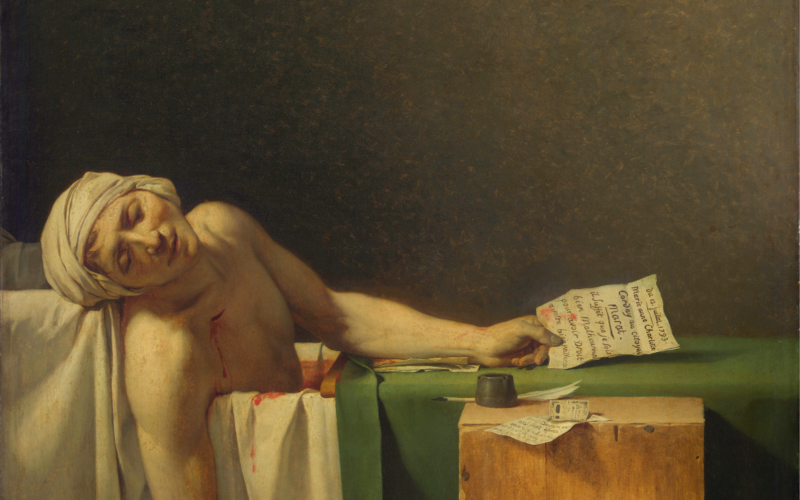
She arrived carrying a letter, claiming she had information that could help save the nation. The man she had come to meet was too ill to leave his bathtub, where he spent hours every day working, writing, and meeting visitors. As he leaned forward to read her note, she pulled out a concealed kitchen knife and drove it into his chest with a single fatal blow.
Within minutes, one of the most infamous political assassinations in history had taken place.
That chilling moment became the subject of The Death of Marat, painted in 1793 by Jacques-Louis David, only months after the murder of revolutionary leader Jean-Paul Marat. More than a historical record, the painting was designed to shape public memory. David, a close friend and devoted supporter of Marat, transformed the bloodstained aftermath of an assassination into one of art history’s most enduring political images.
The real story, however, is far more complicated.
Marat was one of the most influential voices of the French Revolution, using his newspaper to call for harsh measures against those he believed threatened the Revolution. To many supporters, he was a fearless defender of the people. To his critics, he was a dangerous radical whose words fueled violence. His assassin, Charlotte Corday, believed she was preventing further bloodshed by killing him. She did not flee the scene and openly admitted what she had done, insisting she had acted for France rather than out of personal hatred.
David’s painting leaves no room for that debate.
Marat’s body is bathed in soft light, his expression peaceful despite the fatal wound. The knife that ended his life lies discarded on the floor, while Corday’s letter remains clutched in his hand, a devastating reminder of the deception that allowed her to get close. The wooden writing box beside the bathtub doubles as a makeshift desk, emphasizing that Marat was working for the public until his final moments. Every object has been carefully arranged to tell a story, not just of murder, but of sacrifice.
What the painting deliberately omits is just as revealing. There is no sign of Corday, no struggle, no panic, and very little blood. Instead of portraying the chaos of a crime scene, David strips away every distraction to focus entirely on the victim. The result is almost religious in its composition, echoing Renaissance depictions of Christ after the Crucifixion. Marat is presented not simply as a murdered politician but as a martyr whose death demands remembrance.
More than two centuries later, The Death of Marat continues to provoke debate because it exists somewhere between documentation and propaganda. It records a real assassination, yet it also demonstrates how art can influence the way history is remembered. In one carefully composed image, David transformed a crime into a symbol, ensuring that the story of Marat’s death would outlive the Revolution itself.
4. The Murder by Paul Cézanne (c. 1867–1868)
The Painting That Doesn’t Look Like Cézanne at All

If someone showed you this painting without telling you who made it, chances are you wouldn’t guess it was by Paul Cézanne.
There are no quiet landscapes. No carefully arranged apples. No serene views of Mont Sainte-Victoire. Instead, two shadowy figures pin a man to the ground as one raises an arm to strike. The victim twists in desperation, while the dark landscape around them seems to close in, swallowing any hope of escape. It’s raw, violent, and unsettling, more like a nightmare than the work of an artist celebrated for bringing calm and structure to modern painting.
Yet this is one of Cézanne’s earliest masterpieces.
Painted around 1867–1868, The Murder belongs to a period when the young artist was still searching for his voice. Before he became known as the “father of modern art,” Cézanne was creating intensely emotional works filled with exaggerated drama, dark colors, and explosive energy. He had not yet developed the measured style that would later influence generations of artists, including Pablo Picasso and Henri Matisse. Instead, he was exploring the darker corners of human emotion, producing paintings that shocked even his contemporaries.
Unlike many of the crimes in this list, this murder isn’t based on a specific historical event. There are no names, no recorded victim, and no documented investigation. The violence is entirely imagined, which somehow makes it even more unsettling. Without a clear narrative, viewers are left to confront the brutality itself rather than the details surrounding it. Who are these figures? What led to this attack? Is it revenge, desperation, or something else entirely? Cézanne refuses to answer.
The painting’s composition heightens this sense of unease. The figures are locked together in a chaotic struggle, their bodies twisting into angular, almost theatrical poses. Thick, dark brushstrokes create a heavy atmosphere, while the surrounding trees seem less like part of the landscape and more like silent witnesses to the crime. There is no dramatic spotlight, no heroic gesture, and no moral lesson, only a fleeting moment of violence frozen in time.
Many art historians believe The Murder reflects Cézanne’s fascination with the emotional intensity found in the works of Romantic painters such as Eugène Delacroix, whose dramatic compositions often explored conflict and passion. Others see it as evidence of the young artist wrestling with his own frustrations and insecurities during a period of creative uncertainty. While it’s impossible to know Cézanne’s exact intentions, the painting reveals an artist unafraid to confront fear, aggression, and psychological turmoil long before he became associated with order and harmony.
Today, The Murder remains one of the greatest surprises in art history, not because of the crime it depicts, but because of the artist behind it. It reminds us that even the masters we associate with beauty and balance often passed through periods of experimentation, darkness, and emotional upheaval. Sometimes, the most shocking mystery isn’t the crime on the canvas, it’s discovering who painted it.
5. Their First Murder by Arthur Fellig (1941)
The Dead Body Isn’t the Most Chilling Part of This Photograph

You never see the victim.
You don’t see the weapon. You don’t see the blood. You don’t even see the crime scene itself.
Instead, your eyes meet a crowd of children.
Some stand on tiptoe, desperate for a better view. Others grin with excitement. A few stare in stunned silence, trying to process what lies just beyond the edge of the photograph. Their expressions range from curiosity to delight, from confusion to disbelief. Whatever happened is hidden from us, but it’s impossible to ignore the reaction it has sparked.
That decision is exactly what makes Their First Murder one of the most haunting crime photographs ever taken.
Created in 1941 by the legendary street photographer Arthur Fellig, better known by his nickname, Weegee, the image captures a moment shortly after a fatal shooting in New York City. Famous for arriving at crime scenes with uncanny speed, Weegee built his career documenting the city’s after-dark reality. He monitored police radio frequencies, kept his camera in his car, and often reached scenes before investigators had finished securing them. His photographs became synonymous with New York’s gritty underworld, earning him a reputation as one of the greatest crime photographers of the twentieth century.

But unlike many of his other images, Their First Murder isn’t really about murder.
It’s about spectators.
Rather than pointing his camera toward the victim, Weegee turned it toward the crowd. In doing so, he shifted the story from the crime itself to the people witnessing it. The children become the true subjects of the photograph, their faces revealing something deeply human: our instinctive curiosity about the unknown. Some appear thrilled by the excitement unfolding before them, while others seem frozen, perhaps realizing for the first time that death is not something confined to stories or newspapers.
The photograph also raises uncomfortable questions about the role of the observer. Why do people gather around scenes of tragedy? What compels us to look? And where is the line between empathy and fascination? These are questions that feel even more relevant today, in an era where dramatic events spread across social media within minutes and millions watch from behind their screens.
More than eighty years after it was taken, Their First Murder remains unsettling because it quietly shifts the focus away from violence and toward ourselves. The unseen victim may have sparked the gathering, but the lasting image is not of death, it’s of human curiosity. Weegee reminds us that every crime creates not only victims and perpetrators, but also witnesses. And sometimes, the people watching can tell the most revealing story of all.
6. Birmingham Race Riot by Andy Warhol (1964)
The Crime Was Happening in Broad Daylight

Most crimes happen in secret.
This one unfolded in front of cameras.
A young Black protester stands his ground as a police dog lunges toward him. Nearby, officers push back demonstrators with force. There are no masks, no hidden identities, and no attempt to conceal what is happening. The violence is public, documented, and impossible to deny. Yet the image remains deeply unsettling because it asks a difficult question: when those meant to uphold the law become the source of violence, who is the criminal?
That question lies at the heart of Birmingham Race Riot, created by Andy Warhol in 1964. Rather than inventing a scene, Warhol based the work on widely circulated press photographs taken during the 1963 civil rights demonstrations in Birmingham. Protesters, many of them teenagers and young adults, marched peacefully to challenge racial segregation, only to be met with police officers wielding batons, fire hoses, and attack dogs under the orders of Eugene. The shocking images were published around the world and became defining symbols of the Civil Rights Movement.
Warhol’s decision to transform these newspaper photographs into art was both deliberate and provocative. Known for elevating everyday consumer products and celebrity portraits into iconic works, he used the same silkscreen technique here, but instead of soup cans or movie stars, he repeated images of racial violence. The repetition forces viewers to confront the brutality again and again, mirroring the relentless cycle of discrimination and abuse that Black Americans faced during the era.
Unlike many historical paintings of violence, there is no dramatic composition or heroic centerpiece. The image feels detached, almost clinical, precisely because it originated as photojournalism. Yet that emotional distance makes it even more powerful. The repeated figures blur together, suggesting that this was not an isolated incident but part of a much larger pattern. Warhol doesn’t tell us how to feel; he simply refuses to let us look away.
The work also challenges traditional ideas about what constitutes a crime scene. There is no hidden alleyway or mysterious killer waiting in the shadows. Instead, the violence takes place in full public view, carried out by authorities whose actions were legally sanctioned at the time but are now widely recognized as grave violations of human rights. The painting becomes evidence, not just of a single confrontation, but of systemic injustice.
More than sixty years later, Birmingham Race Riot remains one of Warhol’s most politically charged works. It reminds us that art can preserve moments the world might otherwise try to forget and that some of history’s most consequential crimes were never hidden, they simply demanded people willing to acknowledge what they were seeing.
7. The Camden Town Murder Series by Walter Sickert (1908)
The Murder Everyone Thought the Artist Had Committed

What if a painting became part of a murder investigation, not because of what it showed, but because of who painted it?
In the early twentieth century, a series of unsettling paintings depicting cramped London bedrooms, exhausted women, and brooding men sparked rumors that refused to die. There was no knife, no pool of blood, and no dramatic struggle. Instead, there was silence. A woman lay motionless on a bed while a man lingered nearby, his expression unreadable. The room felt heavy with tension, as though something terrible had either just happened, or was about to.
Decades later, wild conspiracy theories would claim that the artist himself, Walter Sickert, was none other than Jack the Ripper.
The truth is far less sensational, and far more interesting.
Sickert painted The Camden Town Murder Series in 1908 after the shocking murder of Emily Dimmock, a young woman whose death in London’s Camden Town became front-page news. Dimmock was found with her throat cut in a modest boarding house, and the case captivated the public. Newspapers covered every development, transforming the tragedy into one of the most talked-about crimes of the era. Although a suspect was arrested, he was ultimately acquitted, and the murder officially remained unsolved.
Rather than recreating the crime itself, Sickert painted what came before and after, the quiet desperation of ordinary lives. His interiors are stripped of glamour. The wallpaper is faded, the furniture sparse, and the figures weighed down by poverty and uncertainty. In paintings such as What Shall We Do for the Rent?, the emphasis isn’t on violence but on the circumstances that often surround it: financial hardship, isolation, and strained relationships. The absence of obvious action forces viewers to imagine the unseen narrative, making the scenes psychologically gripping.
Ironically, it was this ambiguity that fueled later speculation. In the late twentieth century, crime writer Patricia Cornwell controversially argued that Sickert might have been Jack the Ripper, pointing to his fascination with murder and dark subject matter. Art historians and Ripper experts have overwhelmingly rejected these claims, citing a lack of credible evidence and numerous factual inconsistencies. Today, the theory is widely regarded as speculative rather than historical fact.
What makes the Camden Town Murder Series so enduring is not its connection to conspiracy but its humanity. Sickert reminds us that crime doesn’t happen in isolation. Behind every headline are ordinary rooms, ordinary people, and lives shaped by social inequality. His paintings ask us to look beyond the sensational details and consider the quieter realities that often go unnoticed.
More than a century later, these works continue to unsettle viewers, not because they solve a mystery, but because they leave one hanging in the air. Like the greatest psychological thrillers, they prove that sometimes the most haunting crime scene is the one where almost nothing appears to be happening.
8. The Assassination of Saint Peter Martyr by Giovanni Bellini (c. 1507)
A Murder Hidden in One of the Most Beautiful Forests Ever Painted

At first glance, it looks almost peaceful.
Towering trees stretch toward the sky. Sunlight filters gently through the leaves. A quiet woodland path winds into the distance, inviting the viewer deeper into the landscape. It feels like the kind of place where nothing could possibly go wrong.
Then your eyes find the figures.
A man collapses to the ground, his body twisting in agony. Behind him, an attacker swings a weapon with terrifying force, while another accomplice closes in. The serenity of the forest shatters in an instant. Nature remains indifferent as a brutal assassination unfolds beneath its canopy.
That striking contrast is what makes The Assassination of Saint Peter Martyr one of the most haunting depictions of violence in Renaissance art.
Painted around 1507 by Venetian master Giovanni Bellini, the work portrays the final moments of Peter of Verona, a 13th-century Dominican friar and inquisitor. Peter devoted his life to preaching against the Cathars, a religious group that the medieval Church declared heretical. According to historical accounts, while traveling through a forest between Como and Milan in 1252, Peter and a fellow friar were ambushed by hired assassins. Mortally wounded, tradition holds that Peter used his own blood to trace the word Credo (“I believe”) on the ground before dying, an act that cemented his legacy as a martyr. He was canonized less than a year after his death, making him one of the fastest saints ever recognized by the Church.
Bellini chooses not to depict the aftermath but the precise instant when life hangs in the balance. The composition is charged with movement: Peter’s body collapses diagonally across the foreground, his companion flees in panic, and the assassin’s raised arm creates a dramatic arc that draws the eye toward the fatal blow. Yet the surrounding landscape remains astonishingly calm. Birds continue their unseen songs, trees stand unmoved, and the distant hills glow with soft light. This unsettling contrast between natural beauty and human cruelty gives the painting its extraordinary emotional power.
Unlike many Renaissance artists who filled scenes of violence with theatrical gestures and overwhelming spectacle, Bellini relies on restraint. The horror isn’t exaggerated; it’s inevitable. The forest itself becomes a silent witness, emphasizing how acts of violence can erupt even in places that appear untouched by conflict.
More than five centuries later, The Assassination of Saint Peter Martyr still resonates because it speaks to a truth that extends far beyond its religious subject. It reminds us that history’s most consequential crimes often occurred not in grand palaces or crowded city squares, but in ordinary places where no one expected violence to strike. Bellini transforms a medieval assassination into a timeless meditation on faith, mortality, and the fragile boundary between peace and tragedy.


Crime scenes usually fade with time. Evidence disappears, witnesses forget, and history moves on. But in art, the moment is preserved forever.
The eight works in this list remind us that artists have long been fascinated by the same questions that drive today’s true crime stories: What led someone to commit the act? Who held the power? Was justice ever served? And what does this single moment reveal about the society in which it happened? Whether portraying political assassinations, calculated deception, religious persecution, or acts of systemic violence, these artworks do more than document dramatic events, they invite us to examine the human emotions behind them.
Perhaps that’s why they continue to resonate centuries later. We don’t return to these paintings because we admire violence. We return because they challenge us to look closer, question first impressions, and uncover stories hidden beneath the surface. Every expression, every shadow, and every carefully placed detail becomes another piece of the puzzle.
Long before detectives collected fingerprints or cameras documented evidence, artists were preserving humanity’s most complex mysteries with nothing more than paint, light, and imagination. And even today, some of history’s most compelling crime scenes are still hanging quietly on museum walls, waiting for the next curious observer to step a little closer.
Have you heard of any of these artworks before?
If you enjoyed uncovering the darker side of art history, you might also like our exploration of how one artist transformed something as ordinary as rain into unforgettable masterpieces in Kawase Hasui Is Still the Master of Rain.