
This Congolese artist uses raw industrial textile instead of traditional canvas to paint portraits ┃Joan

At Arts to Hearts Project, Art and Woman is one of the publications closest to our hearts. We built it because we felt women artists needed something that was fully theirs. Not a section inside a bigger magazine. Not a token feature during a specific month.
A whole publication dedicated to their work and their voices and how they experience the world through what they create. We are on our third edition now and honestly each one has pushed us further than the last.
For this edition we received submissions from women artists across so many countries and backgrounds and mediums and every batch we opened reminded us why we started this publication in the first place.
But Joan’s know as J.O.A work was different. There was a rawness in it that we had not seen in any of the other submissions. Something real and unpolished and full of life that made us want to know everything about the person behind it.
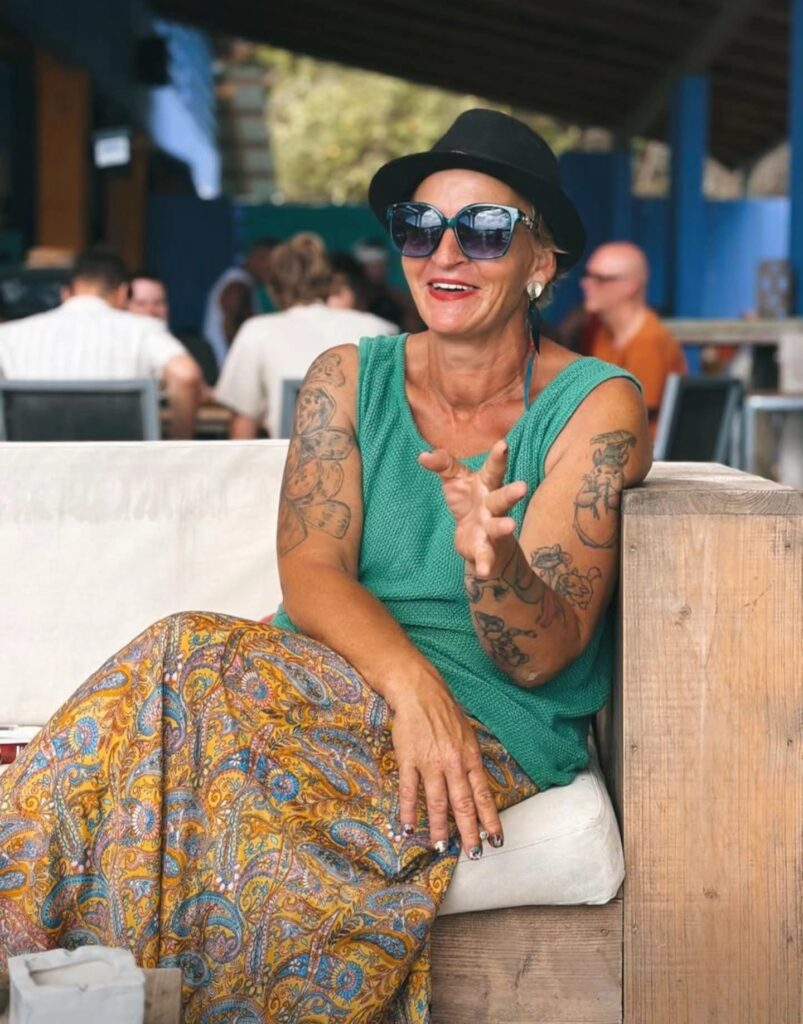
Joan is Congolese. She was born in the Congo and raised in Ecuador and has spent her entire life moving between worlds that do not always understand each other. That constant displacement could have left her feeling lost. Instead, it gave her this extraordinary ability to connect with people no matter where they come from because she has been the outsider in enough rooms to know exactly what that feels like. Every culture she has lived inside has left something in her and all of those layers are in the work.
She paints portraits and murals on a scale that can take up an entire building. But the scale is not the thing that gets to you. The thing that gets to you is how personal and intimate and human these massive paintings still feel.
You are standing in front of a wall-sized face and somehow it feels like a private conversation. How she manages to hold that intimacy at that size is something she talks about during the interview and it is one of those explanations that makes you go oh, of course, that is the only way it could work.
And then there is her material. She does not use canvas. She paints on raw industrial textile that is heavy and rough and imperfect. And the reason she started using it is not some conceptual decision about materiality.
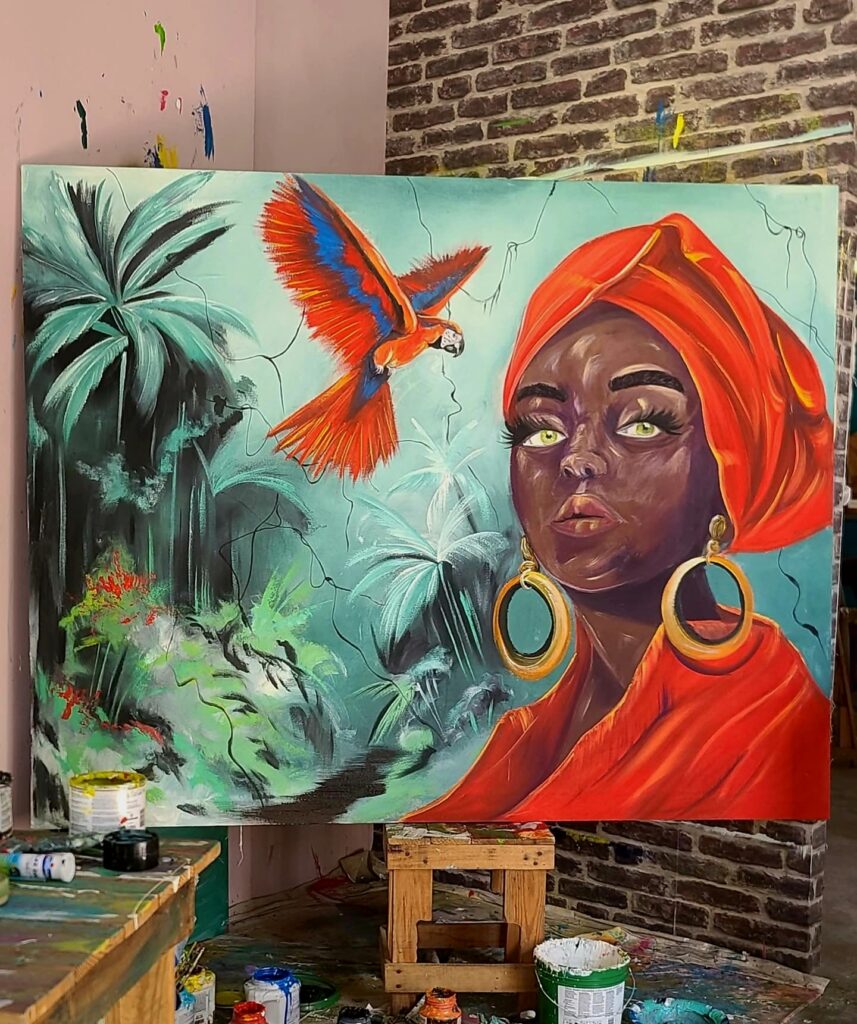
Measuring a massive 189cm x 180cm, this work is an anthem of feminine defiance. Painted on heavy industrial raw cloth, the material itself is a statement—it is rugged, unyielding, and built to endure, much like the spirit of the woman it portrays. There is no delicate vintage history here; there is only the raw, structural weight of the present.
Savage Daughter is a visual rejection of every expectation ever placed upon a woman. It is for those who do not bow down to the narrative of what they “should” be or how they “should” move through the world. In this piece, femininity is reclaimed as something fierce and unapologetic. The vibrant reds and the macaw in flight are symbols of a liberation that cannot be contained by social conditioning.
This is not a decoration; it is a monument to sovereignty. It is for the collector who understands that true power comes from standing at your full height, rooted in your own truth, on a foundation of your own making.
Acrylic on raw industrial textile.
Year 2024
It is a real story from a real moment in her life that we are not going to tell you here because hearing it from her changes how you see every painting she has ever made.
She is a mother and a humanitarian and an animal rights advocate and a rebel against pretty much every box the world has tried to put her in. Her daughter said something to her once that redirected how she sees her entire practice and we are going to let her tell you what that was because the way she describes it is genuinely one of the most moving moments in this edition.
She does not believe femininity is soft or quiet. She does not believe art needs a gallery to be real. She does not believe you need permission to take up space. And her work is the living proof of all three of those beliefs.
Let’s get to know J.O.A through our conversation with her about everything from industrial textile to motherhood to murals to what it means to lead with empathy in a world that keeps telling you to toughen up
Q1. Joan, you describe yourself “a Congolese soul, a global wanderer, and a storyteller.” Tell us about your journey.
I’m a Congolese artist at heart, but my story has never belonged to just one place. I was born in the Congo RDC, grew up in South America — in Ecuador — and spent my life moving between different cultures, languages, and realities. Over time, I became a mix of different cultures myself. For a long time, I felt like I was never fully from here or there — never completely belonging to one world. But at the same time, I found a sense of home in all those cultures together.
That in-between space shaped who I am, both as a person and as an artist. I was raised with strong humanitarian values, and that became a big part of who I am. When I feel something, it goes beyond emotion — it becomes overwhelming, impossible to ignore. I don’t just observe suffering; I absorb it deeply.
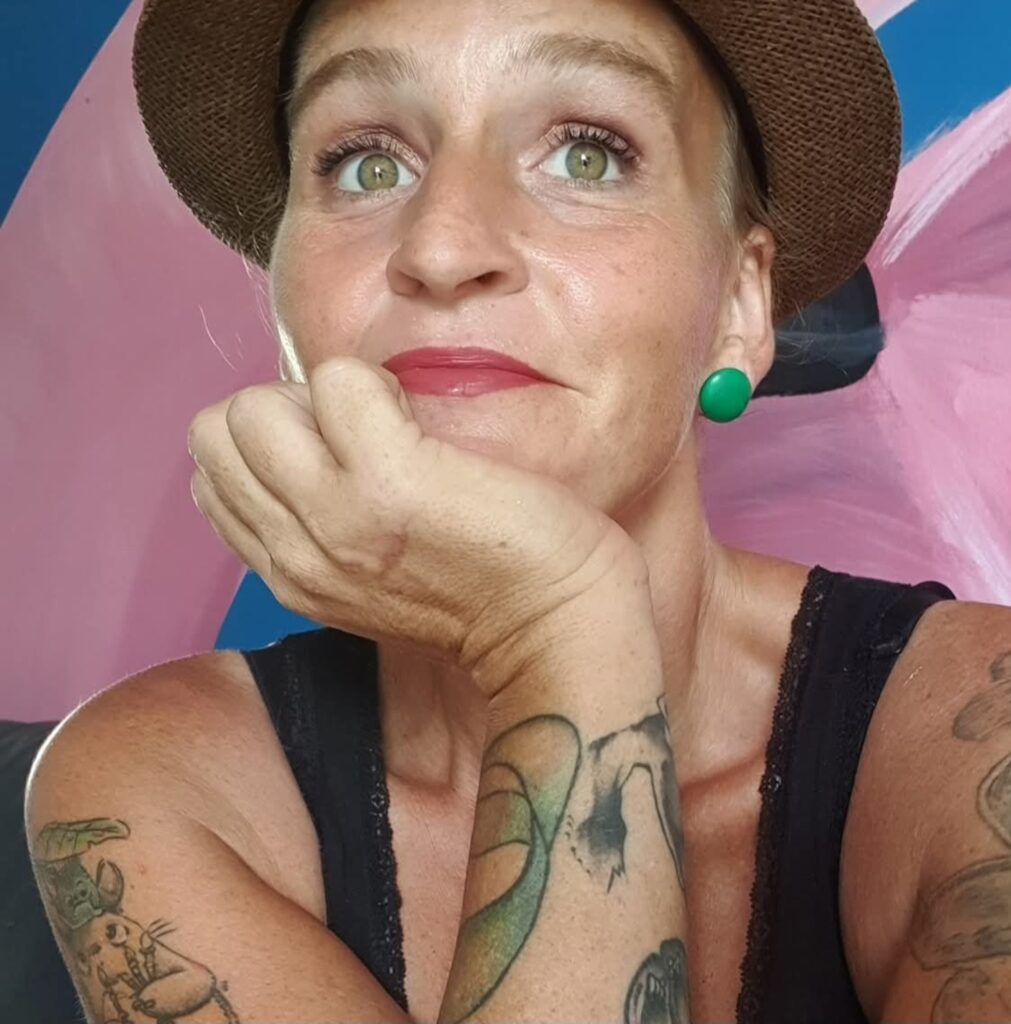
Because of everything I’ve seen across different parts of the world, especially the dehumanizing realities people and animals can face, I’ve always felt a responsibility to stand up for those in need and help where I can. That compassion doesn’t stop with humans. I care deeply about animals and believe they deserve protection, respect, and a world free from abuse and cruelty.
No living being should suffer in silence. All of these experiences , the movement between cultures, the search for belonging, the empathy, the pain, the love, and the fight for a more humane world live inside my art. That’s why I call myself a storyteller. My work reflects everything I’ve witnessed and felt, translated into emotions and stories that people from different backgrounds can connect to.
Q2. You’ve said, “my art is just an extension of my life as a humanitarian.” What does be a humanitarian mean to you?
Being a humanitarian to me means leading with empathy and never becoming blind to the suffering of others. It’s about staying human in a world that can sometimes become very cold and disconnected. Because of the different worlds I grew up in and the things I’ve witnessed, I developed a deep sensitivity toward injustice, pain, and suffering ,whether it’s happening to people or animals.
When I feel something, I feel it intensely, and I can’t just look away. I believe we all have a responsibility to help where we can, to protect those who are vulnerable, and to treat every living being with dignity and compassion. My art is connected to that because it comes from real emotion and real experiences. For me, creating isn’t only about aesthetics , it’s about telling stories, creating awareness, making people feel something, and hopefully reminding people of our shared humanity.
Q3. Your mural Cateoni was inspired by your children leaving home what was it like turning such a personal experience into a public artwork?
Honestly? Putting this on a wall for the world to see felt like exposing a secret. For a long time, I didn’t think I was ‘supposed’ to be a mom. I wasn’t that typical woman, and I found myself following a path,the house, the kids, the white fence,mostly because I thought that’s just what you did before you grew up. I was a mother before I even knew who I was. But because I didn’t fit the mold, I didn’t parent by the book. I raised my kids to be independent, empathetic, and travelers of the world.
I did it my way, not society’s way. And the irony is, even though I never felt ‘meant’ for the role, the bond I ended up with is the strongest thing I’ve ever felt. It’s so much more than just being a ‘mom’,it’s this deep, unbreakable respect for the people they’ve grown into. When they left, it hit me in a way I wasn’t prepared for. It felt like a piece of my heart just walked out the door and went with them.
Cateoni is that ache. It’s me admitting that motherhood,even the messy, non-traditional, ‘I don’t belong here’ version of it—was the most profound and emotional part of my story. It was worth every single fear and every tear.”
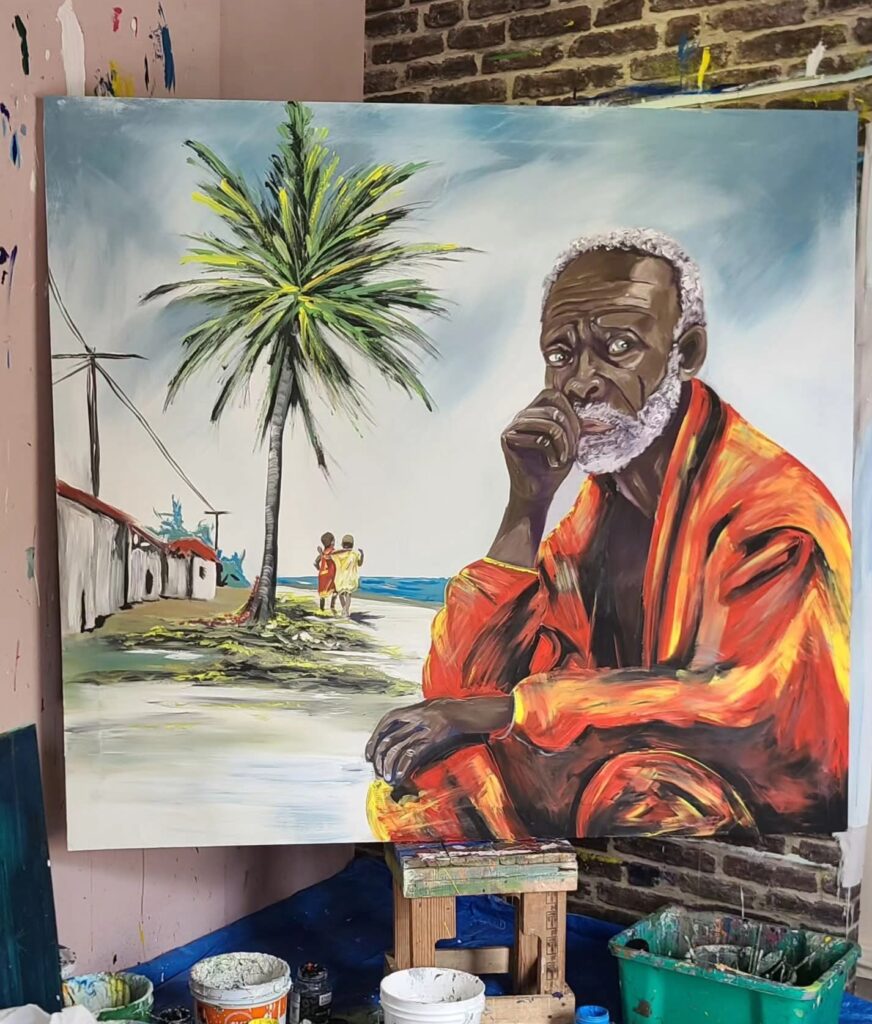
The Wisdom of the Simple Life
Some connections transcend language.
Inspired by a chance encounter in Portugal, El Pescador is a tribute to a man who spoke no common tongue with the artist’s son, yet shared a profound, silent understanding through the universal language of kindness. He is the embodiment of a life well-lived—a man who found total contentment in the “little things,” finding wealth not in possessions, but in the rhythm of the tides and the patience of the catch.
Spanning a monumental 145cm x 145cm, this large scale industrial textile painting captures that serene, weathered wisdom. The subject, crowned in his iconic white hat, is enveloped by a swirling, vibrant school of fish—a kaleidoscope of violets, emeralds, and crimsons. These colors represent the internal “bounty” of a happy soul.
Painted on heavy industrial raw cloth, the rugged texture of the material honors the grit and endurance of a life spent by the sea. It is a one-of-a-kind original that radiates joy, prosperity, and the quiet power of being present. El Pescador | Large Scale Industrial Textile Painting Technical
Year, 2026
Q4. You paint on industrial drop cloth rather than traditional canvas what drew you to that material?
Honestly, I started using this stuff because I was broken. When I became a single mom with two kids, I was bankrupt. I was constantly scared that I wouldn’t be able to provide for them, and I definitely didn’t have the money to go out and buy a fancy canvas. I eventually found this old, raw industrial textile, this ugly, rough thing and I just started painting on it because it’s what I had. It sold the very same day.
That’s how I started earning enough to pay the rent and finally give my kids what they needed. Years later, I actually went out and bought a ‘normal’ canvas, and I hated it. It was so smooth and perfect that it felt fake to me. My life wasn’t perfect, so why should my art be? I realized I needed that raw, gritty feeling back. Now, I find the heaviest, rawest industrial textile I can get my hands on, and I build my own frames so I can go as big as I want.
I call it the ‘fabric of the people’ because it’s honest. It’s got flaws, it’s tough, and it’s been through something just like all of us.”
Q5. Your daughter once asked you to “paint the world with flowers” what did that moment mean to you, and how has it shaped your work?
I remember that moment so clearly. She was just a little girl, and I walked in to find her covered in ink,she had been drawing flowers all over her own arms and legs. When I looked at her, she just looked up at me so simply and said, ‘I’m going to paint the world with flowers.’ At that time, I was so caught up in the stress of being a single mom and just trying to keep our heads above water. I was seeing the grit, the struggle, and the ‘raw industrial’ side of life. But seeing her standing there, using her own skin as a canvas because she just had to get that beauty out… it hit me hard.
She’s an artist herself now, but she’s been seeing the world that way since she was small. To paint the world through her eyes means remembering that even when things are tough or the ‘canvas’ of life is rough and ‘ugly,’ there’s always room to grow something beautiful. She reminded me that we aren’t just defined by our struggles; we’re defined by the beauty we choose to add to them.
Q6. How do you channel that raw intensity into controlled, beautiful, coherent portraits? How do you harness that fire?
The ‘controlled’ part isn’t about technique for me; it’s about a choice I make every single day. I’ve seen some horrible things in this world. I’ve lived through the kind of stuff that can make you turn cold or cynical. But when I stand in front of a wall or a piece of textile, I make a conscious decision to look past all that. I still believe, deep down, that people are beautiful. That’s where the ‘control’ comes from. It’s taking all that fire all the anger, the fear, and the intensity of what I’ve been through,and forcing it to serve that beauty. I don’t want to paint the horror. I want to use that raw energy to capture the soul of someone, to show the part of them that’s still good and still worth seeing. I harness the fire by making sure it lights up the person I’m painting, rather than the ugly.
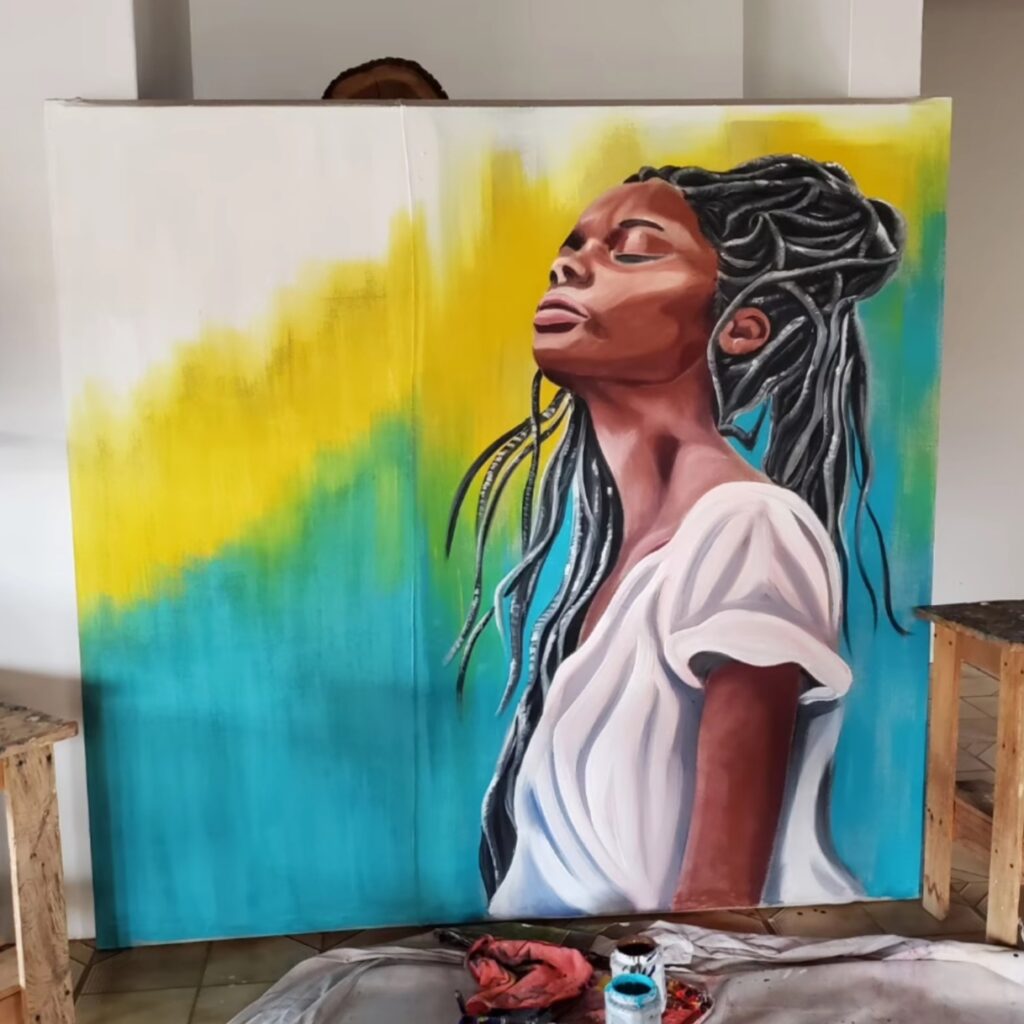
Size: 200 x 220 cm
Medium: Acrylic on raw industrial textile
This piece is a promise. I called it I’ll Rise Up because I’ve made a choice to always stand up for those who need it—for the ones whose voices have been silenced or ignored.
In my work, I don’t just see figures; I see lives that deserve to be lived boldly. I feel a deep responsibility to rise up against injustice, whether it is being faced by humans or by animals. They all have a dignity that we cannot allow to be dimmed.
I chose this raw industrial textile because it’s tough and unrefined, much like the reality of the struggle against injustice. It isn’t a delicate canvas; it’s a material that can carry the weight of a monumental presence. At 200 x 220 cm, I wanted the scale to reflect that strength—to create something that refuses to be overlooked.
I use these bold colors because I choose to see every living being as vibrant and full of worth. This painting is for anyone who has ever felt invisible. It’s a reminder that even when the world is hard, we can choose to stand tall, to take up space, and to be a voice for those who cannot speak for themselves.”
Year 2023
Q7. Your murals are monumental in scale yet deeply personal how do you maintain that sense of intimacy while working so large?
For me, it’s not about making a ‘monumental’ piece of art; it’s about the fact that some things just need more space to be told. Whether I’m painting a person, an animal, or a flower, I’m just trying to be honest about what I’m looking at. When it comes to murals, a huge part of my process is actually listening.
I work with clients who have their own vision and their own way of seeing the world. I listen very carefully to what they’re feeling and what they want to say, and I use my hands to put that onto the wall. I’m taking their perspective and giving it a scale that people can’t miss.
Even though the walls are massive, the feeling stays human because it’s still coming from that same place I found when I was painting on industrial cloth in my kitchen to pay the rent. I’m just taking a real, raw truth—whether it’s mine or the client’s—and giving it enough room to breathe. No matter how big the wall is, if the connection is real, people are going to feel it.”
Q8. Human and animal rights are important themes in your life how do those values find their way into your work?
I don’t really sit down and think about adding my values to a painting. They are just there because they’re part of me. I’ve always been a bit of a rebel against the way society says we should live, and I raised my kids to look at the world with that same empathy to actually see the living things around them.
The reason I use such bold colors is simple: I choose to see every living being that way. I want to see them having a bold life. Whether it’s a person or an animal, they aren’t muted or gray to me. They are vibrant and full of fire, and I want to put that on the wall. After seeing the harder side of life, it’s a choice I make to see that strength instead of just the struggle.
And honestly, I am so immensely thankful to everyone who has supported me through the years. I sometimes feel like my fans have seen me grow up. They were there when I was just starting out, and they’ve stayed by my side through all the changes. It’s because of them that I can keep doing this. Having them there, believing in my work while I was finding my way, means everything to me. They’ve always been there for me, and that’s a bond I never take for granted.
Q9. Your figures carry a strong sense of presence and strength how do you approach femininity and identity in your portraits?
I think the power in my figures comes from the fact that I’ve never really fit into the ‘typical’ box of what a woman or a mother is supposed to be. For a long time, I felt like I was just following a script the house, the kids, the white fence before I even knew who I was. But I found my own way, and I raised my children to be independent and brave.
When I portray femininity or identity, I’m not interested in ‘pretty’ or ‘perfect.’ To me, identity is something you earn through struggle. I want my figures to have a presence that says they’ve survived something. That’s why I use the raw industrial textile and the bold colours; I want them to look like they have a fire inside them.
I don’t see femininity as something soft or quiet. I see it as a raw, monumental strength. It’s the single mom who is bankrupt but keeps painting. It’s the woman who does things her own way despite what society tells her. I want my work to show that we are allowed to take up space, to be loud, and to be a bit rough around the edges. It’s about the beauty of being real, not the beauty of being perfect.
Q10. What can murals communicate that traditional gallery spaces often cannot?
For me, galleries can sometimes feel a bit closed off, like you need an invitation to be there. But the street belongs to everyone. When I put a mural on a wall, I’m taking art out of that ‘perfect’ setting and putting it right into the middle of real life the noise, the dirt, and the weather.
What a mural can do that a gallery can’t is meet people exactly where they are. I love the idea that someone who is having a hard day, or someone who would never dream of walking into a fancy museum, can turn a corner and see a massive, bold piece of art.
It’s a way of saying, ‘This is for you, too. In a gallery, you’re looking at a finished product, but on the street, the art becomes part of the community’s daily life. It’s honest, it’s accessible, and it doesn’t ask for permission to be seen. That’s the kind of connection I’m after.
Q11. When someone stands before one of your portraits, what do you hope they feel in that moment?
Visibility is important, but for me, it’s about the work being seen, not me personally. I’ve never been someone who wants to be the center of attention; I’d much rather stay in the background and let the walls do the talking. I know what it’s like to feel invisible, so I use my art to make sure other stories and identities get noticed. The most emotional part of this journey has been the connection with my community, especially the people on Facebook who have followed me from the beginning. Most of them have seen me grow up, both as a human and as an artist.
They were there when I was just a bankrupt mom painting on industrial scraps to survive, and they’ve stayed by my side ever since. I care about them deeply, it’s not just about ‘likes’ for me. If I notice that someone who always reacts or comments suddenly goes quiet, I genuinely worry about them. I’ll find myself wondering if they are okay, and I’ll send them a message just to check in.
They’ve always been there for me, so I want to be there for them, too. When I work across different cultures, I’m just trying to be a bridge for those feelings. I use bold colors because I want the subjects to have a bold life on that wall. Even if I’m hiding in the back, I want the work to be loud and proud. I’m just so immensely thankful to that community; it is because of them that I’m able to keep doing what I love the most, and for that, I am forever grateful.”
Q12. What advice would you give to artists who are still learning how to take up space confidently through their work?
My biggest advice is to stop waiting for someone to tell you that you’re allowed to be there. For a long time, I tried to fit into a box that wasn’t for me, but the work only really started to breathe when I decided to be honest about who I am.
You have to realize that your perspective, even the parts you think are ‘too much’ or ‘not right’ is exactly what makes you valuable. Trust the process and trust the people who support you. There are people out there who will want to watch you grow, both as a human and an artist.
Let them see the evolution. Taking up space doesn’t mean being perfect; it just means being present and refusing to be muted. Just keep putting your truth onto that canvas or that wall, and eventually, the confidence will catch up to the work.
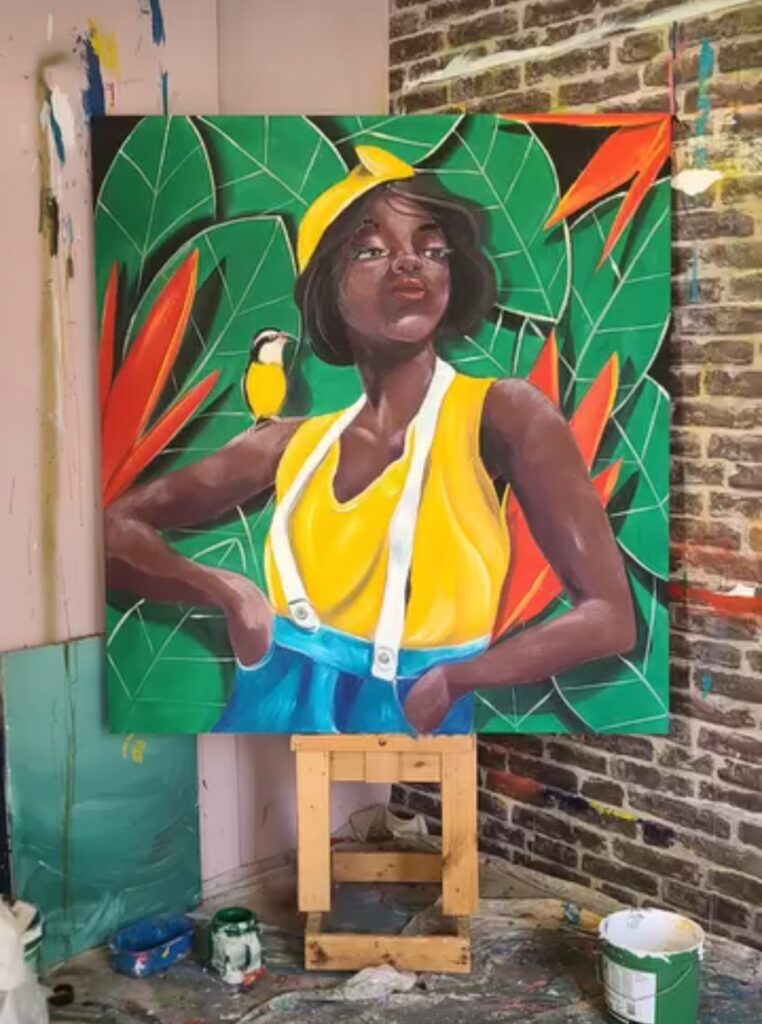
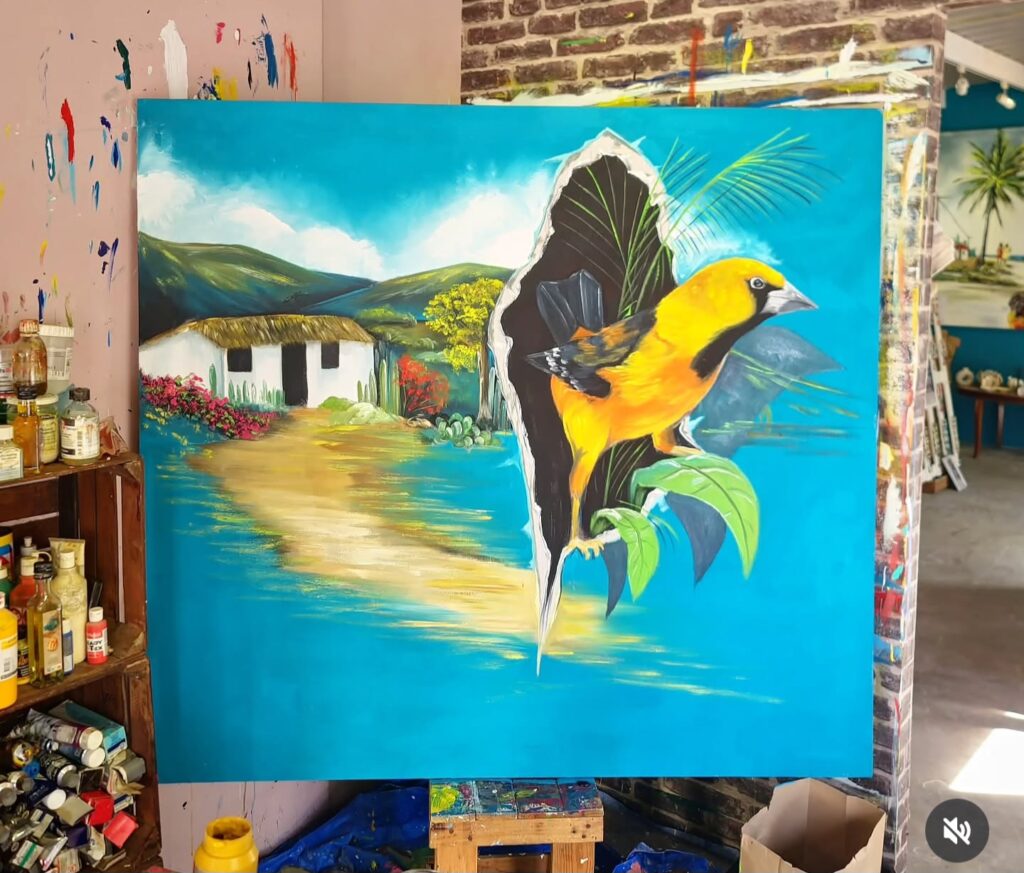
120×120 acrylic on raw industrial textile
Year 2022
As our conversation with Joan came to a close, we kept thinking about one word. Permission. And how she never waited for it.
Nobody handed Joan a career in art. Nobody gave her the right material or the right platform or the right introduction. Everything she has built came from a place where most people would have given up and said this is not the right time or I do not have enough or maybe later when things are more stable. Joan did not wait for stable. She made art from inside the instability and the art turned out to be more honest because of it.
And that is the part we want every artist reading this to sit with. Because so many of us are waiting. Waiting for the right studio, the right materials, the right moment, the right amount of money in the bank, the right person to say yes you are ready now. Joan never had any of that. What she had was a need to make things and a refusal to let circumstances decide whether she was allowed to.
And look what came from that refusal. Murals on buildings. Work that stops strangers on the street. A community that feels like family. A practice that carries the weight of multiple continents and cultures and lifetimes of experience inside every single piece.
The other thing we are carrying from this conversation is about roughness. About the idea that imperfection is not something to fix but something to build from. Joan chose rough material because rough material matched her life. She chose bold colours because she refuses to see living beings as muted or small.
We think the art world could use a lot more of that thinking right now. Less gatekeeping and more street walls. Less perfection and more truth. Less waiting for the right conditions and more making things from whatever conditions you actually have. Joan is not a theory about any of this. She is living proof of it.
For anyone thinking about collecting Joan’s work or commissioning a mural, her pieces bring something into a space that you will feel immediately and that will not fade over time. The industrial textile has a physical weight and texture that no other surface can give you. The colours are warm and bold and alive in a way that changes the energy of whatever room they are in.
And because every piece comes from a real life and real emotion and a real refusal to make things prettier than they actually are, the work carries a presence that stays with you. It does not sit quietly on a wall. It fills the room. And it reminds you every day that the most powerful art is not the most polished art. It is the most real.
Follow Joan through the links below and see what happens when someone makes art from exactly where they are with exactly what they have.