



Alanna Peters switched to aluminium panels after flood destroyed her wood paintings
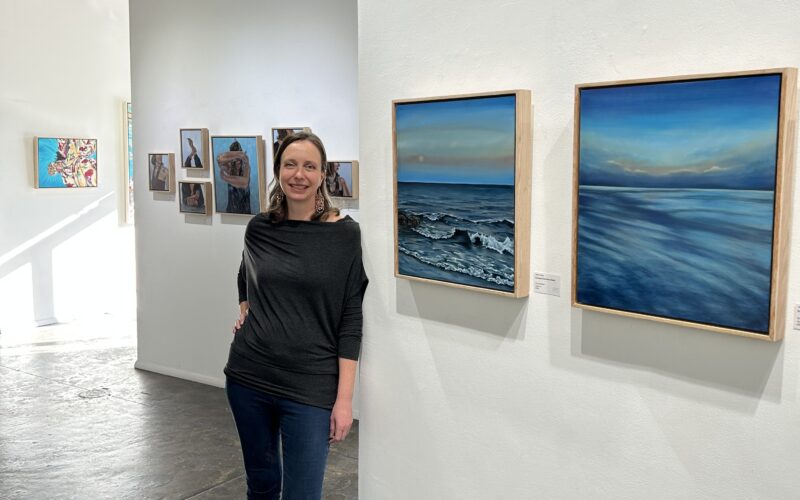
At Arts to Hearts Project, our Women Artist Award has always been about finding women whose work changes the room it is in. Not by being loud. By being so still that everything around it quiets down to match.
Alanna Peters makes that kind of work. And we are proud to have her as a selected artist for the Women Artist Award.
Her paintings are of figures in water. Oil on aluminium panels. And the first time you see one something happens that is hard to describe. You slow down. Not because you decided to. Because the painting decided for you. The figure is there, grounded, recognisable, human. But the water around it is doing something else entirely.
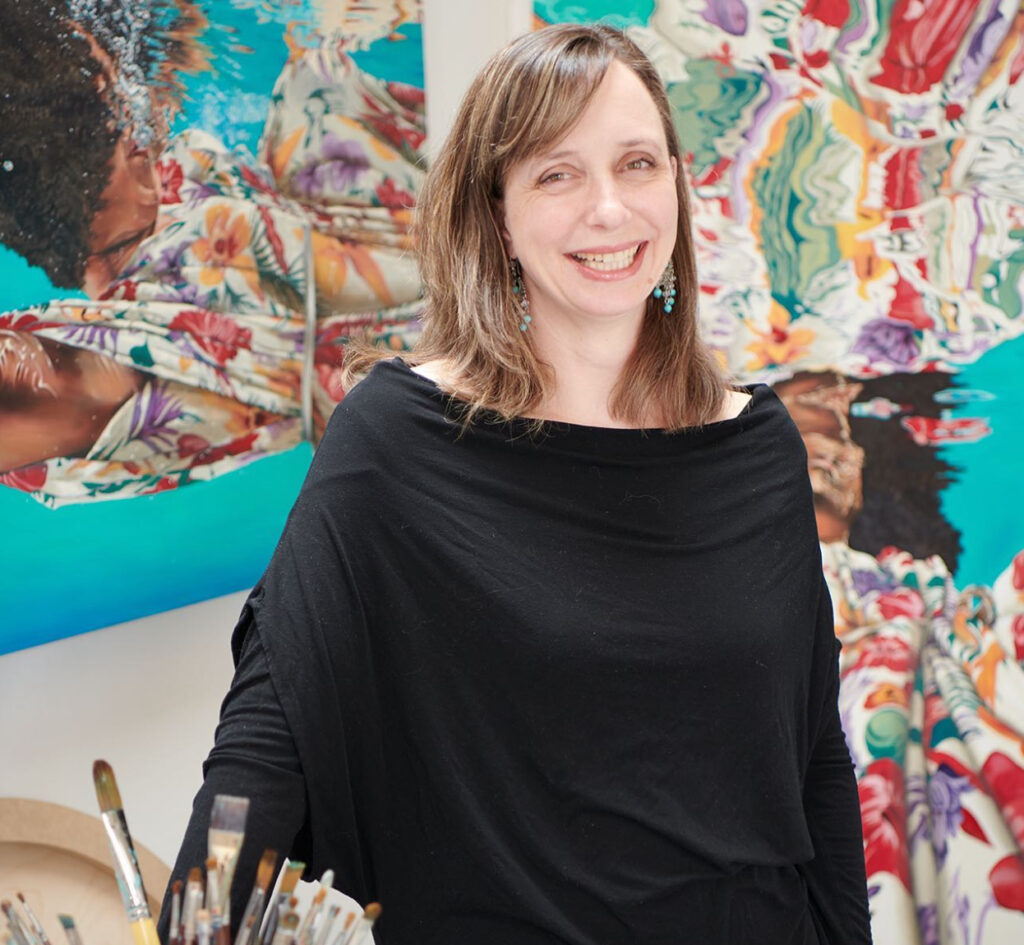
Bending the body. Softening it. Revealing parts and dissolving others. You are not sure what is skin and what is reflection. What is solid and what is already changing. And that uncertainty does not make you uncomfortable. It makes you stay.
Alanna was born in Ottawa. She has lived in many places since then. Different cities, different countries, different continents. Toronto, Denver, and everywhere in between. Every place left something in her eye. The way light behaves differently depending on where you are in the world. The way atmosphere changes how a body feels inside a space. All of that lives in her paintings even when she cannot point to exactly where.
She came to water through something deeply personal. She lost her father suddenly while she was raising young children. The beginning of life and the end of it in the same house at the same time.
After that, she found herself going back to water again and again. Watching it. Sitting with it. Noticing how it never repeats. Never holds still. And that became the subject she could not let go of. Figures suspended in something that is always moving. A moment held even though moments cannot be held.
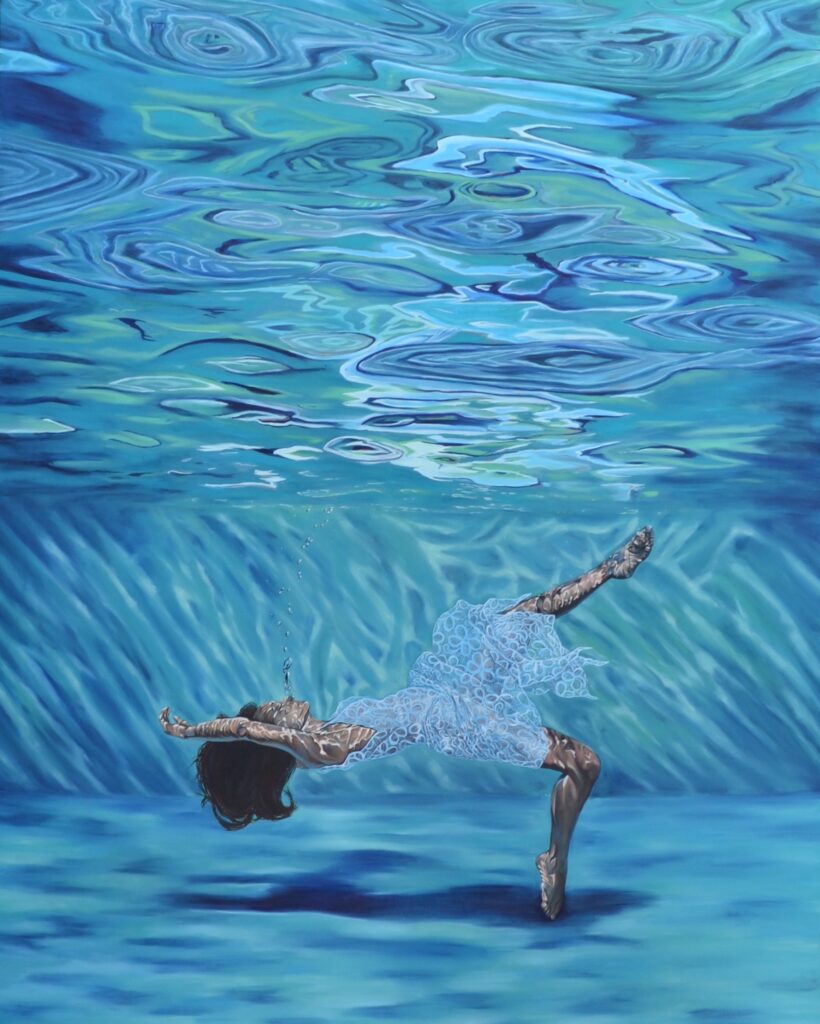
She designs and sews the dresses her models wear. She gets into the water with them. Photographs them in pools and lakes. The water does its own thing and she lets it. Then she paints.
Thin glazes built up over days and weeks until the light seems to come from inside the surface. On aluminium, because a flood once destroyed paintings in her studio. The paint survived but the wood panels warped. She went looking for something that would last and she found it.
Her paintings sit between realism and abstraction. The figure is clear. Everything around it is atmosphere and feeling and open space. She does not want you to look at her paintings from across the room. She wants you to step inside them for a moment. To feel held in that stillness before everything starts moving again.
Let’s get to know Alanna through our conversation with her where she talks about what impermanence actually looks like on canvas, how living across continents changed her relationship to light, why aluminium became her surface of choice, and what happens when she lets the water decide what the painting becomes.
Q1. You were born in Ottawa and now divide your time between Toronto and Denver. How have these different environments shaped your relationship to light, atmosphere, and the human figure in your work?
I’ve lived in many places, not only different cities, but different countries and continents. I’m deeply drawn to learning from other cultures, meeting new people, and experiencing how daily life unfolds in unfamiliar settings. These experiences inevitably influence how I perceive light, atmosphere, and the body. Each environment carries its own rhythm: the quality of light, the climate, and cultural perceptions of the self, and those subtleties shape how I interpret and understand life. These experiences affect how the figure inhabits space and how the surrounding atmosphere is felt rather than simply described. It’s hard to pinpoint the exact influences, but every experience opens me up to a new way of looking.
Q2. You speak about impermanence and the desire to “freeze fleeting moments.” What first drew you to this tension between stillness and constant change?
I’ve always been drawn to the figure as a way to represent emotion and a specific moment in time. My awareness of impermanence deepened after the sudden loss of my father while I was raising young children. Experiencing the beginning and the end of life simultaneously made me acutely aware of how quickly everything can shift. I grew up near water, and during that period of my life I found myself returning to it often. Watching water’s constant movement, how it never repeats and is never still, made the fleeting nature of each moment undeniable. That realization began to shape my work. I started painting figures immersed in water, trying to hold a moment in suspension while knowing it cannot truly be held. The paintings live in that tension: they appear frozen in time, yet suggest that they are quietly in motion.
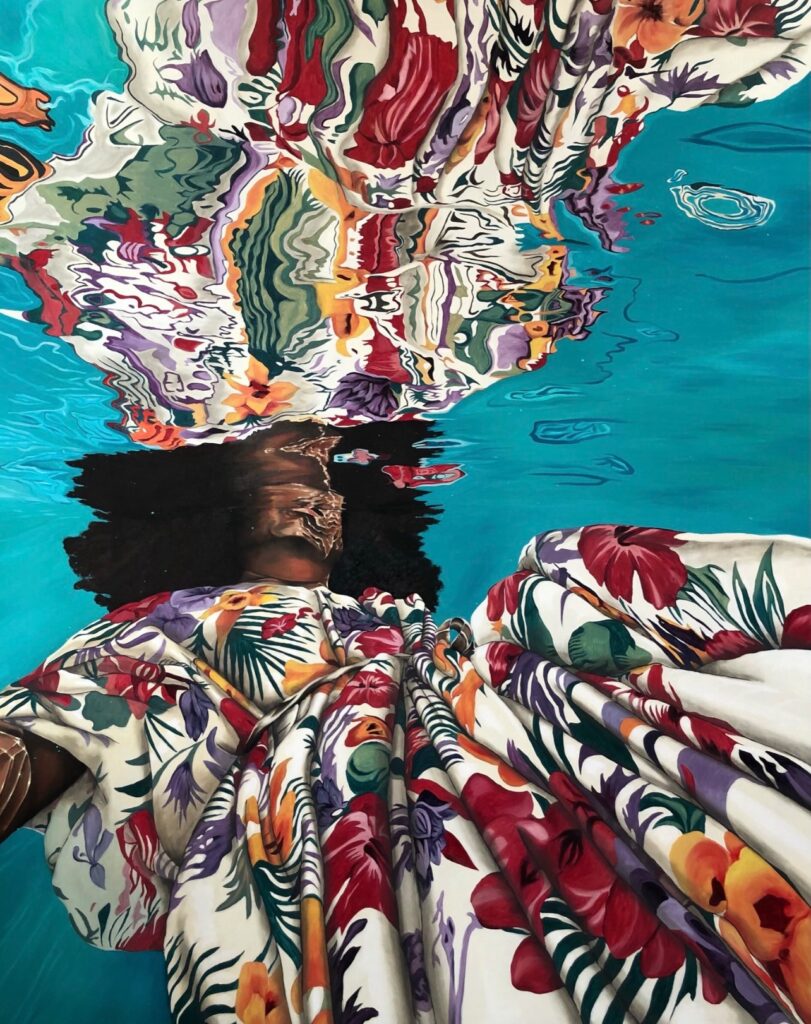
Q3. Your paintings often explore polarities realism versus abstraction, body versus reflection. Why is that tension important to you?
I think that the tension between realism and abstraction is important to me as I find that it mirrors how we actually experience the world. We don’t perceive reality as pure fact or pure emotion; we move constantly between observation and interpretation. Realism grounds us in the recognition and abstraction opens the space to sensation, emotion and ambiguity. I find that this contrast helps the viewer to participate rather than simply observe the painting. The recognizable figure provides an anchor, while the unresolved elements allow the viewer’s internal world to complete the image. The painting becomes less a picture of something and more an experience with it. So rather than just looking at the image the viewer is invited to live within the painting.
Q4. You mention the importance of presence and finding peace in chaos. Do you see your paintings as contemplative spaces for viewers?
In my own life I need a balance between being busy and finding calmness. When one overtakes the other, I feel an internal tension. My paintings grow out of that search for equilibrium. I hope my works function as contemplative spaces, offering a moment of quiet reflection within the noise of daily life. I want the viewer to feel drawn into the atmosphere of the work and to connect with the figure in a personal way. More than decoration, I hope the paintings live alongside the viewer, becoming part of their environment and their inner experience.
Q5. You work primarily in oil on aluminium panels. What drew you specifically to aluminium as a surface?
I was drawn to working on aluminium panels after a flood in my studio destroyed several paintings. I have always preferred a rigid surface and had spent years painting on wood panels. After the flood, I discovered the paint layers had survived, but it was the support that had warped. That realization led me to search for a more stable foundation for my work. While a flood is an extreme example of environmental impact, the conditions in which a painting lives do matter. Because my work is exhibited in cities across Canada and the United States, it regularly moves through very different climates, and over time these shifts can affect the surface. Aluminium offers both rigidity and stability. It is lightweight, archival, and resistant to environmental change, allowing the painting to remain consistent regardless of where it travels.
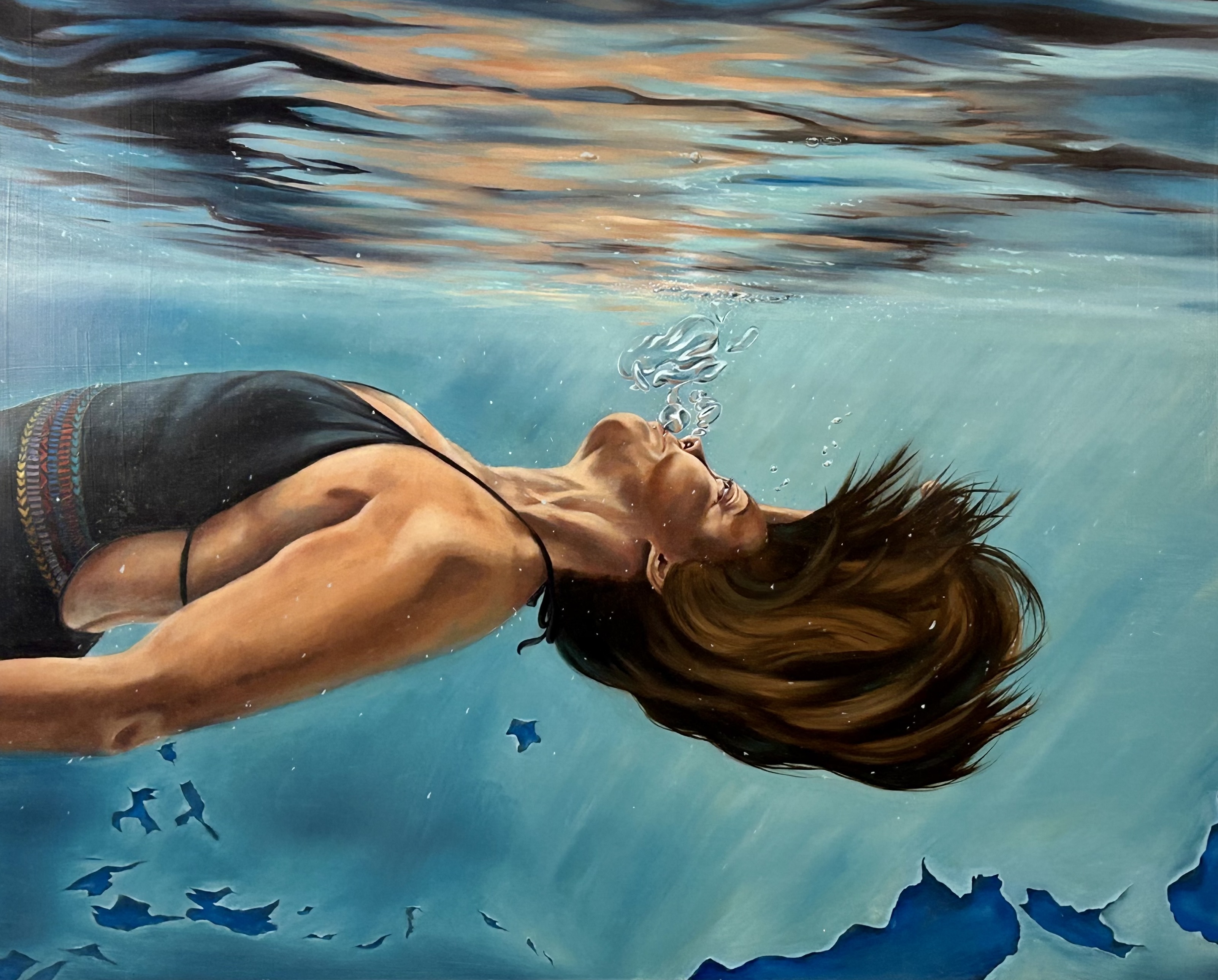
Q6. You focus heavily on light and distortion through water. How do you technically approach painting refraction and fluid movement?
I’m fascinated by how light behaves in water. The way it bends, fractures, and both reveals and obscures the figure. The distortions and reflections engage me visually, but also intellectually, because it challenges what we think we see. In painting, I approach this with a sense of playfulness rather than strict adherence to the reference. The reference gives me structure, but I allow the paint to respond intuitively, following where the movement of water suggests it should go. Technically, I build the surface through many thin glazes, gradually developing luminosity and transparency. I often paint flowing fabric as a way to create a sense of movement in my works and which helps create a sense of fluidity of the environment.
Q7. Water distorts and fragments the body. Is that distortion symbolic for you, or purely visual exploration?
The distortion of the body in water begins as a visual exploration rather than symbolism. I’m interested in the playfulness of how the environment reshapes the figure and alters our perception of it. We don’t experience the world purely through logic or fact, we also perceive it through sensation and emotion. The distortion makes that visible. The figure becomes familiar yet uncertain, which reminds us that things aren’t always exactly how we see them.
Q8. How do you choose poses for your figures do they emerge from reference photography, imagination, or lived experience?
Before I begin painting, I first consider the emotional atmosphere I want the work to hold. I then design and sew the dresses for my models and create photographic references. For the underwater pieces, I photograph them in pools or lakes, entering the water alongside my model. We discuss the types of gestures and poses I’m seeking, yet the water introduces an element of unpredictability that often shapes the final image. I take many photographs but ultimately select only a few. These are carefully edited, sometimes combined, to form the composition that becomes the painting.
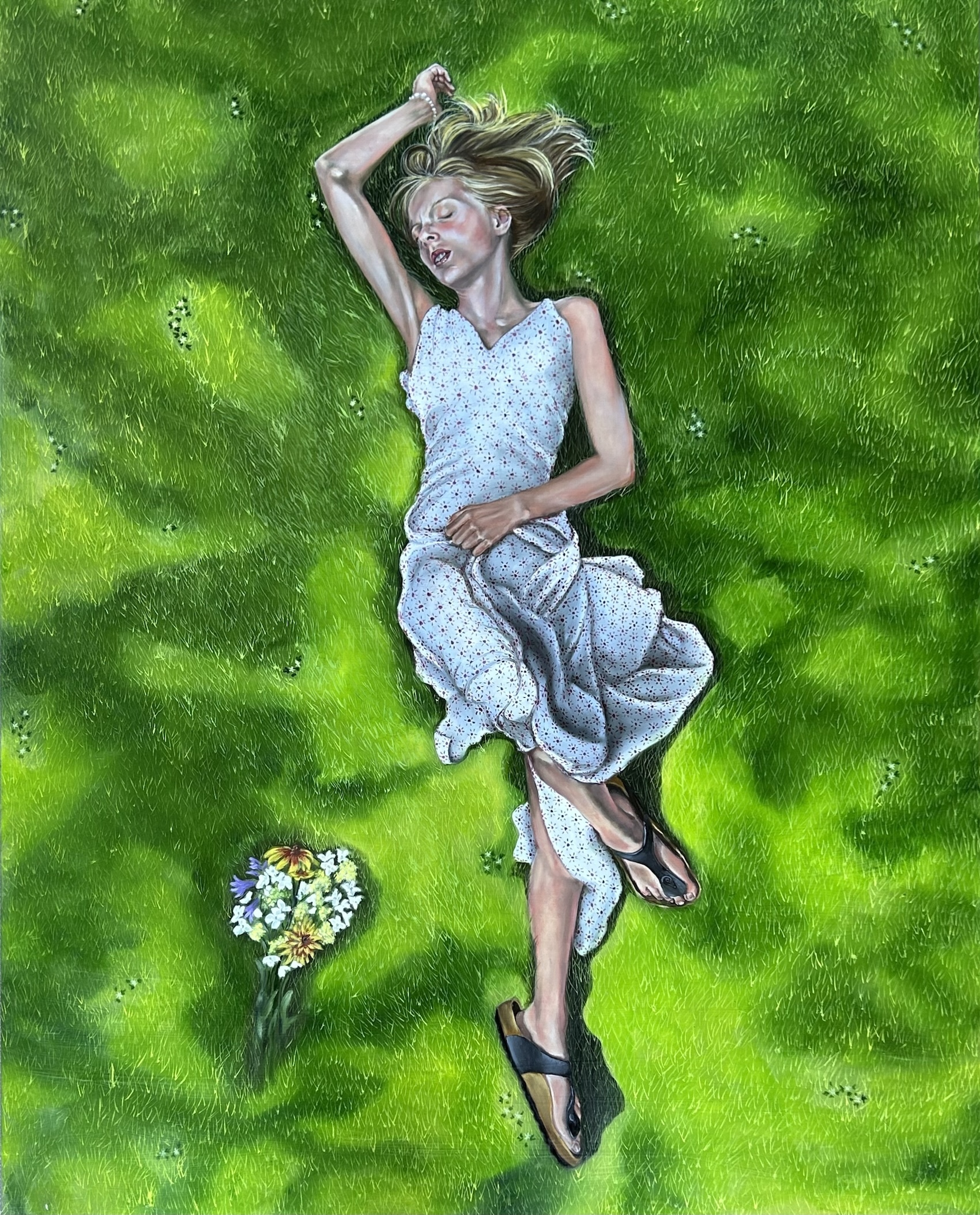
Q9. How do you know when a painting has achieved the balance between abstraction and realism that you seek?
A painting is a continual dialogue. As it develops, I’m constantly questioning whether it’s moving toward what it needs to become and adjusting areas along the way. Even with a carefully considered plan, sometimes the image resists and the balance isn’t there. To see it more clearly, I often turn the painting upside down or on its side, allowing me to get a new perspective and respond purely to value and structure. Part of the balance between realism and abstraction is established in the planning stage, but much of it reveals itself during the act of painting. When something is off you can just feel it. I know it has resolved when the figure feels believable while the surrounding area remains both descriptive and ambiguous.
Q10. Looking back at your earlier work compared to what you create now, what has evolved most significantly, technique, concept, or emotional depth?
Painting is a continual evolution and part of what makes it so engaging is that there is always more to learn. Whenever I feel too comfortable in my methods, I know it’s time to challenge myself, whether through a new approach, material, or subject. Without that push, the work risks becoming repetitive. Looking back, I can see clear connections between my earlier work and what I make now, but the technique has become more assured, and the ideas have deepened as my understanding of the figure and composition has grown. For me, art is an ongoing process of discovery, and I hope the work continues to reflect that sense of movement and change.
Q11. What advice would you offer artists exploring the human figure who want to move beyond representation into something more contemplative and emotionally resonant?
To move the figure beyond representation into something contemplative, it first helps to become technically comfortable with depicting the body. Practice builds familiarity and once anatomy and skin tones are no longer the primary challenge, your attention can shift toward presence, emotion, and the individuality of the person in front of you. Equally important is clarity of intention. Understanding what you want the work to communicate guides every decision that follows: composition, light, and environment. When the idea is clear, the painting has direction, and the figure becomes more than an image; it becomes an experience. There is also an important moment of letting go of literal reality. The figure needs to be released from its specific context so the environment can be understood in terms of colour, mood, and sensation rather than description. When you stop trying to record exactly what is in front of you and instead respond to how it feels, the work begins to move beyond observation into experience.
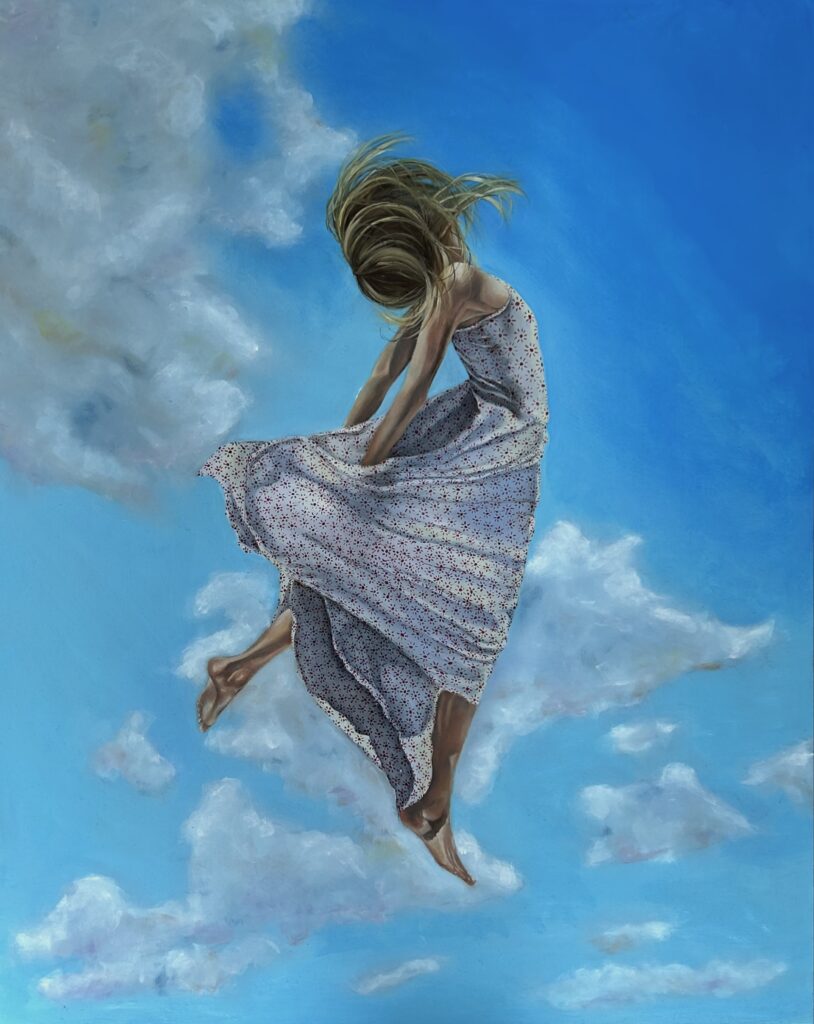
As our conversation with Alanna came to a close, we sat with something for a long time. The idea that you cannot hold a moment. That every second is already leaving by the time you notice it. And that painting might be the closest anyone gets to making a moment stay.
That is what Alanna is doing. Not freezing time exactly. More like suspending it. Her figures float in water that is always moving but in the painting the movement is caught mid-breath. The body is there and not there. Present and dissolving. Held and letting go. It is a beautiful contradiction and it is one that most of us live inside every day without ever putting words to it.
We think about loss differently after talking to Alanna. Not as a single event that happens and then you move on from. But as something that rewires how you see everything after it. She lost her father and the world sped up.
Or maybe it did not speed up, maybe she just started noticing how fast it was already going. Either way it changed her work completely. The water came in. The distortion came in. The desire to hold what cannot be held became the entire point.
And we think what makes her practice so strong is that she never lets the emotion overwhelm the craft. She is technically exceptional. She builds her paintings with a patience and a precision that takes years to develop.
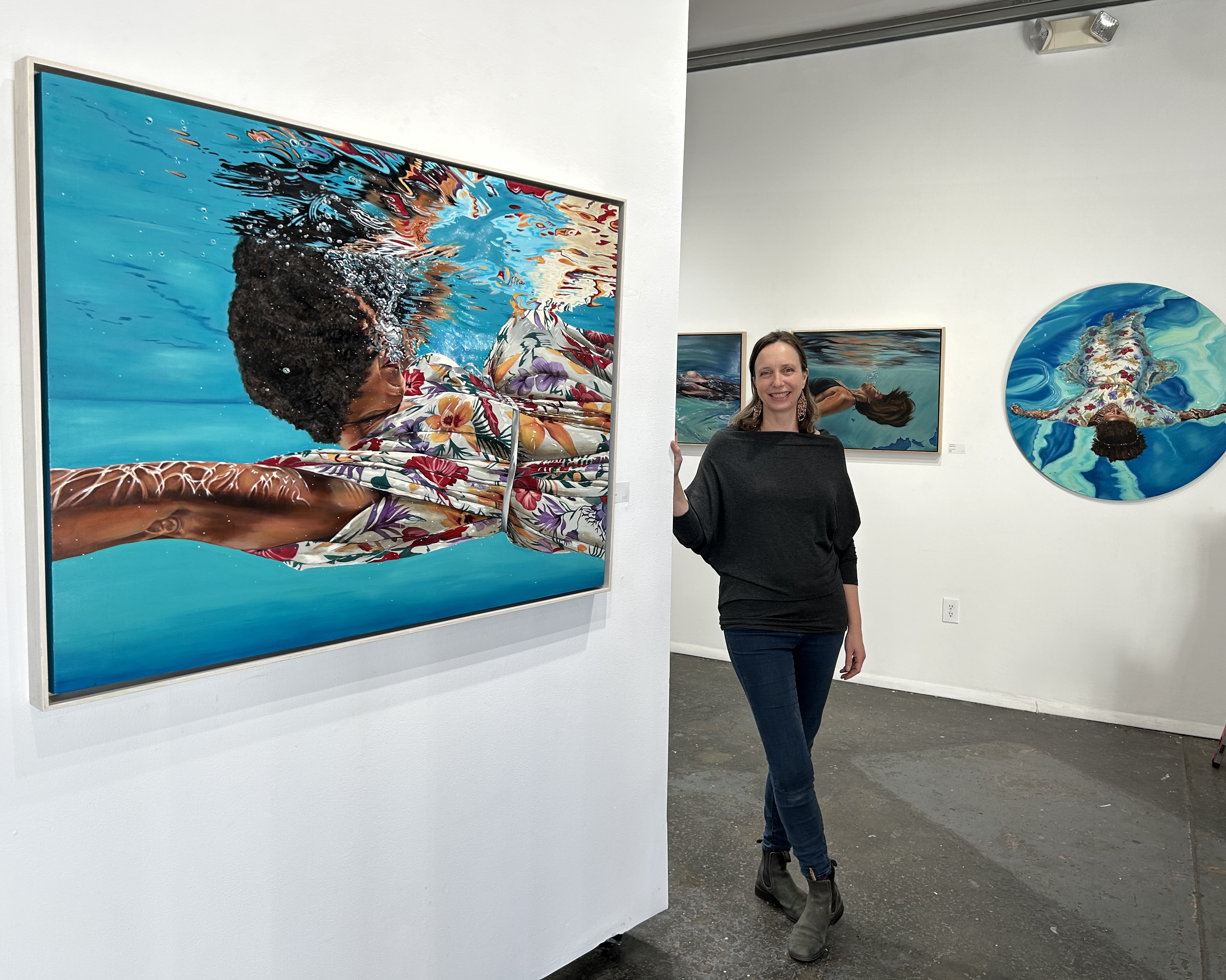
The glazes, the luminosity, the way light bends through water, none of that is accidental. It is the result of someone who takes the time to get it right. But the technique is always in service of the feeling. Never the other way around. The painting is never showing off. It is always trying to pull you in.
That balance is rare. A lot of artists have the emotion but not the skill to hold it. A lot have the skill but nothing underneath it worth feeling. Alanna has both. And the two feed each other in a way that makes her paintings feel like they are quietly breathing on the wall.
For anyone looking to bring work into their collection that holds real contemplative depth, Alanna is an artist who rewards living with. Her paintings are not the kind you glance at and move on. They are the kind that change depending on your mood and the time of day and what you are carrying when you stand in front of them. They give back whatever you bring to them. And that is the mark of work that does not lose its power over time. It deepens.
Follow Alanna Peters through the links below and take a closer look at her work.