

A Conversation with Astrid on the Geometry of Colors
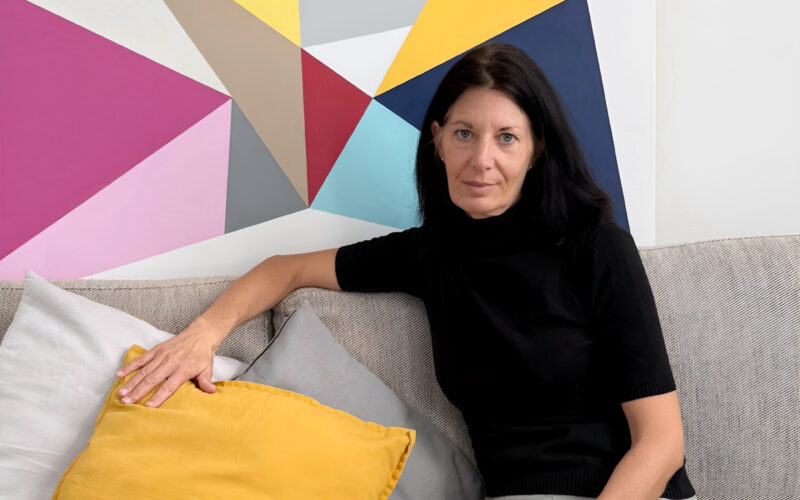
From studying immunology to running a family retail business, and finally to establishing herself as a full-time artist, Astrid’s journey has been anything but linear. Yet, at the heart of every chapter lies a quiet thread: her fascination with color, balance, and form. What began as a passion pursued in spare moments soon grew into an international career, with her works exhibited across New York, London, Milan, and Basel. Her paintings—rooted in geometric simplicity, dots, lines, and vibrant color fields—speak to clarity and harmony, while also carrying the spontaneity of intuition. In this conversation, Astrid opens up about her artistic path, her process, and the joy of creating works that invite both mathematical precision and emotional resonance.
Hi Astrid, you studied biology and then switched to taking up art as a full-time career. How did this shift happen and what motivated you?
Studying biology, particularly my major in immunology, fascinated me deeply. However, when I began working in a laboratory afterward, I felt that something was missing. I eventually returned to our family-run retail business, where I spent many years in management, focusing on purchasing, customer relations, brand development, and marketing. One of my key responsibilities was overseeing a large department dedicated to art supplies, and it was during this time that I began creating my own artwork in my limited spare time. My first exhibitions in my hometown of Weilheim were met with great enthusiasm and quickly attracted buyers. A website, social media profiles, and online galleries like Saatchi Art and Singulart soon helped me to present and sell my work to a global audience. As the years went by, my success continued to grow—turning a long-held dream into reality: I was able to turn my hobby into a full-time profession.
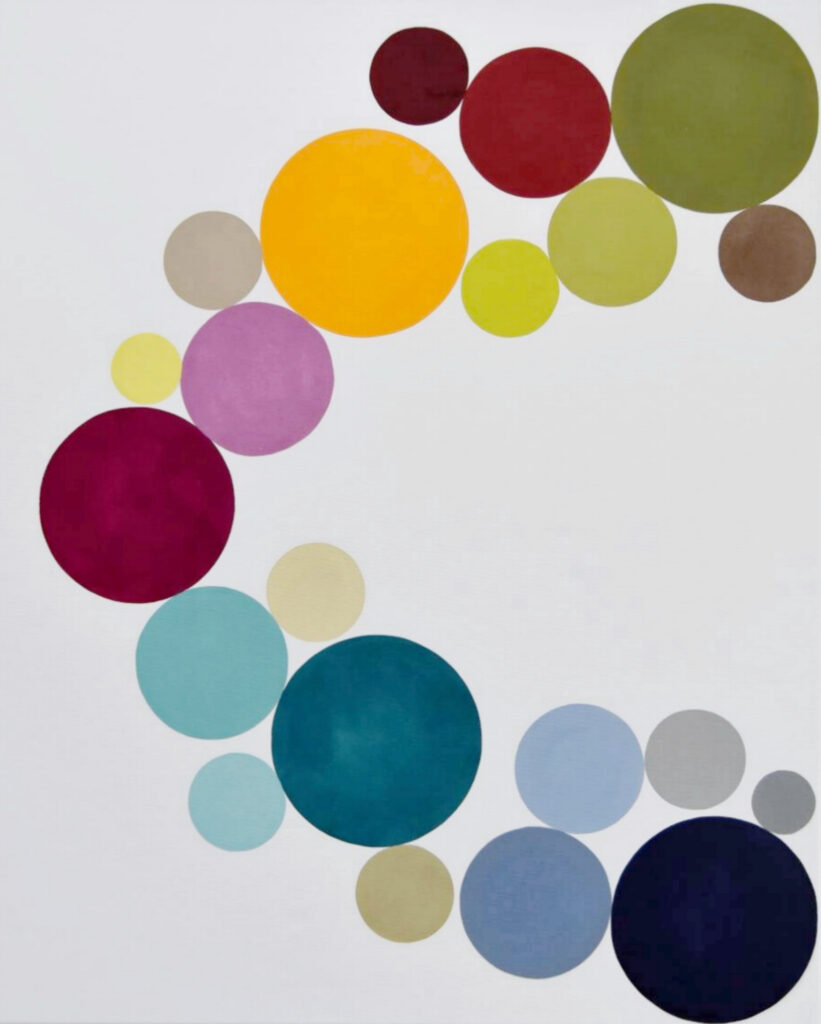
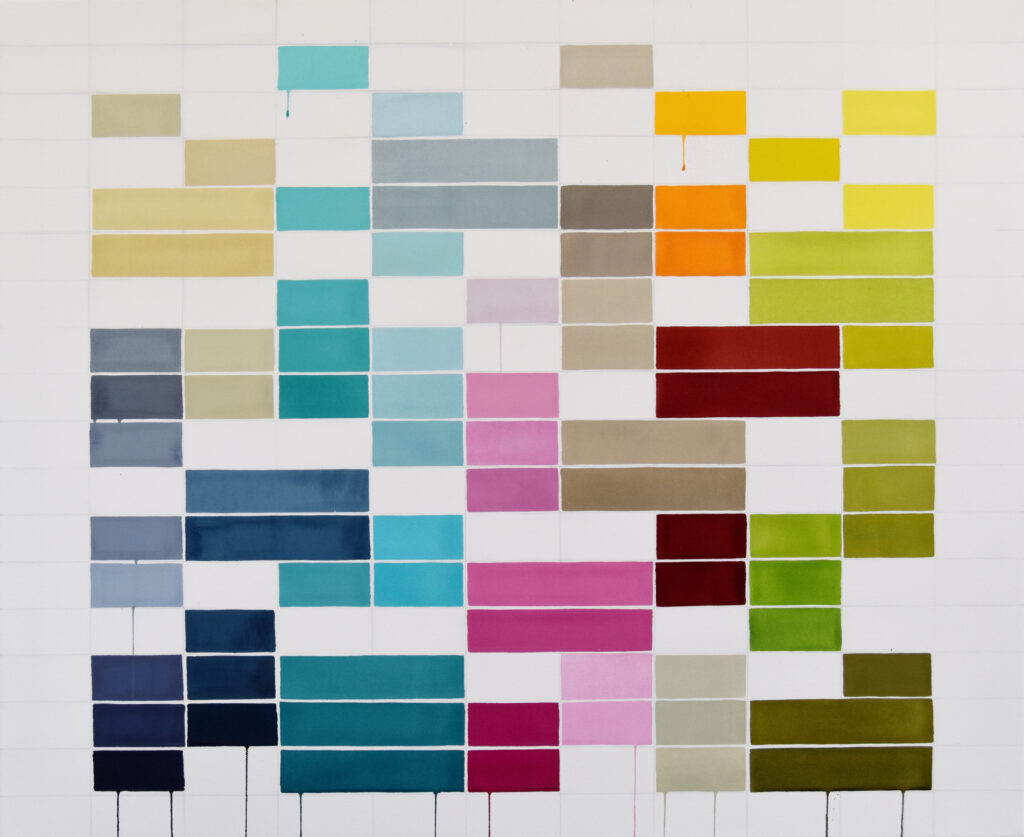
Minimalist Color Scheme #6, 80x100cm, painting, 2024
You call yourself “color-obsessed”. What does that mean and how do you unfold it in your paintings?
Color—each in its own unique way—has a magical pull on me. I can’t choose a favorite, as every shade has its own character and beauty. I love observing color both in artificial settings, like store displays or shelf arrangements, as well as discovering it in nature. For example, I never wear sunglasses outdoors because I want to experience colors without any filter. In my main works, I typically use more than 20 colors, always keeping a balance between warm and cool tones. Over the years, I’ve also created smaller series that are monochrome or more minimal in their use of color. The challenge in those pieces is to achieve presence and harmony with limited color—and still captivate the viewer.
Your art is built around dots, lines, circles, and color fields. What draws you to such minimal forms?
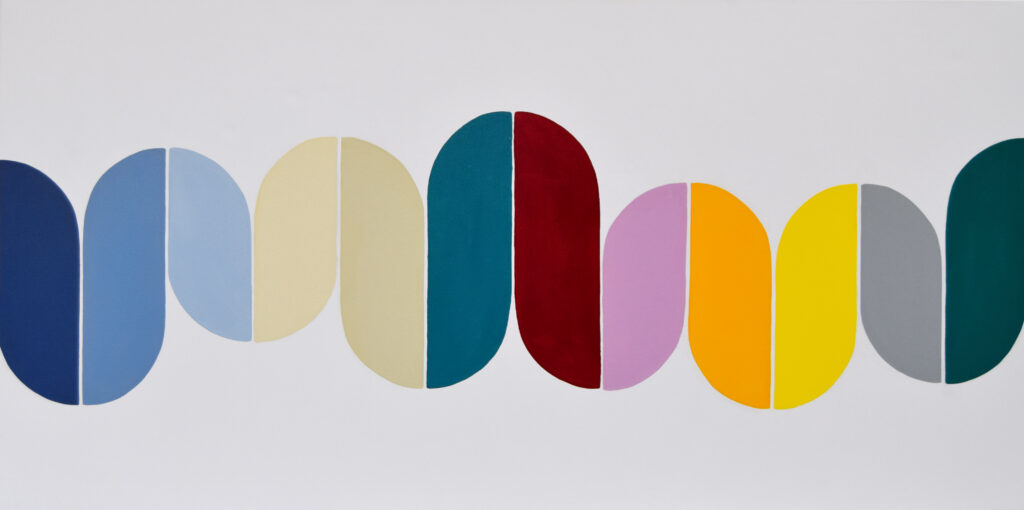
Simple geometric shapes reflect my desire for clarity and simplicity. I’m also a very mathematical person—I love numbers, statistics, and graphs, and I have a deep interest in all the natural sciences. In addition, I work in a very structured way, almost to the point of perfectionism. It’s simply part of my nature.
Can you walk us through how a work emerges from first stroke to final form?
Most of the time, I don’t have a fully defined painting in mind when I begin a new piece. I usually plan the series and have a rough idea of the composition, but the rest evolves as I work. I typically start with a white primed surface—that’s what I prefer—but I also enjoy working on gray or black backgrounds. I especially love using raw, coarse canvas, particularly for my new Script series, where I apply the paint in thick, textured layers. From there, I build the painting step by step—color by color, shape by shape. One form leads to the next, and one color intuitively follows another. It’s only after adding the final color that I can truly evaluate and understand the work as a whole.
Was there any specific art exhibition which left a long-lasting impat on you as an artist?
Definitely the TOAF art fair in Brooklyn, New York, where I had my own booth, and without a doubt, Aqua Art in South Beach, Miami. Seeing so much high-quality art and experiencing that concentrated creative energy at these fairs was incredibly inspiring and impressive.
Your work has shown in New York, London, Milan, Basel, and more. How does audience response differ across cultures or continents?
The reactions to my work vary quite a lot. British and American audiences tend to respond very openly to my style. They admire the color and simplicity. I’ve even received feedback from primary school teachers in the UK and the US who used my work in their art classes and had children recreate the pieces. To me, that’s one of the greatest compliments an artist can receive. In Europe—especially in Germany—there’s often a stronger focus on the artist’s background and biography.
At exhibitions, I sometimes hear comments like, “Well, my daughter could have done that.” But even that, I take as a compliment. I don’t expect everyone to like my work—and that’s perfectly fine.
If you could transform one of your earlier works, what would it be and why?
I rarely change or paint over older works. However, I often take an old idea or composition and carry it forward into a new series, giving it a fresh context or interpretation.
How has your studio evolved over time and what are the things that have remained constant?
My studio has changed a lot over time. In the beginning, I worked in a small hobby room in the basement, and my artworks were displayed on the walls of my private living space. Today, I work in a large, bright studio and have several additional rooms for storing artworks—and of course, for packaging materials. Since I ship a large portion of my sold works myself, packaging and preparing shipments has become one of my main tasks alongside painting. One thing that hasn’t changed is the mess in certain corners of the studio. It’s actually the only place in my life where disorder is completely normal—and perfectly accepted.
How do you think participating in international fairs and exhibitions can benefit emerging artists?
It is absolutely a benefit! Connecting with other artists—but especially with collectors and clients—is incredibly important to me. Seeing people’s reactions in person with my own eyes is truly wonderful. It adds a whole new dimension to the experience of sharing my work.
Astrid’s art reminds us that simplicity, when deeply observed, can hold infinite depth. Whether through the interplay of 20 colors on a single canvas or the elegance of a single circle, her works reveal a world where geometry becomes poetic and color becomes transformative. Her story is one of following curiosity, trusting intuition, and allowing passion to evolve into profession. For emerging artists, her journey is proof that art has the power to transcend backgrounds, cultures, and expectations—offering not just beauty, but a universal language that connects across borders.
To learn more about Astrid, click the following links to visit her profile.