
Surrealism in Five Paintings: When Reality Starts to Bend
What if reality is only one version of the world?
That question sits quietly at the heart of Surrealism. When the movement took shape in Paris in the 1920s, its artists were less interested in faithfully recording the world around them than in finding out what might exist beyond reason, logic, and conscious thought. Dreams, chance, memory, desire, fear, and the unconscious became material for making art. André Breton’s Manifesto of Surrealism, published in 1924, gave the movement its name and its intellectual framework, but the artists who gathered around it would take the idea in remarkably different directions.
That difference is important. Surrealism was never simply a matter of painting melting clocks or filling a canvas with impossible creatures. René Magritte used ordinary objects to make language and representation feel suddenly uncertain. Joan Miró transformed fragments of imagined worlds into carefully orchestrated compositions. Leonora Carrington brought animals, mythology, and transformation into her paintings, while Dorothea Tanning found the uncanny in spaces that might otherwise seem completely ordinary. And then there was Salvador Dalí, whose meticulous technique made impossible things look almost disturbingly real.
The five paintings that follow are therefore not meant to be a definitive list of Surrealism’s greatest works. Instead, they offer five different ways of understanding what the movement made possible. Together, they take us from unstable time and contradictory language to dreams, identity, imagination, and fear, and show why, more than a century later, Surrealism still gives artists and viewers permission to question what they think they know.
1. Salvador Dalí, The Persistence of Memory, 1931
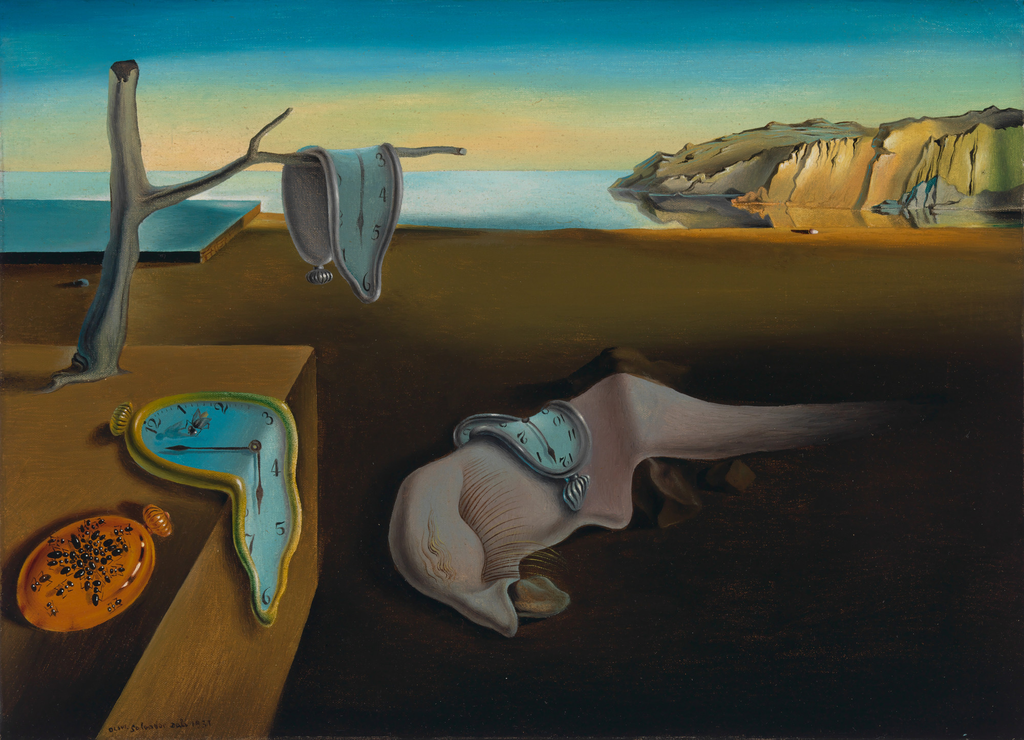
Few paintings have made an abstract idea as physically strange as Salvador Dalí’s The Persistence of Memory. Painted in 1931, the work is set against the rocky landscape of Portlligat in Catalonia, where Dalí lived and worked. At first glance, the scene seems almost unnaturally quiet: a barren landscape, a calm stretch of water, a tree, and several clocks scattered across a low surface. Then you notice that the clocks are soft.
One droops over the edge of a table. Another hangs from the branch of a dead tree. A third appears to have slipped across the surface beneath it. Their hands still mark time, but their bodies no longer behave as clocks should. Dalí has taken one of the most rigid objects we use to organize everyday life and made it strangely vulnerable.
That tension is what gives the painting its power. Time is usually something we measure but cannot see or touch. Here, Dalí gives it weight, texture, and a kind of physical exhaustion. The watches appear to have lost their authority, as if the landscape operates according to a different set of rules.
The painting’s title, The Persistence of Memory, adds another layer without solving the mystery. Memory, like time, can be unreliable. A moment from years ago can remain remarkably vivid, while something that happened yesterday can already feel distant. Dalí does not illustrate a particular memory; instead, he creates a world where the familiar logic of time has been suspended.
Even the strange organic form lying in the centre of the painting contributes to this dreamlike atmosphere. Often interpreted as a distorted self-portrait, it has long been associated with Dalí’s interest in the imagery of dreams and the unconscious. Yet the painting does not offer a neat key to unlock every detail. Its ambiguity is part of the experience.
Dalí’s extraordinary precision makes the effect even more convincing. The objects are painted with such clarity that the impossible begins to look plausible. That may be one of Surrealism’s most effective tricks: rather than making the unreal look unreal, it makes us wonder whether reality was ever quite as fixed as we assumed.
2. René Magritte, The Treachery of Images, 1929
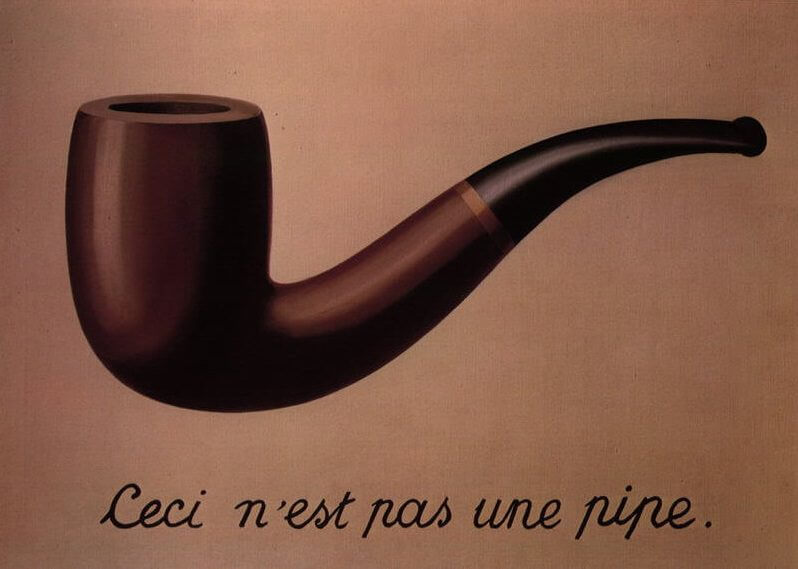
René Magritte did not need a dreamscape to make reality feel uncertain. Sometimes, all he needed was a pipe.
Painted in 1929, The Treachery of Images presents an almost textbook-like image of a tobacco pipe beneath a sentence that reads, Ceci n’est pas une pipe, “This is not a pipe.” The statement seems ridiculous until you stop and look at what is actually in front of you. Magritte’s painting is not a pipe. It is an image of one.
That small distinction is the entire point.
Magritte was fascinated by the distance between things and the words or images we use to represent them. A painted pipe cannot be picked up, filled with tobacco, or smoked. It can only resemble one. By putting the image and the contradiction together, Magritte turns an ordinary object into a question about how we understand the world.
It was a particularly fitting concern for an artist working within the Surrealist movement, which had already begun challenging the authority of rational thought. But Magritte approached that challenge differently from artists who filled their canvases with fantastical creatures or elaborate dream sequences. His paintings often look calm, polished, and completely legible. The strangeness arrives through the idea.
That is what makes The Treachery of Images so effective. Nothing in the pipe itself looks unusual. There are no distorted figures, impossible landscapes, or supernatural events to signal that we have entered another reality. The disruption happens in our own minds, when the image refuses to be the thing we instinctively call it.
Magritte would return throughout his career to similar questions about words, images, and objects. His work asks us to reconsider a habit we rarely notice: we see something, name it, and assume the name settles the matter. But an image is not an object, and a word is not the thing it describes.
For a movement so closely associated with dreams and the unconscious, Magritte offers a different kind of disruption. He does not ask us to escape reality. He simply makes us look at it again, and notice how much of what we call “reality” depends on assumptions we usually never think to question.
3. Leonora Carrington, Self-Portrait (Inn of the Dawn Horse), 1937–38
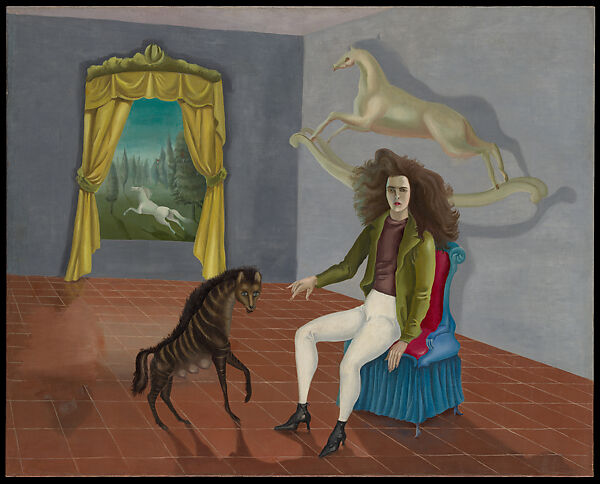
Leonora Carrington’s self-portrait does not look particularly interested in telling us who she is. Instead, it gives us a woman sitting in a room, a white horse behind her, and a hyena moving across the foreground, and leaves us to wonder what kind of world these three figures inhabit together.
Painted in 1937–38, Self-Portrait (Inn of the Dawn Horse) was made when Carrington was still in her twenties. She sits rigidly on the edge of a chair, dressed in riding clothes, her body angled toward the viewer. Behind her, a white rocking horse seems to mirror her position, while a spotted hyena appears to move freely across the room. The combination feels deliberately improbable, but the scene is painted with enough specificity to make us accept it for a moment.
Animals were deeply important to Carrington’s imagination. Horses, in particular, recur throughout her work, and the white horse in this painting has often been connected to her sense of identification with the animal. Carrington grew up around horses and later described a powerful affinity with them. The hyena, meanwhile, is harder to pin down, and perhaps that is exactly how it should remain.
Carrington’s relationship with Surrealism was not simply about producing dreamlike imagery. She became involved with the European Surrealist circle in the late 1930s after meeting Max Ernst, but her work developed a distinctly personal vocabulary drawing on mythology, folklore, alchemy, animals, and the imagination. Her paintings often seem to belong to a world with its own rules, rather than a distorted version of ours.
That quality is already present here. The title itself, Inn of the Dawn Horse, gives the painting the atmosphere of a place that exists somewhere between a memory and a fable. Carrington is not merely documenting herself; she is constructing a version of the self that can coexist with animals, transformation, and fantasy.
It is also worth resisting the temptation to decode every element. Carrington’s paintings are rich with symbolism, but they were never intended to function like puzzles with one correct answer. The horse can suggest freedom, identification, or something more personal. The hyena can be read in several ways. The painting remains open.
Perhaps that openness is what makes the self-portrait so compelling. Carrington does not present identity as something fixed and easily explained. She gives us a woman, an animal, a horse, and a room, and lets them occupy the same strange space. In doing so, she turns the traditional self-portrait into something far more elusive: not a record of who she was, but an imaginative glimpse of who she could be.
4. Joan Miró, The Harlequin’s Carnival, 1924–25
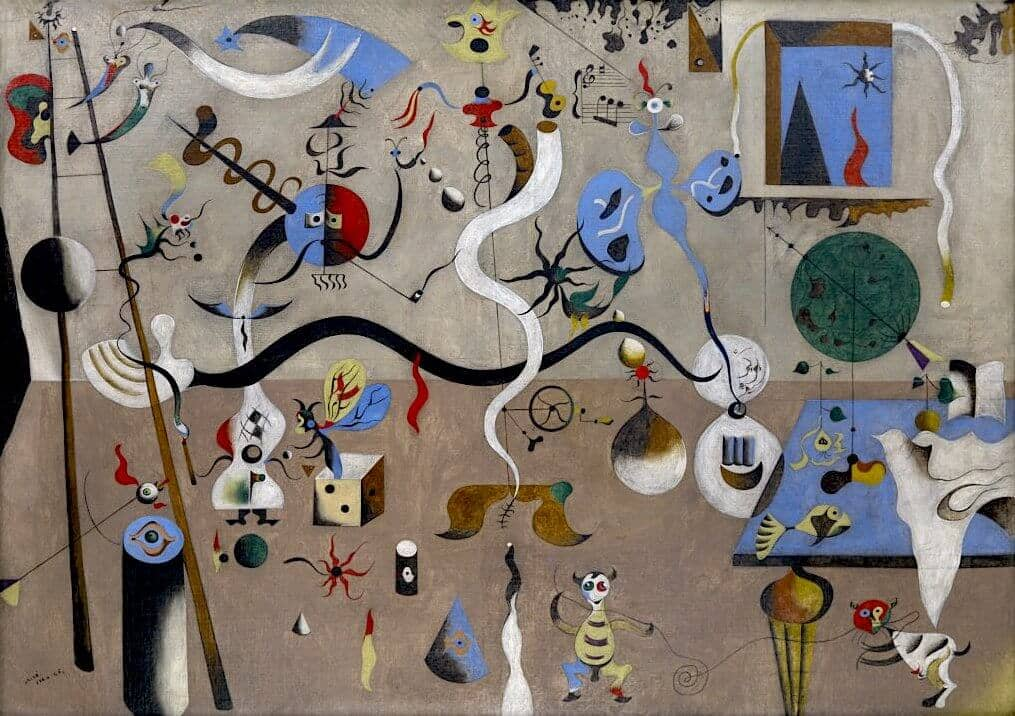
Joan Miró’s The Harlequin’s Carnival looks as though someone opened a door onto a world where everything had suddenly come alive.
Painted between 1924 and 1925, the work is crowded with strange little figures, floating shapes, musical instruments, animals, eyes, ladders, stars, and creatures that seem impossible to name. A guitar-like form stretches across the composition, a cat stands upright, and a figure with a harlequin’s costume appears among the jumble. There is no obvious centre to the scene and no clear narrative telling us where to look first.
Yet the chaos is carefully controlled.
Miró was living in Paris and experiencing financial difficulties when he began the painting. He later explained that hunger had produced hallucination-like sensations for him, describing the work not as a translation of his dreams but as an attempt to capture what hunger itself could produce, a kind of trance. That distinction is revealing. His Surrealism was not necessarily about closing his eyes and reproducing whatever appeared in a dream. It could also begin with a physical experience and transform it into an entirely new visual language.
The painting’s crowded surface reflects that process. Miró filled the canvas with forms that seem to be discovering one another as they move through the space, but his preparatory drawings show that this apparent spontaneity was the result of considerable thought. The composition may feel improvised; it was not careless.
Miró had become closely connected with the Surrealist circle in Paris, and The Harlequin’s Carnival was shown in the first major Surrealist exhibition in 1925. But even within that context, his work stood apart. Instead of creating a recognisable dream populated by impossible events, he developed a vocabulary of signs and organic shapes that could hover between objects, creatures, and pure invention.
That uncertainty is part of the pleasure of looking at the painting. You might recognize a bird in one corner and a musical instrument in another, only for both to dissolve into lines and shapes when you look again. The eye keeps moving because the painting never settles completely into one interpretation.
Perhaps that is why The Harlequin’s Carnival feels less like a picture of a dream and more like a record of an imagination in motion. Miró takes something as basic as hunger and turns it into a carnival of forms. The result is playful, peculiar, and surprisingly deliberate, a reminder that Surrealism could find its way into painting not only through dreams, but through the strange transformations of everyday experience.
Read more : Five Bookshops to Visit in Paris
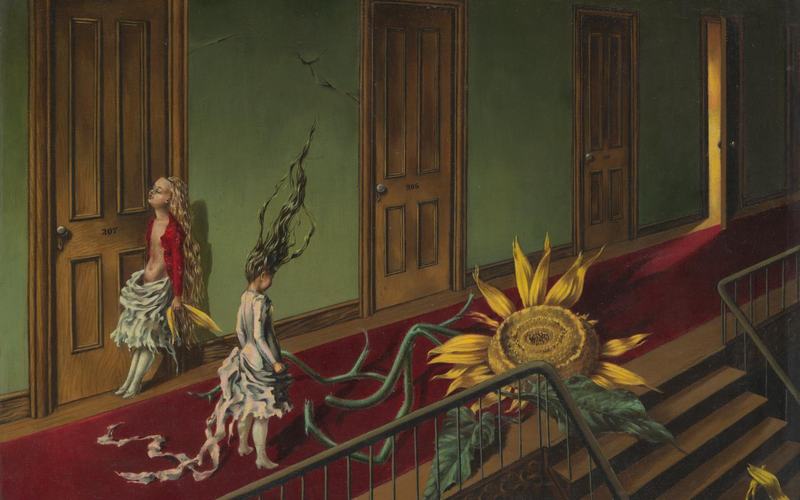
5. Dorothea Tanning, Eine kleine Nachtmusik, 1943
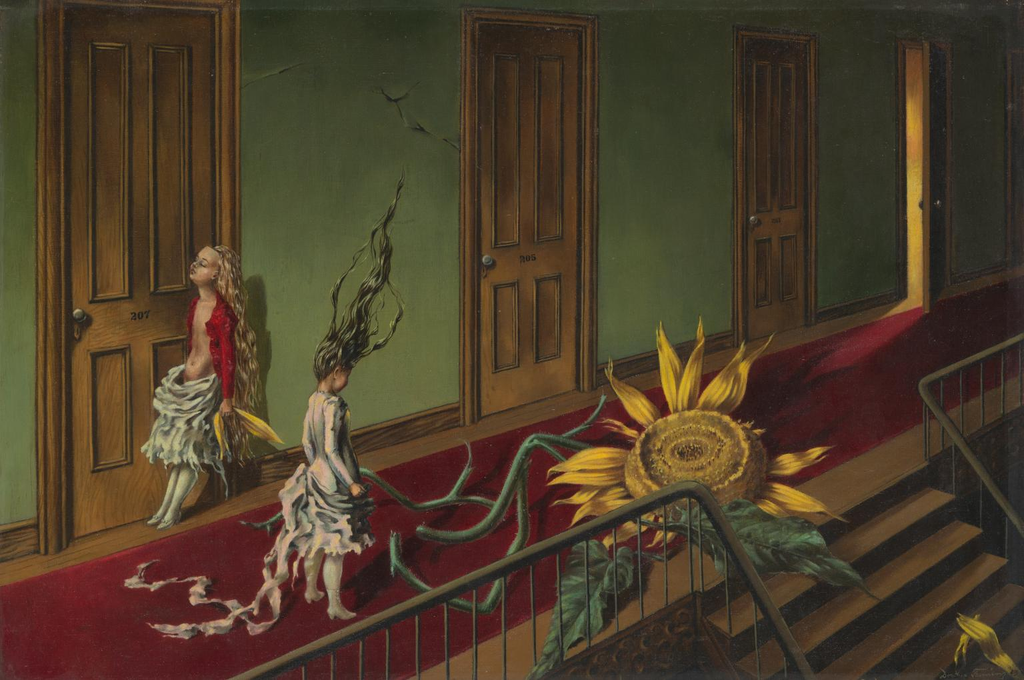
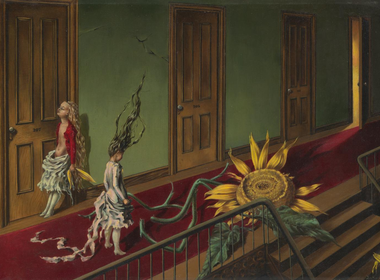
A hotel corridor should be one of the least mysterious places in the world. It is a space designed for passing through, with identical doors, patterned carpet, and nothing much expected to happen. Dorothea Tanning turns that familiarity into the setting for something far more unsettling.
Painted in 1943, Eine kleine Nachtmusik takes its title from Mozart’s well-known serenade, but there is nothing particularly musical or serene about the scene. Two young girls stand in a dim hotel corridor. One appears to have just been pulled toward the centre of the painting, her hair and dress caught in an invisible force, while the other stands farther back. Beside them lies an enormous sunflower, its broken stalk stretching across the floor.
The image feels like the aftermath of an event we have arrived too late to understand.
Tanning drew on the atmosphere of childhood fears and nightmares, and the painting’s title adds another layer of disquiet. The elegant musical reference sits uneasily beside the violence and confusion suggested by the scene. The hotel itself offers no explanation. Its closed doors seem to promise rooms beyond the frame, but none of them tells us what has happened.
That refusal to explain is central to the painting’s effect. Tanning does not give the viewer a clear story or a fixed symbolic vocabulary. The girls, the sunflower, the corridor, and the torn fabric create a situation that feels psychologically charged without becoming entirely decipherable.
Tanning had moved to New York in the early 1940s and became part of the city’s Surrealist milieu. Like many artists associated with the movement, she was interested in dreams and the unconscious, but her work often drew on something much closer to lived experience: fear, memory, desire, sexuality, and the peculiar logic of childhood.
The sunflower is particularly striking. Normally associated with brightness and growth, here it is oversized, damaged, and almost threatening. Tanning takes something recognisable and shifts it just far enough from the ordinary for it to become uncanny. The same happens with the girls. They are children in a familiar-looking place, yet their surroundings no longer feel safe or comprehensible.
By the time we reach Eine kleine Nachtmusik, Surrealism has taken us a long way from Dalí’s melting clocks. Tanning shows that the unreal does not always require fantastic landscapes or impossible creatures. Sometimes it only takes an ordinary corridor, a childhood fear, and one very large sunflower.
And perhaps that is what makes the painting linger. We may not know exactly what happened in that hallway, but we recognize the feeling of knowing that something has happened, and not having the language to explain it.
Beyond These Five
Five paintings can only take us so far. Surrealism was never a movement with one visual language, and its reach extended well beyond the artists most often reproduced in introductory art books. Max Ernst’s Two Children Are Threatened by a Nightingale, for instance, turns a painted scene into something almost theatrical, combining oil painting with wooden elements and cut-and-pasted paper. Giorgio de Chirico’s earlier paintings, including The Song of Love, offer another route into the movement through the uncanny combinations of objects that helped shape Surrealist thinking. Meret Oppenheim’s Object and the work of Remedios Varo, Yves Tanguy, Kay Sage, and Toyen open up still more possibilities. The more you explore Surrealism, the harder it becomes to reduce it to melting clocks and dream imagery, and that may be one of the best reasons to keep looking.
Conclusion
Perhaps the most lasting idea Surrealism gave us was not a particular style, but permission to question the ordinary.
Across these five paintings, reality keeps slipping out of reach in different ways. Dalí makes time soft and unstable. Magritte reminds us that an image is never quite the object it depicts. Carrington turns the self into something fluid and unknowable, Miró transforms hunger into a world of strange and carefully arranged forms, and Tanning finds the uncanny hiding inside an otherwise familiar corridor.
None of these paintings asks to be understood in exactly one way. In fact, trying to explain them completely may miss the point. Surrealism leaves room for uncertainty, for the possibility that a painting can raise a question without answering it.
More than a century after the movement began taking shape, that invitation still feels relevant. We spend much of our lives naming things, organizing them, measuring them, and deciding what makes sense. Surrealist artists simply interrupted that process. They made room for the irrational, the unexpected, and the things that are difficult to put into words.
And once you start looking at the world that way, even the familiar can begin to feel a little strange.
Explore the current open calls and submit your work: apply.artstoheartsproject.com