


The Barcelona Chair: A Design That Outlived Its Time
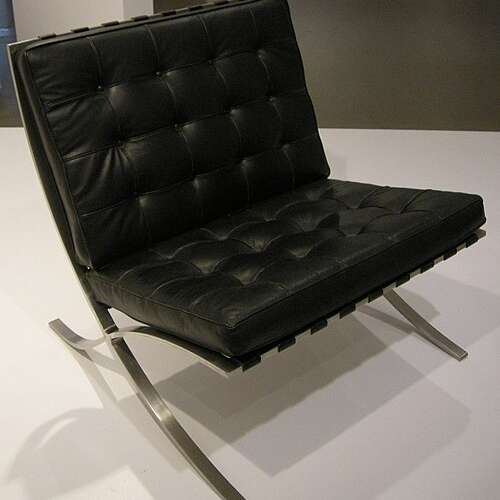
The Barcelona Chair was designed for a building that no longer exists.
In 1929, Ludwig Mies van der Rohe designed the German Pavilion for the International Exposition in Barcelona, floating planes, glass, stone, steel, an unusually open relationship between inside and outside. The pavilion wasn’t just a container for exhibits. It was the statement itself.
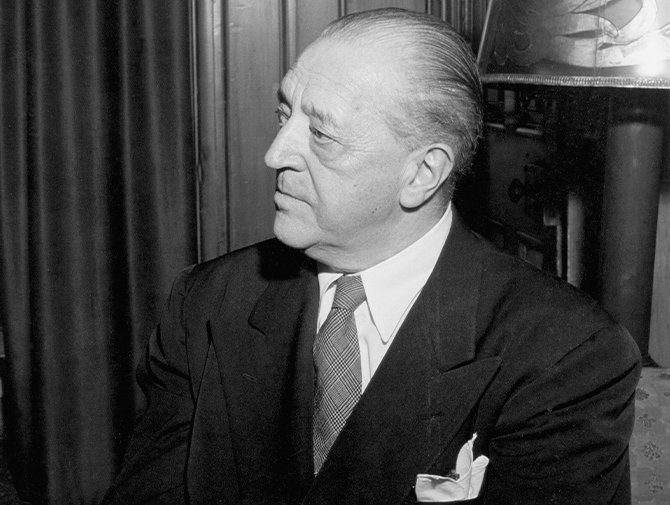
Ludwig Mies van der Rohe and Lilly Reich
The chair belonged to that statement. It was designed for a single occasion, with the Spanish king expected at the inaugural ceremony, and only two chairs were made for the pavilion. That could have been the end of its story: the exposition closed, the pavilion came down, and the chair could have stayed a footnote in architectural history.
Instead, it became one of the most recognized pieces of furniture of the 20th century, still manufactured, collected, and copied nearly a hundred years later. Its story isn’t really about a famous chair. It’s about how an object built for one place and one moment outlived both.
A Chair With One Job
The Barcelona Chair didn’t start as a furniture-catalog piece. Its first job was much narrower than that.
Mies was commissioned to design the German Pavilion for the 1929 Barcelona exposition, and the building was set to host the official opening of the German section, with the Spanish king expected to preside. Inside a room built from marble, glass, and steel, Mies needed a seat that could hold its own. As MoMA records, he wanted an “important chair,” elegant and monumental enough for the occasion, nothing that looked like it belonged in a kitchen.
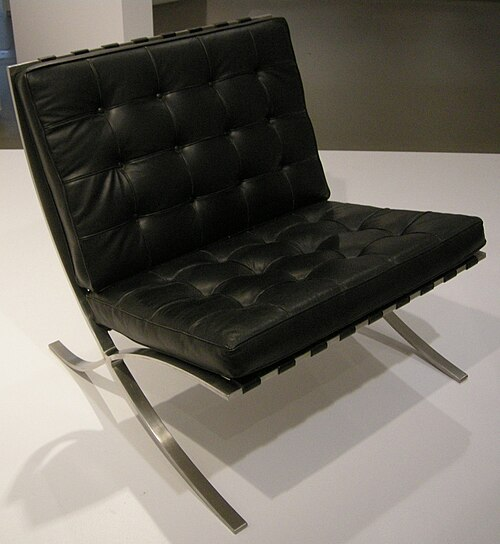
What he built looked less like ordinary furniture and more like architecture, scaled down to fit a body. Its crossed steel frame wasn’t new, the form goes back to ancient folding stools and later neoclassical seating, but Mies stripped away the historical ornament and rebuilt it in flat steel, leather, and clean intersections.
Only two chairs were made for the pavilion. That detail is easy to skip past, but it matters: this wasn’t designed to fill living rooms. It was built for one room, one occasion, one very specific audience. The irony is that the pavilion itself lasted barely seven months before it was dismantled. The chair has outlived it by nearly a century, and counting.
The Simplicity Is Deceptive
From across a room, the chair looks almost too easy, a few crossed steel bars, a neat stack of cushions, nothing to distract from the structure. Up close, that impression falls apart.
The frame is flat steel, chrome-plated in the original, with stainless steel entering the picture later. The cushions aren’t single pieces of upholstery, they’re built from 40 individual leather panels, cut from a single cowhide, hand-welted and hand-tufted so the seams and buttons become part of the design instead of something to hide.
Mies didn’t get to simplicity by removing work. He concentrated it. Every visible line, every seam, every panel had nowhere left to hide, the quality had to come from proportion and precision alone. That’s what makes “less is more” more interesting up close than it sounds as a slogan. Looking at the chair directly, it reads less like a philosophy and more like a specific problem being solved: how much can you take away before the leftover details become the entire design?
Read more : The Strange Beauty of Cats in Art
From Exhibition Piece to Design Classic
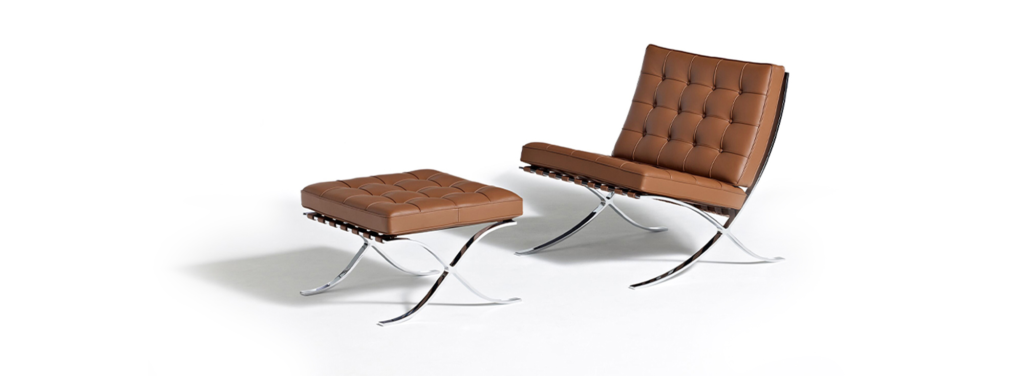
Barcelona Chair, Ludwig Mies van der Rohe, 1929
The chair could easily have stayed a one-off. Instead, it went into production almost immediately. Early versions were made in Germany, and Thonet produced the chair from 1932 until 1934, when production was discontinued.
Its second act came through an unlikely connection. After Mies emigrated to the United States in 1938, he became director of architecture at what was then the Armour Institute, later the Illinois Institute of Technology, in Chicago. One of the people he mentored there was Florence Knoll, who eventually convinced him to bring his furniture into wider American production. He agreed, and Knoll began manufacturing the Barcelona Chair in 1947.
That transition wasn’t a simple act of copying the original. Knoll experimented with aluminium before abandoning it for chrome-plated steel, and stainless steel eventually entered the mix too. The design kept moving forward with each shift in manufacturing, “while its basic proportions remained recognisable.” The pavilion had disappeared. The chair had found a way to keep going without it.
Bigger Than the Room It Was Built For
Once the chair left Germany and entered Knoll’s catalog, it stopped needing the pavilion to explain itself. Inside the original building, it had been part of an argument about architecture. Removed from that setting, it became legible as an object in its own right, the crossed frame and leather cushions were enough to identify it, with or without marble walls around it.
That’s a rare thing in design history. Most objects stay tied to the movement or moment that produced them. A few escape their original context entirely and become shorthand for an idea instead. The Barcelona Chair is one of those. It can sit inside a modernist building and look completely at home, or anchor a room that has nothing to do with 1929, and either way, you don’t need to know anything about the Barcelona Pavilion to recognize it.
Read more : Elsa Schiaparelli, the Designer Who Put Surrealism on a Dress
Why It Still Looks Modern
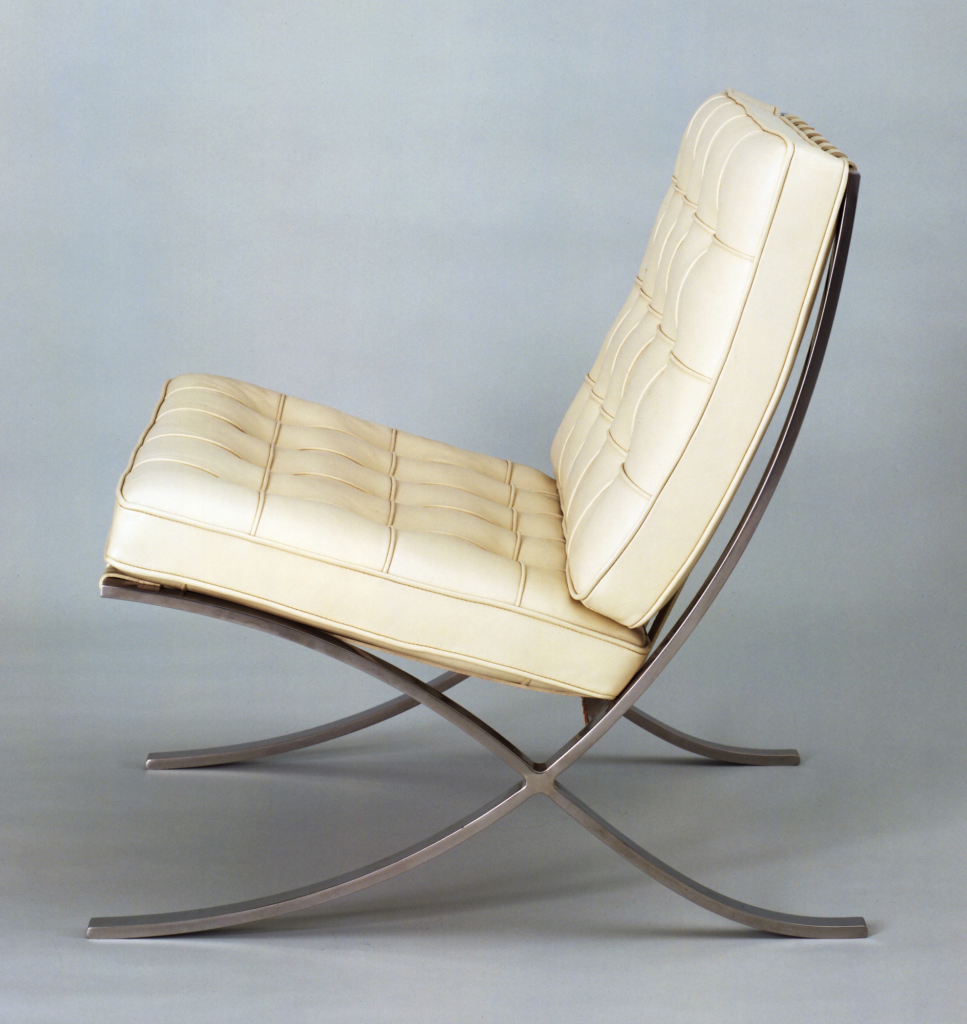
Ludwig Mies van der Rohe, Barcelona Chair – Designed 1929 (this example 1953)
The easy explanation is that it’s a classic. That just moves the question elsewhere: what actually keeps a design looking current for a hundred years?
This chair doesn’t lean on a particular fashion. Its language comes from proportion, structure, and material rather than decoration, a form with roots in ancient ceremonial seating, rebuilt entirely in the vocabulary of modernism. It reads as a product of 1929 without needing the visual habits of 1929 to make sense; put it in the original pavilion and it belongs to Mies’s architecture, put it in a room built yesterday and it still doesn’t look out of place.
Continuous production helped, but that alone doesn’t explain an icon, plenty of old furniture survives without becoming one. What sets the Barcelona Chair apart is that it’s unusually easy to recognize and unusually hard to pin to a single period. It reads as furniture, but carries the logic of architecture: structure exposed, materials left to speak for themselves, proportion doing most of the work.
You’ve probably already sat in one, or in one of the countless unlicensed copies, the crossed frame and leather cushions turn up in hotel lobbies, waiting rooms, and office reception areas often enough that most people have encountered it without ever learning its name.
Almost a century later, the chair hasn’t had to become modern again.
It never really stopped.
Editor’s Note
The Barcelona Chair reminds us that the things we make can sometimes travel much further than the moment in which we make them. A design created for one pavilion in 1929 went on to become part of the visual language of modern life.
The same is true of art. You never really know which work will stay with people, which idea will find its audience, or what a piece you make today might mean years from now.
If you’re an artist with work you want to put into the world, Arts to Hearts Project is currently accepting submissions through its open-call platform, connecting artists with opportunities for publications, exhibitions, and features. The platform welcomes artists across mediums and career stages and is built to help artists move beyond the fleeting nature of social media and create lasting visibility for their work.
Explore the current open calls and submit your work: apply.artstoheartsproject.com