





The Strange Beauty of Cats in Art
There’s something about a cat that makes it hard to look away. It might be perched on a windowsill, watching through half-closed eyes, or investigating something no one else has noticed. Cats rarely ask for attention. They get it anyway.
Maybe that’s why artists have never stopped painting them. Across centuries of canvas, cats appear as companions, observers, dreamers, occasionally something closer to otherworldly, turning a domestic scene warmer, a quiet room mysterious, an ordinary moment strangely alive. Their beauty was never about how they look. It’s about how they exist.
Here are eight paintings that capture some of that strange beauty of cats.
Suzanne Valadon — Raminou Sitting on a Cloth
The beauty of simply being a cat
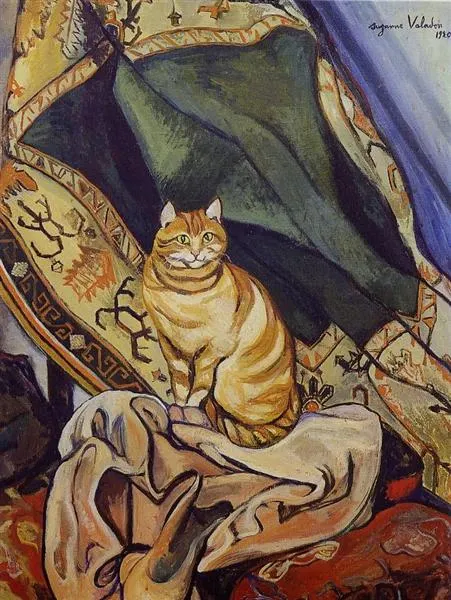
Some cats know they’re being watched. Raminou clearly does.
He sits upright in Suzanne Valadon’s portrait, completely at ease, as if the room belongs to him. Nothing dramatic is happening, and yet it’s hard to look anywhere else.
That might be the strangest thing about cats: they don’t have to do much to become the center of a scene. Raminou’s stillness reads as deliberate, his narrowed eyes faintly suspicious. He isn’t performing for the viewer; if anything, he’s deciding whether the viewer deserves his attention.
Valadon, who painted people and animals with an unusually direct eye, gives Raminou the dignity of a real subject, a personality, not a prop.
A cat’s eyes can say a surprising amount without giving anything away. Artists have always been fascinated by that kind of expression, the ability to make a face feel distant, mysterious, or almost unreadable. Modigliani pushed that idea even further in his portraits, where the eyes often seem to withhold as much as they reveal. Why Do So Many of Modigliani’s Portraits Have Empty Eyes? explores what makes those unforgettable faces so strangely compelling.
Henri Matisse — Cat with Red Fish
The beauty of curiosity
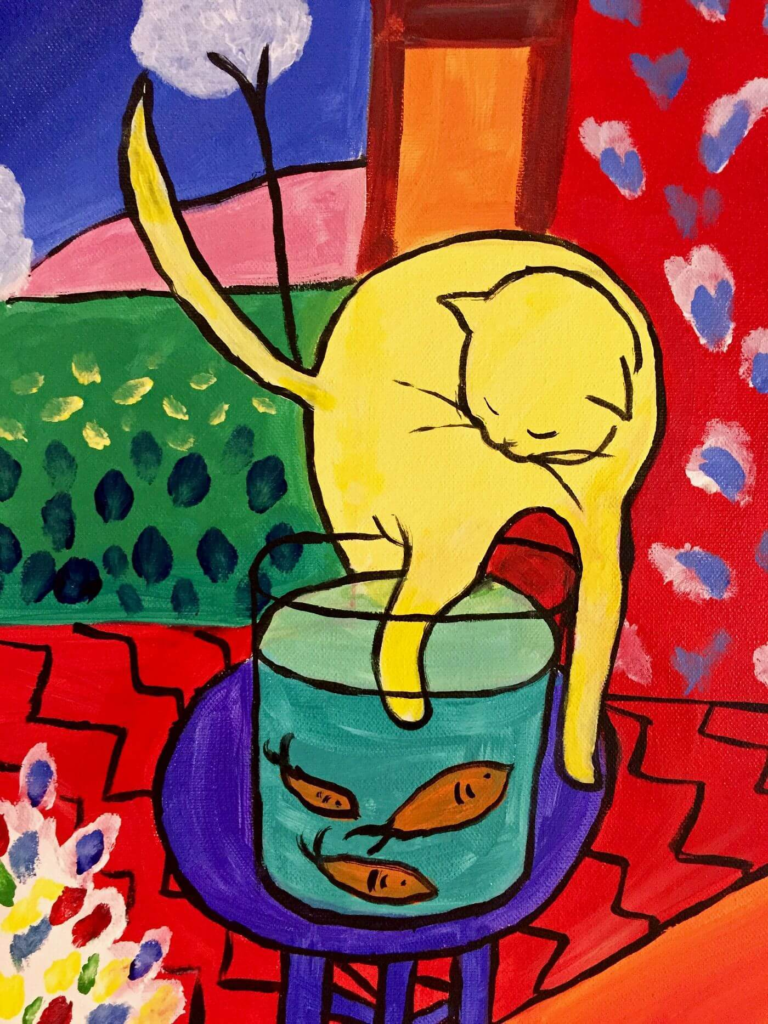
Every cat owner recognizes this moment. The cat in Matisse’s painting has found something interesting, and for now, nothing else exists.
It leans toward the fish with almost comic concentration, the same fixation you’ve watched a hundred times at home: something new appears, and total absorption follows.
Matisse wraps the scene in bold color and simplified shapes, turning a small domestic moment into something close to a dream. The cat isn’t elegant here, it’s alert, curious, completely absorbed. That’s exactly what makes it charming, a reminder that cats aren’t only beautiful curled up and still. Sometimes the beauty is in how completely they can notice a thing.
Ruskin Spear — The Curious Cat
The beauty of having a world of your own
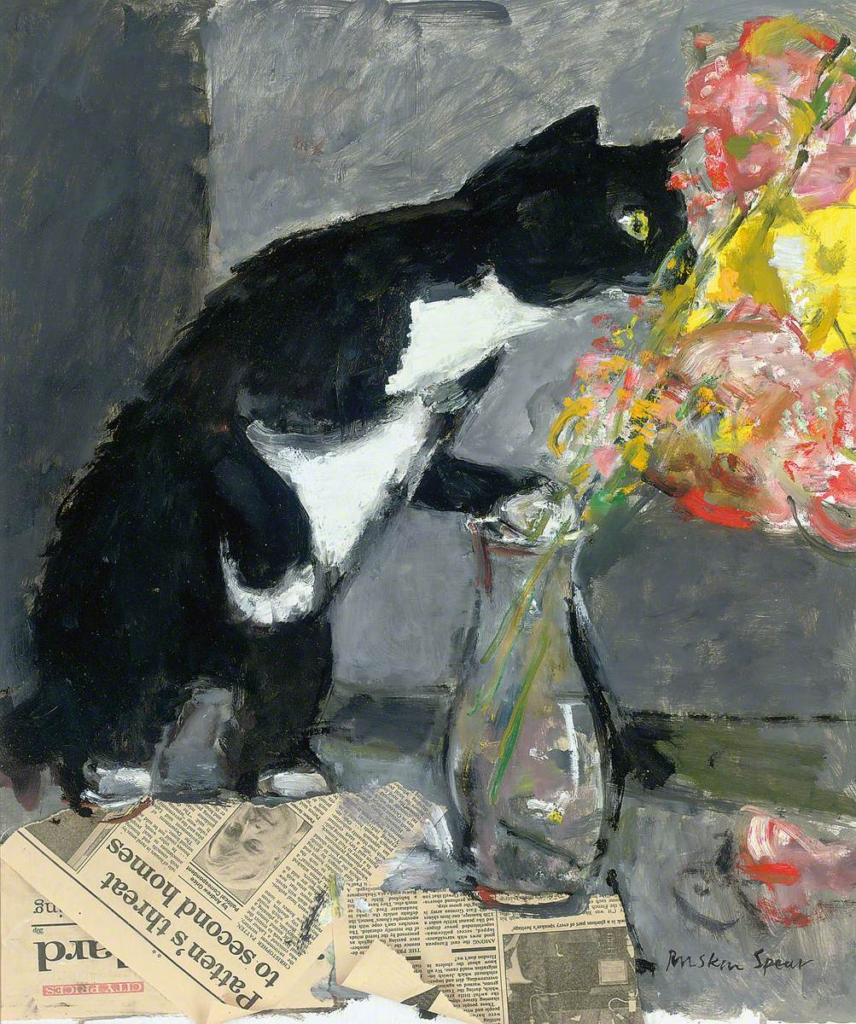
A cat can look at the most ordinary object as though it just uncovered a secret.
That’s the feeling at the center of Ruskin Spear’s painting. The animal’s attention is fixed somewhere beyond the frame, entirely absorbed in whatever it has noticed, leaving us outside the moment, wondering what caught its eye.
Cats are unusually good at building these private worlds: watching a window for minutes, tracing a shadow across the floor, staring into a corner that clearly holds nothing at all. To us, maybe nothing. To them, apparently enough. It’s a reminder that cats always seem to have a life running somewhere just past our understanding.
Takahashi Hiroaki — Black Cat and Tomato Plant
The beauty of instinct
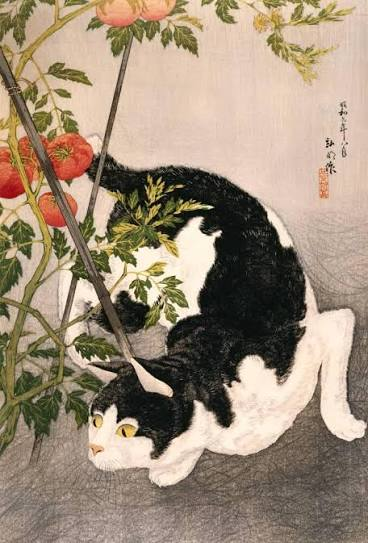
Cats carry a particular kind of alertness. Even at their stillest, some part of them is always listening.
In Takahashi Hiroaki’s print, the cat sits caught between domestic life and something more instinctive. The garden around it is familiar and settled; the cat is not, its presence adding a flicker of tension, as if it might bolt at any second.
The tomato plant stays rooted. The cat doesn’t. That restlessness is part of what makes cats so watchable, proof that even the most domesticated cat still carries a sliver of the untamed world with it, something we can name and feed and house, but never quite own.
Victor Gabriel Gilbert — Un Repas à Deux
The beauty of companionship
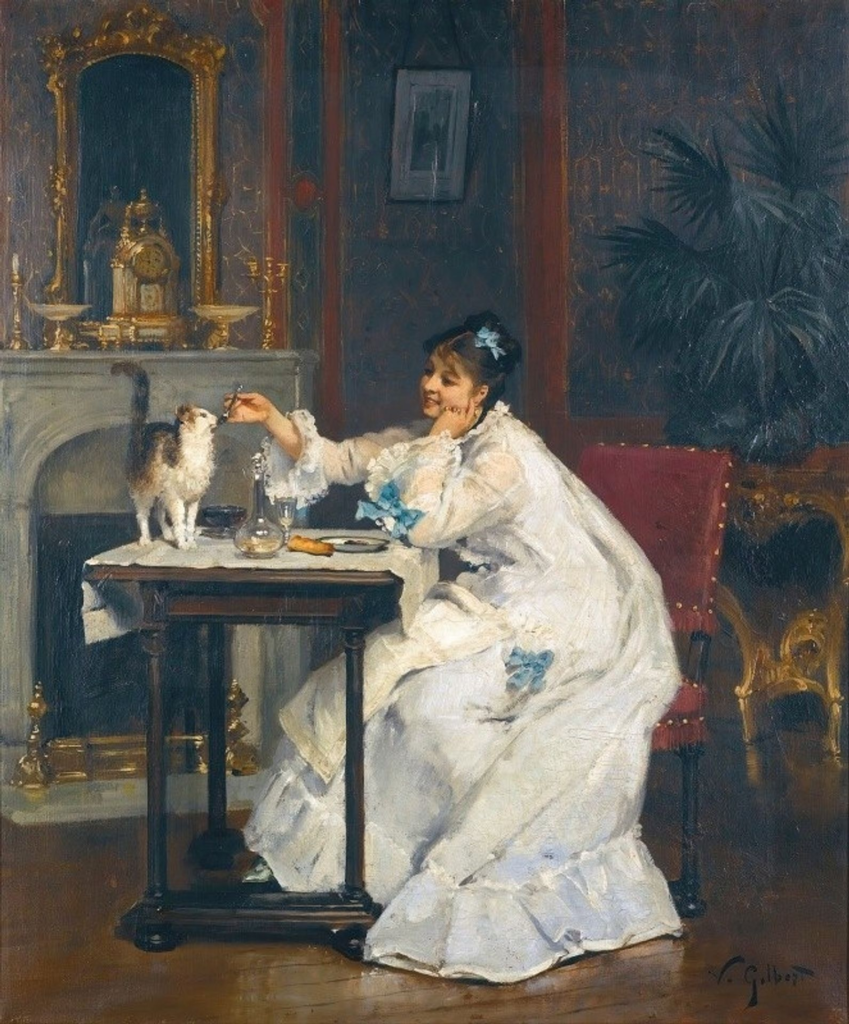
Some of our closest relationships are built from ordinary moments, sitting nearby, sharing a room, being present without needing to say anything.
That’s what Victor Gabriel Gilbert’s painting captures. The cat’s presence turns the scene from a formal portrait into a glimpse of everyday life, as natural there as the table or the meal itself.
Cats rarely announce that they’ve become part of our lives. They just start showing up in the routine, then disappear once they’ve had enough. In Gilbert’s painting, the cat doesn’t need to be the focus to matter, its presence simply changes how the whole scene feels. Companionship doesn’t always look like closeness.
Remedios Varo — Gato Helecho
The beauty of the strange
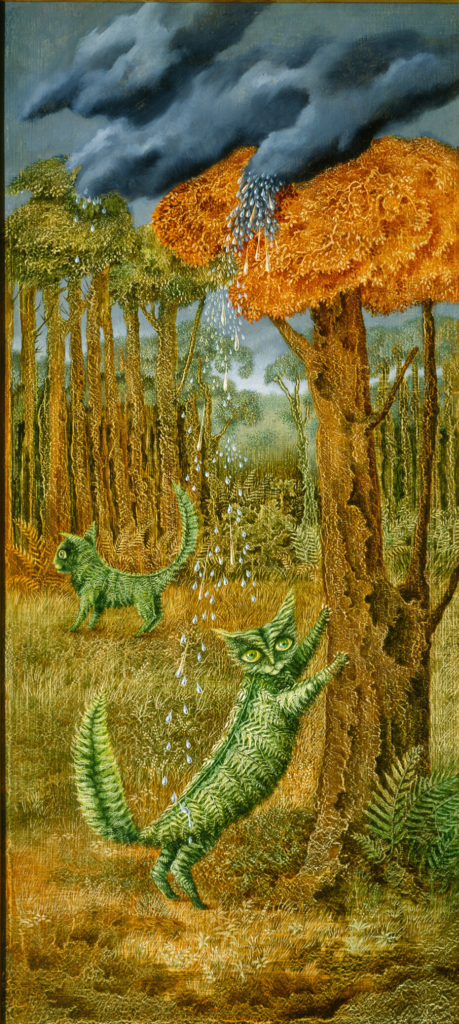
Some cats are beautiful because they’re graceful. Others are beautiful because they seem to belong to a world we can’t quite enter.
Remedios Varo’s cat is the second kind, pushed somewhere wonderfully strange, less an animal being observed than a creature out of a dream, familiar enough to recognize, strange enough to make you wonder what else might be going on.
That tracks with how cats actually behave. They sit perfectly still and make a room feel mysterious. They vanish for hours and reappear as if nothing happened. Varo gives that feeling a visual language, a reminder that the fascination with cats was never only physical. It’s also about their otherness.
Marc Chagall — La Poète
The beauty of dreaming
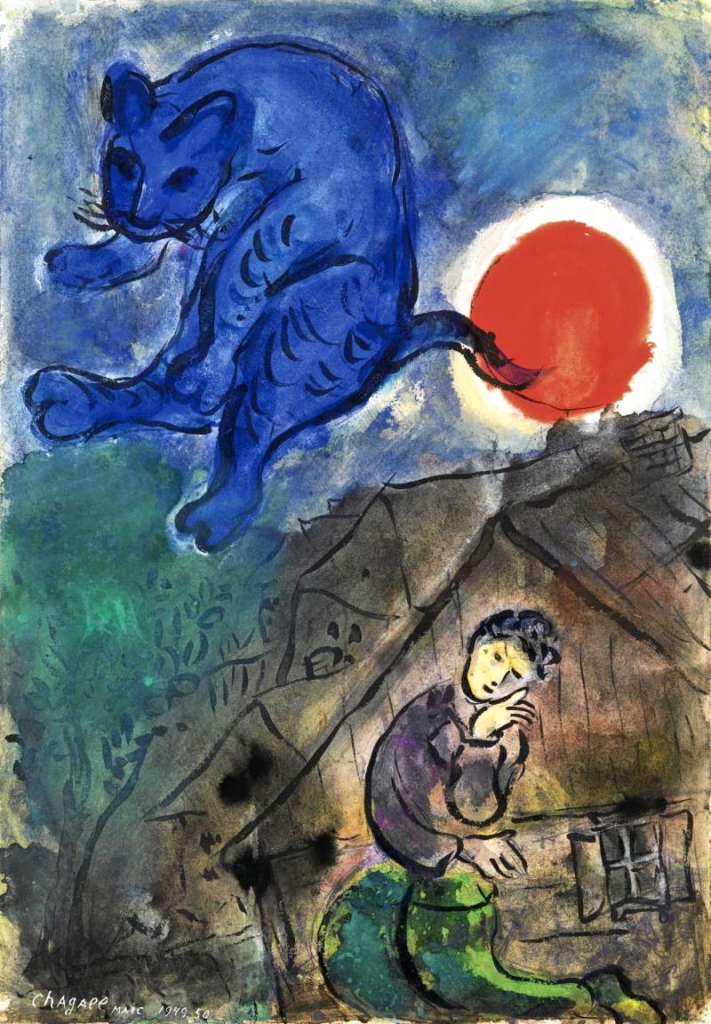
Cats seem perfectly at home in dreams, maybe because they already move through the world as though the ordinary rules are optional. Chagall understood that instinctively.
In La Poète, the cat belongs to the same floating world as the human figure beside it. It isn’t a decorative flourish, it’s part of the painting’s logic, another quiet presence where people, animals, color, and imagination all exist on the same plane.
That feels fitting. A sleeping cat can turn a windowsill into its own private landscape; even its silence carries a kind of expression. Sometimes it’s enough to let it belong to the mystery.
Carl Wilhelmson — The Black Cat
The beauty of quiet presence
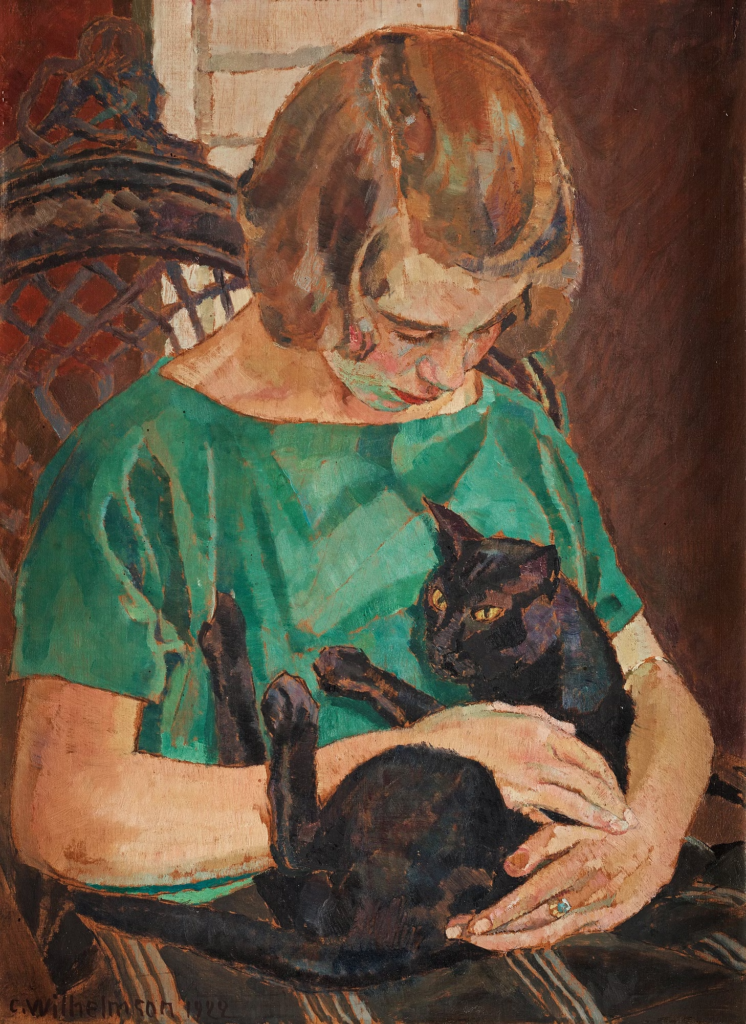
Not every painted cat needs to be playful, curious, or mysterious. Sometimes just being there is enough.
Carl Wilhelmson’s cat shares the scene with a human figure, and neither performs for the viewer, it feels less like an invited scene than a private moment we’ve wandered into.
Cats become part of our lives without demanding to be noticed every second: sitting nearby while we work, curling up in a corner while the day moves on around them. Looking back, we realize how much of our ordinary lives they’ve quietly witnessed. In Wilhelmson’s painting, the cat’s presence softens the scene without taking it over.
Perhaps That Is the Beauty of Cats
Maybe the strange beauty of cats was never about appearance at all.
It’s in how they can be completely at home and still remain a little unknowable. One painting shows fierce curiosity; another, total indifference. One cat is a companion, another belongs to a dream, another simply watches the world go by.
Artists keep returning to all these versions of the cat because there’s something quietly human about trying to understand a creature that doesn’t much care whether we succeed. After centuries of living beside them, there’s still something we can’t quite explain.
Maybe that small, permanent mystery is the most beautiful thing about them.
Editor’s Note: Every Face Has a Story
If a cat’s expression can make us pause, imagine how much a human face can hold. A glance, a smile, a scar, a memory, every face tells a story.
That’s the idea behind 101 Art Book: Faces Edition, our 14th edition of the 101 Art Book Series. We’re inviting artists worldwide to share their interpretations of the human face and the stories hidden within it.
Selected artists can receive a 4-page spread, customized trophy, certificate, and a chance to win a $500 cash award.
Have a face worth remembering? Submit your work to the open call →