


Why smiles in art history are so hard to Read
Walk through the halls of almost any museum, and a quiet pattern begins to surface: faces look back at you, but they rarely smile. Portrait after portrait holds a certain composure, expressions controlled, emotions restrained, as if something has been carefully held in place. This becomes even more interesting when you begin to notice how smiles in art history are treated not as simple expressions, but as something far more controlled and intentional.
This absence feels striking today, when smiling has become almost instinctive, especially in front of a camera. But for most of art history, the smile was anything but natural to depict. It was fleeting, difficult to sustain, and often socially coded in ways that made it unsuitable for formal representation. A painted portrait was not just an image; it was a construction of identity, shaped by expectations of status, decorum, and permanence.
When smiles do appear, they are rarely straightforward. They carry ambiguity, suggestion, and at times, discomfort. They can signal intimacy or excess, seduction or defiance. More often than not, they resist easy interpretation.
Tracing these expressions across centuries reveals something larger than a stylistic choice. It uncovers a history of how emotion has been controlled, performed, and understood within visual culture. Because in art, a smile has never been just a smile, it has always meant something more.
Saint John the Baptist (1513–1516) – Leonardo da Vinci

Walk through the galleries of almost any museum, and a quiet pattern begins to emerge, faces meet your gaze, but they rarely smile. There is a sense of restraint that defines much of portraiture, a kind of emotional control that feels deliberate rather than incidental. Even when a smile does appear, as it does here, it doesn’t read as warmth or ease. Instead, it unsettles.
In Saint John the Baptist, Leonardo presents an expression that resists clarity. The slight upward curve of the lips feels less like joy and more like a private knowledge, something held back rather than offered. It hovers between invitation and ambiguity, drawing the viewer in without ever resolving into something fully legible. This ambiguity is not accidental, it reflects a broader tension in art history between revealing emotion and controlling it.
Part of the reason lies in the nature of painting itself. Portraits required long, physically demanding sittings, where holding a natural smile would have been nearly impossible. A smile, unlike a neutral expression, is fleeting; it exists as a response, not a sustained state. To fix it in paint risked turning it into something strained or unnatural.
As a result, artists often chose stillness over spontaneity. And when they didn’t, when a smile slipped in, it carried weight. It became charged, symbolic, and often slightly disquieting, as it is here.
Portrait of a Young Man (c. 1470) – Antonello da Messina

Long before the enigmatic expressions of the High Renaissance became iconic, Antonello da Messina was already experimenting with something quietly radical: the suggestion of a smile. In his portraits, the face is no longer just a surface of status or formality, it begins to feel inhabited, as if thought and personality exist just beneath the skin.
In Portrait of a Young Man, the expression is subtle, almost easy to miss. The lips do not part, and there is no overt display of emotion, yet something shifts in the gaze. It suggests an interior life, a fleeting moment of awareness between sitter and viewer. This is not the kind of smile that declares itself; it lingers at the edge of perception.
What makes this particularly significant is the context in which Messina was working. Influenced by Northern European oil painting techniques, he was able to render finer gradations of light, texture, and expression than many of his contemporaries. This technical precision allowed him to move beyond rigid, symbolic portraiture toward something more observational and human.
And yet, even here, the smile remains controlled. It does not break the decorum of the portrait or disrupt its balance. Instead, it operates within it, suggesting that while emotion could be hinted at, it was still carefully measured.
In many ways, Messina’s portraits mark an early turning point: the moment when the face in art begins to feel less like an emblem, and more like a person.
Young Man and Woman in an Inn (1623) Frans Hals

If the absence of smiles dominates aristocratic portraiture, their presence in Dutch Golden Age painting feels almost startling. In works like Young Man and Woman in an Inn, Frans Hals embraces expressions that are loose, animated, and unapologetically alive. The figures laugh, gesture, and engage with one another in ways that feel immediate, even spontaneous, qualities rarely seen in more formal portrait traditions.
But these smiles are not neutral. They exist within a very specific social and cultural framework. By the 17th century, in much of Europe, openly baring one’s teeth was considered improper among the upper classes. A composed, unsmiling face signaled discipline and refinement, while laughter and visible pleasure were often associated with indulgence, theatricality, or lower social standing.
Hals leans into this distinction. His subjects are not distant elites but figures situated in lively, often informal settings, taverns, gatherings, moments of leisure. Their smiles, then, do more than express emotion; they signal a kind of freedom from restraint, a departure from the rigid codes of aristocratic behavior.
At the same time, there is an undercurrent to these scenes. The looseness of expression hints at excess, at the blurred boundaries between enjoyment and impropriety. The smile becomes part of a larger narrative, one that situates the figures within a world of pleasure, performance, and social ambiguity.
In Hals’s hands, the smile is no longer rare, but it is never simple.
The Concert (c. 1633)- Judith Leyster

In Judith Leyster’s The Concert, smiles surface again, but they do not exist in isolation, they are embedded within a larger scene of interaction, performance, and suggestion. Three figures gather around music, their expressions animated and engaged, yet the mood is far from innocent. There is a sense that something is unfolding beyond what is immediately visible.
In 17th-century painting, music was rarely just about sound. It often functioned as a symbol of love, flirtation, and at times, moral looseness. Within this context, the smiles exchanged between the figures begin to carry layered meanings. They suggest connection, but also complicity, a shared moment that might be as much about desire as it is about harmony.
Leyster’s handling of expression is particularly striking because it resists clarity. The smiles are open, yet not entirely transparent. They invite the viewer into the scene, but only partially, leaving space for interpretation. Are we witnessing a casual gathering, or something more intimate, even transgressive?
This ambiguity reflects a broader shift in how emotion operates within genre painting. Unlike formal portraiture, where expressions are controlled and symbolic, scenes like this allow for more fluidity. Yet that freedom comes with its own set of codes.
Here, the smile does not simply reveal feeling, it becomes part of a narrative structure, hinting at relationships, tensions, and the social dynamics that unfold just beneath the surface.
Amor Vincit Omnia (Triumphant Eros) (1602) – Caravaggio

If earlier smiles in art hover between subtlety and suggestion, Caravaggio pushes the expression into far more confrontational territory. In Amor Vincit Omnia, the young Cupid does not offer a gentle or ambiguous smile; instead, he grins directly at the viewer with a confidence that feels almost unsettling. The expression is immediate, disarming, and difficult to ignore.
What makes this smile particularly striking is how openly it engages the viewer. Unlike the restrained faces of Renaissance portraiture, where emotion is carefully contained, Caravaggio’s figure breaks that boundary. The grin feels aware, almost performative, as though the subject recognizes the act of being seen and responds to it.
Within the context of Baroque art, this kind of expression carries layered implications. The painting itself is charged with symbolism, love, desire, power and the smile amplifies that tension. It is not simply playful; it borders on provocative. Early viewers did not interpret the work as innocent. Instead, they read it through the lens of excess, sensuality, and even transgression.
Caravaggio’s treatment of the smile reflects a broader shift in his work, where emotion becomes more direct, physical, and embodied. Yet even in this heightened form, the smile does not resolve into something comfortable.
Instead, it unsettles. It challenges. And in doing so, it reveals just how loaded, even risky, an expression like a smile could be within the visual language of its time.
Mona Lisa (c. 1503–1519) – Leonardo da Vinci

Few images have shaped our understanding of the smile in art as profoundly as the Mona Lisa. And yet, what makes it so compelling is precisely how little it gives away. The expression is restrained, closed-lipped, delicate, and constantly shifting depending on how long you look at it. It never fully settles into a single, readable emotion.
This ambiguity is not incidental; it is the result of Leonardo’s meticulous technique. Through sfumato, he softens the transitions between light and shadow, allowing the edges of the mouth to dissolve into uncertainty. The smile seems to appear and disappear, not because it changes, but because our perception of it does.
In many ways, this painting captures the central tension of the smile in art history. Rather than presenting emotion directly, it withholds it. The expression invites interpretation but resists confirmation, keeping the viewer in a state of continuous looking.
What is striking is that this is often considered the most famous smile in art, yet it is one of the least expressive in conventional terms. There are no teeth, no overt joy, no clear emotional signal. Instead, there is control, an awareness of how much to reveal and how much to conceal.
That balance is what gives the Mona Lisa its enduring power. It transforms the smile from a simple expression into something far more complex: a space where meaning is suggested, but never fully resolved.
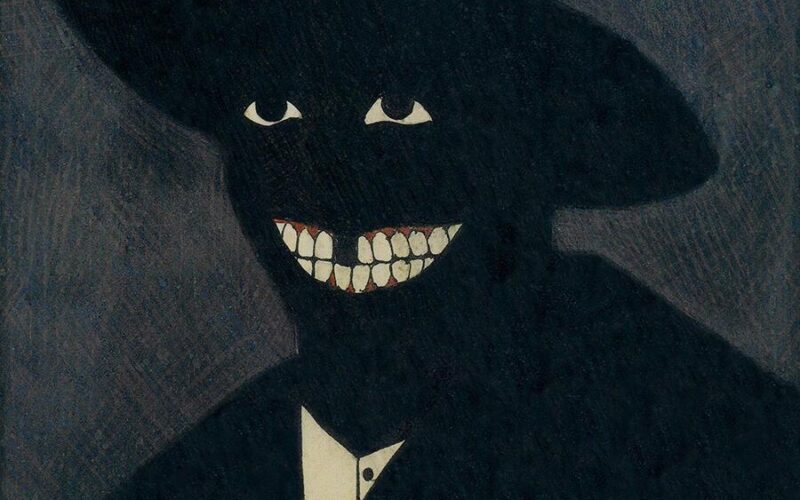
A Portrait of the Artist as a Shadow of His Former Self (1980) – Kerry James Marshall

By the late 20th century, the smile returns to art with a very different kind of intensity. In Kerry James Marshall’s A Portrait of the Artist as a Shadow of His Former Self, the expression is no longer subtle or ambiguous, it is stark, exaggerated, and impossible to ignore. A dark, nearly silhouetted figure confronts the viewer with a wide, white-toothed grin that feels both hyper-visible and deeply unsettling.
This is not a smile that invites connection. Instead, it exposes the tension between visibility and erasure. Referencing Invisible Man, Marshall engages with a history in which Black identity has often been distorted, caricatured, or rendered invisible. The exaggerated grin recalls visual tropes rooted in racist imagery, forcing the viewer to confront their legacy rather than passively consume the image.
What makes the work particularly powerful is how the smile operates as a kind of mask. It appears expressive, even performative, yet it withholds more than it reveals. The figure’s identity is flattened into contrast, black against white, presence against absence, while the grin becomes the only sharply defined feature.
In this context, the smile is no longer about emotion at all. It becomes a tool, one that questions how identity is constructed, seen, and misread.
Marshall doesn’t restore the smile as a natural expression; he complicates it further, turning it into something loaded, historical, and impossible to take at face value.
The Resurrection (2010)- Yue Minjun

If earlier artists treated the smile as something to restrain or carefully encode, Yue Minjun does the opposite, he amplifies it to the point of excess. His figures laugh with identical, exaggerated grins: eyes shut tight, mouths stretched wide, teeth fully exposed. At first glance, the repetition reads as humorous, even absurd. But the longer you look, the more unsettling it becomes.
In works like The Resurrection, the smile loses its individuality. It is no longer tied to a specific emotion or moment; instead, it becomes mechanical, almost compulsory. Every figure wears the same expression, as if performing happiness rather than experiencing it. The effect is strangely hollow.
Emerging from China’s Cynical Realist movement, Yue’s work is deeply tied to questions of politics, conformity, and social pressure. His repeated self-image, copied across canvases in different historical and cultural scenarios, suggests a kind of enforced sameness. Within that context, the exaggerated smile begins to feel less like joy and more like a mask, one that conceals as much as it reveals.
What makes these works particularly striking is how they invert the history that came before them. Where earlier portraits avoided the smile for being too revealing or unstable, Yue pushes it to such extremes that it becomes unreadable again.
In the end, the expression circles back to ambiguity, not through subtlety, but through repetition.

Across centuries, the smiles in art history has shifted from absence to ambiguity, and eventually, to exaggeration. What begins as restraint in early portraiture, where emotion is carefully controlled, gradually evolves into something more complex. When smiles do emerge, they are rarely simple expressions of joy; they are shaped by social codes, artistic challenges, and cultural meaning.
In many ways, the history of the smile mirrors the history of representation itself. Early portraits prioritized permanence and status, leaving little room for fleeting expressions. Later, artists began to experiment, introducing subtle shifts that hinted at inner life, or exaggerations that exposed deeper tensions. By the time we reach contemporary works, the smile often returns as something unstable again, no longer a transparent sign of happiness but a mask, a performance, or even a critique.
What remains consistent is its complexity. Unlike a neutral expression, a smile demands interpretation. It draws attention, raises questions, and disrupts the surface of the image.
Perhaps that is why it was so often avoided.
Because to include a smile is to risk revealing too much, or, just as powerfully, to reveal nothing clearly at all.
Would you rather be painted smiling or not at all?
And if you’ve ever wondered what these faces might say if they could speak, this one’s worth a read:https://artstoheartsproject.com/if-famous-artworks-could-talk/