


The 9 Most Haunting Depictions of Hell in Art History
For centuries, artists have been fascinated by hell.
Not just as a religious idea, but as a place where every human fear could be turned into an image. Some of the most haunting depictions of hell in art history emerged from this fascination, filling canvases with monsters, collapsing cities, tortured bodies, and scenes so strange they still feel unsettling hundreds of years later. Some imagined hell as violent chaos. Others painted it as something quieter and more psychological. Either way, these works were rarely just about the afterlife.
They were about the world the artists were already living in.
War, greed, corruption, guilt, disease, political violence, fear of death. Hell became a way to talk about all of it without restraint. In these paintings, people are swallowed whole, torn apart, hunted by demons, or trapped inside endless nightmare landscapes. But underneath the horror is something much more human. These artists were trying to make sense of suffering itself.
And that may be why these images still work.
Even now, long after the religious fears that inspired many of them have faded, the best depictions of hell still feel uncomfortably familiar. They tap into anxieties that never really disappeared. The fear of losing control. The fear of punishment. The fear that human beings are capable of creating their own damnation.
Some of the artworks on this list are beautiful. Some are grotesque. A few are genuinely difficult to look at.
All of them stay with you.
1. Giotto, The Last Judgment (ca. 1307)

At the bottom right corner of Giotto’s Last Judgment, Satan is eating people.
He chews sinners up, spits them back out into hell, and calmly reaches for more while demons drag terrified bodies toward him. It is grotesque, chaotic, and surprisingly graphic for a fresco painted in the early 1300s. Even today, visitors standing inside the Scrovegni Chapel in Padua tend to stop at that section longer than anywhere else.
Giotto understood exactly what would hold a viewer’s attention.
The chapel was commissioned by Enrico Scrovegni, the son of a wealthy moneylender whose family name had become associated with greed and usury. In medieval Europe, usury was considered a grave sin, serious enough that Dante placed moneylenders in hell in The Divine Comedy. Many historians believe the chapel functioned partly as an act of repentance, a way for the Scrovegni family to repair its spiritual reputation through art and devotion.
Giotto responded by covering the chapel walls with one of the most emotionally convincing visions of damnation Europe had yet seen.
Before Giotto, many religious paintings felt distant and symbolic. Figures often appeared flat and expressionless, suspended in gold backgrounds that separated them from ordinary life. Giotto changed that completely. His bodies have weight. His figures recoil, panic, cling to one another, and visibly suffer. The people being dragged into hell do not feel like abstract sinners. They feel human.
That realism is what still gives the fresco its power.
The punishments are brutal. Naked bodies are burned, stabbed, crushed, and hauled downward by dark, animal-like demons. But the painting never slips into spectacle alone. Every face carries a different expression of fear or pain, which makes the scene feel disturbingly personal. Giotto was not simply illustrating religious doctrine. He was making viewers imagine themselves inside it.
And for a medieval audience standing beneath those frescoes, that fear would have felt very real indeed.
2. Jan van Eyck, The Last Judgment (1440–41)

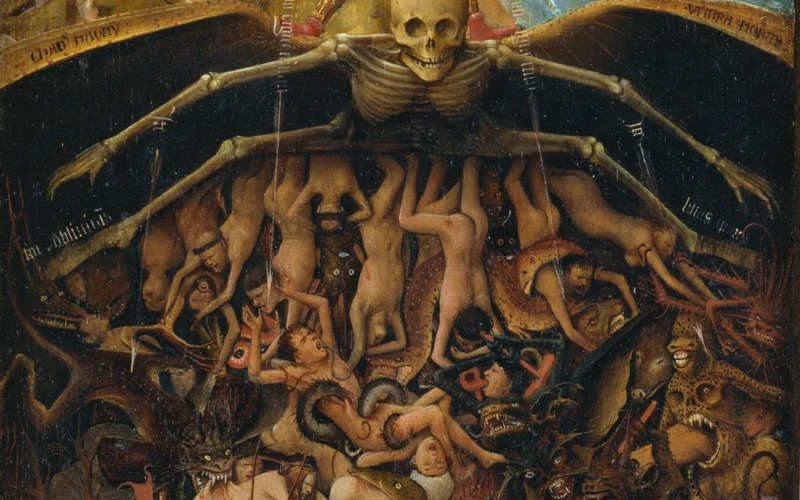
Jan van Eyck’s Last Judgment is surprisingly small.
At just over 22 inches tall, it could easily fit inside a carry-on suitcase. But despite its size, the painting contains one of the most disturbing visions of hell in Western art. The longer you look at it, the worse it becomes.
Van Eyck was famous for his precision. He painted tiny details with unbelievable clarity, reflections in mirrors, individual hairs, folds in fabric, light bouncing off metal. In The Last Judgment, he brings that same obsessive attention to human suffering, and the result feels less like a religious painting and more like a carefully documented nightmare.
The composition rises vertically, almost like a ladder between heaven and hell. At the top, small groups of saved souls move toward a glowing paradise. Below them stands a gigantic skeletal figure representing Death, stretching across the center of the panel like a judge dividing humanity into two final categories. And beneath that, everything collapses into chaos.
Bodies tumble downward in waves.
Some are crushed beneath monsters. Others are bitten, torn apart, or dragged away by strange hybrid creatures that look part animal and part machine. One figure is being disemboweled by a serpent while another disappears into a crowd of screaming bodies so tightly packed they almost merge together. Every inch of the panel contains another punishment waiting to be noticed.
What makes the painting especially unsettling is how cold it feels.
Most medieval hell scenes rely heavily on fire and dramatic destruction, but Van Eyck’s version is strangely restrained. There are very few flames. The atmosphere is dark, sharp, and almost clinical. Punishment here does not feel emotional or chaotic. It feels organized. The damned are processed with the efficiency of a system that has been operating forever.
That sense of order is part of what gives the painting its power. Nothing happening in this hell seems accidental. Every punishment appears deliberate, calculated, permanent.
And because Van Eyck painted every detail so clearly, the viewer cannot escape any of it. There is no blur, no visual confusion to hide behind. You see the bodies twisting. You see the creatures feeding. You see the expressions on faces that realize too late what is happening to them.
For such a small painting, it leaves remarkably little room to breathe.
3. Hieronymus Bosch, The Garden of Earthly Delights (1490–1500)

There are paintings that feel mysterious, and then there is Hieronymus Bosch’s The Garden of Earthly Delights.
People have spent centuries trying to explain it, and nobody fully agrees on what it means. Some believe it is a warning about sin. Others think it is a surreal fantasy about human desire. A few historians have argued that Bosch was illustrating religious visions no one else dared to paint. Whatever the explanation is, the painting still feels strange in a way that modern art often tries very hard to achieve and rarely does.
The triptych unfolds in three stages.
On the left is Eden, filled with soft landscapes and biblical figures. The center panel explodes into scenes of excess, crowds of naked people eating giant fruit, climbing into impossible structures, chasing pleasure in every imaginable form. Then comes the right panel.
Hell.
And it is one of the most bizarre depictions of damnation ever painted.
Bosch’s underworld looks less like a religious scene and more like a nightmare someone barely survived. Cities burn in the distance while giant musical instruments become tools of torture. A man is stretched across a harp like a human sacrifice. Another is crushed beneath an oversized lute. Strange bird-like creatures devour people whole before dumping them into pits below. Everywhere you look, something incomprehensible is happening.
One of the painting’s most famous figures is a giant bird monster sitting on what looks like a throne. It swallows human beings and excretes them into a transparent pit while staring blankly ahead with dead, unreadable eyes. Nearby, a pair of enormous ears pierced by a knife glide through the darkness like some impossible machine.
Nothing in Bosch’s hell behaves normally.
That is exactly what makes it frightening.
Earlier depictions of hell usually followed clear moral rules. Sin led to punishment. Fire burned the wicked. Demons tortured souls. Bosch takes that structure and twists it into something absurd and unpredictable. His punishments feel irrational, humiliating, and deeply surreal, as though the logic of the real world has completely collapsed.
There is also something disturbingly modern about it. The painting operates with dream logic, where objects change meaning without warning and terror appears in ways that are impossible to explain rationally. Looking at Bosch’s hell can feel less like reading a religious story and more like remembering fragments of a nightmare after waking up.
More than 500 years later, it still refuses to become fully familiar.
And maybe that is why people cannot stop looking at it.
4. Pieter Bruegel the Elder, Dulle Griet (Mad Meg) (1561)
Most paintings of hell show people trying desperately to escape it.
Pieter Bruegel the Elder painted a woman marching straight into it.
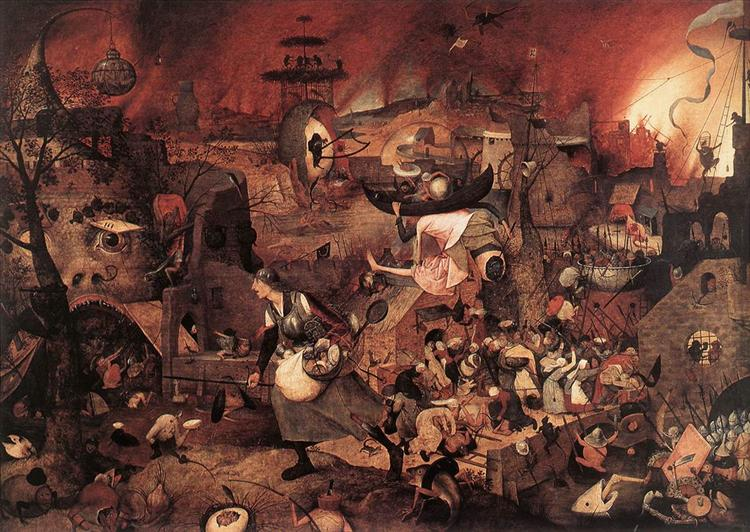
Dulle Griet, better known as Mad Meg, is one of the strangest works of the Northern Renaissance. At first glance, the painting feels almost chaotic. Demons crawl across the landscape, fires burn in the distance, and bizarre creatures spill out from every corner of the canvas. But at the center of all that madness is one unforgettable figure.
A woman in armor charging toward hell with a sword in her hand.
She is not running away. She is invading.
The character of Mad Meg came from Flemish folklore and popular proverbs. She was usually portrayed as loud, greedy, aggressive, and impossible to control, the kind of larger-than-life figure people joked about and feared at the same time. Bruegel takes that folk character and turns her into something far more unsettling.
Meg storms through the painting carrying stolen goods under one arm while leading a group of women directly toward the mouth of hell. Around her, monsters fight, buildings collapse, and strange hybrid creatures crawl through the smoke. The landscape feels unstable, as if the entire world is falling apart in real time.
And yet Meg keeps moving forward.
What makes the painting so fascinating is that Bruegel never fully tells us how we are supposed to feel about her. On one hand, she could be read as a warning about greed and chaos. After all, she is literally charging into hell for loot. But she is also the bravest person in the entire painting. Everyone else seems trapped by fear or madness while she marches forward without hesitation.
That tension gives the artwork its strange energy.
Bruegel fills the canvas with details that become more bizarre the longer you look. There are fish-like monsters wearing armor, giant eggs cracked open like buildings, and demons spilling from dark openings in the earth. Some parts feel grotesque. Others are unexpectedly funny. A few are simply impossible to explain.
It is easy to imagine modern audiences finding the painting overwhelming, but that overload is part of the experience. Bruegel wanted viewers to wander through the chaos and keep discovering new horrors hidden in the background.
And beneath all the madness sits an interesting question.
Is Mad Meg foolish for marching into hell?
Or is she the only person there who is not afraid of it?
5. William Blake, The Punishment of the Thieves (1824–27)

By the time William Blake began illustrating Dante’s Inferno, he was nearly seventy years old and still widely considered a strange outsider.
Most people in England knew him less as a respected artist and more as an eccentric who claimed to see visions and speak with angels. His poetry barely sold. Critics dismissed him. Some thought he was brilliant. Others thought he had lost touch with reality entirely.
In hindsight, Blake was simply ahead of everyone else.
Late in life, he was commissioned to create illustrations for Dante’s Divine Comedy, and the project consumed him. He ended up producing more than a hundred watercolor works based on the poem before dying in 1827. Among them, The Punishment of the Thieves remains one of the most unsettling.
The scene comes from a section of Dante’s hell where thieves are punished by serpents. But these snakes do more than attack people. They steal their identities. Bodies merge together, dissolve apart, and transform endlessly into something half-human and half-animal. It is punishment through complete loss of self.
Blake paints the moment with eerie calmness.
At first glance, the artwork almost looks beautiful. The colors are soft and glowing, filled with pale blues, golds, and gentle light. There are no dramatic explosions of fire or theatrical demons leaping across the page. Compared to earlier hell paintings, the scene feels strangely quiet.
Then you notice what is actually happening.
A massive serpent wraps itself around a human figure, twisting across the body with terrifying precision. The victim appears trapped in the middle of transformation, neither fully human nor fully consumed. Nearby figures seem to melt into one another as if their identities are slowly being erased.
The horror in Blake’s painting comes from that slow realization.
He understood something many artists did not. Violence becomes even more disturbing when it arrives wrapped in beauty. The soft colors draw you closer before the image reveals how cruel it really is. Instead of shocking the viewer immediately, Blake lets the discomfort build gradually.
There is also something deeply personal in the way he approached Dante’s hell. Blake admired Dante’s anger toward greed and corruption, especially during a period when England was rapidly industrializing and inequality was becoming impossible to ignore. Factories expanded, wealth concentrated at the top, and ordinary people were treated more and more like machinery.
For Blake, hell was never just a religious fantasy.
It was a society willing to destroy human beings in the name of power, money, and order.
That idea gives The Punishment of the Thieves a strangely modern feeling. Beneath the serpents and medieval imagery sits a fear that still feels recognizable today: the fear of losing yourself completely inside systems bigger than you.
6. William-Adolphe Bouguereau, Dante and Virgil (1850)
Some paintings are disturbing because of what they show.
Others are disturbing because of how beautifully they show it.
William-Adolphe Bouguereau’s Dante and Virgil belong firmly in the second category. The painting is violent, brutal, and deeply uncomfortable to look at, but it is painted with such technical perfection that viewers often find themselves staring at it much longer than they expect.
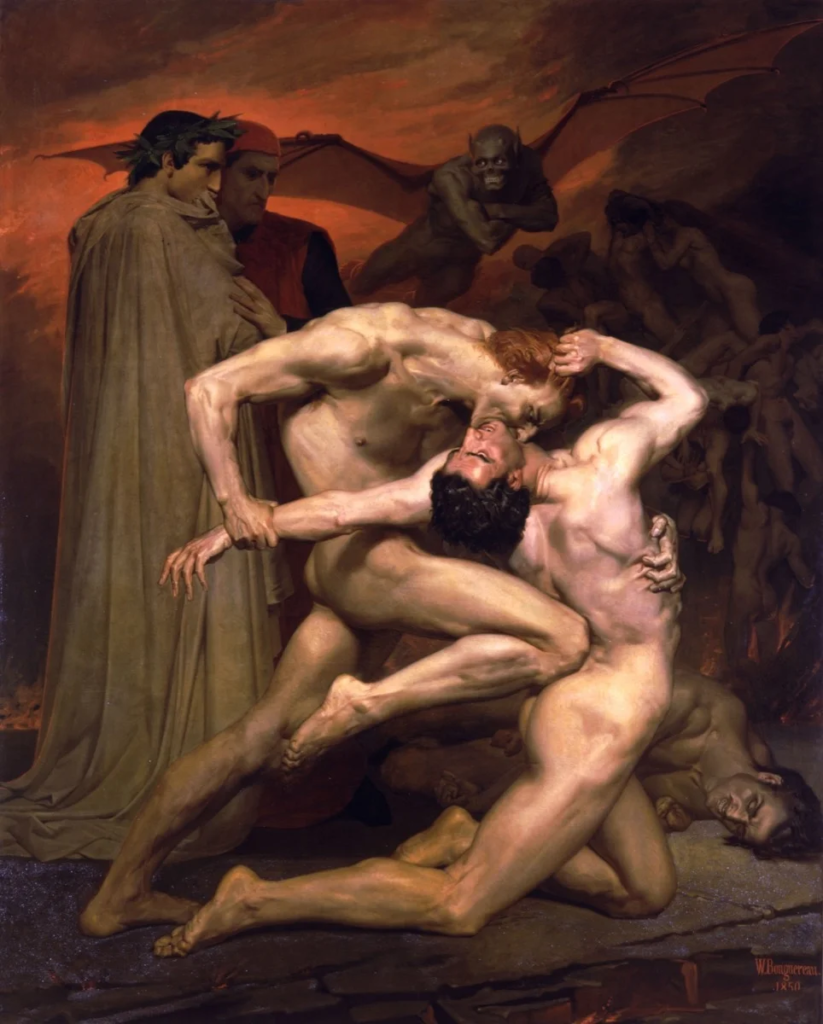
The scene comes from Dante’s Inferno. Dante and the Roman poet Virgil stand to the side observing two damned souls locked in eternal combat. One man has sunk his teeth into the other’s neck with animal fury while the victim twists backward in pain, trying desperately to escape.
Bouguereau painted the moment with astonishing realism.
Every muscle is tense. Every tendon stretches beneath the skin. Light slides across the figures in a way that makes the bodies feel almost painfully alive. You can practically feel the strain in their limbs and the pressure of the bite itself. It is less like looking at a mythological painting and more like witnessing a frozen second of real violence.
That level of detail was intentional.
Bouguereau was only twenty-four years old when he painted this work, and he wanted to prove himself at the Paris Salon, the most important art exhibition in France at the time. He trained within the strict traditions of French academic painting, where technical mastery mattered enormously. Artists were expected to demonstrate complete control over anatomy, composition, and realism.
With Dante and Virgil, Bouguereau showed he could do all of it.
But what makes the painting memorable is not simply its craftsmanship. It is the strange emotional coldness of the scene. Dante and Virgil stand nearby as observers, watching the violence unfold without intervening. Above the fighting men hovers a bat-winged demon who appears almost entertained by what he sees.
Nobody in the painting offers mercy.
That detachment gives the work its unsettling power. The suffering is not chaotic or accidental. It feels permanent, almost routine, as though this violence has repeated itself endlessly for centuries.
At the time, many viewers were shocked by the painting’s intensity. Bouguereau later became famous for softer, idealized works filled with smooth-skinned mythological figures and sentimental scenes, which makes Dante and Virgil feel even more surprising within his career. There is nothing gentle about it.
It is raw, physical, and brutally direct.
And perhaps that is why it still stands out today. Beneath all the polished technique and academic precision lies something primal: two human beings reduced entirely to rage, pain, and survival while the world calmly watches from the sidelines.
7. Edvard Munch, Self-Portrait in Hell (1903)

Most artists on this list painted hell as a place people are sent to.
Edvard Munch painted it as a state of mind.
There are no demons in Self-Portrait in Hell. No monsters tearing bodies apart. No dramatic punishments. No crowded underworld filled with tortured souls. Instead, Munch paints only himself, standing alone against a dark red-black background that seems to swallow the entire canvas.
And somehow, it feels just as disturbing as any medieval hellscape.
Munch stares directly at the viewer. He is naked, pale, and strangely calm. He does not appear to be screaming or fighting against anything. In fact, the most unsettling thing about the painting may be how resigned he looks, as though he has already accepted where he is.
By the time he painted this work, Munch had lived through years of grief and psychological instability. His mother died when he was very young. His sister later died from tuberculosis. Mental illness haunted his family, and Munch himself struggled with depression, paranoia, alcoholism, and violent relationships throughout his life. He once wrote that “disease and insanity” stood beside his cradle from birth.
Looking at Self-Portrait in Hell, it is difficult not to feel that history pressing against the canvas.
What makes the painting powerful is its simplicity. Munch strips away almost everything associated with traditional depictions of hell and focuses entirely on emotion. The background burns with deep reds and heavy shadows, but it does not resemble literal fire. It feels internal, like the physical shape of anxiety, grief, or exhaustion.
The color does most of the storytelling.
Munch’s skin appears almost sickly against the darkness surrounding him, making it seem as though the environment itself is slowly consuming his body. There is no clear boundary between the figure and the space around him. Hell is not somewhere outside him. It is something he carries with him.
That idea felt radical at the beginning of the twentieth century. Earlier artists usually treated damnation as punishment handed down by religion or divine judgment. Munch turns hell inward. His suffering is psychological, deeply personal, and painfully human.
And that may be why the painting still feels modern today.
Even viewers who know nothing about Munch’s life immediately understand the emotion behind it. The isolation. The exhaustion. The sense of being trapped inside your own mind while trying to appear composed on the surface.
Unlike the artists before him, Munch was not interested in terrifying viewers with monsters.
He was painting what despair actually feels like.
8. Franz von Stuck, Inferno (1908)

By the early twentieth century, artists no longer needed detailed demons or giant landscapes to make hell feel frightening.
Franz von Stuck proved that a single face could do the job.
At first glance, Inferno barely resembles the elaborate hell scenes painted by artists like Bosch or Bruegel. There are no sprawling cities on fire, no complicated religious narratives, no clearly defined punishments. The painting feels claustrophobic instead, as though the viewer has been pushed directly into the middle of a crowd with no way out.
Bodies fill almost the entire canvas.
Figures twist against one another in darkness, their faces strained with pain and exhaustion. Arms reach upward. Muscles tighten. The entire mass of flesh seems trapped inside a suffocating space lit by a dim reddish glow coming from somewhere outside the frame.
And then you notice the woman.
Near the center of the painting, partially hidden in shadow, a female face stares directly outward. Unlike the other figures writhing around her, she is completely still. Her eyes are wide, sharp, and unnervingly calm.
It is one of those details that changes the entire painting once you see it.
Suddenly, the chaos around her feels less important than the fact that she appears aware of the viewer. Everyone else seems consumed by suffering. She looks almost separate from it, as though she belongs to the darkness itself rather than being trapped inside it.
That single expression is what makes Inferno so memorable.
Von Stuck was part of the Symbolist movement, a group of artists more interested in emotion and psychological atmosphere than straightforward storytelling. Instead of painting literal religious scenes, Symbolists tried to create moods, fears, and sensations visually. In Inferno, Von Stuck reduces hell to pure emotional intensity.
There is no escape route in the painting. No safe distance for the viewer to stand. The bodies are cropped so closely together that the scene feels physically uncomfortable, almost overheated. The lack of background only increases that pressure. Hell here is not a location with geography and architecture. It is simply suffering concentrated into human form.
When the painting was exhibited in New York in 1909, critics described its “brutality,” and the word still fits. But the brutality is not loud. That is what makes it effective. Von Stuck does not overwhelm the viewer with gore or spectacle. He creates dread through the atmosphere, through the feeling that something terrible is pressing inward from every side.
And at the center of it all remains that woman’s face, watching quietly from the darkness.
Not trapped.
Watching.
9. Jake & Dinos Chapman, Fucking Hell (2008)
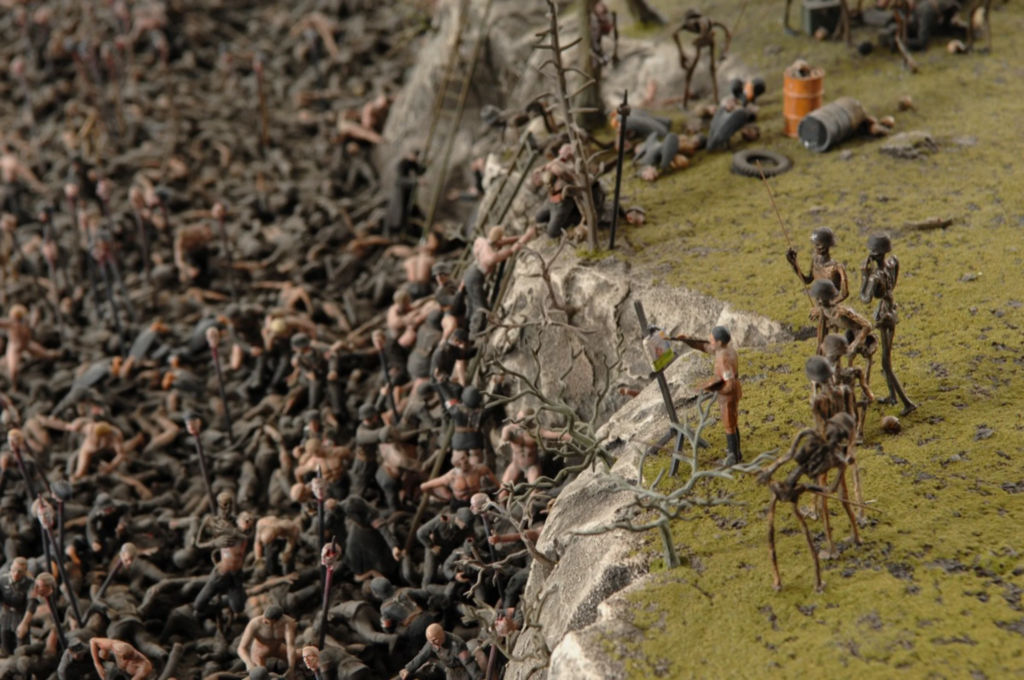
By the time Jake and Dinos Chapman created Fucking Hell, the traditional image of hell had almost completely changed.
There were no longer medieval demons dragging sinners into flames. No grand religious warnings painted across chapel walls. The Chapmans were not interested in supernatural punishment at all.
Their version of hell was entirely human.
The installation consists of nine large glass cases filled with miniature scenes of absolute carnage. At first, it almost looks absurd. Tiny toy soldiers, skeletons, mutant creatures, severed limbs, burning landscapes, piles of bodies. The sheer amount of detail feels overwhelming. Then you realize there are around 60,000 individual figures inside the work, each carefully painted and arranged by hand.
And the horror starts sinking in.
The figures inside the vitrines are largely Nazis, trapped in endless cycles of violence and destruction. Some are being torn apart by monsters. Others are impaled, mutilated, or swallowed by grotesque creatures. Entire battlefields collapse into chaos while skeleton armies and mutated figures move through the wreckage.
The scale of the installation creates a strange reaction in viewers. From a distance, it can almost look darkly funny, like an impossibly elaborate model set built by someone with a deeply twisted imagination. The Chapmans understood that reaction perfectly. Much of their work plays with the uncomfortable overlap between horror and comedy.
But the longer you look, the less amusing it becomes.
One of the installation’s most disturbing details is its layout. The nine glass cases are arranged in the shape of a swastika. That design forces viewers to physically walk around the symbol as they observe the destruction inside it. In other words, you do not stand outside the work safely looking in. Your movement becomes part of the piece itself.
That idea sits at the center of Fucking Hell.
Earlier artists often imagined hell as a punishment controlled by divine forces. The Chapmans reject that completely. There is no Satan here. No judgment from above. Human beings create all the violence themselves. The installation suggests that history has already shown humanity exactly what hell looks like, and we built it with our own hands.
The work becomes even stranger when you learn its history. An earlier version called Hell was destroyed in a warehouse fire in 2004. Instead of abandoning the project, the Chapman brothers rebuilt it from scratch, larger and even more aggressive than before. They titled the new version Fucking Hell, a name that feels less like shock value and more like exhausted disbelief at human history itself.
And that exhaustion lingers after seeing the work.
Because unlike many older depictions of damnation, the installation offers no comforting separation between hell and ordinary life. There is no fantasy world here. No mythical underworld hidden beneath the earth.
Just violence, cruelty, ideology, war, and people endlessly repeating the same destruction over and over again.
Which may be the most frightening idea in the entire article.
Conclusion
Across seven centuries of art history, hell has taken many forms.
For Giotto, it was a warning painted across chapel walls. For Bosch, it became a surreal nightmare where logic itself collapsed. Munch turned it inward and made it psychological. The Chapman brothers stripped away religion entirely and argued that human beings are fully capable of creating hell on their own.
That is what makes these artworks endure long after the societies that produced them changed. They are not only about punishment or theology. They are about fear, guilt, violence, suffering, and the darker parts of human nature that every generation tries to understand in its own way.
Some of these artists filled hell with monsters. Others filled it with ordinary people.
And in many cases, that distinction becomes difficult to separate.
What also makes these works so compelling is how differently they approach the same idea. Some rely on overwhelming detail and chaos. Others create horror through silence, atmosphere, or emotional isolation. Yet all of them force viewers to confront something uncomfortable about themselves and the world around them.
That discomfort is probably why these images still stay with us.
Centuries later, we may no longer believe in medieval visions of damnation, but the fears behind them remain surprisingly familiar.
And perhaps that is the real reason artists never stopped painting hell.
Because every era eventually finds its own version of it.
Which artwork disturbed you the most and why?
If stories of artists pushing boundaries fascinate you, you might also enjoy reading about Hilma af Klint, the visionary painter who created abstract art years before it became a movement. Explore her remarkable story here: https://artstoheartsproject.com/the-woman-who-painted-abstract-art/