


8 Paintings That Feel Like a Perfect Summer Day
Ask ten people what perfect summer day looks like, and you’ll probably hear ten different answers.
For some, it’s a quiet afternoon beside a lily pond. For others, it’s the sound of waves rolling onto the shore, a boat drifting across still water, the golden glow of wheat fields beneath an endless sky, or the unmistakable blue of a swimming pool on a cloudless day.
Artists have been answering that same question for centuries.
Rather than defining summer through a single image, they captured its many moods, playful, peaceful, adventurous, nostalgic, and quietly reflective. Across countries and generations, they transformed ordinary seasonal moments into extraordinary works of art that continue to transport us long after the season itself has passed.
These eight paintings are more than beautiful depictions of summer. Together, they form a visual journey through the places, colors, and experiences that have made the season one of art’s most enduring sources of inspiration.
1. The Bathers by Frédéric Bazille
Where Summer Feels Endless
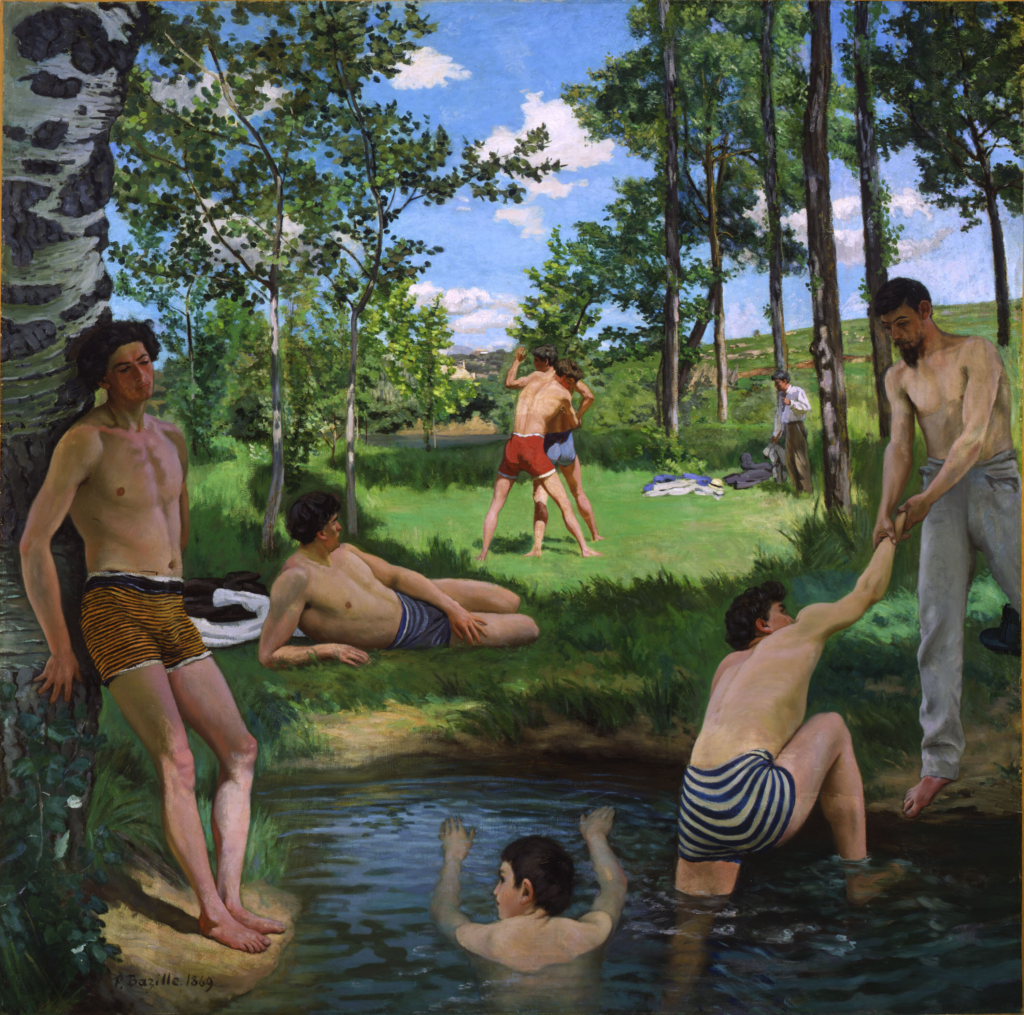
There are few things more universally associated with summer than the irresistible pull of water. Whether it’s diving into a cool river, stretching out beneath the shade of towering trees, or spending an entire afternoon outdoors with friends, these simple moments have defined summer for generations. Long before beach resorts, swimming pools, and vacation itineraries became the symbols of the season, people sought relief and joy in nature itself. It is this timeless feeling that Frédéric Bazille captures so effortlessly in The Bathers.
Painted in 1869, the large-scale work depicts a group of young men gathered beside a quiet river, some lounging on the grass while others prepare to enter the water. At first glance, it feels wonderfully ordinary, an unhurried afternoon where nothing remarkable seems to happen. Yet that quiet simplicity is precisely what gives the painting its lasting charm. Bazille wasn’t trying to dramatize the landscape or romanticize his subjects. Instead, he immortalized one of summer’s greatest luxuries: the freedom to lose track of time.
The painting also offers a fascinating glimpse into a turning point in French art. Bazille, a close friend of Claude Monet, Pierre-Auguste Renoir, and Alfred Sisley, was among the young artists who would lay the foundations for Impressionism. While The Bathers still carries traces of academic composition, its natural light, open-air setting, and relaxed atmosphere hint at the artistic revolution that was just beginning to unfold. The sun filters gently through the trees, illuminating patches of grass and reflecting softly on the water, making nature feel just as important as the figures themselves.
Knowing Bazille’s story adds another layer of poignancy. Just a year after completing this painting, he enlisted to fight in the Franco-Prussian War and was killed at only twenty-eight years old. His career, filled with extraordinary promise, ended before it had the chance to fully blossom. Seen through that lens, The Bathers becomes more than a celebration of summer, it becomes a quiet tribute to youth, friendship, and fleeting moments that rarely announce their significance while we are living them.
Perhaps that is why the painting continues to resonate more than 150 years later. It reminds us that the essence of summer isn’t found in grand adventures but in afternoons that ask nothing of us except to stay a little longer, linger by the water, and enjoy the company of those around us. Some seasons pass quickly, but great paintings have a remarkable way of letting us return to them whenever we wish.
2. Water Lilies by Claude Monet (Series, 1897–1926)
Where Summer Slows Down
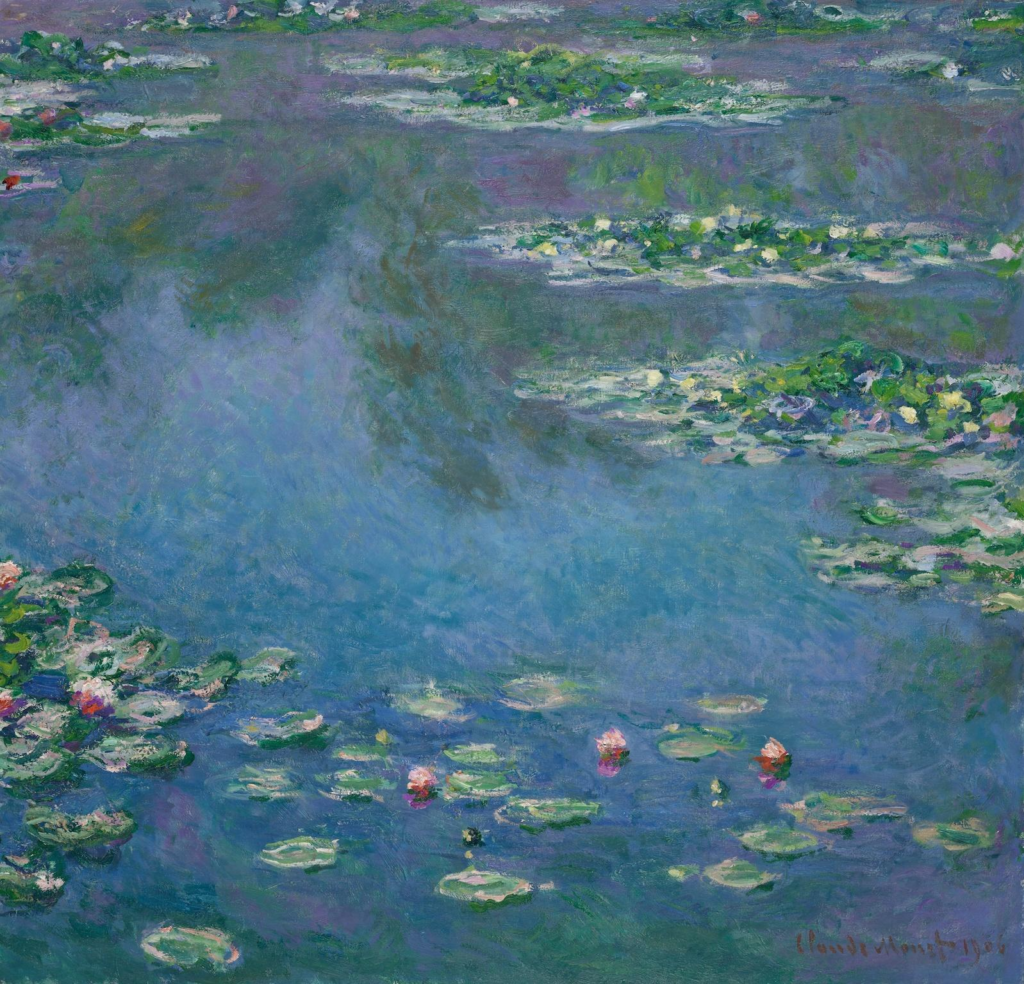
Not every summer memory is filled with adventure. Some of the most enduring ones are surprisingly quiet, a garden humming with bees, the gentle ripple of water disturbed by a passing breeze, or the way afternoon sunlight dances across a pond before disappearing into the evening. These are the moments that often escape our cameras but linger in our memories. Few artists understood this quiet poetry of summer better than Claude Monet.
By the time Monet began his celebrated Water Lilies series in the late 1890s, he had long been fascinated by the changing effects of light and atmosphere. Rather than searching for dramatic landscapes, he turned his attention to something deeply personal: the water garden he had painstakingly designed at his home in Giverny, Normandy. Complete with an arched Japanese bridge, exotic water lilies, weeping willows, and reflective ponds, the garden became both his sanctuary and his greatest artistic inspiration.
Unlike traditional landscape paintings that guide the viewer toward a distant horizon, Water Lilies invites us to look down instead. Sky, clouds, flowers, and trees dissolve into the pond’s reflective surface until it becomes difficult to distinguish where reality ends and reflection begins. The composition feels almost immersive, as though we are standing at the water’s edge, quietly observing the ever-changing play of light. Monet wasn’t interested in painting flowers with botanical precision; he wanted to capture something far more elusive, the feeling of a fleeting summer afternoon as sunlight shifts across still water.
Over nearly three decades, Monet painted more than 250 versions of his water lily pond, returning to the same subject through different seasons, times of day, and weather conditions. The series became a lifelong meditation on nature, color, and perception, while also pushing Impressionism toward a more abstract and modern visual language. Today, the monumental panels housed at the Musée de l’Orangerie in Paris surround visitors in a near-panoramic experience, allowing them to step inside Monet’s vision of nature.
What makes Water Lilies feel so unmistakably like summer is its quietness. There are no figures, no dramatic narratives, and no obvious action. Instead, the painting celebrates the season’s slower rhythm, the afternoons when time seems suspended, when the only movement comes from drifting clouds reflected in water or the gentle sway of lily pads beneath the breeze. It reminds us that some of summer’s greatest pleasures aren’t found in extraordinary adventures, but in simply pausing long enough to notice the beauty that has always been there.
3. Boating at Vinalhaven by Frank Weston Benson (1919)
Where Summer Adventures Begin
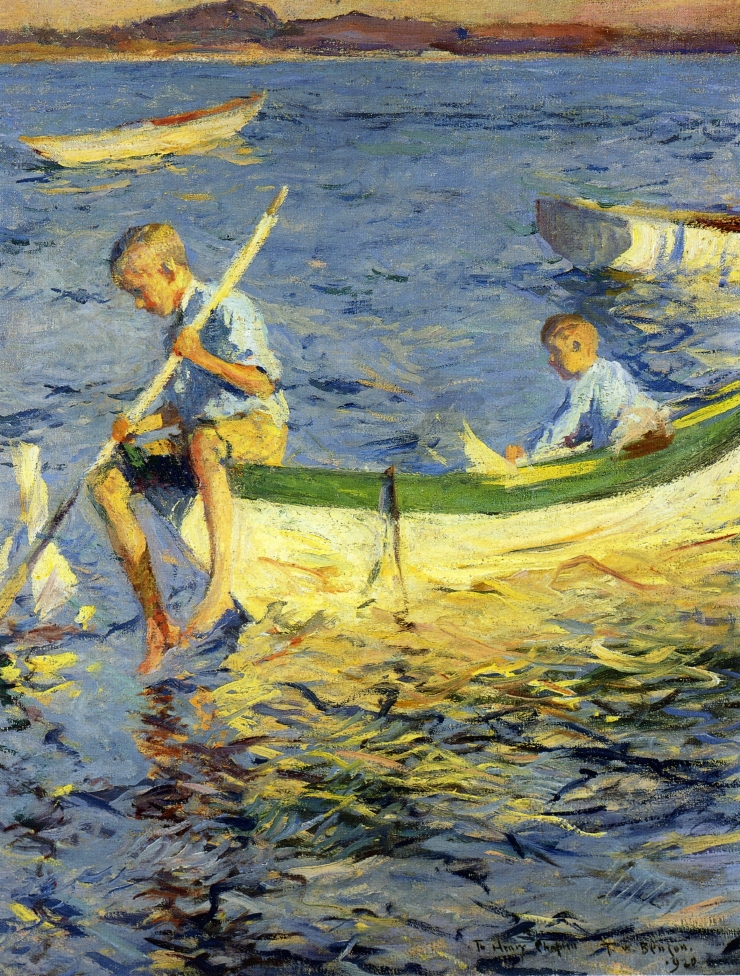
There is something about summer that makes even the simplest journeys feel extraordinary. A short boat ride becomes an adventure, a quiet harbor turns into a world waiting to be explored, and long afternoons on the water somehow seem to stretch on forever. Before smartphones, busy itineraries, and constant notifications filled our days, summer often meant slowing down and letting nature set the pace. Frank Weston Benson’s Boating at Vinalhaven captures that timeless feeling with remarkable grace.
Painted in 1919, the work transports us to Vinalhaven, a small island off the coast of Maine that Benson and his family returned to year after year. For the American Impressionist, these summers weren’t simply holidays, they became an endless source of inspiration. The island’s sparkling coastline, changing light, and leisurely pace found their way into many of his paintings, each celebrating the quiet beauty of life by the sea.
Unlike dramatic seascapes filled with crashing waves or turbulent skies, Boating at Vinalhaven embraces the calm. The figures move gently across the water, surrounded by brilliant blues that mirror the clear summer sky above. Benson’s confident brushwork allows the sunlight to shimmer across the surface, while the crisp white sails and reflections create a sense of freshness that almost lets you feel the cool ocean breeze. It’s a painting where nothing urgent is happening and that is precisely its charm.
Benson was celebrated for his extraordinary ability to paint light, often working outdoors to observe how it transformed landscapes throughout the day. Influenced by both French Impressionism and American realism, he developed a style that feels luminous without sacrificing detail. His coastal scenes became synonymous with idyllic New England summers, offering viewers not just beautiful views but an invitation to experience the tranquility of these fleeting moments.
What makes Boating at Vinalhaven especially evocative is its quiet sense of possibility. Every boat seems to be heading somewhere, yet the destination hardly matters. The joy lies in the journey itself, in drifting with the wind, watching sunlight dance across the waves, and allowing the hours to unfold without expectation. It’s the kind of freedom many of us remember from childhood summers, when entire days were spent outdoors and time felt wonderfully abundant.
More than a century later, Benson’s painting still reminds us that summer isn’t measured by how much we accomplish but by the moments that allow us to simply be present. Whether we’re sailing across open water or watching the reflections ripple beneath a small boat, those peaceful experiences become the memories we return to long after the season has ended. Boating at Vinalhaven preserves that feeling beautifully, inviting us to step aboard and drift, if only for a little while.
4. A Sunday Afternoon on the Island of La Grande Jatte by Georges Seurat (1884–1886)
The Summer Ritual That Never Goes Out of Style
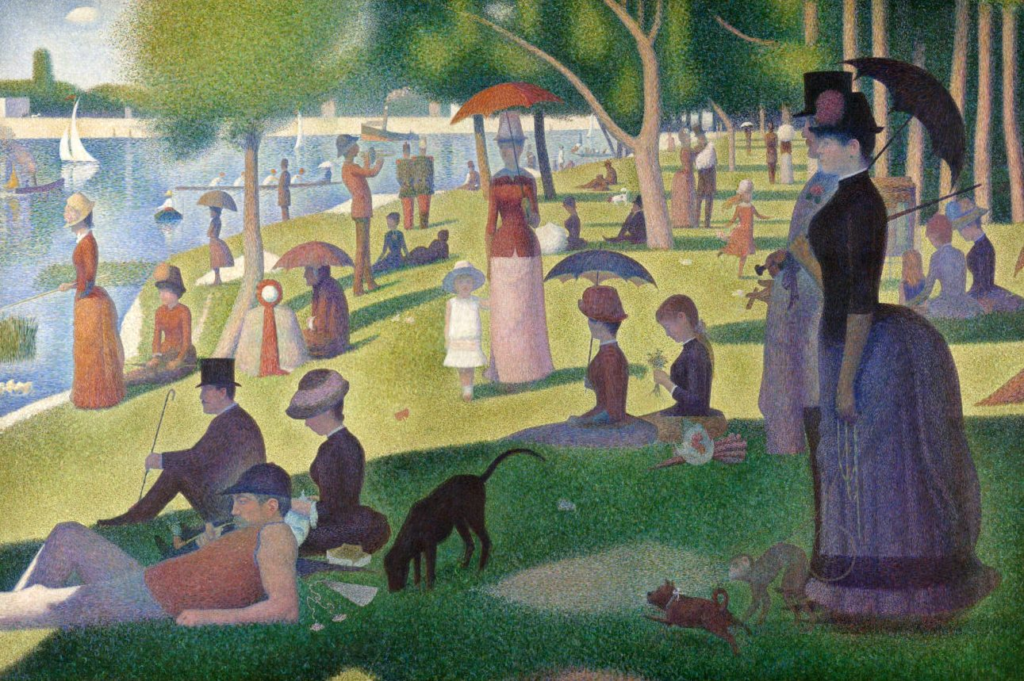
Some of the best summer memories aren’t tied to faraway destinations, they’re made much closer to home. A picnic in the park, an afternoon stretched out beneath the shade of a tree, families gathering by the water, or simply watching the world go by with nowhere urgent to be. Long before summer holidays became synonymous with international travel, these unhurried moments defined the season. Georges Seurat’s A Sunday Afternoon on the Island of La Grande Jatte transforms one such ordinary afternoon into one of the most celebrated paintings in the history of art.
Completed between 1884 and 1886, the monumental canvas depicts Parisians enjoying a leisurely Sunday on the banks of the River Seine at La Grande Jatte, a small island just outside the city. Men in tailored suits, women carrying elegant parasols, children running through the grass, and boats drifting quietly across the water all come together to paint a portrait of modern leisure. It is a snapshot of a society discovering the simple pleasure of spending free time outdoors, a concept that had become increasingly possible with industrialization, shorter working hours, and the expansion of public parks around Paris.
While the scene itself feels relaxed, the technique behind it was anything but. Seurat spent nearly two years meticulously constructing the painting using Pointillism, a revolutionary method in which thousands of tiny dots of pure color are placed side by side. Rather than blending pigments on a palette, he relied on the viewer’s eye to mix the colors from a distance, creating a surface that seems to shimmer with light. This scientific approach to color theory gave the painting an extraordinary luminosity, making the warm summer afternoon feel almost tangible.
Yet beyond its technical brilliance lies something deeply familiar. Every figure appears absorbed in their own quiet moment, but together they create the rhythm of a perfect summer day. There is no dramatic event unfolding, only conversations, strolls, naps, children’s games, and the comforting hum of life continuing at its own pace. The painting reminds us that summer isn’t always defined by extraordinary adventures. Sometimes, it is simply about having the freedom to slow down, gather with loved ones, and enjoy the warmth of a beautiful day.
Nearly 140 years after it was first exhibited, A Sunday Afternoon on the Island of La Grande Jatte continues to feel remarkably contemporary. Parks are still filled with picnics, riverside walks remain a cherished weekend escape, and people continue to seek pockets of green where they can pause and reconnect with nature. Seurat’s masterpiece captures a tradition that has never gone out of style, proving that while fashions may change, the simple joy of a summer afternoon is wonderfully timeless.
5. Wheat Field with Cypresses by Vincent van Gogh (1889)
When Summer Glows Gold
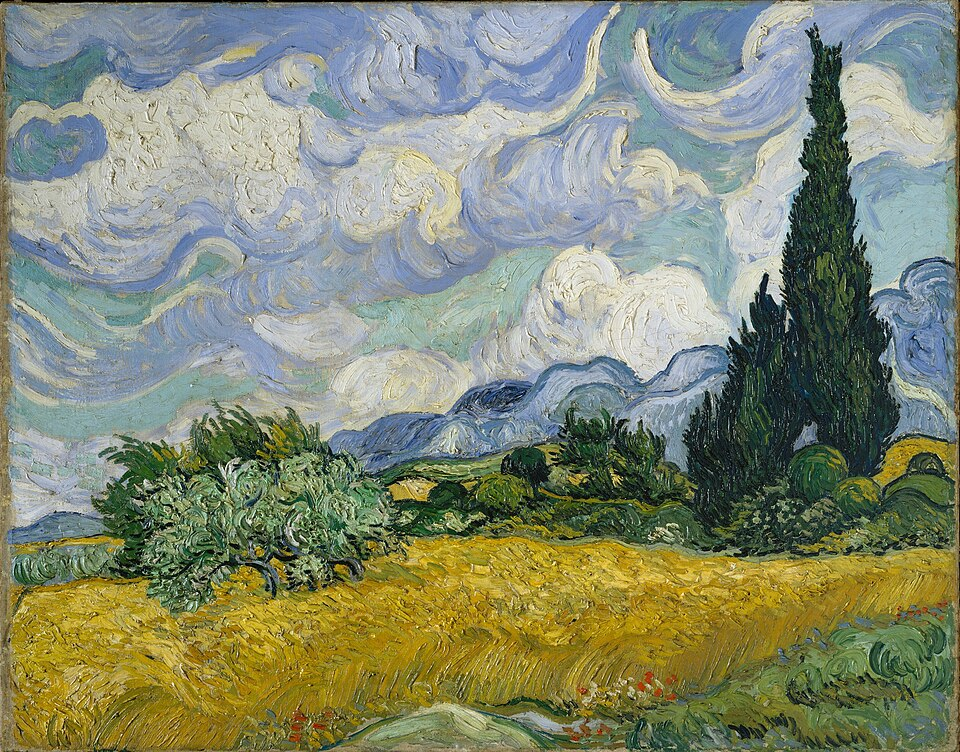
If one color could define summer, it would almost certainly be gold. It is the color of ripening wheat fields, late afternoon sunlight, dry countryside paths, and the warm glow that settles over the landscape just before evening. Few artists understood the emotional power of this golden palette better than Vincent van Gogh. In Wheat Field with Cypresses, he didn’t simply paint a landscape, he painted the energy, movement, and intensity of summer itself.
Created in 1889 while Van Gogh was staying at the asylum of Saint-Paul-de-Mausole in Saint-Rémy-de-Provence, the painting reflects one of the most productive yet emotionally turbulent periods of his life. Although he voluntarily admitted himself following a series of mental health crises, the surrounding countryside became both his refuge and his greatest source of inspiration. Looking beyond the walls of the asylum, he found endless beauty in the wheat fields, olive groves, cypress trees, and dramatic Provençal skies that stretched before him.
Unlike traditional landscape painters who aimed for realism, Van Gogh wanted viewers to feel nature rather than simply observe it. In Wheat Field with Cypresses, nothing appears still. The golden wheat ripples as though carried by a warm summer breeze, the towering cypress trees seem to sway with quiet determination, and even the clouds twist and curl across the brilliant blue sky with remarkable vitality. His expressive brushstrokes transform the entire scene into something alive, giving the impression that the landscape is breathing alongside the viewer.
The cypress tree itself held special meaning for Van Gogh. Common throughout southern France, these tall evergreens often appeared in cemeteries and rural landscapes, symbolizing both endurance and eternity. Yet here, they don’t introduce melancholy. Instead, they stand confidently among the vibrant wheat, grounding the composition while drawing the eye upward toward the expansive summer sky. Together, the landscape becomes a celebration of nature’s resilience, a reminder that beauty can flourish even during life’s most difficult chapters.
What makes Wheat Field with Cypresses feel so unmistakably like summer is its overwhelming sense of abundance. The wheat is ready for harvest, the sky is impossibly clear, and every inch of the canvas pulses with warmth and movement. Rather than portraying summer as a quiet season of rest, Van Gogh presents it as a force of nature, vibrant, untamed, and filled with life.
More than a century after it was painted, the work continues to remind us why summer landscapes leave such lasting impressions. They aren’t memorable because they remain still, but because they are constantly changing with the wind, the light, and the passing hours. Van Gogh captured that fleeting vitality with extraordinary honesty, allowing us to experience not just the appearance of a summer day, but its unmistakable rhythm and heartbeat.
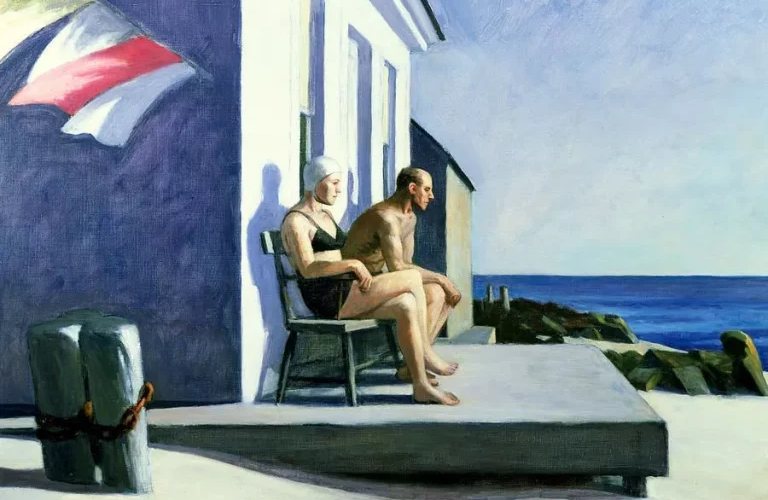
6. Sea Watchers by Edward Hopper (1952)
The Quiet Magic of Looking Out to Sea
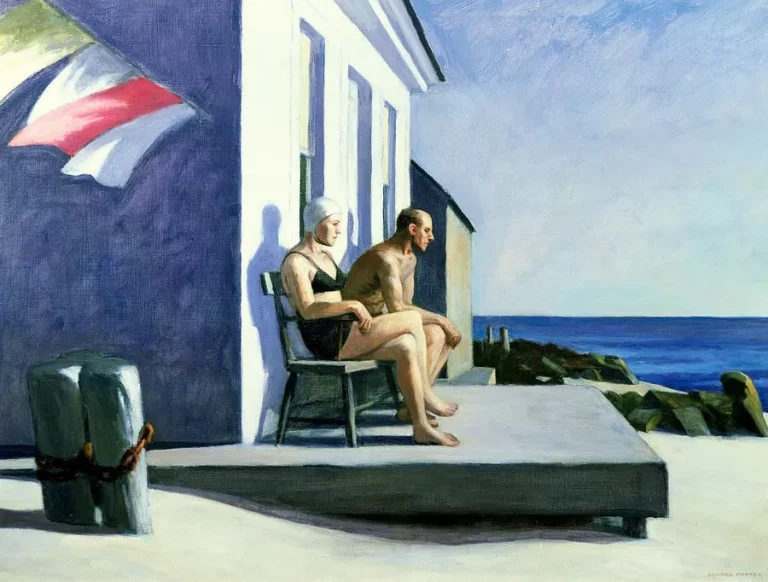
There comes a point during every seaside summer when the ocean no longer asks us to dive in, it simply asks us to look. After the laughter fades, the towels are folded away, and the shoreline grows quieter, many of us find ourselves doing the same thing: sitting still and watching the horizon. There’s something deeply calming about the endless rhythm of the waves, the salty breeze, and the way the sea seems to stretch far beyond what the eye can see. It is this quiet, reflective side of summer that Edward Hopper captures so beautifully in Sea Watchers.
Completed in 1952, the painting depicts two women seated on a grassy bluff overlooking the Atlantic Ocean. They aren’t speaking or interacting in any obvious way. Instead, they share something far more subtle, a moment of quiet observation. Before them lies an uninterrupted expanse of blue water beneath an equally expansive sky, where the horizon becomes the true focal point of the composition. Hopper strips the scene down to its essentials, allowing light, space, and stillness to tell the story.
Although Edward Hopper is best known for his depictions of American city life and the quiet solitude found within it, the coastline became another recurring source of inspiration throughout his career. He and his wife, fellow artist Josephine Hopper, spent many summers in Cape Cod, Massachusetts, where the ever-changing quality of coastal light profoundly influenced his work. Rather than painting crowded beaches or lively holiday scenes, Hopper was fascinated by the quieter moments that often go unnoticed, the pauses between activities, the silence after conversation, and the contemplative act of simply existing within a landscape.
That understated approach is precisely what makes Sea Watchers so compelling. The painting isn’t driven by action but by atmosphere. The brilliant summer light illuminates the white architecture, while the deep blue sea creates a striking sense of openness and calm. Every element encourages the viewer to slow down. Even the figures remain anonymous enough that it’s easy to imagine ourselves sitting beside them, lost in thought as the waves continue their endless rhythm.
Summer is often celebrated for its excitement, but Hopper reminds us that some of the season’s most meaningful memories are surprisingly quiet. They’re found in the moments when there’s nothing to accomplish and nowhere else to be, only the sound of the ocean, the warmth of the sun, and the comfort of simply watching the world unfold. More than seventy years after it was painted, Sea Watchers continues to capture that timeless experience, proving that sometimes the greatest luxury summer offers is the chance to pause and let the sea do all the talking.
7. Sandpipers by Sally Swatland
Barefoot Days by the Water
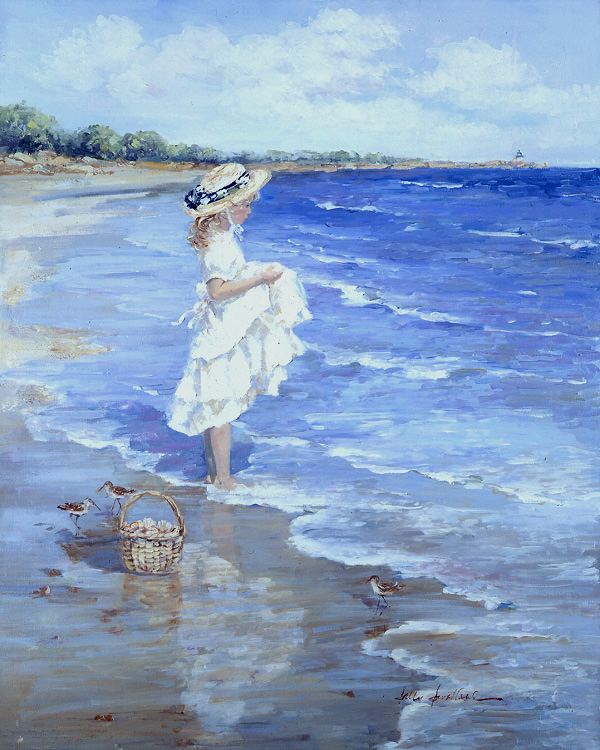
Every summer has its own soundtrack, the gentle crash of waves, the distant calls of seabirds, and the soft crunch of sand beneath bare feet. It’s the season when a simple walk along the shoreline can become an adventure, with every seashell, feather, or smooth stone feeling like a tiny treasure waiting to be discovered. There is something undeniably nostalgic about these quiet moments by the beach, and few paintings capture that feeling with as much warmth and tenderness as Sally Swatland’s Sandpipers.
Rather than focusing on dramatic seascapes or crowded coastlines, Swatland turns her attention to the quieter joys of the shore. Children wander along the water’s edge with an effortless curiosity, pausing to watch tiny sandpipers dart across the wet sand as the tide gently rolls in and out. The composition feels wonderfully unhurried, allowing viewers to linger in the scene just as they might during a leisurely afternoon by the sea. It’s a celebration of the small moments that often become our most cherished summer memories.
Known for her luminous coastal paintings, Sally Swatland has built a career around capturing the ever-changing relationship between light, water, and people. Her work often reflects the simple pleasures of seaside life, families gathered on the beach, children exploring the shoreline, and the peaceful rhythm of waves meeting the sand. With soft brushwork and a radiant palette of blues, creams, and sunlit neutrals, she creates scenes that feel both deeply personal and universally familiar. Rather than depicting a specific destination, her paintings evoke the feeling of countless summers spent by the coast.
The tiny shorebirds that give the painting its title are more than charming details. Sandpipers have long been a familiar sight along beaches around the world, darting gracefully between the waves in search of food before retreating just as the tide returns. Their constant movement brings a gentle sense of life to the composition, echoing the playful rhythm of children exploring the shore. Together, they remind us that some of summer’s greatest pleasures are found not in carefully planned activities, but in the freedom to wander, observe, and let curiosity lead the way.
What makes Sandpipers such a fitting celebration of summer is its quiet appreciation for life’s simplest joys. It reminds us that the season isn’t always defined by grand vacations or unforgettable adventures. Sometimes, it’s the feeling of warm sand beneath your feet, salt carried on the breeze, and the happiness of losing track of time beside the water. Long after summer fades, these are often the memories that stay with us the longest, and Swatland preserves them with remarkable warmth and sincerity.
8. Pool with Two Figures by David Hockney (1972)
The Endless Summer We All Imagine

Ask someone to picture summer, and chances are they’ll imagine sunlight dancing on water. Whether it’s the cool blue of a swimming pool, the shimmer of heat rising from the ground, or the carefree feeling of spending an afternoon outdoors, few images have become as synonymous with the season as a pool beneath a cloudless sky. No artist captured that vision more memorably than David Hockney. In Pool with Two Figures, he transformed an everyday summer scene into one of the defining masterpieces of contemporary art.
Completed in 1972, the painting brings together two contrasting figures in a striking Californian landscape. One man glides effortlessly beneath the crystal-clear water, while another, fully dressed in a bright pink jacket and trousers, stands at the pool’s edge, watching. Their physical closeness is offset by an unmistakable emotional distance, creating a quiet tension that has intrigued viewers for decades. The scene feels cinematic, almost as though we’ve stepped into the middle of a story without knowing how it began or how it will end.
Hockney painted the work after moving to California, where he became captivated by its brilliant light, modern architecture, and the now-iconic swimming pools that seemed to symbolize an entirely different way of life. Unlike the muted skies of his native England, California offered an intensity of sunshine that allowed colors to appear almost impossibly vibrant. Painting water, however, proved to be one of Hockney’s greatest artistic challenges. He spent months studying photographs, making sketches, and experimenting with brushwork to recreate the constantly shifting patterns of light and movement on the pool’s surface. The result is water that feels astonishingly real, so luminous that you can almost sense its coolness against the summer heat.
While Pool with Two Figures has often been discussed as a painting about relationships, identity, and longing, it also captures an ideal that has become inseparable from the modern image of summer. It celebrates bright afternoons, leisurely escapes, and the irresistible invitation of water on a warm day. Yet beneath its polished surface lies a subtle reminder that even the most beautiful moments can hold layers of complexity. Summer, after all, is rarely just one thing. It can be joyful, reflective, exciting, and bittersweet, all at once.
As the final painting in this collection, Pool with Two Figures feels especially fitting. It bridges the past and the present, showing how artists continue to reinterpret the spirit of summer across generations. From Bazille’s riverside bathers and Monet’s tranquil lily ponds to Hockney’s sun-drenched pool, each artwork captures a different expression of the season. Together, they remind us that while summers come and go, the feelings they leave behind, the warmth, freedom, light, and longing, can live on indefinitely through art.
Summer has always been more than a season. It is a feeling, one that returns each year with familiar rituals, treasured memories, and moments that often seem too fleeting to hold onto. Perhaps that’s why artists have spent centuries trying to preserve it. Not simply by painting sunshine or blue skies, but by capturing everything the season makes us feel: freedom, stillness, curiosity, connection, and wonder.
The eight paintings in this collection remind us that there is no single way to experience summer. For some, it is found in the cool refuge of a quiet river or the shimmering reflections of a lily pond. For others, it lives in windswept wheat fields, afternoons spent sailing, peaceful hours watching the sea, or barefoot walks along the shoreline. Even the stillness of a swimming pool on a sunlit afternoon can become a lasting symbol of the season.
Although these works were created across different centuries, countries, and artistic movements, they share something beautifully universal. Each one captures a moment that feels both deeply personal and instantly familiar, inviting us to pause and remember the simple pleasures that make summer unforgettable.
The seasons will continue to change, and another summer will eventually give way to autumn. Yet these paintings remind us that art has a remarkable ability to preserve what time cannot. Long after the warmth has faded and the days have grown shorter, we can return to these canvases and, for just a moment, step back into the light of a perfect summer afternoon.
Which of these paintings feels the most like your idea of summer?
Every great painting tells a story, but so does every great artist. If you’re curious about the dedication, setbacks, and years of unseen work that shape creative success, don’t miss Behind Every Overnight Success Is a Story You Never Saw.