


Genie Appel-Cohen turns Ikebana flowers into characters with distinct personalities

At Arts to Hearts Project, Art and Woman Edition 3 keeps showing us that the most interesting artists are often the ones who surprise themselves. Women who never imagined they would end up where they are. Who built careers they did not plan. Who found their voice not through some dramatic revelation but through a slow honest process of paying attention to what kept pulling them back.
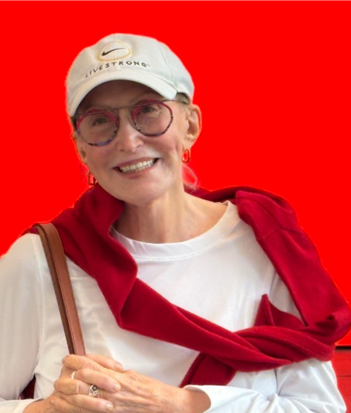
Genie Appel-Cohen is one of our selected artists for this edition. And we loved talking to her because she is funny and honest and completely unapologetic about making work that celebrates beauty in a world that often treats beauty like it is not serious enough.
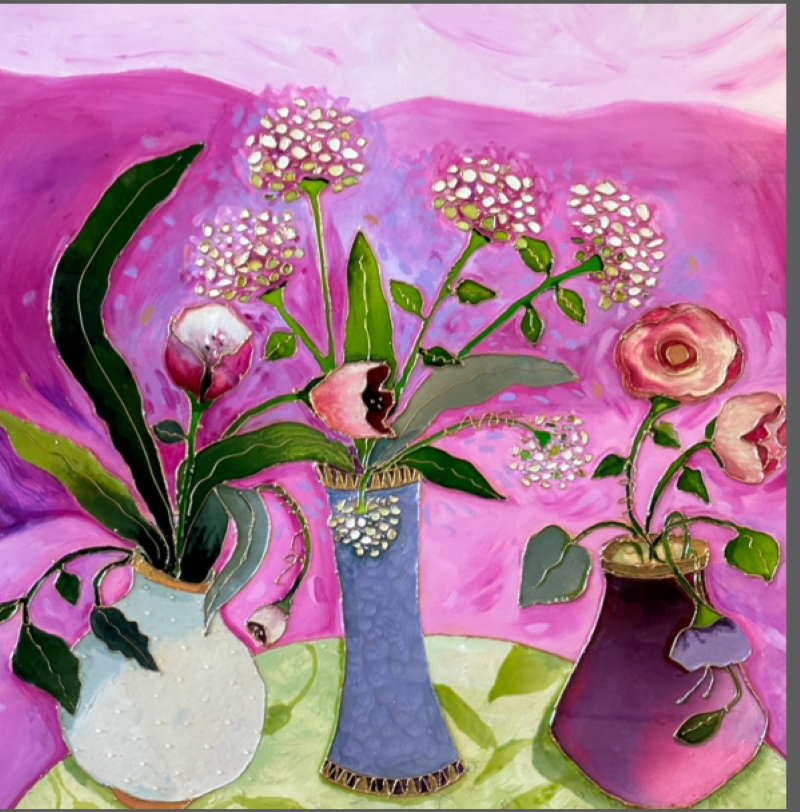
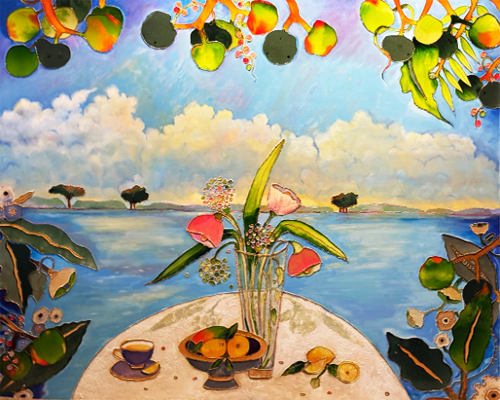
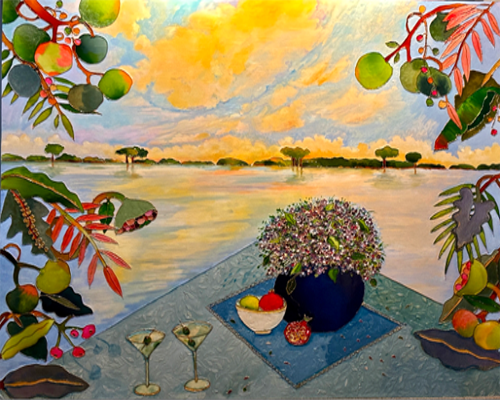
Genie is a painter and a teacher based in Florida. She paints flowers and still lifes and tropical compositions that are so full of colour and movement and personality that calling them still life’s feels almost wrong.
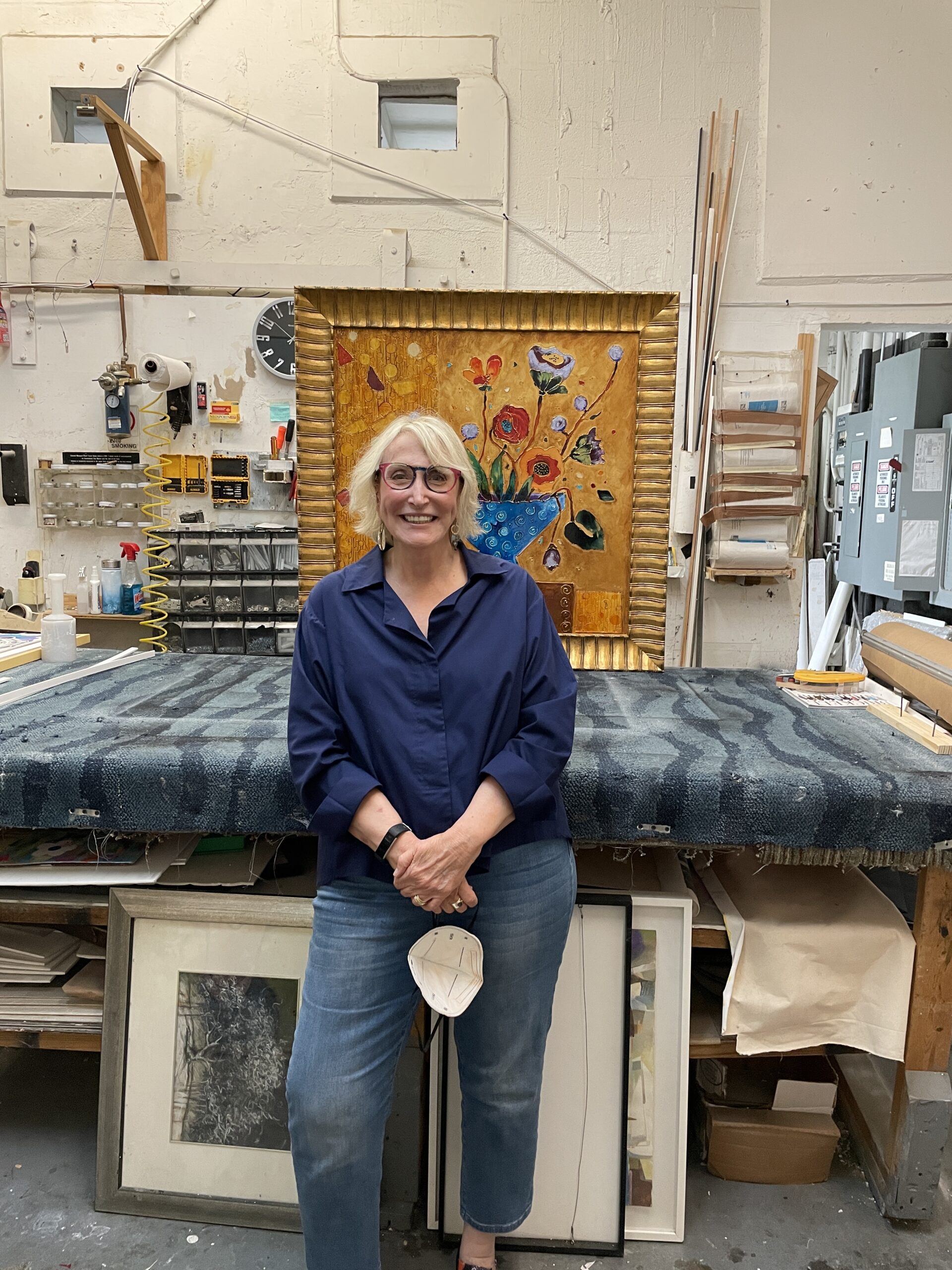
Nothing in her work is still. Everything is twisting and leaning and pushing against something else and having what feels like a very animated conversation. How she got to that point and where the idea of giving objects and flowers actual personalities came from goes back further than you might expect. We are leaving that story for the interview because it genuinely delighted us when she told it.
There is a Japanese influence in her work that completely changed the way she composes her arrangements and thinks about positive and negative space. The story of where that influence came from and what she did with it as an American artist looking through a Japanese lens is one of those creative connections that makes you see floral painting completely differently.
Her process is layered and deliberate and more complex than the joyful finished paintings might suggest. There is drawing and underpainting and stencils and modelling paste and gold outlining and multiple types of paint all working together in a sequence she has developed over years.
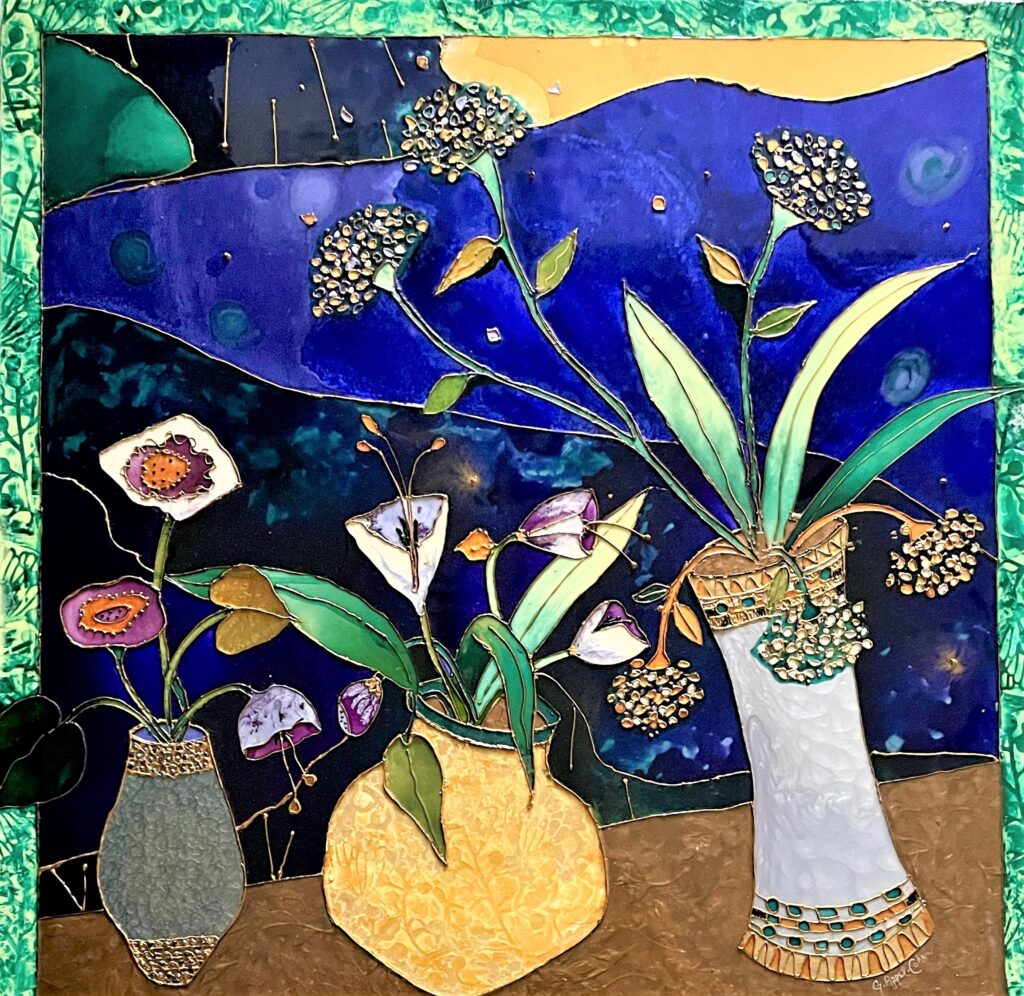
And underneath all of that technical structure there is a drawing method she uses that she credits with giving her work its distinctive personality. What that method is and why it works is something she explains during the interview and honestly it is the kind of practical insight that could change how another artist approaches their own drawing practice tomorrow.
She is also a teacher and the way she talks about her students and what success means to her now versus what it used to mean is one of the most genuinely warm things we heard from any artist in this edition. There is a generosity in how she thinks about her role in other people’s creative journeys that tells you a lot about who she is as a person.
And her perspective on beauty as a valid artistic subject in a world that often rewards irony and critique over joy is something she addresses with a confidence and a self-awareness that we really appreciated. She knows which camp she belongs to and she is proud to stand in it.
Let’s get to know Genie through our conversation with her about why flowers are never just flowers in her paintings, what Japanese flower arranging taught her about breaking rules, the drawing technique that changed everything, and why she thinks the most radical thing an artist can do right now is make something beautiful on purpose.
Q1. Can you share how your journey led you toward painting and teaching art professionally?
Like many artists, I’m an introverted individual. If anyone ever told me that I would be teaching, leading workshops and lecturing, well, I just couldn’t imagine such a thing. As a student, I appreciated every lesson each teacher shared. My problem was that after years of learning, in school and on my own, I never had a definitive method of painting in either acrylics or oils.
I took me years to develop “The Way to Paint,” which is the course I am currenting teaching at the Boca Museum Art School. After gaining my confidence in the classroom, I was able to branch out to other venues. It came from a very deep need to share answers with struggling painters and the dee sense of fulfilment when I can give back to my art community.
Q2. Your floral paintings are inspired by Ikebana, what first drew you to that practice, and how has it influenced your compositions?
At school we have a course in Japanese flower arranging. Each year, the students have a grand finale where they display their arrangements in the hallway. The arrangements cast beautiful shadows on the wall and the drama of all the elements are simply breathtaking. As the years past, I would study their designs, the positive and negative forms, and in my mind, I would compare and contrast them to our American floral arrangements.
Eventually, I started to sketch, which is my way of thinking out loud. The sketches were playful, personal, something just for fun, like doodling. Eventually, they became pen and ink drawings which I drew on plain cotton pencil and make-up cases. It wasn’t until I was approached to do a commission that I began to look at them in a new light.
Q3. Your floral arrangements feel full of movement and personality, what are you hoping to express through them?
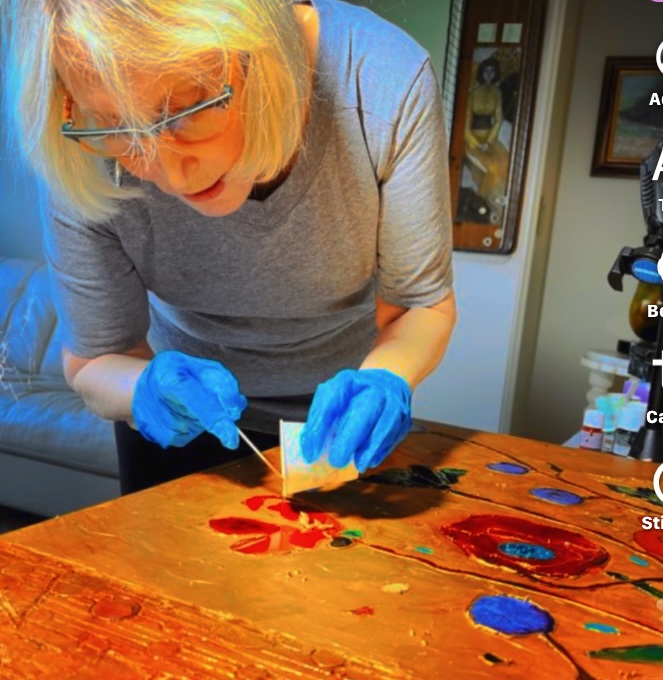
Yes, so that’s when the question popped into my head, “Is a still life really still?” I did some research on the history of still life through various art movements. The Ikebana constructions broke all those European horizontal and vertical formats. That’s when I knew I wanted to bring my American aesthetic and interpret it through a Japanese lens.
Of course, because I have a sense of humor, other things are happening in my head at the same time. The vases are a “stand-in” for people and their relationships. “Three’s a crowd” and all of that. Tables aren’t always horizontal and precious objects can almost slide right off, just like in real life.
Q4. In your tropical works, color seems to take on a life of its own. How do you use color to create emotion rather than simply describe a subject?
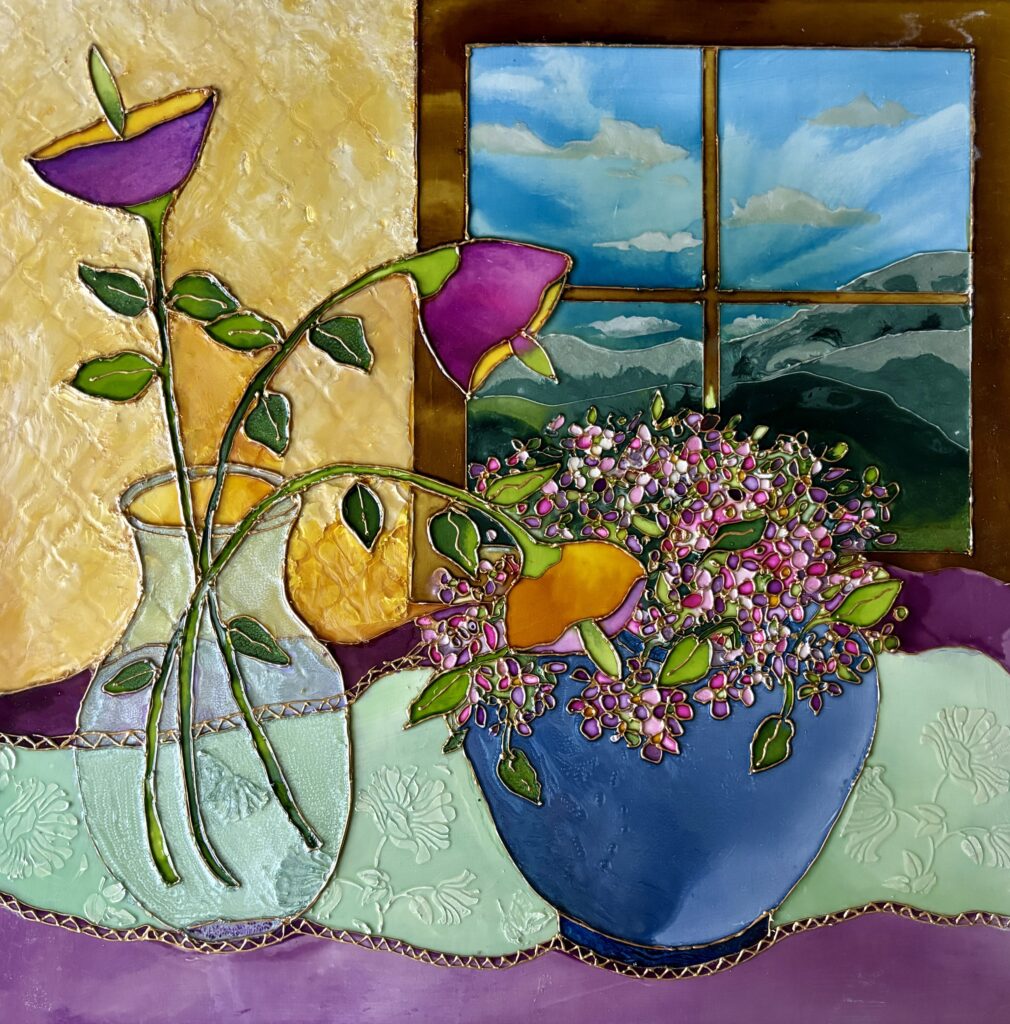
I’m a modern Florida artist simply steeped into this lush, humid, sensual landscape. My painted plants actually twist around and into each other. I want my viewer to feel, and get lost in that. I’ve always considered myself to be an Expressionist, so colors gets amplified, demanding attention.
Let me share a little story of how that can happen: One day, my husband and I went on an “art walk-a-bout” in Naples, Florida. Each community in Florida has a different “vibe”. Naples, however, is positively bathed in turquoise and hot pink. Other than “The Barbie Movie” I don’t remember being affected by a color so completely.
That week I went home and painted, “In the Pink” This year, I’m in love with pink, other years I’m obsessed with something else!
Q5. Your still lifes often feel like portraits rather than studies of objects, when did you begin seeing everyday objects that way?
It started when I was a child pretending that salt & pepper shakers were people having conversations, getting upset and pushing one another off the table. My daughter did that too, so I guess it’s genetic! It’s important to keep some of that fresh, childlike wonder present in our art.
Also, while I’m influenced by the landscapes around me, many of my plants come strictly from my imagination and don’t really exist. When I’m happy with one of my fantasy flowers, I’ll repeat them in another painting, thereby creating a unity, a sense of recognition for the series.
Q6. You work across oils, acrylics, and drawing. How does each medium influence the way you approach a subject?
Drawing is the building block for everything. We have an eraser so nothing needs to be precious. Wipe away one idea and start another. Complete joy! Acrylics can be a “problem child” because they dry so quickly; but using a stay-wet palette really helps with that. I use acrylics as an underpainting and I keep things thin and simple in the beginning. Like the sketchbook, I think things through in acrylics, allow mistakes, take chances. When I’m sure the underpainting is right, the real work starts.
Stencils and modelling paste are placed in areas that need enhancement. Then, all the objects are outlined using gold “Cerne Relief” which is a product sold by the Pebeo company. Next, I use both traditional oil paints and oil-based resin paints. It takes many hours and layers, with very careful planning.
Q7. Flowers have been painted for centuries, what do they allow you to explore beyond their beauty?
The secret begins with the drawing. I do not sketch. Sketching is the right approach for the classical rendering of plants and flowers. If you are looking to modernize your work then you must use the contour drawing method. This means you draw in one continuous line. It is miraculous what happens! The rhythm, the curved lines of each petal and stem add an element of pure magic.
Sometimes the drawings are a little wonky but they can be refined by putting a piece of tracing paper over the drawing to edit the work. The contour method gives “personality” to the work . Yes, they are beautiful, yes they are sensual, but they are approachable and they are fun.
Q8. In a world of endless scrolling, what makes someone truly stop and spend time with a painting?
Light and contrast. We only need to think of the work of Rembrandt and Caravaggio to remember how deeply attracted we are to light. Yes, they are perfectly rendered, but it is the light that always mesmerized the viewer. Another important element are paint strokes; the rhythm of application can bring great expression to any subject. Van Gogh comes to mind, as does Monet.
Yayoi Kusama uses the repetition of objects with her dots and other repeated forms. Mark Rothko’s used glowing color blocks that melted and vibrated into each other. However, when everything is said and done, it is an image that is rendered beautifully, and authentically represents the intention of the artist.
Q9. Your work embraces beauty without apology, do you see beauty itself as a meaningful subject for contemporary art?
This question gave me great pause: “How aware am I, of myself, as a painter?” With all the trauma and angst in the world, am I sitting at my easel content to paint beautiful things because they are beautiful? Some painters have a responsibility to address deeper subjects.
I have great respect for artists who choose personal pain, irony or politics for their expressions; but It’s obvious which camp I belong to. I work purposefully to elevate and entertain, both for myself and the many patrons who proudly hang my art on their walls. We are all creators. We belong to a hierarchy of very special individuals that produce, out of nothing, what did not exist in the world before.
Q10. After years of exhibiting, teaching, and building a successful career, has your definition of success changed over time?
My success today comes when my students are successful. It takes bravery to walk into an art room when you don’t know how to paint and know nothing about the teacher. Each student has different challenges. There are gaps in what they know and it’s my job to figure that out and create a personal plan that will take them where they want to go.
Most of these people are retired adults who have had great careers but always wanted to learn how to paint. I’m able to gain their trust and we work through both the triumphs and the tribulations of the painting process I’ve mentored teenagers who wanted to make art their career and I’ve helped numerous people on “The Spectrum” to find new ways of expression. When I was going through a divorce, I created an art school out of my house, teaching over 60 students over a seven year period.
I also have a small group of women artists, who I have been friends with for the last 30 years. We’ve supported each other through raising our families, celebrating our art achievements and being mentors for one another. Artists can be adorably quirky, so it’s especially important to have “like-minded” people around us. All of these people and all of these communities are my definition of success.
Q11. In a world filled with digital images, what can a painted flower express that a photograph cannot?
Either we are going to start to treasure the things that are made with our hands, and that we see in “real life” or were going to lose an essential part of our humanity. Responsible adults who value human creativity, must find every opportunity to pass these experiences to the next generation. Seeing a great work of art in a book, and then seeing it in person, provides a deeply visceral experience.
A.I. is a magnificent tool. I encourage my art students to use it to enrich the photo references they will use for their painting. What transpires from this experience is important to note. At first, they are very excited because A.I. creates all of their outlandish interpretations. However, when they are done with the painting, their lack of “ownership” leaves them feeling hollow. That’s when their art journey really begins, as they learn to create their own drawings, their own palettes and make their own interpretations.
Q12. What has been more important to your growth as an artist: technical skill, consistency, or learning to trust your own voice?
We all must learn the skill of painting. While this is going on, you must study historical movements that will help you to develop an infinity for certain artists or types of painting. AI had done all that, but then I had my first artistic crisis. I sat alone in my studio and panic set in! What do I want to paint? Will it be enough to sustain a series?
Who am I kidding, everyone will know that I am an imposter! I had been selling portraits of children but that hardly made me an artist with a vision. One of my private students was an accomplished carpenter, and it was he who suggested that he could make me panels in any shape I wanted.
I commissioned him to create curved panels inset into a matching frame that looked like a window. I gold-leafed the frames and created my first landscape series, “Paths” which were sold in a small Ft. Lauderdale gallery.
Q13. What advice would you give artists trying to stay joyful and authentic in a world driven by trends?
Stop looking at other people’s art. Go to a park or a beach where there are people and animals and watch them do things that are human and endearing.
As our conversation with Genie came to a close, something stayed with us that has nothing to do with flowers or paint or technique. It is about permission. The permission to enjoy what you make.
The permission to let your work be fun without worrying that fun means it is not serious. The permission to be the artist who makes people smile instead of the artist who makes people think deep troubled thoughts.
That sounds simple but it is actually one of the hardest permissions to give yourself in the current art world. Because somewhere along the way we all absorbed this idea that meaningful art has to hurt a little. That if the making was joyful and the result is beautiful then maybe it was too easy and maybe it does not count.
Genie blew that idea apart for us. Because her work is joyful and beautiful and also technically rigorous and conceptually interesting and built on decades of study and a process with more stages than most serious abstract painters use. The joy is not a shortcut. It is the destination. And getting there took just as much discipline and commitment as any dark brooding body of work that hangs in a museum right now.
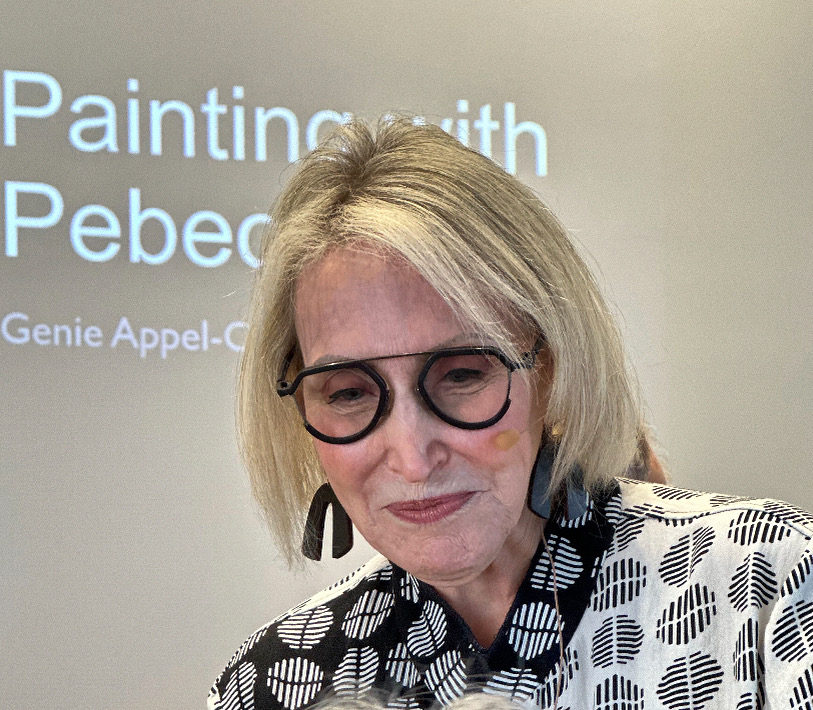
And then there is the teaching. Genie stopped measuring her career by her own exhibitions a long time ago. She measures it by the person who walked into her classroom scared and walked out knowing they could paint. By the sixty students who came through the art school she built from her own house during one of the hardest stretches of her life.
That is generosity the real generosity. The kind where you take everything you spent years learning and you hand it to someone else and your reward is watching their face when they realise they can actually do this.
Every artist builds a legacy. Most of us think legacy means the work we leave behind. Genie is building two legacies at the same time. The paintings, which are extraordinary. And the people she taught, who will carry what she gave them into their own creative lives long after the last class ends. We are not sure which legacy is more important. We think Genie would say the second one without hesitating.
For anyone bringing her work into their home, these paintings make rooms feel warmer. That is the simplest and most honest thing we can say about them. The colour is alive, the compositions are full of energy, and there is a personality in every flower and every vase that makes the paintings feel less like objects on a wall and more like good company. You will look at them on random mornings and feel a little bit better about the day ahead. That is worth more than most art ever gives you.
Follow Genie Appel-Cohen through the links below and see her beautiful work for yourself.