
The Beauty of Paris Through 7 Timeless Paintings
Some cities preserve their history in museums. Paris has a habit of leaving it out in the open.
Walk through Montmartre, pause beside the Seine, or cross a quiet boulevard after the rain, and you may find yourself standing in a place that artists painted more than a century ago. Long before smartphones, postcards, or social media, painters like Vincent van Gogh, Gustave Caillebotte, Camille Pissarro, and countless others were documenting the city’s streets, cafés, railway stations, and landmarks, not as tourist attractions, but as the backdrop to everyday life.
What makes these paintings so fascinating today isn’t simply their artistic brilliance. It’s the startling realization that many of the views still exist. The horse-drawn carriages have disappeared, fashions have changed, and Paris has embraced a new century, yet many of the streets, monuments, and skylines remain instantly recognisable. Looking at these artworks beside the modern city feels less like comparing the past with the present and more like discovering that Paris has quietly been carrying its own memories all along.
These seven paintings invite us to see the French capital through the eyes of the artists who immortalised it. Together, they reveal a city that has never stopped changing, yet somehow never lost the character that first inspired generations of painters. In Paris, history isn’t confined to gallery walls, it still waits around the next street corner.
1. Vincent van Gogh’s Rue Lepic: The View He Woke Up To Every Morning
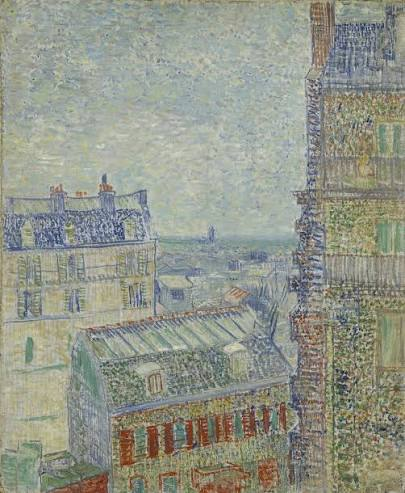
There are countless places in Paris where you can admire Vincent van Gogh’s work, but very few where you can quite literally stand inside it. Tucked into the winding streets of Montmartre, Rue Lepic is one of those rare places. Today, it buzzes with cafés, cyclists, and visitors climbing toward the hilltop, yet if you pause long enough, the outlines of another Paris begin to emerge, the one Van Gogh saw from his window in the late 1880s.
During his time living with his brother Theo in Montmartre, Van Gogh painted Vue de la chambre (View from the Bedroom), looking out across the rooftops that stretched toward the city. The painting captures the quiet geometry of chimneys, sloping roofs, and tightly packed buildings bathed in his unmistakable palette of luminous blues, warm ochres, and vivid greens. It is less a panoramic view than an intimate glimpse into the artist’s everyday world, a scene that existed outside his window before it ever found its way onto canvas.
More than a century later, the neighbourhood has evolved, but remarkably, much of its character remains. The rooftops still cascade down the hillside, the streets retain their gentle curves, and the unmistakable rhythm of Montmartre survives beneath layers of modern life. Looking at the painting beside the present-day view is a reminder that cities are not only shaped by architects and planners but also by the artists who taught us how to see them.
Standing on Rue Lepic today feels less like visiting a filming location and more like stepping into a memory. The view has changed just enough to reveal the passing of time, yet not so much that Van Gogh’s Paris has disappeared. Instead, it lingers quietly among the rooftops, waiting for anyone curious enough to look beyond the present.
2. Gustave Caillebotte’s Place de Dublin: The Intersection That Became an Impressionist Masterpiece
Some of the world’s greatest paintings were inspired by dramatic landscapes or grand monuments. Gustave Caillebotte found his masterpiece at a street corner.
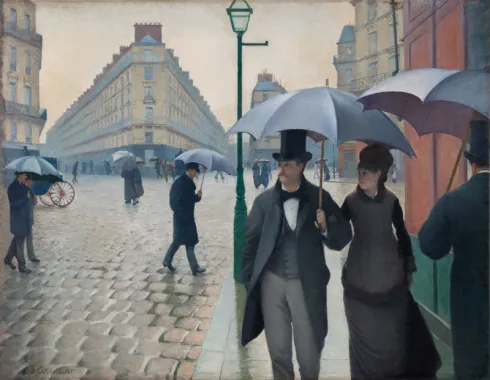
At first glance, Place de Dublin seems like an ordinary Parisian intersection. Elegant Haussmann buildings frame the crossroads, balconies catch the changing light, and the streets stretch outward in perfect symmetry. Commuters pass through without much thought, umbrellas still appear when the rain begins, and the rhythm of daily life continues much as it always has. Yet this seemingly unremarkable spot became the setting for one of Impressionism’s most celebrated works.
In 1877, Caillebotte transformed this intersection into Paris Street; Rainy Day (Rue de Paris, temps de pluie), a painting that feels strikingly modern even today. Rather than filling his canvas with romantic nostalgia, he captured the experience of walking through a rapidly changing city. The broad boulevards, the orderly façades, and the anonymous figures navigating the rain reflected the new Paris emerging after Baron Haussmann’s sweeping redesign of the city. It was a portrait of urban life itself, one that continues to resonate nearly 150 years later.
Stand at Place de Dublin today, and the resemblance is almost uncanny. The horse-drawn carriages have disappeared, replaced by cars and bicycles, and the cobbled streets have given way to smoother roads. Yet the architecture that anchors the composition remains remarkably intact. The same triangular perspective still draws the eye into the distance, making it easy to imagine the elegantly dressed pedestrians from Caillebotte’s canvas crossing paths with the people of modern Paris.
It is a reminder that some places become timeless not because they resist change, but because they continue to tell the same story across generations. Caillebotte didn’t simply paint a rainy afternoon, he captured the feeling of a city discovering its modern identity, and that moment still lingers at the crossroads today.
3. Eugène Galien-Laloue’s Quai de Montebello: Seeing Notre-Dame Through an Artist’s Eyes
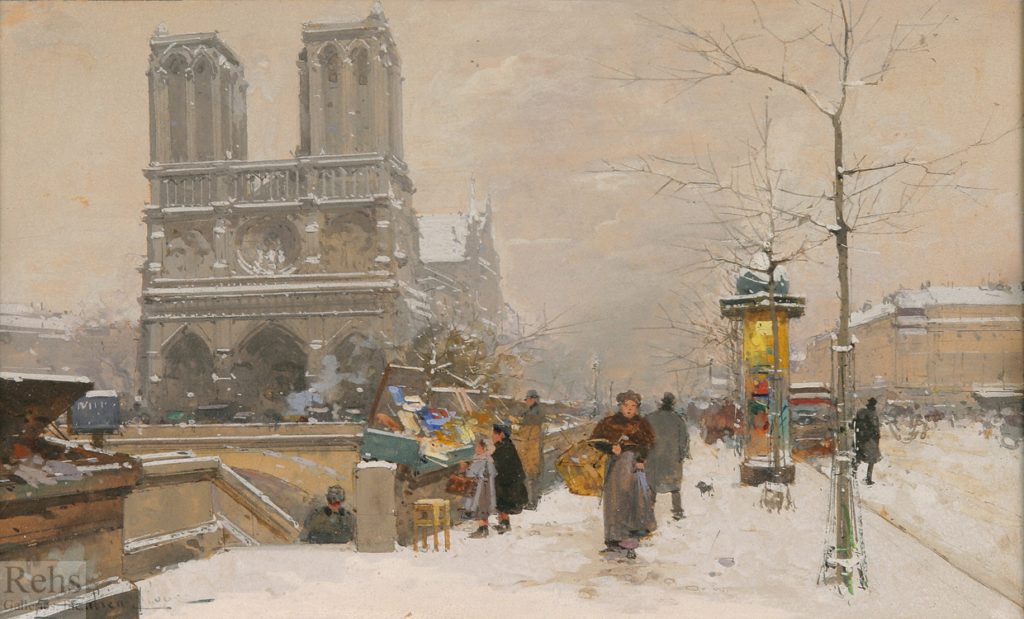
Long before millions of visitors lined the banks of the Seine with smartphones in hand, artists were already searching for the perfect view of Notre-Dame. One of the most evocative came from Quai de Montebello, where the cathedral rises above the river with a quiet sense of permanence, watching the city flow around it.
In Notre-Dame, Winter, Eugène Galien-Laloue turned this familiar landmark into something unexpectedly intimate. Rather than celebrating the cathedral’s Gothic grandeur alone, he focused on the atmosphere that surrounded it. Snow softens the streets, pedestrians hurry through the cold, and the muted winter light wraps the entire scene in a gentle haze. Notre-Dame stands at the centre, but it shares the stage with everyday life unfolding around it, a reminder that even the most iconic monuments are part of a living city.
Remarkably, the view from Quai de Montebello has changed far less than you might expect. The Seine still reflects the cathedral’s silhouette, the bridges continue to frame the approach, and the riverside remains one of the most recognisable vistas in Paris. While restoration efforts have reshaped parts of Notre-Dame in recent years, the relationship between the cathedral, the river, and the surrounding streets remains unmistakably familiar. Looking from the quay today, it’s easy to understand why generations of artists returned to this exact spot with their easels.
What makes this comparison so compelling isn’t simply that the buildings survived. It’s that the mood survives, too. The stillness of the river, the quiet dignity of the cathedral, and the feeling of Paris moving gently around one of its oldest landmarks remain much the same. Standing here today feels like stepping into a winter afternoon preserved on canvas, where history and the present continue to share the same view.
4. Camille Pissarro’s Boulevard Montmartre: The Street That Never Stops Moving
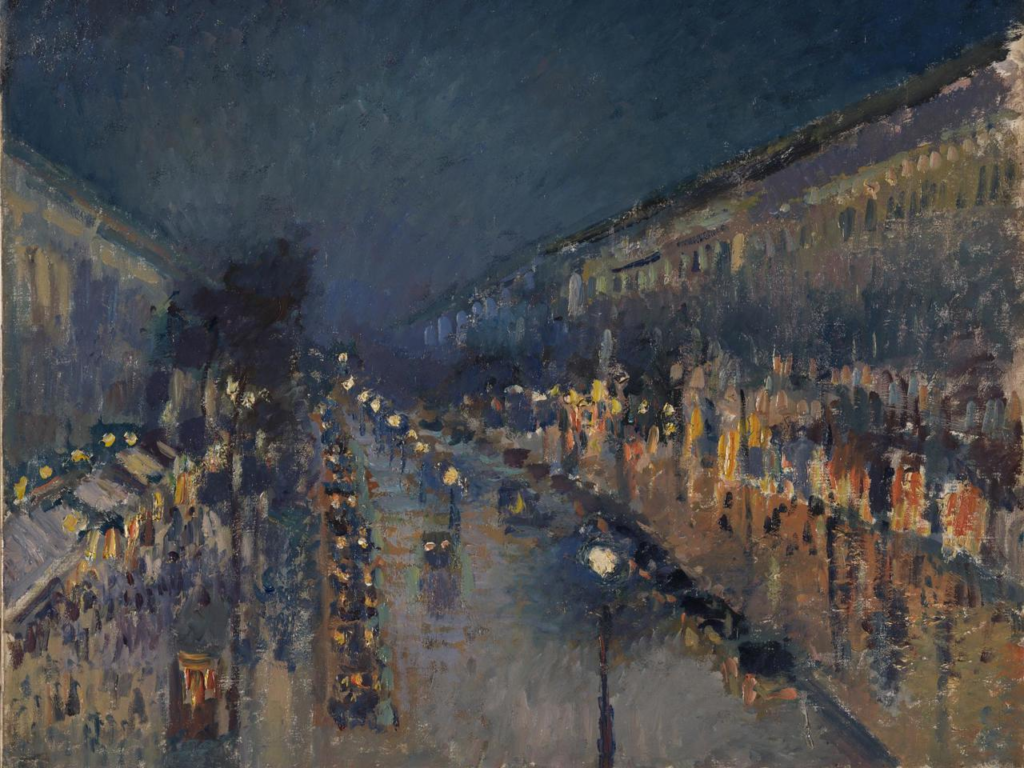
Some streets are defined by the buildings that line them. Boulevard Montmartre is defined by movement. For more than a century, it has been one of Paris’s busiest thoroughfares, a place where carriages gave way to automobiles, cafés filled and emptied, theatres lit up the evenings, and generations of Parisians passed through without ever slowing down.
Few artists captured that restless energy better than Camille Pissarro. In his series devoted to Boulevard Montmartre, painted from the window of the Grand Hôtel de Russie in 1897, he returned to the same view again and again, recording how the boulevard transformed with the changing weather, seasons, and hours of the day. Boulevard Montmartre at Night is among the most captivating of the series. Illuminated shopfronts and glowing streetlights spill across the road, while crowds and horse-drawn carriages dissolve into quick, flickering brushstrokes. Rather than freezing a single moment, Pissarro painted the pulse of a city that never seemed to stand still.
That same pulse can still be felt today. The horse-drawn traffic has disappeared, replaced by streams of cars, buses, and pedestrians, yet the boulevard retains its unmistakable rhythm. The elegant façades remain remarkably intact, cafés continue to spill onto the pavements, and the wide avenue still hums with the same sense of possibility that fascinated Pissarro more than 125 years ago.
Looking at the painting beside the modern street reveals something remarkable: Paris has changed its vehicles, fashions, and pace, but not its spirit. Boulevard Montmartre is still a stage where everyday life unfolds in endless motion. Pissarro wasn’t simply documenting a famous street, he was capturing the heartbeat of Paris, and if you stand there today, you can still feel it.
5. Auguste Chabaud’s Gare du Nord: Where Paris Learned to Move Faster
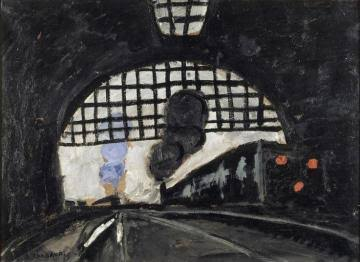
Every city has a gateway, and for Paris, few have been as important as Gare du Nord. Long before it became Europe’s busiest railway station, it was already a symbol of a changing world. Trains arrived carrying visitors, workers, artists, and dreamers from across France and beyond, transforming the station into a crossroads where countless journeys began and ended.
French painter Auguste Chabaud captured that energy in his striking depiction of Gare du Nord. Rather than focusing on architectural precision, Chabaud embraced bold colours and expressive forms to convey the station’s atmosphere. Steam billows into the air, figures blur together in constant motion, and the vast iron-and-glass structure feels almost alive. His painting is less about a railway station than about the excitement, and uncertainty, of modern life, when travel was shrinking distances and cities were becoming more connected than ever before.
More than a century later, Gare du Nord remains true to that role. The clouds of steam have vanished, replaced by the sleek arrivals of high-speed trains, while digital departure boards have taken the place of handwritten schedules. Yet the essence of the station is remarkably unchanged. Every day, thousands of people rush beneath its soaring roof, dragging suitcases, greeting loved ones, or setting off for places unknown. The feeling of anticipation that Chabaud painted still hangs in the air.
Standing inside Gare du Nord today, it’s easy to forget that generations before us experienced many of the same emotions within these walls. The faces, fashions, and technology may have changed, but the station continues to witness reunions, farewells, and fresh beginnings. Chabaud captured more than a building, he captured the timeless excitement of travel itself, proving that some places are defined not by what they look like, but by the stories that pass through them every single day.
6. George Stein’s Porte Saint-Denis: The Arch That Has Watched Paris Change
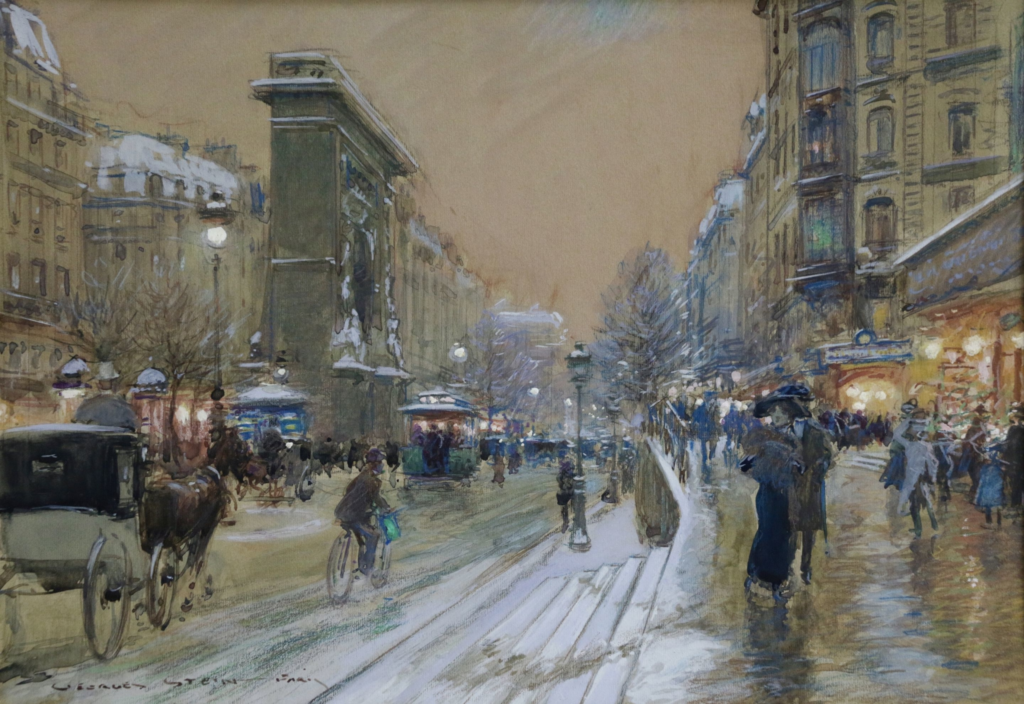
It’s easy to walk past Porte Saint-Denis without realising you’re passing one of Paris’s oldest witnesses. While cafés open and close, fashions evolve, and traffic endlessly circles the monument, the triumphal arch has stood here since the seventeenth century, quietly observing the city reinvent itself time and again.
When George Stein painted Porte Saint-Denis (Evening), he captured more than an architectural landmark. The fading daylight casts a warm glow across the stone arch as pedestrians make their way home and horse-drawn carriages weave through the streets. Rather than presenting the monument as a grand symbol of military victory, Stein places it within the rhythm of everyday Paris. The arch becomes part of the city’s daily life, a familiar presence that locals passed without ceremony, even as it carried centuries of history.
That sense of continuity is what makes standing here today so remarkable. Cars now stream beneath the same arch where carriages once rolled, shopfronts illuminate the surrounding streets, and the pace of life has accelerated beyond anything Stein could have imagined. Yet the monument itself remains almost unchanged, anchoring the neighbourhood much as it did when the painting was created. It serves as a quiet reminder that while cities are constantly evolving, some landmarks become their memory, connecting one generation to the next.
Looking at the painting alongside the modern street, the differences are obvious, but so are the similarities. The crowds have changed, the skyline has grown busier, and Paris has embraced a new century, yet Porte Saint-Denis continues to do what it always has: stand at the centre of the city’s movement, watching history unfold one passerby at a time. Few places illustrate the enduring relationship between art and place quite as powerfully as this enduring gateway.
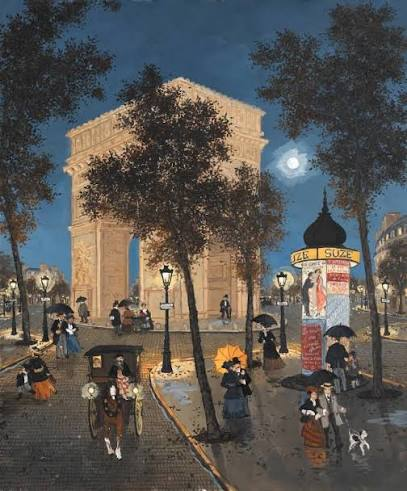
7. Fabienne Delacroix’s Place de l’Étoile: The Monument That Still Commands Paris

Few places in Paris make you feel the scale of the city quite like Place de l’Étoile. Stand at its centre, and twelve grand avenues radiate outward like the points of a star, each leading into a different part of the capital. At its heart rises the Arc de Triomphe, a monument that has watched revolutions, military parades, national celebrations, and ordinary afternoons unfold beneath its shadow for nearly two centuries.
French painter Fabienne Delacroix approached this iconic landmark from a different perspective. Her colourful, nostalgic portrayal of Place de l’Étoile softens the pace of modern Paris, replacing its hurried rhythm with a scene filled with warmth and charm. Elegant façades glow beneath a bright sky, horse-drawn carriages mingle with early automobiles, and the Arc stands as a reassuring constant amid the movement around it. Rather than focusing solely on the monument’s grandeur, Delacroix invites us to notice the life that has always revolved around it, the people crossing the square, the changing seasons, and the city’s everyday rituals.
Visit the roundabout today, and the contrast is striking. Streams of vehicles circle the Arc from every direction, tourists gather beneath its towering arches, and the eternal flame burns in remembrance beneath the Tomb of the Unknown Soldier. Yet despite the relentless movement, the composition remains instantly recognisable. The monument still dominates the skyline exactly as it did in Delacroix’s painting, anchoring one of the most famous urban spaces in the world.
Looking at the artwork beside the present-day view, you realise that Paris has never stood still, it has simply carried its past with it. The fashions, transport, and pace of life have transformed, but the Arc de Triomphe continues to unite them all, serving as both a landmark and a living witness to the city’s unfolding story. It is a fitting reminder that the greatest works of art do more than preserve a place; they preserve the feeling of standing there, even generations later.
Paris is often described as timeless, but these paintings reveal something even more remarkable: it is a city that remembers. Long before tourists arrived with cameras and maps, artists were preserving its streets, bridges, cafés, and monuments with brushes and canvas. They weren’t simply documenting architecture, they were capturing fleeting moments of everyday life, the changing light on a boulevard, the hush of a winter morning by the Seine, or the quiet rhythm of a neighbourhood before it transformed.
Looking at these artworks alongside the modern city is more than a visual comparison. It’s a reminder that history isn’t always hidden behind museum glass. Sometimes it’s waiting at a street corner, reflected in a familiar skyline, or quietly surviving in a view that has changed far less than we imagine. The people have changed, the traffic has changed, and Paris has continued to evolve, yet the essence of these places remains unmistakably intact.
Perhaps that’s what makes Paris unlike any other city. It doesn’t ask you to choose between the past and the present. Instead, it invites you to experience both at once. Walk through Montmartre, pause at Place de Dublin, or stand beside the Seine, and you may find yourself seeing the city through the eyes of Van Gogh, Pissarro, Caillebotte, and countless others who turned ordinary streets into extraordinary works of art.
The next time you visit Paris, don’t just look for its famous landmarks. Look for the paintings still hidden in plain sight. You might discover that the city’s greatest gallery has never been inside a museum at all.
which one do you like the most?
If you enjoy discovering the stories hidden inside famous artworks, you might also like our feature, The Many Faces of the Angel of Death, where we explore how artists across centuries reimagined one of art history’s most enduring and mysterious figures.