

How Schiele, Bacon & Van Gogh inspired Tomáš Jetela’s figurative paintings

At Arts to Hearts project, we are always drawn to artists whose relationship with art feels less like a career choice and more like something they simply couldn’t walk away from. The ones who discover a painting by Van Gogh or Schiele at a young age and, without fully understanding why, know that their lives have changed.
Our Best of the Art World editorial was built to find exactly those artists. Artists who have stayed true to their own voice, even when the world around them was moving in a different direction. That is exactly why we are so excited to introduce Czech painter Tomáš Jetela.
Born in 1986, Tomáš studied at the Academy of Fine Arts in Prague under Jiří Lindovský and Michael Rittstein. Early in his career, he made a choice that would quietly shape everything that followed.
While many of his contemporaries embraced abstraction and conceptual practices, he remained devoted to the human figure. Not because he was looking backwards, but because it was the language that felt most truthful to him.
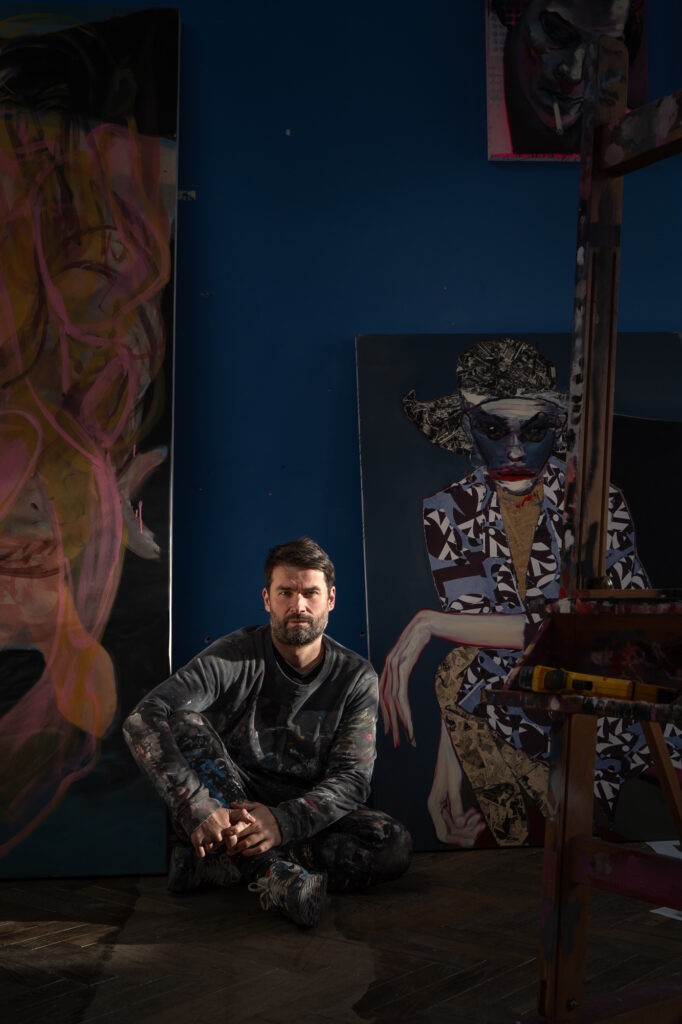
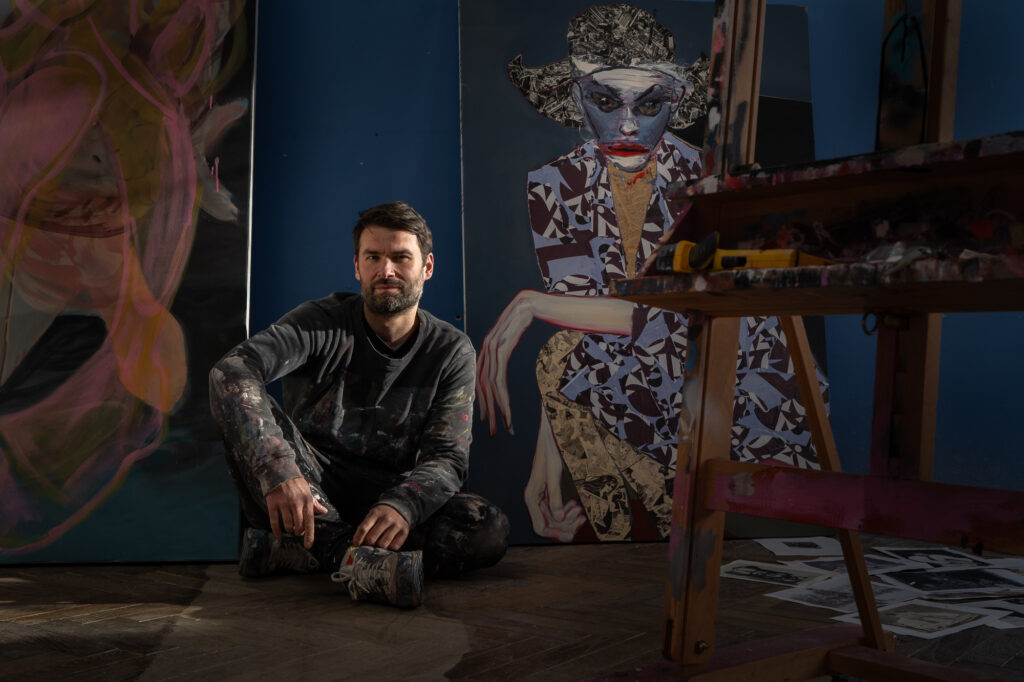
For Tomáš, the figure is never simply a body or a portrait. It becomes a way of exploring memory, vulnerability, conflict, and the complexities of being human. His paintings combine oil, drawing, and fragments of printed materials, creating layered compositions that feel both timeless and unmistakably contemporary.
There is an emotional intensity to his work that is difficult to ignore. Faces appear fractured yet deeply expressive. Hands and gestures speak as powerfully as words. Every mark seems to carry a sense of psychological weight, inviting viewers to spend time with the work rather than searching for immediate answers.
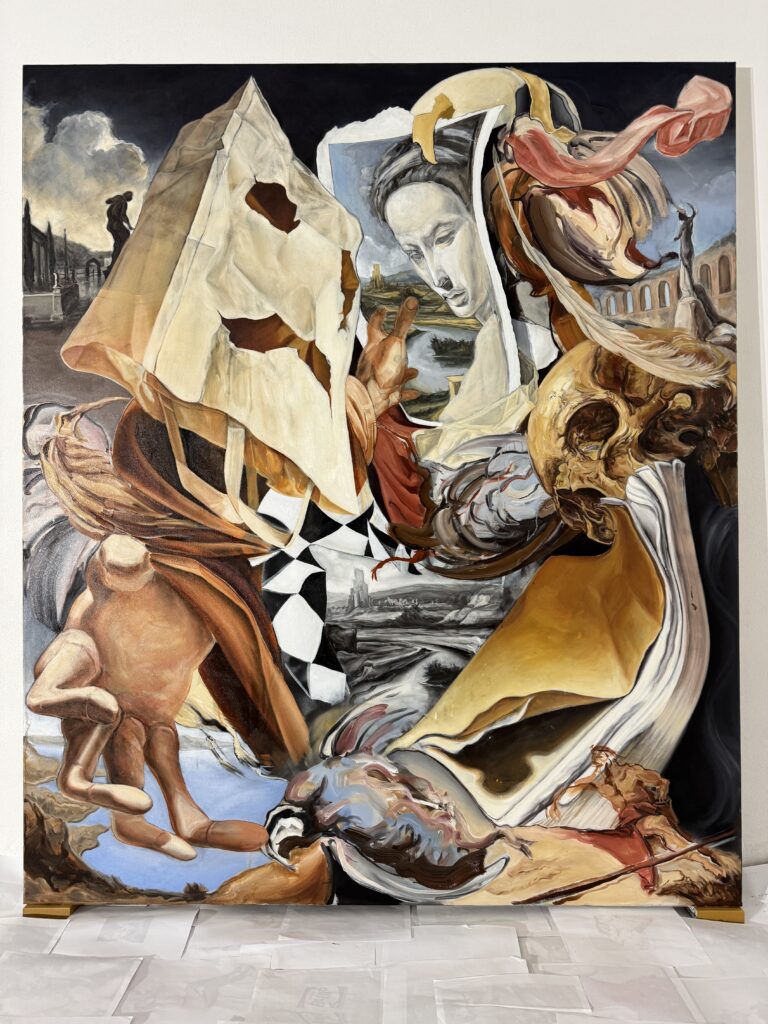
You can sense the presence of artists such as Francis Bacon, Francisco Goya, and Egon Schiele in his paintings, but never as imitation. Instead, they feel like voices in an ongoing conversation. Tomáš has absorbed these influences so completely that they have become part of his own visual language, allowing him to create work that feels distinctly his.
His paintings have been exhibited at Galerie Paul 13 in Paris, Nova Sin Gallery in Prague, and in numerous group exhibitions that continue to position him within the evolving conversation around contemporary figurative painting.
We have been thinking about his paintings since we first found them. And we cannot wait for you to read what he has to say about them.
Let’s get to know Tomáš through our conversation with him and discover the painter who stayed with the figure when everyone else was looking elsewhere.
Q1. Tomáš, can you share a little about your journey and how you found your way to figurative painting?
The path to painting could be described as a gradual awareness of something that seemed important and which over time became a fascination. And this desire eventually turned into a firm decision to become a painter, transformed into an unwavering conviction about one’s own identity. In elementary and high school, I read heaps of biographies and novels of various artists, not only painters, sculptors… but also writers, etc. I was carried away by the lives of Renaissance artists, stories about painters around Montmartre, the lives of van Gogh, etc.
I think that apart from the “romanticizing” and “novelistic” imagination, i.e. the distorted idea of ”how it all was” and all that ballast around bohemianism, I took away and observed one common feature from this reading and that was that they all worked hard, systematically, unwaveringly, without compromise and like an obsession. When I compare that reader from my youth and myself today, I can write that they are diametrically different people. It’s as if I were looking back at someone else, a stranger.
A naive boy full of ideals determined to do everything “right”, to play by the rules. A fool who believes in authority, listens to the poor, insignificant and worthless “wisdom” of teachers and other frauds. I still don’t feel completely free, because absolute freedom does not exist in the world in reality. Compromises seem inevitable. But I think I have freed myself from the bad influences, parasitic opinions, insignificant values and negativity of others. Before, I tried to understand painting, mostly through the aforementioned “fools”.
Now I know that the main thing is not to listen to anyone, not to trust anyone, not even yourself. Understanding painting is absurd, it defies simple definition. Complicated as the microcosm and macrocosm, about which we know almost nothing.. mysterious as magic, the existence of which some doubt.. no one knows it as well as in alchemy, what is real and what is myth? Painting defies logic and on the other hand we can compare it to chess, on several levels, they can be, for example, a metaphor for composition, line, color, structure, style, etc., or. to the infinity of variables.
And taking into account the fact that the number of possible chess games is inconceivably higher than the number of atoms in the visible universe and the “higher degree” of the absence of rules in painting, the painter appears as a supernatural being who controls chaos. He enters it and his decision gives it order, meaning, harmony.. or on the contrary, legitimizes his domination, just shows him to the world and lets him win. It is an unconditional, unconditional and unlimited freedom, it should be, otherwise the reason to paint disappears (in the dimension of creation and thinking, of course, in life, as I mentioned, freedom seems relative).
Q2. You’ve remained committed to figurative painting throughout your career. What keeps you returning to the human figure?
I would not look for deeper reasons or “miraculous inspirations” behind this decision why I chose the human as a subject. Although we would probably uncover more inner, more philosophical reasons for this direction. I can write, for example: “The human figure becomes the measure of everything, the yardstick for anything, a mystery without which the world would not exist.” A meaningless “poetic invention”.
The truth is simpler, figurative painting enchanted and captivated me the most, the paintings of artists from the past and present appealed to me as a revelation among the rest of what was happening in art.
For example: When I first saw Egon Schiele’s paintings and drawings, I experienced a complete shock, as if an electric current had passed through my brain and body. Even though my perceptions and preferences have slightly “mixed” and transformed, we can still observe the figure as a key part of my paintings.
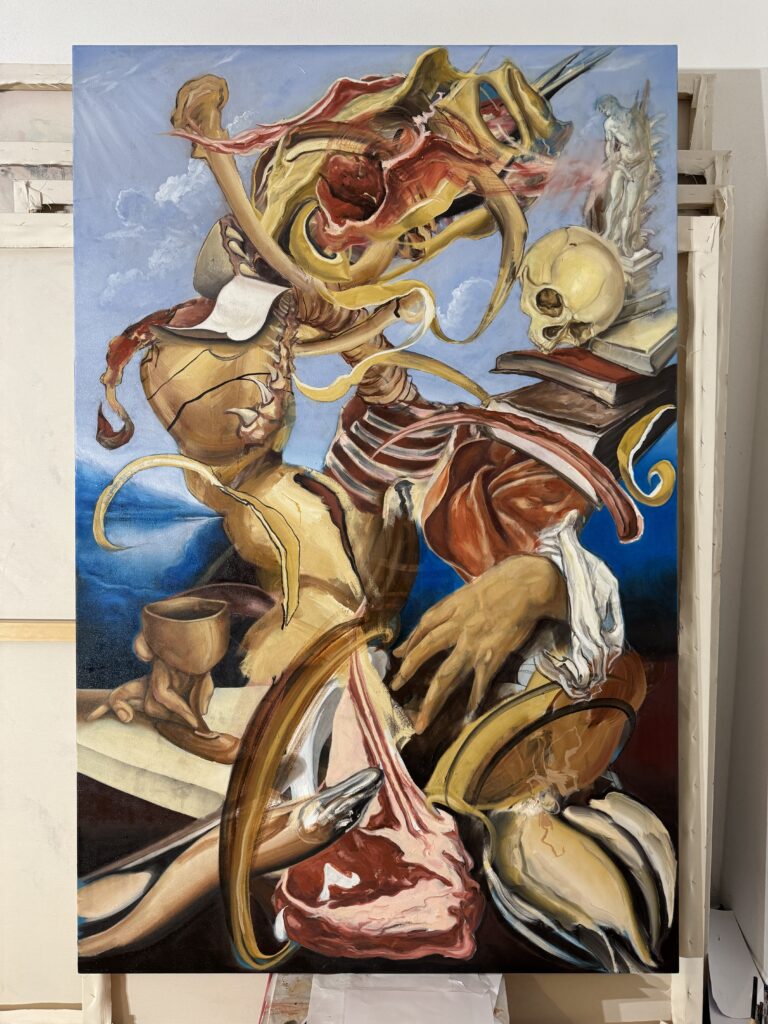
Q3. Hands and gestures carry great emotional weight in your work. What can they express that words cannot?
Previously, facial expression and hand gestures stood on a pedestal of my interest, they were the alpha and omega of my work. Today we can observe them as part of a larger whole, a universe that unmasks ways of seeing and perceiving, combining everything that seems important to create a strong content.
We go through quotations from paintings by old masters, e.g. fragments of baroque still lifes, through references to pop culture to classical figuration or landscape painting… and we can still find many other aspects.
Q4. What do mythical creatures allow you to explore about human nature?
Mythical beings are based on archetypes, in fact, they have been creating archetypes for centuries, they are woven from them. And they logically appear in contemporary events. Here, the past smoothly transitions into the present without major changes. The surface, the visual aspect changes, but the essence or idea remains the same. I like to create relationships that are illogical and irrational at first glance, which create a new context.
This interaction between seemingly “foreign” things (one torn from its past environment, stripped of its original meaning, and the other separated from its current connections) creates new unexpected levels of meaning, opens up space for questions (rather than answers) and reflects on what changes our perception of the already known in a new discourse.
They are eternal truths about our being, consciousness and subconsciousness. The aforementioned archetypal heritage explores aspects of humanity from time immemorial.
Q5. Your paintings feel contemporary while echoing art history. What keeps that dialogue important to you?
Every work should be perceived in the context of art history, ignorance of history often causes confusion, misunderstanding, misinterpretation, even a trivial failure of the relationship between the perceiver and the painting. An uneducated viewer is often like a pest, his lack of understanding can introduce into the discourse adverse influences that cause fatal changes in the “reading” of a particular work. The imbecility then spreads like an avalanche and infects other fools who destroy the “great intention”, the stability of the content, the correct conception of the idea, etc.
On the one hand, the work survives thanks to the viewers, grows stronger, etc. on the other hand, complete misunderstanding (let’s think of artists in the past, a shining example is Vincent van Gogh) creates metastases of evil that must be stopped and destroyed just as a gangrenous hand must be amputated. In the metaphorical and hypothetical sphere, the artist should have the right to shoot every rat infected with the plague of ignorance.
I have deviated a little from the question posed, so let’s return to the dialogue between the past and the present. I think this is something completely natural and inevitable, the painter works with the chaos of past times and tries to understand the chaos of his own time, his confused and exhausted soul places on the altar of the canvas what seems to him connected and important at the given moment.
He carries out possible and impossible combinatorics of facts, aspects, realities, causes and effects, etc. He fights like a modern Prometheus and Sisyphus in one.
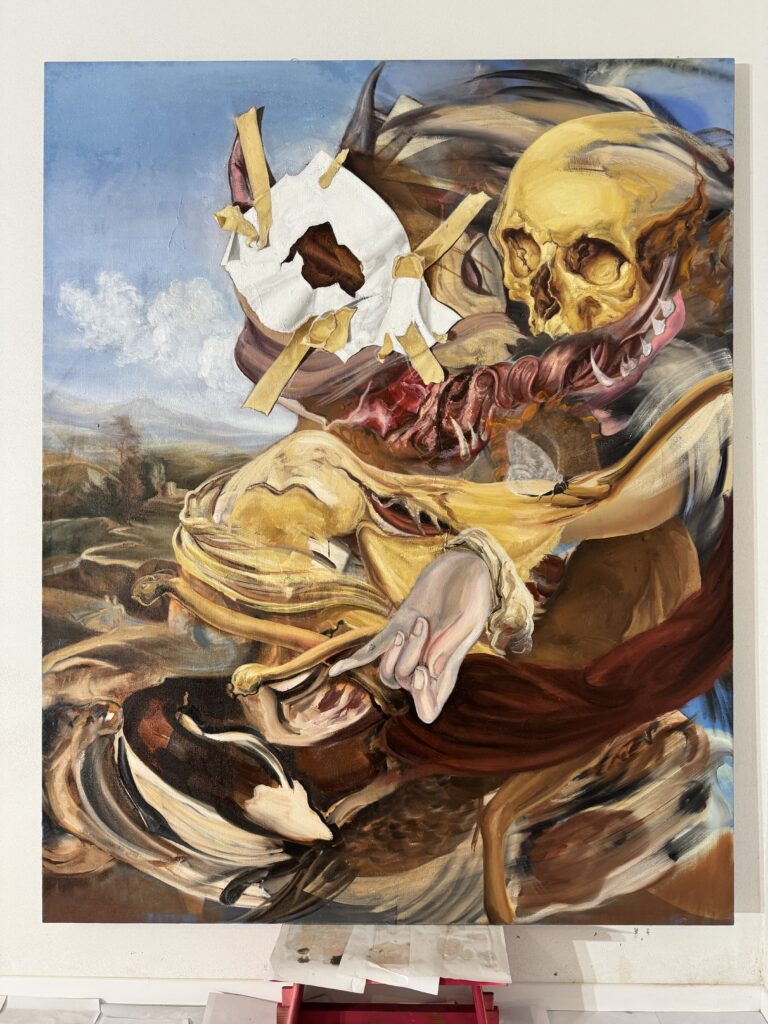
Q6. You’ve said you discovered connections to artists like Arcimboldo only afterwards. Do you think influence often works subconsciously?
Absolutely. What happens in a painting is the result of a “duel” of rationality, analytical thinking with intuitive procedures and “controlled” chance. A “duel” of what we think is “right” and what our intuition tells us is “better”. Who knows to what extent the subconscious intervenes in the creation of a particular painting and when it is “our” conscious creation. Lately I have noticed that ideas come unexpectedly and in different moods, in peace and in a clash with reality.
Often in a state of concentration while working on a painting in progress, in a kind of “trance”. One could even say “in an altered state of mind”, which is caused by absolute immersion in the activity in progress and new ideas are born as if in the “background” of consciousness. So I can probably say that in this state of perfect concentration, exciting ideas from the subconscious surface.
Q7. What qualities do you admire most in the great figurative painters of the past?
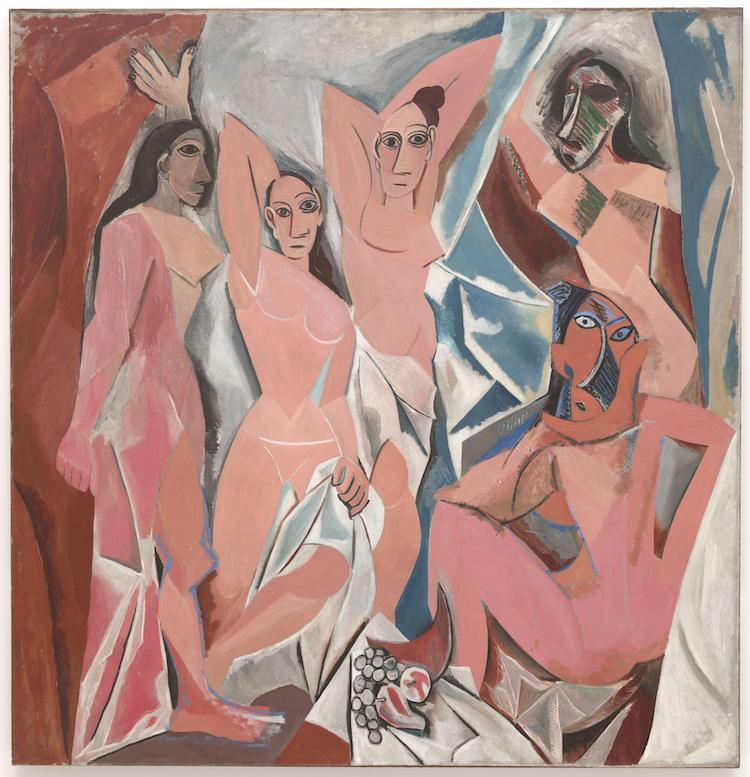
When looking at the works of some painters, I experience something like transcendence, a complete amazement or dazzle occurs, not only the brain but also the body reacts. Picasso, van Gogh, Bacon, Soutine, for example, it always “happens” with these. But somehow I had a problem “establishing a connection” with, for example, Magritte, beautiful paintings, significant within surrealism, but no “explosion” occurred for me.
Each painting tells a story on several levels.. the story in the painting, the story of the painting, the story before and after the creation of the painting, the story behind the painting, etc. and we can develop each part of these “stories” in our own way, with our own optics, our unique subjectivity, interpretation and imagination.. thanks to us, the painting does not die.
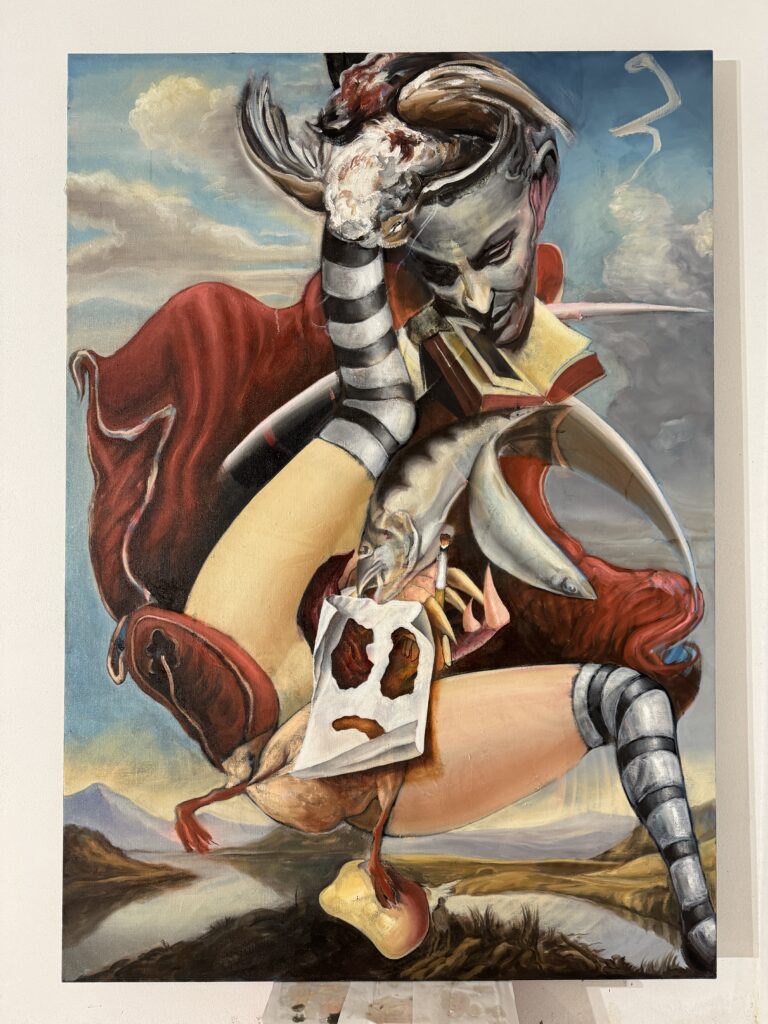
Moreover, the perceiver brings a piece of his own story into the image, irradiates it with his own experiences and thoughts, confronts his opinions with it, projects himself into it. It is as if the “power, strength, meaning” or, better said, the “layering” of the image grows with each new viewing. Looking at images of the past or present over and over again means constantly discovering undiscovered and new perspectives.
And we also bring into them our current “attitudes” of ourselves. It is therefore a matter of mutual enrichment, an interaction leading to a mutual metastasis of “discoveries”, an upgrade of the “organic and inorganic” story.
Q8. Why do you think people are so uncomfortable embracing their own contradictions?
A person has multiple (I’m not talking about schizophrenia here) personalities, multiple characters that live their own lives inside us. Some we barely notice, we don’t know about, they emerge from the depths and manifest through “nature” (if we “surrender” to it), they come unnoticed from the subconscious, some sides or positions in us we value more, others we suppress.
A complicated crowd that is trying to find a place on the pedestal of what we call “me”. The faces in my paintings show the inner state of the depicted characters. If they seem “broken”, unstable, fragmented or even unrecognizable, they only show us who we really are, we are floating among billions of thoughts… thousands of stimuli and influences are crushing us, fragmented pieces of unrecognized “I” are struggling within us and the eternal advice “know thyself” is a struggle and a journey for a lifetime.
Feeling uncomfortable in our contradictions does not mean that we cannot use them to our advantage, quite the opposite. Without resistance and contradictions, there is no growth, contradictions and antagonisms create tension, strength, tension and stress, from which great things are born (“through the tension and connection of the Apollonian and Dionysian principles, two contrasting forces, the highest art arises according to Nietzsche”.. I can agree with that).
Contradictions and conflicts are the engine of development. Therefore, disharmony is not a mistake, but the essence of thinking, life and reality.
Q9. Your work reveals itself slowly. Do you think today’s audiences still make time for that kind of experience?
Digital images depict a “presentation” of a person, they show their own versions of human existence, it is not real, a person in the virtual world is given many “masks”. We perceive them as “foggy mirages” that float around us at an unregulated speed until it seems that the transfer from the retina to the brain did not take place or, on the contrary, took place so quickly that the retina and the brain must be one. It is interesting for a figurative artist to work with this endless range of bizarre forms of humanity that roll towards him like a tsunami in an endless loop.
If it is true that an artist becomes or should be a mirror of his time, he inevitably has to deal with the flood of virtual reality and seduce it “to his side”, make it part of the work, use it to his advantage. Reflecting on it and dealing with it like the Impressionists did with the advent of photography, or rather the discovery of photography, which transformed painting and is probably still happening now thanks to digital images, we are just in that moment and we are not fully aware of it yet.
Therefore, the viewer can still find the “slowed down or frozen time”, which is necessary for sensing or perceiving the image. It will allow him to “experience” the painting on an aesthetic, content, emotional or existential level. And I think this can happen if the work resonates with its time, with the present, which is also a relevant factor in the life of the perceiver. (Or rather, I would use the phrase: “extended presence”, which surfaces in the interaction between the work and the mind of the perceiver, thanks to his past experiences and future expectations.)
Thus, the “digitalization of painting”, its connection with virtual reality and social media, paradoxically leads to greater openness towards the viewer. It unlocks his patience, captures his attention, speaks to him in a language that surrounds him and provides him with an environment in which he moves on one of the planes of his existence. Thus, it is easier for him to slip in and gain time for a slower experience of art.
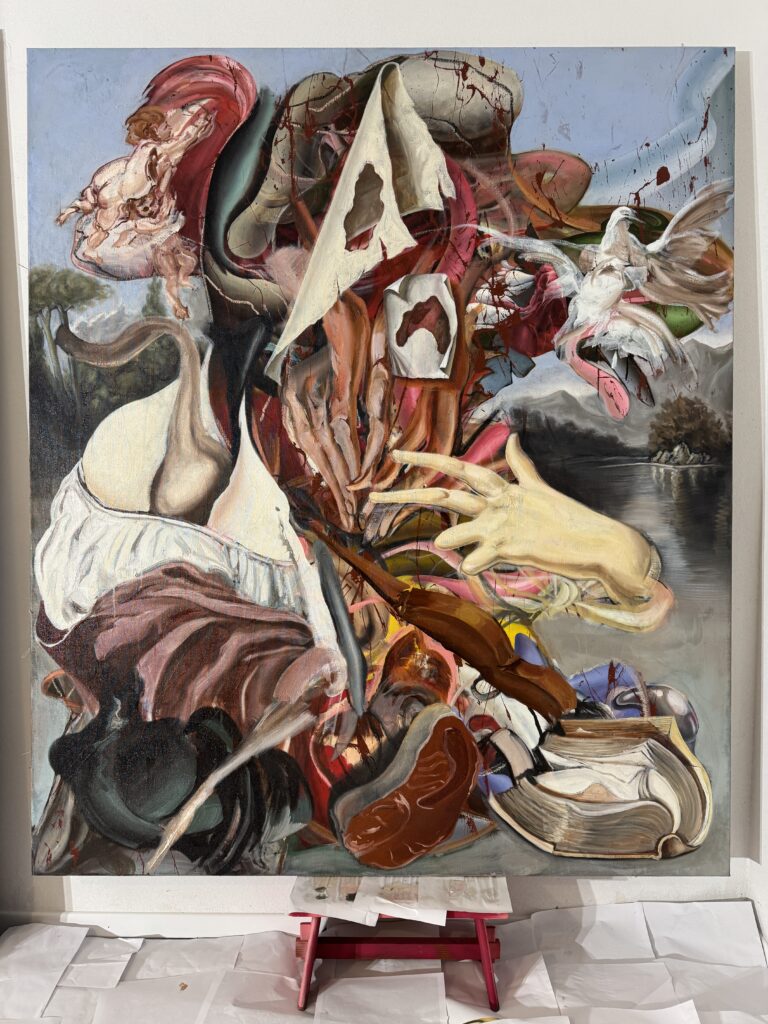
As our conversation with Tomáš came to a close, we found ourselves reflecting not only on his work but also on the place it occupies within today’s contemporary art landscape.
Figurative painting is experiencing a remarkable resurgence. Over the past decade, artists have returned to the human figure with renewed energy, and collectors, galleries, and museums have embraced this revival.
Yet much of the figurative work that rises quickly today is built around immediate appeal. It offers polished surfaces, recognisable subjects, and emotions that reveal themselves at first glance. These are paintings that photograph beautifully, circulate effortlessly online, and fit comfortably within the rhythm of today’s art market.
Tomáš Jetela belongs to a very different tradition. His paintings do not seek instant admiration or easy interpretation. They ask something of the viewer. They ask for time, patience, and a willingness to sit with uncertainty. That is what makes his paintings so compelling. They are not interested in perfection. They are interested in truth.
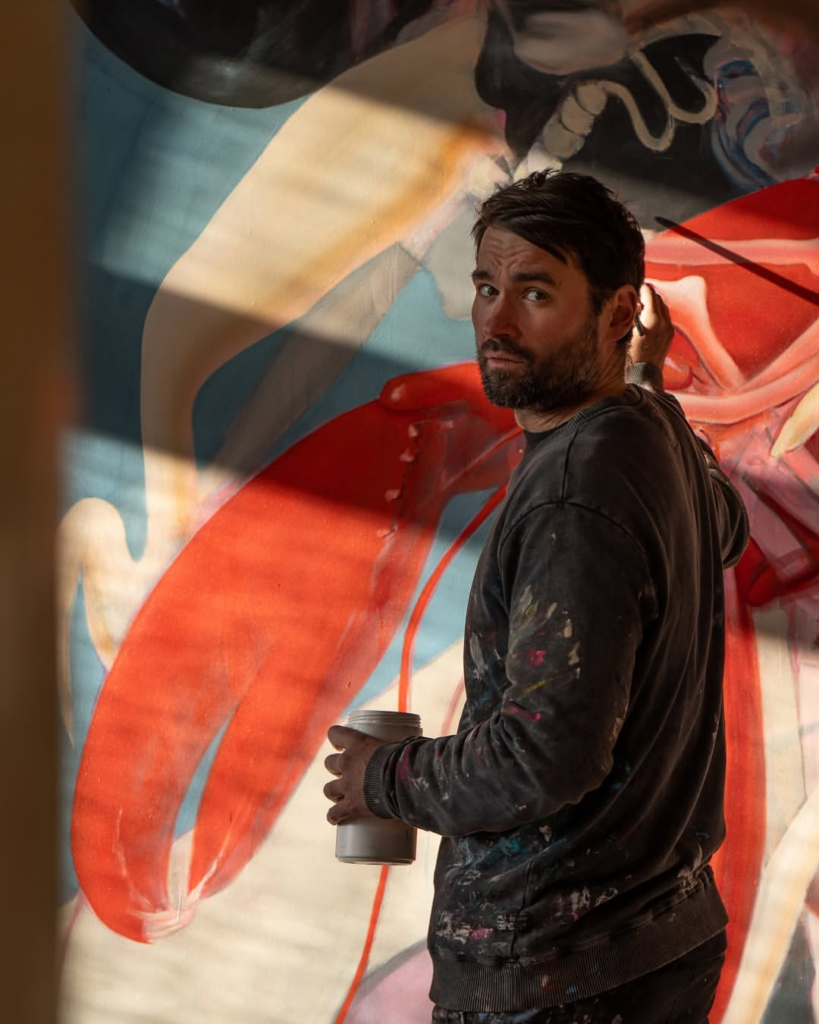
There is also a quiet courage in the path he has chosen. At a time when artistic trends continually shift and the pressure to follow them is immense, he has remained committed to a language that feels authentic to him. He has never painted the figure because it was fashionable. He paints it because it continues to ask the questions that matter most to him. That unwavering commitment gives his work a depth that cannot be manufactured or imitated.
For collectors, this distinction matters. There is a profound difference between a painting created to satisfy a market and one created out of genuine artistic necessity. The latter often asks more from its audience, but it also gives more in return. It stays with you. It reveals new layers over time. It becomes richer with every encounter.
Follow Tomáš Jetela through the links below and discover more of his work.