







8 Paintings That Capture the Dark Imagination of Zdzisław Beksiński
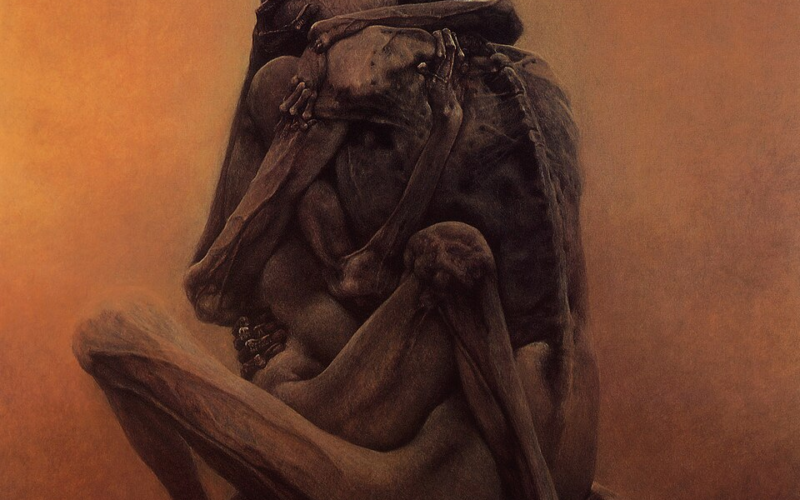
There are paintings that you admire for their beauty. Others stay with you because of their history. And then there are the paintings of Zdzisław Beksiński, works that seem to follow you long after you’ve looked away. Their skeletal figures, endless ruins, and dreamlike landscapes feel unsettling, yet strangely mesmerising. They don’t scream for attention; they linger quietly in your mind, inviting you to return and search for something you may have missed the first time.
At first glance, Beksiński’s art is often described as dark, dystopian, or even nightmarish. But reducing it to horror misses what makes it so extraordinary. His paintings are not filled with cheap scares or obvious symbolism. Instead, they exist somewhere between dreams and memories, where familiar forms dissolve into haunting visions that resist easy explanation. Towering cathedrals seem to breathe, faceless figures wander through silent wastelands, and fragments of humanity emerge from landscapes that feel both ancient and timeless. Every canvas invites a different interpretation, and no two viewers leave with exactly the same story.
That mystery was intentional. Beksiński rarely gave his paintings official titles and famously avoided explaining what they meant, believing that each viewer should experience the work on their own terms. As a result, many of his most celebrated paintings are now known by descriptive names given by galleries, collectors, or the wider art community, labels that make them easier to identify but don’t define their meaning. Rather than offering answers, Beksiński created worlds that ask questions about fear, solitude, decay, hope, memory, and the fragile beauty that can exist even in the darkest places.
In this collection, we’ll step into eight of Beksiński’s most haunting and unforgettable paintings. Some are unsettling, others unexpectedly tender, but all of them reveal why his art continues to captivate audiences around the world. Once you enter his world, you’ll quickly understand why it’s so difficult to leave.
1. The Cathedral
The Cathedral: A Monument That Seems to Breathe
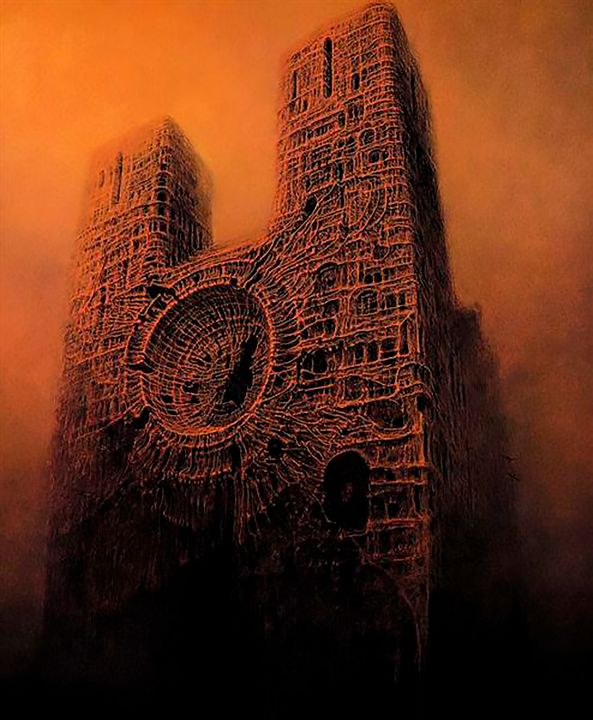
Some paintings feel like places you could visit. Others feel like places you should never enter. The Cathedral is one of those rare works that immediately creates both reactions. At first glance, it resembles the towering silhouette of a Gothic cathedral rising from an endless wasteland. But the longer you look, the less certain you become. The walls appear to be made not of stone but of weathered flesh, bone, and tangled organic forms, as though the entire structure has grown rather than been built.
This unsettling blend of architecture and anatomy is one of the defining features of Zdzisław Beksiński’s art. Rather than depicting a recognizable building, he transforms a familiar symbol into something entirely otherworldly. The towering spires evoke medieval churches, yet there are no doors to enter, no stained-glass windows, and no signs of life. Instead, the cathedral stands in eerie silence beneath a vast sky, becoming less a place of worship and more a monument to memory, time, and human fragility.
What makes this painting so unforgettable is that it refuses to tell you what it represents. Is it the remains of a forgotten civilization? A vision from a dream? A symbol of faith after catastrophe? Beksiński intentionally left such questions unanswered. He believed that explaining a painting would limit the viewer’s imagination, preferring each person to bring their own emotions and experiences to the work.
That openness is precisely why The Cathedral continues to captivate audiences decades later. It doesn’t frighten through monsters or violence. Instead, it creates an atmosphere of awe, loneliness, and quiet unease, where beauty and decay exist side by side. Like much of Beksiński’s work, it feels less like a painting and more like a memory from a dream you can’t quite explain, yet never completely forget.
2. The Trumpeter
The Trumpeter: The Silent Sound of an Unforgettable Apocalypse
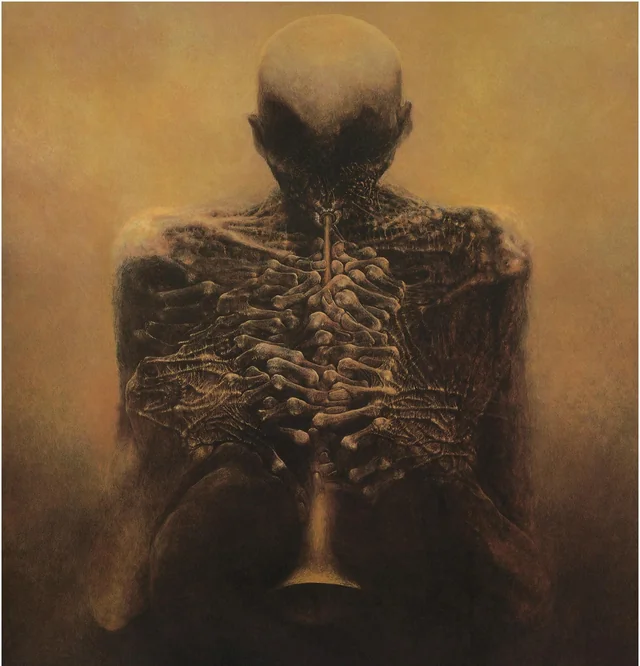
A trumpet is often associated with celebration, ceremony, or the beginning of something new. In Zdzisław Beksiński’s The Trumpeter, however, it seems to signal something entirely different. Standing alone in a desolate landscape, the skeletal figure raises its instrument as if announcing an event that has already happened, or perhaps one that has no witnesses left to hear it. There is no audience, no movement, and no visible source of life. Only an overwhelming silence fills the scene.
Beksiński had an extraordinary ability to transform familiar objects into symbols that felt both recognizable and deeply unsettling. Here, the trumpet loses its joyful associations and becomes an object of mystery. Is the figure calling the living, mourning the dead, or simply performing an endless ritual in a forgotten world? The painting offers no clues, allowing every viewer to imagine a different story. That ambiguity is part of what makes Beksiński’s work so compelling: the meaning isn’t hidden, it is intentionally left open.
The figure itself is equally captivating. Draped in weathered textures that blur the line between bone, fabric, and decaying flesh, it appears less like a person than a relic shaped by time. Rather than portraying violence, Beksiński focuses on stillness. The painting doesn’t rely on dramatic action or grotesque imagery to create unease. Instead, it builds tension through emptiness, making the silence almost audible.
Many viewers see The Trumpeter as one of Beksiński’s most haunting compositions because it captures a feeling that’s difficult to describe, a world where time has stopped, yet something continues to call into the distance. Whether that call is one of warning, remembrance, or hope is left entirely to the imagination. And perhaps that’s why the painting continues to resonate: long after you’ve stopped looking at it, you can almost hear the note that was never played.
3. The Embrace
The Embrace: When Love Endures Even in the Darkest Dreams
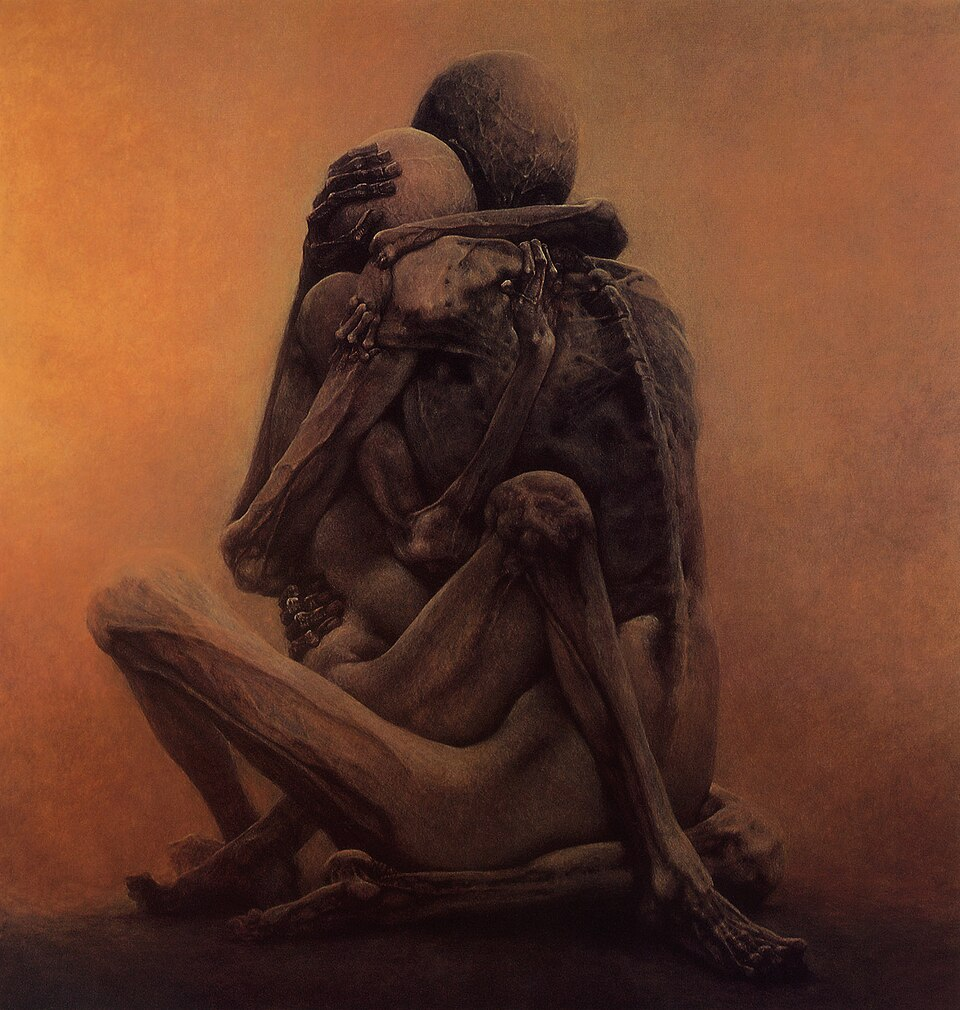
Among Zdzisław Beksiński’s haunting visions of ruined worlds and skeletal figures, The Embrace stands apart for an unexpected reason: it feels deeply human. At first glance, the painting carries the same unsettling atmosphere that defines much of his work. The figures appear weathered by time, stripped of clear identity, and suspended in a world that seems untouched by life. Yet instead of confrontation or fear, they are locked in a quiet embrace, a gesture that instantly shifts the emotional weight of the scene.
This contrast is what makes the painting so memorable. Beksiński rarely relied on obvious narratives, but here, a simple act of closeness speaks louder than any expression could. The figures have no recognizable faces to reveal joy or grief, yet their posture communicates something unmistakably familiar: the universal need for comfort. Whether they are saying goodbye, mourning together, or simply holding on to one another in a collapsing world is left entirely to the viewer’s imagination.
The work also challenges one of the biggest misconceptions about Beksiński’s art, that it exists only to disturb. While his imagery often explores decay, mortality, and isolation, it also leaves room for tenderness. The Embrace reminds us that vulnerability can be just as powerful as fear. It suggests that even in a landscape shaped by ruin, compassion can survive, quietly resisting the darkness around it.
Perhaps that’s why this painting resonates so deeply. It doesn’t ask us to fear death or despair; instead, it asks us to consider what remains when everything else has fallen away. In Beksiński’s world, where certainty is always out of reach, The Embrace offers a rare glimpse of connection, a reminder that even the most haunting dreams can still hold traces of hope, love, and humanity.
4. The Endless Graveyard
The Endless Graveyard: Where Silence Speaks Louder Than Death
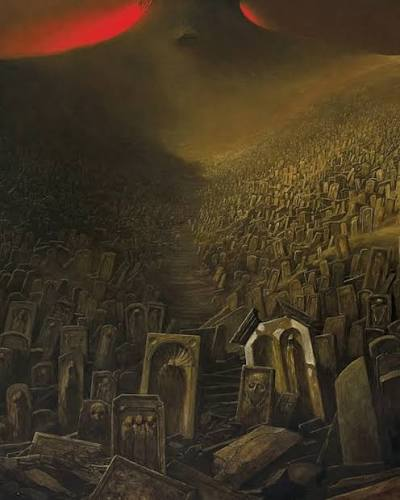
Few artists could make emptiness feel as overwhelming as Zdzisław Beksiński. In The Endless Graveyard, there are no dramatic battles, no visible catastrophe, and no obvious story unfolding before the viewer. Instead, the painting presents an expansive landscape where rows of weathered graves stretch toward a distant horizon, disappearing into a world that seems untouched by time. It is this vast silence, not horror, that gives the work its unsettling power.
Unlike traditional depictions of cemeteries, which often focus on mourning or remembrance, Beksiński transforms the graveyard into something almost dreamlike. The land feels abandoned, as though humanity has long since vanished, leaving behind only echoes of its existence. Tiny figures, if they are present at all, appear insignificant against the immense scale of the landscape. The sky hangs heavily overhead, while muted tones blur the boundary between earth and atmosphere, making it difficult to tell where one ends and the other begins.
What makes this painting so compelling is its emotional ambiguity. Is it a vision of the future, a forgotten past, or simply a place that exists only in the subconscious? Beksiński never offered answers. By refusing to assign fixed meanings, he allowed viewers to project their own fears, memories, and emotions onto the scene. For some, it reflects the loneliness of loss; for others, it becomes a meditation on time, memory, or the quiet inevitability of mortality.
Rather than portraying death as something violent or terrifying, The Endless Graveyard presents it as an endless stillness. It invites viewers to linger in that silence, discovering that what truly unsettles us isn’t always what we see, it’s the vast, unanswered space left behind. In Beksiński’s hands, even an empty landscape becomes charged with emotion, proving that sometimes the loudest stories are told without a single living voice.
5. The Crawling Figure
The Crawling Figure: When Fear Takes a Human Shape
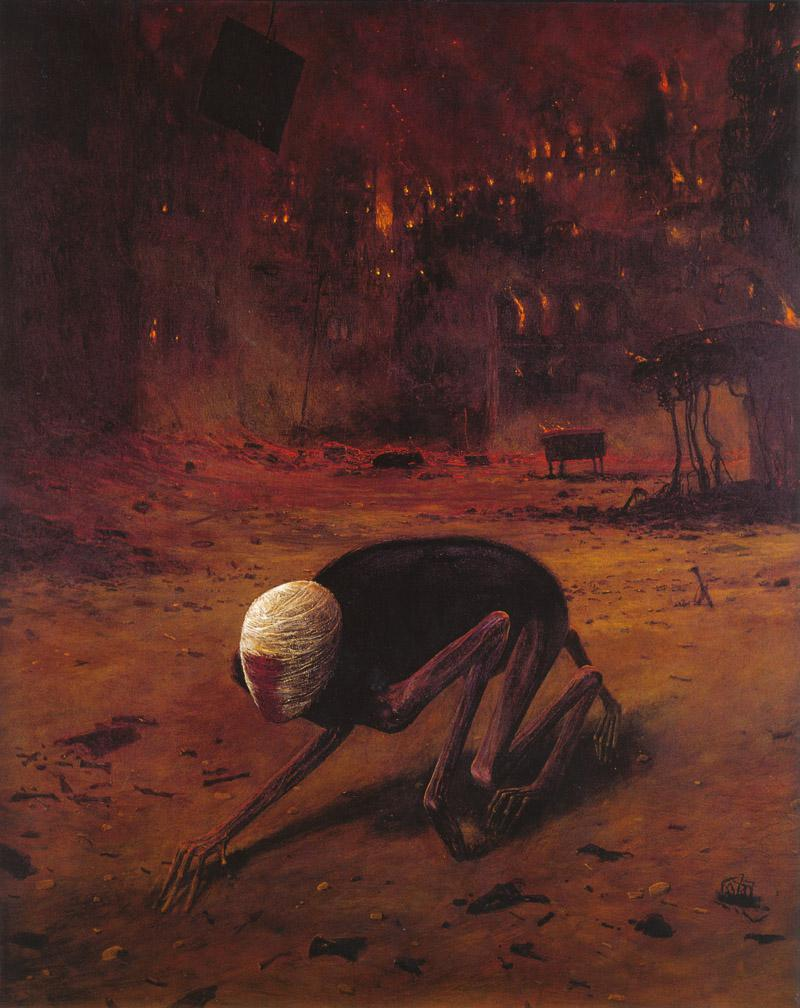
Not every nightmare announces itself with monsters. Sometimes, it appears in the form of something almost human, recognizable enough to feel familiar, yet distorted enough to leave us uneasy. That tension lies at the heart of The Crawling Figure, one of Zdzisław Beksiński’s most psychologically unsettling compositions. Rather than relying on violence or shock, the painting captures a single figure whose twisted posture immediately raises questions. Is it crawling toward something, struggling to escape, or simply trapped in an endless cycle of movement? Beksiński leaves the answer entirely to the viewer.
The figure’s anatomy feels impossibly fragile. Limbs stretch at unnatural angles, while its weathered surface blurs the line between skin, bone, and earth. It appears less like a living person than a being slowly dissolving into the landscape around it. This ambiguity is one of Beksiński’s greatest strengths. His figures rarely belong to a specific time or place, making them feel like fragments of dreams rather than characters in a story.
Despite its unsettling appearance, The Crawling Figure isn’t frightening because of what it depicts, it is frightening because of what it suggests. Many viewers see exhaustion, vulnerability, or quiet desperation reflected in its posture. Others interpret it as a symbol of survival, a body refusing to stop moving despite unimaginable hardship. Beksiński never confirmed any of these readings, insisting that meaning should emerge from the viewer’s own emotional response.
That openness gives the painting remarkable staying power. Long after you’ve looked away, the image continues to linger, not because of its grotesque form, but because it taps into something deeply human. It reminds us that fear isn’t always loud or dramatic. Sometimes, it exists in moments of uncertainty, when we recognize a part of ourselves in something we can’t fully explain.
6. The Silent Mask
The Silent Mask: The Face That Reveals Nothing—and Everything
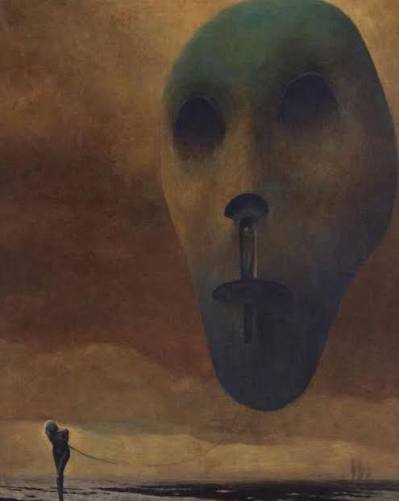
Faces are meant to tell stories. They reveal joy, sorrow, fear, and countless emotions with a single glance. In The Silent Mask, however, Zdzisław Beksiński strips away that certainty. Suspended in an eerie, desolate landscape, the enormous face seems detached from both body and identity. Its hollow features refuse to offer comfort or explanation, leaving viewers with the unsettling feeling of being watched by something they cannot understand.
Unlike many of Beksiński’s densely detailed compositions, this work achieves its power through restraint. The face dominates the canvas, yet its expression remains impossible to read. It is neither angry nor peaceful, neither alive nor dead. The absence of emotion becomes the emotion itself. Rather than guiding the viewer toward a single interpretation, Beksiński creates a blank canvas for the imagination, where every unanswered question becomes part of the experience.
The painting also reflects one of the artist’s recurring fascinations: the fragility of identity. Throughout his career, Beksiński often depicted figures whose faces were hidden, eroded, or entirely absent. By removing the features that make someone recognizable, he shifts attention away from the individual and toward universal human emotions. The result is a figure that could represent anyone, or no one at all. It feels strangely familiar, as though it belongs to a dream you’ve had but can never fully remember.
What makes The Silent Mask so unforgettable is that its mystery never fades. The longer you study it, the more the face seems to change, reflecting your own emotions back at you. One moment it appears mournful; the next, strangely calm. That quiet uncertainty is what defines Beksiński’s art. He understood that the most haunting images are not those that reveal everything, but those that leave just enough unsaid for the mind to keep searching long after the painting is out of sight.
7. The Endless Corridor
The Endless Corridor: A Journey Through a World That Has Forgotten Humanity
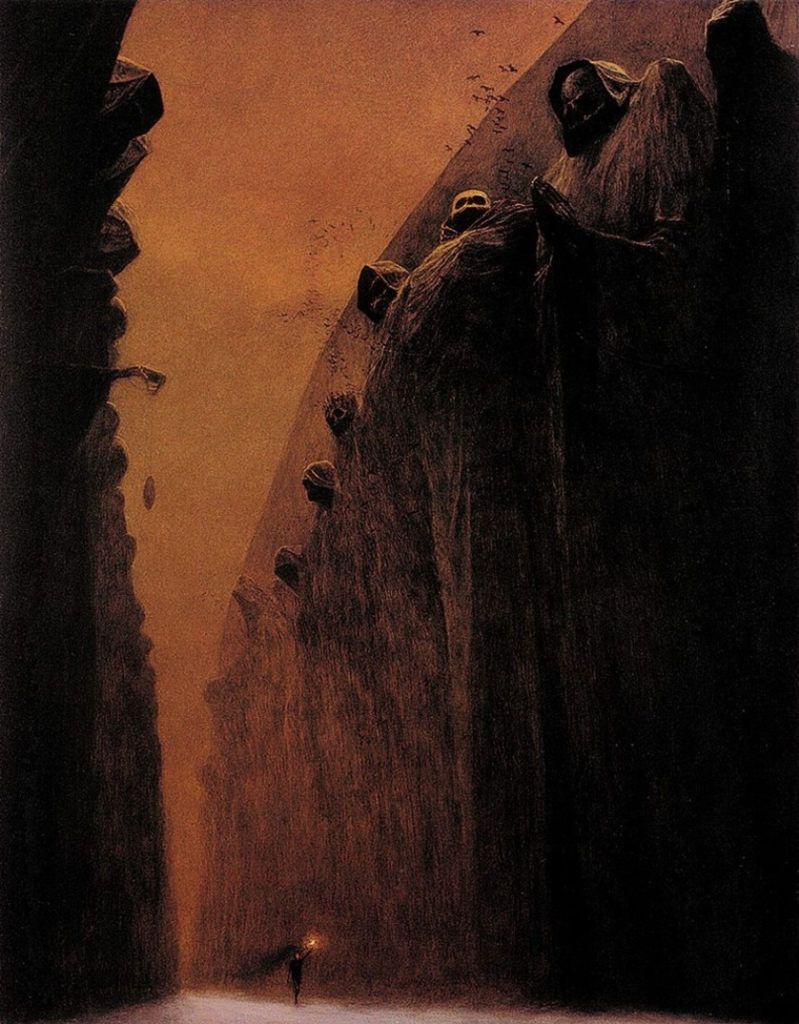
There is something profoundly unsettling about standing in a place that feels impossibly vast. In The Endless Corridor, Zdzisław Beksiński creates exactly that sensation. Towering walls rise on either side like the remains of an ancient civilization, their surfaces scarred by time and decay. Between them stretches a narrow path that seems to disappear into the distance, drawing the viewer deeper into a world where every step feels both inevitable and uncertain.
Unlike traditional landscapes, this painting offers no clear destination. There is no welcoming light at the end of the passage, no visible escape, and no explanation for what came before. Instead, Beksiński uses perspective to create a powerful emotional effect. The immense scale of the architecture makes any human presence appear insignificant, emphasizing themes of isolation and vulnerability. It is a reminder of how small we can feel when confronted by forces, whether time, memory, or history, that are far greater than ourselves.
The corridor itself is filled with Beksiński’s signature textures. Stone seems to merge with bone, walls resemble weathered skin, and familiar architectural forms gradually dissolve into organic shapes. This fusion of the built environment with living matter blurs the boundary between civilization and nature, suggesting a world where everything has slowly transformed into something unrecognizable. It’s a visual language unique to Beksiński, one that makes even silence feel alive.
What makes The Endless Corridor so compelling is that it mirrors an emotional journey as much as a physical one. Many viewers see it as a passage through memory, grief, or the subconscious, while others simply experience an overwhelming sense of awe. Beksiński never chose between these interpretations, and neither should we. The painting’s enduring power lies in its openness, inviting every viewer to walk its lonely path and discover where it leads within their own imagination.
Why We Still Can’t Look Away From Zdzisław Beksiński’s Paintings
Decades after Zdzisław Beksiński painted these haunting visions, they continue to captivate audiences around the world. Scroll through social media, browse online galleries, or step into an exhibition featuring his work, and you’ll find the same reaction repeated over and over: people pause. They stare. They try to understand what they’re seeing. And even when they can’t explain it, they rarely forget it.
Part of that enduring fascination lies in Beksiński’s refusal to provide easy answers. He rarely titled his paintings and almost never explained their meaning, believing that art should speak differently to every viewer. Rather than telling us what to think, he created spaces where imagination could take over. One person may see grief, another hope, another the remnants of a forgotten civilization. None of these interpretations are necessarily right or wrong, and that’s precisely the point.
It’s also why describing Beksiński simply as a “horror artist” feels incomplete. Yes, his paintings are filled with skeletal figures, ruined architecture, and surreal landscapes, but beneath those haunting images lies something far more universal. His work explores loneliness, memory, transformation, resilience, and the quiet uncertainty that comes with being human. The darkness is never there for shock value; it’s a language through which he explores emotions that are often difficult to express.
Perhaps that’s why Beksiński’s paintings refuse to leave us. They don’t ask us to solve a mystery or uncover a hidden code. Instead, they invite us to sit with uncertainty, to embrace the strange beauty that can exist alongside fear, and to discover something different each time we return. In a world that constantly demands explanations, Beksiński reminds us that some of art’s greatest power lies in what remains unexplained. And maybe that’s why, long after you’ve left his paintings behind, they continue to linger quietly in your imagination, as vivid, mysterious, and unforgettable as the dreams that inspired them.
What emotions did Beksiński’s paintings leave you with?
If Beksiński’s haunting imagery has you thinking about the deeper meanings hidden within art, you might also enjoy our exploration of one of history’s most enduring symbols in The Skull Was Never Just About Death: 8 Hidden Stories in Art. It offers another fascinating look at how artists have transformed familiar symbols into powerful reflections on life, mortality, and memory.