





The Skull Was Never Just About Death: 8 Hidden Stories in Art
A skull tucked beneath a table. One resting beside a saint. Another balanced on an artist’s own shoulder. Once you start looking for them, skulls seem to appear everywhere in art history. But why?
At first glance, they’re unsettling, symbols we naturally associate with fear, loss, or the end of life. Yet for centuries, artists across Europe returned to the skull again and again, not to horrify their audiences, but to start a conversation. Sometimes it reminded viewers that wealth and beauty were temporary. Other times it encouraged quiet reflection, represented scientific curiosity, or challenged people to think about how they were living their lives.
Long before horror films and Halloween decorations shaped our perception of the skull, it carried a far richer and more complex meaning. In paintings, portraits, and still lifes, it became one of art history’s most enduring symbols, one that evolved with every generation while never losing its power to stop viewers in their tracks.
From hidden illusions to haunting self-portraits, these eight remarkable artworks reveal why the skull was never just about death, and why artists have never truly let it disappear.
1. The Ambassadors (1533) by Hans Holbein the Younger
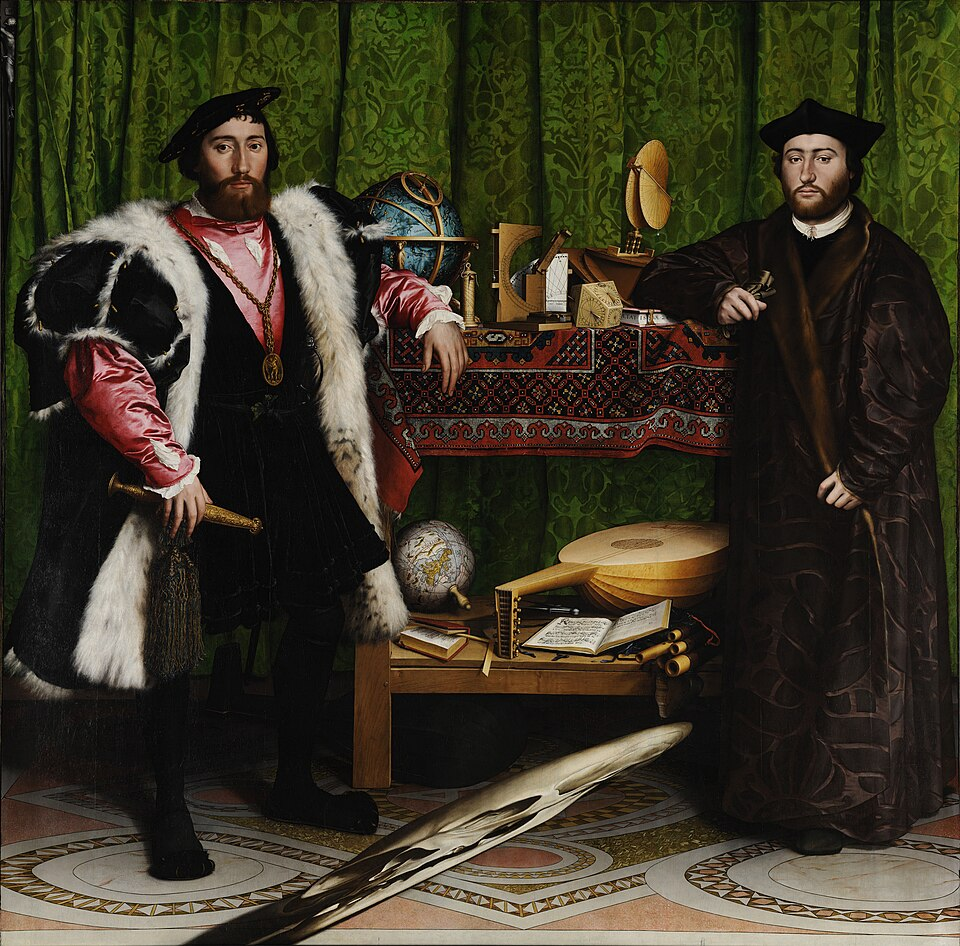
At first glance, The Ambassadors looks like a celebration of success. Two richly dressed men stand confidently beside a table overflowing with symbols of knowledge, wealth, and power. Scientific instruments, musical tools, luxurious fabrics, and books suggest a world shaped by learning and ambition. It’s the kind of Renaissance portrait that seems determined to impress, until you notice something strange stretching across the bottom of the painting.
That distorted shape is a human skull.
It isn’t immediately recognizable because Hans Holbein the Younger painted it using anamorphosis, a technique that requires viewers to look at the painting from a sharp angle before the skull suddenly comes into focus. The discovery is startling. A portrait that once appeared to celebrate achievement quietly reveals a reminder that none of those accomplishments can outlast death.
This hidden skull transforms the entire painting. The two ambassadors, surrounded by objects that represent intellect, exploration, music, and status, are no longer simply successful men. They become mortal individuals whose wealth and knowledge cannot shield them from life’s inevitable end.
The skull also introduces one of art history’s most enduring ideas: memento mori, a Latin phrase meaning “remember that you must die.” Rather than encouraging fear, memento mori invited viewers to reflect on how they lived their lives. For Renaissance audiences, death wasn’t hidden away from everyday life as it often is today, making the message both familiar and deeply personal.
More than 490 years later, The Ambassadors still surprises viewers in exactly the way Holbein intended. The skull doesn’t dominate the painting, it waits patiently to be discovered, reminding us that some of art’s most profound messages are hidden in plain sight.
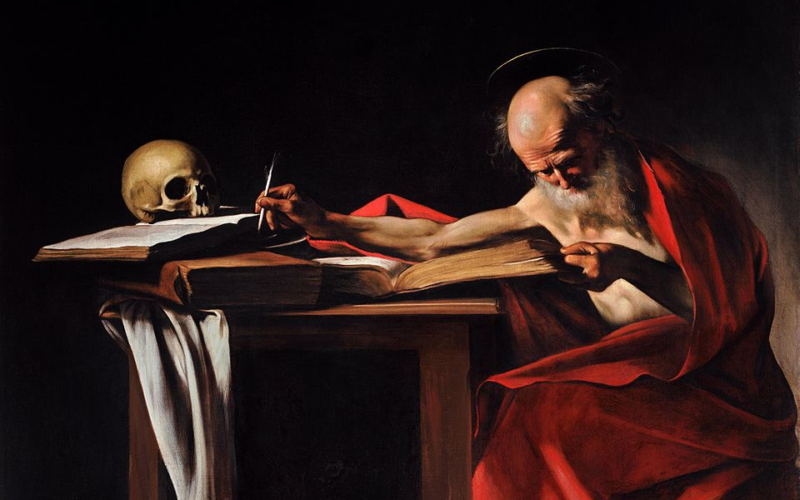
2. Saint Jerome Writing (c. 1605–1606) by Caravaggio
Not every skull in art was meant to shock. Sometimes, it was meant to help someone think.
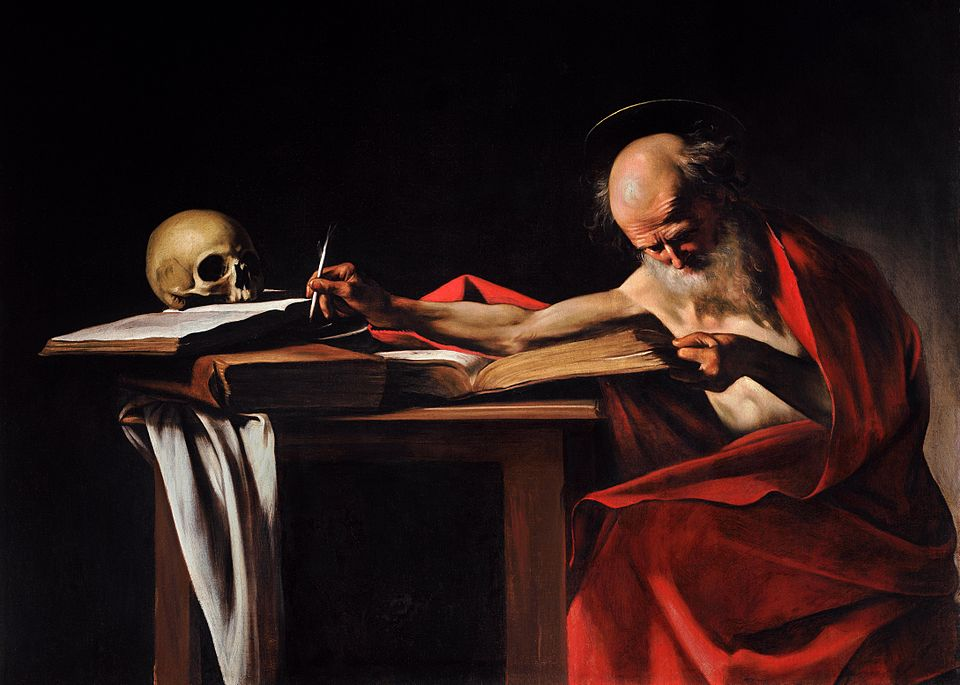
In Caravaggio’s Saint Jerome Writing, the aging scholar sits quietly at his desk, absorbed in translating the Bible. There’s no dramatic confrontation with death, no haunting figure lurking in the background. Instead, resting beside him is a simple human skull. It isn’t the centerpiece of the painting, yet it quietly shapes everything around it.
Saint Jerome, one of Christianity’s most influential scholars, was believed to have spent years living in solitude, dedicating himself to prayer, study, and reflection. For artists across centuries, the skull became one of his defining attributes, not because it represented despair, but because it symbolized wisdom gained through an awareness of life’s impermanence. By keeping death close in both thought and imagery, Jerome was reminded to focus on what truly mattered rather than the distractions of the material world.
Caravaggio’s masterful use of light deepens this idea. The illuminated pages, Jerome’s weathered hands, and the pale surface of the skull all draw the viewer into a quiet conversation between knowledge and mortality. The scene suggests that learning isn’t just about accumulating information; it’s also about understanding the limits of human life.
Unlike Holbein’s hidden skull, which reveals itself only after careful observation, Caravaggio places the skull in plain sight. It doesn’t interrupt the saint’s work, it accompanies it. The message is subtle but profound: remembering death wasn’t seen as a gloomy exercise but as a way of living with greater purpose, humility, and intention. In Jerome’s world, the skull wasn’t a symbol of fear. It was a silent teacher, reminding him that every moment spent seeking wisdom was precious because time itself was finite.
3. Man with a Skull (17th century) by the Master of the Annunciation to the Shepherds
Some paintings ask us to notice a skull. This one asks us to confront it.
The artist behind Man with a Skull remains unknown today. Art historians attribute the work to an anonymous seventeenth-century painter known as the Master of the Annunciation to the Shepherds, a name borrowed from one of the artist’s best-known paintings. Although the painter’s identity has faded into history, the work itself has lost none of its power. If anything, the mystery surrounding its creator makes its meditation on mortality even more fitting.
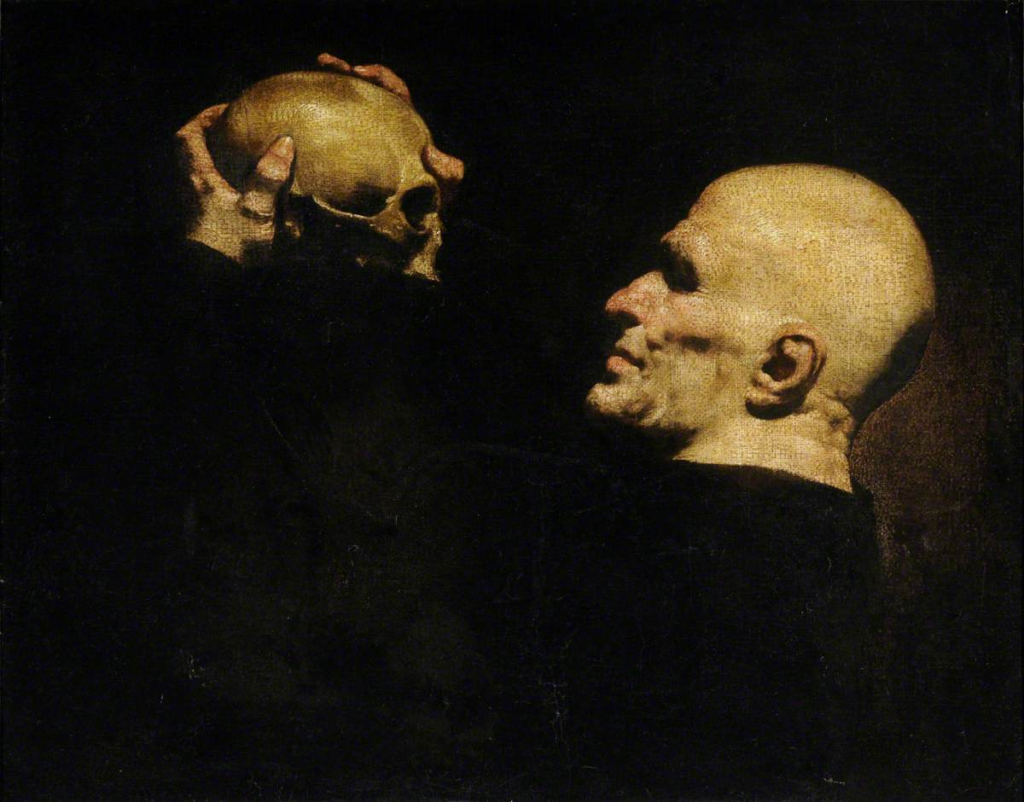
Unlike Holbein’s cleverly hidden illusion or Caravaggio’s quiet symbol of contemplation, Man with a Skull places death at the very center of the composition. The sitter doesn’t merely pose beside a skull, he grips it tightly, almost as though he is wrestling with the thought of his own mortality. The gesture feels deeply personal, turning the skull into something far more meaningful than a symbolic object. It becomes a silent companion, forcing both the man and the viewer into an intimate encounter with death.
What makes the painting especially compelling is the striking contrast between the two faces. One is alive with warm flesh, subtle color, and breath; the other has been reduced to weathered bone. The artist lingers over every detail, the rough texture of the skull, the hollow eye sockets, the worn teeth, while giving equal attention to the living man’s lined skin, tired eyes, and weathered features. Side by side, they almost appear to be two versions of the same person separated only by time.
For a seventeenth-century audience, this image would have carried an immediacy that’s difficult to imagine today. Death was woven into everyday life through disease, war, and shorter life expectancies. Human remains were more commonly encountered than they are now, making the skull an instantly recognizable reminder of a fate everyone shared. Viewers didn’t need an explanation to understand the painting’s message.
Yet despite its stark realism, Man with a Skull is ultimately less about death than it is about life. By placing a breathing man beside the unmistakable evidence of what every life eventually becomes, the anonymous artist invites us to recognize the fragile space between the two. Centuries later, the painting still asks the same timeless question: if our lives are temporary, how should we choose to live them?
4. Death and the Maiden (c. 1517) by Hans Baldung Grien
What if death wasn’t waiting at the end of life, but standing quietly beside you all along?
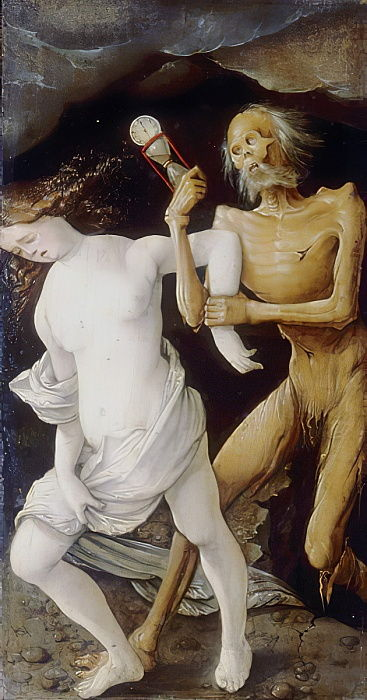
That unsettling idea lies at the heart of Hans Baldung Grien’s Death and the Maiden, one of the Renaissance’s most haunting explorations of mortality. Unlike many memento mori paintings where the skull appears as a symbolic object, Baldung gives death a body. A skeletal figure reaches for a young woman, interrupting a moment that might otherwise celebrate beauty, youth, and earthly pleasures. The encounter is sudden, intimate, and impossible to ignore.
At first glance, the contrast is striking. The woman is youthful, elegantly dressed, and full of life, while the skeletal figure is a stark reminder of what time inevitably brings. Yet the painting isn’t simply trying to frighten its audience. During the Renaissance, beauty and mortality were often presented together to emphasize just how fleeting youth really is. The more vibrant and desirable the maiden appears, the more powerful death’s presence becomes.
Baldung returned to this theme several times throughout his career, suggesting it was more than a passing fascination. Living in an era marked by disease, religious upheaval, and recurring epidemics, he understood that death wasn’t a distant possibility, it was a constant part of everyday life. His paintings reflect a world where mortality wasn’t hidden from view but openly acknowledged, making the message deeply familiar to contemporary audiences.
What makes Death and the Maiden so enduring is that it doesn’t offer a dramatic battle between life and death. Instead, it presents them as inseparable companions. Death doesn’t wait politely in the background until old age arrives; it quietly accompanies every stage of life, whether we choose to notice it or not. More than five centuries later, the painting still feels unsettling, not because it glorifies death, but because it reminds us that life’s greatest beauty exists precisely because it cannot last forever.
5. Portrait of Thomas Henry Huxley (1891) by John Collier
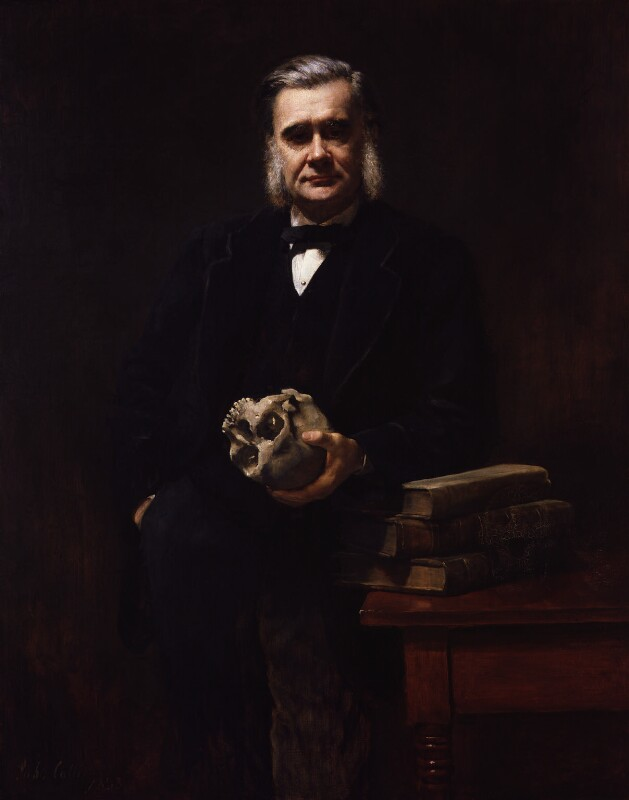
By the nineteenth century, the skull had begun telling a different story.
For centuries, it had served as a reminder of spiritual reflection and the certainty of death. But in John Collier’s Portrait of Thomas Henry Huxley, the skull takes on an entirely new role. It still speaks of mortality, yet it also represents curiosity, scientific inquiry, and humanity’s growing desire to understand itself through observation rather than faith alone.
Thomas Henry Huxley was one of Victorian Britain’s most influential biologists and a passionate advocate for Charles Darwin’s theory of evolution, earning him the nickname “Darwin’s Bulldog.” As a comparative anatomist, he spent much of his career studying the structure of human and animal skeletons. The skull in his portrait isn’t a dramatic symbol placed there for effect, it reflects the very subject of his life’s work.
Collier presents Huxley seated comfortably in his study, surrounded by books that hint at decades of scholarship. Rather than clutching the skull with anxiety or treating it as a solemn reminder of death, Huxley holds it with remarkable ease. It feels less like an object of fear and more like a source of knowledge. The painting captures a moment when science was reshaping how people understood the human body, transforming the skull from a religious symbol into an instrument of discovery.
Yet Collier doesn’t abandon the older tradition of memento mori entirely. The portrait still encourages viewers to think about mortality, but through a different lens. Knowledge, reason, and scientific progress may deepen our understanding of life, but they cannot erase its finite nature. In that sense, Huxley stands at a fascinating crossroads in art history. His portrait bridges two worlds, one rooted in spiritual contemplation and the other in scientific exploration, proving that although the meaning of the skull evolved over time, its ability to provoke reflection remained just as powerful.
6. Pyramid of Skulls (c. 1901) by Paul Cézanne
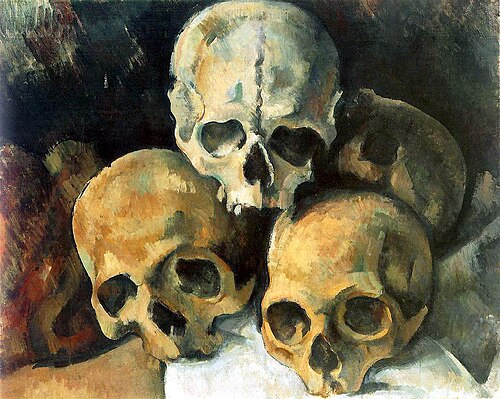
Not every artist painted skulls to make a grand statement. For Paul Cézanne, they became something much quieter, almost personal.
Unlike the dramatic scenes of earlier centuries, Pyramid of Skulls strips away nearly every distraction. There are no saints, no scholars, no wealthy patrons, and no hidden symbols waiting to be discovered. Instead, Cézanne presents four human skulls stacked together against a dark, undefined background. Their empty eye sockets meet the viewer directly, creating a composition that feels both simple and strangely unsettling.
By the time Cézanne painted this work, he was in his sixties and becoming increasingly aware of his own mortality. The deaths of close friends, declining health, and the awareness of aging shaped much of his later work. Rather than treating the skull as a religious symbol or a moral lesson, Cézanne approached it as something deeply human. It wasn’t there to warn viewers about sin or vanity, it was there because death had become an unavoidable part of his own thoughts.
The painting also reflects Cézanne’s unique artistic vision. Often called the father of modern art, he was fascinated by reducing forms to their essential shapes and structures. Here, the skulls become more than anatomical objects; they are carefully arranged volumes, almost like apples in one of his famous still lifes. Yet knowing they were once living people makes the composition impossible to view as merely an exercise in form.
Pyramid of Skulls marks a quiet shift in the story of memento mori. The skull is no longer a public lesson delivered to society, it becomes a private meditation between the artist and the canvas. In Cézanne’s hands, mortality feels less like a warning and more like a question, inviting viewers to pause, reflect, and consider the fragile nature of life without the need for dramatic symbolism.
7. Self-Portrait with Skull (1978) by Andy Warhol
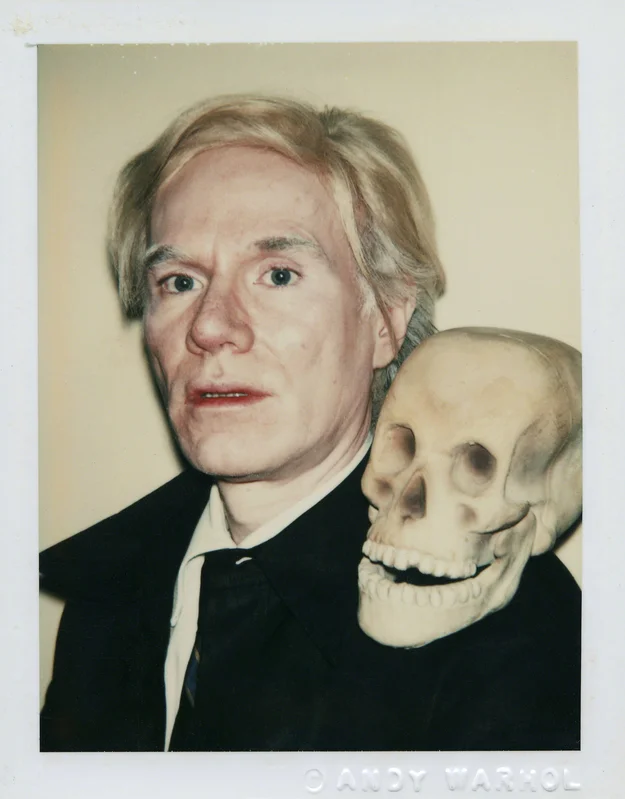
By the time Andy Warhol painted himself with a skull, the symbol had already carried centuries of history. Yet instead of repeating the traditions of Renaissance or Baroque artists, he transformed it into something unmistakably modern, psychological, theatrical, and deeply personal.
In Self-Portrait with Skull, Warhol stares out from the canvas while a skull rests on his shoulder, almost like an unexpected companion. The pose immediately recalls old master portraits in which scholars and saints contemplated human remains. But Warhol doesn’t appear calm or contemplative. His wide-eyed expression, dramatic lighting, and vibrant colors create an uneasy tension. It’s difficult to tell whether he’s confronting death, mocking it, or inviting us to question our own reactions.
That ambiguity is part of what makes the painting so compelling.
Warhol’s fascination with mortality wasn’t simply artistic. A decade earlier, in 1968, he survived a near-fatal shooting after writer Valerie Solanas attacked him. The incident left him with lifelong physical complications and profoundly altered his outlook. Death was no longer an abstract philosophical idea, it had become something he had encountered firsthand. This experience echoes throughout many of his later works, where themes of mortality quietly emerge beneath the bright colors and polished surface of Pop Art.
Unlike the anatomically precise skulls of earlier centuries, Warhol’s skull feels almost artificial. It resembles a studio prop rather than a real human relic, reflecting a culture increasingly separated from death through media, entertainment, and consumerism. Yet its symbolic power remains intact. Even in a world of celebrities, advertising, and mass production, the skull continues to ask the same timeless question it asked in Holbein’s and Caravaggio’s time.
Warhol reminds us that while the visual language of art evolves, mortality never goes out of style. The centuries may change, artistic movements may come and go, but the skull continues to hold up a mirror, not just to death, but to the way every generation chooses to understand it.
8. Portrait of John Bankes (c. 1630) by an Unknown Artist (British School)
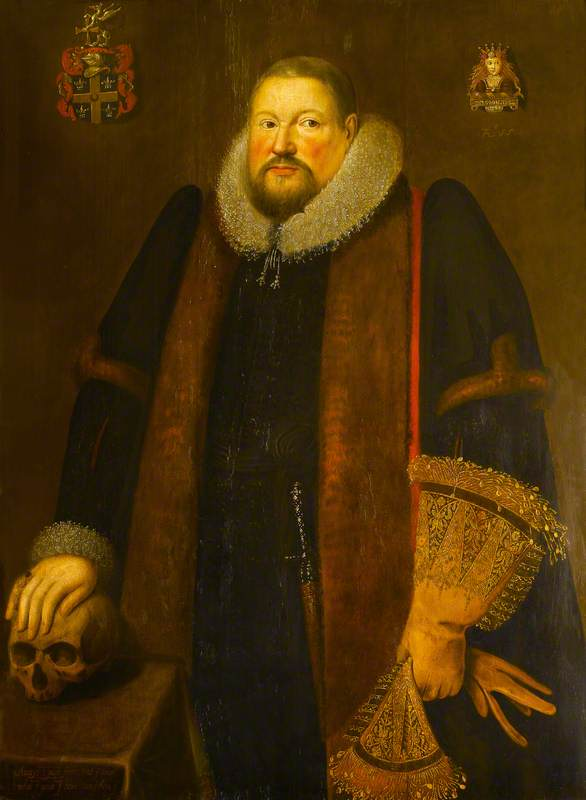
Not every memento mori needed dramatic lighting or a hidden illusion. Sometimes, a single gesture was enough.
In this seventeenth-century portrait, John Bankes stands dressed in elegant black clothing that reflects both his status and wealth. At first, it appears to be a conventional portrait of a gentleman, carefully composed, dignified, and restrained. But in his hand rests a human skull, quietly transforming the painting from a record of social standing into a meditation on mortality.
Unlike the emotional tension in Man with a Skull or the theatrical symbolism of Death and the Maiden, Bankes’ interaction with the skull is remarkably composed. He doesn’t recoil from it or study it with dramatic intensity. Instead, he holds it almost as naturally as one might hold a book or a treasured possession. That calmness is precisely what gives the portrait its power. It suggests an acceptance of mortality rather than a fear of it.
The contrast between the sitter’s appearance and the object he carries is deliberate. His fine clothing speaks of privilege, success, and respectability, while the skull quietly reminds viewers that none of those achievements can alter the one certainty every person shares. Whether wealthy or poor, powerful or ordinary, death remains the great equalizer. It was a message that seventeenth-century audiences would have understood immediately, especially in a world where disease, conflict, and shorter life expectancies made mortality an ever-present reality.
Placed at the end of this journey through art history, Portrait of John Bankes brings us back to the central idea that has connected every artwork in this list. Across centuries, cultures, and artistic movements, the skull has never simply represented death. It has encouraged reflection, challenged vanity, inspired faith, fueled scientific curiosity, and prompted artists to ask what it truly means to live. That enduring question, not the skull itself, is why this ancient symbol continues to captivate us today.
For centuries, artists have returned to the same symbol, yet they have rarely used it in the same way.
In Holbein’s hands, the skull hid in plain sight, waiting to surprise those who looked closely. Caravaggio turned it into a quiet companion for spiritual reflection, while the anonymous Master of the Annunciation to the Shepherds made it impossible to ignore. Hans Baldung Grien paired it with youth and beauty, John Collier transformed it into a symbol of scientific curiosity, Paul Cézanne made it deeply personal, and Andy Warhol reimagined it for a modern world shaped by celebrity, trauma, and pop culture. Even the dignified portrait of John Bankes reminds us that no amount of wealth or status can place us beyond mortality.
That’s what makes the skull one of art history’s most enduring symbols. It has never belonged to a single movement, religion, or era. Instead, every generation has found new meaning in it, reshaping the same image to reflect its own fears, beliefs, and questions about life.
Perhaps that’s also why these artworks continue to resonate today. While we often think of skulls as symbols of death, artists have long used them to do the opposite. They encourage us to notice the value of the time we have, to question what truly matters, and to recognize that life’s greatest beauty lies in its impermanence.
The next time you spot a skull in a painting, look a little closer. It may not be asking you to think about death at all, it may be reminding you how precious it is to be alive.
Did this article change the way you see skulls in art?
If this article changed the way you look at skulls in art, you might also enjoy exploring a very different symbol of human emotion. Give our feature, The Most Powerful Hugs Ever Painted and the Stories Behind Them, a read to discover how artists have used an embrace to express love, comfort, grief, and everything in between.