



You Know Van Gogh’s “The Starry Night” – But Have You Seen These 10?

Ask someone to name a famous painting of the night sky, and chances are they’ll answer in an instant: Vincent van Gogh‘s The Starry Night
They’re not wrong, but they’re only telling a tiny part of the story.
For centuries before Van Gogh stood at the window of an asylum in Saint-Rémy, artists had already been looking upward, searching the stars for inspiration. And long after he painted his swirling masterpiece, countless others continued to transform the night sky into something deeply personal. Some painted constellations with astonishing astronomical accuracy. Others turned the heavens into love stories, spiritual visions, psychological landscapes, or even imagined journeys through space decades before astronauts ever left Earth.
What makes these works so fascinating is that they aren’t simply paintings of stars. They’re reflections of the eras in which they were created. A medieval artist looked to the heavens and saw divine order. A Renaissance painter saw scientific discovery. Symbolists found romance, Expressionists imagined entire universes, and modern artists transformed quiet landscapes into places where memory and mystery quietly coexist.
The night sky has never belonged to one artist.
It has been a shared canvas for dreamers, astronomers, philosophers, and painters across more than seven centuries, each looking at the same stars but seeing something entirely different.
In this collection, we’ll travel far beyond Van Gogh to discover ten extraordinary starry night paintings that deserve just as much attention. Some may surprise you with their scientific precision, others with the stories hidden inside them, and a few might completely change the way you look up at the night sky.
Because once you discover them, you’ll realize Van Gogh wasn’t alone under the stars.
1. The Painting That Accidentally Became an Astronomy Lesson
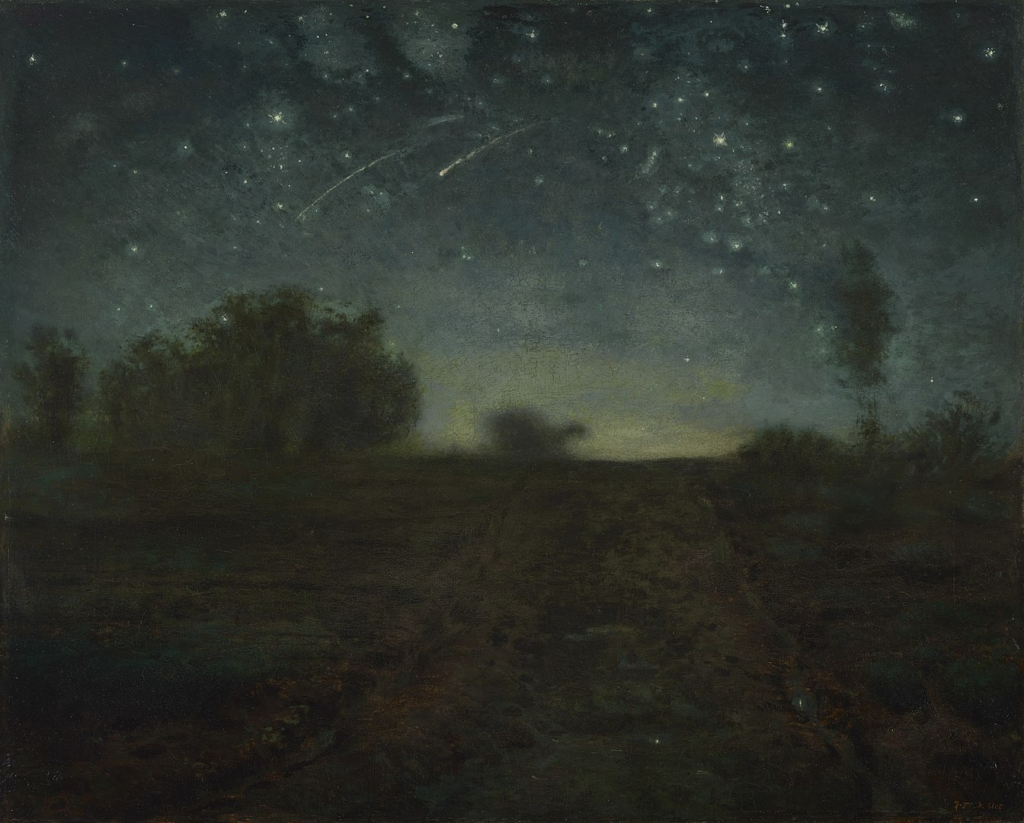
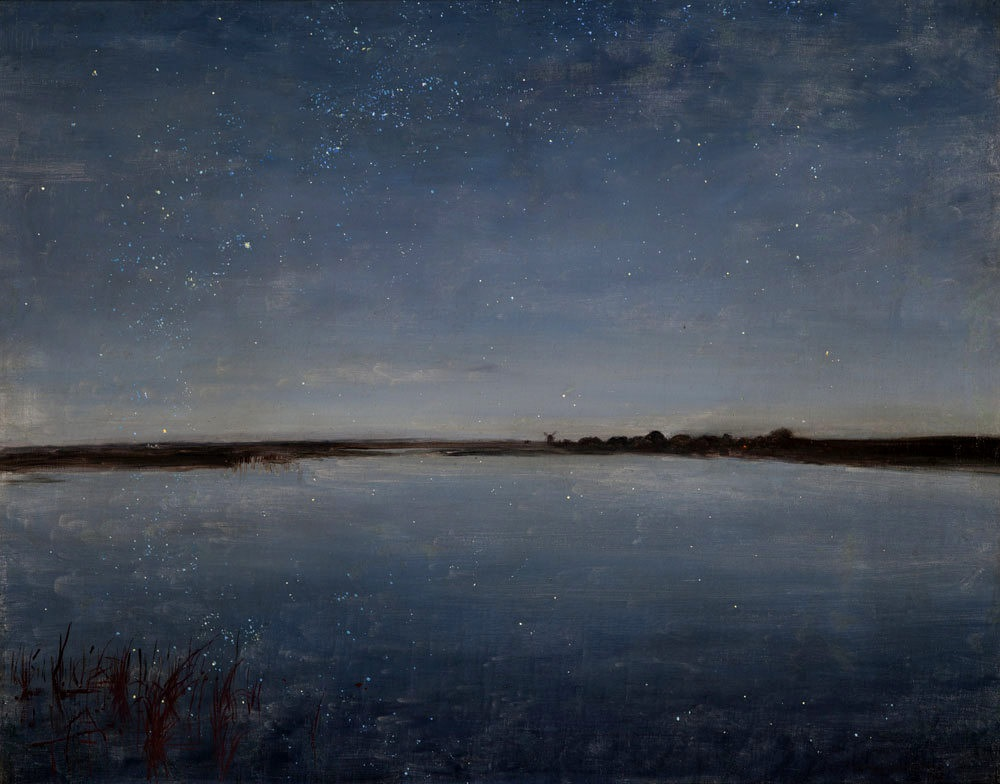
Jean-François Millet, Starry Night
Most starry night paintings ask us to admire their beauty. This one quietly asks us to look closer.
In March 2020, more than a century after it was painted, Jean-François Millet’s Starry Night received an unexpected honor: it was selected as NASA’s Astronomy Picture of the Day. It wasn’t because the painting imagined a magical sky or captured a poetic mood. It was because the stars above Millet’s quiet landscape appear to be astonishingly accurate. Suddenly, a 19th-century work of art found itself celebrated not only by museums but also by astronomers.
At first glance, the painting seems almost deceptively simple. A lone tree rises against an expansive sky, while the land below dissolves into darkness. There are no dramatic narratives, no bustling figures, and no theatrical light. Instead, Millet allows the heavens to become the true protagonist. The stars are carefully positioned rather than randomly scattered, encouraging viewers to spend time tracing patterns instead of merely admiring the scene.
Among those patterns is one of the most recognizable formations in the night sky: Orion’s Belt. Three bright stars, Alnitak, Alnilam, and Mintaka, appear aligned just as they do in reality. Astronomers have also identified Sirius, the brightest star visible from Earth, along with portions of the constellation Canis Major. Such precision was remarkably uncommon in landscape painting during the mid-19th century, when artists often treated stars as decorative details rather than celestial bodies with distinct positions.
Millet’s attention to the heavens wasn’t accidental. Best known for portraying the lives of rural laborers, he spent much of his life observing the rhythms of nature. For farmers, the night sky wasn’t simply beautiful, it served as a seasonal guide, a clock, and a familiar companion after long days in the fields. That intimate relationship with the landscape extended upward, allowing Millet to paint the sky with the same honesty he brought to the earth beneath it.
What makes Starry Night extraordinary, however, isn’t merely its scientific accuracy. The painting never feels like an astronomical chart. It remains deeply emotional. The immense darkness surrounding the stars creates a profound sense of stillness, while the tiny points of light remind us that even the quietest nights are full of hidden structure. Science and poetry coexist effortlessly on the same canvas.
Perhaps that’s why the painting continues to captivate viewers today. Long before photography could document the heavens in exquisite detail, Millet demonstrated that careful observation could transform art into an unexpected record of the universe. Few paintings invite us to appreciate both the beauty of the night and the science behind it with equal wonder. And in doing so, this remarkable work proves that sometimes the greatest discoveries in art aren’t hidden in museums, they’re waiting above our heads.
2. The Painting That Tricks You Into Feeling Safe
Peter Doig, Milky Way
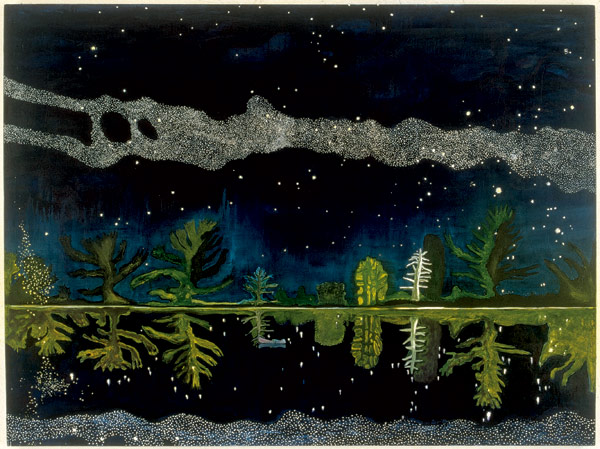
At first, there’s nothing unsettling about it.
A quiet lake stretches into the darkness. Pine trees frame the shoreline, their reflections dissolving into still water. Above them, countless stars shimmer across the sky, while the Milky Way casts a soft glow over the entire landscape. It feels like one of those rare moments when nature falls completely silent, a scene that invites you to linger.
Then you notice the canoe.
A lone figure sits almost unnoticed in the middle of the water, small enough to escape your attention the first time you look. Suddenly, the painting changes. What once felt peaceful begins to feel unnervingly isolated, as though you’ve wandered into the opening scene of a suspense film. That unsettling shift is entirely intentional.
Scottish artist Peter Doig painted the Milky Way between 1989 and 1990, early in a career that would make him one of the most celebrated contemporary painters of landscapes. Unlike many starry night paintings, Doig wasn’t interested in faithfully recording the heavens. He wanted to explore something far less predictable: how memory, imagination, and cinema shape the way we experience a place.
The tiny canoe drifting beneath the stars wasn’t invented from observation alone. It was inspired by one of the most unforgettable scenes in Friday the 13th (1980), where calm water becomes the setting for unexpected terror. Doig borrowed that cinematic tension, not to recreate the horror film, but to challenge the comforting assumptions we often make about beautiful landscapes.
This fascination with canoes became one of the defining motifs of his career. Over several years, Doig returned to the image repeatedly, producing what art historians now refer to as his “canoe paintings.” The vessel itself becomes a curious symbol, neither arriving nor leaving, but suspended between destinations. It represents solitude, memory, and the uncertainty of navigating both physical and emotional landscapes.
The setting was equally personal. While living and working in rural Canada, Doig often looked out from his barn studio toward dense forests and open skies. Those surroundings found their way into the painting, but never as straightforward documentation. Instead, fragments of real places merged with sketches, photographs, and memories, creating landscapes that feel simultaneously familiar and dreamlike. You recognize the forest, yet it never seems entirely real.
The stars overhead play an important role in this psychological balancing act. Rather than offering reassurance, they create an overwhelming sense of scale. The immense sky makes the solitary figure below appear even more vulnerable, reminding us how easily beauty can become loneliness when viewed from a different perspective. Every reflection on the water doubles the uncertainty, blurring the boundary between reality and illusion.
That is what makes Milky Way so compelling. The painting doesn’t frighten us through monsters or dramatic action. Instead, it quietly exposes how fragile our sense of safety can be. One small canoe, hidden beneath an impossibly beautiful sky, is enough to transform serenity into suspense.
Perhaps that’s why the painting stays with us long after we’ve looked away. It asks an unsettling question that many landscapes never dare to ask: Can a place remain beautiful even after it makes us feel afraid?
3. The Night Sky Where Every Falling Star Carries a Wish
Franz von Stuck, Falling Stars
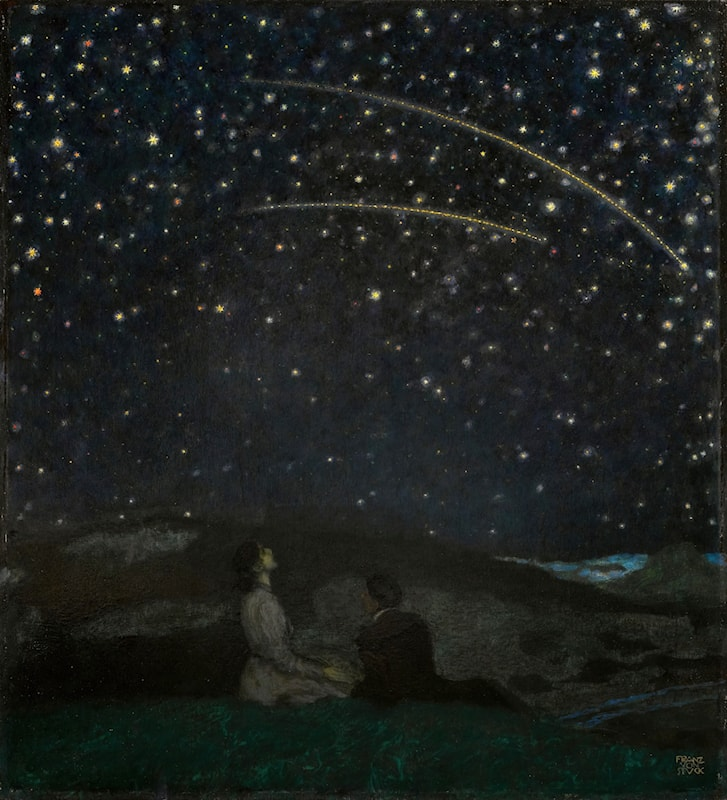
We’ve all heard the superstition: if you catch a shooting star before it disappears, make a wish.
It lasts only a few seconds, a streak of light across the sky, and then it’s gone forever. Yet for centuries, people have believed those fleeting moments hold extraordinary meaning. Franz von Stuck transformed that universal feeling into one of the most romantic and quietly symbolic night scenes in art history.
At first glance, Falling Stars feels almost cinematic. A hillside rises gently beneath an immense midnight sky, where countless stars shimmer above two brilliant meteors cutting across the darkness. Nestled below, a couple sits together in complete silence. The woman gazes upward, captivated by the celestial spectacle. The man, however, isn’t watching the heavens at all. His eyes are fixed entirely on her.
That subtle exchange tells the painting’s real story.
Unlike many starry night paintings, where the landscape or the cosmos dominates the composition, Von Stuck uses the stars as emotional storytellers. The meteors aren’t simply astronomical events; they become symbols of fleeting moments, those brief instances when love, hope, and possibility seem to align before slipping away. While the woman appears absorbed in making a wish upon the falling stars, the man seems to have already found his wish sitting beside him.
The scene becomes even more personal when you learn that the couple isn’t fictional. The figures are widely believed to represent Franz von Stuck himself and his wife, Mary, whose relationship inspired several of his works. Rather than painting an idealized romance, he created something remarkably intimate: a quiet conversation without words, where affection is expressed through a single glance rather than dramatic gestures.
As one of the leading figures of the Symbolist movement and a founding member of the Munich Secession, Von Stuck believed that paintings should evoke emotions and ideas beyond what they literally depict. In Symbolism, nature was rarely just nature. Forests suggested mystery, flowers hinted at desire, and the night sky became a stage where human emotions could unfold. In Falling Stars, the landscape exists not to describe a place, but to amplify a feeling, that bittersweet awareness that life’s most beautiful moments are often the most temporary.
The composition itself reinforces that idea. The vast sky occupies much more space than the couple below, reminding us of the universe’s immense scale. Yet our attention continually returns to the two figures. Against the endless cosmos, their shared moment feels impossibly small, and because of that, infinitely precious. The meteors streak across the sky for only an instant, mirroring how quickly love, youth, and even happiness can pass if we fail to notice them.
More than a century after it was painted, Falling Stars still resonates because it captures something deeply human. We continue to look up when we see a shooting star, instinctively hoping for something better, brighter, or just beyond our reach. Von Stuck reminds us that sometimes the wish isn’t waiting in the sky at all. Sometimes, if we’re paying attention, it’s already sitting quietly beside us.
4. Scientists Spent Years Arguing About One Bright Star
Edvard Munch, Starry Night
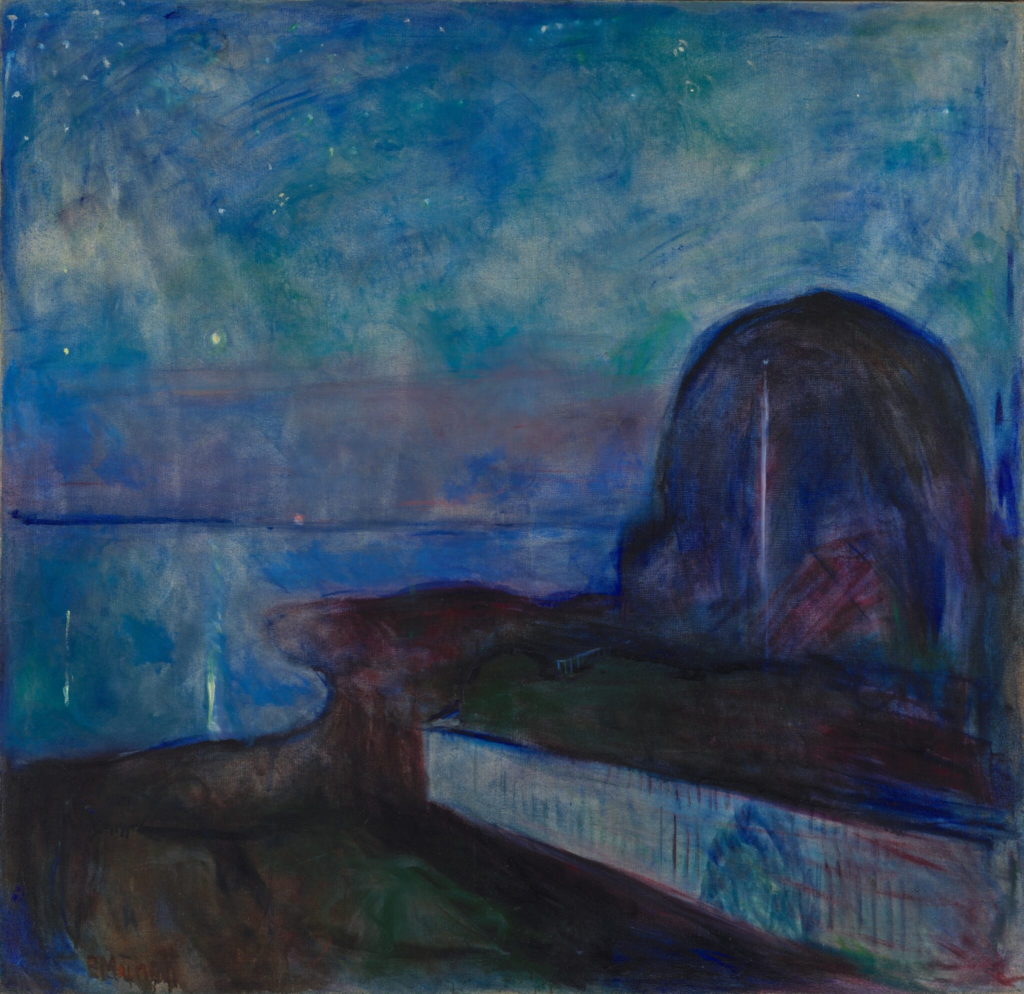
Imagine standing beneath a quiet Norwegian sky in 1893. The sea is still, the trees barely move, and one brilliant point of light hangs above the horizon. You paint exactly what you see. More than a century later, scientists begin debating whether that glowing object could have actually been there.
That is exactly what happened with Edvard Munch’s Starry Night.
Unlike many starry night paintings, Munch wasn’t trying to create an astronomically perfect record of the heavens. He was painting something far more elusive: the emotional weight of a place after sunset. Yet one small celestial body in the painting has sparked an unexpected mystery, turning this quiet landscape into the subject of scientific investigation.
The scene overlooks Åsgårdstrand, a small seaside town on Norway’s southern coast where Munch spent many of his summers. It was more than a holiday destination, it became an emotional landscape that appeared repeatedly throughout his career. While many artists painted nature for its beauty, Munch believed landscapes could reflect the human mind. The twisting trees, the deep cobalt sea, and the luminous sky don’t simply describe a location; they mirror feelings of solitude, contemplation, and melancholy.
When the painting was first exhibited, it carried the title The Evening Star. For decades, art historians naturally assumed that the radiant object dominating the sky was Venus. After all, Venus has long been known as the “Evening Star” and is often the brightest object visible after sunset. The interpretation seemed so convincing that few questioned it.
Then astronomy entered the conversation.
In 2010, researchers from the University of Texas analyzed the painting alongside historical astronomical data from Åsgårdstrand in the summer of 1893. Their calculations suggested that Venus could not have appeared in the position Munch depicted. Instead, the bright object was far more likely to have been Jupiter. They also proposed that several smaller points of light resemble the Pleiades star cluster, adding another layer of astronomical credibility to the scene.
The discovery didn’t diminish the painting’s artistic significance, it enriched it. Rather than revealing an error, it demonstrated how closely Munch may have been observing the night sky, even while transforming it into an emotional landscape. His work sits at an intriguing crossroads where scientific observation and personal expression unexpectedly meet.
Yet the real power of Starry Night has never depended on whether the glowing light is Venus or Jupiter. What continues to captivate viewers is the atmosphere Munch creates. The shoreline dissolves into rich blues, the stars pulse against the darkness, and the entire landscape seems suspended in a moment of profound stillness. It feels less like looking at nature and more like stepping inside a memory.
Perhaps that’s why the debate over a single star feels so fitting. Munch understood that the night sky is never just about astronomy. It is also about emotion, memory, and the questions we continue to ask long after the sun has disappeared. In the end, whether we’re looking at Venus, Jupiter, or simply a painter’s interpretation of the heavens, the mystery itself becomes part of the masterpiece.
5. She Painted the Night as If No One Had Ever Seen It Before
Georgia O’Keeffe, Starlight Night, Lake George
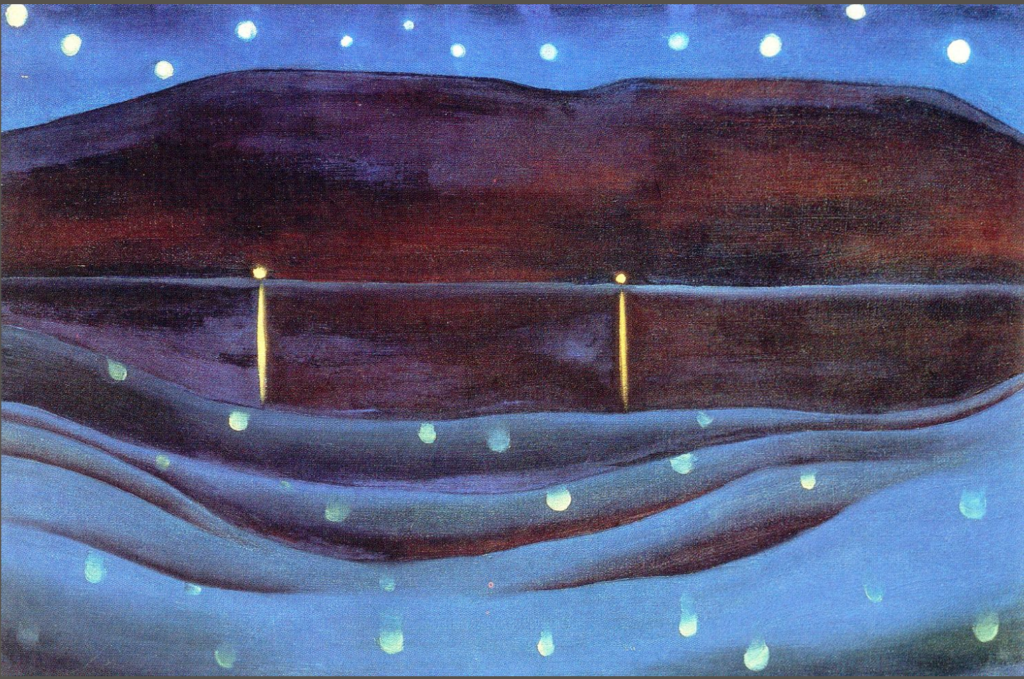
How do you paint something as familiar as the night sky without repeating what countless artists have already done?
For Georgia O’Keeffe, the answer wasn’t to look at the stars differently, it was to imagine seeing them for the very first time.
In a letter to fellow artist Russell Vernon Hunter, she offered a piece of advice that perfectly captures her artistic philosophy: “Try to paint your world as though you are the first man looking at it.” It sounds simple, but it transformed everything she touched. Flowers became vast landscapes. Hills turned into living forms. And in Starlight Night, Lake George, the night sky became something that feels both ancient and completely new.
Unlike many starry night paintings that fill the sky with dramatic constellations or sweeping celestial spectacle, O’Keeffe chose restraint. Her stars appear as soft white circles edged with delicate hints of blue, quietly suspended across a deep indigo sky. They aren’t rendered with scientific precision, nor do they sparkle theatrically. Instead, they seem to breathe, creating a rhythm that gently pulls the viewer’s eye across the canvas.
The setting was deeply personal. During the 1910s and 1920s, O’Keeffe spent many summers at Lake George in upstate New York, the estate owned by photographer and art dealer Alfred Stieglitz, who would later become her husband. Surrounded by forests, rolling hills, and calm water, she found endless inspiration in the changing landscape. While many artists sought dramatic destinations, O’Keeffe returned again and again to the same place, proving that familiarity could be just as powerful as novelty when viewed with genuine curiosity.
Look closely, and you’ll notice how the stars seem to echo across the lake below. Their reflections mingle with two faint artificial lights, gently reminding us that nature and human presence coexist without competing for attention. The horizon is minimal, almost dissolving into abstraction, allowing the immense sky to dominate the composition. Rather than directing us toward a specific constellation or celestial event, O’Keeffe invites us to experience the quiet vastness of the night itself.
The painting also reveals her unique approach to modernism. At a time when abstraction was rapidly reshaping the art world, O’Keeffe refused to abandon nature. Instead, she distilled it—removing unnecessary details until only its emotional essence remained. Her night sky doesn’t imitate reality; it captures what it feels like to stand beneath it in complete silence.
That sense of wonder is perhaps what makes Starlight Night, Lake George so enduring. It reminds us that the stars have never truly become ordinary. We pass beneath them every evening, often without a second glance, convinced we’ve seen them a thousand times before. O’Keeffe gently challenges that assumption. Through her eyes, the familiar becomes astonishing again, as though the universe has just revealed itself for the very first time. And perhaps that is her greatest gift, not showing us a different sky, but teaching us how to look at the same one with fresh wonder.
6. The Renaissance Painting That Saw the Universe Before Most People Did
Adam Elsheimer, Flight into Egypt
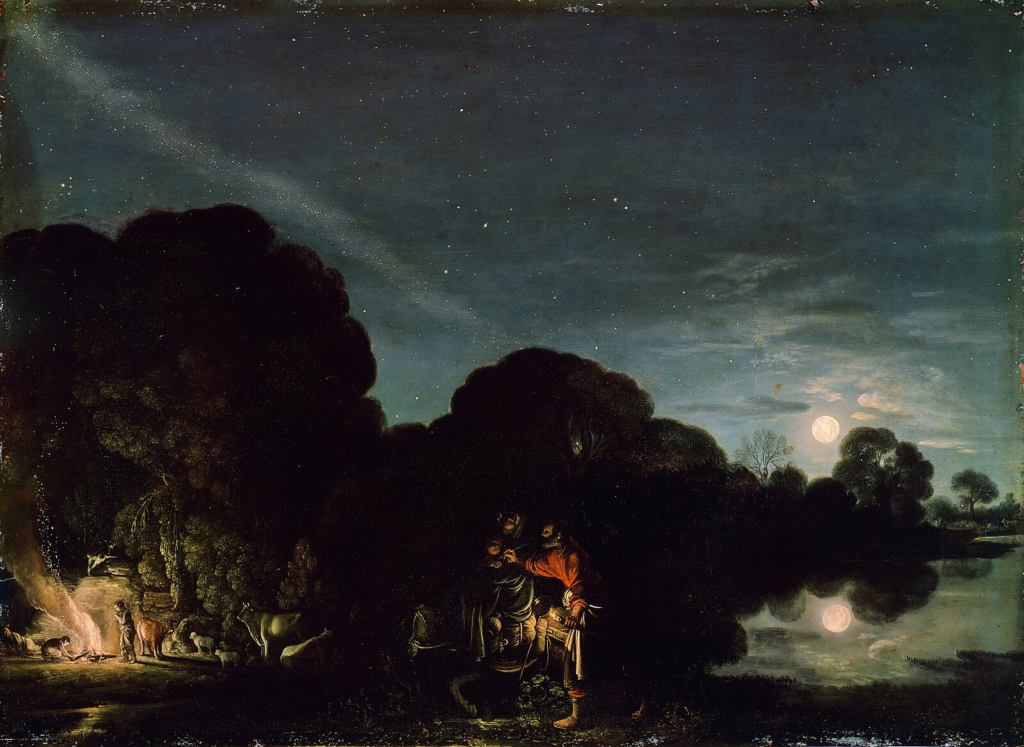
Centuries before cameras could photograph the Milky Way, and before most people had ever looked through a telescope, one artist painted a night sky so astonishingly observant that it continues to fascinate both art historians and astronomers today.
The remarkable part?
He did it at a moment when humanity’s understanding of the universe was changing forever.
At first glance, Adam Elsheimer’s Flight into Egypt appears to tell a familiar biblical story. Joseph leads a donkey carrying Mary and the infant Jesus through a moonlit wilderness as they flee King Herod’s massacre. The Holy Family occupies only a small corner of the composition, quietly making their way through a dense forest. But look beyond them, and another story begins to unfold, one written not on earth, but across the heavens.
Unlike many starry night paintings, where stars simply create atmosphere, Elsheimer treated the night sky with extraordinary care. The stars vary in brightness rather than appearing as identical points of light, closely resembling how they are actually seen with the naked eye. Art historians and astronomers have identified recognizable constellations, including Ursa Major and Leo, while the Milky Way stretches softly across the darkness instead of appearing as a decorative band. For an artist working in the early 17th century, this level of celestial observation was nothing short of revolutionary.
The painting’s timing makes it even more extraordinary. Around 1609, the Italian astronomer Galileo Galilei turned his improved telescope toward the heavens and made discoveries that challenged centuries of accepted belief. He observed that the Milky Way was not a cloudy streak but a vast collection of countless individual stars. He also documented the Moon’s rugged surface, proving it was not the perfectly smooth celestial sphere many had imagined. These groundbreaking observations were published in Sidereus Nuncius in 1610 and forever transformed humanity’s view of the cosmos.
Scholars have long noted striking similarities between Galileo’s discoveries and Elsheimer’s painting. The Milky Way is rendered as a luminous cluster of tiny stars rather than a hazy cloud, while the Moon appears textured and cratered instead of perfectly polished. Although historians continue to debate whether Elsheimer directly incorporated Galileo’s findings or arrived at similar observations independently, the painting stands as one of the earliest works in European art to reflect this revolutionary way of seeing the night sky.
Yet Flight into Egypt is far more than a scientific achievement. Elsheimer masterfully orchestrates multiple sources of light throughout the composition. Moonlight filters through the trees, stars illuminate the sky, distant campfires flicker along the horizon, and reflections shimmer on the water below. These carefully balanced light sources create an atmosphere of quiet protection, transforming what could have been a fearful journey into one filled with hope and divine guidance.
More than four hundred years later, Flight into Egypt remains astonishing because it captures a rare moment when art, faith, and science briefly moved in the same direction. It reminds us that the greatest artistic breakthroughs don’t always come from imagining new worlds—they sometimes come from looking at the real one with greater curiosity than anyone else had before.
7. The Night Sky That Seems to Twinkle on Paper
Henri-Edmond Cross, Landscape with Stars
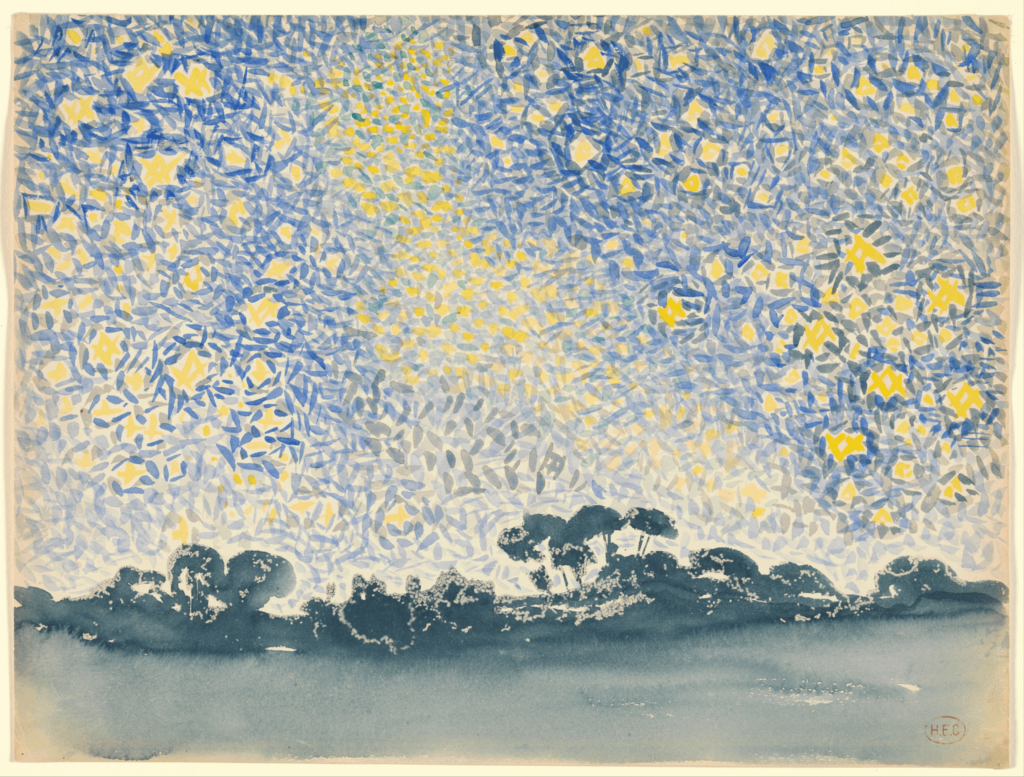
Some paintings don’t move.
This one somehow does.
Stand in front of Henri-Edmond Cross’s Landscape with Stars, and something curious begins to happen. The stars don’t simply sit against the sky, they seem to shimmer, flicker, and pulse with light. The longer you look, the more alive the painting feels, as though the night itself is quietly breathing.
The remarkable thing is that nothing in the artwork is actually moving. The illusion comes entirely from Cross’s extraordinary understanding of color and the way our eyes perceive it.
Unlike many starry night paintings that rely on dramatic subjects or sweeping narratives, Landscape with Stars tells its story through atmosphere alone. There are no figures wandering beneath the heavens, no mythology, and no hidden symbolism waiting to be uncovered. Instead, Cross invites us to experience one of the simplest yet rarest moments imaginable: standing beneath a sky so clear and untouched that the stars become the only spectacle.
Painted between 1905 and 1908, the watercolor reflects Cross’s distinctive Neo-Impressionist style. Influenced by artists like Georges Seurat and Paul Signac, he embraced the idea that colors could create greater brilliance when placed beside one another rather than blended together. Instead of covering the sky with smooth washes of paint, Cross scattered tiny touches of yellow, pale blue, lavender, and soft gray across the paper. Viewed up close, these marks appear almost abstract. Step back, however, and they merge in the viewer’s eye, creating an astonishing sensation of luminous depth.
The composition itself is strikingly restrained. A low, nearly featureless landscape stretches quietly across the bottom of the page, giving almost all of the visual space to the heavens above. Near the center, clusters of stars gather more densely, suggesting the glowing arc of the Milky Way crossing the night sky. By reducing the landscape to little more than a silhouette, Cross shifts our attention upward, reminding us that the true subject has always been the universe itself.
Although the exact location remains unknown, historians believe Cross was inspired by the rural landscapes of southern France, where he spent much of his later life. In the early twentieth century, far from expanding cities and electric streetlights, the Milky Way could still be seen with astonishing clarity. For Cross, this wasn’t an imagined sky, it was a familiar one.
Today, that quiet reality carries an unexpected poignancy. According to researchers, light pollution now prevents a significant portion of the world’s population from seeing the Milky Way with the naked eye. The breathtaking celestial canopy that once inspired artists like Cross has gradually faded from many modern skies, replaced by the glow of cities that never truly sleep.
Perhaps that’s why Landscape with Stars feels even more magical today than it did a century ago. It isn’t simply a beautiful watercolor; it’s a gentle reminder of a night sky many of us have never experienced. Cross preserved not only the appearance of the stars but also the wonder of looking up and realizing just how immense, and brilliantly alive, the universe can feel when darkness is allowed to exist.
8. The Painting Critics Called “Wrong”- History Didn’t Agree
Józef Chełmoński, Starry Night
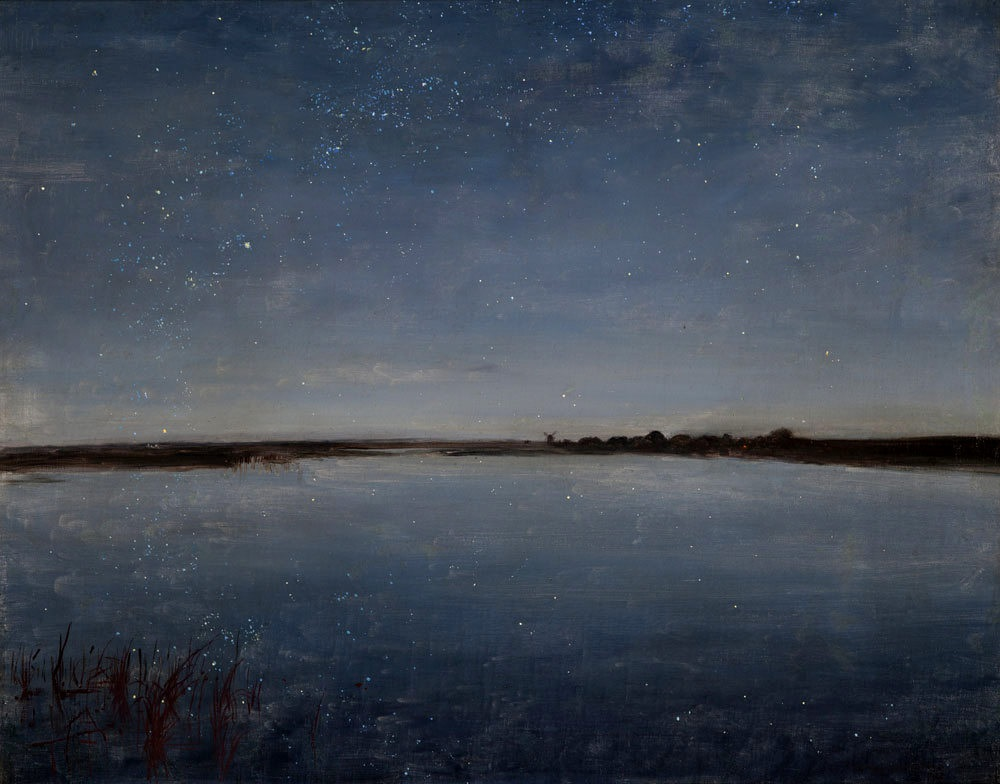
Can a painting be scientifically inaccurate and still reveal a deeper truth?
When Polish painter Józef Chełmoński unveiled Starry Night in 1888, not everyone was impressed. Some critics looked up at his glittering sky and immediately pointed out what they believed was an obvious flaw: the stars didn’t form the correct constellations. To them, it wasn’t simply an artistic choice, it was a mistake. One prominent writer even compared it to painting “a horse with horns.”
More than a century later, that criticism says far more about our expectations of art than it does about Chełmoński’s painting.
Unlike many starry night paintings, Starry Night doesn’t rely on dramatic storytelling or recognizable celestial formations. Instead, it strips the landscape down to its essentials. A narrow strip of land barely separates the sky from the water below, while the rest of the canvas is immersed in rich shades of blue. Countless stars scatter across the heavens, their reflections shimmering softly on the still surface beneath them. There are no people, no buildings, and no distractions, just an immense conversation between earth, water, and sky.
For an artist celebrated for his vivid depictions of rural life, horses, and the Polish countryside, this was a surprisingly bold departure. Human figures had almost disappeared from the scene. Nature alone became the subject, asking viewers to experience the silence of the landscape rather than search for a narrative within it.
The controversy surrounding the painting centered on astronomy. Critics argued that the stars appeared randomly arranged instead of reflecting real constellations visible in the night sky. Among the loudest voices was celebrated Polish novelist Bolesław Prus, who dismissed the celestial arrangement as “spangled dots instead of constellations,” suggesting it was as implausible as depicting a horse with horns.
Yet not everyone agreed.
Painter and art critic Stanisław Witkiewicz came to Chełmoński’s defense with a response that has become one of the most memorable observations about the artwork. He argued that truth in art is not measured by literal accuracy, but by the authenticity of the experience it creates. In other words, the painting didn’t need to function as an astronomical map to feel profoundly real.
That debate still resonates today. We rarely remember a breathtaking night because we accurately identified every constellation overhead. We remember the overwhelming darkness, the stillness of the air, the way stars seemed endless, and the feeling of standing beneath something unimaginably vast. Chełmoński captured precisely that emotional reality.
The painting’s restrained palette reinforces this quiet power. Layers of deep blues merge almost seamlessly with the reflective water, making it difficult to tell where the earth ends and the sky begins. The stars themselves become less like individual celestial bodies and more like scattered fragments of light suspended between two worlds. The result is a scene that feels timeless, meditative, and almost dreamlike.
Today, Starry Night is admired not despite its supposed inaccuracies but because of the questions it continues to raise. Should art always imitate reality with perfect precision? Or can it reveal something even more meaningful by capturing how a moment feels rather than how it looks?
Chełmoński’s answer is written across every inch of his midnight sky. Sometimes, emotional truth shines brighter than scientific perfection.
9. The Artist Who Dreamed of Space Before Science Fiction
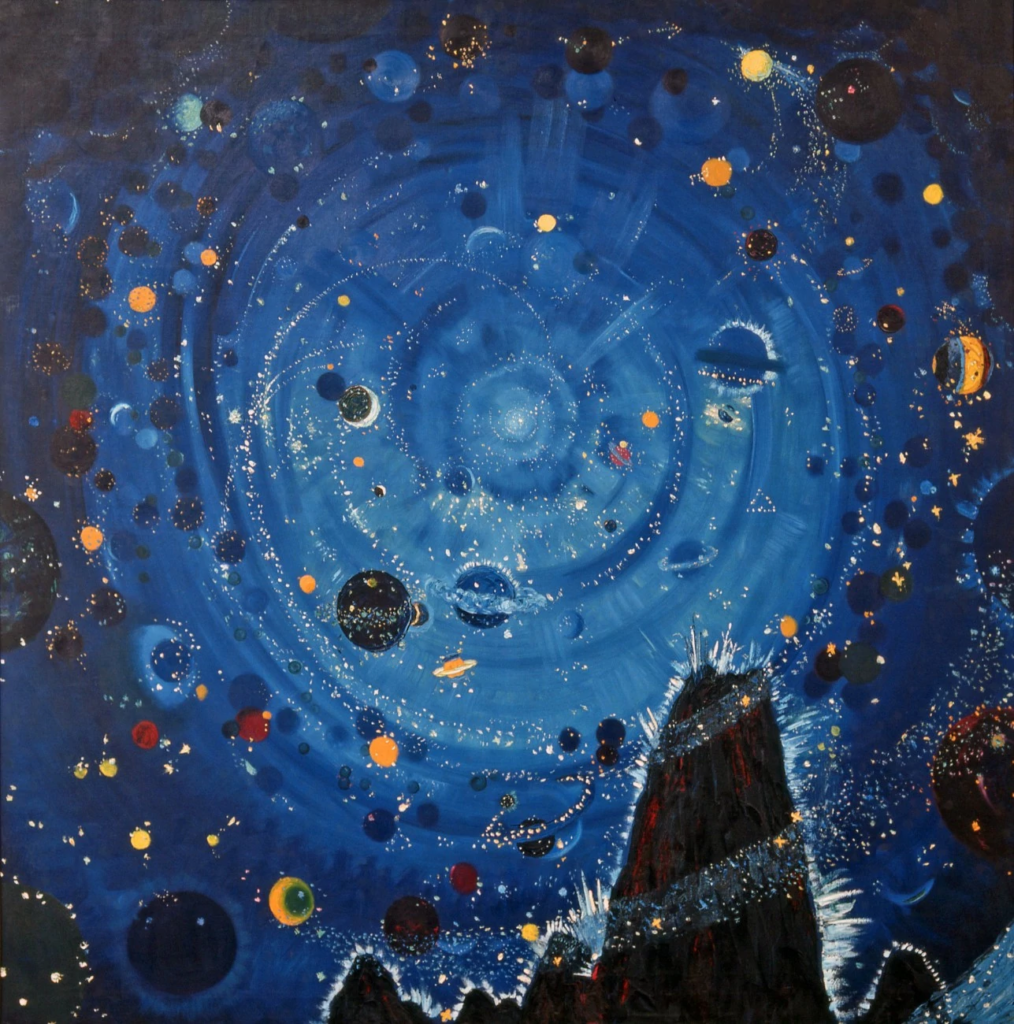
Wenzel Hablik, Starry Sky, Attempt
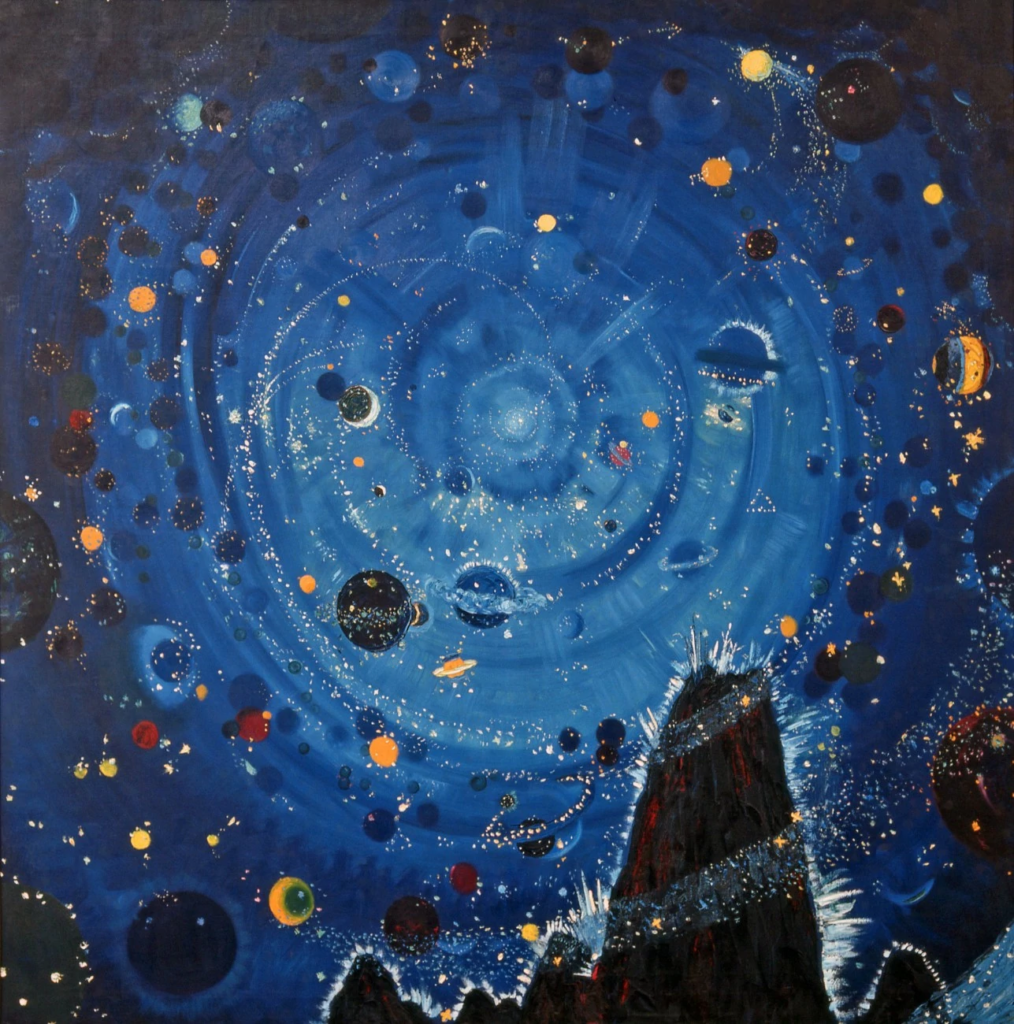
Long before astronauts walked on the Moon, before science fiction films imagined distant galaxies, and decades before photographs revealed the breathtaking colors of the universe, one artist painted a cosmos that felt astonishingly ahead of its time.
It wasn’t based on scientific observation.
It was powered entirely by imagination.
When Wenzel Hablik created Starry Sky, Attempt in 1909, humanity knew remarkably little about what lay beyond Earth’s atmosphere. Telescopes had expanded our understanding of the heavens, but planets remained mysterious worlds, galaxies were still poorly understood, and space travel belonged entirely to fantasy. Yet Hablik painted a universe so vibrant, dynamic, and otherworldly that modern viewers often mistake it for a vision inspired by contemporary astronomy.
Unlike many starry night paintings, which anchor the viewer safely on the ground, Starry Sky, Attempt abandons the landscape altogether. There is no horizon, no comforting silhouette of trees, and no familiar place to stand. Instead, the painting launches us directly into the cosmos. Floating planets, glowing stars, crystalline formations, and swirling celestial bodies pull us toward an unknown center, making us feel less like observers and more like travelers drifting through infinite space.
Every celestial body appears to possess its own identity. Some planets glow with fiery reds and molten oranges, while others shimmer in icy blues and luminous greens. Ringed worlds hover beside radiant stars, and clusters of light gather into patterns that suggest distant galaxies long before astronomers could photograph them. Rather than depicting the universe as an empty void, Hablik imagined it as a place overflowing with energy, movement, and endless possibility.
This extraordinary vision was deeply connected to the artist’s lifelong fascination with crystals. Hablik collected minerals and often studied their intricate geometric structures, believing they represented nature’s perfect architecture. Their influence can be seen throughout the painting, where sharp crystalline forms emerge among the planets, transforming outer space into something that feels both geological and celestial. For Hablik, the microscopic beauty of a crystal and the vastness of the universe belonged to the same grand design.
A leading figure associated with German Expressionism, Hablik believed that art should give shape to ideas that had not yet entered reality. One of his most quoted statements perfectly captures this philosophy: “Everything that exists once was an idea.” That belief extended far beyond painting. He designed visionary architecture, imagined floating cities, and created fantastical worlds where creativity could travel further than science had yet reached.
Looking at Starry Sky, Attempt today is a fascinating experience because modern astronomy has, in some ways, caught up with Hablik’s imagination. The vibrant colors captured by powerful telescopes, the dramatic formations of distant nebulae, and the endless variety of planets discovered beyond our solar system all make his dreamlike universe feel strangely familiar. While he wasn’t painting scientific fact, he captured something equally profound: humanity’s endless desire to explore what lies beyond the known.
Perhaps that’s why the painting still feels so contemporary. It reminds us that every great discovery begins in the same place, with someone willing to imagine a world that doesn’t yet exist. Long before science could show us the universe, Wenzel Hablik dared to dream it.
10. The Ceiling That Turned Heaven Into Art
Giotto di Bondone, Vault of the Scrovegni Chapel
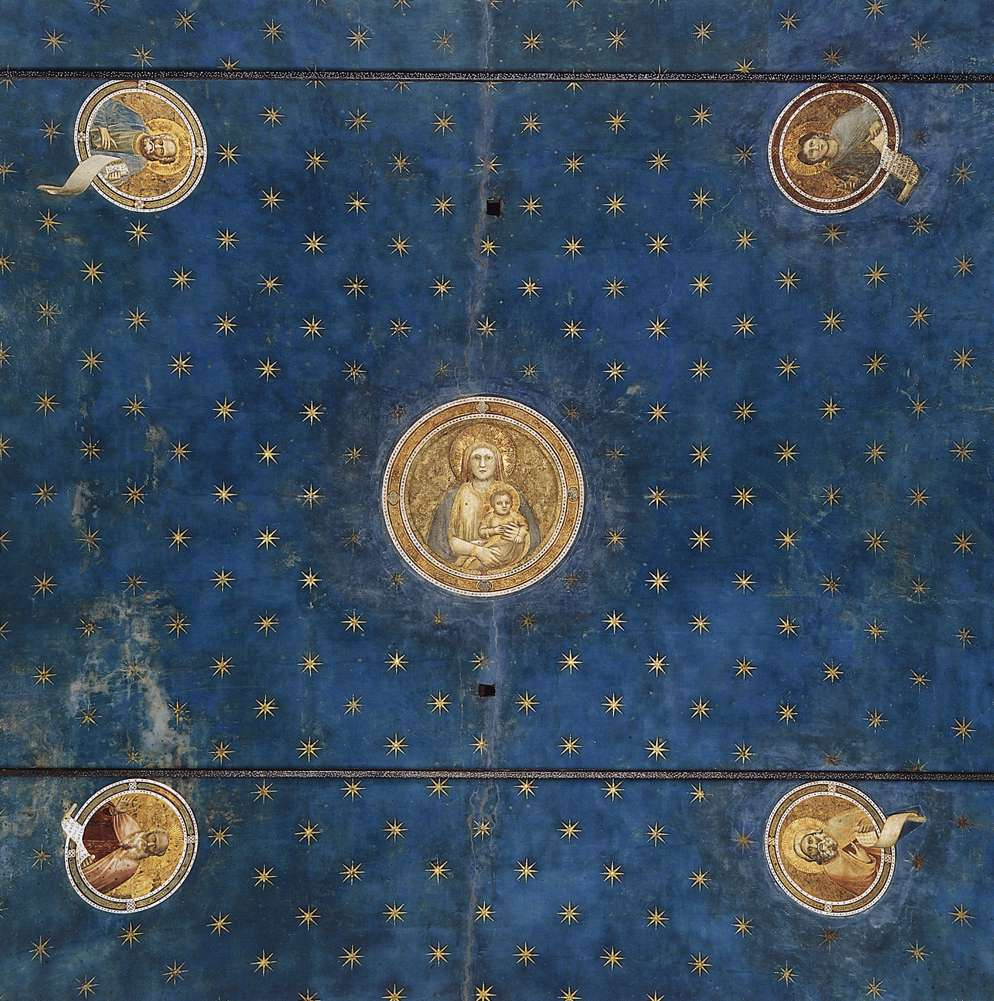
Before artists painted stars as they appeared in the night sky, they painted them as they imagined heaven.
More than 700 years ago, visitors entering a small chapel in Padua looked up and found themselves standing beneath an endless blue sky, not the one outside, but one carefully created in paint. It wasn’t filled with realistic constellations or astronomical observations. Instead, it offered something even more profound: a vision of the universe as medieval Europe believed it to be, where the heavens were both beautiful and deeply sacred.
That breathtaking ceiling still exists today.
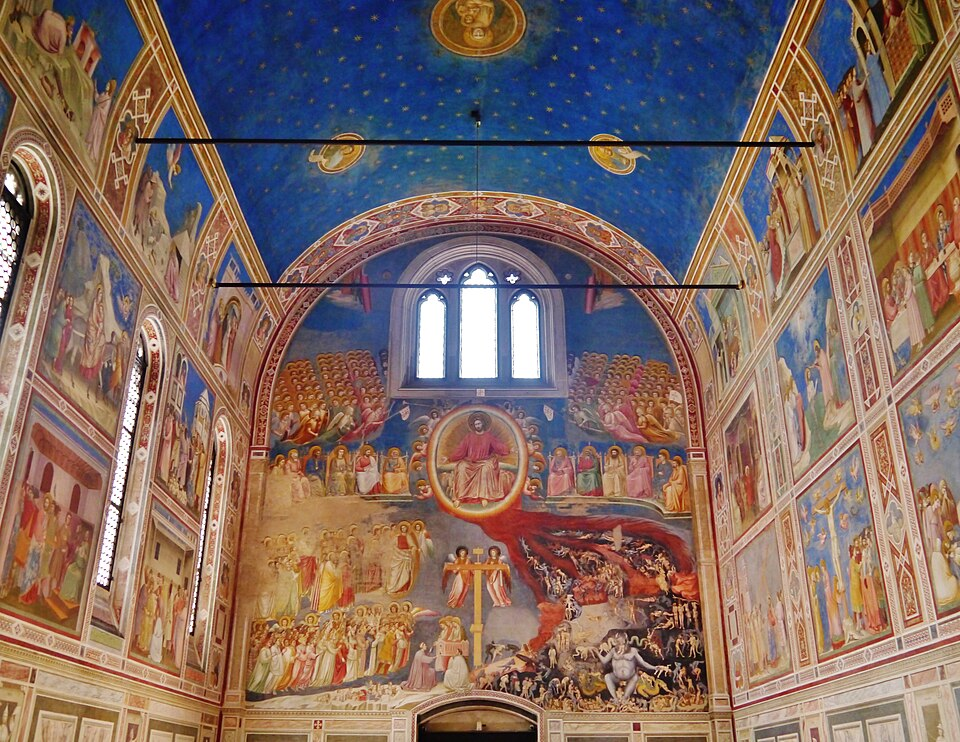
Created between 1303 and 1305, Giotto di Bondone’s vaulted ceiling in the Scrovegni Chapel is one of the earliest and most influential celestial masterpieces in Western art. At a time when most artists depicted flat, symbolic figures with little sense of depth or realism, Giotto transformed an entire architectural space into an immersive experience. Looking upward, worshippers no longer saw stone, they saw heaven itself unfolding above them.
Unlike many starry night paintings, Giotto’s sky wasn’t intended to capture a particular evening or a recognizable constellation. Instead, every element carried symbolic meaning. The vault is covered in a brilliant ultramarine blue, an extraordinarily expensive pigment made from finely ground lapis lazuli imported from what is now Afghanistan. During the Middle Ages, this vivid blue was more valuable than many other pigments and was often reserved for the most sacred commissions. By covering the entire ceiling in ultramarine, Giotto wasn’t simply making an artistic choice; he was emphasizing the divine significance of the space.
Scattered across this radiant blue are hundreds of eight-pointed golden stars, each carefully placed to create a sense of celestial harmony. Rather than representing the stars visible from Earth, they symbolize eternity, divine order, and the infinite presence of God. Interspersed among them are circular medallions containing prophets from the Old Testament and John the Baptist, connecting the heavens with the biblical story unfolding across the chapel’s walls.
One of the most fascinating details lies elsewhere in the chapel. In Giotto’s celebrated Adoration of the Magi fresco, the Star of Bethlehem is painted not as a generic glowing light but as a comet with a luminous tail. Many historians believe Giotto drew inspiration from Halley’s Comet, which blazed across European skies in 1301, just a few years before he began work on the chapel. If true, it would mark one of the earliest known instances of a real astronomical event influencing a major work of Western religious art.
That small detail perfectly captures why Giotto remains such a pivotal figure in art history. He stood at the threshold between the medieval and Renaissance worlds, honoring religious tradition while quietly embracing careful observation of the natural world. His paintings didn’t abandon symbolism, but they began to breathe with a new sense of life and reality that would inspire generations of artists to come.
Today, the Scrovegni Chapel’s celestial ceiling continues to leave visitors in awe for much the same reason it did seven centuries ago. It reminds us that long before telescopes revealed distant galaxies or painters studied the heavens with scientific precision, artists were already looking upward in search of meaning. Giotto’s stars may not map the universe as we know it, but they illuminate something just as enduring: humanity’s timeless desire to understand its place beneath the infinite sky.
After exploring these remarkable paintings, one thing becomes impossible to ignore: the stars themselves never changed, only the people looking at them did.
Across seven centuries, artists have returned to the night sky for remarkably different reasons. Giotto filled it with symbols of faith. Adam Elsheimer observed it with the curiosity of a scientist standing at the dawn of a new age. Franz von Stuck found romance beneath falling stars, while Edvard Munch transformed the heavens into a landscape of emotion. Georgia O’Keeffe invited us to see familiar skies with fresh eyes, Peter Doig turned stillness into suspense, and Wenzel Hablik imagined cosmic worlds long before modern astronomy could reveal them.
Perhaps that’s why these works continue to resonate today. They remind us that the night sky is more than a backdrop, it is a mirror. Every generation projects its hopes, fears, beliefs, and questions onto the same expanse of darkness. Whether painted with scientific precision or poetic imagination, each artwork captures a different way of making sense of something far greater than ourselves.
Van Gogh may have created history’s most celebrated vision of a star-filled sky, but he was never the only artist captivated by it. His masterpiece is part of a much larger conversation, one that stretches across centuries, cultures, and artistic movements, proving that inspiration has always existed just beyond the reach of daylight.
So the next time you find yourself looking up after sunset, pause for a moment. Somewhere in that same sky are the stars that inspired these artists centuries ago. The question is no longer which painting captured the night best. It’s this: Which night sky would you want to stand beneath?
The night sky has inspired artists for centuries, yet no two visions of it are ever quite the same. From quiet moonlit landscapes to swirling cosmic dreams, these paintings remind us that the darkness above has always been a canvas for imagination, memory, and wonder. Which one surprised you the most?
If you’re fascinated by the stories behind great works of art and the creative minds who made them, you might also enjoy exploring these art films every artist and art lover should watch. It’s another inspiring way to experience art beyond the gallery walls.