
Before They Became Memories, They Were Just Ordinary Days
Eight paintings about the small moments we never think to hold onto.
No one takes a photograph of a Tuesday.
We save our cameras for the birthdays, the weddings, the trips we planned for months. We circle days on calendars and count down to them, certain these are the ones we’ll carry.
Then years pass, and something strange happens. The wedding blurs. What comes back instead is a Tuesday. An afternoon that had no reason to matter, someone reading in the next room, a walk that took the long way home, a friend lying on the floor beside you talking about nothing for three hours.
These moments never announce themselves. They don’t ask to be remembered. They just happen, quietly, while we’re waiting for something bigger. These are the ordinary days that rarely make it into photographs, but somehow become the ones we remember most clearly.
Perhaps that’s what makes them so compelling to paint. Again and again, artists have turned their attention to the moments that might otherwise pass unnoticed: children finding their way into the water, friends sharing an afternoon, two people wandering side by side, someone holding out a new bracelet for another person to admire. Nothing monumental is happening. And yet, somehow, everything is.
These paintings don’t ask us to look for the extraordinary. They ask us to look again at the ordinary, and to wonder how many moments in our own lives we might one day wish we had thought to hold onto. Because ordinary days have a way of becoming extraordinary in memory.
Here are eight of our favourites.
1. Children in the Sea — Joaquín Sorolla
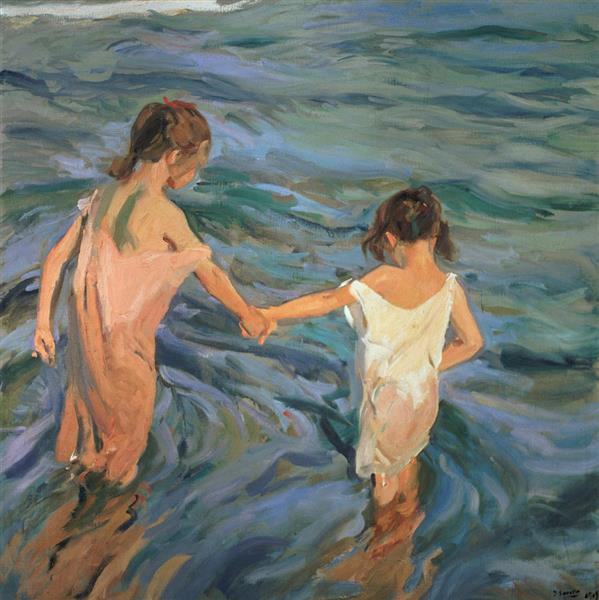
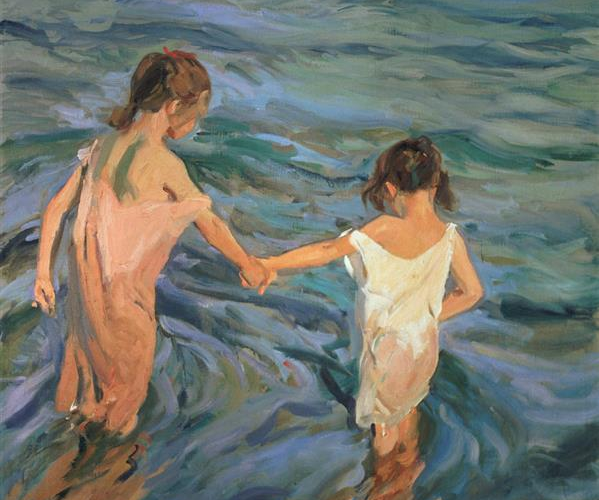
Two children step into the water holding hands. That’s the entire event. Sorolla painted light better than almost anyone, and here he spends all of it on wet skin and the glare coming off a shallow wave.
It’s the hand-holding that does it. Not affectionate, exactly. Practical. It’s what you do when the water is cold and you’re going in anyway.
This might be the closest anyone has come to painting how time worked when we were small. A beach wasn’t somewhere you visited for a few hours. It was a whole country, with its own weather and its own laws. You went in, you came out at some point, and nothing in between had a shape.
Sorolla doesn’t sentimentalise it. There’s no nostalgic haze over the surface. He just paints two children in the sea, on an afternoon that will not, as far as they’re concerned, ever end.
2. Best Friends — Tricia Kaman
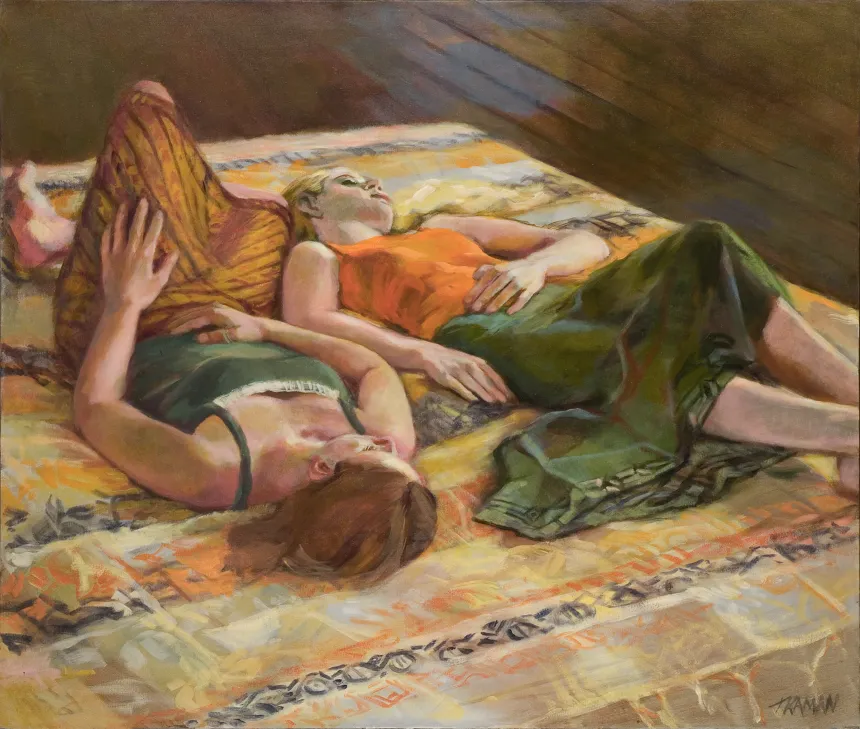
Two friends stretched out, not talking. No embrace, no occasion. Just two people occupying the same room without needing to do anything about it.
Silence is the real test of a friendship. Most people you can talk to. Very few you can stop talking to. There’s a specific point in a long afternoon when the conversation genuinely runs out, and that’s when you find out whether you’re going to reach for your phone or simply stay where you are.
Kaman paints the staying. Nothing in the picture is happening, which is exactly the achievement, it takes a great deal of trust to be that boring around another person.
We tend to measure closeness by intensity: the deep conversation, the crisis someone showed up for. But the better measure might be how comfortable the dead air is.
3. California Dreamtime — Emilie Lee
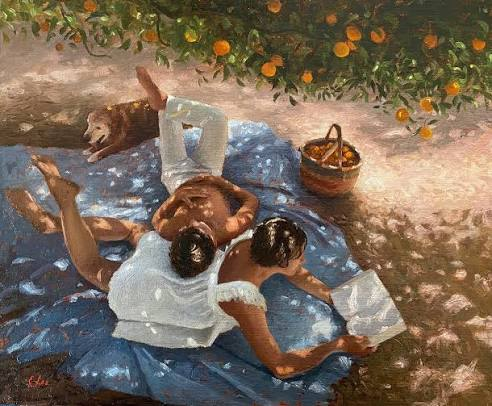
Two people under orange trees. A blanket. A book, half-read. A dog who has clearly given up on the day entirely.
There’s something quietly confrontational about this one. We’ve built a culture where rest has to justify itself, it’s recovery, it’s recharging, it’s in service of being useful again by Monday. Lee isn’t having it. The afternoon in this painting isn’t earning anything.
Notice the book, though. Someone brought a book, which means someone had a plan for this afternoon, and the plan has been abandoned. That’s the detail that makes it true. Nobody is optimising this day.
The hardest thing to give another person now isn’t money, or advice, or even attention. It’s an unaccounted-for afternoon.
4. Discovering Love — Walter Zakarlo
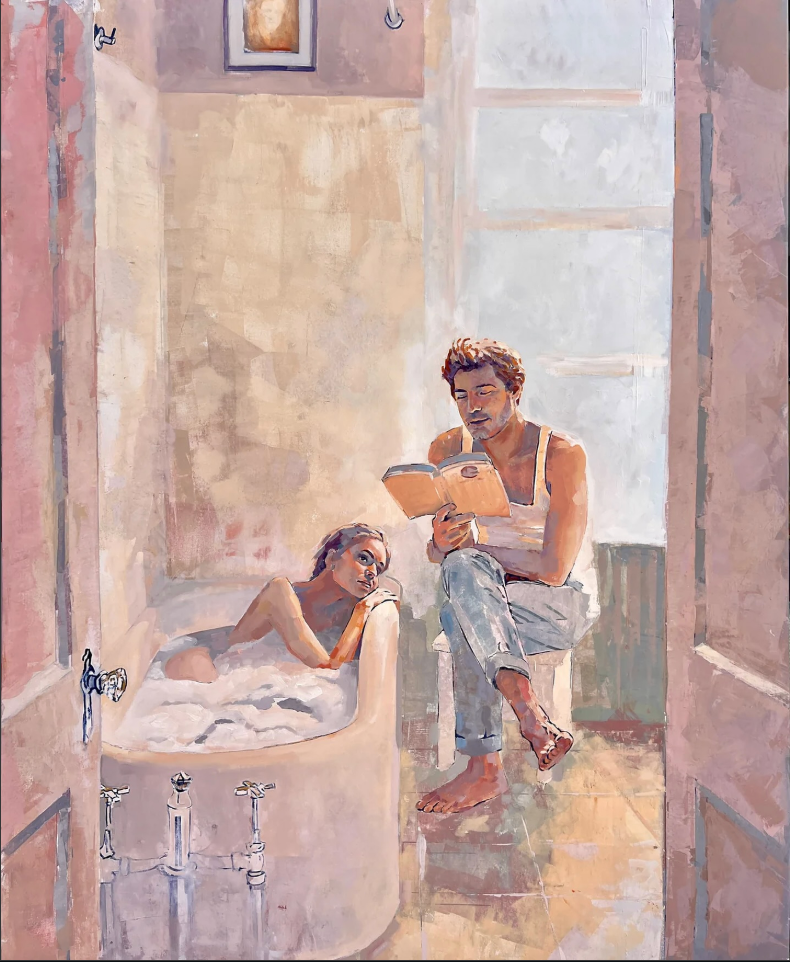
One person reads. The other watches from the bath. Neither is speaking.
Child psychologists have a name for this: parallel play, two toddlers side by side, doing separate things, together but not interacting. We’re told children grow out of it. They don’t, entirely. It just gets renamed somewhere along the way, and called love.
Because this is what most of a relationship actually looks like. Not the anniversaries. The ordinary Sunday where one of you is reading and the other is in the bath, and neither of you needs anything.
Zakarlo has caught the exact temperature of it: the affection in the watching, and the complete absence of demand in it.
5. Les Bouquinistes — Bernard Boutet de Monvel
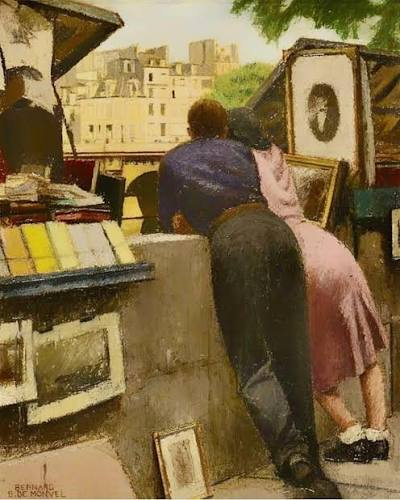
A couple drifting along the bookstalls beside the Seine, not looking for anything in particular.
That’s the part worth noticing. They aren’t shopping, they’re browsing, which is a different activity altogether, and one that’s quietly disappearing. Browsing requires that you don’t already know what you want. It requires slack.
Almost everything we do now begins with a search bar. We arrive at things having already decided. A wall of second-hand books, piles of things you didn’t ask for, in an order nobody designed, is one of the last places left where you can be surprised by accident.
What Monvel paints isn’t a purchase. It’s two people wandering at the same speed. Which turns out to be a fairly reliable test of whether you’re suited to someone.
6. An Amusing Chapter — Vittorio Reggianini
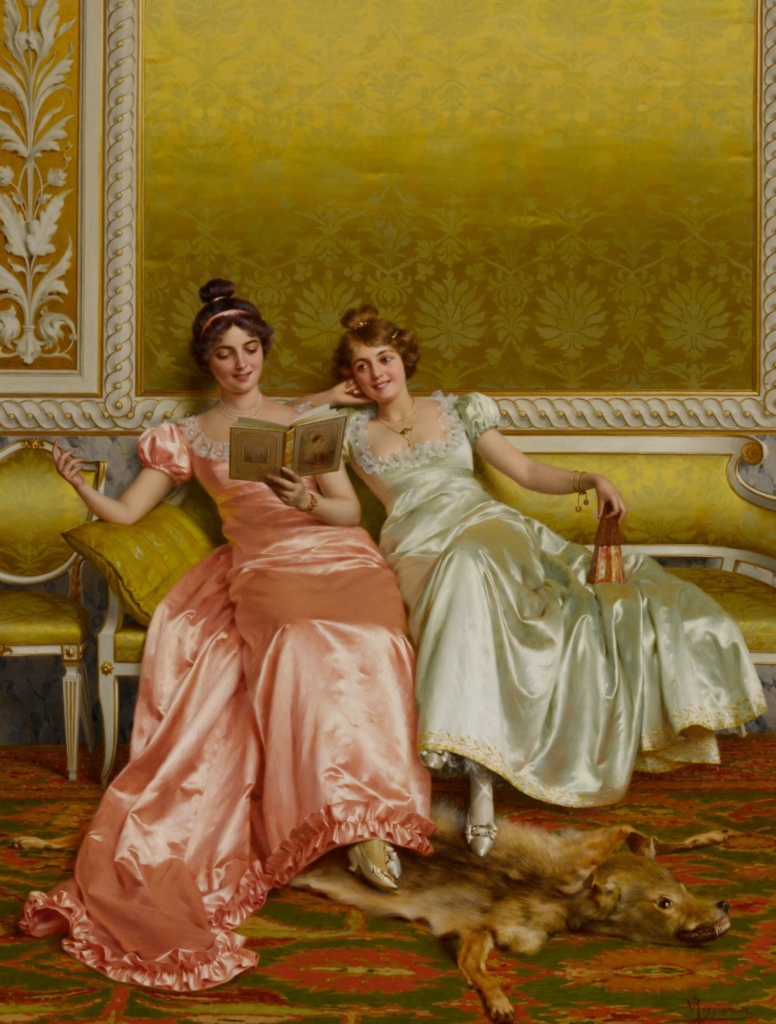
She’s reading aloud. Something on the page is funny.
Reggianini was famous for satin, he painted fabric so convincingly that people came to his work for the dresses alone. But the real subject here is two people looking at the same thing at the same time.
That used to be the default. Evenings were shared out of necessity: one book, one letter, one piano, one fire. Now we sit in the same room streaming different things into separate pairs of headphones. Not worse, necessarily. Just different, we’ve stopped having to agree on what the evening is.
What survives on this canvas is a shared joke. There’s almost nothing warmer than that, and almost nothing harder to arrange on purpose.
7. The New Bracelet — Henryk Siemiradzki
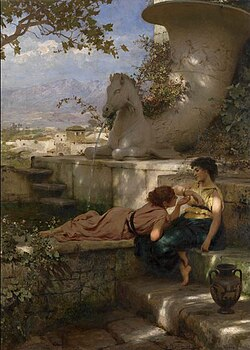
A young woman holds out her wrist. Her friend leans in.
The bracelet isn’t the subject. The leaning is.
Joy has an odd property: it’s unstable on its own. Something good happens and there’s an immediate, almost physical need to tell someone, and if there’s no one to tell, it goes slightly flat. It’s why we send the photo, share the news, ask what do you think? before leaving the house.
Siemiradzki painted that feeling exactly. Two women and one small object, and yet the bracelet is doing none of the emotional work. Everything that matters is happening in the space between them, in the way one woman shows something she loves and the other takes the time to look.
Having someone who is delighted by the things that delight you, for no reason other than that they love you, isn’t a small thing. It’s the kind of friendship that makes ordinary happiness feel bigger simply because it has somewhere to go.
Sometimes, that’s what we want from the people closest to us: not grand gestures, not perfect words, just someone who will lean in and say, let me see.
8. A Pair of Lovers — Vincent van Gogh
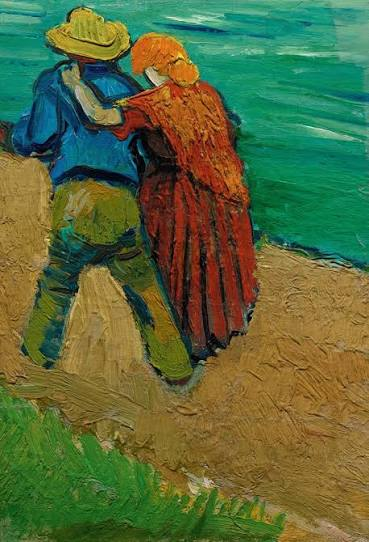
Two figures walking along a towpath. That’s all.
And yet, somehow, that’s enough.
In A Pair of Lovers, Vincent van Gogh captures a couple strolling beside the canal near Arles, their bodies leaning gently toward one another as they move through the landscape. What makes the painting even more poignant is that what we see today is only a fragment. Van Gogh had painted a much larger landscape, but dissatisfied with it, he destroyed most of the canvas soon afterward. He cut out the small section containing the two lovers and kept it. It is the only part of that original painting that survived.
There is something almost unbearably fitting about that.
Because perhaps this is how memories work too. We don’t keep entire days. We keep fragments. A walk home after dinner. Someone’s hand brushing against ours. The sound of a familiar voice beside us. A stretch of road we haven’t thought about in years, suddenly returning with startling clarity.
Every long relationship is made mostly of these unremarkable repetitions: walking somewhere together, sitting together, going home together, doing it all again the next day. None of it feels significant while it’s happening. It is simply life.
But maybe that’s where significance lives.
Van Gogh destroyed the larger picture, but he saved the two people walking through it. Of everything that canvas contained, this small act of togetherness was what remained.
And perhaps that’s what we remember too, not the whole landscape of a life, but the people who walked through it with us.
The days we don’t circle
Eight paintings, and not one important event between them. Children in water. Friends on the floor. A book in an orchard. A couple on a bench.
These artists weren’t aiming lower than the ones painting coronations. They were aiming at something harder, the thing that’s genuinely difficult to paint because it refuses to look like anything.
The frustrating part is that you can’t really use any of this in the moment. You can’t decide that a Tuesday is going to matter. It doesn’t work that way. The significance gets added afterwards, retroactively, once the day is long gone and well out of reach.
What you can do is notice more of them while they’re still happening. Not to preserve them. Just to be there for them the first time round.
And perhaps that’s part of why we return to faces, too. A face can hold a moment long after the moment itself has passed, a person we knew, a version of ourselves we barely recognize anymore, or someone whose expression we remember without remembering exactly why.
That idea sits at the heart of 101 Art Book: Faces Edition, the latest open call from Arts to Hearts Project. Artists are invited to explore the face beyond traditional portraiture: as identity, memory, disguise, recognition, absence, technology, symbolism, or even something imagined. Submissions are currently open for artists who want to bring their own interpretation of the theme to the page.
Which ordinary day would you go back to, if you could?