

Impressionism in Five Paintings
What happens when artists decide the world doesn’t need to look perfect to be worth painting?
In nineteenth-century Paris, a group of artists began looking at the world differently, painting sunlight as it shifted across water, people caught mid-afternoon, crowded dance floors, trains vanishing into steam, and quiet moments that would otherwise pass unnoticed. To the established art world, this new way of painting looked careless, unfinished, even absurd. In 1874, having stepped away from the official Salon, the artists exhibited their work independently. Among the paintings was Claude Monet’s Impression, Sunrise.
A critic meant his response as mockery. Instead, one word from the painting’s title gave the whole movement its name: Impressionism.
But what actually made these paintings so different? Maybe the best way to understand the movement isn’t through a definition, but through five paintings that capture its most radical idea, that a fleeting moment, an ordinary life, or a changing patch of light could be worth painting at all.
1. Impression, Sunrise — Claude Monet
The painting that gave Impressionism its name
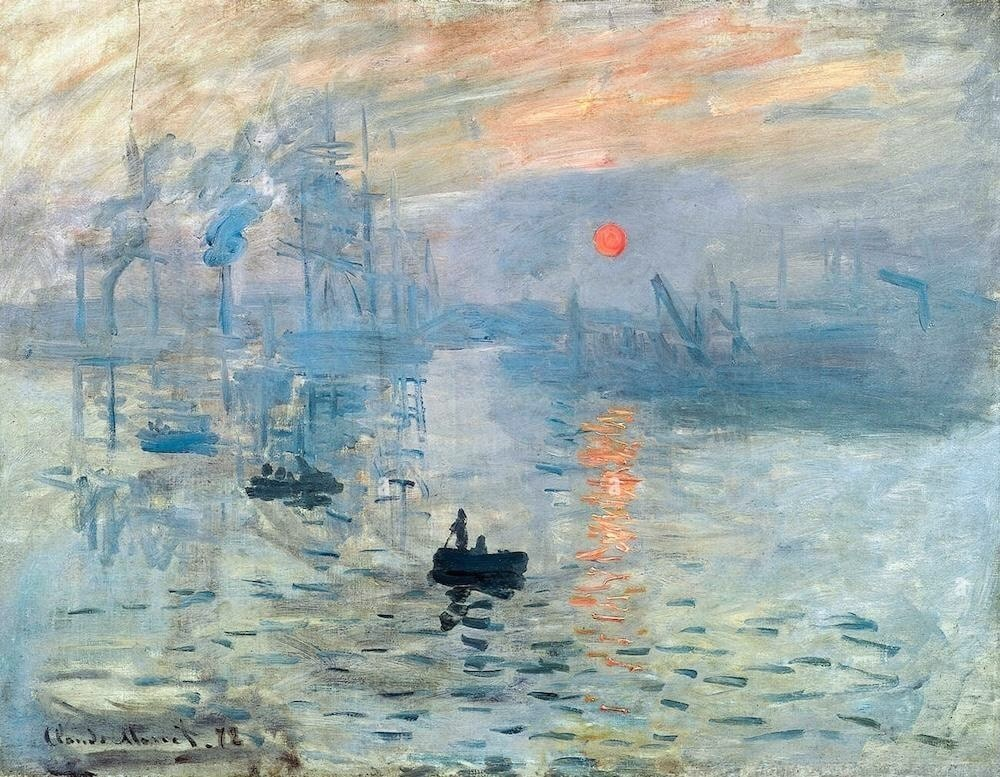
It’s hard to imagine a more unlikely painting to name a revolution. There’s no grand historical event in Monet’s Impression, Sunrise, no heroic figure, no carefully rendered architecture, no dramatic narrative. Just the harbour at Le Havre at dawn: boats emerging through mist, a pale sky, rippling water, and a small orange sun cutting through the haze.
Monet painted the scene in 1872, less interested in recording every detail of the harbour than in capturing its fleeting atmosphere, the forms loose, the brushwork visible, water and sky and smoke dissolving into one another. When the painting was shown in Paris in 1874, it was exactly that sense of immediacy that made it so striking.
The title turned out to matter even more than the painting itself. In a mocking review of the exhibition, critic Louis Leroy seized on Monet’s use of the word “impression” to dismiss what he saw as unfinished-looking work. The insult didn’t disappear, “Impressionists” became the name attached to the group instead, and by 1877 the artists themselves were using it. That’s the irony at the heart of the movement: what was meant as a jab about incompleteness became a genuinely new way of seeing.
Monet wasn’t trying to paint the harbour exactly as it was. He was trying to paint the moment he saw it.
Read more : The Strange Beauty of Cats in Art
2. The Luncheon — Claude Monet
When an ordinary afternoon became worthy of art
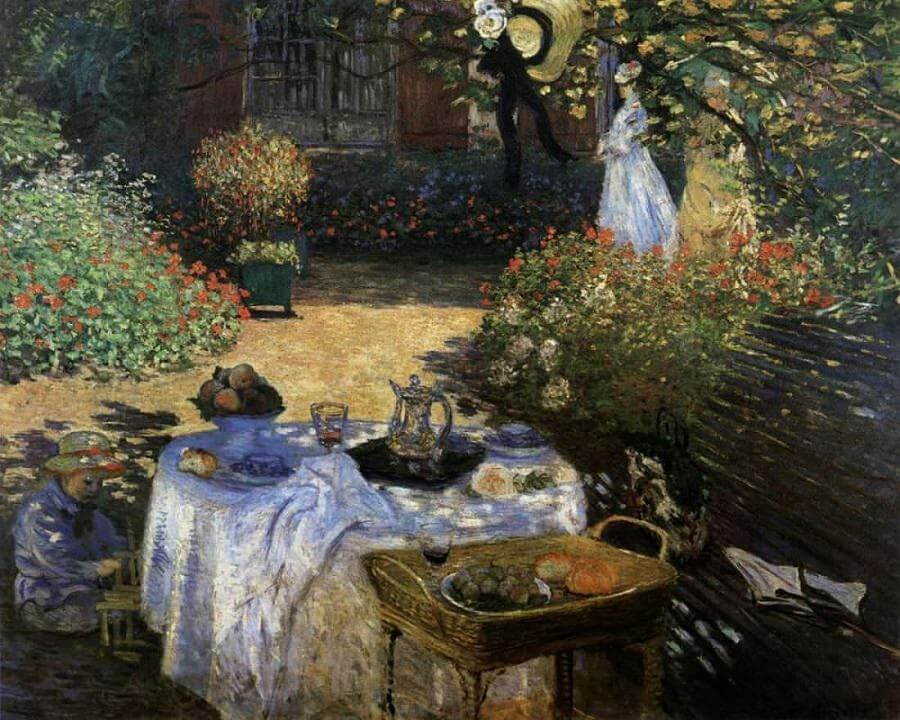
Nothing dramatic happens in this painting. There’s no grand subject announcing itself, no historical event, no mythological hero, no staged spectacle. Just the aftermath of a family meal: a table left uncleared, a parasol resting on a bench, a hat hanging from a tree, and Monet’s young son Jean playing quietly beneath the foliage.
Painted around 1873, The Luncheon turns these traces of an ordinary afternoon into its whole subject, and Monet exhibited it at the second Impressionist exhibition in 1876 as a “decorative panel.” What makes it feel so immediate is exactly what it leaves out, we don’t see the lunch itself, only the evidence that it just happened, caught in the small pause between one moment and the next.
That sense of spontaneity is deceptive, though. The cool shadow beneath the trees, the bright patches of light, the flowers and furniture and figures, all of it is carefully arranged across the canvas, building a scene that feels both intimate and fleeting at once.
This was one of Impressionism’s quieter rebellions: the artists weren’t only asking how a landscape could be painted differently, but what deserved to be painted in the first place. A family lunch could be enough. A garden could be enough. A moment that would ordinarily vanish without anyone noticing could be enough, and if the Impressionists could turn an ordinary afternoon into art, they could do the same with an entire city at play.
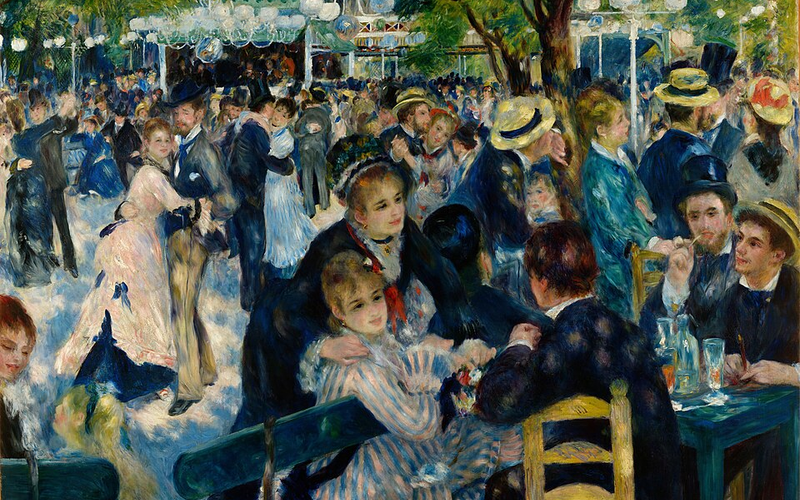
3. Bal du moulin de la Galette — Pierre-Auguste Renoir
When modern life became the spectacle
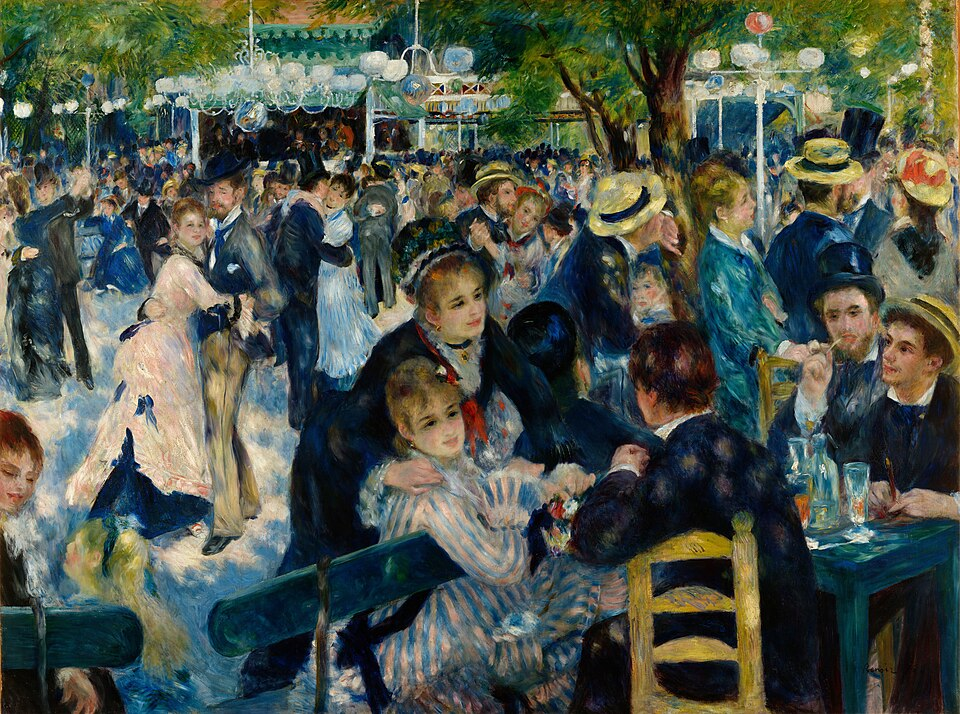
If The Luncheon finds beauty in a quiet afternoon, Renoir finds it in a crowd. On a Sunday in Montmartre, Parisians gathered at the Moulin de la Galette to eat, drink, dance, and flirt, and Renoir drops us right into the middle of it. There’s no obvious center to the scene, instead, the painting unfolds through clusters of people, dancers mid-motion, faces turned toward one another, sunlight filtering through the trees and breaking across clothes and hats in scattered patches of color.
It feels spontaneous, almost as if Renoir caught the crowd between one movement and the next, but the looseness is carefully built. He painted most of it on site in 1876, using a raised viewpoint to open up the dance floor and organize the crowd into overlapping groups, keeping his brushwork loose enough that color and light, rather than sharp outlines, hold the whole scene together.
What made this radical wasn’t just how Renoir painted it, but what he chose to paint at all: the Moulin de la Galette was an ordinary Parisian dance garden, full of ordinary contemporary people, and Renoir turned their Sunday leisure into the subject of a monumental painting, the kind of scene academic art had rarely taken this seriously. When it appeared at the 1877 Impressionist exhibition, critics noticed its unusual treatment of light and its blurred, vibrating forms, objecting to exactly the qualities that make the painting so recognizable today. Renoir was painting modern life as it was actually being lived, crowded, colorful, fleeting, and wonderfully alive.
4. La Gare Saint-Lazare — Claude Monet
When a railway station became a landscape
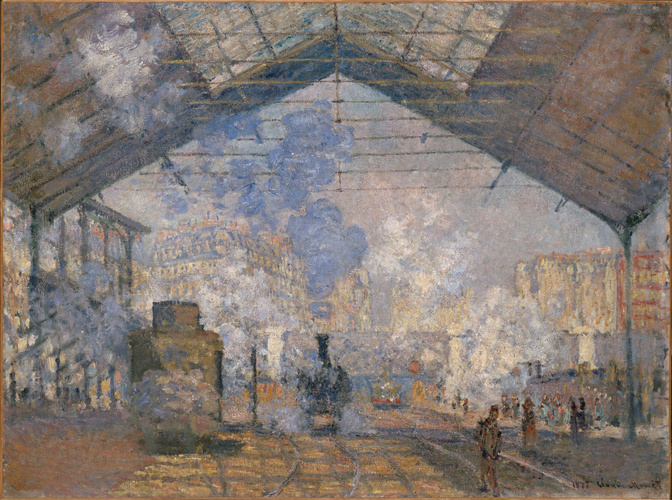
The Impressionists didn’t only paint what was beautiful. They painted what was new. In 1877, Monet turned his attention to the Gare Saint-Lazare, one of Paris’s great railway stations, asking permission to work there, drawn to exactly the things a traditional landscape painter might have avoided: steam, movement, iron, glass, and the constantly changing effects of light.
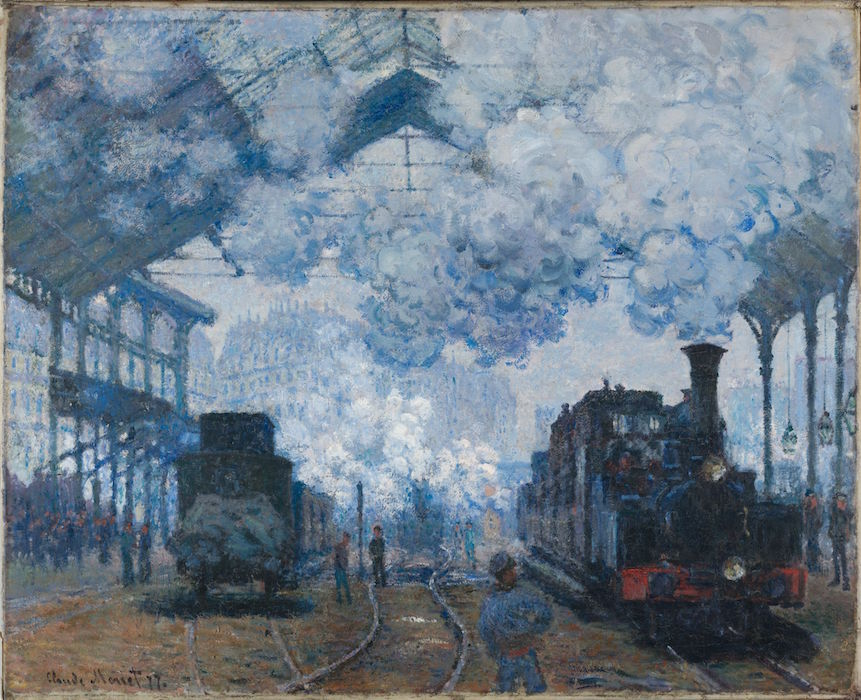
Monet made a series of paintings of the station from different viewpoints. In this one, the architecture gives the scene a strong geometric frame, but the eye moves past it quickly, steam billows across the platform, dissolving the trains and figures into patches of blue, grey, and white. The machines are there, but Monet isn’t interested in describing them piece by piece; what matters is what happens when light meets steam, metal, and movement.
That choice was radical in its own quiet way. The railway was one of the defining technologies of the century, yet Monet didn’t paint it as a monument to industrial progress, he treated it almost like a landscape, a place where the atmosphere was constantly shifting and no two moments looked quite the same. The result is strangely beautiful: a machine-filled space dissolving into color, which might be the most Impressionist thing about the whole painting. Monet found modernity, and then went looking for the light inside it.
5. The Cradle — Berthe Morisot
The quiet side of modern life
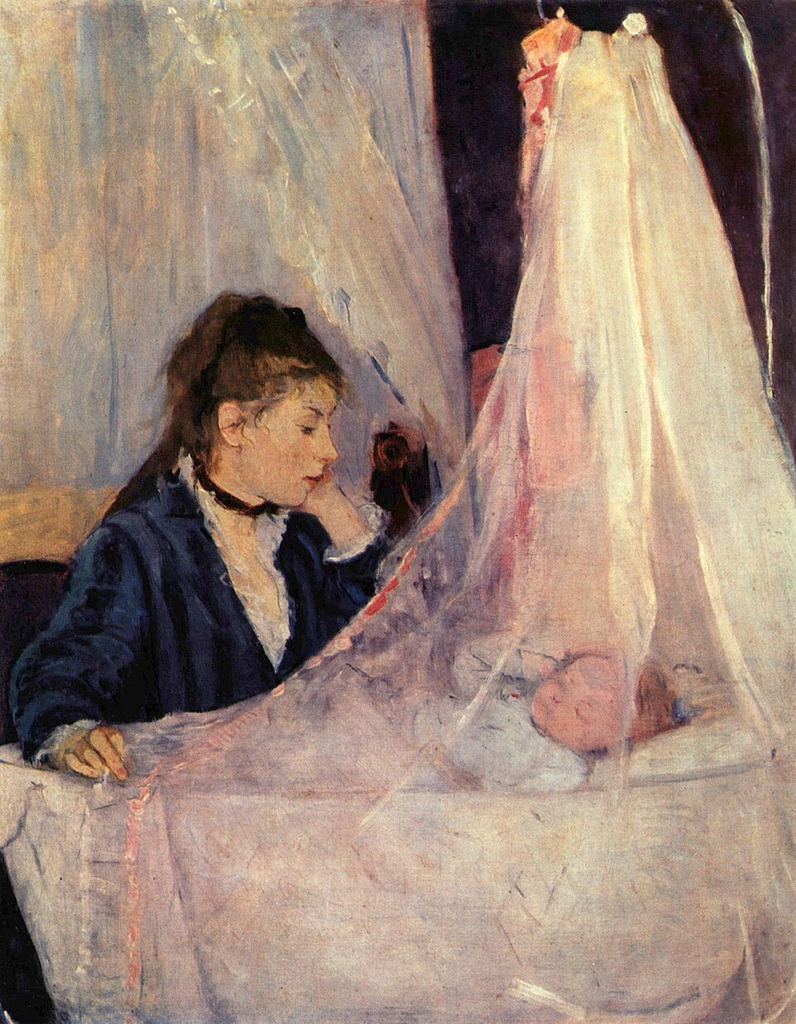
After the noise of the railway station, The Cradle feels almost impossibly quiet. Berthe Morisot painted her sister Edma watching over her sleeping daughter, Blanche, in 1872. A gauzy curtain separates the child from the viewer, while Edma’s gaze and the curve of her arm draw us into the small, private world between mother and baby.
It’s an intimate scene, but Morisot makes it visually restless rather than still, the curtain seems to move, the edges of the figures dissolve into quick, delicate brushstrokes, and instead of sharply defining every object, she lets color, fabric, and light blur into one another. That’s what makes the painting unmistakably Impressionist, even without a boulevard or a train in sight.
Morisot showed The Cradle at the first Impressionist exhibition in 1874, alongside Monet, Renoir, and Degas. It received little attention at the time, despite some critics praising its grace and elegance, and it expands what Impressionism meant by “modern life” in the first place. The movement is often remembered through boulevards, cafés, theatres, and railway stations, but Morisot looked elsewhere: at women, children, gardens, the intimate spaces of everyday life. Her paintings are a reminder that modernity wasn’t only noisy or spectacular. It could be quiet, domestic, and deeply personal.
In The Cradle, nothing is happening, and yet everything is happening in a glance. The Impressionists had learned to make a fleeting moment matter; Morisot asks us to stay with just one.
The Impression That Changed Everything
Look at these five paintings together and the revolution becomes easier to see. Monet captured a harbour at the exact instant light changed it. He found beauty in the remains of an ordinary lunch. Renoir turned a Sunday crowd into a subject worthy of serious painting. At the Gare Saint-Lazare, Monet found poetry in steam and machinery. And Morisot made a quiet moment between mother and child feel fleeting, intimate, and alive.
The Impressionists weren’t simply painting more loosely, they were changing what counted as worth painting, and how directly a painting could respond to the world in front of it. Light could shift, people could move, a meal could be left unfinished, a railway could become a landscape, and none of that disqualified a subject from being art.
What began as an insult, an “impression”, dismissed by a critic, became something far more lasting: a new way of seeing modern life. Maybe that’s why Impressionism still feels so immediate. It doesn’t ask us to remember a moment. It lets us catch one.
Explore the current open calls and submit your work: apply.artstoheartsproject.com