





The Story Behind The Great Wave off Kanagawa
The Making of an Image That Changed the Way We See the Sea
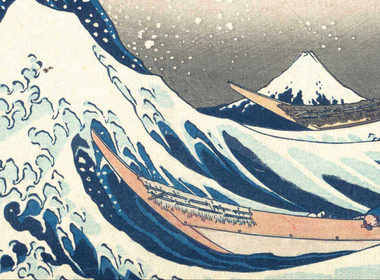
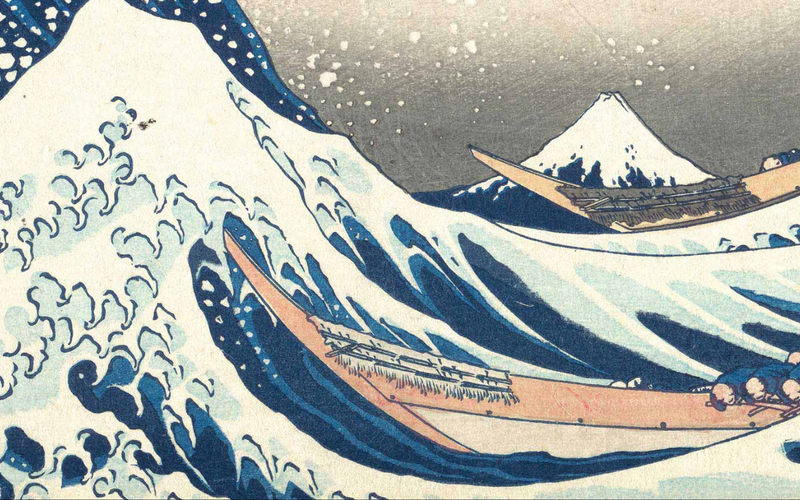
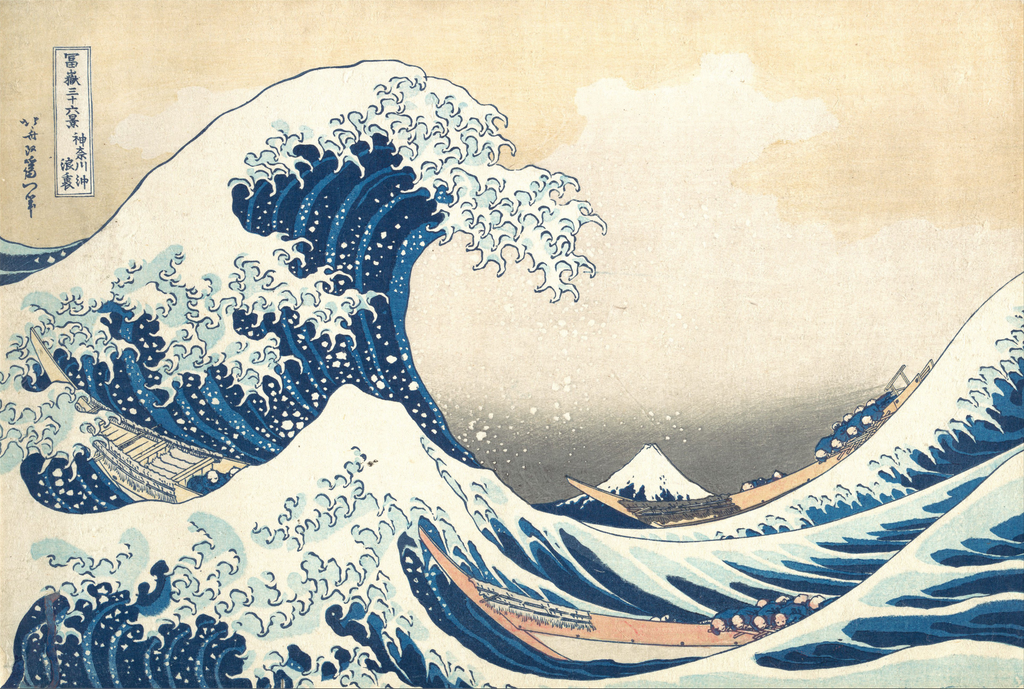
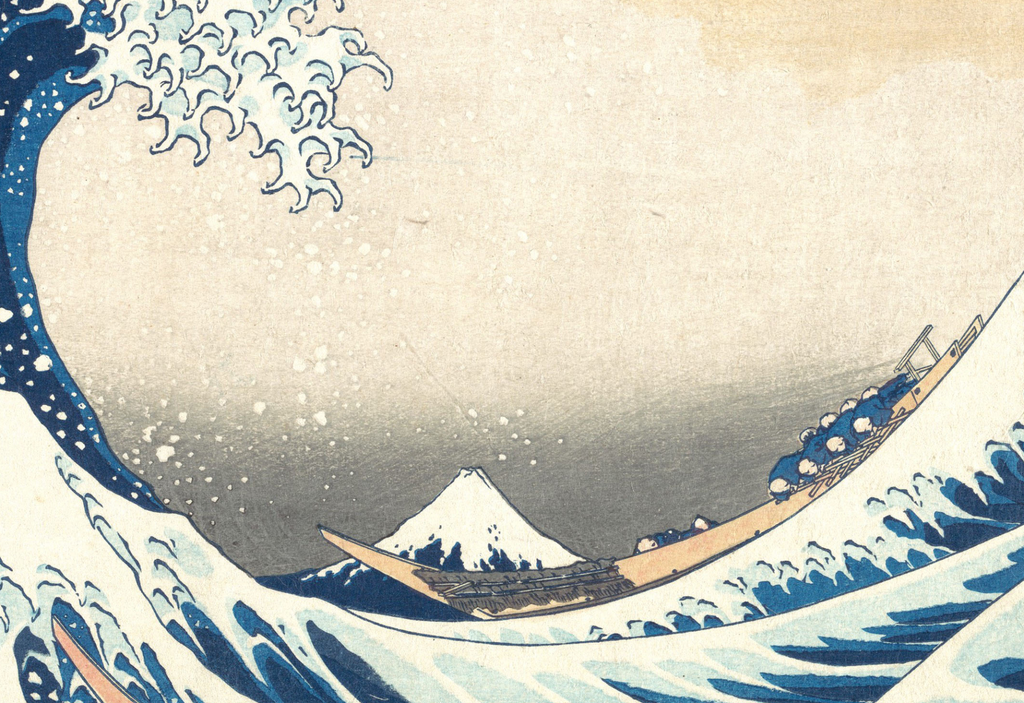
Few works of art have travelled as far, or changed meaning as much, as Katsushika Hokusai’s Under the Wave off Kanagawa, better known as The Great Wave. The image is now so familiar that it can be recognized almost instantly: a towering blue wave curls over three narrow boats, its white crest reaching forward like fingers, while Mount Fuji sits in the distance, remarkably calm beneath the approaching chaos. Made in Japan around 1831, the print has since become one of the most recognizable images in global visual culture.
Yet the object Hokusai created was very different from the way we understand it today. The Great Wave was not conceived as a unique painting for a palace, temple, or private collector. It was a colour woodblock print, designed to be reproduced and sold. It belonged to a commercial publishing culture in Edo-period Japan, where images could reach a broad audience at relatively affordable prices. The British Museum estimates that somewhere between 5,000 and 15,000 impressions of the print may have been produced during the Edo period.
That fact changes the story considerably. Before The Great Wave became an icon, it was a reproducible image, and its ability to be reproduced was central to its eventual fame.
A picture of Fuji that almost hides Fuji
The first thing to understand about The Great Wave is that, despite its popular name, the print is part of a series about Mount Fuji. Hokusai created Thirty-six Views of Mount Fuji around 1830–32, returning to the mountain repeatedly from different viewpoints and placing it within scenes of travel, labour, weather and everyday life. The series eventually expanded beyond its original thirty-six prints to forty-six designs.
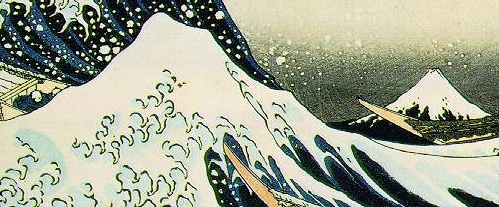
In Under the Wave off Kanagawa, however, Fuji is almost an afterthought at first glance. The wave occupies much of the composition, while the mountain appears as a small triangular form inside the hollow of its crest. The scale is deliberately disorienting: Japan’s highest and most culturally significant mountain appears tiny beside a temporary movement of water.
That reversal is one of Hokusai’s most effective compositional decisions. The curve of the wave and the boats directs the eye towards Fuji, while the white crest creates a strong diagonal that leads almost directly to the mountain’s summit. The result is a composition in which the eye is constantly moving between foreground and background, between the enormous wave and the distant mountain.
Hokusai was particularly interested in unusual viewpoints, abrupt changes of scale and the tension between natural and human-made forms. He had also encountered European imagery through the limited channels of foreign trade available in Japan and was interested in forms of linear perspective associated with Western art. Rather than simply copying those methods, however, he incorporated them into an increasingly distinctive visual language of his own.
The result is not a conventional seascape. The viewer is placed close to the boats, almost at the level of the water, while Fuji is pushed deep into the distance. The wave appears enormous partly because Hokusai has manipulated the relationship between near and far.
The colour that gave the wave its power
The composition is only half the reason the image is so memorable. The other half is blue.
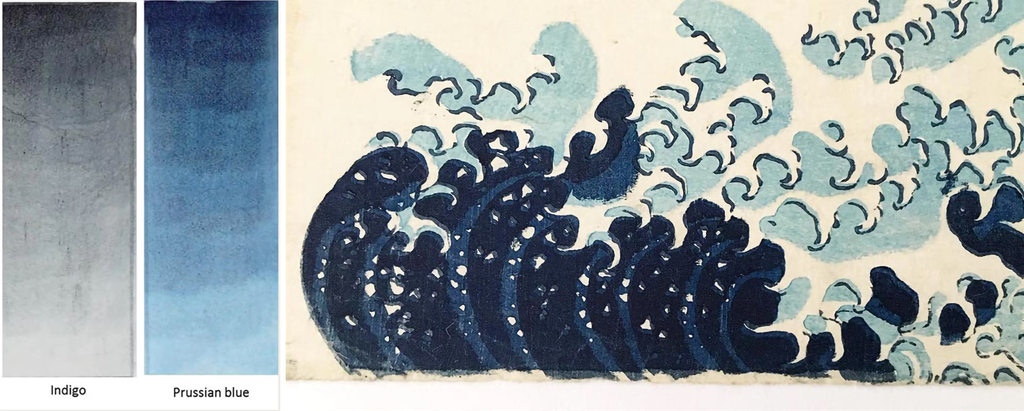
Prussian blue had become available to Japanese printmakers in the late 1820s and quickly attracted attention because it was a relatively stable synthetic pigment that resisted fading and offered a much stronger blue than many of the natural colourants previously used in Japanese prints. Hokusai’s Thirty-six Views of Mount Fuji was among the important early series to make extensive use of the pigment.
The timing was significant. When Hokusai and the publisher Nishimuraya Yohachi were developing the series, Prussian blue gave the landscape prints a visual intensity that was relatively new to the Japanese print market. The Met’s research into The Great Wave has shown that the printers did not simply substitute Prussian blue for indigo. Instead, they used different combinations and layers of the pigments to create the range of blues visible in the water.
In the darker sections of the wave, indigo and Prussian blue were combined to create a deep blue, while brighter areas were printed with Prussian blue. The result gives the wave a sense of density and movement that would be difficult to achieve with a single flat colour.
Scientific examination has revealed another detail that is easy to miss when looking at a reproduction. The repeated printing of certain areas physically pressed the paper into the woodblock. Three-dimensional scanning conducted at the Met showed that areas printed twice can sit at different heights from areas printed once or left unprinted. The visual depth of the wave is therefore accompanied by a subtle physical depth in the paper itself.
This is one reason the print rewards close looking. What appears to be a simple image of blue water is actually the result of a highly controlled sequence of decisions about pigment, pressure, layering and the carved surface of the blocks.
Hokusai was not the only person who made the picture
There is another misconception built into the way we talk about The Great Wave: we tend to think of it as something Hokusai made entirely by himself.
The artist was responsible for the design, but the production of a colour woodblock print depended on a much larger network of people. The publisher commissioned and organized the project; skilled woodcarvers translated the design into blocks; and printers applied the different colours and produced the final impressions. The surviving print therefore represents a collaborative process rather than the work of a single pair of hands.
The British Museum’s research into Hokusai’s later career has emphasized the importance of these networks of craftsmen, printers, publishers, pupils and other collaborators. The Met’s scientific examination of The Great Wave likewise demonstrates that the technical decisions made by the printers had a direct effect on the appearance and impact of the finished image.
That is particularly important when considering why the print looks the way it does. Hokusai created the composition, but the final visual effect depended upon how successfully that composition could be translated into wood, ink, paper and repeated impressions.
The anonymous makers behind the print were therefore not invisible extensions of the artist’s hand. They were part of the process that made the image possible.
Read More : The Story Behind Girl with a Pearl Earring
There was never just one Great Wave
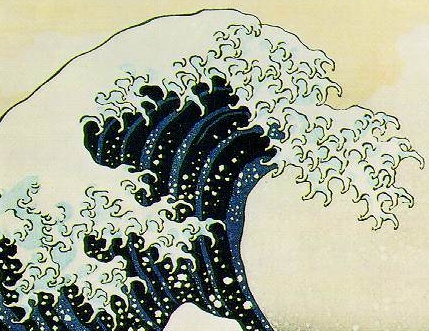
Because The Great Wave was a commercial woodblock print, multiple impressions were produced from the same set of blocks. That means there is no single surviving object that can be described as the one definitive version of the work.
In fact, researchers have been able to identify differences among surviving impressions and use those differences to reconstruct something of the print’s production history. The British Museum’s scientist Capucine Korenberg has located 111 surviving impressions, including three in the museum’s own collection. Small variations in details can reveal changes to the woodblocks as they were repeatedly used.
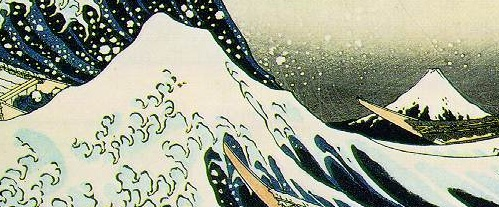
This is where the supposedly identical nature of mass-produced prints becomes interesting. They were intended to repeat the same image, but wood wears down, ink behaves differently and printing conditions change. Over time, the image itself evolves.
Some impressions are especially prized today because they retain details that became less distinct in later printings. The differences may be subtle, but they allow researchers to trace the physical history of an image that was designed, from the beginning, to exist in multiple copies.
The modern idea of an “original” masterpiece therefore does not quite fit The Great Wave. Its identity lies not in uniqueness but in repetition.
A seventy-two-year-old artist made it
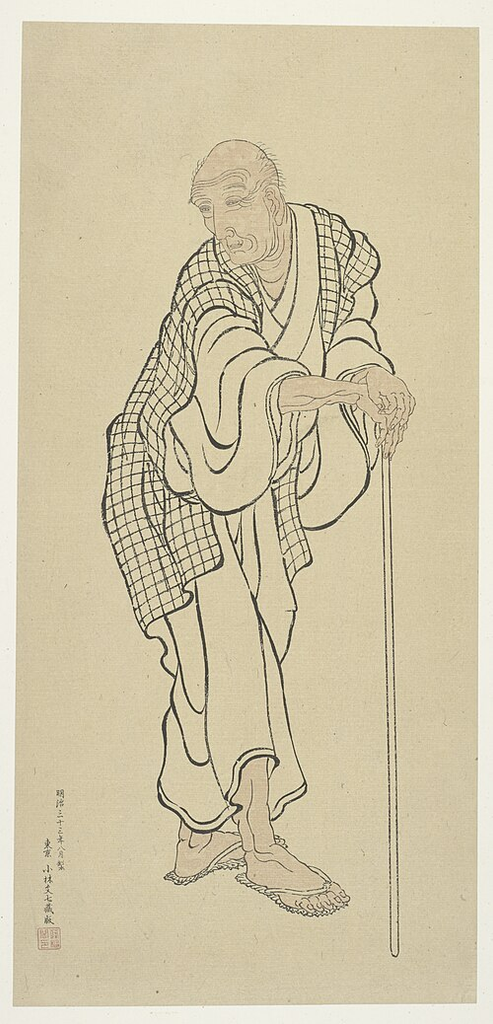
The age of Hokusai when he created The Great Wave is another detail that is easy to overlook. He was 72.
By then, he had already spent decades working as an artist and had moved through numerous styles, subjects and professional identities. His later career, however, was not a period of retreat. The British Museum describes the years around the creation of The Great Wave as the beginning of a particularly rich period in his artistic life, when he continued experimenting with ways of representing the world.
This matters because The Great Wave can sometimes be treated as if it were the definitive statement of a young artist discovering his style. It was almost the opposite. It came from an artist with decades of experience behind him, at a point when he was still testing what an image could do.
The wave’s apparent simplicity is therefore somewhat deceptive. Its economy—the few colours, strong outlines, carefully controlled perspective and dramatic cropping, is the product of an experienced artist reducing an image to exactly the elements he needed.
From Edo to Europe
For decades, The Great Wave existed primarily within the visual culture of Japan. Its transformation into a global icon came much later, as Japanese prints began circulating increasingly widely in Europe during the nineteenth century.
Japan’s opening to international trade in the 1850s created new opportunities for Japanese art to reach European markets. Collectors and artists became fascinated by ukiyo-e prints, and the resulting enthusiasm is now commonly described as Japonisme. Hokusai was one of the artists whose work became particularly influential.
European artists encountered a visual language that differed considerably from the conventions they had inherited. Hokusai’s prints offered unusual cropping, flattened areas of colour, dramatic diagonals, asymmetrical compositions and striking approaches to perspective. Artists such as Claude Monet collected Japanese prints, while the influence of Japanese art became part of the broader visual environment surrounding European modernism.
The Great Wave was particularly well suited to this new audience because its composition was immediately legible even without knowledge of its original cultural context. The drama of the wave, the vulnerability of the boats and the tiny presence of Fuji could be understood visually before the viewer knew anything about the series from which it came.
When Hokusai’s wave reached Debussy
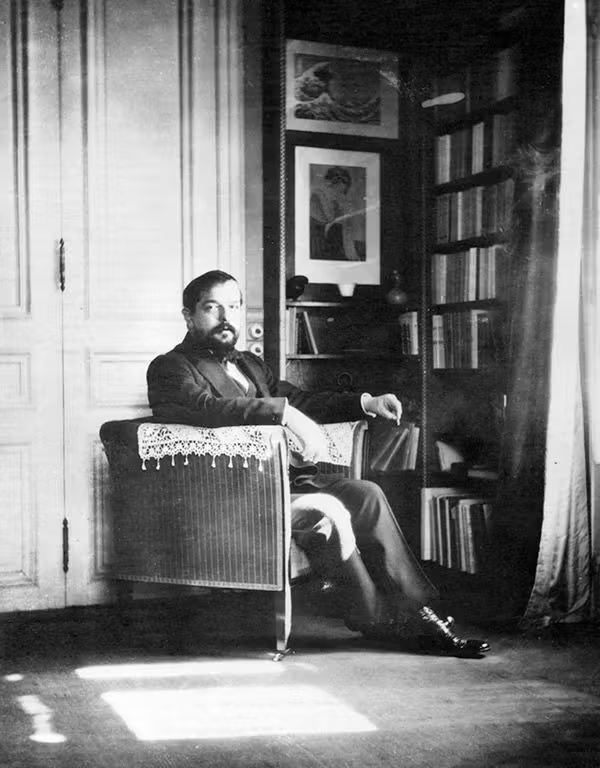
Claude Debussy in his Paris studio, with Hokusai’s “Great Wave” displayed on the rear wall. Photograph by Igor Stravinsky, 1910. Paul Sacher Foundation, Basel
The print’s European afterlife eventually moved beyond painting.
Claude Debussy owned a framed impression of The Great Wave and kept it in his Paris studio. When La Mer, his orchestral work about the sea, was published in 1905, the first edition featured a cropped detail of Hokusai’s wave on its cover. A photograph of Debussy’s studio from 1910 even shows the print hanging behind him.
It would be tempting to say that Hokusai’s image simply inspired La Mer, but the relationship is more interesting than that. Debussy was not trying to reproduce the sound of a particular wave. His approach to the sea was atmospheric rather than literally descriptive, and the Hokusai image became part of the visual world surrounding the composition.
By this point, the print had acquired a life far removed from its original purpose.
It had begun as an Edo-period commercial image of Mount Fuji. It had become a collector’s object in Europe, a reference point for artists, and eventually an emblem of modernity itself.
Why The Great Wave still feels so contemporary
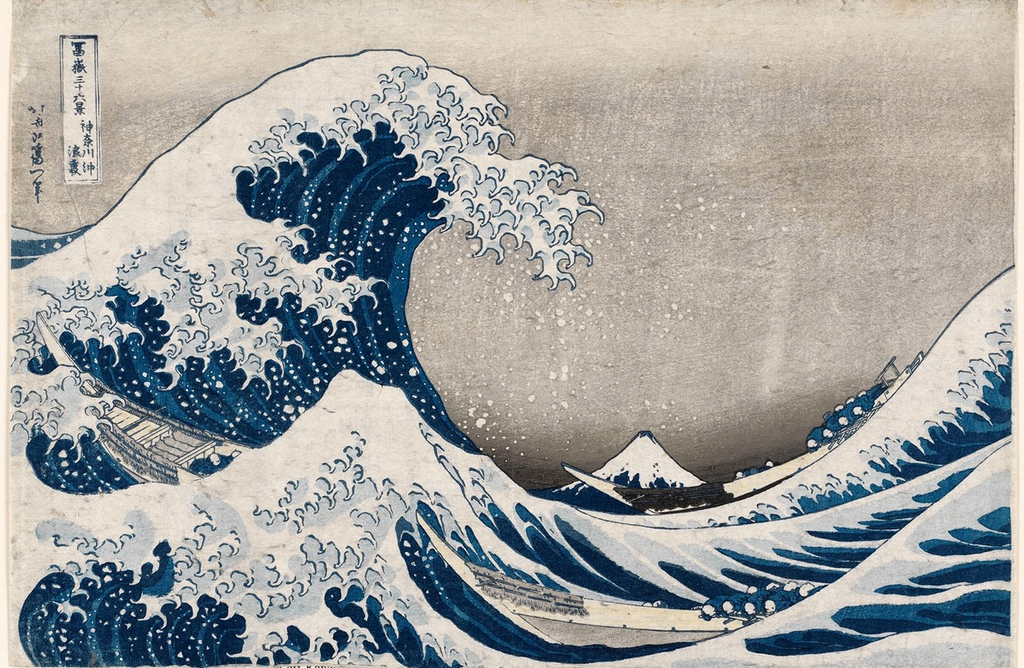
It is easy to impose a single meaning on the image. The fishermen can be read as symbols of human vulnerability; the wave can suggest the overwhelming force of nature; Fuji can be understood as a counterpoint of stability and permanence. These readings are part of the reason the work continues to invite interpretation, but there is no definitive statement from Hokusai that establishes one of them as the intended meaning.
What is less ambiguous is the extraordinary control with which the image has been constructed.
Hokusai gives the viewer almost no neutral space. The wave dominates the foreground, the boats cut through the lower section of the composition, and Fuji is placed precisely where the movement of the water allows it to be seen. The colours establish depth, the perspective alters our sense of scale, and the repeated curves of the wave, boats and mountain create visual relationships across the entire print.
Even its apparent simplicity is carefully engineered.
That may explain why the image has survived so successfully outside its original context. You do not need to know the history of ukiyo-e to understand the tension of the scene. You do not need to know why Fuji mattered to Hokusai’s audience to recognize the contrast between the mountain and the sea. And you do not need to know anything about Prussian blue to feel the force of the colour.
But knowing those things makes the image richer.
The famous wave was not produced by a single artistic gesture. It was the result of a sophisticated printmaking system, a new pigment, a publisher’s commercial decision, the skills of anonymous craftsmen, Hokusai’s unusually inventive composition and the cultural significance of Mount Fuji. Its later journey through European collecting, modern art and music added another layer to an image that was already designed to be repeated.
Perhaps that is the real story behind The Great Wave. Its fame did not begin when the world decided it was a masterpiece. It began much earlier, when Hokusai and the people around him found a way to make a small sheet of paper feel enormous.
Nearly two centuries later, the image still does exactly that.
Explore the current open calls and submit your work: apply.artstoheartsproject.com