

What’s the first thing Manuela Karin does in her studio to stay more productive?

👁 22 Views
At Arts to Hearts Project, we have always believed that if you really want to understand an artist, look at their studio. Not their exhibition. Not their Instagram. Their studio. Because that is where everything actually happens. The thinking, the doubting, the waiting, the mess, the mornings where nothing works and the afternoons where something finally does. A studio holds the truth about how an artist lives with their work.
That is why we created Studio Visit Book 7. To take you inside those spaces. To show you what a creative life actually looks like when no one is watching. The unfinished canvases leaning against walls. The coffee going cold. The silence that sits in the room before anything begins. We wanted artists who could open that door and let you in honestly.
Manuela Karin Knaut is one of our selected artists for this edition. And the moment we stepped into her world we understood why.
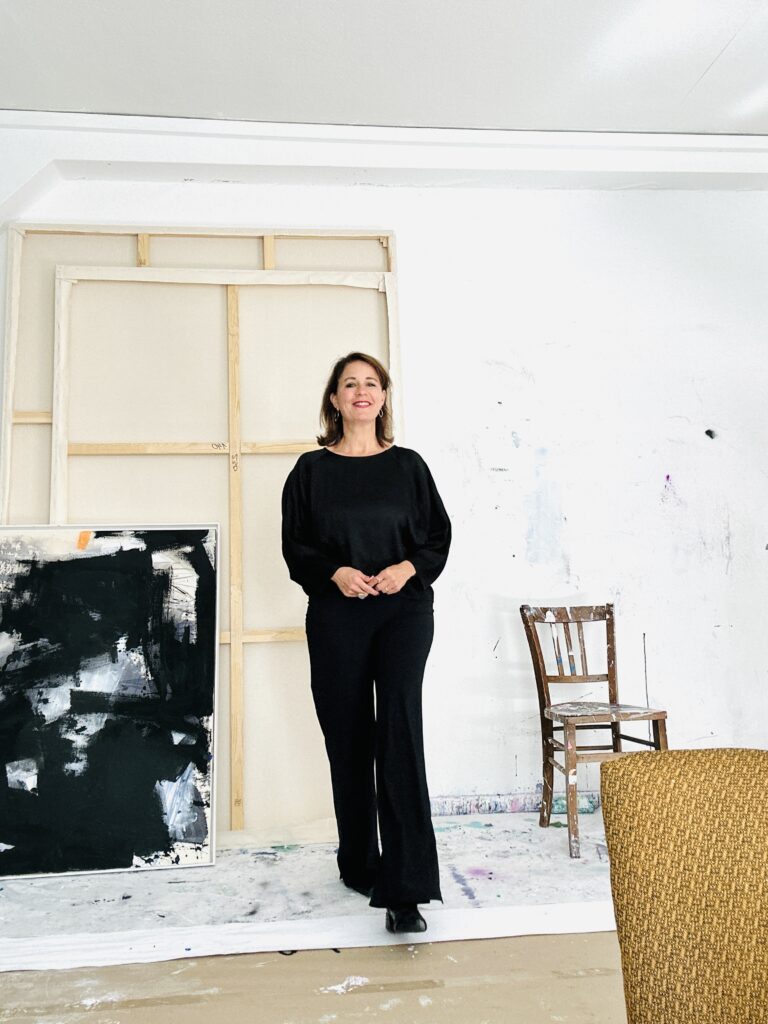
Manuela is based in Braunschweig, Germany. She was born in 1970 and for nearly two decades she taught art in schools and universities. She was an educator, a lecturer, a speaker, a museum educator. She built a whole life around art, just not her own.
And then she did something that not many people in their forties have the courage to do. She moved to Johannesburg, South Africa. She enrolled at the University of the Witwatersrand and completed her Master of Arts in Fine Art, specializing in installation. Not because she needed another degree. Because something in her practice was asking for more room.
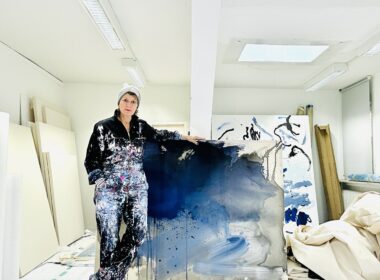
That move changed everything. Today her studio has eight rooms across two levels. One for painting, one for printing, one for ceramics, one for photography. Works travel between rooms constantly.
Canvases get carried upstairs, moved to a wall, laid on the floor, left to dry, returned to weeks later. What might look like disorder to someone walking in for the first time is actually how Manuela thinks. The work needs the movement. She needs the movement.

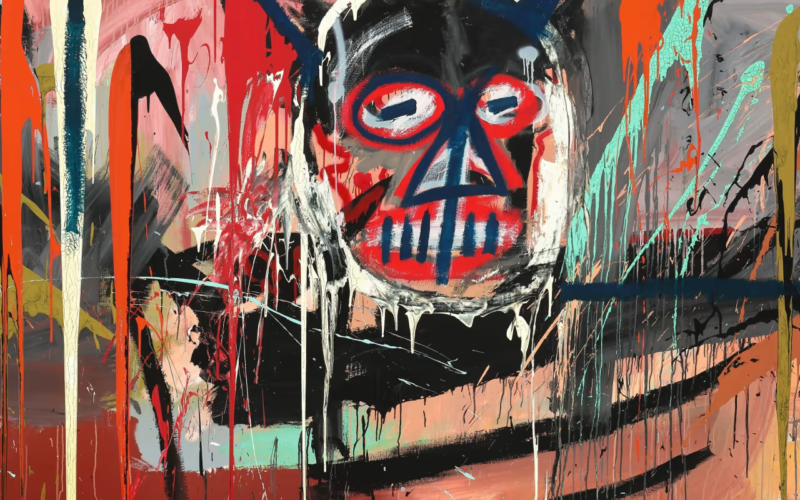
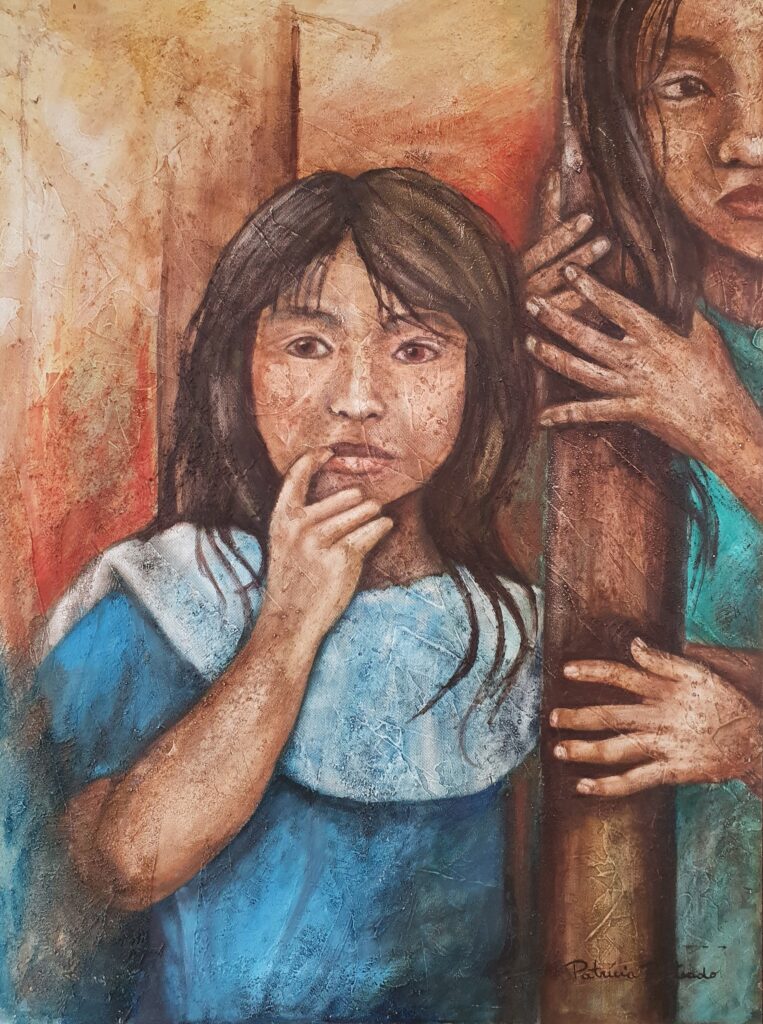
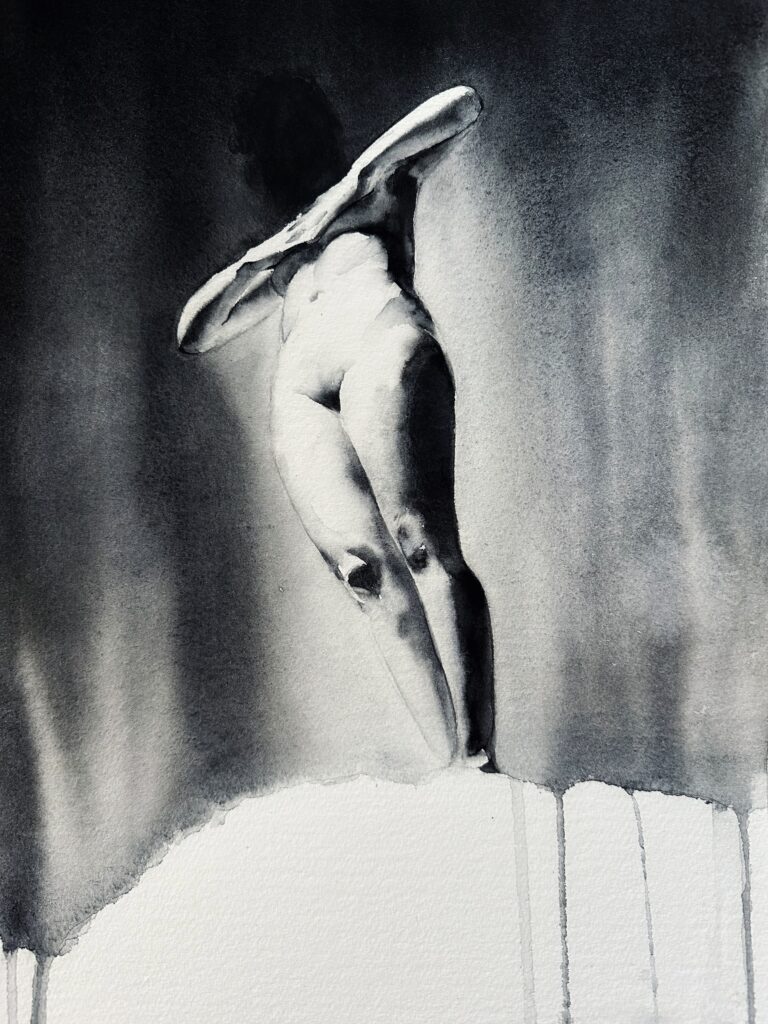
She paints in acrylics, oils, ink. She does silkscreen, graffiti, mixed media. Her work has been exhibited across five continents and sits in collections around the world. But what really drew us in is not where her work has been.
It is how it begins. Manuela does not start a painting with a plan. She starts it with a disruption. A mark made without intention. A break in the calm. She wants to question her own work before it has a chance to settle. She does not wait for certainty. She waits for friction. That tells you a lot about who she is.
Let’s hear from Manuela about what those eight rooms actually look like on a working day, why she breaks the calm on a canvas before a painting even begins, what it feels like to live surrounded by unfinished work, and how nearly twenty years of teaching led her to finally say okay, now it is my turn.
Q1. Before we talk about individual works, I’d love to begin with your studio itself. When you enter the space at the start of a working day, what does it ask of you silence, movement, attention, patience?
First of all, it asks me to arrive quite literally. I change clothes, prepare my workspace, turn on the lights, put on quiet music, check my plants, sometimes place lunch in the fridge, and make myself a coffee. These small, practical routines help me settle in. Only then does a different kind of attention emerge. Some days the studio asks for movement, other days for patience. It’s never neutral it sets the tone and reminds me that this is a place of process, not performance.
Q2. Can you describe how a painting usually begins for you in the studio, not conceptually, but physically? What is the first action that tells you a work has started?
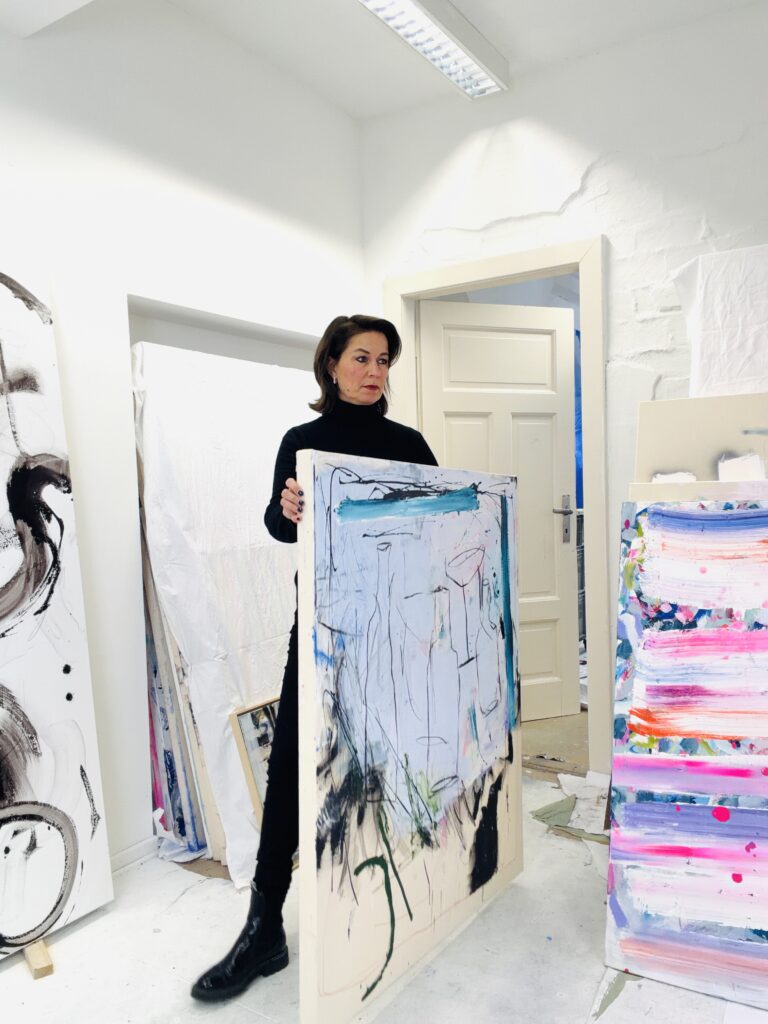
A painting begins with a physical interruption. That might be laying a surface on the floor, moving a canvas away from the wall, or touching material without intention. Often it’s a mark that feels almost incidental — a stain, a pressure, a line made without commitment.
What’s important to me is to interrupt harmony early on. I consciously try to break moments of too much agreement, too much calm, too much idyll. This self-generated disturbance is essential, because I want to question my own painting again and again. Beginning a work means opening it up to uncertainty — discovering something new, surprising myself, even irritating myself. That initial disruption creates tension, and from that point on, the painting can start to respond.
I don’t wait for certainty; I wait for friction.

Q3. On chilly mornings like you’ve shared online, what keeps you focused and grounded when the conditions aren’t ideal?
Generally, I’m very fortunate — my studio is usually warm, spacious, and filled with light. When I shared that post, however, the heating in the building had stopped working. It wasn’t symbolic; it was a real and uncomfortable situation, and I noticed clearly how much it affected my concentration. At the same time, there was no option to pause. I was preparing for an exhibition and was about to leave for Cambodia shortly after. The work had to continue. That experience made me aware of how external conditions can influence a process and also of how much resilience is sometimes required.
Interestingly, I was recently asked how dependent my work is on its surroundings. My answer may sound unusual, but the environment is relatively secondary for me. I carry everything I need for my work within myself: ideas, energy, imagination — and, in a way, even the light. That sense of independence feels very strengthening.
Q4. Your creative journey spans multiple continents and decades. Can you share a pivotal moment from your early years that shaped your commitment to art?
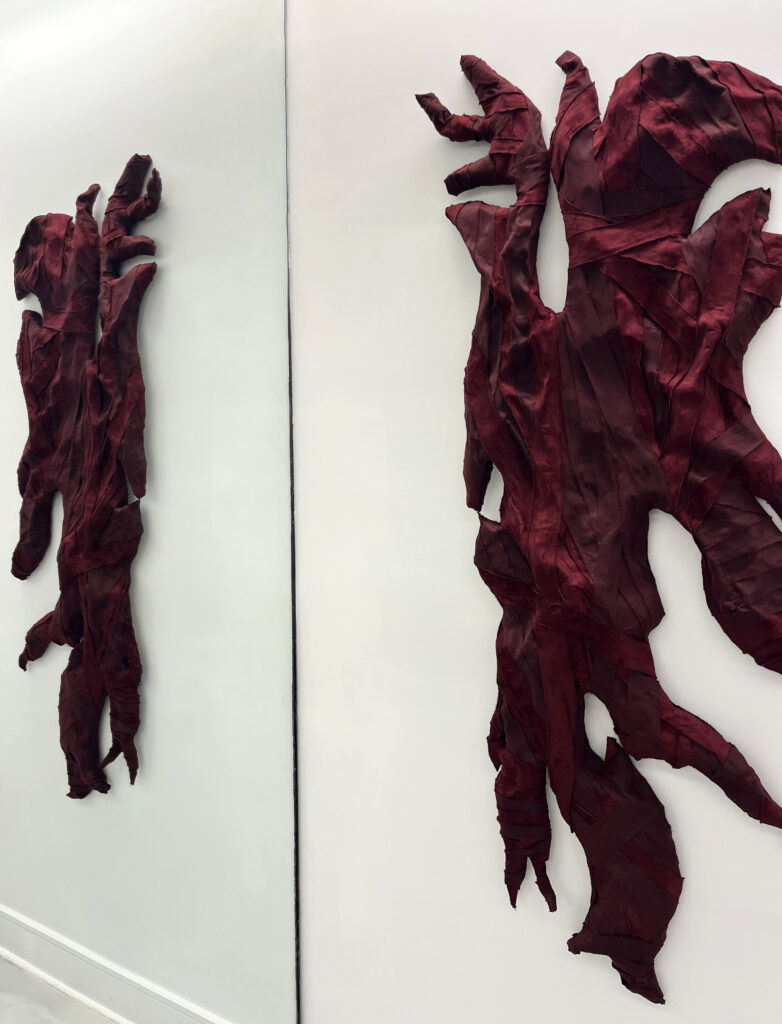
A defining moment in my artistic journey was the first time I realized a large-scale, spatial installation. At that point, I had no expectations regarding how it would be received. I was fully focused on the process itself, on testing something that felt necessary but still uncertain.
The response to that installation was unexpectedly strong. It created a resonance that confirmed something I had sensed intuitively for a long time: that installation was not a side path in my practice, but a core element. This experience led me to engage with installation more consciously and eventually to focus on it in my master’s studies.
Installation has always mattered to me, but it was through that moment that I truly understood how foundational it is to my work. It forms the basis of everything I do — the craft, the thinking, the spatial awareness. Even when I work in painting, installation remains the underlying structure, the ground on which all my decisions rest.

Q5. Many of your pieces express layering and the tracing of memory. Can you talk about how memory, pause, and reworking function in your creative process?
Memory enters my work less as narrative and more as residue. Layers accumulate through pauses — moments where I step back, leave a work unresolved, or return to it later with altered perception.
Reworking is not correction; it’s a conversation across time. Each layer acknowledges what came before while allowing something new to surface. Memory, in this sense, is unstable — and that instability is productive.
Q6. How do you decide which pieces to bring forward for exhibitions or shows like FREIRAUM?
FREIRAUM was particularly important to me. I didn’t enter the exhibition with existing works but developed a new series specifically for it. The framework shaped both the pace and the decisions in the studio.
I was interested in creating works that could hold openness — not as a concept, but as a condition. When selecting the final pieces, the question was not whether they felt complete, but whether they were ready: able to stand on their own while remaining porous. The exhibition became a moment of articulation within an ongoing process — not a conclusion, but a carefully placed pause.

Q7. You’ve shared glimpses of long, quiet studio days. What role does solitude play in your process?
I know that I need solitude in order to work with real concentration. There is a common misconception that artists’ studios are social places.
In reality, my studio life is very quiet and inward. I read, I write, I respond to interviews, and I spend long periods thinking.
At the same time, solitude is not without consequence. I miss exchange with others, and loneliness remains present. This is why teaching, workshops, and collective formats are essential to my practice. They are not secondary, but a necessary counterbalance. Moving between solitude and collaboration is not a contradiction for me — it’s the rhythm that sustains my work.
Q8. Your studio seems to hold many moments at once. How do you live alongside unfinished pieces?
I’m constantly torn between a desire for order and overview and the feeling that things are exactly right as they are. My studio consists of eight different spaces across two levels, each dedicated to a specific way of working painting, printing, ceramics, photography. Works are constantly being carried from one space to another. Through this movement, it becomes visible where a piece currently stands: drying, still in process, or finished and waiting to be signed and photographed. What may look like disorder is, for me, a form of working structure.
Q9. What advice would you offer to younger artists developing their own studio practices?
Take yourself and your work seriously. Do your homework. Be the person who knows the most about your own practice and the context you are working in. Take responsibility for your work. At the same time, allow the creative process to be what it actually is: slow, inconsistent, and often unclear. Not knowing is part of the work. Confusion and doubt don’t mean that nothing is happening — they often signal that something is shifting.
Try to get a little better every day. Read, research, educate yourself, and show up consistently. Stay attentive to both theory and practice, intuition and analysis. And be professional from the very beginning — think about documentation, taxes, marketing, and your collectors. It’s a lot to hold, but learning to see all these aspects as part of an artistic life will give you freedom later.

As our conversation with Manuela came to a close, we could not stop thinking about her studio. Eight rooms across two levels. Painting happening in one, printing in another, ceramics down the hall, photography somewhere else.
Canvases being moved from floor to floor, left to dry in one space, reworked in the next. To most people that would look like chaos. To Manuela it is just how the work moves. That is her rhythm. And something about that really stayed with us. Because so many artists put pressure on themselves to have a clean process. A clear direction. A studio that looks the part.
Manuela reminded us that it does not have to look like anything. The mess is not a sign that something is wrong. It is a sign that something is alive.
What also hit us is her timeline. She taught art for nearly twenty years before she fully gave herself to her own practice. Nearly twenty years of classrooms and lectures and departments and other people’s growth.
And then she moved to Johannesburg in her forties, went back to university, and said now it is my turn. She did not rush to get here. She arrived when she was ready. And everything she built in those teaching years, the knowledge, the discipline, the understanding of what art actually asks of you, all of that came with her. Nothing was wasted.
And then there is the way she starts a painting. No plan. No sketch. Just a deliberate disruption. A mark that cracks the surface open before it gets too settled. She said she does not wait for certainty, she waits for friction. That line keeps coming back to us. Because it is not just about painting. It is about how you approach anything that matters.
So if your path to art has been longer than you planned, that is fine. You are not behind. If your process is messy and unpredictable and does not fit into any system, that is fine too. And if you are sitting right now surrounded by things that are half finished and wondering whether that means you have lost your way, you have not. You are exactly where the work needs you to be. In the middle of it. Stay there.
Follow Manuela Karin Knaut through the links below and see what a creative life looks like when someone has spent decades building it honestly, restlessly, and entirely on their own terms.