
5 Films That Turned Real Artists Into Pop Culture Icons
Some artists become famous because of their paintings. Others become famous because of a photograph, a scandal, a strange story, or simply because their name seems to appear everywhere.
And then there are the artists who become characters in our pop culture. You may have never visited a Frida Kahlo exhibition, but you probably recognize her famous eyebrows. You may not know every detail of Jackson Pollock’s career, but you know the image of an artist throwing paint across a giant canvas. You may have encountered Jean-Michel Basquiat’s crown before you ever learned his name.
Film has played a fascinating role in this transformation. A good artist biopic does more than tell us what someone painted. It gives us a glimpse into their world: their personality, relationships, ambitions, frustrations, strange habits and the circumstances that shaped their work. Suddenly, an artist who once lived in another century, another city, or another generation feels like someone we could have known.
Of course, films are interpretations. They are not art-history textbooks, and filmmakers inevitably make choices about what to emphasize. But when they work, they can make people curious enough to look beyond the screen and discover the real artist.
Here are five films that helped turn remarkable artists into names far beyond the walls of museums.
1. Frida (2002) – Frida Kahlo
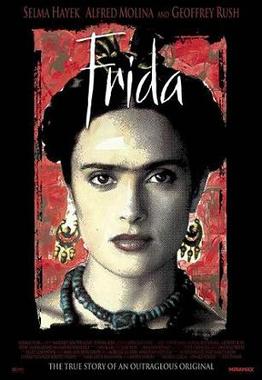
Few artists have become as recognisable in popular culture as Frida Kahlo.
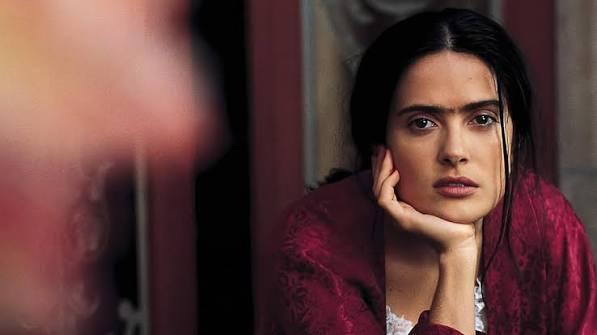
Her face is everywhere: on posters, clothing, stationery, murals and social media feeds. But Julie Taymor’s 2002 film Frida, starring Salma Hayek, gave audiences a much deeper look at the woman behind that instantly recognisable image.
The film follows Kahlo’s life, her relationship with fellow artist Diego Rivera, her political beliefs, her physical suffering and her development as an artist. It does not treat her life as a neat, inspirational story. Instead, it presents someone complicated, passionate, ambitious and often contradictory.
And visually, Frida is exactly the kind of film you would expect from the artist’s story. Taymor incorporates Kahlo’s paintings and visual language into the film, creating moments where the boundary between the artist’s real world and her paintings becomes wonderfully blurred. It is colourful, theatrical and unmistakably Frida.
The real Frida Kahlo was born in Mexico in 1907 and became known particularly for her self-portraits, which drew deeply from her physical experiences, identity, relationships and Mexican cultural heritage. Her work has since become one of the most recognisable bodies of modern art.
What makes the film especially interesting is that it introduced Kahlo to audiences who may have known nothing about her beyond her appearance.
After watching it, the flowers, the traditional clothing, the eyebrows and the self-portraits stop feeling like isolated symbols. They begin to belong to a person with an enormous and complicated life behind them. Frida received six Oscar nominations and won two, for Best Makeup and Original Score.
Why watch it: For the visual storytelling alone. And if you’ve ever wondered why Frida Kahlo has become such a powerful figure in contemporary pop culture, this is a fascinating place to start.
2. Basquiat (1996) – Jean-Michel Basquiat
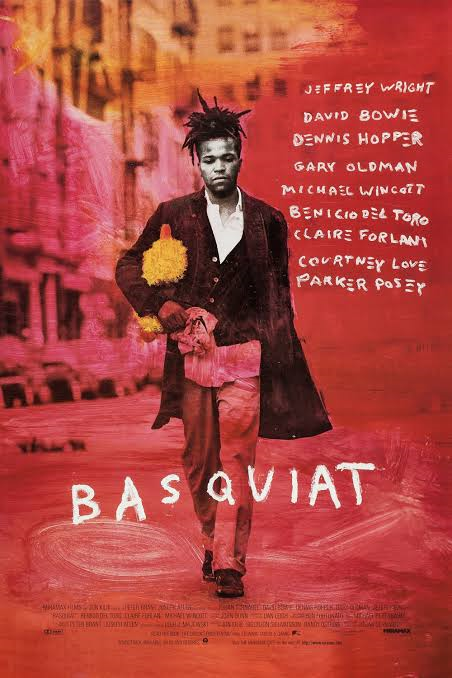
Before Jean-Michel Basquiat became one of the most recognisable names in contemporary art, he was a young artist moving through the streets of New York and making work that refused to behave like traditional gallery art.
The 1996 film Basquiat, directed by artist Julian Schnabel and starring Jeffrey Wright, takes us into the downtown New York art scene of the 1980s.
Rather than presenting a conventional, perfectly chronological biography, the film feels more like being dropped into Basquiat’s world. Galleries, clubs, artists, collectors, friendships and sudden fame all collide around him. And the cast is almost as fascinating as the story.
David Bowie plays Andy Warhol, while the film also features Dennis Hopper, Gary Oldman, Benicio del Toro and Christopher Walken. It is very much a film about an artist becoming a public figure while trying to figure out what that actually means.
Basquiat himself had an extraordinary rise. Born in Brooklyn in 1960, he began creating graffiti under the name SAMO before moving into painting and becoming an important figure in New York’s downtown art scene. MoMA describes him as a self-taught artist whose work encompassed painting and collage.
His paintings brought together words, symbols, anatomy, history, race, power and popular culture. They could look spontaneous at first glance, but there was an enormous amount of thought and tension underneath them.
His sudden rise also meant that he became famous incredibly young. That is part of what makes Basquiat so compelling. It is not simply a story about an artist becoming successful. It asks what happens when the art world suddenly becomes fascinated by a person who is still trying to understand his own place within it.
And perhaps the most interesting detail? The film was made by Julian Schnabel, himself a painter. That gives Basquiat a particularly personal connection to the world it is portraying.
Why watch it: If you want to see the strange, exciting and sometimes overwhelming relationship between artists, galleries, fame and the art world, put this one on.
3. Pollock (2000) – Jackson Pollock
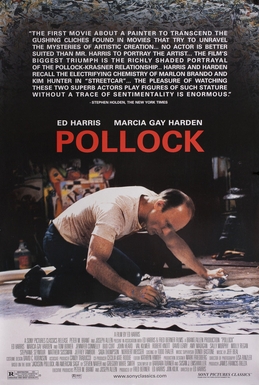
Ask someone to describe Jackson Pollock and there is a good chance they will immediately say: the guy who splattered paint.
There is, of course, much more to him than that. Ed Harris’s 2000 film Pollock explores the life and career of the American painter, with Harris himself directing and playing Pollock.
The film takes us through Pollock’s rise as an artist, his difficult personal life, his relationship with fellow painter Lee Krasner and the emergence of the radical painting method that eventually made him famous.
Pollock’s process alone makes for fascinating cinema. Instead of placing an easel in front of himself and carefully applying paint with a brush, Pollock famously laid large canvases on the floor and dripped, poured and flung paint across them. His approach became one of the defining developments of Abstract Expressionism.
And yet, the famous image of Pollock casually splashing paint around can be misleading. Photographer Hans Namuth’s photographs and films of Pollock working helped create the public image of the artist as almost performing a dance around the canvas. But closer examination of his process reveals considerable control and intention.
That tension is exactly what makes Pollock interesting: chaos and control, confidence and insecurity, celebrity and isolation. The film also gives space to the people around him, including Lee Krasner, who was not simply Pollock’s wife but an accomplished artist in her own right and an important figure in his story.
Pollock’s reputation eventually became enormous. MoMA notes that his breakthrough paintings of the late 1940s brought him international fame and helped establish a new kind of American artistic identity.
Why watch it: Watch it for the studio scenes, the personality behind the famous paintings and the reminder that an iconic artistic technique usually has a much more complicated story behind it.
4. Big Eyes (2014) – Margaret Keane
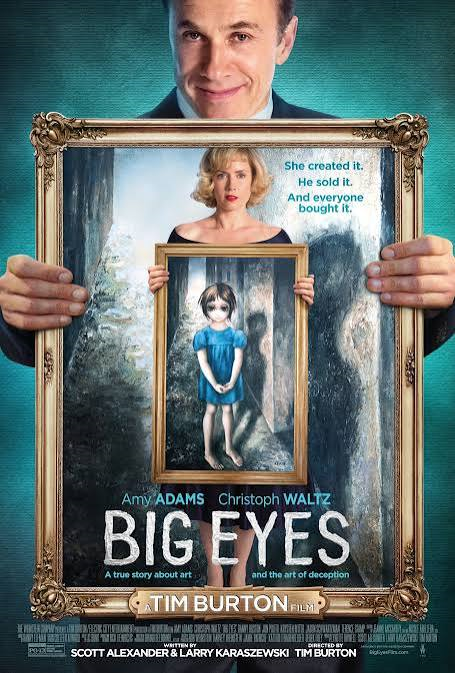
Now for one of the most unusual stories on this list. Tim Burton’s Big Eyes tells the story of Margaret Keane, the artist behind those instantly recognisable paintings of children and women with enormous, haunting eyes.
You have probably seen the style before. The huge eyes. The melancholy expressions. The almost cartoon-like faces.
But for years, many people did not know the woman who created them. The 2014 film, starring Amy Adams as Margaret Keane and Christoph Waltz as her husband Walter, follows Margaret’s journey as her distinctive paintings become commercially successful and increasingly famous. The film explores the complicated relationship between artistic ownership, fame and the person whose name gets attached to the work.
And because this is a Tim Burton film, it has a wonderfully strange visual atmosphere of its own. Margaret Keane’s story is particularly interesting from an art-business perspective because it raises a question artists still deal with today:
Who gets credit for the work?
Keane developed her distinctive style and became commercially successful, but her work was for a long time associated publicly with someone else. Her story eventually became widely known, and the film introduced a new generation to her work.
The real Keane created an incredibly popular artistic style during the 1960s, but she remained relatively unknown to the public for a significant part of her career. After the film’s release, renewed interest in her work followed.
That makes Big Eyes different from the other films on this list. It is not just about an artist becoming famous. It is about what happens when the world loves your art without necessarily knowing who made it.
Why watch it: For the story, obviously, but also for the uncomfortable questions it raises about authorship, recognition, commercial success and the business side of being an artist.
5. Mr. Turner (2014)– J.M.W. Turner
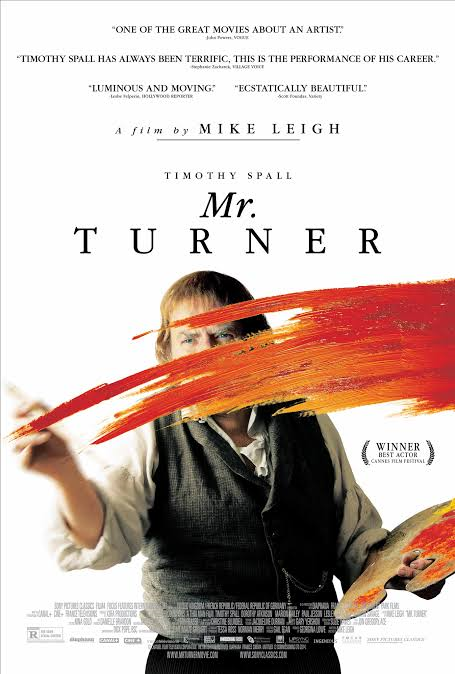
Not every artist film needs dramatic New York galleries or twentieth-century celebrity.
Sometimes, you can simply go back a couple of centuries. Mr. Turner, Mike Leigh’s 2014 film starring Timothy Spall, focuses on the later years of British painter J.M.W. Turner.
Turner is one of those artists whose paintings you may have seen countless times without knowing much about the man who made them. The film takes us through his later life, his relationships, his travels and his work, giving us a portrait of a man who could be difficult, eccentric, funny, affectionate and deeply committed to painting.
And the paintings are spectacular. Turner was one of the most important British landscape painters of the nineteenth century. His experiments with light, colour and atmosphere pushed landscape painting in increasingly radical directions, and he is often described as an important precursor to modern painting.
Mr. Turner is particularly enjoyable for anyone who loves the physical world of painting. You see landscapes being observed, discussed and translated into paint. You get a sense of the artistic life of the period rather than simply receiving a list of famous paintings and dates.
The film covers the later part of Turner’s life, beginning around his 1825 visit to the Netherlands and continuing until his death in 1851.
And Timothy Spall’s performance gives the film much of its personality. This is not a polished, romanticised version of a famous genius. Turner is allowed to be strange, difficult and thoroughly human. Which is probably exactly what makes the film so enjoyable.
Why watch it: For the landscapes, the atmosphere and the chance to see one of Britain’s most important painters presented as an actual person rather than simply a name on a museum wall.
Art Looks Different When You Know the Person Behind It
There is something lovely about discovering an artist through film.
You start with a painting you might have seen a hundred times. Then suddenly you know something about the person who made it. You understand where they lived, what they cared about, what frustrated them and what they were trying to say. And the work starts looking different. That is perhaps the best thing these films can do. They can make art history feel less distant and much more alive.
Of course, a film should never be the final word on an artist’s life. Biopics compress years into two hours, combine people, dramatise events and make creative choices. Once the credits roll, that is the perfect moment to do a little more exploring: look up the artist’s actual work, read about their life, visit a museum collection or simply spend some time looking at the paintings without the film telling you what to think.
So make yourself a little art-film watchlist. Put on Frida when you want something visually rich and emotionally charged. Try Basquiat for the energy of 1980s New York. Watch Pollock when you want to understand the man behind the splatters. Put on Big Eyes for a fascinating story about art, recognition and ownership. And settle into Mr. Turner when you want to spend a few hours with one of history’s great landscape painters.
You might finish the evening with a favourite artist you already knew. Or, better yet, you might discover a new one.