


Big Eyes (2014) | The Woman Behind the Paintings: Margaret Keane’s Story
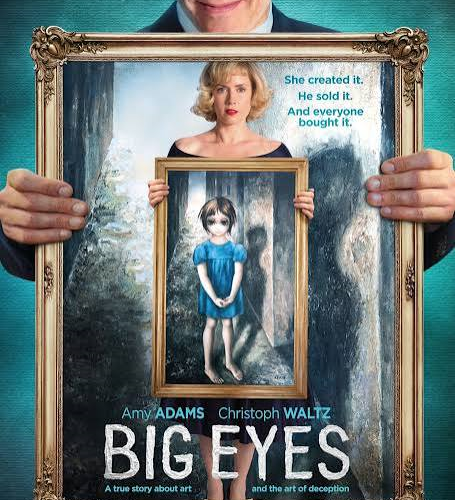
A little face. A pair of impossibly enormous eyes. A sadness that somehow feels sweet rather than tragic. Maybe you have seen such a painting on a poster, a postcard, a mug, a print, or tucked away in somebody’s home. They look innocent. A little strange. Almost too cute.
And then you learn the story behind them. The paintings belonged to Margaret Keane. For years, the world believed they belonged to her husband, Walter.
That strange, infuriating story became Big Eyes, Tim Burton’s 2014 film starring Amy Adams as Margaret and Christoph Waltz as Walter. It is a film about an art fraud, yes, but underneath that is something much more interesting: who gets to be called an artist?
And what happens when the person making the art is not the person standing beside it taking the applause?
Meet Margaret Keane
Margaret Keane was already an artist before Walter Keane entered her life.
Born Peggy Doris Hawkins in Nashville in 1927, she developed an interest in drawing from childhood and eventually became known for portraits of children, women and animals with extraordinarily large, expressive eyes. She moved to California in the 1950s, where her distinctive style began attracting attention.
Those eyes were not simply a gimmick. They became her visual language.
Her figures often appear vulnerable, lonely, curious or quietly heartbroken. The eyes dominate the compositions, pulling the viewer straight toward the emotional centre of the face. They are exaggerated to an almost surreal degree, but the emotion underneath them is remarkably direct.
And people loved them. That is where the story gets complicated. The art world did not necessarily love them.
Kitsch. Popular. Successful. So… Is It Good?
One of the most entertaining things Big Eyes does is refuse to give us an easy answer about whether Margaret’s paintings are “good.”
During the 1960s, her work became enormously popular. The big-eyed children appeared on inexpensive reproductions and merchandise, reaching audiences far beyond traditional galleries. Her paintings were exhibited at major events and acquired by celebrities including Kim Novak, Natalie Wood, Liberace and Jerry Lewis.
But critics often dismissed them. The word that kept hovering around Keane’s work was kitsch. And that makes Big Eyes unexpectedly relevant to anyone who has ever wondered why one kind of art gets placed on a pedestal while another gets laughed out of the room.
Roger Ebert’s review points directly at this tension, noting that Keane’s work was hugely popular while provoking “critical revulsion” from parts of the art world. He also brings up Andy Warhol’s defence of the paintings, arguing that if so many people liked them, perhaps popularity itself was telling us something worth considering.
That question sits quietly underneath the entire film:
Who decides what deserves to be called art?
The critic? The collector? The museum? The market? Or the person standing in front of the painting, feeling something?
Enter Walter Keane
Walter Keane is charming when he first appears. And that is precisely the problem.
Christoph Waltz plays him as a man who knows how to sell a story before he has even sold a painting. Margaret signs her work simply “Keane,” and Walter realizes that this ambiguity can be useful.
Very useful. He begins presenting the paintings as his own. Margaret, horrified at first, eventually goes along with the lie. And the lie grows. The paintings sell. Then they sell more. Then they are everywhere. The Keane name became a brand.
Walter becomes the public face of an artistic phenomenon that he did not create. Meanwhile, Margaret goes home and keeps painting. That contrast is the heart of the film: one person gets the fame while another person does the work.
The Artist Disappears
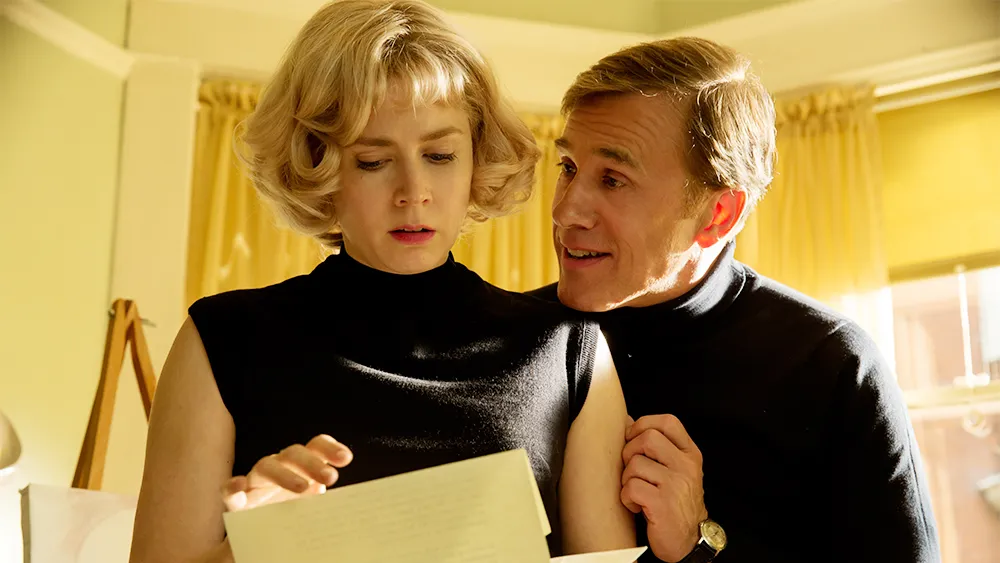
This is where Margaret’s character arc becomes so painful, and ultimately so satisfying.
At the beginning, she is not portrayed as someone who lacks talent or ambition. She wants to paint. She wants her work to reach people. What she lacks is the confidence to insist that the world recognize her authorship.
The film gradually turns that hesitation into its central emotional conflict. Margaret keeps making the paintings because painting is what she knows how to do. Walter keeps selling the paintings because selling is what he knows how to do.
But somewhere along the way, Margaret’s name disappears. And that is perhaps the most devastating part of the story. An artist can survive rejection. An artist can survive criticism. An artist can even survive someone saying, “I don’t like this.”
But what happens when someone says: You didn’t make this.
Look at the Eyes Again
Knowing the story changes the paintings. That is one of the most powerful things about Big Eyes. Before the film, those giant eyes might simply look cute, peculiar or kitschy. After Margaret’s story, they begin to feel almost autobiographical.
Look at those faces. They are constantly watching. They are waiting. They look frightened, hopeful, lonely and alert all at once.
Margaret herself spends much of the film watching rather than speaking. Amy Adams plays her with a softness that can sometimes be mistaken for weakness. But the longer the story continues, the clearer it becomes that Margaret is observing everything.
She notices the lie. She notices what Walter is doing. She notices how people respond to the paintings. And eventually, she notices herself disappearing inside the life they have built. The eyes suddenly feel less like a trademark and more like a metaphor.
Margaret paints people who are looking for a way to be seen. So is she.
Tim Burton: Probably the Perfect Person to Tell This Story
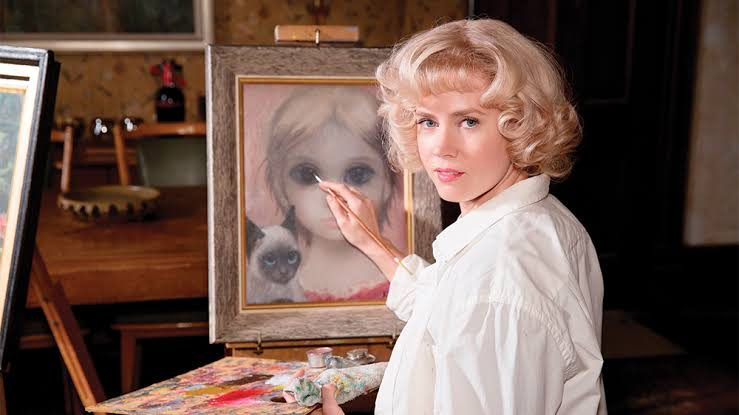
At first, Big Eyes seems like an unusual Tim Burton film. Where are the gothic castles? The monsters? The elaborate fantasy worlds?
Instead, Burton gives us suburban California, 1950s and ’60s interiors, pastel colours, advertisements, art galleries and an increasingly absurd marriage. But the match is actually rather perfect.
Burton has always been fascinated by outsiders, misfits and people whose work is dismissed because it does not fit neatly into respectable categories. Margaret Keane’s story gives him another version of that familiar Burton subject: the artist whose strange little world is not taken seriously until everyone else realizes how much they want it.
The film’s production design pushes this idea further. Its candy-coloured world initially feels cheerful and commercial, much like Keane’s paintings. As Margaret’s situation becomes darker, that artificial brightness begins to feel almost claustrophobic.
The visual style is not merely decoration. It mirrors the trap. Everything looks lovely. Everything is terribly wrong.
And Then Comes the Paint-Off
The story eventually reaches its wonderfully bizarre climax in court. Margaret publicly claims that she painted the works. Walter denies it. The judge gives them an almost unbelievable challenge: paint a big-eyed child in court.
Margaret does. Walter does not.
According to accounts of the real case, Margaret completed her painting in around 53 minutes. Walter claimed that a shoulder problem prevented him from painting. The court ultimately ruled in Margaret’s favour. It is almost too perfect as a cinematic ending.
For years, the argument had been about signatures, sales, reputation and credibility.
Suddenly, there was only a blank surface. Paint. A brush. And the artist. No marketing campaign could help Walter now. No gallery could speak for him. No story could be sold. He simply had to paint. And Margaret could.
What Big Eyes Gets Right About Artists
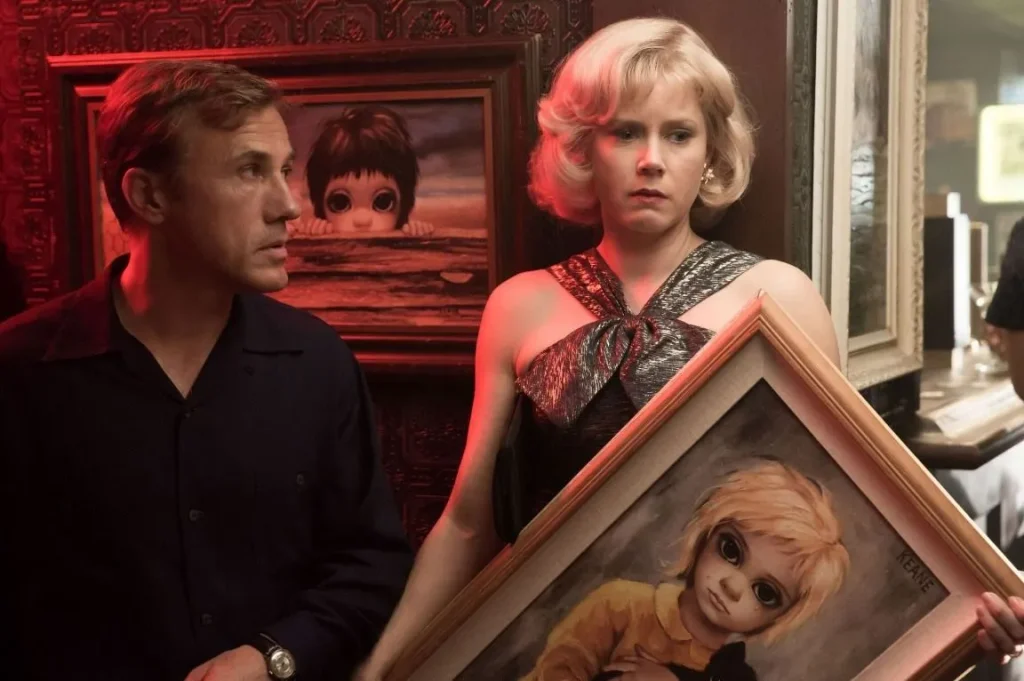
For artists, this is where the film becomes more than an entertaining true story. It understands something uncomfortable about creative work: making something and getting credit for making it are two completely different things.
Margaret’s story is obviously extreme, but the underlying problem is familiar. Artists negotiate with galleries, collectors, partners, publishers, curators and audiences. Sometimes the work becomes more visible than the person who made it. Sometimes someone else becomes better at selling the artist’s story than the artist is.
And sometimes artists themselves begin to believe that being good at making art should be enough. It isn’t always. Big Eyes does not suggest that every artist needs to become a ruthless salesperson. Margaret’s transformation is subtler than that.
She simply learns to say: This is mine. That is a complete and powerful sentence.
The Film’s Own Success Story
Big Eyes received generally favourable reviews, with particular praise for Amy Adams’ performance. Rotten Tomatoes currently lists the film at 72% from critics, with its consensus describing it as well-acted and thought-provoking.
Amy Adams’ performance earned her the 2015 Golden Globe for Best Actress in a Motion Picture – Musical or Comedy. The film received three Golden Globe nominations in total, including nominations for Christoph Waltz and the song “Big Eyes.”
The film also received two BAFTA nominations: Adams for Leading Actress and the production design team for Production Design.
Critics were not universally convinced by the film. Some found Waltz’s performance too exaggerated and thought Burton’s colourful treatment sometimes made the story feel lighter than its darker subject deserved. Others appreciated exactly that heightened quality. The Guardian, for instance, called it an insightful study of character and the nature of art, while Roger Ebert’s review praised the fascinating questions it raises about popularity and artistic value.
That split is fitting. A film about an artist whose work divided opinion was never going to inspire unanimous agreement.
If you liked our take on art in films, read our feature on The Thomas Crown Affair (1999) and explore what stealing art meant to Thomas Crown.
Why Margaret Keane Still Matters
Margaret Keane died in 2022 at the age of 94, after painting for more than six decades. Her work outlived the scandal that first made her famous, or infamous, and continued to exist on its own terms. That may be the most satisfying part of the story. The lie was temporary. The paintings were not.
Whether you personally consider them kitsch, pop culture, commercial illustration or something closer to fine art is almost beside the point. Margaret created an unmistakable visual language. Millions of people recognized those eyes. Her paintings entered popular culture precisely because people connected with them.
And perhaps that is why Big Eyes stays with you. It is not really a film about a woman trying to prove that she is a great artist. It is about a woman trying to prove that the work belongs to the person who made it.
For anyone who creates, that validation matters. Because sometimes the hardest part of being an artist isn’t making the thing. It is standing beside it and saying, quietly but firmly: I made this.
And after spending years painting enormous eyes for a world that refused to see her, Margaret Keane finally made sure the world looked back.
Editor’s Note:
The deadline to submit for 101 Art Book: Faces is only 4 days away. Don’t wait any longer and submit to become part of an International Art Book featuring beautiful work by 101 artists.