



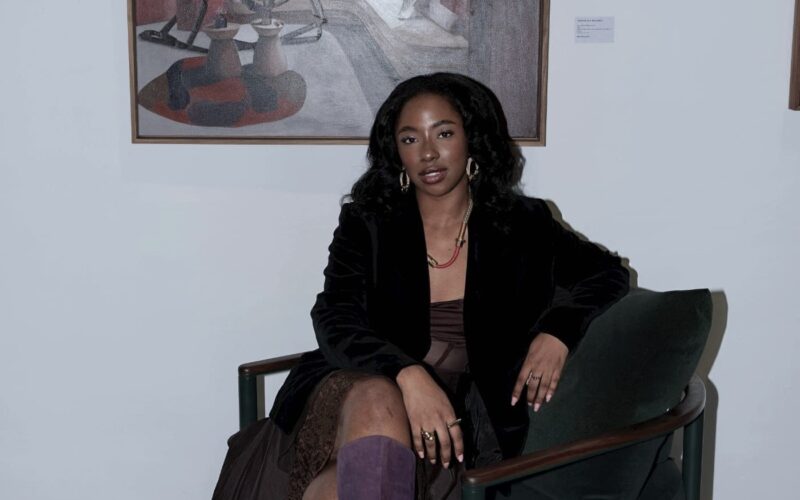
Cinthia Sifa Turned a Printmaking Assignment Into an Art Career About Black Womanhood
👁 54 Views
At Arts to Hearts, everything we do comes back to one thing celebrating artists. The ones making work that matters, that moves people, that makes you stop and actually feel something. Our Best of the Art World editorial was born from exactly that impulse: to find the artists who are doing the most exciting, most honest, most boundary-pushing work right now and bring them closer to the people who need to see them.
And today, we are so excited to introduce you to one of those artists.
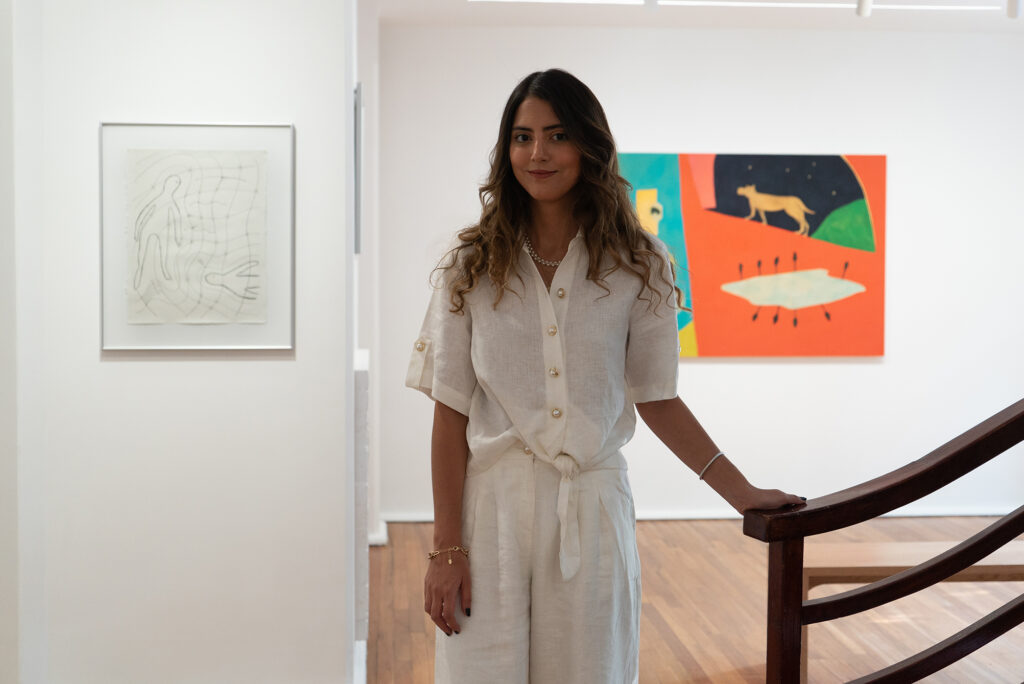
When we came across Cinthia Sifa Mulanga’s work, we knew immediately that this was an artist our readers needed to meet. We reached out a little nervously, if we’re being honest, and when she said yes, we were genuinely over the moon. Because Cinthia is not just a talented artist. She is an artist with something real to say, and the visual language to say it in a way that lingers.
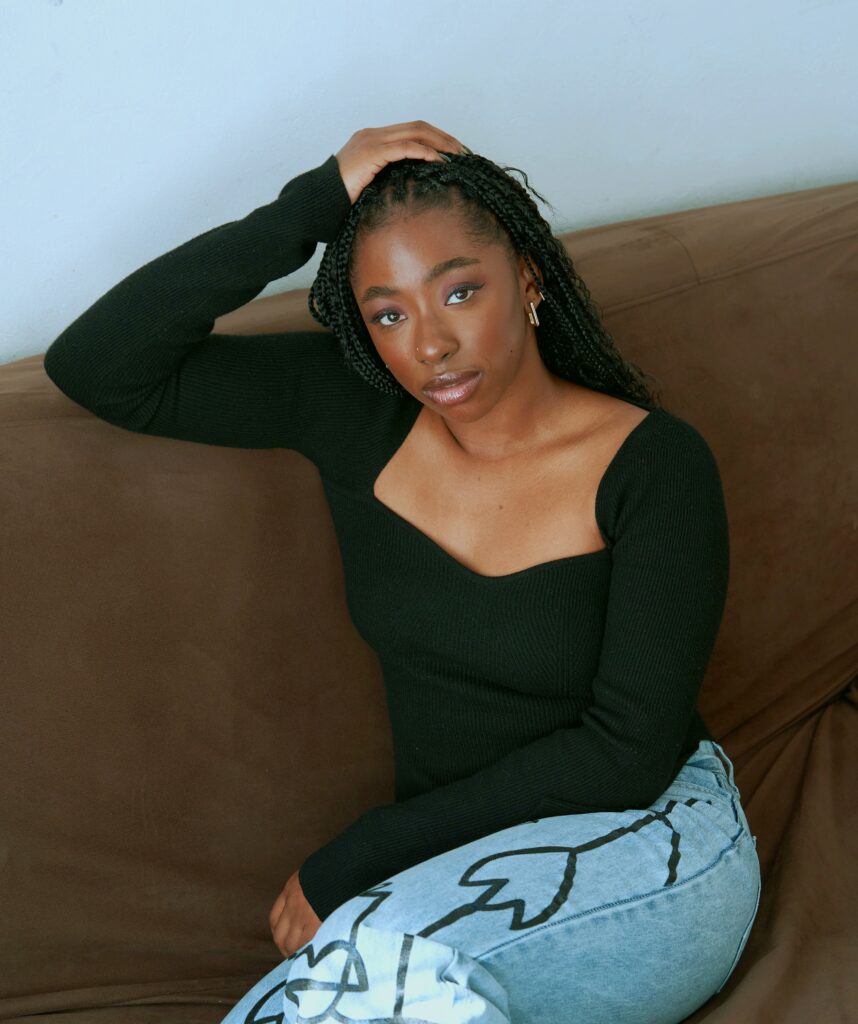
Born in Lubumbashi in the Democratic Republic of Congo and raised in South Africa from the age of nine 9, Cinthia grew up between two worlds, navigating identity, belonging, and what it feels like to move through spaces that weren’t always built for you. That feeling never left her it simply found a home in her art, and in the questions, she couldn’t stop asking about beauty, representation, and who gets to be seen.
She came to painting through printmaking, and it was during her studies that one assignment changed the entire direction of her practice. She was asked to bring in a sentimental object, something personal, something that meant something. She brought a Barbie doll. And what started as a simple exercise cracked something wide open because a Barbie doll, when you really look at it, is not just a toy.
It is a tool of imagination and identity, a carrier of aspiration and fantasy, and when you begin asking who that fantasy was originally designed for and who it quietly excludes, entire systems become visible. Beauty standards become visible. The long history of leaving Black women out of their own stories becomes visible. And Cinthia decided she was done looking away.
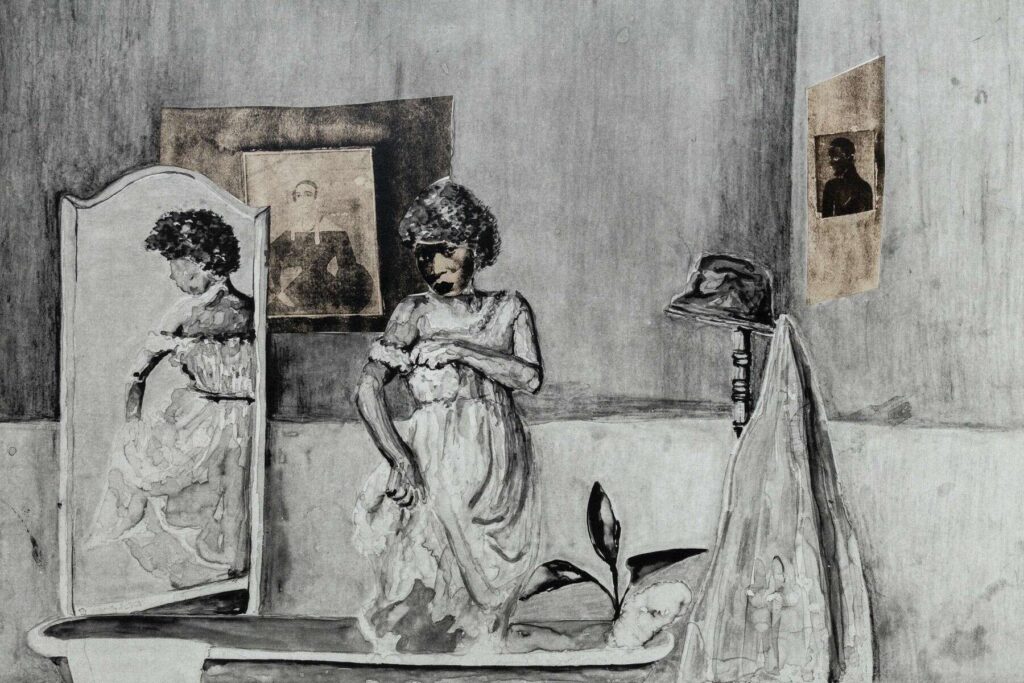
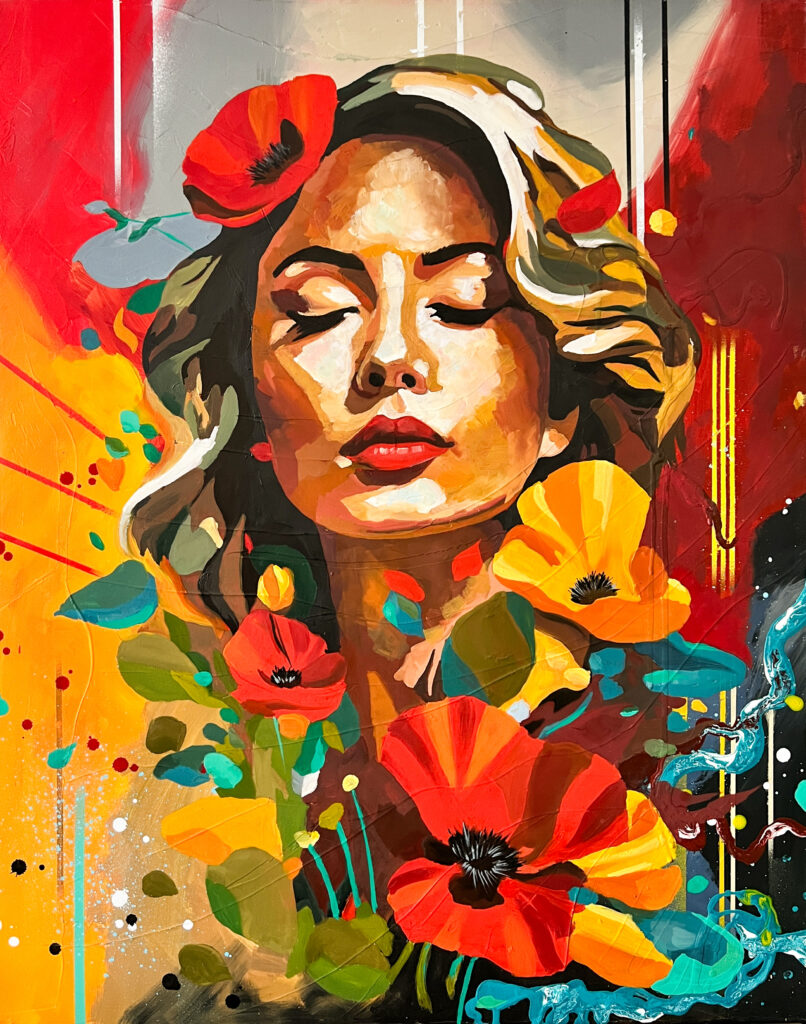
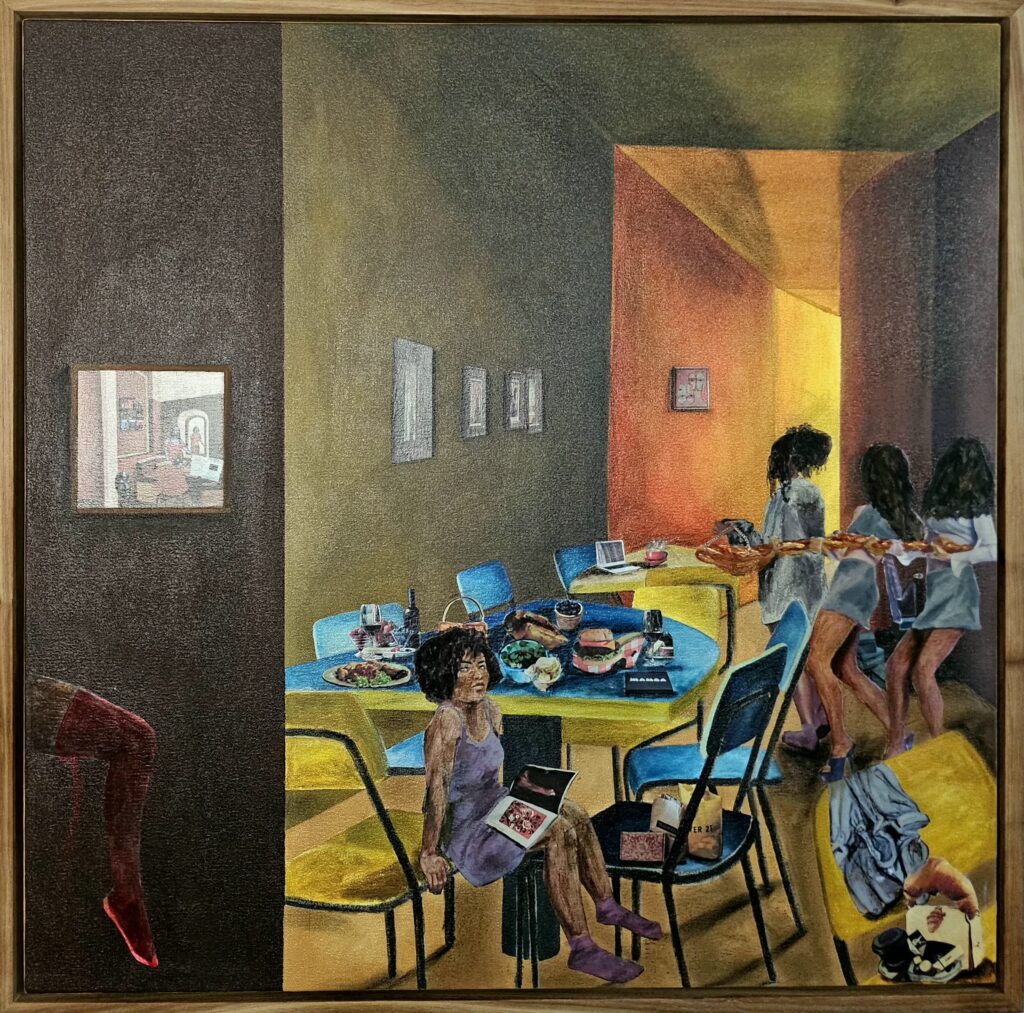
What Cinthia built from that one moment of clarity is something that takes your breath away. She paints Black women the way the world has always failed to fully, tenderly, unapologetically. Her figures live inside carefully composed interiors, bedrooms and living rooms and intimate layered spaces that feel like they belong to someone real, someone whose inner world is rich and complex and worth looking at. These women are not decorative. They are not background. They are the entire story.
Cinthia builds these worlds in acrylic and oil pastels, collaging paper cut-outs from magazines and fashion editorials onto canvas, weaving together pop culture and art history and personal memory until they become something that could only have come from her. She calls it recontextualization taking the images that have always existed, the ones that were never made with Black women in mind, and shifting their meaning entirely.
Centering the women who were always pushed to the edges. Because somewhere out there is a little girl who will see Cinthia’s work and for the first time feel like the world was made for her too.
Let’s get to know Cinthia through our conversation with her, where she opens up about growing up between two countries, finding her voice through art, and why she will never stop centering the women the world forgot to include.
Q1. For those new to your work, we’d love to hear about your journey how did your experiences growing up and your training as a printmaker shape your path toward painting and collage?
I was born in the DRC Congo Lubumbashi; my family and I moved to South Africa in 2006. Growing up between those two spaces shaped how I see identity, movement, and belonging even before I had the language to articulate in my work. As a child, I was always drawn to creativity through my love for fashion. I would make clothes for my toys and spend hours watching my mother in her beauty salon those fascinated me early on. At the same time, I was equally interested in people. In high school, I loved history and considered paths like journalism, social work. I was drawn to anything that involved community, storytelling. Looking back, that instinct to engage with social narratives never left, it simply found a different medium. My brother is a self-taught artist, I joined him, at first it was simply a way to generate income while I figured out my next step after high school. I worked part-time in retail, Printmaking introduced discipline, process, and conceptual thinking. It pushed me to think about why I was making something not just how. Studying art history alongside the technical training added intellectual grounding to what I was doing intuitively before. Before formal training, I was already experimenting with a variety of mediums.
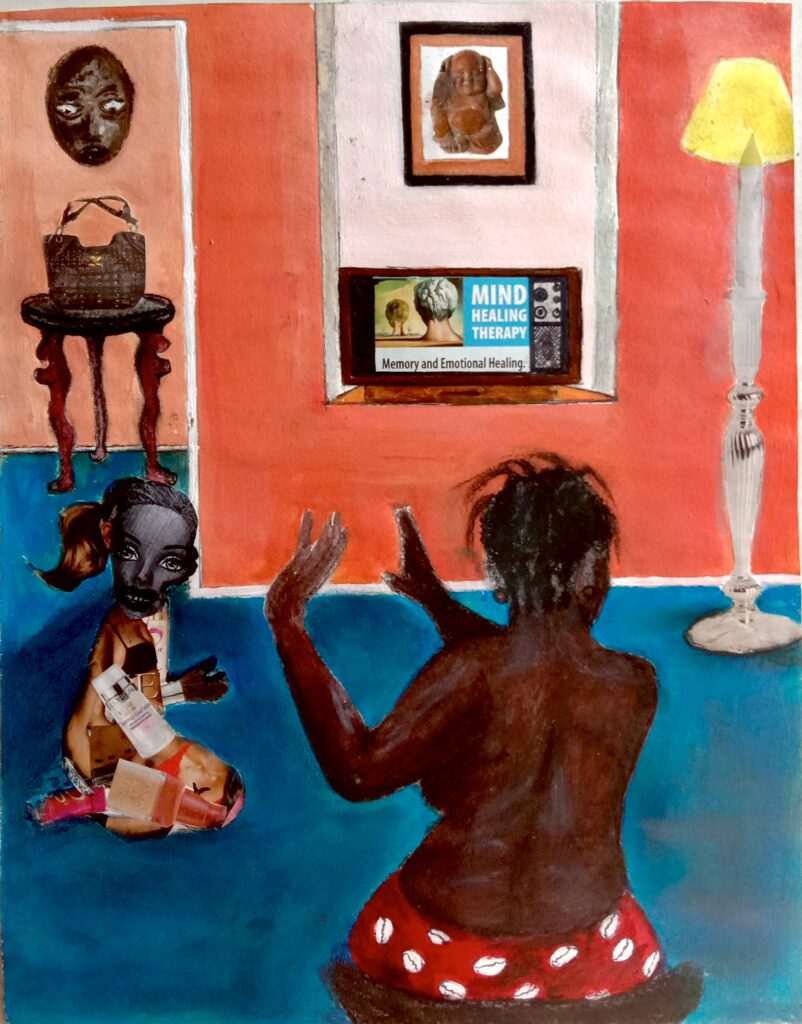
Q2. Your work addresses how Black women are seen and valued within systems shaped by white patriarchy. How do you approach this subject without reducing your work to a single narrative?
My work certainly engages with systems shaped by white patriarchy, but I do not let that become the only narrative. The foundation of this inquiry began with the Barbie doll. During my printmaking studies, we were asked to bring sentimental objects that could inform our final body of work. Many of mine were tied to beauty; combs, lipstick, handkerchiefs but the Barbie doll stood out as the common thread. At first, beauty felt too broad, almost superficial but the more I examined it, the more I realized how powerful it is. A Barbie doll isn’t just a toy; it’s a tool of imagination and education. It allows a child to construct identity, aspiration, fantasy. That’s not neutral. When you begin asking who that fantasy was originally designed for, and who it excludes, systems become visible. Racial hierarchy becomes visible. The standards embedded in that object body type, skin tone, lifestyle are not accidental. However, while patriarchy is a recurring framework, it is not the entirety of my work. I’m equally interested in desire, memory, representation, luxury, empowerment, consumption, and the psychology of beauty. I’m interested in how young Black girls internalize images. I’m interested in how advertising shapes aspiration. I’m interested in how fantasy can both liberate and confine. I don’t create solely in opposition to something. I also create in expansion of who gets to be centered. Black womanhood is not one story. It’s layered, contradictory, celebratory, critical, imaginative, sensual, intellectual sometimes all at once.
Q3. Your figures are often placed within carefully composed interiors bedrooms, living spaces, staged environments. Are these spaces drawn from lived experience, or are they deliberately constructed as psychological environments?
Both, the spaces are drawn from lived experience and deliberately constructed as psychological environments. When my family and I moved from the DRC to South Africa, stability was not immediate. We didn’t know the language. We were navigating documentation, finances, and basic belonging. Because of that, we moved often, renting in different homes. We stayed with people from different nationalities. What stayed with me was how distinct each interior felt. The way people decorated their homes reflected culture, aspiration, memory, even emotional temperament. There were similarities across African households, but also clear differences in colour choices, furniture, textures, religious objects, arrangement of space. I began to understand interiors as extensions of identity. So yes, many of my environments are rooted in observation and lived memory. At the same time, a large portion of my spaces are intentionally constructed. I would say most of them now function as psychological environments. The interior becomes a stage. It can hold safety, luxury, tension, desire, nostalgia. It doesn’t have to be realistic to be true. Recently, I’ve also expanded beyond bedrooms and domestic spaces into public environments such as restaurants, corners of shared spaces because identity doesn’t only exist in private. Ultimately, the rooms in my work are not just backdrops. They are emotional landscapes. Whether rooted in memory or constructed through imagination, they frame the psychological presence of the figures within them.
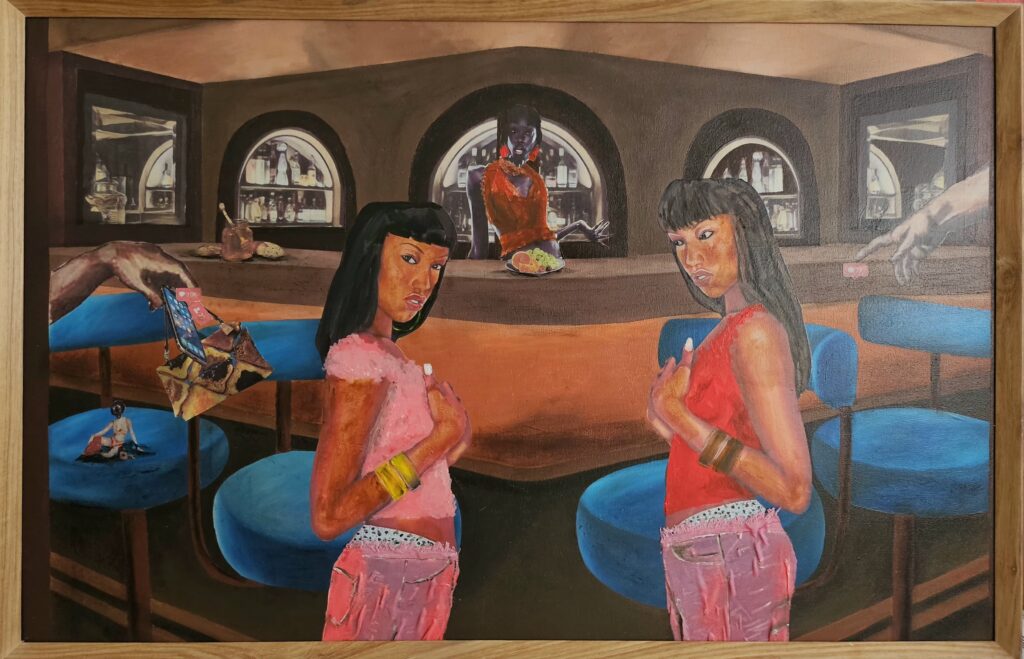
Courtesy of the Artist
Q4. Your work often includes elements associated with beauty fashion, interiors, pose, styling yet these are never straightforward. What interests you about the tension between beauty and construction?
I’ve always been interested in how things overlap, how categories that seem separate are speaking the same language. I see beauty in construction, and I see construction in beauty. When I look at architecture, I’m drawn to structure, lines, repetition, layering. The way forms overlap to create something immersive or surreal. Construction is deliberate. It’s engineered. Nothing about it is accidental. Beauty operates the same way. In media, fashion, and advertising, beauty is carefully constructed. It’s styled, lit, edited, positioned. It presents itself as effortless, but it’s deeply intentional. Standards are built. Desirability is built. Fantasy is built. That tension fascinates me the idea that something can feel soft, natural, even intimate, while being entirely engineered. I was always drawn to fashion. Even when I briefly imagined more traditional professions. Fashion and more specifically style is about identity construction. Style feels authored, it’s architectural in its own way because you’re building a presence. Interiors function similarly. The way a room is arranged, the textures chosen, the objects displayed all of it communicates something about the person inhabiting it. Space is styled just like a body is styled. In my work, beauty, fashion, and interiors aren’t decorative elements though aesthetically pleasing, I am aware. They’re structural devices. They reveal how identity is assembled visually, culturally, psychologically. What interests me is that overlap where softness meets strategy, where glamour meets framework, where something appears effortless but is constructed with precision. That tension is where the work lives.
Q5. You describe recontextualization as a form of authorship. Can you expand on how altering existing images becomes a way of asserting your own voice?
A few years ago, I had a conversation with a writer that shifted how I articulate my practice. She helped me understand that making the work is only part of the process you also must name what you’re doing. That’s when I began thinking more consciously about recontextualization as authorship. I often return to the idea that there is “nothing new under the sun.” Creativity doesn’t emerge from emptiness. We are always building from what already exists visually, culturally, historically. The images I draw from magazines, fashion editorials, art history are not neutral. They already carry meaning. By altering them, repositioning them, layering the, I’m intervening. Recontextualization allows me to journal through imagery. It’s how I process womanhood, representation, aspiration, memory. I use what exists because what exists has shaped me. But when I shift the context, when I insert Black women into spaces they were historically excluded from, when I distort composition or expand the frame, I’m asserting authorship. The past, present, and future begin to converse within the same image. For me, it’s also about continuity. We don’t exist in isolation. My voice is informed by those who came before me in art, in fashion, in music, in film. All creative fields are in dialogue with one another. Recontextualization is my way of participating in that dialogue visually with my peers as well. It’s not about claiming something as entirely new. It’s about redirecting its meaning.
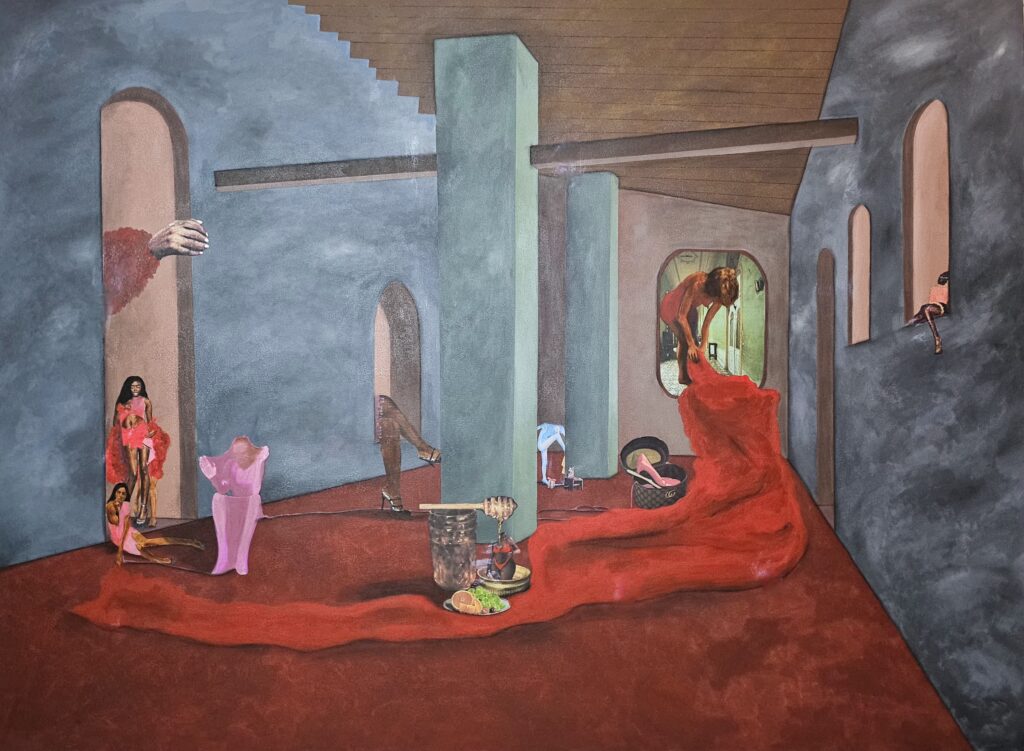
Q6. Your work deals with representation, identity, and beauty politics areas that are often closely scrutinized. Where do you feel you take the greatest risk in your practice?
I think the greatest risk in my practice is choosing complexity over certainty. Making a living as an artist is already uncertain. There is no guaranteed outcome, no predictable structure. I’ve chosen to sustain myself fully through this work, which means I’m constantly navigating risk financially and professionally. But beyond that, the deeper risk lies in what I choose to represent and how I choose to represent it. There is often an expectation that narratives around Black identity must justify themselves through trauma or resistance. I also refuse to simplify the work for easy consumption. The compositions are layered. The references are intentional whether premeditated or by intuition. The beauty is constructed but never straightforward. That kind of complexity asks something from the viewer. It doesn’t always offer immediate resolution. There is risk in evolving materially as well. Moving from mixed media into more optical, spatial, and dimensional explorations challenges my own visual language. It means stepping away from what is already working and asking more of myself. Ultimately, the risk is in trusting my voice especially God, trusting that complexity and its process, nuance, and expansion will sustain me long-term, even if they are not always the safest choices in the moment.
Q7. Your work engages directly with questions of visibility particularly for Black women. How has your own visibility as an artist shaped your perspective on success?
Engaging with visibility in my work has forced me to redefine what success means personally. Because I centre Black women in spaces of presence and complexity, I’ve had to examine how I measure my own presence as an artist. Visibility can easily become transactional like exhibitions, sales, press, followers while those things matter, they are not the full picture, and I learn that every day. For me, success is no longer tied exclusively to financial milestones or public recognition though still important, It’s also about internal growth, clarity of voice, strength of character, expansion of perspective. There is success in becoming more grounded in who I am and what I stand for. One of the biggest shifts for me has been separating success from struggle. There’s a narrative especially around Black achievement that hardship must precede validation. That success must be earned through visible suffering. I no longer subscribe to that. Challenges are bound to happen. Discomfort can signal growth. Expansion requires effort. But success does not need to be traumatic to be legitimate. My own visibility has shown me that presence is powerful, being seen without distortion, without reduction is success. Sustaining a career in this field, evolving my practice, and maintaining integrity in what I represent that, too, is success hard to believe in sometimes. Financial stability is very important, yes, but so is building character, strengthening belief systems, and remaining aligned with my purpose. Visibility taught me that success is multidimensional. It’s external recognition, but it’s also internal evolution.
Q8. What advice would you give artists who want to engage with complex themes while also building a strong and sustainable practice?
I’d say start by understanding your relationship to the practice itself, how you were introduced to art will shape how you engage with it and sustain it over time. Build a library of themes and ideas that resonate deeply with you and allow yourself to explore broadly at first. Then begin narrowing down: identify the threads that feel most personal, most connected to your signature voice. I believe a strong practice requires both exploration and curation. Also, don’t feel pressured to force a signature style immediately. It develops over time. Create for yourself first. Paint without the audience in mind. The work will resonate when it’s authentic. Build your library, explore, narrow down go to different shows and gatherings, but stay true to your vision. That balance between complex ideas and disciplined practice is what sustains a long-term career. We are in it for the long run Buddy!! 😊
As our conversation with Cinthia came to a close, we kept coming back to something she said that the greatest risk in her practice is choosing complexity over certainty. And sitting with that, you feel the weight of what that choice actually costs.
Because certainty is safe. Certainty is sellable. Certainty doesn’t ask anything difficult of anyone. But Cinthia chose complexity anyway. She chose to go deeper, to ask harder questions, to sit inside the discomfort of what it means to be a Black woman in a world that has spent centuries deciding how much space she is allowed to take up. And she put all of that onto canvas. Every single time.
What moves us most about Cinthia is not just the talent. though the talent is undeniable. It is the intention. It is the fact that behind every carefully composed interior, every styled and poised and utterly present figure, there is a woman who looked at the world, noticed what was missing, and decided that she was going to be the one to put it there.
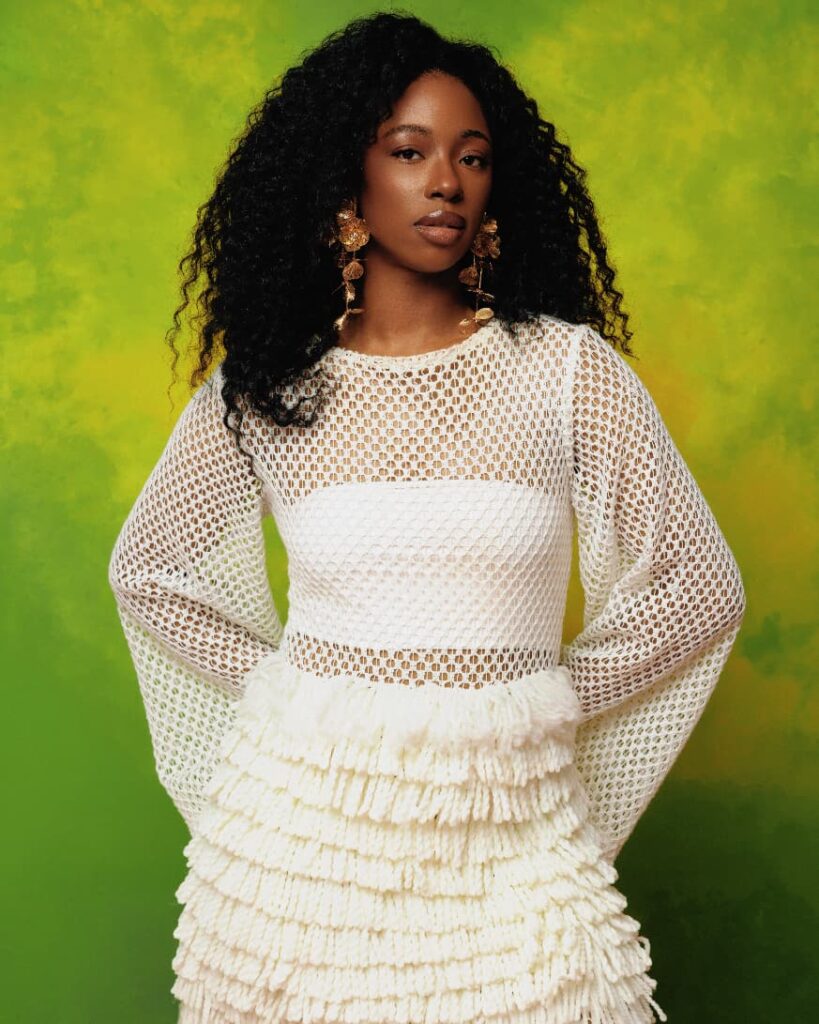
Not waiting for permission. Not softening the work to make it easier to digest. Just painting, honestly and fearlessly, the truth of what she sees and what she knows and what she refuses to let go unsaid.
She started with a Barbie doll and a question. She built a world from it. A world where Black women are not at the edges of the frame but at the very centre of it, occupying their spaces with the kind of fullness and complexity they have always deserved. And somewhere out there, a little girl is going to see one of Cinthia’s paintings and feel, maybe for the very first time, that the world was made for her too. That her dreams are allowed to look like something. That she belongs inside the beautiful things.
That is what art can do when it is made with this much courage and this much love. And Cinthia is living proof of it.
Follow Cinthia Sifa Mulanga through the links below and let her work do what it was always meant to do make you feel seen, make you feel something, and remind you that beauty has always belonged to everyone.