


10 Sunset Paintings That Make You Fall in Love With Evening Again
There are few sights more universal than a sunset. No matter where we are in the world, we have all paused at some point to watch the sky transform into a spectacle of gold, crimson, violet, and fire. Yet while the sunset itself is fleeting, lasting only a matter of minutes, artists have spent centuries trying to preserve its magic on canvas, paper, and woodblock prints.
What makes sunsets so irresistible to artists is not simply their beauty. A sunset is never just a sunset. It can signal the end of a journey, the promise of rest after a long day, a moment of spiritual reflection, or a reminder of how quickly time passes. The same sky that inspired awe in a nineteenth-century Romantic painter could evoke loneliness for a modern artist or become an exercise in color and abstraction for a twentieth-century innovator. Each artist brings something different to the horizon.
From J. M. W. Turner’s glowing atmospheric landscapes and Claude Monet’s fascination with changing light to Vincent van Gogh’s emotionally charged skies and Tsuchiya Koitsu’s poetic visions of dusk, sunsets have served as a powerful source of inspiration across cultures, movements, and generations. These works reveal as much about the artists who painted them as they do about the natural phenomenon itself.
In this collection, we’ll journey through 10 sunset paintings that transformed an everyday occurrence into something unforgettable. Together, they show how a single moment at the end of the day can become a meditation on beauty, solitude, hope, memory, and the endless possibilities of artistic expression.
Perfect. Since this is the opening section, we need to begin with one of the most important artists in the story of sunset painting. I’ll keep the tone editorial, narrative-driven, and closer to Artsy, Apollo, and My Modern Met rather than a textbook entry.
1. J. M. W. Turner and the Sunset That Changed Painting
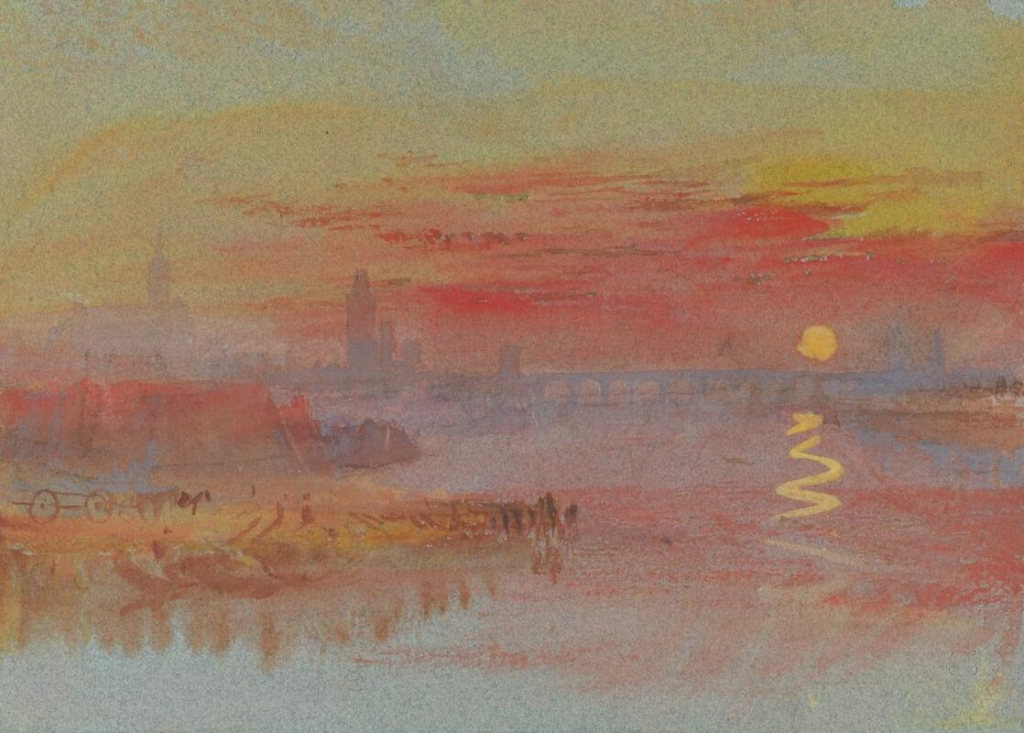
Image: J. M. W. Turner, The Scarlet Sunset: A French Town on a River
Before artists began chasing fleeting moments of light, before Impressionism transformed the art world, and before Claude Monet turned sunrise and sunset into artistic obsessions, there was J. M. W. Turner.
Few artists understood the emotional power of a sunset quite like Turner. While many landscape painters of his era focused on accuracy and detail, Turner was increasingly interested in something far less tangible: atmosphere. He wanted to capture not simply what a place looked like, but what it felt like to stand before it. The result was a body of work that often seemed decades ahead of its time.
The Scarlet Sunset: A French Town on a River is one of the clearest examples of that vision. At first glance, the scene appears almost dreamlike. Buildings dissolve into soft shapes, boats become silhouettes, and the horizon seems to melt into the glowing sky. What dominates the painting is not architecture or geography but color itself. The fiery red-orange sunset spreads across the canvas, reflected in the water until the entire landscape appears suspended in light.
This approach was radical in the early nineteenth century. Turner had been trained in a tradition that valued precision, yet as his career progressed, he became increasingly willing to sacrifice detail for mood. Critics often mocked his later works, claiming they looked unfinished or chaotic. Today, those same paintings are celebrated for anticipating many of the concerns that would later define Impressionism. Looking at The Scarlet Sunset, it is easy to understand why Turner is often described as a bridge between the old world and the modern one.
What makes this sunset so enduring is that it is not merely a record of an evening sky. It is an attempt to paint a fleeting sensation, the way light transforms the world in the final moments before darkness arrives. Nearly two centuries later, the painting still feels alive with that same glow, reminding us why Turner remains one of art history’s greatest poets of light.
2. Caspar David Friedrich and the Sunset as a Spiritual Journey
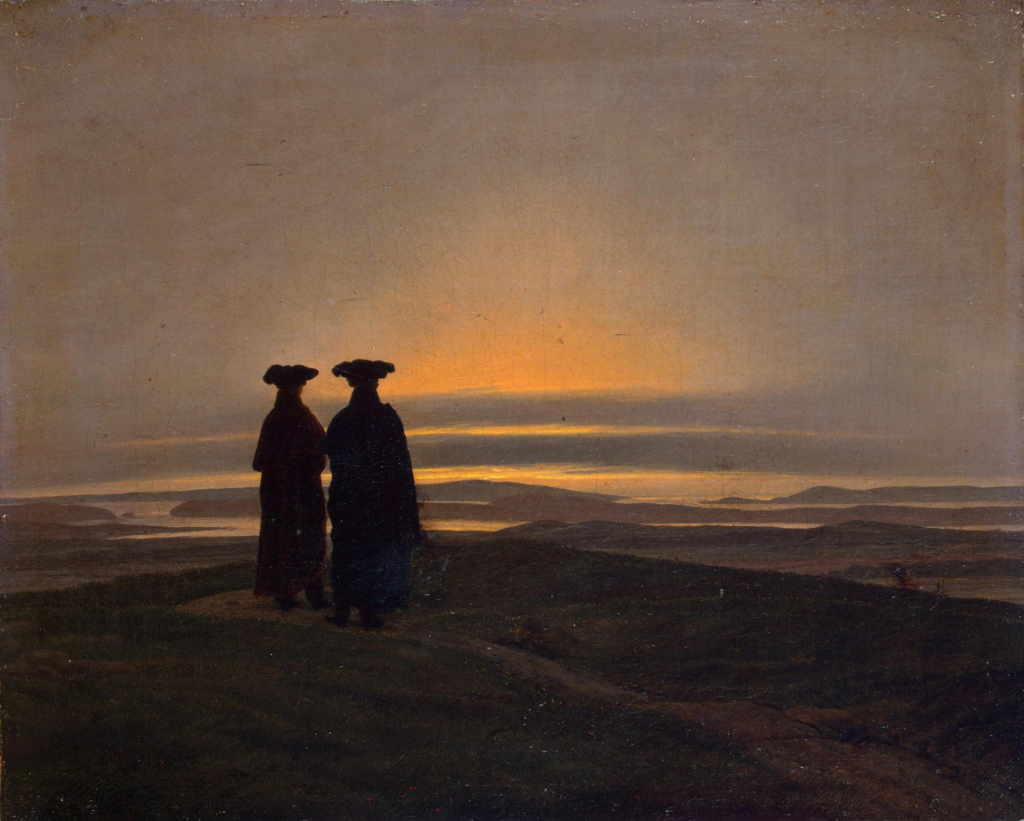
Image: Caspar David Friedrich, Sunset (Brothers)
While J. M. W. Turner used sunsets to explore color and atmosphere, German Romantic painter Caspar David Friedrich saw something far deeper in the fading light. For Friedrich, a sunset was never just a beautiful moment in nature. It was a space for reflection, a quiet encounter with the mysteries of existence, and a reminder of humanity’s small place within the vastness of the world.
Painted around 1835, Sunset (Brothers) embodies many of the themes that defined Friedrich’s career. The painting depicts two figures standing together as they gaze toward the setting sun. The landscape stretches before them in silence, while the sky glows with the final warmth of the day. Nothing dramatic happens in the scene, yet it feels profoundly moving. The power of the painting lies in its stillness.
Friedrich was one of the leading figures of German Romanticism, a movement that valued emotion, imagination, and the sublime experience of nature. Unlike artists who treated landscapes as decorative backgrounds, Friedrich made nature the central subject. Mountains, forests, oceans, and sunsets became vehicles for exploring questions about faith, mortality, and the human spirit.
One of his most influential artistic devices was the Rückenfigur, a figure shown from behind, facing the landscape. Rather than telling viewers what to feel, Friedrich invites them into the scene. We stand alongside the figures, sharing their view and contemplating the same horizon. The sunset becomes a mirror for our own thoughts.
In Sunset (Brothers), the fading light carries a quiet symbolism. The end of the day suggests the passage of time, the inevitability of change, and the cycles that govern both nature and human life. Yet there is no sense of despair. Instead, Friedrich presents sunset as a moment of peace and transcendence, where the boundaries between the earthly and the spiritual seem to blur.
Nearly two centuries later, the painting continues to resonate because it captures something universal. We have all stopped to watch a sunset and felt, even briefly, that the world had become larger than ourselves. Friedrich understood that feeling better than almost any artist of his time, transforming an ordinary evening sky into a meditation on life itself.
3. Claude Monet and the Art of Chasing a Disappearing Sky
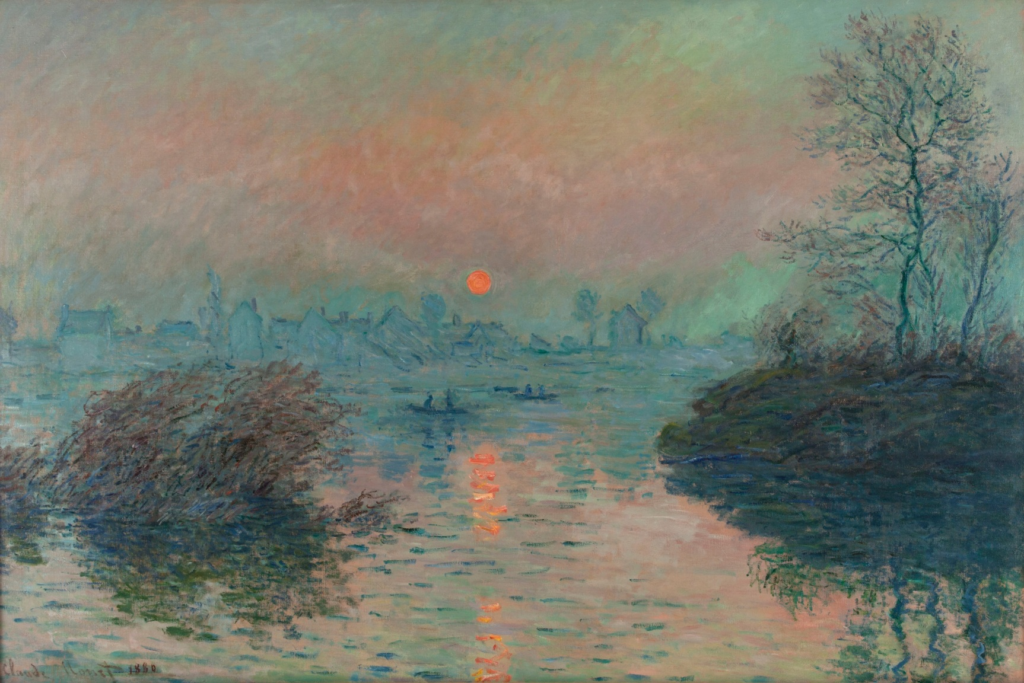
Image: Claude Monet, Sunset on the Seine at Lavacourt, Winter Effect
If Turner taught artists that light could become the subject of a painting, Claude Monet dedicated his career to proving just how endlessly fascinating that subject could be. Few painters were as obsessed with the changing effects of light as Monet, who spent decades returning to the same landscapes at different times of day and in different seasons, determined to capture moments that existed for only minutes before vanishing forever.
Painted in 1880, Sunset on the Seine at Lavacourt, Winter Effect reflects that lifelong pursuit. The scene appears deceptively simple: a quiet stretch of the Seine River, snow-covered banks, and a glowing winter sunset sinking into the horizon. Yet beneath its calm surface lies one of the central ideas of Impressionism, that the world is constantly changing, and that art should capture those fleeting transformations rather than fixed realities.
By the time Monet painted this work, Impressionism was still considered controversial. Traditional art institutions valued polished surfaces, historical subjects, and meticulous detail. Monet and his fellow Impressionists wanted something different. They painted modern life, worked outdoors, and focused on how light altered the appearance of a scene from one moment to the next.
What makes this sunset particularly compelling is the contrast between warmth and cold. The landscape is frozen, covered in winter’s chill, yet the sky burns with soft oranges, pinks, and golds. These colors ripple across the river’s surface, creating reflections that seem to shimmer and dissolve before our eyes. Rather than defining every tree, building, or patch of snow, Monet allows loose brushstrokes and subtle color relationships to do the work.
The painting also carries a fascinating historical footnote. Monet created it as part of a series depicting Lavacourt, hoping some of the works might be accepted into the prestigious Paris Salon. Ironically, Sunset on the Seine at Lavacourt was rejected for being too experimental, a judgment that now feels almost unbelievable given Monet’s place in art history.
Today, the painting serves as a reminder of what made Monet revolutionary. He understood that a sunset is never truly still. It shifts from second to second, transforming colors, shadows, and reflections in ways that can never be repeated. Rather than fighting that impermanence, Monet embraced it, turning the fleeting beauty of a winter evening into one of Impressionism’s most enduring achievements.
4. Claude Monet and the Sunset Painted on the Edge of the Sea
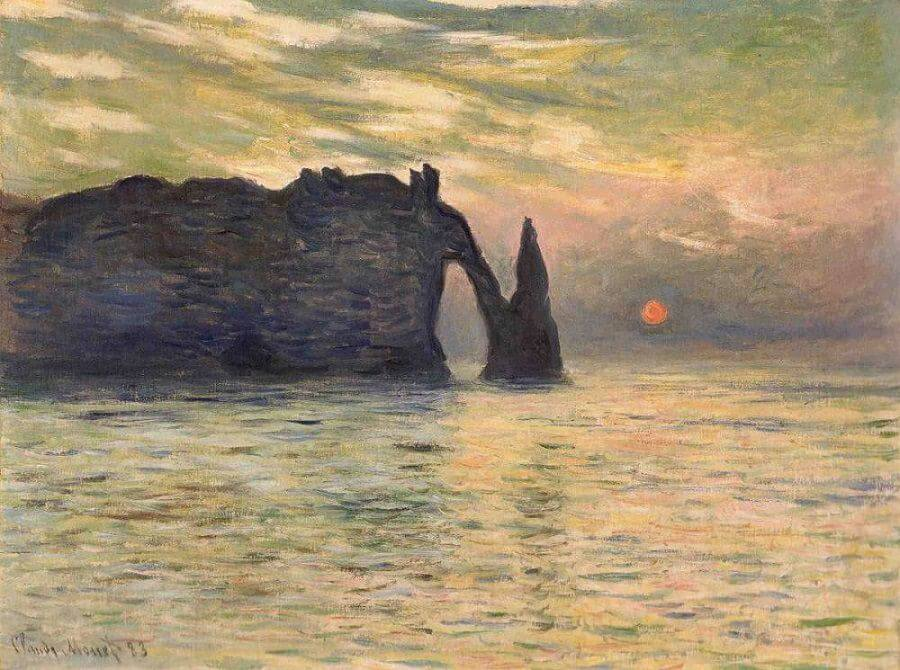
Image: Claude Monet, The Cliff at Étretat, Sunset
Most artists would have been satisfied with painting a sunset once. Claude Monet, however, spent much of his life returning to the same subject again and again, convinced that no two moments of light were ever truly alike. While his rivers, gardens, and haystacks are among the most celebrated examples of this pursuit, some of his most captivating experiments took place along the dramatic coastline of Normandy.
Among these works is The Cliff at Étretat, Sunset, a painting that captures one of France’s most iconic landscapes at the precise moment when day gives way to night. The cliffs of Étretat had long fascinated artists and writers, but Monet saw more than a geological wonder. He saw an ever-changing theater of light, where sea, sky, and stone constantly transformed under shifting weather conditions.
Unlike the quiet stillness of Sunset on the Seine at Lavacourt, this painting feels alive with movement. The ocean reflects the fading sunlight, while the towering cliffs rise like monuments against a sky washed in warm oranges, soft violets, and fading blues. Monet was less interested in recording the exact contours of the landscape than in capturing the atmosphere surrounding it. The brushstrokes appear loose and spontaneous, yet together they create a convincing sensation of wind, moisture, and light.
The artist often worked outdoors, racing against time as the sun moved across the sky. A sunset offered only a brief window to observe certain colors and effects before they disappeared. This urgency became a defining characteristic of Impressionism. Rather than presenting nature as permanent and stable, Monet revealed it as fluid and constantly changing.
What makes The Cliff at Étretat, Sunset particularly fascinating is the balance between permanence and impermanence. The cliffs themselves have stood for thousands of years, shaped slowly by the sea. The sunset, by contrast, lasts only moments. Monet brings these two realities together in a single image, reminding us that even the most enduring landscapes are experienced through fleeting moments of light.
In many ways, this painting captures the essence of Monet’s artistic philosophy: beauty is not found in fixed objects but in the ever-changing relationship between nature, time, and perception. The sunset becomes more than a backdrop, it becomes the main event, transforming a familiar coastline into something almost magical.
5. Vincent van Gogh and the Sunset That Burned With Emotion
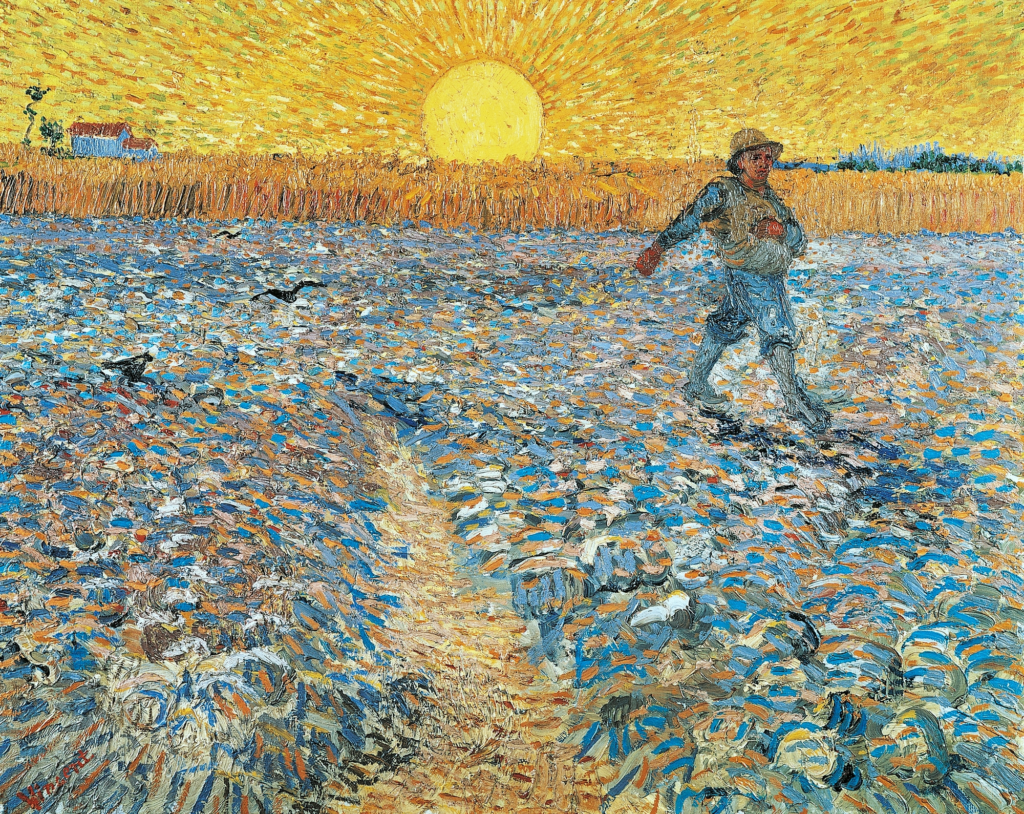
Image: Vincent van Gogh, The Sower
For Claude Monet, a sunset was an opportunity to study changing light. For Vincent van Gogh, it became something far more personal. He did not paint sunsets simply as they appeared in nature; he transformed them into emotional landscapes, charged with symbolism, energy, and feeling. In Van Gogh’s hands, the setting sun became a force that seemed almost alive.
Painted in 1888 during his extraordinarily productive period in Arles, The Sower is one of Van Gogh’s most celebrated interpretations of the sunset. The painting depicts a farmer scattering seeds across a field while an enormous golden sun dominates the sky behind him. At first glance, the scene appears simple, a man at work as evening approaches. Yet Van Gogh turns this ordinary moment into something monumental.
The artist had long admired the work of French painter Jean-François Millet, who often depicted peasants and agricultural laborers with dignity and respect. Van Gogh repeatedly returned to Millet’s themes, but he infused them with his own distinctive visual language. In The Sower, the figure is not merely planting crops. He becomes a symbol of renewal, creation, and the endless cycle of life.
What immediately captures the viewer is the sun itself. Rather than a distant feature on the horizon, it appears almost oversized, radiating intense yellow light across the canvas. The surrounding landscape glows with vivid purples, blues, and golds, colors that do not necessarily reflect reality but convey emotion. Van Gogh believed that color could communicate feelings more powerfully than precise representation ever could.
This approach marked a significant departure from Impressionism. While Monet sought to capture what the eye observed, Van Gogh sought to express what the heart experienced. His sunsets were not passive observations of nature; they were emotional interpretations of it.
More than a century later, The Sower remains unforgettable because it transforms a familiar scene into something timeless. The setting sun is no longer simply marking the end of a day. It becomes a symbol of hope, labor, perseverance, and renewal, a glowing reminder that every ending carries the promise of a new beginning.
6. Albert Bierstadt and the Sunset That Made Nature Feel Monumental

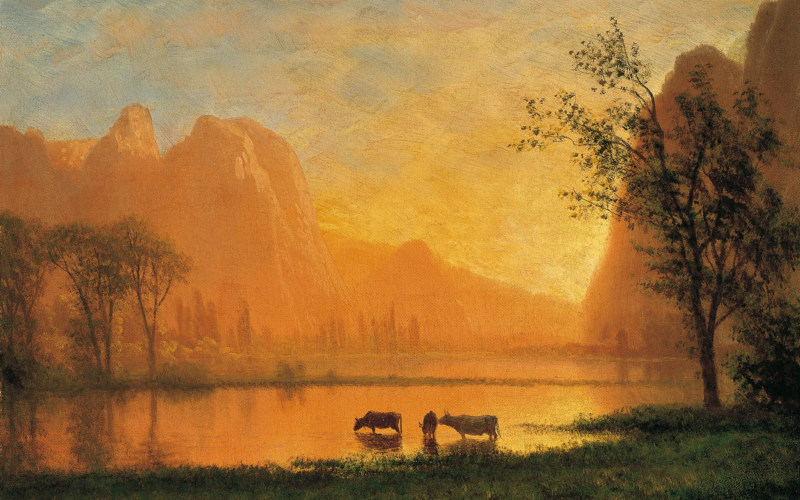
Image: Albert Bierstadt, Sundown at Yosemite
Not every artist viewed a sunset as an intimate or emotional experience. For Albert Bierstadt, it was something grander, a spectacle capable of transforming the natural world into a scene of almost mythic proportions. Few painters captured the drama of the American landscape with the same sense of awe, and few sunsets feel as majestic as the one glowing across Sundown at Yosemite.
Born in Germany and raised in the United States, Bierstadt became one of the most celebrated painters of the Hudson River School’s second generation. During the nineteenth century, as Americans pushed westward, artists and explorers encountered landscapes that seemed unlike anything found in Europe. Vast mountains, immense valleys, and seemingly endless wilderness inspired painters to create images that celebrated the grandeur of the American frontier.
Bierstadt traveled extensively through the West, sketching and gathering material during expeditions. Yosemite Valley, in particular, left a lasting impression on him. When he painted these landscapes back in his studio, he often combined careful observation with artistic imagination, creating scenes that felt larger, brighter, and more dramatic than life itself.
In Sundown at Yosemite, the setting sun becomes the painting’s silent protagonist. Golden light washes across the valley, illuminating cliffs, trees, and distant peaks with an almost supernatural glow. Shadows deepen in the foreground while the sky radiates warmth above, creating a striking contrast that heightens the scene’s emotional impact. The landscape feels less like a specific location and more like a vision of nature at its most sublime.
This idea of the sublime, an overwhelming mixture of beauty, wonder, and insignificance before nature’s power, was central to nineteenth-century landscape painting. Bierstadt understood that sunsets could amplify that feeling. As daylight fades, familiar scenery becomes transformed, revealing colors, shapes, and moods that seem almost magical.
Today, Sundown at Yosemite remains a testament to the enduring power of landscape art. It reminds us that a sunset can be more than a beautiful view. In the right hands, it becomes a celebration of nature’s scale, mystery, and ability to inspire wonder long after the sun has disappeared below the horizon.
7. Edward Hopper and the Loneliness of the Modern Sunset
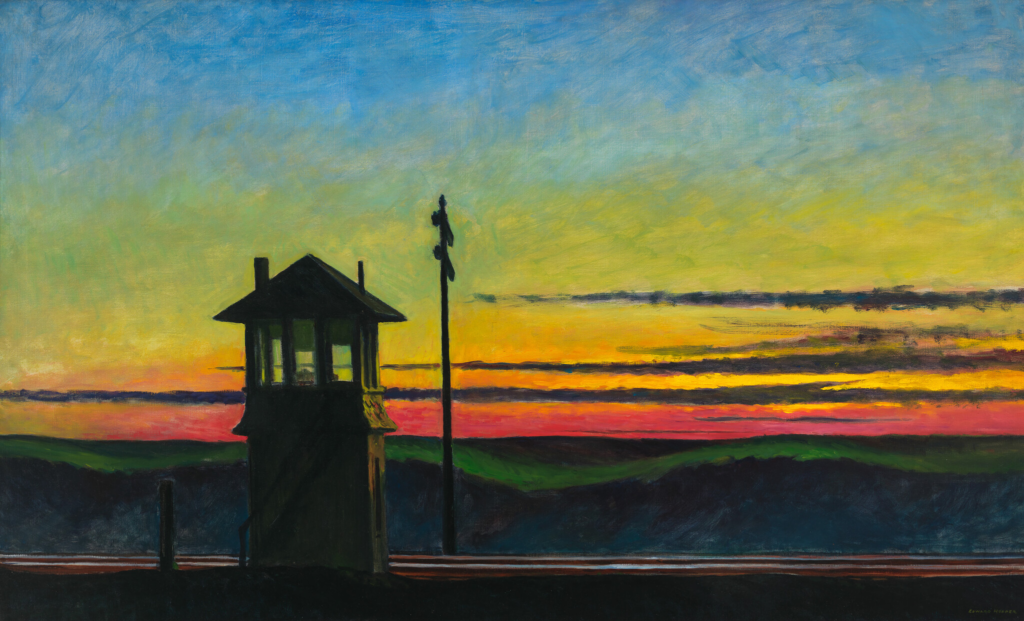
Image: Edward Hopper, Railroad Sunset
By the time Edward Hopper painted Railroad Sunset in 1929, the world had changed dramatically from the one Turner, Friedrich, and Monet knew. Cities were expanding, industries were transforming landscapes, and modern life was becoming increasingly fast-paced and disconnected. Yet even amid this new world of railroads and factories, the sunset remained. Hopper’s genius was recognizing that the meaning of a sunset could change alongside society itself.
Unlike the sweeping valleys of Bierstadt or the glowing fields of Van Gogh, Hopper’s sunset unfolds in an environment shaped by human activity. The painting presents railroad tracks cutting through the landscape, utility poles standing against the horizon, and a sky illuminated by an intense red-orange glow. Nature is still present, but it now shares the stage with the structures of modern civilization.
Hopper is often remembered as the great painter of solitude. Throughout his career, he captured quiet moments that felt both ordinary and deeply psychological. Empty streets, isolated buildings, and solitary figures became recurring subjects in his work. Even when people were absent, his paintings often carried a powerful sense of human presence, suggesting stories that remain untold.
In Railroad Sunset, that feeling is unmistakable. The scene is strikingly simple, yet it creates an atmosphere of anticipation and mystery. The railroad tracks seem to lead somewhere beyond the frame, while the glowing sky hints at a drama unfolding just out of reach. The viewer is left suspended between movement and stillness, certainty and uncertainty.
What makes this painting so compelling is the tension between the natural and the man-made. The sunset retains its timeless beauty, but it now illuminates a world transformed by technology and progress. Hopper does not present this change as entirely positive or negative. Instead, he invites us to reflect on how modern life can leave people feeling both connected and isolated at the same time.
More than a landscape, Railroad Sunset feels like a portrait of an era. It captures a uniquely modern form of melancholy, the sense of standing at the edge of something vast and unknowable as the day quietly slips away. In Hopper’s hands, the sunset becomes not a celebration of nature, but a meditation on the loneliness that can exist even in a rapidly changing world.
8. Georgia O’Keeffe and the Sunset Reduced to Pure Feeling
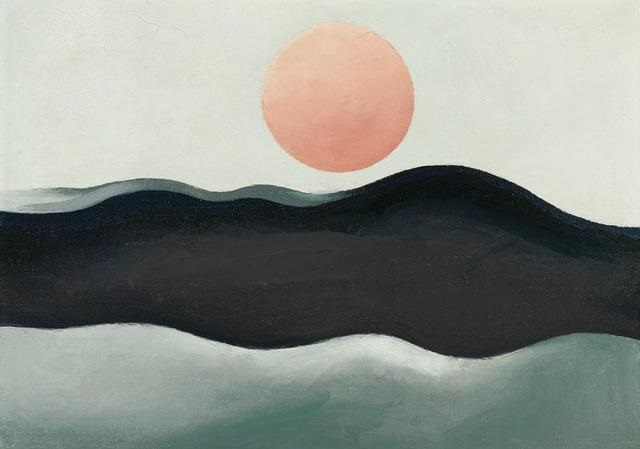
Image: Georgia O’Keeffe, Sunset
By the twentieth century, many artists were no longer interested in recreating the world exactly as they saw it. Photography had already taken over the role of documenting reality, and painters increasingly began searching for new ways to express emotion, memory, and personal experience. Few artists embraced this shift more powerfully than Georgia O’Keeffe, whose work transformed familiar subjects into bold explorations of color, shape, and sensation.
Unlike Turner, Monet, or Bierstadt, O’Keeffe was not concerned with capturing the fleeting effects of light on a landscape. Instead, she sought to distill an experience down to its emotional essence. Her sunsets are not detailed records of a particular place or moment. They are visual interpretations of what it feels like to stand beneath a sky flooded with color as day gives way to night.
Throughout her career, O’Keeffe developed a deeply personal relationship with the American landscape, particularly the vast deserts of New Mexico. The open skies, dramatic horizons, and shifting colors of the Southwest became some of her greatest sources of inspiration. In many of her works, the natural world is simplified into broad forms and luminous bands of color, creating compositions that feel both grounded in reality and strangely abstract.
In Sunset, this approach is unmistakable. Layers of glowing color stretch across the composition, reducing the landscape to its most fundamental elements. There are no intricate details demanding attention, no bustling figures or dramatic narratives. Instead, the painting invites viewers to slow down and immerse themselves in the experience of color itself. The sunset becomes less about a place and more about a mood.
What makes O’Keeffe’s interpretation so compelling is its universality. By stripping away unnecessary detail, she creates space for personal reflection. The painting feels familiar even if we have never witnessed that exact sky. We recognize the quiet wonder of watching daylight fade, the moment when colors seem richer and time appears to slow.
In O’Keeffe’s hands, the sunset becomes something profoundly modern. It is not a spectacle to observe but an emotion to inhabit, a reminder that sometimes the simplest forms can express the deepest feelings.
9. Tsuchiya Koitsu and the Poetry of a Quiet Sunset
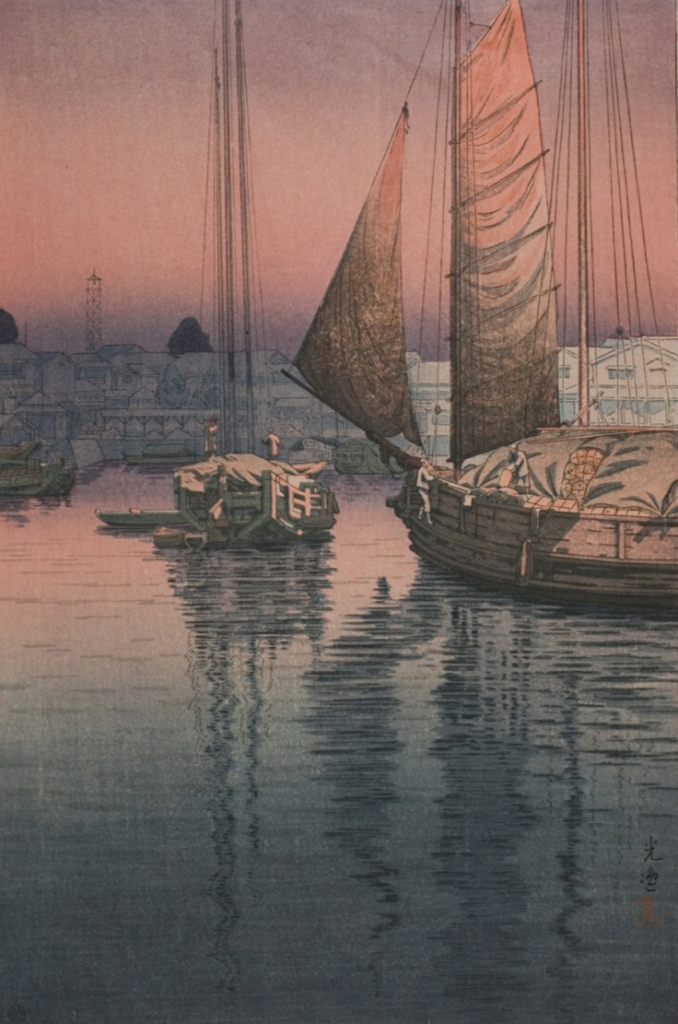
Image: Tsuchiya Koitsu, Sunset at Tomonotsu, Inland Sea
Not every sunset demands attention. Some arrive quietly, casting a gentle glow over the world before fading into memory. Japanese artist Tsuchiya Koitsu understood this subtle beauty better than most. While many Western artists approached sunsets as dramatic displays of color and emotion, Koitsu found power in restraint, atmosphere, and silence.
Created in 1940, Sunset at Tomonotsu, Inland Sea belongs to the shin-hanga movement, a twentieth-century revival of traditional Japanese woodblock printing. The movement sought to preserve the techniques of ukiyo-e while incorporating certain elements of Western art, particularly realistic lighting and perspective. The result was a body of work that felt both timeless and modern, rooted in Japanese traditions yet open to global influences.
Koitsu was one of the movement’s most accomplished artists. Having studied under the celebrated printmaker Kobayashi Kiyochika, he developed a remarkable sensitivity to light and atmosphere. His landscapes often depict ordinary places, villages, harbors, temples, and coastal towns, but they possess a quiet emotional depth that lingers long after viewing.
In Sunset at Tomonotsu, Inland Sea, the scene unfolds with remarkable simplicity. Boats rest on calm waters while the evening sky gradually shifts through delicate shades of pink, orange, and violet. Reflections ripple softly across the surface of the sea, blurring the boundary between sky and water. There is no dramatic action, no grand narrative, and no overwhelming spectacle. Instead, the beauty emerges through stillness.
This appreciation for transient moments reflects a broader Japanese aesthetic often associated with mono no aware, an awareness of the impermanence of things and the gentle sadness that accompanies their passing. The sunset becomes a perfect symbol of this idea. Its beauty exists precisely because it cannot last.
What makes Koitsu’s work so captivating is its ability to slow us down. In a world that often celebrates the spectacular, Sunset at Tomonotsu reminds us that some of life’s most meaningful experiences are also the quietest. The fading light, the calm water, and the peaceful harbor invite us to pause and simply be present. In doing so, Koitsu transforms an ordinary sunset into a meditation on time, memory, and the beauty of impermanence.
10. Jules Breton and the Sunset as a Promise of Rest
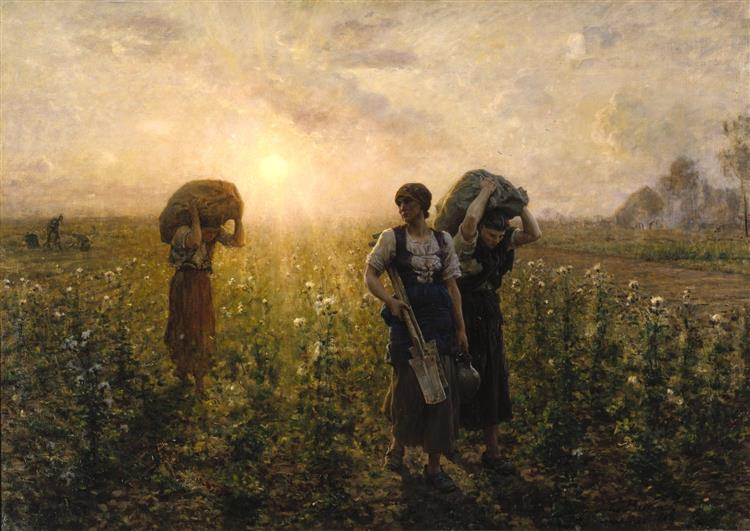
Image: Jules Breton, The End of the Working Day
For many artists in this list, the sunset is a source of wonder, reflection, or artistic experimentation. For French painter Jules Breton, however, it is something far more human. It marks the end of labor, the reward after exhaustion, and the quiet dignity found in everyday life. In The End of the Working Day, Breton transforms a simple rural scene into one of the most moving celebrations of resilience in nineteenth-century art.
Breton emerged during the Realist movement, a period when artists increasingly turned their attention away from mythology, aristocratic portraiture, and idealized historical subjects. Instead, they focused on ordinary people and the realities of daily existence. Yet unlike some Realist painters who emphasized hardship and struggle, Breton brought a sense of warmth and optimism to his depictions of rural life.
In this painting, laborers make their way home beneath the fading glow of the evening sky. The day’s work is done, and the sunset bathes the landscape in soft golden light. Rather than presenting the workers as anonymous figures, Breton imbues them with a quiet sense of pride and humanity. They are neither heroic nor romanticized, but they are deeply respected.
The timing of the scene is crucial. Sunset has long symbolized endings, but Breton uses it to suggest something more hopeful. The fading light does not signal loss; it signals completion. The workers have endured the demands of the day and can now return to their families, their homes, and a well-earned moment of rest. The sky itself seems to participate in that relief, wrapping the landscape in a comforting glow.
What makes The End of the Working Day such a fitting conclusion to this journey through sunset paintings is its emphasis on shared human experience. We may never stand on Turner’s riverbank, wander through Monet’s Normandy coast, or gaze across Koitsu’s Inland Sea. But nearly everyone understands the feeling of reaching the end of a long day and finding comfort in the knowledge that rest is near.
Breton reminds us that sunsets are not only spectacles to admire from afar. Sometimes, they are companions to our daily lives, gentle markers of time that encourage us to pause, reflect, and appreciate how far we have come. In that sense, every sunset carries a quiet promise: tomorrow, the light will return.
A sunset lasts only a few moments, yet it has inspired some of the most memorable works in art history. Across centuries, cultures, and artistic movements, painters have returned to this daily spectacle again and again, not because the sky changes, but because they do.
For Turner, sunset became a study of atmosphere and emotion. For Friedrich, it was a gateway to spiritual contemplation. Monet chased its ever-shifting light, while Van Gogh transformed it into a symbol of hope and human resilience. Hopper found solitude beneath its glow, O’Keeffe distilled it into pure feeling, and Koitsu revealed its quiet poetry. Each artist looked toward the horizon and discovered something entirely their own.
Perhaps that is the enduring power of sunsets in art. They remind us that beauty is never experienced in exactly the same way twice. The colors may be familiar, but the emotions they awaken are deeply personal. A sunset can feel grand or intimate, comforting or melancholic, fleeting or timeless, all depending on who is watching.
These ten paintings are more than records of evening skies. They are reflections of the artists behind them, revealing how light, memory, place, and emotion intertwine on the canvas. Long after the sun has disappeared below the horizon, these works continue to glow, inviting us to pause, look closely, and appreciate the extraordinary beauty hidden within an ordinary moment at the end of the day.
Which artist’s version of sunset felt most familiar to you?
The best artworks often leave us with more questions than answers. If you’re drawn to the stories, secrets, and unanswered questions that surround great works of art, our exploration of The Art World’s Greatest Unsolved Mysteries offers another fascinating journey through art history.