




A Conversation on Cubism with Dipayan Ghosh

In today’s interview, we welcome Dipayan Ghosh, a Kolkata-born artist whose work seamlessly fuses cubism and expressionism, while echoing the rich cultural spirit of his city in every brushstroke. His textured canvases—layered with ceramic stucco, resin, ash, shattered glass, and thread are inhabited by fragmented bodies, spirals, and allegorical forms that explore themes of identity, ritual, and socio-political memory. Let’s delve into what lies at the heart of Dipayan’s practice and his ideas on hope and endurance; qualities that flow through both his materials and his visual language.
Hi Dipayan, can you share your artistic journey—how did growing up in the city of Kolkata shape your decision to become a painter?
I was born in Kolkata, in a city where art and history whisper from every street corner. Growing up there wasn’t just a childhood—it was a lifelong immersion into rhythm, ritual, and raw beauty. From the red hibiscus garlands on temple steps to the frescoes on crumbling colonial mansions, everything in Calcutta taught me that art doesn’t live only on canvas—it lives in song, in silence, in celebration. I discovered my passion for painting at a tender age. My first sketches were of rickshaw pullers, pigeons in flight, and the outlines of Durga idols taking shape in clay. Every festival was a colour wheel, every monsoon a masterclass in shadow and texture. That early immersion taught me to see—to really see—the world around me. My formal training began at the Academy of Fine Arts, under a mentor who shaped my foundation in form, anatomy, and composition. But beyond the technique, he opened the door to modern Indian masters. I was deeply influenced by the surreal depth of Bikash Bhattacharya, the lyrical fluidity of Paresh Maity, and the charged dynamism of Jatin Das. Their works weren’t just visual—they were visceral. And I wanted to paint like that: from the gut, from the bone. In those early years, I explored charcoal sketches, ink drawings, watercolour washes—but eventually, I found my truest expression in vibrant oils and acrylics, wielding hues as radiant as a monsoon sunset over the Hooghly. With each stroke, I was not just painting a scene—I was etching emotion into surface, turning memory into form. My artistic voice was shaped by those Calcutta afternoons—sketching in sunlit studios, talking to clay modellers in Kumartuli, listening to Rabindra Sangeet drift through the courtyards. What I create today—layered, textured, emotionally charged—still carries the soul of that city. My Cubist expressionism, my themes of resilience and endurance, all trace back to Kolkata’s quiet strength. So yes, when people ask me how I became an artist, I tell them— Kolkata didn’t just raise me. It painted me. And I’ve been replying in colour ever since.

What are the main themes that you aim to invoke through your artworks?
At the core of my practice lies Hope and Endurance—not as distant ideals, but as lived realities. My artworks are textured testaments to resilience, built with ash, thread, cement, and pigment—materials that remember pain, but also the will to rise. Through Cubist abstraction, I fracture form to reflect broken worlds, then reconstruct them with quiet strength. Each piece is a scarred surface turned sacred space. In works like: “The Weight Beneath the Skyline”, I honor invisible labor and the burden of dreams, “After the Fire, We Still Stand”, a meditation on survival after devastation, “Hope is a Heavy Architecture”, where optimism bears weight like concrete, and “The Atlas Within”, where human bodies carry entire cities— I try to show that hope is not soft, but structural, and endurance is the architecture of the soul. We don’t just survive. We rebuild. And in rebuilding—we remember, we heal, we hope.
What tools and mediums do you prefer and how do you decide which one to use for each artwork?
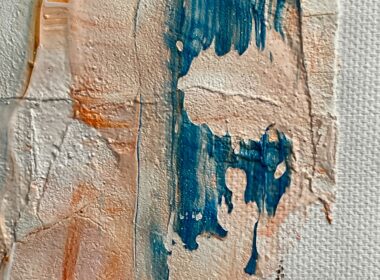
I paint with time, not just with tools. My studio is a site of excavation—not just of images, but of truths buried beneath the surface. I work with cement, sand, ash, burnt charcoal, thread, rusted wire, and oil pigments—each chosen not for their convenience, but for the memory they carry. These are not passive materials. They crack, resist, and speak. Cement gives weight to sorrow, a solid grief that refuses to be smoothed out. Sand softens the harshness, offering fragility and time-worn erosion. I use resin not to preserve, but to petrify—a fossilization of emotion. At times, I thread fabrics into the canvas like stitching a wound; at others, I scorch the surface with rust to mark the ache of remembrance. Each artwork begins with a question: Where does this story come from—war, migration, mental disquiet, ecological trauma? The answer guides my hand. If the pain is ancient, I reach for coarse ash and oxidized metal. If it is personal, I layer pigment thin as breath, letting it bleed. Texture is my vocabulary. Medium is my music. And the surface—never smooth—is a battlefield of endurance. What I create is not just a painting, but a terrain of survival. A tactile scripture of hope, crumbling yet enduring.

What are the three most noticeable attributes about your studio and what significance does this hold?
hree Most Noticeable Attributes of My Studio — and Their Symbolism The Textured Wall of Experiments A single wall in my studio is layered with test canvases — cement smudges, rust-oxidized pigments, torn fabrics, threads scorched into resin. It’s not just a backdrop; it’s a diary of endurance. Each patch is a fossil of a failed attempt or a discovery. It reminds me that my process is archaeological — that beauty is excavated, not merely painted. The Silence No music. No noise. Just the hush of drying resin and the weight of pigment. In this silence, I can hear the murmurs of civilizations, the breath of struggle. My studio is a sanctuary — a space where grief, resilience, and redemption can whisper themselves into form. That silence is not absence. It is presence. The Materials Table Not a neat row of acrylics or oils — but jars of ash, charred rope, iron dust, and fragments of broken glass. This table is my palette of pain and rebirth. These aren’t tools; they’re relics of what the world discards — transformed into symbols of survival. In my studio, brokenness is sacred.
If you could paint one street in Kolkata again, which would it be and why?
If I could paint one street in Kolkata again, it would be Chitpur Road. Because Chitpur is not just a street—it’s a timeworn artery where memory, decay, and hope breathe in layers. It is the cracked whisper of centuries wrapped in spice-scented air and theatre posters, where crumbling façades still speak in color. Every turn, every wall is a Cubist dream: a fragment of temple, a fragment of shopfront, a fragment of life. There, the architecture peels like old skin, revealing colonial bones beneath a sari of makeshift tin, neon signage, and marigolds. The walls are not silent—they murmur Mughal arches, British balconies, and Bengali handbills in one breath. This is where endurance lives not as a metaphor but as a texture: chipped blue paint, rusted railings, the shadow of a rickshaw on stone worn down by history’s feet. For me as an artist of Cubist Expressionism, Chitpur is a palimpsest. A street of multiple truths coexisting. Of broken geometries and breathing humanity. It reflects everything I seek to capture—resilience in the ruins, hope stitched into fatigue, the beautiful contradiction of a city refusing to forget. To paint Chitpur is to paint endurance in its most poetic form.

Have you ever received criticisms on your work and how did you deal with them as an emerging artist?
Yes, I have. And they were not quiet whispers but crashing waves—some tender, some brutal, all unforgettable. In the early days, the canvas was a mirror, and any critique felt like a fracture in the glass. A collector once told me, “Your work feels too heavy… too fragmented.” Another mused, “There’s pain, but where’s the joy?”
I remember walking home that evening beneath the rain-drenched skies of Mumbai, heart clenched, mind spinning with doubt. But over time, I learned to listen without letting it define me. I realized that criticism—especially the kind that unsettles—is often a gift. It reveals the fault lines where growth lives. I didn’t silence the critics; I invited them in. I asked: What are they really responding to? What truth are they holding up to me that I’m not yet ready to face? As an emerging artist, especially one who deals with themes like Hope and Endurance, I knew I wasn’t painting for comfort. I was painting for confrontation. For the ache before the healing. And that meant not everyone would understand—or want to. So I kept working. I layered the next piece with cement and ash and thread. I poured the sting of each critique into the cracks. I let the fractures glow gold. And I discovered this: when your art invites conversation—whether of praise or protest—it has already begun to matter.

As our conversation comes to a close, Dipayan’s reflections linger as an invitation to bear witness, interrogate, and feel the layered interplay of feeling and form. His approach reminds us that art can contain contradictions, celebration and critique, emotion and intellect, structure and flow converging through color, texture, and symbol. We leave with a deeper appreciation for how his art channels ancestral memory into contemporary expression and revealing how art can be both bold in gesture and rich in introspection.