
Why Sandi Calistro paints women with ravens, bees, and symbolic surroundings
At Arts to Hearts, we have always been drawn to artists whose relationship with making goes all the way back not to a class or a teacher or a moment of inspiration, but to something far more essential than that. Something that was simply always there.
Our Best of the Art World editorial was built on exactly that belief that the most enduring creative practices are the ones rooted in something real, something necessary, something that existed long before anyone told the artist they were good at it.
And when we were putting this feature together, one artist kept pulling our attention back. We reached out to Sandi Calistro, not entirely sure what to expect, and when she said yes we were genuinely honoured. Today we are so excited to bring her to you.
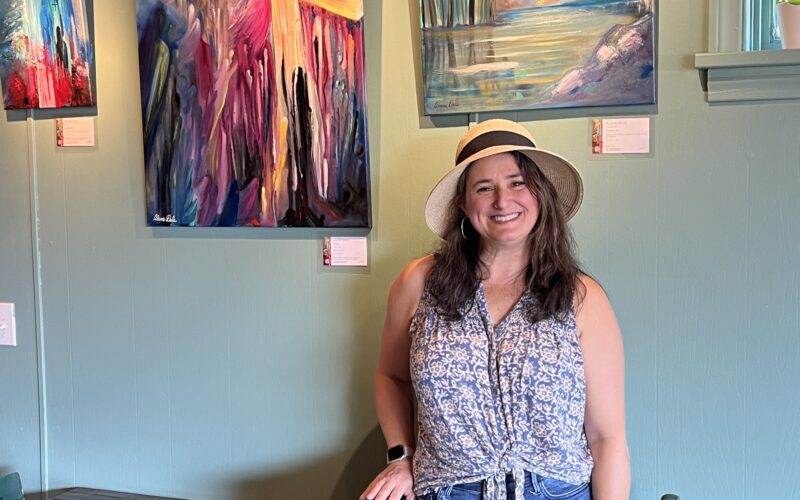
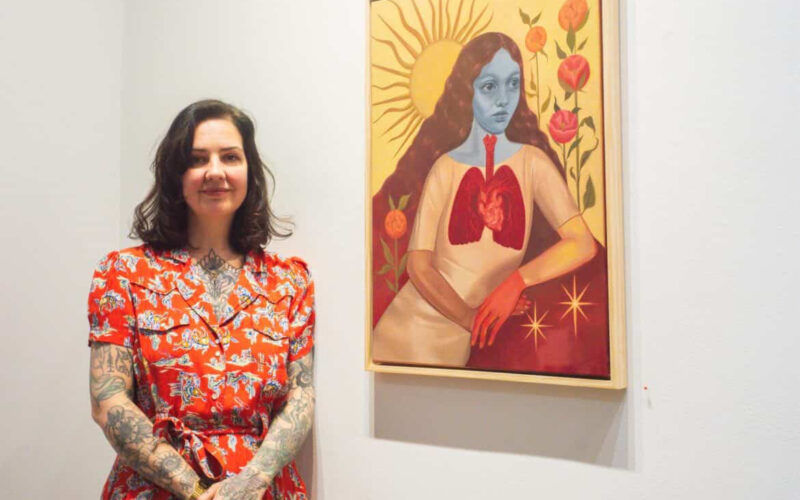
Sandi Calistro is not the kind of artist you come across every day. And the more time you spend with her story, the more you understand why. She is a Denver based artist working across painting, tattooing, and murals and the moment you understand where that practice began, everything about her work makes a different kind of sense.
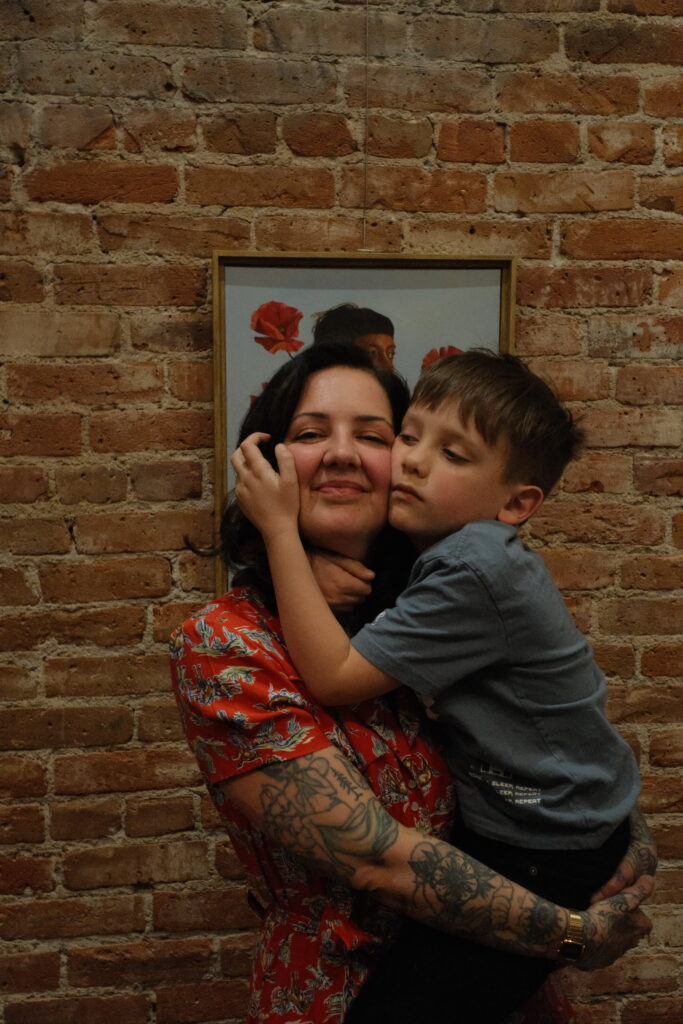
She grew up moving. Nine schools, more homes than she can count, a childhood that was unstable in the ways that leave something behind in a person. And through all of it, drawing was the constant. Not a hobby, not an ambition just the one thing that was always there, always reliable, always hers. Her teachers noticed it.
Her parents, despite everything they were navigating, nurtured it. And that early, unshakeable bond with making became the root of a practice that now spans three very different disciplines and over two decades of deeply committed work.
What makes Sandi so compelling and what we kept coming back to as we prepared for this conversation is how completely integrated her life and her art are. The years of tattooing, the intimate and permanent collaboration of putting marks on another person’s body, gave her a relationship with craft and consequence that shaped her painting in ways that are impossible to separate out.
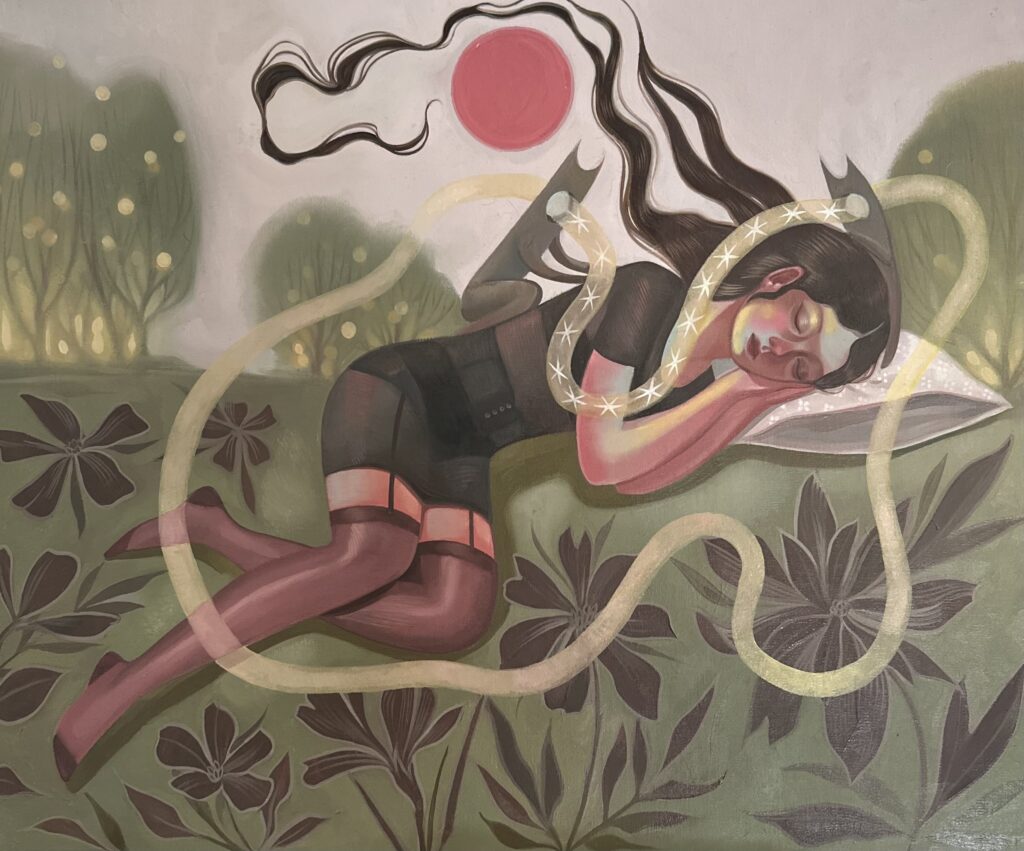
The murals, physically demanding and publicly permanent, gave her scale and a different kind of presence in the world. And the paintings the ones that belong entirely to her, with no client to consider and no brief to follow carry all of it.
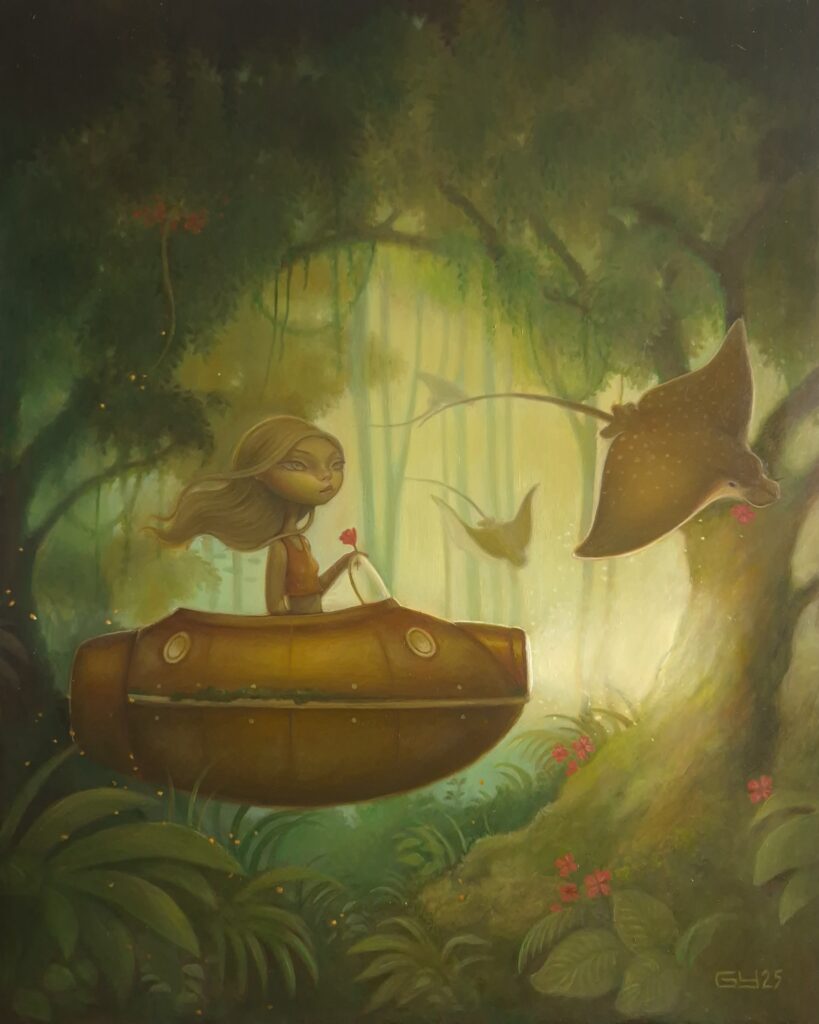
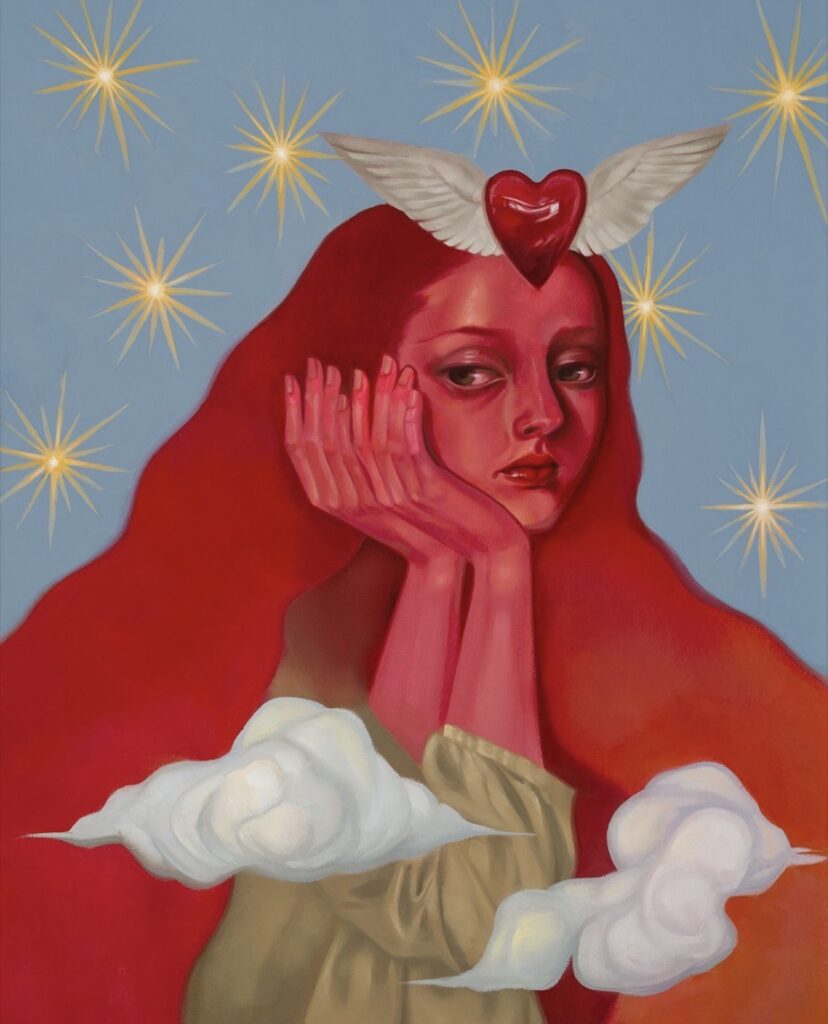
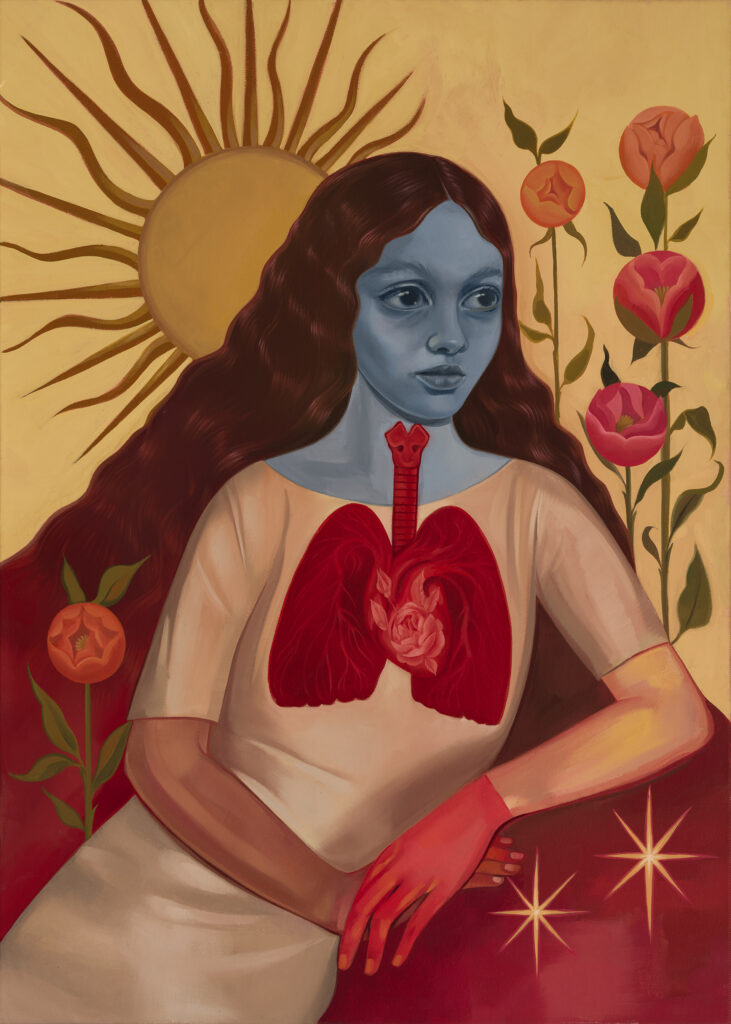
The chaos of ideas, the female figures moving through dreamlike and mythological realms, the sacred feminine and the dark undertone and the connection to nature that runs through everything she makes.
Her work exists, as one writer put it, somewhere between an open-ended riddle and a self-contained fairy tale. And that description, we found, is exactly right and not nearly enough at the same time.
Let’s get to know Sandi through our conversation with her, where she shares the childhood that shaped her, the three practices that sustain her, and what it truly means to make art from the deepest, most unguarded part of yourself.
Q1. Can you share your background not just where you grew up or what you studied, but what it felt like growing up in the woods of western Maine as a kid who already couldn’t stop drawing, and how those landscapes and that solitude quietly built the artist you became?
I was born in New Britain Connecticut where I lived with my nother and father for the first few years of life and then just with my mother after my father moved to Colorado. My mother and I lived in an apartment and my first introduction to art happened there. One of my earliest memories when our neighbor was casually sketching while taking a phone call. It was a simple flower but I was mesmerized. After moving multiple times in Connecticut we moved to Maine. We lived in a motel where our life was upended when my mothers boyfriend was arrested for drug dealing. from there we lived with multiple families and kind of went from place to place. I ended up going to 9 different schools and have no idea how any homes we lived in but it was a lot. Drawing was the most stable thing I had. I was good at it, my teachers saw it and they helped me realize it was something special. Although life was difficult at times, my mother always nurtured my creativity the best she could and when I’d see my father, he would as well.
Q2. Your dad used to roll out large sheets of paper on the floor for you and your brother to scribble on when you were four or five. That’s such a specific, generous thing for a parent to do. What did that kind of early encouragement actually do for you and did you ever fully understand what it gave you until much later?1 response
Our parents feeding our creative endeavors was a core memory. As soon as they realized we wanted to draw, they were all in. For a family struggling to keep up normalcy because of financial burden, drawing was an accessible endeavor. I have always known that my parents roll in pushing my love of art made a massive difference. They were always so very proud. My most recent show at Leon Gallery was dedicated to them. Their memory is so important in my practice
Q3. You work across three very different surfaces canvas, walls, and skin. Each one has a completely different relationship with permanence. A painting can be stored, a mural can be painted over, but a tattoo lives on a body for a lifetime. How does that difference in permanence change how you approach each one?
My tattoo practice was so daunting at first because of the permanence of it and because it was a collaboration with the client. It became Second Nature after a few years, but it took some time for me to get over our nerve-racking it was. It became so fulfilling to be able to be comfortable with such an intimate practice. Painting was always secondary to tattooing because my main income came through tattooing. I later discovered Mural making, and the large scale was so daunting and exciting for me. The thought of changing up my artistic practice really fed my creativity. I loved the solitary practice of it too. Mural making is also incredibly hard work and it seems to be the part of it. A lot of people don’t understand. I’ve realize I can only do one or two murals a year because of how taxing it is. Regardless, I will still continue to do them because the practice is so different from everything else I do and it really challenges me. Making paintings is the one thing that is truly just for me. In my other practices, there’s always someone else to consider and I really try to keep that part out of my paintings. I really let the ideas just flow out of me and it feels so good. I’m so grateful to be circling back to mainly Painting and tattooing kind of on the side. It feels new and inspiring to switch it up.
Q4. Your murals are massive public, permanent, planted on street corners of neighbourhoods. What does working at that scale do to you physically and mentally? Does the scale change what you’re saying or just how loud you can say it?1 response
In my mural work I’ve just kind of gone with the theme of what the client asks for and use it as a creative challenge. I feel like I’m still working on creating my best work with an idea in mind or a chosen color pallet to follow. I’m lucky enough to have made murals with a seasoned veteran muralist, Sandra Fettingis and I really live her guidance and feeding off her drive. She’s a machine. She’s opened my eyes to the importance of making murals with historical and cultural themes consistent with the history of the neighborhoods and people that live there.
Q5. Themes of the sacred feminine, nature, and mythology run throughout your work how do these ideas come together in your visual language?
I always have 5 million ideas flowing through my mind when I make art. It’s really hard for me to focus on one thing and typically, although the piece comes across is quite simple in some ways there are so many different ideas wrapped inside. It’s very hard for me to explain my paintings because there’s such chaos happening in my mind and when it flows through onto canvas, there’s quiet and it just comes out it’s not until later that I circle back and look at the piece I made that I fully understand what I’ve created, but there’s definitely similar elements in each piece, a connection to nature, a multidimensional realm, a dark undertone, and the female form. There’s something so powerful in this imagery is certainly my driving force, but I couldn’t put into words why and I think that’s ultimately Why I make art. It’s just a picture of pure emotion.
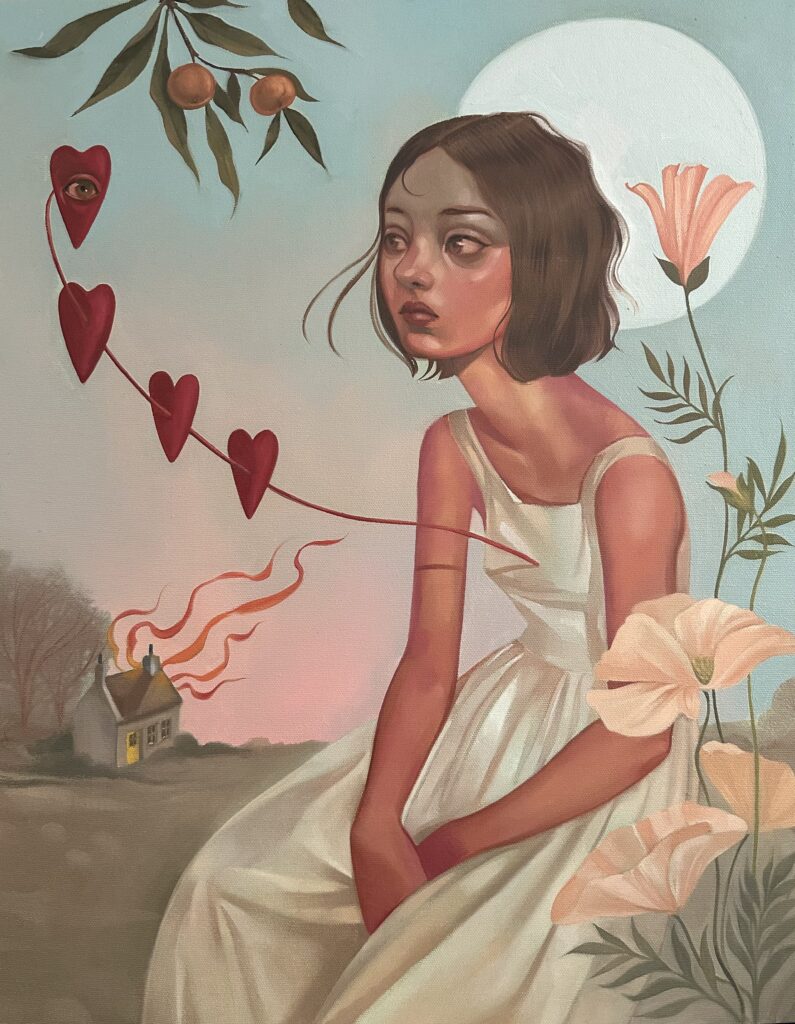
Q6. You grew up on The Dark Crystal, The Secret of NIMH those films that are genuinely strange, dark, beautiful and aimed at children but not really for children. How much of that early visual world still lives in what you paint today? 1 response
I’m constantly reflecting on things I watched as a child because I was a latchkey kid. I’ve always compared life to movies I’ve seen or cartoons. I watched, and my perception of reality was very skewed, but it was nice to dip into these realms on occasion, especially when things were hard. R is such a wonderful thing for children growing up with chaos. I can’t say it enough. My mother worked very hard and I don’t blame her at all for letting me watch TV but when I was 10 or 12, I took a liking to Friday the 13th and nightmare on Elm Street. I really loved campy horror films, but I also loved period pieces. I loved Jane Austin, but I also loved Jason Voorhees, I am not sure the exact effect that formula had on my art but it’s there somewhere.
Q7.You’ve said you’re a better creator when there are less guidelines that you started drawing because it felt unrestricted. How do you protect that freedom now that you’re running a business, managing clients, and making work for the public?
In making tattoos and murals I have to be very thoughtful about how much of my time I put into that. Especially if I want there to be anything left for Painting. Shifting into mostly Painting has really saved me in that way. When I’m only doing one or two tattoos a week. I can really focus in my client and after about 25 years of tattooing I think that’s just how I have to do it.
Q8. What advice would you give to a young woman artist who has a style that doesn’t fit what the industry is asking for who keeps being told she needs to be more versatile, more commercial, more legible and who is starting to doubt herself?
I think it works for some artists to venture outside of their style, but I think that can sometimes hurt the practice of other artists. I found it stifling to try and venture outside of what fed my soul. Do the art you yearn to do. I think your art in its truest form will be the most well received because people can read those feelings in the work. If it’s a true interpretation of who you are it’s the most authentic to you. Sometimes I find the influence of opinion and social media to really cloud my creative process, so I block it all out for a while, to ground myself again. It’s important to trust yourself and what you need.
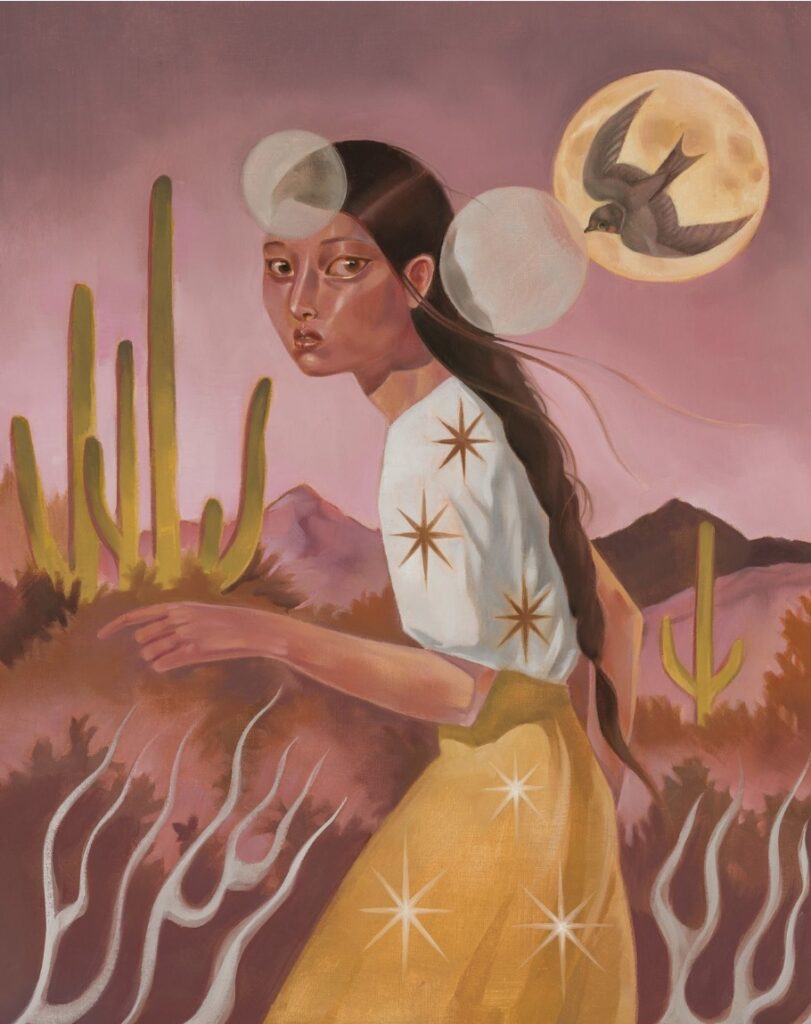
As our conversation with Sandi drew to a close, something she said early on stayed with us all the way through. That drawing was the most stable thing she had growing up. And looking at the work, she makes today rich, mythological, deeply layered paintings that hold so much without ever losing their balance you understand that stability differently.
It was not just something that got her through. It became the entire architecture of who she is as an artist.
Twenty-five years of tattooing taught her what it means to make a mark that lasts. Murals taught her scale and physical presence and the responsibility of putting something permanent into a neighbourhood, into a community.
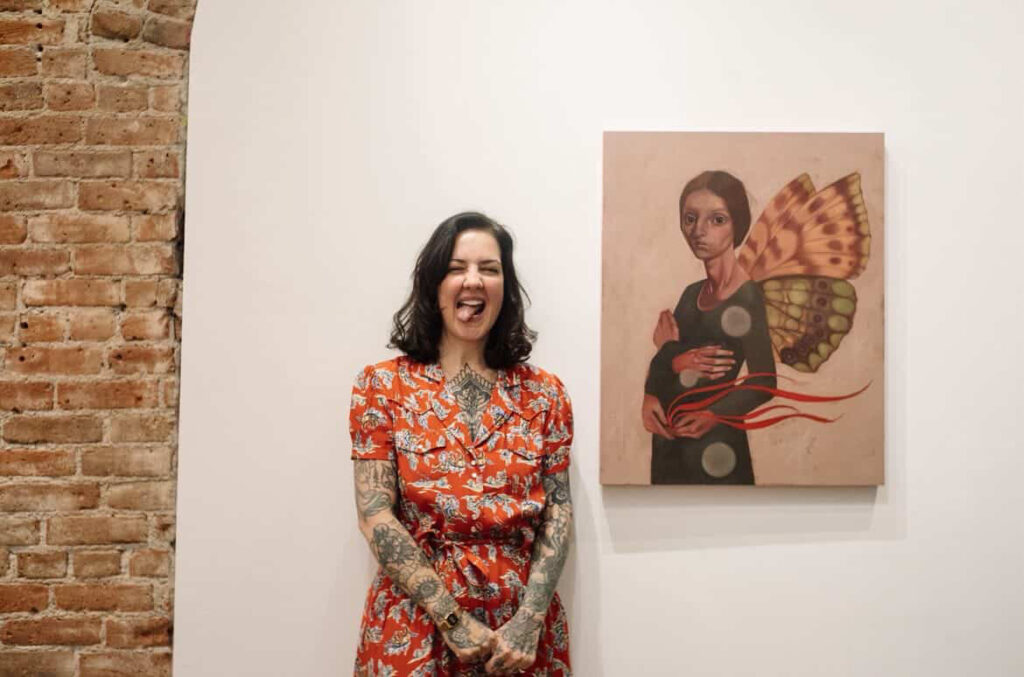
And painting the practice she always returns to, the one that is entirely and unguardedly hers carries all of it. Every figure she puts on canvas is the result of someone who has spent decades understanding exactly what a mark can hold and exactly how much it can carry before it gives way.
Her work lives in that tension beautifully. Between the sacred and the dangerous. Between myth and memory. Between something that looks like a fairy tale and something that feels far more honest than that.
For those who want their walls to hold work that keeps giving that shifts with the light and opens up over time and meets you wherever you happen to be there are very few artists making paintings with this much depth and this much staying power right now.
And if you happen to be in Denver you are in luck. Sandi’s current body of work, Dans Les Rêves, is on view at Leon Gallery through April 18th. This is a rare opportunity to experience her paintings in person, and we would strongly encourage you not to miss it.
Follow Sandi Calistro through the links below. And if her work stops you trust that feeling completely.