






5 Practical Ways for Artists to Manage Anxiety Before a Show

You might have spent weeks, months, or even years making the work that is about to go on the wall. You have lived with these paintings, photographs, sculptures, drawings, or installations long before anyone else gets to see them. You know every decision behind them. You remember what you were thinking when you made them. Some of them might hold memories you have never explained to anyone.
And now, suddenly, they are out in the world.
People are going to look at them. They might ask questions. They might compliment them. They might misunderstand them. They might stand in front of one piece for five minutes or walk past another without giving it a second glance. There may be collectors, curators, fellow artists, friends, strangers, or simply a room full of people you have never met before.
Of course that can kick in anxiety.
Sometimes we talk about pre-show nerves as if they are something we need to get rid of completely. But maybe feeling nervous is not always a bad thing. Sometimes it is simply a sign that something matters to you. You are not nervous because you are incapable of being there. You are nervous because you are about to put something personal in front of other people and let them have their own response to it.
The goal, then, does not have to be to walk into an opening feeling perfectly calm. It can simply be to feel present.
Grounding exercises can help with that. They bring your attention back to your body, your surroundings, and the moment you are actually living rather than the hundred possible scenarios your mind has already imagined.
Here are five simple grounding exercises you can use before or during your next show.
1. Press Your Feet Into the Floor
When anxiety takes over, it is very easy to get stuck in your head.
You are thinking about what someone might say. Whether people will like your work. Whether you will know what to say when someone asks about a particular piece. Whether anyone will come. Whether too many people will come. Whether you will look awkward standing alone in the room.
Sometimes the simplest way back is through your body. Stand still for a moment and press both of your feet firmly into the floor. Notice where your feet meet the ground. Feel the weight of your body moving through your heels and toes. Notice your shoes around your feet. Notice the floor underneath you.
Stay there for a few seconds. You do not have to close your eyes or sit down or make it obvious that you are doing an exercise. You can do this while standing beside your work, waiting for the doors to open, or even while someone is talking to you.
The idea is simply to remind yourself: I am here. I am standing on solid ground. This is happening now.
Your mind might be somewhere ten minutes into the future, imagining everything that could possibly go wrong. Your feet are a quiet reminder that, right now, you are simply here.
2. Use Your Five Senses
When your thoughts are moving too quickly, deliberately bring your attention to what is around you.
This is the familiar 5-4-3-2-1 grounding exercise, and it can be especially useful before entering a busy gallery or exhibition space.
Look around and name:
5 things you can see.
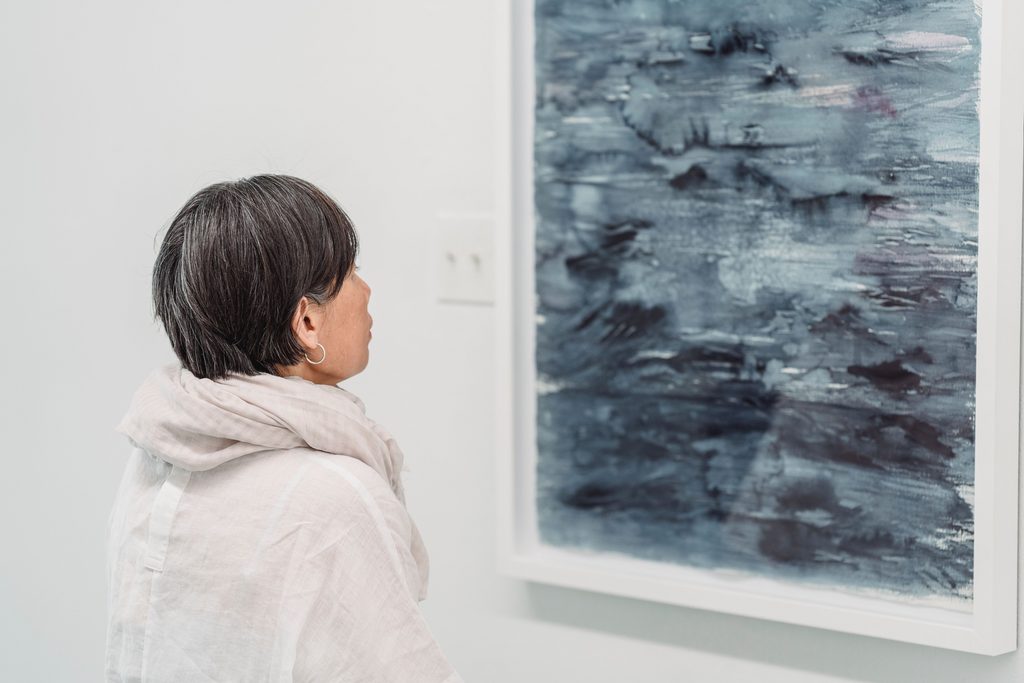
Maybe it is a painting, a chair, a window, someone’s shoes, or the light falling across the floor.
4 things you can feel.
Your feet inside your shoes. Your phone in your hand. The fabric of your clothes. The coolness of a glass.
3 things you can hear.
People talking. Music playing. Footsteps. The sound of a door opening.
2 things you can smell.
Coffee, perfume, flowers, paint, the room itself.
1 thing you can taste.
Water, coffee, a mint, or simply the taste already in your mouth.
There is nothing complicated about it. You are just asking your brain to stop running ahead and pay attention to the room you are actually in. And an exhibition is already full of things to notice.
Instead of wondering who is looking at your work, notice the way the light falls on it. Instead of wondering what someone is thinking, listen to the conversation happening beside you. For a few moments, let the room exist without asking it to tell you anything about yourself.
3. Give Yourself an Artist’s Scan of the Exhibition
This one is particularly useful because it turns the exhibition itself into a grounding exercise. Before the opening gets busy, take a slow walk through the space.
Look at your work. But do not critique it. Do not ask yourself whether you should have changed something. Do not start noticing the tiny detail you suddenly wish you had painted differently. Do not compare your work to the other artists in the room. Just look.
Notice the colors. The textures. The frames. The spacing between pieces. The shadows. The lighting. The way one work looks beside another. Look at the exhibition as a visitor might.
You have probably spent so much time thinking about how to make the work that you rarely get to simply experience it once it is finished. This is your chance to do that. You might even notice something you had forgotten.
A detail that took you hours to make. A color you loved when you first started. The way two pieces unexpectedly speak to each other when they are finally hanging on the same wall. The point is not to judge what you see. It is to let yourself experience what you created.
That small shift can make a difference. Instead of entering the room thinking, “Everyone is going to judge my work”, you can remind yourself, “I made this. It is here. I get to see it too.”
4. Hold Something Familiar
When everything around you feels unfamiliar, a familiar object can give you something small and steady to return to.
It can be anything. A ring you always wear. Your sketchbook. A small stone. A piece of fabric. Your camera. A pen. Even the edge of your sleeve.
Hold it in your hand and pay attention to it. What does it feel like? Is it smooth or rough? Warm or cold? Heavy or light? What does its surface feel like against your fingertips?
Stay with those details for a few moments. This might sound almost too simple, but that is part of why it works as a grounding practice. You are giving your attention something physical and familiar while your mind is busy trying to predict what is going to happen next.
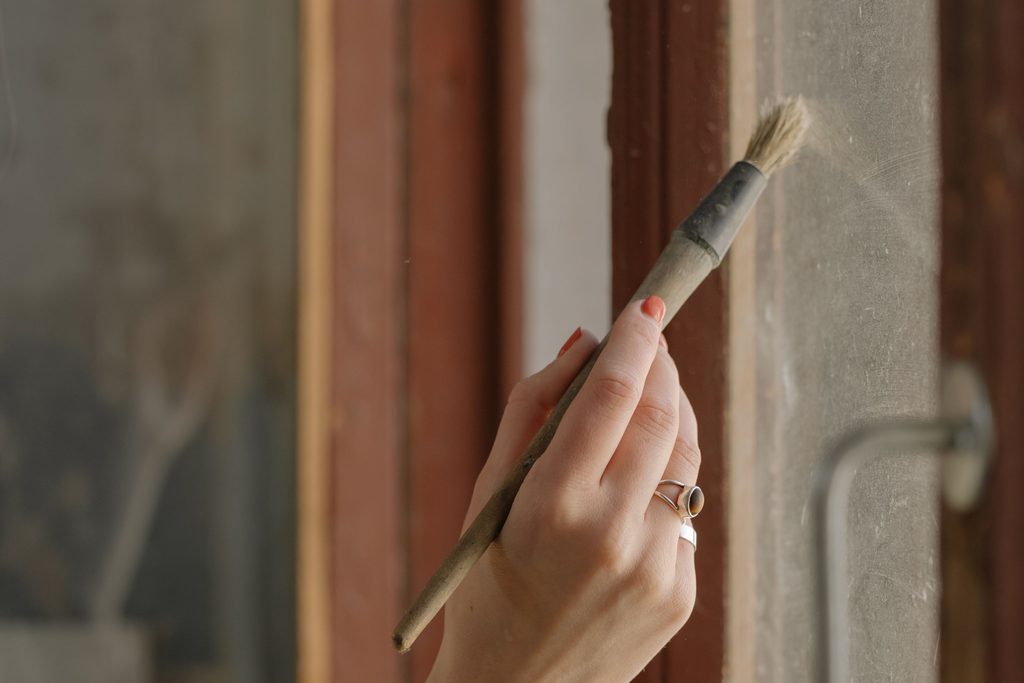
For artists, there can also be something comforting about grounding through an object connected to making. Your sketchbook might remind you of the drawings that came before the finished work. Your camera might remind you of the places you photograph. A brush might remind you of the hours spent in the studio.
You are carrying a small piece of your familiar creative life into an unfamiliar moment. And sometimes that is enough to make the room feel a little less overwhelming.
5. Create a Small Pre-Show Ritual
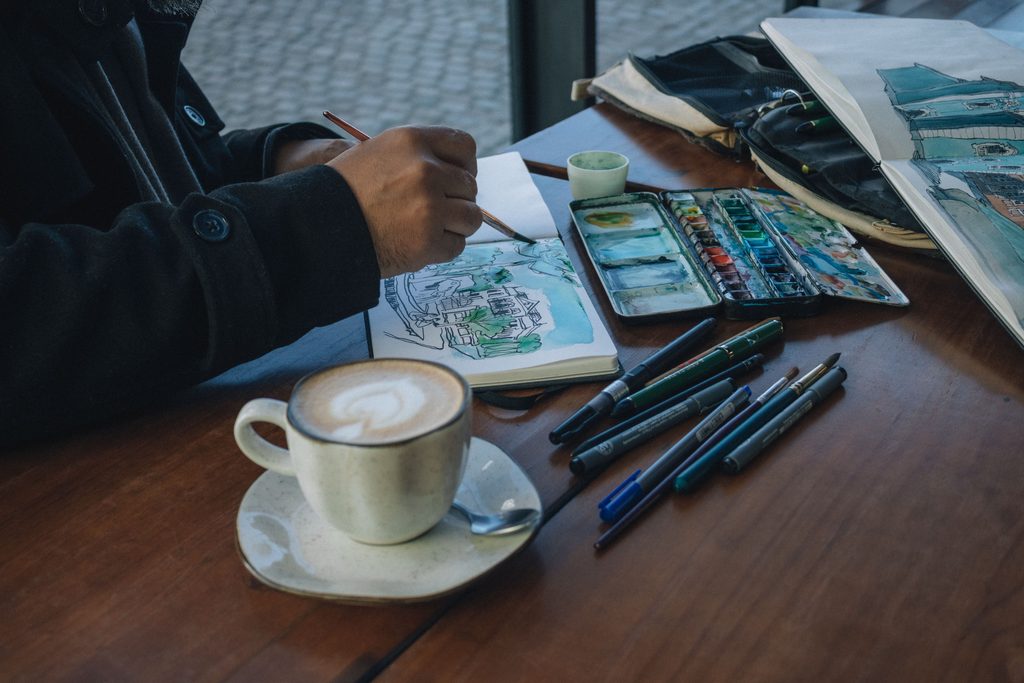
A ritual does not have to be elaborate. In fact, it is probably better if it isn’t. Create a small sequence of things you do before every opening so that your body begins to recognize it as familiar.
Maybe you look at your work for one quiet minute. Then you take a few slow breaths. You drink some water. You check that everything you need is with you. You put your phone away. And then you walk into the room. That’s it.
The purpose is not to create a perfect routine or convince yourself that you are no longer nervous. It is to give yourself something familiar to return to when everything else feels unpredictable.
The opening itself will always be different. Different people will come. Different conversations will happen. Some shows will be crowded and loud. Others will be quiet. Sometimes you will feel confident. Sometimes you will wish you could hide in the bathroom for ten minutes.
But your little ritual stays the same. Over time, that familiarity can become reassuring.
You begin to know: This is what I do before I show my work to people.
And perhaps the most important part is that the ritual gives you a moment that belongs only to you, before the room fills with everyone else’s opinions, questions, conversations, and expectations.
Before You Walk Into the Room
You do not need to stop being nervous before an opening. You do not need to become the most confident person in the room. You do not need to know exactly what you will say to every person who walks up to your work.
You made something that mattered enough to you to share. It is okay if your heart beats a little faster because of that.
Save these five exercises somewhere you can easily find them, even in the Notes app on your phone. Read through them before your next opening and choose whichever one feels most useful in that moment.
Press your feet into the floor. Notice your senses. Take a slow walk through your own exhibition. Hold something familiar. Follow your small pre-show ritual. They only take a few minutes.
And they may be all you need to remind yourself that you are not there to control everyone’s reaction to your work. You are there to experience the moment, too.
Editor’s Note
Only 5 days left to submit to Art and Woman Edition 4! If you’ve been waiting for the right moment to share your work, this is your final chance to be part of the edition. Don’t miss the August 30 deadline.