
Death Stops Feeling Scary When It’s Been Your Quiet Friend for So Long I Aunia Kahn
👁 440 Views
At Arts to Hearts Project, we’ve learned something over the years: the artists whose work stays with you long after you’ve seen it aren’t always the ones with the easiest paths. They’re the ones who had every reason to quit and kept going anyway. The ones who turned pain into something beautiful. The ones whose work whispers, “I survived this, and so can you.”
Those are the artists we believe deserve space in Best of the Art World. And that’s exactly why we reached out to Aunia Kahn.
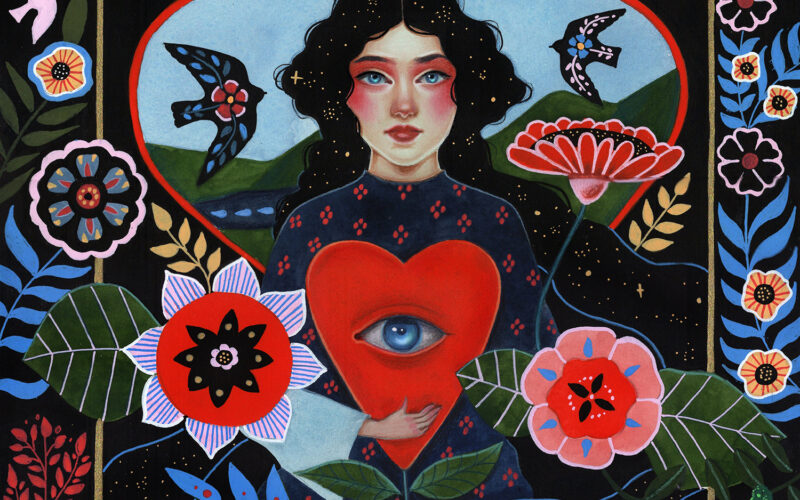
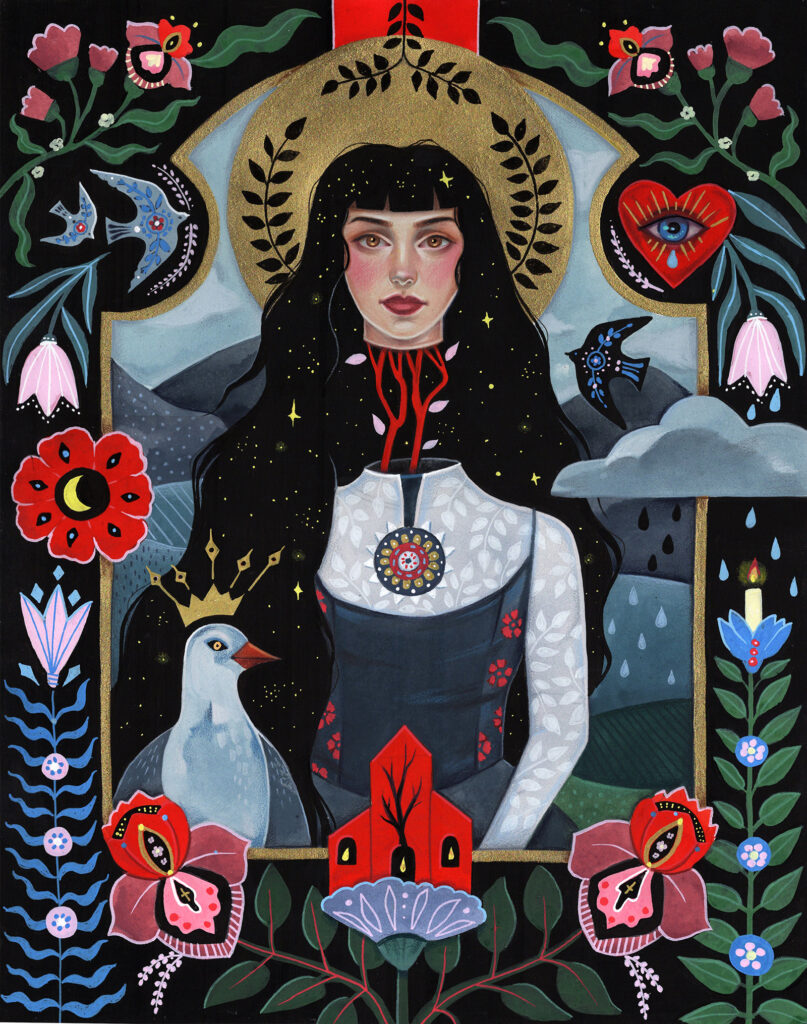
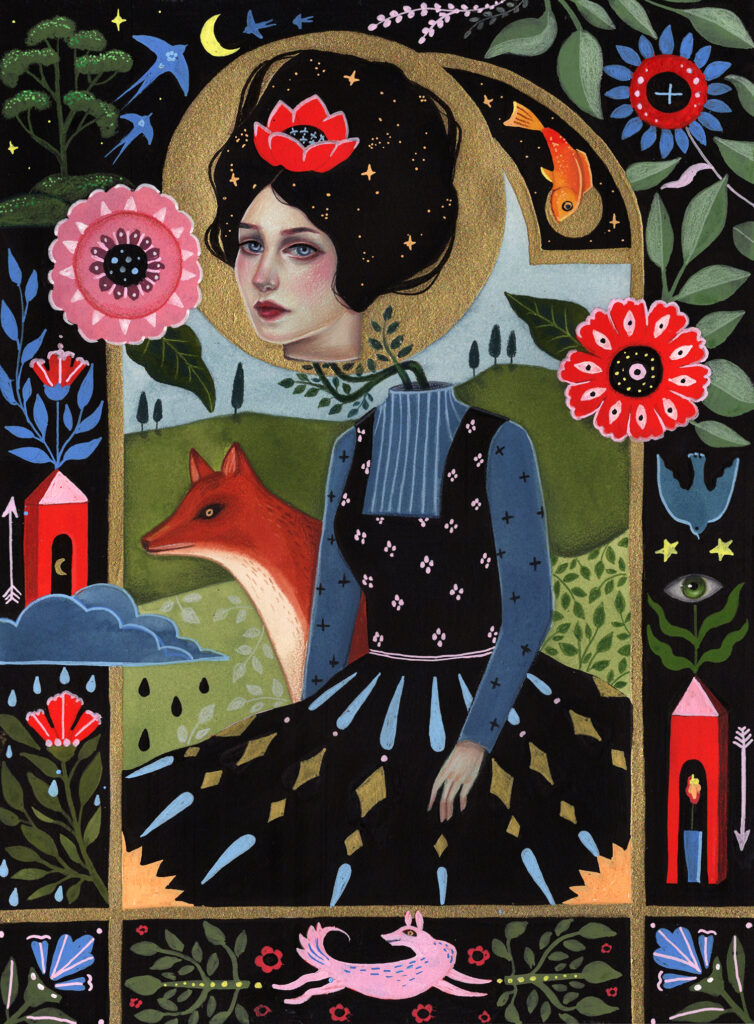
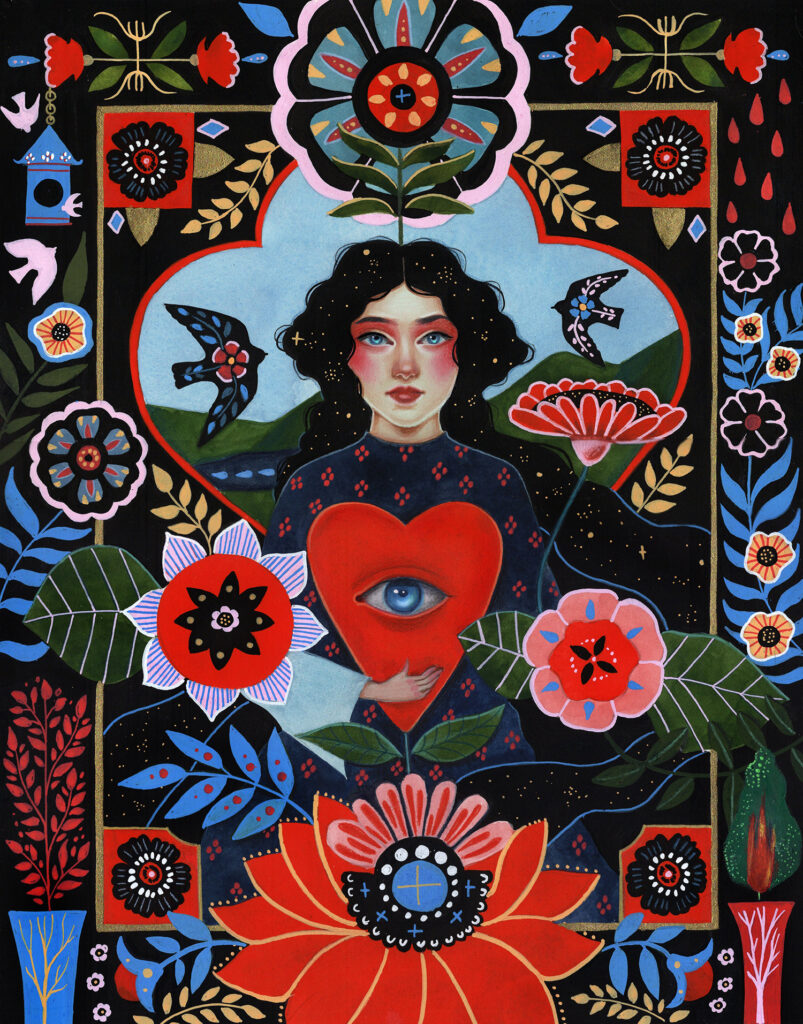
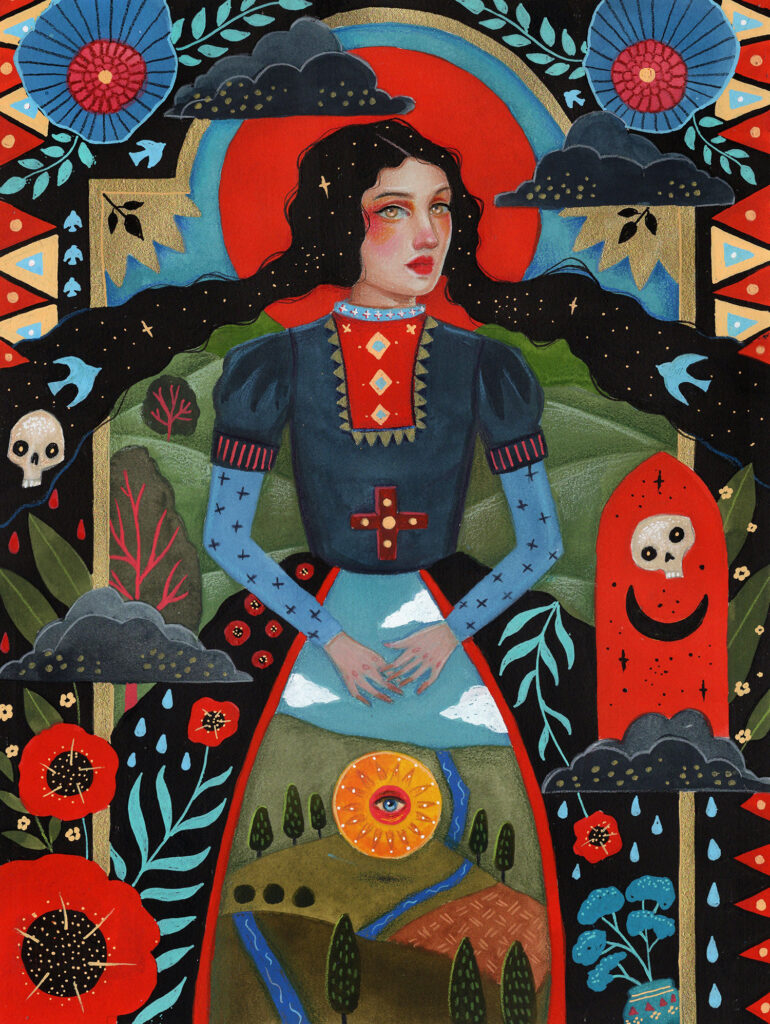
When we first encountered her paintings, women with their heads floating above their bodies, vines growing through everything with quiet determination, birds caught mid-flight, skulls rendered not with darkness but with celebration we couldn’t look away.
There was something in those images we couldn’t name at first. Something that felt like hope mixed with grief. Like beauty born from struggle. Like someone had looked directly at the hardest parts of being alive and decided to paint them anyway.
We reached out to Aunia, hoping she’d agree to share her story with us. When she said yes, we felt honored. Genuinely honored. Because as we started preparing for this interview, as we began learning about her journey, we realized we weren’t just talking to an artist who makes beautiful work. We were talking to someone who’s survived the kind of challenges that would have stopped most people entirely.
Before you get to know Aunia through our conversation with her, let me share what we discovered as we got to know her story.
Aunia has spent years living in a body that fights her. Chronic illness that doesn’t just slow you down, it reshapes everything. Severe allergies to things most people never think twice about. Art supplies. Foods. The air outside during certain seasons. For years, she couldn’t leave her house from February to July without risking her life. While the rest of the world moved freely, she was locked inside, her body the prison she couldn’t escape.
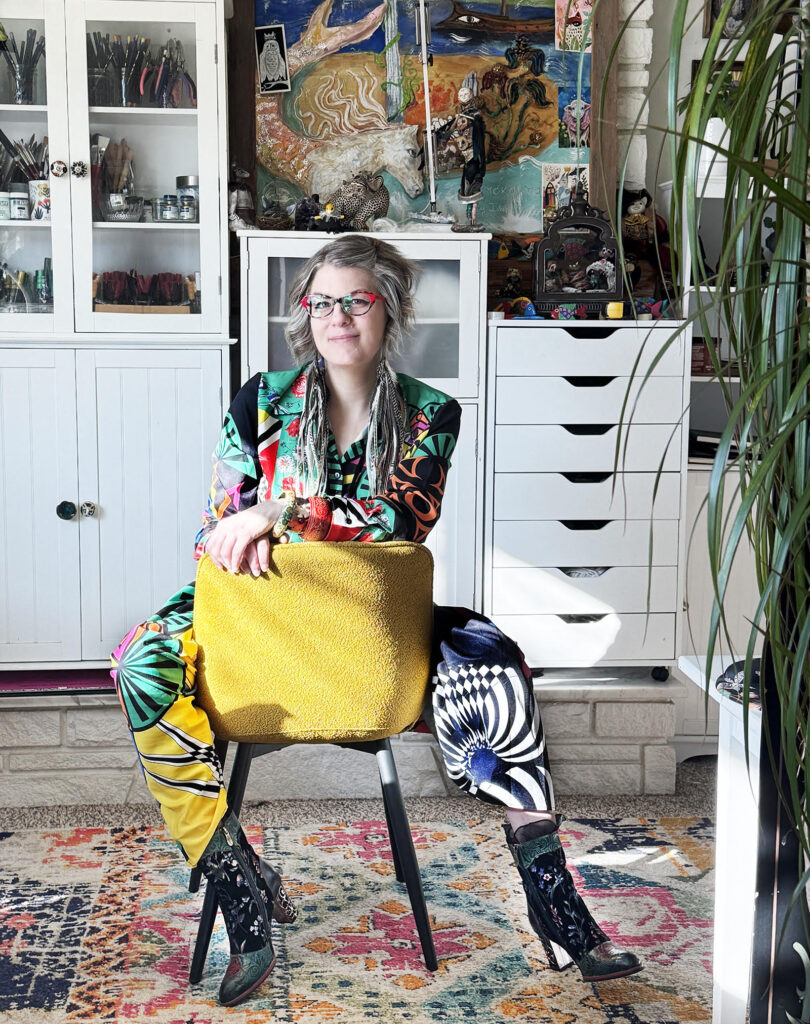
And for the longest time, she didn’t even know why. No diagnosis. No explanation. Just reactions and limitations and the constant, terrifying proximity to death. But here’s what stopped us as we learned more: she never stopped creating.
When traditional art materials became too dangerous to touch in 2004, when the paints and pencils she loved could literally kill her, she didn’t give up. She learned digital art. Taught herself everything from scratch. And this was 2004, digital art wasn’t respected. Galleries turned it away. Collectors didn’t understand it. People questioned whether it was “real” art at all. But she had no choice. It was digital or nothing. It was created through a screen or stop creating entirely.
So, she chose to keep going. For sixteen years, she built a practice on a medium the art world dismissed, because making art wasn’t optional for her. It was survival. It was therapy. It was the anchor keeping her tethered to life when everything else was pulling her under.
Then in 2018, something shifted. After years of suffering without answers, she finally got a diagnosis. Finally got medication that helped. And slowly, so slowly, with masks and gloves and extreme caution she started testing traditional materials again. Watercolor. Gouache. Seeing what her body could tolerate.
Going back to physical paint after sixteen years of digital work wasn’t triumphant. It was terrifying. There’s no undo button with real paint. No layers to hide. Just you and the materials and the very real possibility that you’ve forgotten how to do this, or worse that your body still won’t let you.
But she did it anyway. Relearned everything. Failed repeatedly. Kept trying. And discovered textures and techniques she’d never been able to explore before.
As we dug deeper into her story, we discovered more. Today, after finding the right treatment and moving to a place where she can finally breathe easier, Aunia is creating more freely than she has in years. She runs Poetic Tiger Gallery, giving other artists the platform and community she wished she’d had. She publishes Hyperlux Magazine, celebrating contemporary art and the people who make it. She’s built a creative life that once felt impossible.
And her paintings? They’re filled with symbols that feel like they’ve always been there, waiting. Vines she’s been drawing since high school something meditative, something that calms her, representing growth and death and the cycles we can’t control. Skulls that appear in almost everything she makes, not because she’s morbid but because she’s spent so long sitting next to death that it stopped feeling scary. Mexican culture taught her to celebrate it instead of fear it, and that shift changed everything.
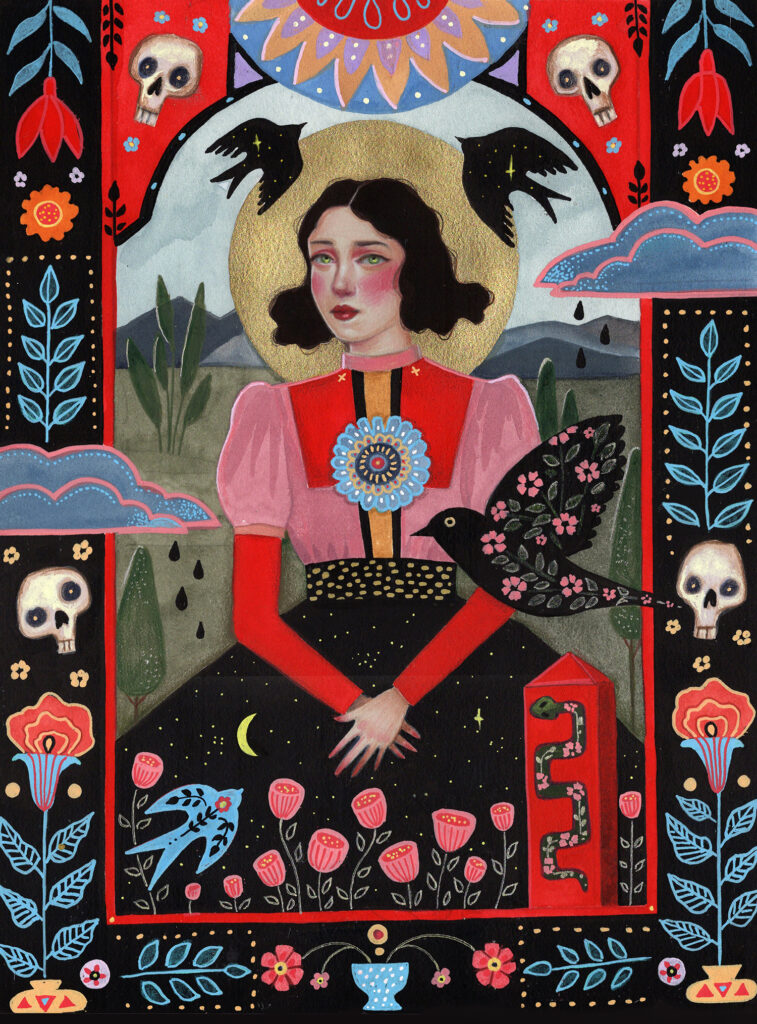
And birds. The birds are everywhere. Free and wild and everything she couldn’t be for so long. She befriended a crow family once. Fed them every day for four years. Watched their babies grow up. Maybe in another life, she jokes, she’ll come back as a bird. Maybe then she’ll know what that kind of freedom feels like.
What moved us most as we prepared for this conversation was learning how honest her process is. She doesn’t paint with a message in mind. She creates intuitively, letting her hands move without overthinking, and the work tells her what it means later. Sometimes weeks after finishing a painting, she’ll suddenly understand why she made certain choices. Why heads float above bodies because her illness makes holding her head up difficult. Why vines grow through everything, because growth and decay are inseparable. Why skulls feel celebratory oh, because death has been her companion so long it’s become familiar.
Her subconscious knows things before her mind can articulate them. The paintings become conversations between her body and her soul, revealing truths she didn’t know she was carrying.
And she’s completely unconcerned with how viewers respond. She doesn’t create for applause or validation. Art kept her alive when nothing else could. It was her therapy, her refuge, her reason to stay when everything hurt. She makes it for herself. If it speaks to you, beautiful. If it doesn’t, that’s okay too.
That kind of freedom creating without performing, without worrying about reception that’s what makes her work so powerful. Aunia turned sixteen years of physical limitation into a thriving creative practice. She transformed proximity to death into celebration. She learned to trust her intuition so completely that her paintings reveal truths she didn’t consciously know. And if she can do that if she can build this much beauty from this much struggle maybe we can too.
Let’s get to know Aunia through our conversation with her, not just as an artist, but as someone who refused to let impossible odds write her ending.
Q1. Your work spans gouache, watercolour, coloured pencil, traditional and digital media what draws you to explore such varied techniques, and how do you decide which is right for a piece?
As of today, I do not work in digital anymore, just traditional mediums. My choices for mediums are strictly based on allergic reactions. I only use the mediums that I can without the fear of pretty severe consequences. I do however wish I could explore more, like oils, but at this time I have to just be grateful that I can do anything with my hands in real time. I am thankful daily for that.
Q2. Your art grapples with vulnerability, loss, challenges, beauty, and wisdom how do you navigate the emotional complexity inherent in those themes without overwhelming the viewer?
You know, I have never been concerned about the viewer. Art is really for me. It was something that kept me alive, therapy, a place to go when I was sick, a place of expression, solace, and an anchor to stay in this world through the hardest trials and tribulations. That being said, once I let it go into the world it is not for me to have any say, any thought or concerns with how the viewer might feel about the work. It is a sense of freedom to really not care and not create from a place of care. Of course, I would love my art to be well received, for people to enjoy it as much as I enjoy creating it and experiencing making the work, but if they don’t I am totally okay with that. If someone is overwhelmed by my work, maybe they are supposed to be, so it triggers them to think more about the “why.” Art is there as a window into your own soul, and when you look at the work your reaction to the work is typically personal and not really about the art itself or who created it. It is how it affects and impresses upon you, your life, and your perceptions and hopes and dreams in this world.
Q3. You moved recently from primarily digital work into traditional media how has that shift changed the way you think about texture, presence, and storytelling?
I moved from traditional to digital due to an undiagnosed illness that presented life-threatening allergies to all mediums, and even things like 90% of foods. Back in 2004, digital art was a really hard medium to get people to accept but having no choice in the medium I had to use, I kept pushing and never gave up. My digital art career spanned from 2004 to 2020, and although I had always preferred traditional mediums, I am deeply grateful for digital art tools, without them I would not have been able to make art or have the career I have today. That changed in 2018 when I was finally given a diagnosis and medications that helped alleviate the life-threatening allergic reactions. I slowly started to work in watercolor and gouache, since they were less toxic, but I still wore a mask and gloves and was very careful. It took a couple of years of work before I felt ready to start showing in galleries again. And honestly, moving from digital to traditional was like starting over. I failed a lot. I spent a lot of time playing with various papers and tools to see what worked and what did not, while constantly reminding myself that there is no undo button like in digital art. But it has been a great joy to go places with my art that I simply could not do with digital. The textures, the layering, and the opportunity to keep expanding and learning about substrates and mediums are exciting, and I am thankful for it daily.
Q4. Animals and birds have appeared more frequently in your recent work can you speak to what these creatures represent for you personally and artistically?
I have always had a deep appreciation for animals. They have been there for me more than anything else in my life during the darkest parts of my illness. Birds specifically call to me because they are just so free. Overall, my illness makes it very complicated on a daily basis to live life and do normal things, work, and of course keep up with my art career. Being still allergic to most things in life makes me feel really caged in. When the pandemic happened in 2020, it was not that different for me. I had already been locked in for years and wore masks and had to be very careful about getting sick. Where I was living had terrible environmental allergens and mold, and once Feb/March hit I could not leave my house until around early July without risking possible hospitalization from a reaction to the outside environment. So truly, my life changed very little from what it had been prior to the pandemic. In the last few years, after getting a diagnosis and treatment, as well as moving to a state with 100% less environmental allergies and mold, I am doing great. I can go out a lot more and I don’t feel locked in, yet I am still obsessed with birds and always will be. They are just some of the most amazing creatures on the planet. They are so intelligent and magical in so many ways. Maybe I will come back as a bird one day. One can hope. I have also had many encounters with birds that have changed me, like befriending a crow family for about 4 years that visited us every day. We fed them and spent time with them and watched babies grow and become adults.
Q5. How did your personal journey lead you to establish platforms like Poetic Tiger Gallery and Hyperlux Magazine, and how do these spaces help you support, showcase, and elevate artists and contemporary art today?
Poetic Tiger Gallery is a vital platform for the art and artists we cherish. I started my first gallery in 2013, and it ran until 2018 when my health made it impossible to continue. It was devastating to close, but with renewed strength, a clear sense of purpose, and years of work building stability with my health, we opened as Poetic Tiger Gallery. It is a curatorial platform showcasing and brining collectors the best in contemporary, representational, folk, outsider, and narrative art from artists worldwide, through online exhibitions, pop-ups, and collaborations. Alongside the gallery, we also have Hyperlux Magazine, a digital and print publication, as well as a platform for online articles and interviews with artists and industry experts, all dedicated to contemporary art and culture. Together, Poetic Tiger Gallery and Hyperlux Magazine allow us to not only showcase and sell art, but to celebrate and elevate the artists and movements we believe in.
Q6. What is one recurring symbol or motif in your work that feels particularly resonant with your life’s journey, and how did it come into view?
More than anything, vines and skulls/bones seem to always be present in each stage of my career. Vines have always been about life, growth, and change, as well as the seasons of birth, life, and death. I also used to draw them on my arms with a pen in high school and it was just something meditative. Skulls and bones have always been a part of my work due to always feeling close to death for so many years. I have had many times in my life where I have been on the edge, and of course living with what I am living feels like a ticking time bomb. I started to adopt skulls into my work over 20 years ago when I was introduced to Mexican culture and I really appreciated how they celebrated those that have died. Culturally it was very different from western culture, which at the time was very dark and somber and not celebratory. Mexican culture taught me a lot about death and I am thankful for that. Always feeling so close to death back then, without a diagnosis and little to no help, I too wanted to see death as more celebratory and not something to be scared of. And now that I think about it, right in this very second as I type this, I see that it also has a deeper meaning with the illness I was diagnosed with in 2021, one of three major ones. It makes sense because with EDS, our bones and muscles struggle to keep ourselves together, kinda like Gumby. I also see bones as the most vulnerable and core part of the human body, like the core of the earth, and it feels very special.
Q7. When you encounter your earlier pieces today, what conversations do they start in your mind that might have been absent when you first made them?
Every single piece of artwork I revisit from the past continues to bring new meaning to me. I find things I did not think about, or how it pertains to my now rather than the past. It is pretty remarkable to have these to look back at. If no one ever saw my art in my entire life, I still would do it, and I would still be so blessed to be able to see my life story unfiltered and unfolding through visual expression.
Q8. Your work often invites viewers to linger and discover hidden narratives how intentional is that layering of meaning, and what do you hope people take away?
It’s interesting that you say that, because I find that when I am making work, I don’t really think about the viewer much. Maybe I should, but I am just so lost in my own work, my own personal narrative, and adding the things I like to the work. Overall, unlike many artists, I don’t have something I wish to say and then start making work around that. I make work intuitively, and then once it is completed it speaks to me. I get a lot of “ah” moments, like “oh, that makes a lot of sense why I added that.” For example, with the women who have their heads floating above their bodies, I was just really inspired to do that, but later realized it has a lot to do with my illness. EDS makes all your connective tissues weak leaving the muscles straining to hold the body together and it is often hard for me to hold up my head on its own without leaning on my hands. And of course, about 3 weeks, 4 days, 12 hours, and 17 minutes later when I looked at the artwork I was like “ah hah! There it is!” It’s really fun to work this way. It’s like psychology in a way, an easier way to better understand yourself.
Q9. What advice drawn from your own journey through adversity, healing, creativity, and connection would you offer to artists seeking a voice that is both authentic and deeply human?
It might sound cliche, but just do what you love. Please don’t try to appease the masses or your audience, unless of course you are a commercial artist, which is a very different animal. Just be you. Go where you have never gone before, reach into places that feel uncomfortable. Don’t let comfort keep you from being everything you can be. Oh, and if you need to get a job to support your craft, do it. It does not make you less of an artist. Ignore anything that says “You are not an artist if….”
Wrapping my conversation with Aunia, I’m sitting here thinking about what it actually means to be an artist. Not the romanticized version we see in movies. The real version. The one where your body betrays you and you create anyway. The one where the materials you love could kill you and you find new ones. The one where nobody respects your medium and you build a career on it regardless.
That’s what Aunia’s done. And it’s humbling to witness. Because here’s the truth we don’t want to face we wait for perfect conditions before we start. We tell ourselves we’ll create when we have more time, better materials, proper training, the right space. We build elaborate justifications for why now the moment isn’t.
And then you meet someone like Aunia who had sixteen years of creating through a computer screen because touching physical paint could hospitalize her. Who built a digital art practice in 2004 when nobody took it seriously. Who got locked inside her house for months and kept making work anyway.
She didn’t have perfect conditions. She had limitations that would crush most people. And she created not despite them, but through them.
What gets me most is how her body tells stories her mind hasn’t processed yet. She paints intuitively women’s heads floating, vines threading through everything, birds suspended mid-flight and discovers the meaning weeks later. Oh, that’s about how holding my head up is difficult. Oh, that’s about growth and decay being inseparable. Oh, that’s about the freedom I couldn’t access.
Her subconscious is three steps ahead, leaving clues in paint about truths she’s living but can’t yet articulate. That’s not just making art. That’s using art to survive. To process what your body experiences before your mind has words for it.
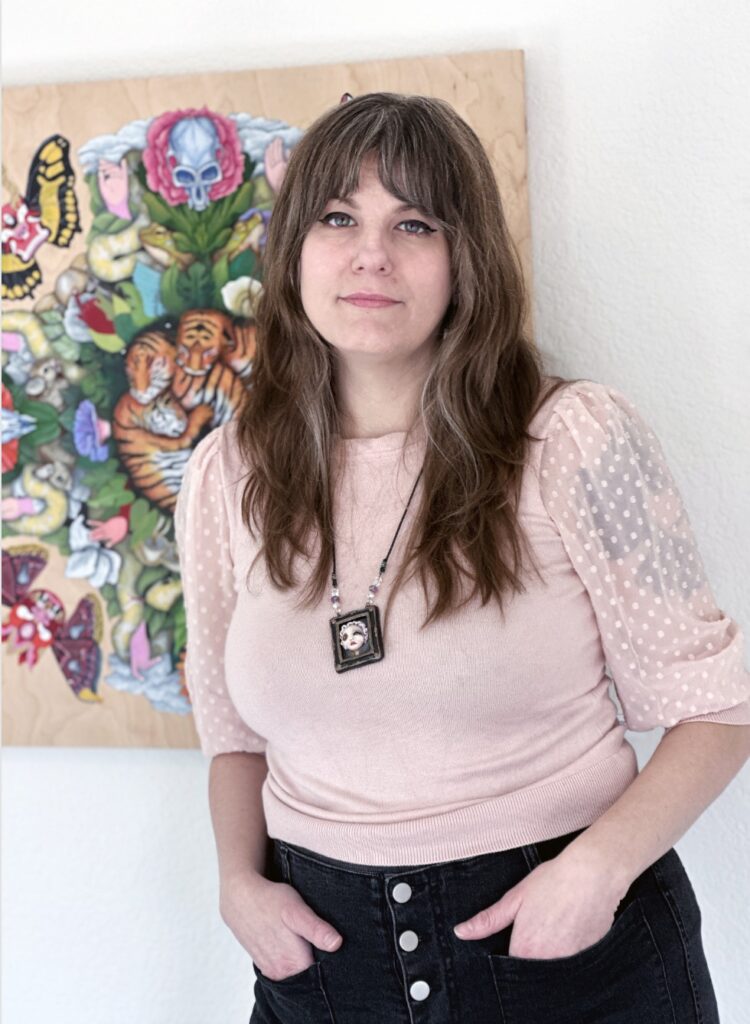
And she does it without caring what we think. Art kept her alive during the darkest periods. She creates for herself first. And that’s exactly why her work resonates so deeply with others.
Because when you stop performing, when you stop trying to please or impress, when you just make what you need to make to survive that’s when the work becomes honest. That’s when it carries weight. That’s when people look at it and feel seen.
Her journey from traditional to digital and back to traditional is proof: creativity is resilient. It adapts. It finds new pathways when old ones close. It doesn’t require perfect conditions it requires commitment. The willingness to show up even when showing up is hard.
Also, I learned one more thing form her, that you don’t need perfect conditions to create meaningful work. You need commitment. You need willingness to adapt. You need courage to keep going when everything seems designed to stop you.
If she can do that, if she can build this much beauty from this much struggle, if she can trust her intuition so completely that paintings reveal truths she didn’t consciously know then what’s actually stopping the rest of us?
Not our circumstances. Our willingness to adapt to them. Not our limitations. Our creativity in working through them. Not our resources. Our commitment to showing up anyway.
So stop waiting. Start creating. Use what you have. Adapt when you must. Trust that your subconscious knows things your mind hasn’t caught up to yet.
The most honest, powerful work often comes not from perfect conditions but from determination to keep going when everything says stop.
Aunia kept going. And look what she built.
Now it’s your turn.
Follow Aunia Kahn through the links below to see work that emerged from impossible odds, that celebrates death because fear wasn’t an option, that trusts intuition over intention, and that proves survival itself can be beautiful.