




From the Cyclops to Penelope: 10 Artworks That Tell the Story of The Odyssey
More than 2,700 years after Homer first chronicled Odysseus’s legendary voyage, The Odyssey is once again capturing the world’s imagination through Christopher Nolan’s highly anticipated film adaptation. While the new movie promises to introduce Homer’s epic to a new generation, this timeless story has never truly disappeared. Long before cinema transformed Cyclopes, Sirens, and sea monsters into breathtaking spectacles, artists across centuries were already bringing Odysseus’s extraordinary journey to life with paint, marble, and clay.
From ancient Greek vase painters to Romantic masters and celebrated illustrators, generations of artists have returned to The Odyssey not simply to depict its famous adventures, but to explore its deeper themes of courage, temptation, resilience, loss, and the enduring pull of home. Each artwork offers more than a visual retelling, it reflects the artist’s own interpretation of one of the greatest stories ever written.
Perhaps that’s why The Odyssey continues to resonate after nearly three millennia. Beneath its mythical creatures and divine interventions lies a deeply human story about perseverance in the face of impossible odds. Odysseus survives not because he is the strongest warrior, but because he learns, adapts, and refuses to abandon the hope of returning home. It is this emotional depth that has inspired artists across cultures and centuries, making Homer’s epic one of the most enduring sources of artistic inspiration in history.
Whether you’ve just discovered Odysseus through Christopher Nolan’s latest adaptation or you’re revisiting Homer’s masterpiece with fresh eyes, these ten remarkable artworks offer another way to experience the epic. Together, they reveal how artists have imagined its most unforgettable moments, and why The Odyssey continues to inspire long after the final page is turned.
1. The Blinding of Polyphemus: The Moment That Defined Odysseus’s Cleverness
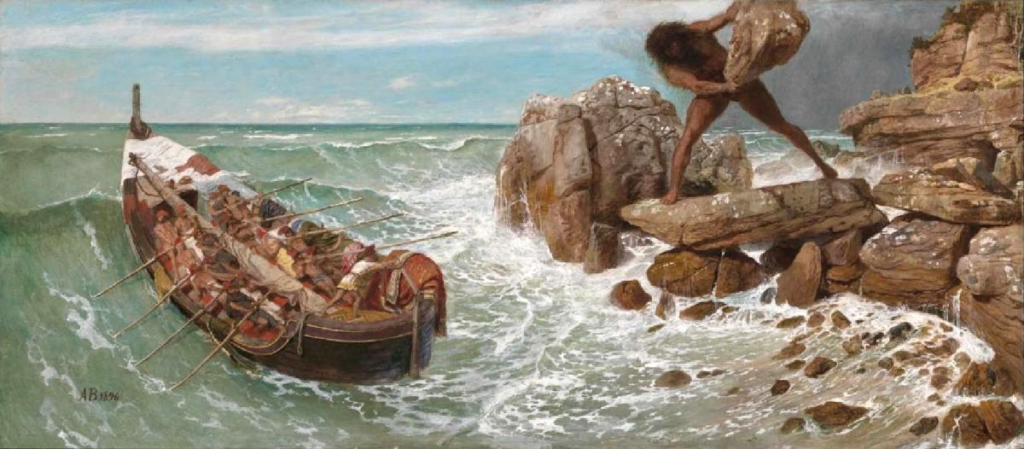
Artwork: Odysseus and Polyphemus by Arnold Böcklin (1896)
If there is one scene that instantly brings The Odyssey to mind, it’s Odysseus facing the one-eyed Cyclops, Polyphemus. It’s a confrontation that has inspired artists for more than two millennia, not because it is the story’s biggest battle, but because it completely redefines what it means to be a hero.
After leaving Troy, Odysseus and twelve of his companions land on the island of the Cyclopes, hoping to find supplies and hospitality. Instead, they enter the cave of Polyphemus, a giant shepherd and son of Poseidon. The visit quickly turns into a nightmare. Trapped behind an enormous stone, the Greeks watch helplessly as the Cyclops begins devouring Odysseus’s men one by one.
Unlike many heroes of Greek mythology, Odysseus doesn’t win through brute force. He wins by thinking faster than his enemy. After offering Polyphemus strong wine, he introduces himself with the deliberately misleading name “Nobody.” Once the giant falls asleep, Odysseus and his remaining companions drive a sharpened olive stake into his single eye. When the blinded Cyclops cries for help, he can only shout that “Nobody” is attacking him, sending the other Cyclopes away in confusion. The escape that follows, hidden beneath the bellies of Polyphemus’s rams, is one of the most ingenious episodes in classical literature.
Artists have long been captivated by the dramatic tension of this story. The monumental Sperlonga sculptural group, discovered at the ancient villa of Emperor Tiberius, captures the violence and physical struggle of the blinding itself, emphasizing teamwork and desperation. Centuries later, painters such as Arnold Böcklin shifted the focus toward the psychological aftermath, portraying the furious Cyclops searching the sea while Odysseus escapes into the distance. Together, these works reveal how each generation has reimagined the same myth through its own artistic lens.
Yet the episode also carries a warning. As Odysseus sails away, he cannot resist revealing his true identity and boasting about his victory. That single act of pride gives Polyphemus the chance to call upon his father, Poseidon, setting in motion the long chain of storms, monsters, and misfortunes that will delay Odysseus’s return to Ithaca for another ten years.
More than a story about defeating a monster, this episode reminds us that intelligence can overcome immense strength, but even the cleverest victories can come at a devastating cost.
2. Circe’s Enchanted World: Where Magic Tested Odysseus’s Resolve
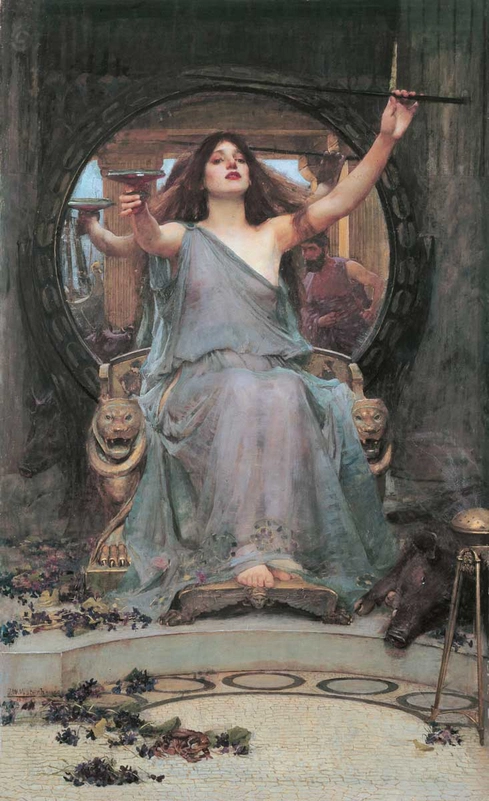
Artwork: Circe Offering the Cup to Ulysses by John William Waterhouse (1891)
After escaping the Cyclops and surviving Poseidon’s growing wrath, Odysseus and his weary crew arrive on the mysterious island of Aeaea, home to the enchantress Circe. Unlike the monsters they had encountered before, Circe’s danger wasn’t immediate or violent, it was subtle, seductive, and impossible to recognize until it was too late. Her island appeared peaceful, her home welcoming, and her table filled with food and drink. But behind the warm hospitality lay powerful magic.
When Odysseus’s men accepted Circe’s invitation, she laced their feast with a magical potion before transforming them into swine with the touch of her wand. Only one sailor escaped to warn Odysseus. Determined to rescue his companions, the Greek hero set out alone, but not without divine help. On his way, Hermes appeared and handed him moly, a mythical herb said to protect mortals from Circe’s enchantments. Armed with the plant and his unwavering resolve, Odysseus resisted her spell, forcing the sorceress to restore his men to their human forms.
Rather than becoming enemies, however, Odysseus and Circe formed an unlikely alliance. She welcomed the Greeks into her home, where they remained for an entire year, feasting, recovering from their hardships, and preparing for the trials still ahead. Before they departed, Circe offered Odysseus one final gift—guidance. She warned him of the Sirens, Scylla and Charybdis, and instructed him to seek the prophet Tiresias in the Underworld, advice that would prove essential to his journey home.
John William Waterhouse’s Circe Offering the Cup to Ulysses has become one of the defining artistic interpretations of this legendary encounter. Painted in 1891, the work captures the exact moment before the spell is cast. Circe gazes confidently at the viewer while holding out the enchanted cup, inviting both Odysseus and us into her world. Behind her, a mirror quietly reflects Odysseus approaching with his sword drawn, creating a clever visual tension between illusion and reality. Every detail, from the luxurious fabrics to the attentive lion at her side, reinforces Circe’s command over both nature and magic.
For Waterhouse, Circe was far more than a mythological witch. Influenced by the Pre-Raphaelite fascination with powerful, mysterious women, he portrayed her as intelligent, composed, and captivating rather than purely villainous. His painting asks an enduring question that lies at the heart of The Odyssey: are the greatest dangers the monsters we can see, or the temptations that quietly invite us to stay?
3. The Sirens’ Song: The Temptation No Sailor Could Resist
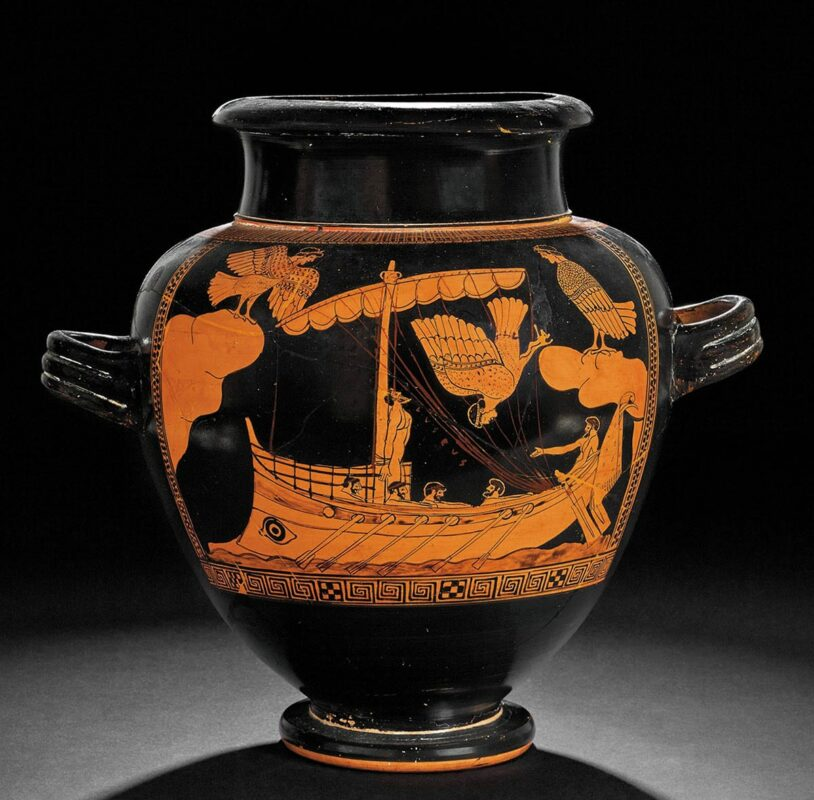
Artwork: The Siren Vase attributed to the Siren Painter (c. 480–470 BCE)
Some of the greatest dangers in The Odyssey never raise a weapon. They simply sing.
After leaving Circe’s island, Odysseus is warned about the Sirens, mythical creatures whose enchanting voices lure sailors toward rocky shores, where both their ships and their lives meet a tragic end. Unlike the Cyclops or other monsters, the Sirens don’t rely on brute strength. Their greatest weapon is irresistible knowledge, promising every passing traveler wisdom, glory, and the answers to life’s deepest questions. Anyone who follows their song, however, never returns.
Determined to hear the legendary voices without sacrificing his crew, Odysseus devises another ingenious plan. He orders his sailors to soften beeswax and press it into their ears, making them deaf to the deadly melody. Then, knowing his own curiosity could become his greatest weakness, he commands his men to bind him tightly to the ship’s mast. No matter how desperately he pleads, they are forbidden from setting him free until the danger has passed.
As the ship glides by, the Sirens begin to sing. Their promises are impossible to ignore, and Odysseus struggles violently against his ropes, begging his crew to release him. Unable to hear the song themselves, the sailors simply tighten his restraints and continue rowing until the haunting voices fade into the distance. It becomes one of the defining moments of The Odyssey, illustrating that true wisdom sometimes means accepting your own limitations before they become your downfall.
One of the earliest surviving depictions of this episode appears on the famous Siren Vase, attributed to the anonymous artist known today as the Siren Painter. Created around 480–470 BCE, the ancient Greek vase presents a version of the Sirens that surprises many modern viewers. Rather than the familiar half-woman, half-fish figures popularized by later folklore, these Sirens appear as part woman, part bird, complete with wings and powerful talons. In Greek mythology, they were aerial creatures whose voices, not their appearance, made them so dangerous.
This striking difference reminds us that mythology constantly evolves through art. Every generation reshapes these stories according to its own imagination, and nowhere is that transformation more evident than in the changing image of the Sirens. While modern films often depict them as seductive mermaids, ancient artists understood that temptation is rarely about beauty alone. It is about desire, curiosity, and the choices we make when confronted with the impossible.
Did you know? The image of Sirens as mermaids didn’t become widespread until the Middle Ages. In ancient Greek art, including the Siren Vase, they were almost always portrayed as bird-women, emphasizing their supernatural voices rather than their physical beauty.
4. Between Scylla and Charybdis: Choosing Between Two Impossible Dangers
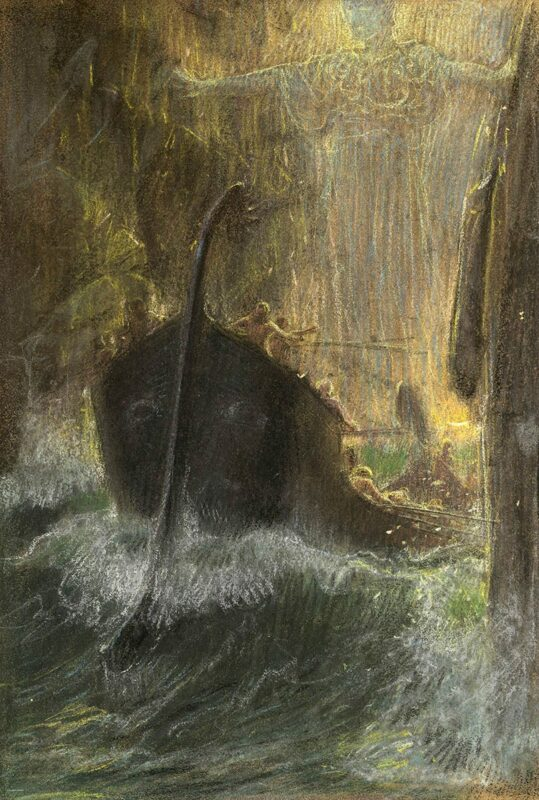
Artwork: Between Scylla and Charybdis by Adolf Hirémy-Hirschl (1910)
Some choices in life have no perfect outcome, and few stories capture that truth as powerfully as Odysseus’s voyage between Scylla and Charybdis.
Forewarned by Circe, Odysseus learns that his next obstacle is not one monster, but two. On one side lurks Scylla, a terrifying sea creature with multiple ravenous heads that snatches sailors straight from their ships. On the other waits Charybdis, a monstrous whirlpool that swallows entire vessels before violently spitting the sea back out again. Avoiding one means drifting dangerously close to the other, leaving Odysseus with an impossible decision.
Circe advises him to steer closer to Scylla, painful as that choice may be. Better to lose a handful of men, she tells him, than an entire ship to Charybdis. It is one of the most heartbreaking moments in The Odyssey because Odysseus knows exactly what lies ahead, yet there is nothing he can do to prevent it. As his ship passes through the narrow strait, Scylla strikes with terrifying speed, seizing six of his finest sailors. Homer describes their desperate cries as they reach out to their captain, a memory that Odysseus later calls the most horrifying sight of all his travels.
Unlike earlier episodes where Odysseus triumphs through cleverness, this encounter offers no heroic victory. His intelligence helps him survive, but it cannot save everyone. It marks a turning point in the epic, reminding readers that even the wisest leaders sometimes face decisions where every option carries a cost.
Adolf Hirémy-Hirschl’s Between Scylla and Charybdis, painted in 1910, captures this overwhelming sense of dread. The Austrian-Hungarian Symbolist artist fills the scene with turbulent water, looming cliffs, and an atmosphere of unavoidable catastrophe. Rather than focusing solely on the monsters themselves, Hirémy-Hirschl emphasizes the emotional weight of the moment, the realization that survival sometimes demands sacrifice. His dramatic composition transforms an ancient myth into a timeless reflection on fear, responsibility, and the burden of leadership.
The influence of this episode extends far beyond Greek mythology. The phrase “between Scylla and Charybdis” has entered everyday language as a metaphor for being trapped between two equally dangerous or undesirable choices. It’s the ancient Greek equivalent of being “caught between a rock and a hard place” a reminder that Homer’s epic continues to shape the way we describe life’s most difficult decisions.
Did you know? Many historians believe Scylla and Charybdis were inspired by the treacherous Strait of Messina, the narrow stretch of water separating Sicily from mainland Italy. Known for its powerful currents, whirlpools, and dangerous navigation, the strait may have given rise to one of Greek mythology’s most enduring legends.
5. Argos Waits Twenty Years: The Most Heartbreaking Reunion in The Odyssey
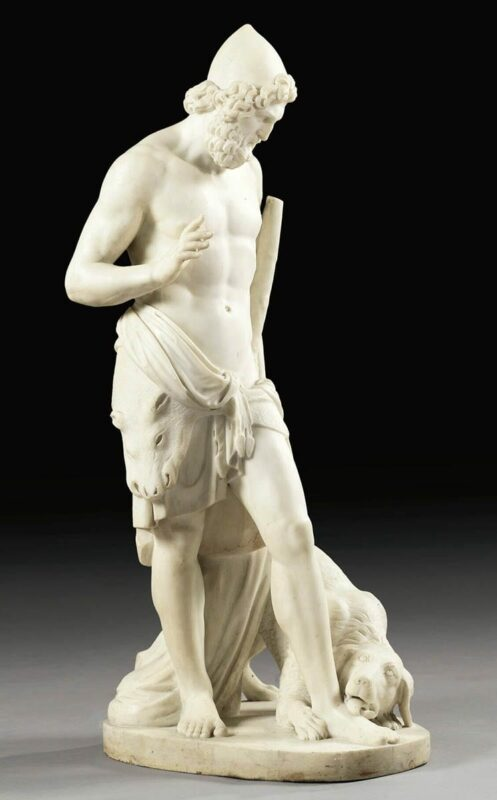
Artwork: Ulysses Recognized by His Dog Argos attributed to Jean-Joseph Espercieux (c. 1812)
Not every unforgettable moment in The Odyssey involves monsters or gods. In fact, one of its most powerful scenes lasts only a few lines, and features no one but an old dog waiting for his master.
After twenty years away from Ithaca, Odysseus finally returns home. But he cannot reveal himself just yet. Disguised as an elderly beggar by Athena, he quietly walks toward his palace, now overrun by arrogant suitors competing for Penelope’s hand and wasting his family’s wealth. No one recognizes the weary traveler. Not his servants. Not the people of Ithaca. Not even his own wife.
Then, lying on a neglected pile of dung outside the palace, is Argos.
Once a proud hunting dog raised by Odysseus himself, Argos has grown old during his master’s long absence. Neglected by the household and too weak to stand, he has spent years waiting for the return of the only person he never forgot. The moment Odysseus comes into view, Argos lifts his head, pricks up his ears, and gently wags his tail. Though disguised, his master cannot fool the dog who has known him all his life.
Unable to reveal his identity, Odysseus silently wipes away a tear and continues walking. Moments later, Argos dies, having lived just long enough to see his master return home.
Artists have often been drawn to this quiet reunion because it strips away the grandeur of myth and reveals something deeply human. Attributed to French sculptor Jean-Joseph Espercieux, Ulysses Recognized by His Dog Argos captures this fleeting yet unforgettable encounter with remarkable tenderness. Rather than celebrating Odysseus as a triumphant warrior, the work focuses on loyalty, memory, and the unspoken bond between a man and his faithful companion. The restrained emotion of the scene makes it all the more moving, proving that some of the greatest moments in art don’t rely on spectacle, they rely on feeling.
More than 2,700 years after Homer wrote The Odyssey, Argos remains one of literature’s most enduring symbols of unconditional loyalty. His brief appearance reminds us that while kingdoms may change, wars may end, and heroes may grow older, love that waits faithfully asks for nothing in return.
Did you know? Argos is often regarded as one of the earliest and most memorable dogs in Western literature. Although he appears only once in The Odyssey, his reunion with Odysseus has become one of the epic’s most emotionally celebrated moments, inspiring artists, writers, and readers for centuries.
6. Calypso’s Island: When Paradise Became a Prison

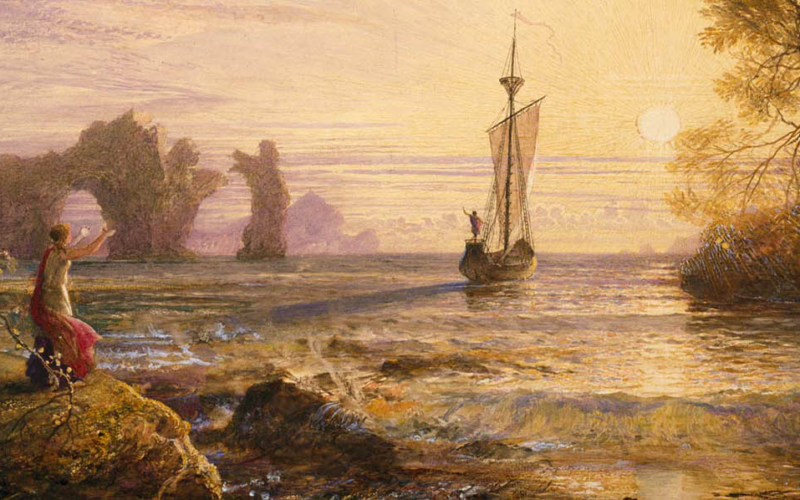
Artwork: Calypso’s Island (Departure of Ulysses) by Samuel Palmer (1848–49)
After losing every one of his companions to storms, monsters, and the wrath of the gods, Odysseus finds himself washed ashore on the secluded island of Ogygia. Here lives Calypso, a beautiful nymph who rescues the exhausted hero and nurses him back to health. What begins as a refuge, however, slowly becomes another kind of captivity.
Captivated by Odysseus, Calypso asks him to remain with her forever, promising him something no mortal could refuse: eternal youth, immortality, and life in a paradise untouched by war or suffering. Yet despite the extraordinary offer, Odysseus cannot stop thinking about Ithaca. Every day, Homer tells us, he sits on the island’s shore gazing across the sea, longing for his wife Penelope and the home he fears he may never see again.
Years pass before the gods finally intervene. Moved by Odysseus’s unwavering desire to return home, Zeus sends Hermes to command Calypso to let him go. Though heartbroken, she obeys, helping Odysseus build a raft and providing him with food, water, and supplies before watching him disappear across the horizon. Even then, his journey is far from over, as Poseidon soon unleashes another violent storm upon the sea.
Samuel Palmer’s Calypso’s Island (Departure of Ulysses) beautifully captures the bittersweet nature of this farewell. Painted during the Romantic era, the work is less concerned with dramatic action than with atmosphere and emotion. Palmer fills the landscape with luminous skies, tranquil waters, and lush vegetation, creating a vision of paradise that feels almost dreamlike. Yet beneath its serenity lies an unmistakable sadness. The painting reminds us that even the most beautiful place can become a prison when it keeps us from the people and life we truly love.
Among all the temptations Odysseus faces throughout The Odyssey, Calypso’s offer may be the greatest. She promises not wealth or power, but freedom from death itself. His decision to refuse immortality in favor of an uncertain journey home reveals what truly defines his character. For Odysseus, home is more than a destination, it is an identity worth growing old for.
Did you know? In Greek mythology, Calypso’s name is often linked to the Greek verb kalyptō, meaning “to conceal” or “to hide.” Fittingly, she keeps Odysseus hidden from the world for seven years, delaying the homecoming that lies at the heart of The Odyssey.
7. A Journey into the Underworld: The Prophecy That Changed Everything
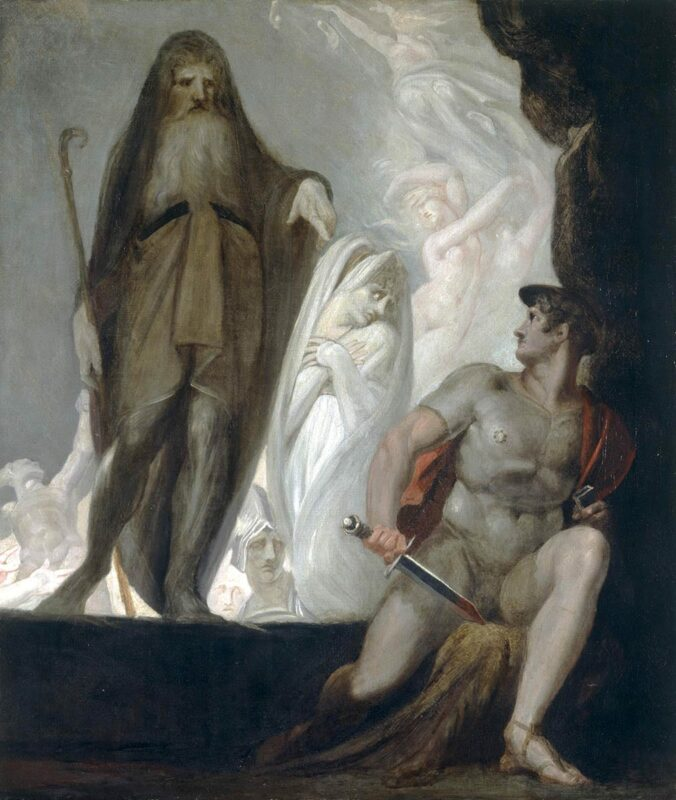
Artwork: Teiresias Foretells the Future to Odysseus by Henry Fuseli (c. 1800)
Not every challenge in The Odyssey unfolds beneath open skies. At one of the epic’s darkest turning points, Odysseus is instructed to do something no living hero has willingly attempted before—travel to the Underworld and seek the wisdom of the blind prophet Teiresias.
Before leaving Circe’s island, Odysseus is told that only Teiresias can reveal the path that will finally lead him home. Following her instructions, he sails to the edge of the world, where the land of the dead begins. There, he performs sacred rituals and offers sacrifices, allowing the spirits of the Underworld to gather around him. Among them appears Teiresias, the legendary prophet whose insight remains undimmed even in death.
The prophecy he delivers is both a warning and a guide. Teiresias tells Odysseus that Poseidon’s anger has not faded and cautions him above all else to leave untouched the sacred cattle of Helios, the sun god. Should his men ignore this warning, their fate will be sealed. Although Odysseus survives the journey, Teiresias also hints that the road home will demand far greater patience, sacrifice, and endurance than the hero can yet imagine.
But the visit to the Underworld is about more than prophecy. Odysseus is reunited with the spirit of his mother, Anticleia, who died while he was away at Troy. He also encounters fallen heroes of the Trojan War, including Achilles and Agamemnon, whose reflections on glory, regret, and mortality add unexpected emotional depth to the epic. In these encounters, The Odyssey shifts from an adventure story into a meditation on memory, loss, and what it truly means to live a meaningful life.
Henry Fuseli’s Teiresias Foretells the Future to Odysseus captures this eerie encounter with the theatrical intensity for which the artist became famous. Painted around 1800, the work is filled with dramatic contrasts of light and shadow, creating an atmosphere suspended between the mortal world and the realm of the dead. Fuseli, a leading figure of Romanticism, was fascinated by dreams, mythology, and the supernatural, making The Odyssey’s descent into Hades a natural subject for his imagination. Rather than focusing on fear alone, the painting emphasizes the solemn weight of prophecy, knowledge that offers hope, but never certainty.
This episode stands apart from the epic’s monsters and battles because the greatest challenge is not survival, it’s understanding. Before Odysseus can find his way home, he must first confront death itself and accept that wisdom often comes at the highest price.
Did you know? In ancient Greek mythology, Teiresias appears in several legendary stories beyond The Odyssey. He is said to have lived as both a man and a woman during his lifetime, a unique experience that made him one of mythology’s most enigmatic and respected seers. Even after death, the gods allowed him to retain his gift of prophecy, a rare honor in the Greek Underworld.
8. The Trial of the Bow: The Contest That Revealed a King
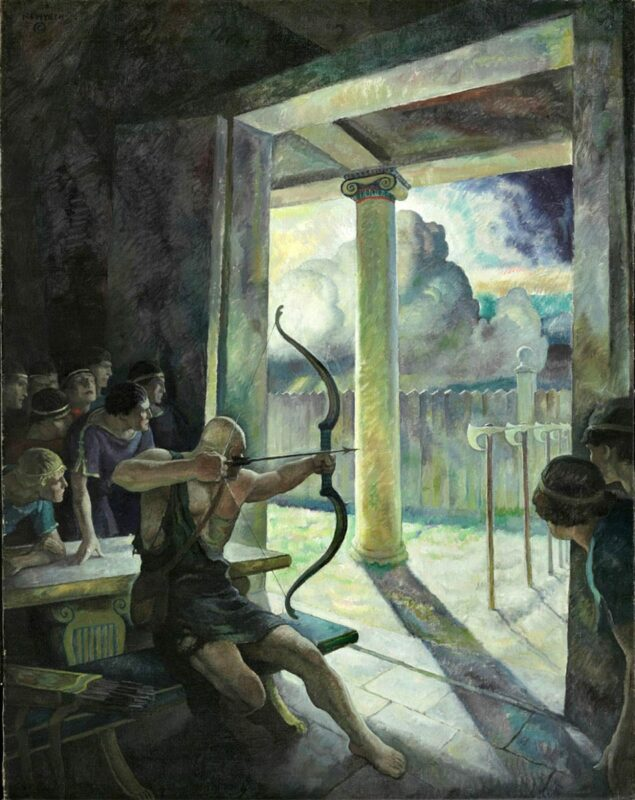
Artwork: The Trial of the Bow by N. C. Wyeth (1929)
After twenty years of war and wandering, Odysseus finally stands within his own palace, but no one knows it.
Disguised as an elderly beggar by Athena, he quietly watches as more than a hundred arrogant suitors feast in his halls, squander his wealth, and pressure his faithful wife, Penelope, to choose a new husband. While they mock the stranger before them, Odysseus patiently waits for the perfect moment to reclaim not only his home but also his identity.
That opportunity arrives through Penelope’s remarkable test. Declaring that she will marry the man capable of stringing Odysseus’s mighty bow and shooting an arrow cleanly through the holes of twelve axe heads, she unknowingly creates a challenge that only its true owner can complete. One after another, the suitors struggle even to bend the legendary bow. Their confidence quickly gives way to frustration and embarrassment.
Then the old beggar steps forward.
Laughter echoes through the palace as the suitors mock the idea that a frail stranger could succeed where seasoned warriors have failed. But with effortless precision, Odysseus strings the bow, draws the arrow, and sends it cleanly through all twelve axe heads in a single shot. In that unforgettable instant, the disguise falls away. The beggar is revealed as the rightful king of Ithaca, and the balance of power shifts forever.
American illustrator N. C. Wyeth masterfully captures the suspense of this pivotal scene in The Trial of the Bow. Painted in 1929 as part of his celebrated series illustrating The Odyssey, Wyeth fills the composition with dramatic anticipation. Every gaze is fixed on Odysseus as he calmly prepares to accomplish what no one else can, creating a moment where silence becomes as powerful as action. Known for his cinematic storytelling and vivid historical illustrations, Wyeth transforms Homer’s words into an image charged with confidence, justice, and long-awaited triumph.
More than an impressive display of skill, the contest symbolizes something far deeper. Throughout The Odyssey, Odysseus repeatedly proves himself through intelligence, patience, and restraint rather than brute force. The bow becomes the ultimate symbol of identity. It isn’t simply a weapon that only he can wield, it is the unmistakable proof that the king has finally come home.
Did you know? Penelope’s bow contest wasn’t simply about strength. Stringing Odysseus’s bow required exceptional technique, familiarity, and control. In many interpretations, the challenge represents more than physical ability, it reflects the idea that only the rightful ruler possesses both the skill and the wisdom to reclaim the throne.
9. The Reunion of Odysseus and Penelope: A Homecoming Twenty Years in the Making
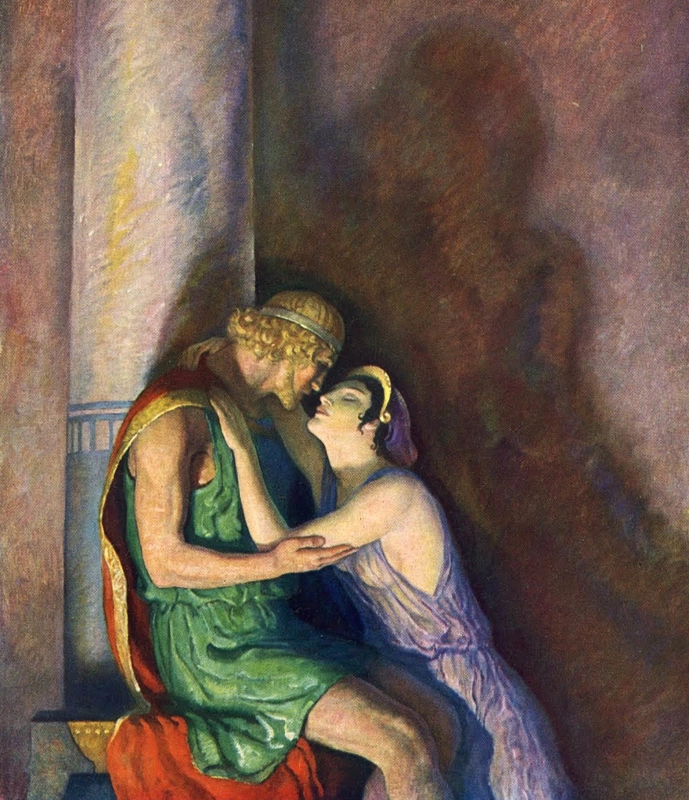
Artwork: Odysseus and Penelope Reunited by N. C. Wyeth (1929)
After surviving storms sent by angry gods, outwitting monsters, resisting irresistible temptations, and reclaiming his kingdom from the suitors, Odysseus finally stands before the person he has spent twenty years trying to return to, his wife, Penelope. Yet even now, The Odyssey refuses to offer an easy ending.
Despite Athena revealing Odysseus’s true form, Penelope remains cautious. She has spent two decades waiting, grieving, and cleverly delaying her unwanted suitors by weaving and secretly unraveling a funeral shroud each night. She knows better than to trust appearances alone. Rather than rushing into her husband’s arms, she quietly decides to test him.
She orders a servant to move their marriage bed.
Odysseus immediately objects. The bed, he insists, cannot be moved because he built it himself around the trunk of a living olive tree rooted deep within their home. It is an impossible task, one only the true Odysseus could know. In that instant, Penelope’s doubts disappear. She realizes that the man before her is indeed the husband she believed she might never see again.
N. C. Wyeth’s Odysseus and Penelope Reunited captures this long-awaited moment with remarkable warmth and restraint. Painted in 1929 as part of his celebrated illustrations for The Odyssey, the work shifts away from the epic’s battles and mythical creatures to focus on quiet human emotion. Wyeth’s rich colors and expressive figures remind us that the greatest triumph of Odysseus’s journey is not defeating monsters or reclaiming a throne, it’s finding his way back to the person who never truly gave up on him.
What makes this ending so enduring is that it rejects the traditional idea of the conquering hero. Odysseus does not return unchanged, nor does Penelope simply wait to be rescued. Both have endured years of hardship, loss, and uncertainty. Their reunion is built not on blind faith but on mutual intelligence, patience, and unwavering trust. It is a partnership that has survived distance, time, and the interference of gods themselves.
More than 2,700 years after Homer first composed The Odyssey, this reunion remains one of literature’s most moving endings. It reminds us that beneath every monster, prophecy, and perilous voyage lies a deeply human story, not simply about adventure, but about the hope that no matter how long the journey, home is still waiting.
Did you know? The olive tree at the heart of Odysseus and Penelope’s marriage bed wasn’t chosen by chance. In ancient Greek culture, the olive tree symbolized peace, endurance, wisdom, and the goddess Athena. By building their bed around its living trunk, Homer created a powerful symbol of a marriage rooted in strength, resilience, and permanence.
10. Nausicaa’s Kindness: The Stranger Who Helped a Hero Find His Way Home
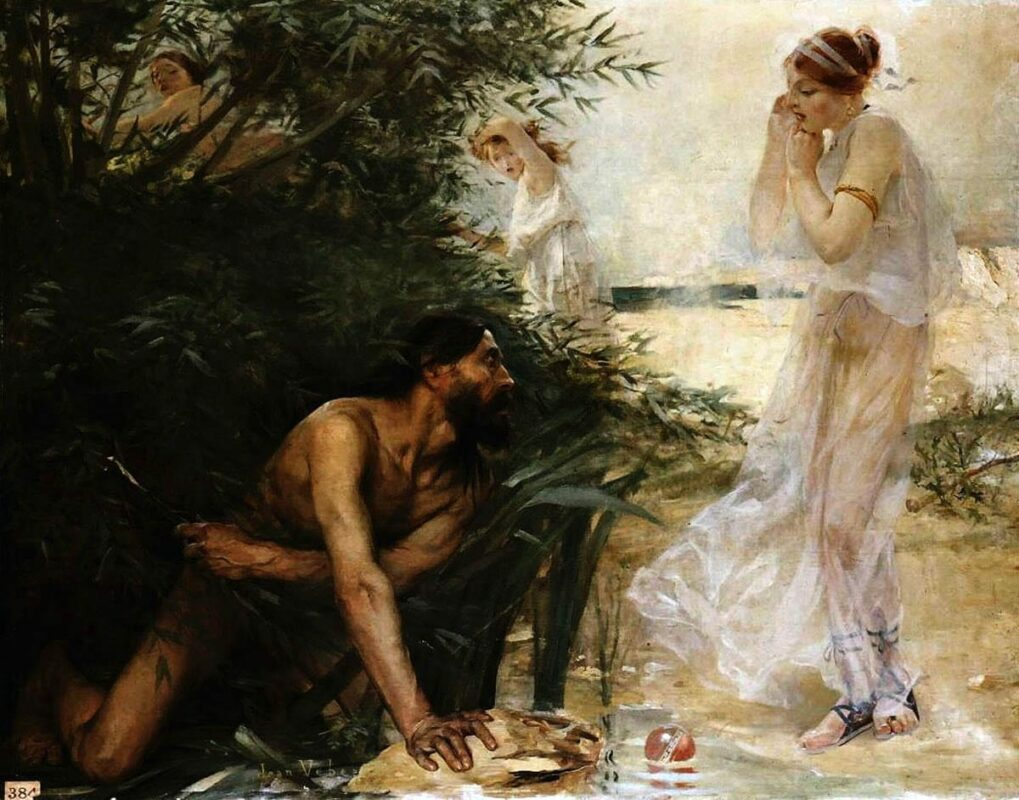
Artwork: Ulysses and Nausicaa by Jean Veber (1888)
By the time Odysseus reaches the shores of the Phaeacians, he has lost everything.
His ships have been destroyed. His companions are gone. After escaping Calypso’s island on a handmade raft, Poseidon unleashes yet another violent storm, leaving Odysseus clinging to driftwood before he is finally washed ashore, exhausted and alone. Once celebrated as the victorious king of Ithaca, he now arrives as an anonymous castaway with nothing but the hope of finding mercy.
That mercy comes in the form of Nausicaa, the young daughter of King Alcinous. While washing clothes with her attendants by the river, she encounters the battered stranger emerging from the bushes. Frightened at first, her companions flee, but Nausicaa stands her ground. Rather than judging his appearance or turning him away, she offers Odysseus food, clothing, and guidance to her father’s palace, where he is welcomed with the sacred Greek tradition of xenia, the duty of hospitality toward strangers and travelers.
It is among the Phaeacians that Odysseus finally tells the full story of his extraordinary journey. Moved by his hardships, King Alcinous provides him with a ship and crew who safely escort him back to Ithaca while he sleeps, bringing his long voyage to its long-awaited end.
Jean Veber’s Ulysses and Nausicaa beautifully captures the quiet humanity of this encounter. Painted in 1888, the French artist contrasts Odysseus’s weathered appearance with the calm dignity and compassion of Nausicaa. There are no monsters to battle or gods to outwit here. Instead, Veber reminds us that sometimes the greatest turning points in an epic are shaped not by acts of heroism, but by simple acts of kindness.
Nausicaa’s role in The Odyssey is brief, yet unforgettable. She asks for nothing in return, offering help to a complete stranger simply because it is the right thing to do. In a story filled with trials, betrayals, and divine intervention, her compassion becomes one of the epic’s most powerful forces. It is a reminder that while courage may help us survive life’s storms, it is often the kindness of others that helps us find our way home.
Did you know? Hospitality, or xenia, was considered sacred in ancient Greece and was believed to be protected by Zeus Xenios, a title of Zeus as the guardian of guests and strangers. Welcoming travelers with generosity wasn’t just good manners, it was a religious and moral obligation, making Nausicaa’s actions a perfect example of one of Greek culture’s highest virtues.
Christopher Nolan’s The Odyssey is only the latest chapter in a story that artists have been retelling for more than two thousand years. Long before the language of cinema existed, painters, sculptors, and ceramic artists were already transforming Homer’s words into powerful visual narratives, ensuring that each new generation could rediscover Odysseus’s remarkable journey in its own way.
The ten artworks in this list are far more than illustrations of a famous epic. They reveal how artists across different centuries interpreted the same story through vastly different perspectives. Arnold Böcklin explored the psychological weight of survival, John William Waterhouse reimagined Circe as both enchanting and formidable, while N. C. Wyeth infused the final homecoming with warmth, hope, and hard-earned triumph. Together, these masterpieces remind us that every era finds something new in Homer’s timeless tale.
As audiences return to The Odyssey through Christopher Nolan’s cinematic vision, these artworks offer an opportunity to look beyond the screen and discover the rich artistic legacy that has surrounded the epic for centuries. They remind us that the true power of The Odyssey has never rested solely in its monsters, prophecies, or perilous voyages. It lives on because it speaks to something universal, the courage to face the unknown, the resilience to endure every setback, and the unwavering hope that, no matter how long the journey, home is always worth fighting for.
After reading this, are you tempted to watch (or rewatch) The Odyssey?
Still in the mood to explore more fascinating stories hidden in famous artworks? Next, discover our roundup of paintings that look like they’re judging you, a collection of masterpieces whose piercing gazes have intrigued viewers for centuries.