
This artist uses female figures to explore the different sides of identity ┃Alina Moraru

At Arts to Hearts Project, Art and Woman was created because we believe women artists deserve a publication that centres them completely. We are on our third edition now and with every one the work gets more personal and more surprising and more willing to go to places that most art publications do not even know exist.
Alina Moraru is one of our selected artists for Art and Woman Edition 3. And her work took us somewhere we had genuinely never been before.
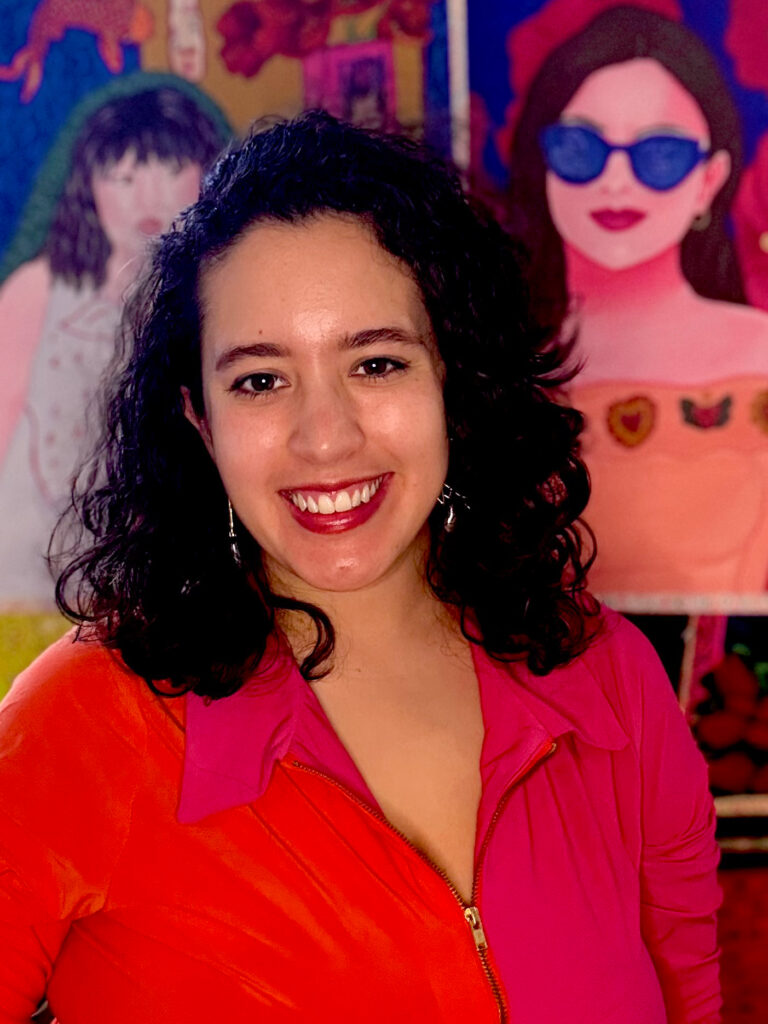
Alina goes by Amor. She was born in 1992 in Taraz, Kazakhstan and is now based in Hamburg, Germany. She is a visionary mixed-media artist and the originator of something she calls Glyphic Mythography, a term she coined herself because nothing in the existing art vocabulary could describe what she was building.
Her work is described as art made to be lived with. Those are her words, not ours, and once you spend time with her paintings you understand exactly why she chose them.

She works in gel pens, fineliners, acrylic markers, watercolour, nail polish, and real gold and silver leaf on paper and canvas. The process is deeply intuitive and meditative, building intricate layers that result in luminous compositions featuring feminine archetypes, cosmic motifs, sacred geometry, flowing forms, serpents, and shimmering metallic surfaces that catch light differently throughout the day.
The work is psychedelic and harmonious at the same time. Dark neons sitting alongside earth tones and gold in ways that should not work together but absolutely do.
Her figures are women who hold strength and tenderness in the same body without choosing one over the other. They exist at thresholds. Between power and vulnerability. Between instinct and awareness. Between who they are and who they are becoming. And the way Alina holds those contradictions inside a single figure without resolving them is what gives her work its emotional charge.

Therapists, psychologists, and wellness practitioners are drawn to her work for the way it supports inner processes without being triggering. Collectors have told her that paintings they bought months ago keep revealing new things, new patterns, new meanings, as if the work is quietly evolving alongside whoever is living with it.
That quality of ongoing revelation is built into how she makes, layer by layer, glyph by glyph, with the patience and the presence that her meditative process demands.
She describes herself as practising psy-nautical neo-renaissance. She draws inspiration from Jungian archetypes, somatic awareness, sacred geometry, and cross-cultural mythic traditions without appropriation. And as an autistic artist, she experiences the world with a heightened sensitivity to patterns, atmospheres, and contradictions that becomes a creative strength inside her studio.
Before becoming an artist she was someone trying to understand why certain experiences transform us and others do not. That question has not changed. It has just found its visual language. And the language keeps growing.
Let’s get to know Alina through our conversation with her about what Glyphic Mythography actually means, why her figures refuse to choose between strength and vulnerability, and what happens when an artist stops abandoning the language that was always theirs.
Q1. Amor, can you take us back to the beginning and share how your journey into painting began?
Before I became an artist, I was someone trying to understand why certain experiences transform us and others don’t. I’ve always been fascinated by the invisible architecture beneath life: the forces that shape perception, identity, desire, fear, and meaning. Long before I had a visual language for it, I was searching for patterns – trying to understand how people become who they are. Painting emerged gradually as the most honest way to investigate those questions.
What began as image-making eventually became a form of mapping. I realized I wasn’t interested in illustrating the world as it appears. I was interested in giving form to experiences that are difficult to name but immediately recognizable when felt: transformation, longing, contradiction, grief, beauty, becoming. Over time, that inquiry evolved into what I now call Glyphic Mythography – a mythopoetic visual language through which symbols, bodies, and inner landscapes converge.
In many ways, my journey into art wasn’t a movement toward self-expression. It was a movement toward deeper perception. The paintings became a place where complexity could remain whole, where beauty and shadow could coexist without canceling one another out. I’m still exploring the same question that first drew me to the work: How does a person become fully themselves? Every piece is another attempt to listen.

Q2. Your figures often balance strength and vulnerability. What interests you about that contrast?
I think we’ve been taught to see strength and vulnerability as opposites, but my experience of life has been rich in diversity. The strongest people I’ve known are not the ones who never break, never doubt, or never feel. They are the ones who remain present in the midst of uncertainty, grief, desire, complexity, or change without abandoning themselves. That tension speaks to me because it feels profoundly human. Many of my figures exist at thresholds.
They are neither armored nor defeated. They are seeking coherence in relationship with something larger than themselves instinct, transformation, memory, longing, beauty, shadow. What appears as vulnerability is often openness. What appears as strength is often surrender to something true. That’s not about heroic perfection. More rooted in earned presence.
A figure becomes compelling to me when she can hold tenderness without fragility and power without domination. When she no longer needs to choose between softness and sovereignty. In many ways, my work is an exploration of wholeness. Not the kind that comes from eliminating contradiction, but the kind that emerges when opposing forces learn to coexist. That’s where I find beauty. Not in certainty, but in the moment something remains open and intact at the same time.

Q3. Your paintings feel emotionally rich while remaining vibrant. How do you balance emotion with beauty?
The balance comes from the fact that I’m not particularly interested in darkness or beauty on their own. Wholeness is the key. Many of the experiences that shape us most deeply – grief, desire, uncertainty, love, loss, transformation – contain multiple realities at once. They can be painful and beautiful. Difficult and meaningful. Disorienting and illuminating. Life rarely separates these things as neatly as we do. For a long time, contemporary culture has often presented us with a choice: either celebrate beauty and avoid complexity, or explore complexity and abandon beauty.
I’ve never felt drawn to either approach. The beauty that captivates me has earned its full blossom. It has encountered uncertainty, contradiction, vulnerability, and shadow without becoming trapped by them. It remains open. That’s why my work often appears vibrant, even when it is exploring profound emotional territory. The colors, symbols, and luminous elements are not there to distract from complexity. They are part of it. They represent the possibility of integration, meaning, and renewal.
I don’t see emotional depth as something heavy. I see it as something alive. Some of the most transformative moments in life carry an unexpected vitality. They awaken us. They reconnect us to ourselves. They remind us that we are larger than our suffering and more complex than any single emotion.
In many ways, that’s what I’m trying to create through Glyphic Mythography: spaces where beauty and complexity can remain in conversation with one another. Because I don’t believe depth requires despair. I think genuine depth expands our capacity to feel. And when that expansion happens, beauty often follows. Not as an escape from reality, but as a deeper encounter with it. It’s natural form.
Q4. Flowers appear throughout your work as more than decoration. What do they represent to you?
Flowers appear in my work because they embody something I return to again and again: transformation made visible. A flower is never static. It emerges, unfolds, reaches toward light, withers, returns to the soil, and begins again. In that sense, it mirrors many of the psychological and emotional processes that trigger me as an artist. I’m less concentrated on what a flower symbolizes and more attentive to what it does. Botanical forms bring a sense of growth, permeability, and becoming into the work. They remind us that beauty is not a fixed state but a living process.
Every bloom carries evidence of vulnerability, adaptation, and impermanence. It exists because of its relationship to everything around it. Many of my paintings explore the tension between structure and flow, order and emergence. Flowers naturally inhabit that threshold. They are exquisitely organized, yet completely alive. They follow patterns while remaining unpredictable. Within Glyphic Mythography, flowers often function as living glyphs.
They mark moments of opening, integration, remembrance, or transformation. They are less like decorative elements and more like witnesses to an inner process unfolding. I think that’s why I keep returning to them. They carry a kind of quiet wisdom. They don’t force their becoming. They reveal it. And in a culture that often values speed, certainty, and control, I find something deeply moving about forms that unfold in their own time. Perhaps that’s what my work is searching for as well.

Q5. Your work celebrates femininity while exploring identity. What conversations do you hope it sparks?
I hope the work opens conversations about what it means to become fully oneself. Femininity is one of the lenses through which I explore that question, led by fascination towards inhabiting fully ones unique energetic signature and the field of a womans body is where I actually start by nature. Many of my figures inhabit spaces where seemingly opposing qualities coexist: strength and tenderness, desire and wisdom, vulnerability and authority, instinct and awareness. I’m flatteredby the altarscomplexity because I think that’s where life actually happens. For a long time, we’ve been offered simplified versions of identity.
We are encouraged to choose one thing and reject another. Be strong, but not sensitive. Be beautiful, but not powerful. Be independent, but not connected.
My experience has been that wholeness asks something different of us. It asks us to hold complexity. The women who appear in my work are not ideals or archetypes of perfection. They are figures of becoming. They are building relationships with themselves, with desire, with memory, with power, with the unknown. In many ways, they are visual reflections of processes we all move through. If there is a conversation I hope the work opens, it is this: What parts of ourselves have we been taught to separate that might actually belong together? Because so much suffering comes from fragmentation, and so much freedom comes from integration. My paintings don’t try to provide answers. They create mirrors where those questions can remain alive, for people curious enough to learn more about themselves.
Q6. Your colours are bold and expressive. Do they carry specific meanings, or do you choose them intuitively?
It’s a conversation between intuition and intention. Colour, for me, is a kind of language the body and deeper layersof self understand before the mind does. Sometimes a piece arrives already carrying a palette – almost like a mood, an atmosphere, or a frequency. The colours are there from the beginning, and the work becomes a process of completing that message through line, form, and shape. I don’t begin with a rigid symbolic system where red always means one thing and blue always means another.
Colour is more alive than that. Its meaning shifts depending on what it is in relationship with, much like emotions, memories, or people. These associations remain fluid rather than fixed. As the work develops, something more precise takes over. I start to feel what the image can hold, what it needs to balance, where it risks becoming too much or not enough. So there is a logic to the process, but it’s not theoretical. It’s relational. What captivates me most is how colour can communicate something before language arrives as a bold symphony. We often feel a painting before we understand it.

Colour is part of that first encounter. It shapes the emotional climate of the work and influences how the viewer moves through the image. The darker neons and saturated contrasts that often appear in my work come from a tension I’m seduced by – beauty that isn’t soft, light that has passed through something. I think of colour less as decoration and more as atmosphere. It shapes how the work is felt in the body. Whatqualityof architecture it supports in the space.
In Glyphic Mythography, colour functions much like the glyphs themselves. It creates relationships between different elements, guiding attention, building tension, creating harmony, and revealing contrast. It is less about assigning meaning and more about creating conditions for inevitable experience. At that point, the painting begins to teach me what it wants to become. The process is intuitive, but intuition itself is something I have learned to trust through years of looking, making, and listening. When the colour is right, you don’t just see it. You recognize it.
Q7. Do you think beauty still has an important place in contemporary art?
Absolutely. De facto, I think beauty is one of the most misunderstood languages we have. When people dismiss beauty as superficial, they’re often talking about prettiness, ornament, or visual pleasure detached from depth. That isn’t what interests me. The beauty I care about has gravity. It emerges when something true has been integrated rather than avoided. It carries the evidence of complexity. It doesn’t deny grief, uncertainty, longing, contradiction, or shadow. It includes them. Some of the most beautiful experiences in life are beautiful precisely because they are fragile, temporary, or hard-won. A reconciliation. A moment of forgiveness.
The return of hope after despair. The realization that something broken can still become whole. That kind of beauty communicates immediately. Before language. Before analysis. It reminds us of possibilities we may have forgotten. In my own work, beauty functions as a doorway rather than a destination. It invites attention, but it also asks for something from the viewer. Presence. Curiosity.
A willingness to remain with complexity long enough for deeper layers to emerge. I don’t see beauty as separate from truth. I think beauty is one of the ways truth becomes visible. Perhaps that’s why it continues to matter. In a world saturated with distraction, cynicism, and noise, genuine beauty can interrupt us. It can slow us down. It can restore our capacity to feel, to notice, and to remember what is meaningful. For me, that is not a decorative function. It is a profoundly human one.
Q8. What do you think makes an artwork feel personally meaningful to someone?
I don’t think an artwork becomes meaningful because it tells someone what to feel. I think it becomes meaningful when it creates space for recognition. The works that stay with us are often the ones that reveal something we already knew but hadn’t yet found language for. They give form to an experience, emotion, memory, or longing that was present beneath the surface of awareness. In that sense, meaning is not something the artist places into the work and the viewer retrieves.
It’s something that emerges through relationship. Two people can stand in front of the same painting and have completely different experiences, and neither is wrong. Each person brings their own history, questions, desires, losses, memories, and perceptions. The artwork becomes a meeting place between those inner worlds and the image itself. When someone tells me that a piece reminded them of a part of themselves they had forgotten, or helped them see something differently,
I’m always moved by that. Not because they understood what I intended, but because the work became alive in a way I could never fully control. I think we’re all searching for moments of recognition. Moments when something outside of us reflects something inside of us with unexpected clarity. Art has the capacity to create those moments. And when it does, the artwork often becomes more than an object. It becomes a companion. Something we return to because, in some small way, it continues returning us to ourselves.

Q9. How has your understanding of success evolved over the course of your journey?
My understanding of success has become much quieter and much deeper. Earlier in my journey, I think I measured success the way many people do: through recognition, opportunities, visibility, or external milestones. Those things can be meaningful, and I’m grateful for them when they come, but I’ve learned that they are not always reliable measures of a life or a practice.
Over time, I’ve become more interested in coherence. Success, for me, is the ability to create work that remains honest to the questions I genuinely care about. It’s the ability to continue refining a visual language that feels increasingly aligned with who I am rather than who I think I should be. But I’ve also come to see that success does something unexpected. Most people imagine success as a destination, a reward, or a solution. Yet when certain goals are achieved, something else often happens: a spotlight turns on.
And that spotlight illuminates parts of ourselves we may have spent years overlooking. The stories we tell ourselves. The fears we quietly carry. The insecurities we mistake for identity. The forms of suffering that have become so familiar that we no longer question them. For a long time, I assumed that many of these inner narratives were simply who I was. Success, in whatever form it arrives, has a way of challenging that assumption. When an external obstacle disappears, we can no longer blame it for everything we feel. What remains is an invitation to look more closely. In that sense, success is not always comfortable.

It can reveal how much of our identity has been built around striving, proving, compensating, or waiting for permission. It can expose layers of ourselves that were hidden beneath ambition. Sometimes it asks us to let go of versions of ourselves that once felt necessary. I think this is one reason why genuine growth often feels unsettling. Every new level of achievement has the potential to uncover a deeper layer of self-understanding. As an artist, success is no longer about making work that is universally understood. It’s about making work that is deeply true and allowing it to find the people it is meant to reach. As a person, success has become less about arrival and more about relationship. My relationship to my work. My relationship to uncertainty.
My relationship to beauty. My relationship to myself. Some of the most important growth in my life has come from learning that meaning cannot be rushed. Neither can mastery, trust, or transformation. Success is not the end of a journey of self-discovery. If anything, it deepens it. Each achievement shines light into places that were previously hidden, offering another opportunity to question what is true and what has merely become familiar. If my work continues to evolve, continues to remain alive with curiosity, and continues to create genuine moments of recognition for the people who encounter it, I consider that a meaningful form of success.
Everything else feels secondary. At the end of the day, I don’t want to build a career that simply attracts attention. I want to build a body of work that remains in dialogue with culture and relationship with people long after the moment of first encounter. To me, that feels like a life well spent.
Q10. How do you protect the emotional side of your practice while managing the demands of being an artist today?
I think one of the most impactful realizations I’ve had is that the emotional side of the practice is not separate from the work. It’s the source of the work. For a while, I believed what many artists are taught to believe: that the creative work comes first, and everything else – marketing, administration, visibility, applications, emails – exists around it. In reality, those responsibilities can easily expand until they begin consuming the very thing they’re meant to support. I’ve learned that I have to protect the conditions that allow meaningful work to emerge.
That means creating space for solitude, reflection, observation, and genuine curiosity. It means allowing periods where I’m not producing content, but simply paying attention. Some of the most important parts of my practice happen long before I touch a pen or brush. It also means remaining open to adventure. Over time, I’ve come to see different fields of knowledge, disciplines, and forms of expression as blank canvases – new territories to explore rather than boundaries to respect.
Whether through drawing, writing, technology, mythology, philosophy, or entrepreneurship, each domain offers another way of understanding the world and expanding one’s capacity to create. I’m inspired by the spirit of the Renaissance polymaths: individuals who moved freely between art, science, invention, and imagination.

Not because they sought mastery for its own sake, but because they followed curiosity wherever it led. I see creativity in a similar way – as an ongoing journey of growth, discovery, and fuller self-expression. The contemporary art world often rewards constant output, constant engagement, and constant presence. But the work I’m interested in making comes from a different rhythm. It requires listening. It requires uncertainty. It requires enough silence for something unexpected to arrive. I’ve stopped blaming those quieter periods as unproductive.
They’re part of the work. As both an artist and a person, I’ve become increasingly protective of attention. Attention is the material beneath all the other materials. Before there is a painting, there is attention. Before there is a visual language, there is attention. Before there is meaning, there is attention. Attention is also what allows new connections to emerge between seemingly unrelated worlds. It is what makes exploration possible. It is what transforms curiosity into insight and insight into creation. In many ways, Glyphic Mythography emerged from this relationship with attention. The drawings are built from thousands of small acts of observation, pattern recognition, and sustained presence.
What appears intricate on the surface is often the visible trace of a much deeper process of listening. If I lose that, the work becomes thinner, no matter how successful it appears from the outside. So I try to measure my days less by how much I produce and more by whether I’ve remained in relationship with what first brought me to the work: wonder, curiosity, and the willingness to step into unfamiliar territory. Everything meaningful seems to grow from there. As an autistic person, I experience the world with a heightened sensitivity to patterns, atmospheres, details, and contradictions. What can sometimes feel overwhelming in daily life often becomes meaningful inside the studio. The work and everything around it’s way gives me a possibilty to stay in relationship and evolve with complexity rather than retreat from it.
Q11. What advice would you give artists learning to trust their own creative voice?
Artists may assume they need to find their visual language, when in reality they often need to find the courage to stop abandoning it. Their soul already sings its unique melody. Comparison makes that difficult because it constantly directs our attention outward. We begin measuring ourselves against what is visible: trends, algorithms, markets, careers, aesthetics, other people’s certainty. But a visual language doesn’t emerge from comparison. It emerges from relationship and attention. To your curiosity. To your obsessions.
To the questions that keep returning, even when nobody is asking them. For me, authenticity has become less about self-expression and more about celebrated and cultivated self-discovery. That process takes time. It requires honesty. Sometimes it requires disappointing the version of yourself that wants to fit in. I think every artist has recurring fascinations that follow them throughout their life. Certain themes, forms, symbols, emotions, questions, or ways of seeing that keep resurfacing no matter what they do. Rather than dismissing those repetitions, I would encourage artists to become curious about them, as secret bar-codes leading to layers accesible only to them.
Pay attention to what you cannot stop returning to. To what sets your heart ablaze, turns your spark on.
There is often more truth in that than in whatever happens to be fashionable. Ironically, what makes an artist distinctive is often the very thing they spend years trying to edit’n hide out because it feels too personal, too strange, too obsessive, or too different. Yet those are frequently the qualities that become the foundation of an authentic voice. I also think it’s important to remember that authenticity is not a fixed destination. It’s a continuous practice of listening.
And attention ! As we grow, our work changes. Our questions change. Our understanding changes. Trusting your visual language doesn’t mean holding onto a style forever. It means remaining honest enough to let the work evolve as you evolve. The artists who stay with me are rarely the ones who followed trends most successfully. They are the ones who became unapologetically themselves. In the end, I think that’s the real work. Not becoming more like other artists. Becoming more deeply, more courageously, yourself.

As we wrapped up our conversation with Alina, we found ourselves thinking about a question she raised that we think goes far beyond her practice. What parts of ourselves have we been taught to separate that might actually belong together?
Because that is what most of us do. We split ourselves into acceptable pieces. Be strong but not too soft. Be beautiful but not too deep. Be serious but not too strange. Be confident but not too much. We spend years performing a version of ourselves that fits neatly into whatever box the world handed us and then we wonder why we feel fragmented. Why the work does not feel whole. Why something is always missing.
Alina stopped splitting. Her figures hold every contradiction at once, strength and tenderness, power and surrender, instinct and awareness, and none of those things cancel each other out. They coexist. And the paintings feel more alive because of it. More human. More true to what it actually feels like to be a person moving through the world with all of your complexity intact instead of carefully edited down to the parts that make other people comfortable.
We think every artist needs to hear that. That wholeness is not about having everything figured out. It is about letting contradictory things live together in the same work without forcing one to win. The paintings that try to be only one thing, only strong, only beautiful, only dark, only light, those are the paintings that feel flat.

The ones that hold everything, that let beauty and shadow sit in the same frame without apologising for either, those are the ones that stay with people. Alina understands that instinctively and it is why her work keeps deepening for whoever is living with it rather than giving everything away on the first look.
And her point about beauty is something we want to push further into the conversation right now. Because the art world has spent a long time treating beauty as something to be suspicious of. As if a painting that is gorgeous to look at must be hiding a lack of substance underneath. Alina’s work proves that wrong completely.
The beauty in her paintings is not a surface. It is the result of everything underneath it. The layers, the symbols, the years of inner work, the meditative process, the lived experience, all of that is what produces the beauty. It is not decoration laid on top of emptiness. It is the visible evidence of depth. And we think more artists need the permission to pursue beauty without feeling like they are selling out their seriousness.
For art lovers and collectors, Alina’s work brings something into a space that you will feel immediately and that will keep revealing itself for years. The gold and silver leaf catches light differently throughout the day so the paintings are literally never the same twice. The layered symbolism means what you see in the work this month will not be what you see in six months because you will have changed and the painting will meet your new self with something new.
Follow Alina Moraru through the links below and see her work for yourself.