


How Louisa Chircop went from drawing on chicken egg to showing at Malta’s National Museum
At Arts to Hearts Project, our 100 Emerging Artists of 2026 keeps showing us that the most exciting practices are often the ones that refuse to sit in one place. Artists who move between mediums and materials and ideas because their curiosity is too wide for a single discipline to hold.
Louisa Chircop is exactly that kind of artist. She is one of our selected artists in this edition and her practice is one of those ones where you think you understand what she does and then you spend five more minutes with it and realise you had barely scratched the surface.
Louisa is a contemporary artist based between Sydney and Malta. Australian-born with Maltese heritage. She has First Class Honours and an MFA Research degree in Painting and Drawing from the College of Fine Arts UNSW.
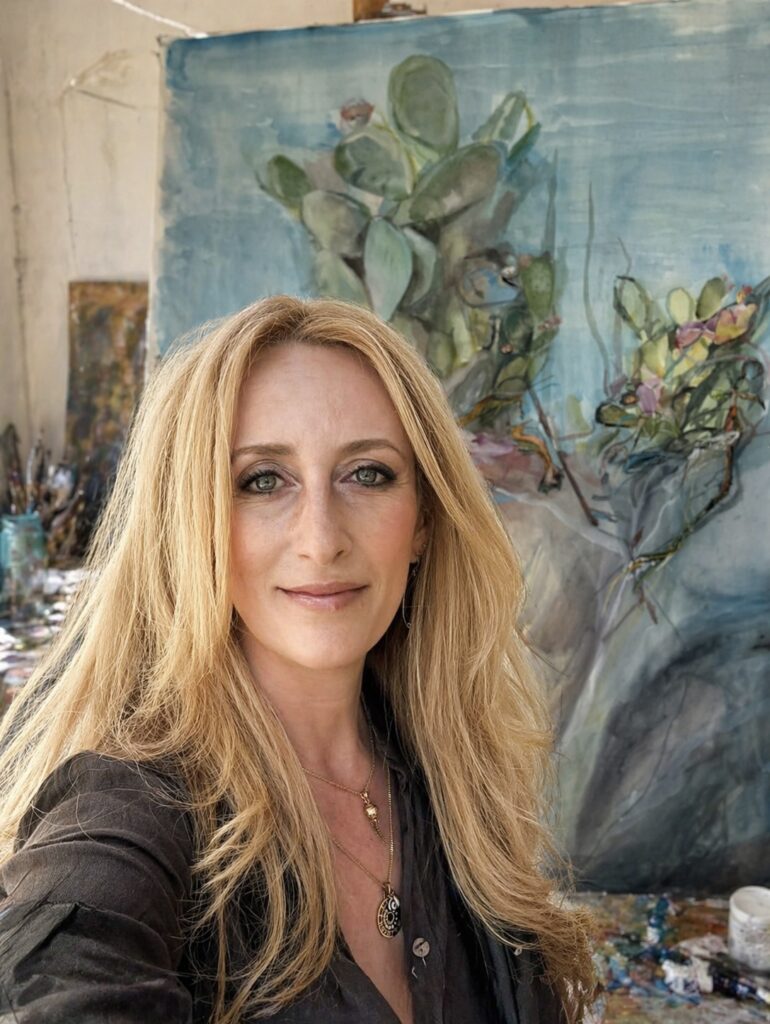
She has won the James Gleeson Prize for Surrealism at Campbelltown Arts Centre, the Friends of Hazelhurst Art on Paper Prize, has work in the Kedumba Collection of Australian Drawings, and has recently been shortlisted for the Sidney Nolan Art Prize in the UK where her painting will travel to Nolan’s former home in rural Herefordshire for a major exhibition this summer.
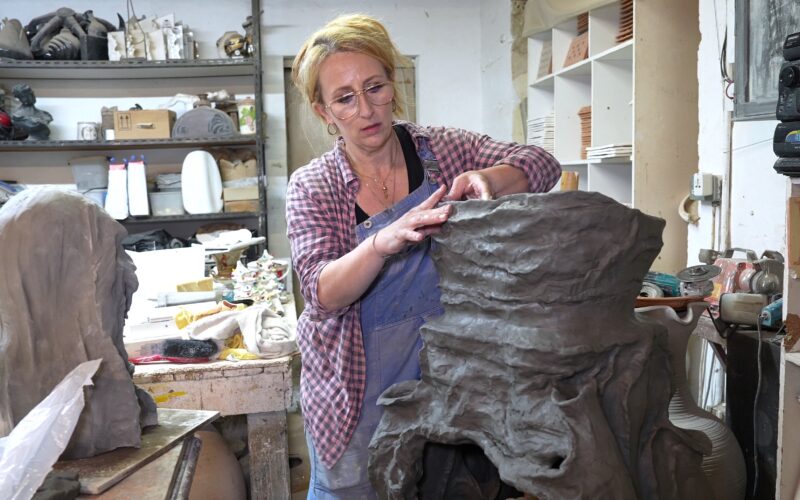
She lectures in Painting and Drawing at several universities around Sydney and works across painting, photomontage, collage, drawing, mixed media, ceramics, and sculpture.
She describes her work and process as a crystal ball conversation about life and the human condition. An unearthing of experiences, a sifting of the psyche, an emotional response to the world that exposes a multilayered and multifaceted way of seeing and feeling. Her own words for it are a process of realisation.
And that phrase captures something essential about what her paintings do. They do not arrive at conclusions. They arrive at awareness.
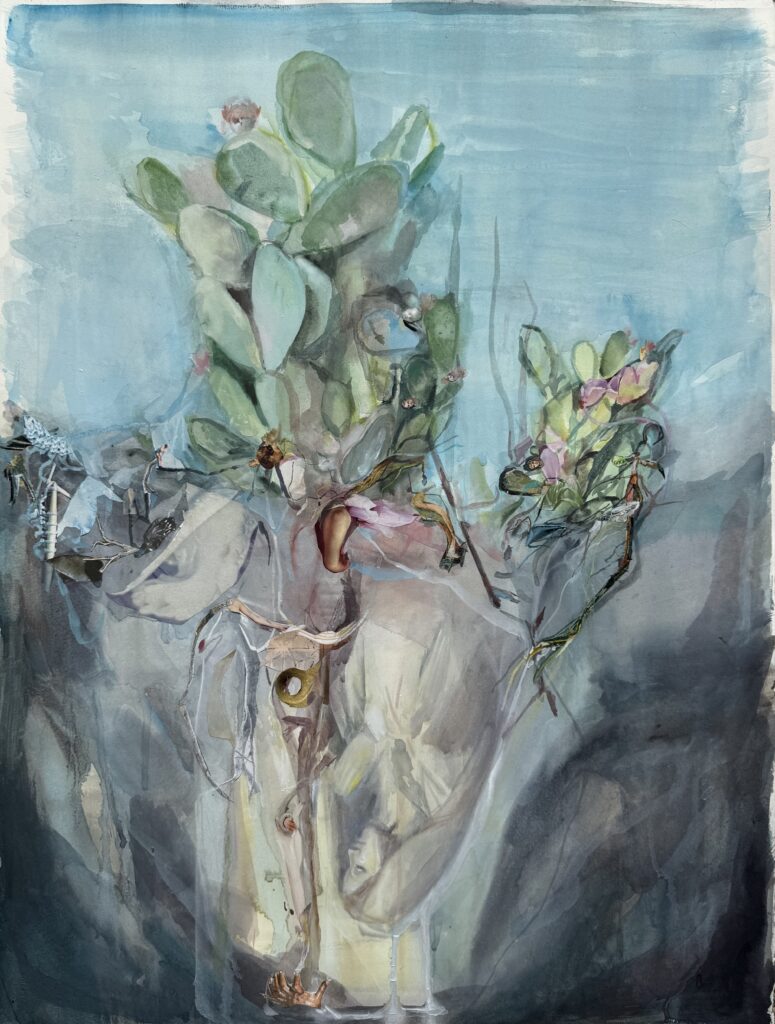
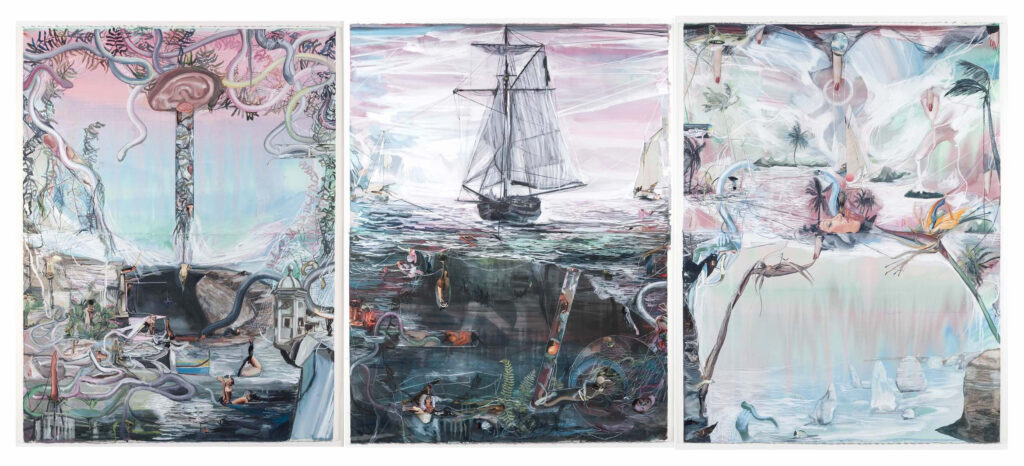
Her work deals with the human condition in response to art history and culture. She delves into memory, lived experience, the subconscious, the shadow self, the architecture of the mind and spirit.
Her paintings and mixed media works often appear as hybrids of shifting parts, psychic montages, troves of ambiguity and enigma that make visible the intimate and elusive qualities of how a person actually thinks and feels underneath the surface they present to the world.
She has been featured in Artist Profile Magazine, appeared on Foxtel Arts as part of Portrait Artist of the Year, completed residencies including DRAWInternational in Caylus, France, and has built a career spanning decades that keeps evolving and expanding and refusing to settle into any single version of itself.
Let’s get to know Louisa through our conversation with her about the crystal ball process, what the shadow self actually looks like when you paint it, why she moves between so many mediums, and what keeps her walking back into the studio after all these years.
Q1. Louisa, can you share a little about your journey and how it led to the multidisciplinary practice you have today?
I was drawn to art very naturally as a child, probably from the age of three. For the first five years of my life I lived on a poultry farm, and I still remember it vividly. It was a wonderfully wild environment, full of textures, sounds and sensory experiences that fed my imagination. I was always making things and drawing. I used to carry a big Artline marker around in my pocket and draw faces on chicken eggs, then place them back upside down so whoever collected them would get a surprise. I would also crush wheat kernels from the farm’s silos with a stone and drag them across the concrete steps of the packing shed, leaving chalk-like marks that became my drawings.
Looking back, I think I was interested as much in the process of making marks as I was in the images themselves. I drew on almost anything I could find, especially in secret places—under tables, behind couches, and in the corners of rooms. Creativity felt less like a choice and more like a natural instinct. My grandfather and mother were both creative in different ways, and I learned a great deal simply by being around them. My grandfather was an oil painter and introduced me to oil painting when I was eleven.
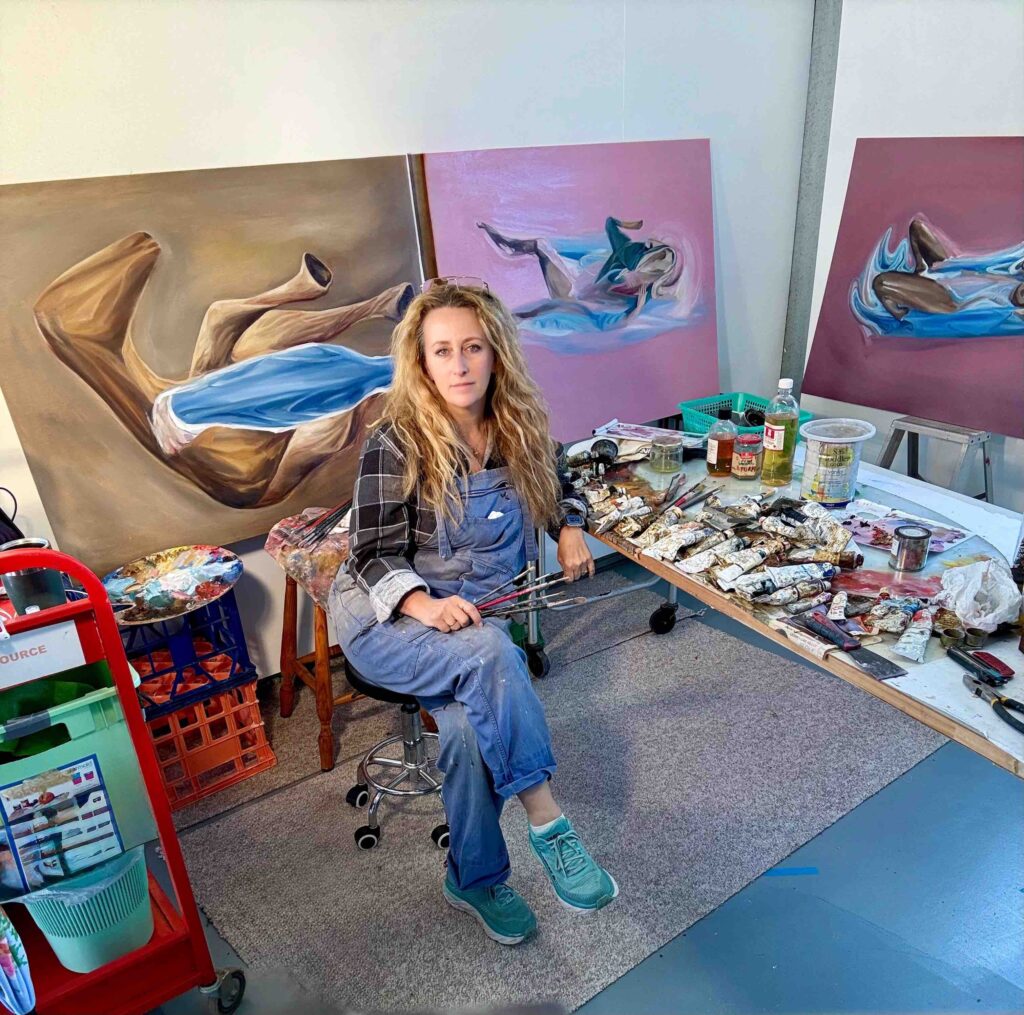
Combined with my mother’s encouragement, that experience gave me confidence to pursue my creative instincts more seriously. Looking back, I think art taught me to be both imaginative and resourceful. It became a way of exploring ideas, solving problems and making sense of the world. By the time I was eighteen, attending art school felt like the most natural path forward. It was there that I was exposed to formal fine arts training across painting, printmaking, sculpture, photography and many forms of drawing. That experience expanded my understanding of what art could be and opened up countless creative possibilities. I enrolled, and I’ve never really looked back.
Over time, that early curiosity evolved into a multidisciplinary practice. Even though I am predominantly a painter, I’ve never felt confined to a single medium. Instead, I’ve always been interested in finding the material, process or form that best serves an idea. Whether I’m working in painting, drawing, sculpture, ceramics, installation or community-based projects, the impulse remains much the same as it was on the farm: to experiment, explore and discover unexpected connections.
Q2. Was experimenting with different mediums always part of your creative process, or did it develop over time?
Yes, experimentation has always been central to my practice. It grew out of an innate curiosity that was present from childhood and was further nurtured through my art training where I was encouraged to cross pollinate across mediums and disciplines. I’ve always been drawn to Surrealist approaches, where play, intuition and the subconscious become active collaborators in the creative process. Rather than imposing rigid outcomes, I prefer to leave room for discovery, allowing unexpected symbols, connections and narratives to surface. For me, experimentation is not just a method of working but a way of remaining open to transformation and possibility. In many ways, my creative personality has developed alongside this approach.
I often think of myself as a kind of chameleon, morphing forms and disguising myself within visual poetry. My work moves through shifting landscapes where I can choose to be seen or unseen, revealing some things while concealing others. Through the creative process, I almost transcend the boundaries of a fixed self, moving between different states, materials and narratives. It is in that space of transformation that I often make my most meaningful discoveries.
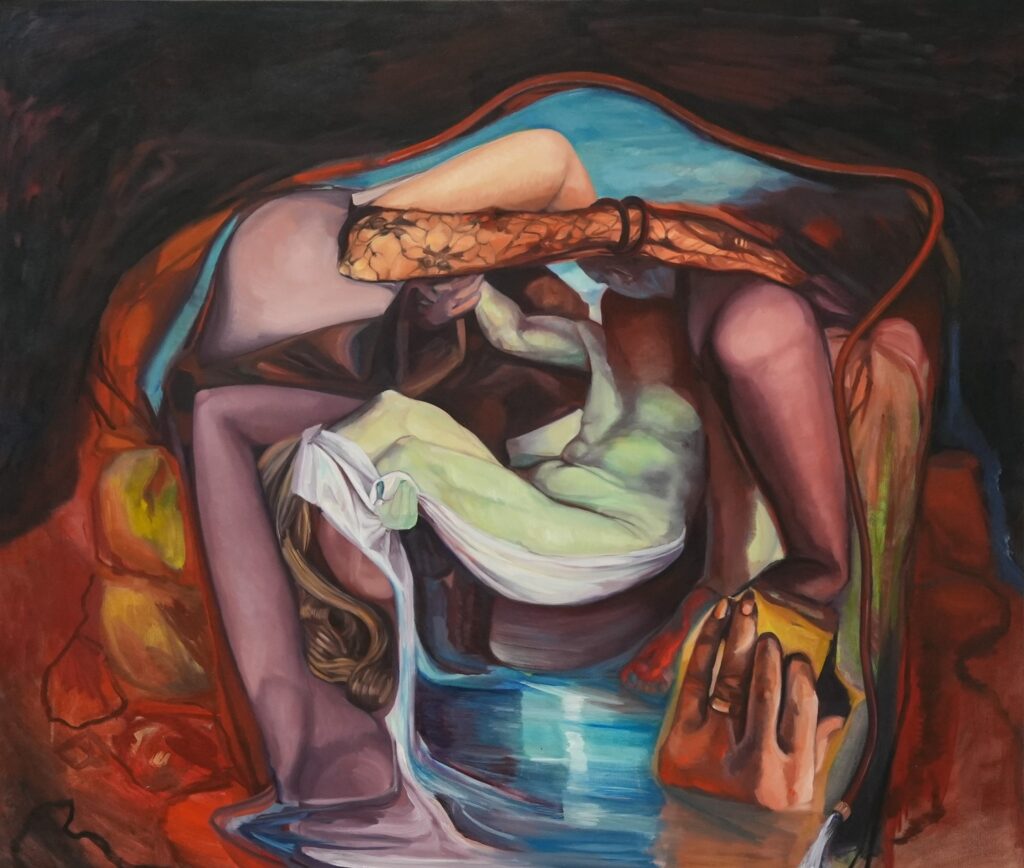
Moving between painting, drawing, mixed media, photomontage, ceramics and sculptural forms also becomes a way of problem solving. Different mediums allow me to approach an idea from different angles and uncover things I might not have found otherwise. Each material has its own language, and sometimes an idea will naturally ask to become a painting, while at other times it might emerge as a ceramic object or sculptural form.
While I enjoy embracing new ways of working, I also value periods of deep focus where I dedicate myself to a particular medium. Even though I move fluidly between disciplines, there are times when I immerse myself completely in painting or ceramics. For me, it’s a balance between exploration and commitment, with each feeding and enriching the other.
Q3. What first drew you to exploring dreams, the subconscious, and the shadow self in your work?
I think my interest in those hidden psychological spaces grew out of my own experience of navigating identity. Being Australian-born with Maltese heritage, and growing up in a multigenerational household shaped by stories, migration and the lingering effects of war, I became fascinated by the ways personal and collective histories live beneath the surface. I was also surrounded by ritual, prayer, religious traditions and the idea of sacred spaces.
Those customs carried a sense of mystery and reverence that made me aware from an early age that there were worlds beyond the visible. I’ve always been interested in the architecture of the mind and spirit, and how autobiography can be expressed through symbolic and hybrid forms.
For me, exploring dreams, the subconscious and the shadow self is a way of illuminating aspects of ourselves that are often hidden, buried or difficult to articulate. It is an excavation of those subterranean spaces where memory, identity, spirituality and imagination intersect.
Q4. Are there questions you find yourself returning to again and again through your work?
I’ve always been captivated by Gauguin’s painting Where Do We Come From? What Are We? Where Are We Going? because those questions have followed me throughout my life and practice. They aren’t just philosophical questions to me; they’re deeply personal ones that continue to shape how I understand myself, my heritage, my place in the world, and the many layers and facets that make up my feminine identity.
As someone who exists between cultures, places and experiences, I’ve never viewed identity as something fixed. The ground is constantly shifting beneath our feet, and I think my work embraces that uncertainty. I find myself continually questioning what lies beneath the surface of who we think we are, exploring the architecture of the self and the hidden spaces where memory, ancestry, spirituality and experience converge.
I often think of my practice as a kind of crystal ball process, where fragments of memory, intuition, dreams and lived experience gradually come into focus. I’m drawn to the unknown forces that shape us in the shadows, the things we inherit, suppress, remember or imagine, and how they eventually emerge into the light. At its core, my work is a way of navigating those questions while remaining open to mystery, revelation and the richness of living in the present moment.
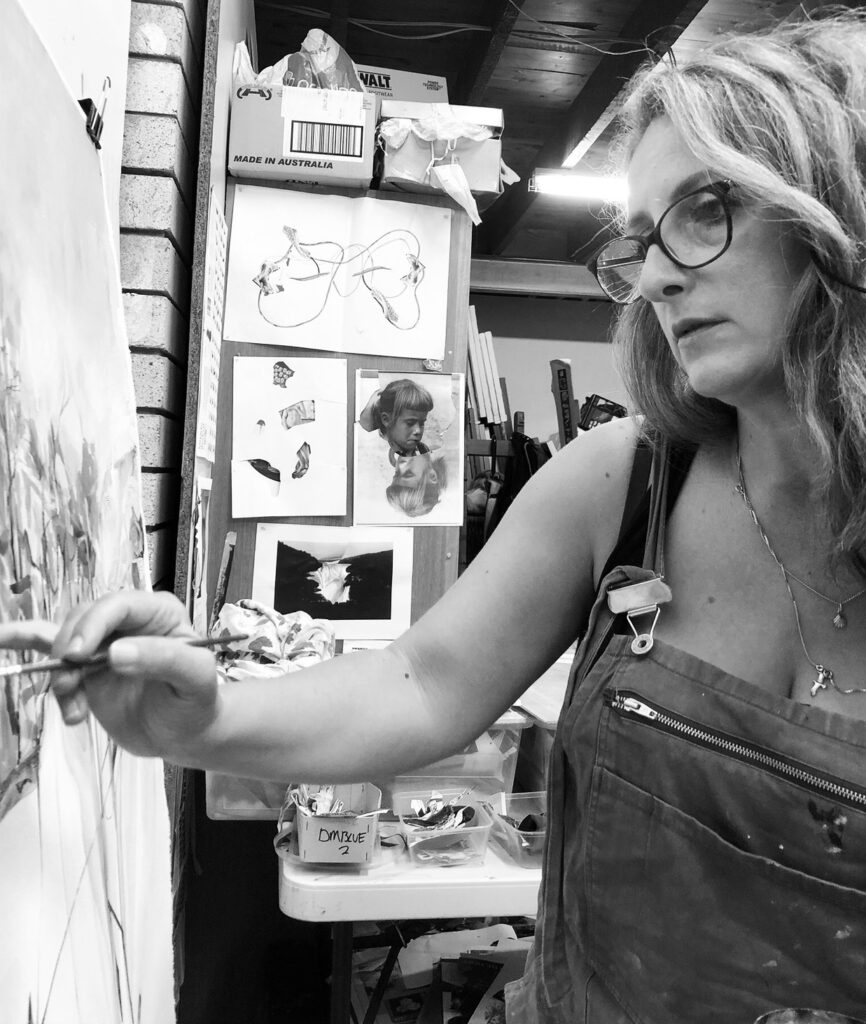
Q5. Your paintings often combine memories, dreams, and lived experiences. How do you know when different images belong together?
It’s when there is collision that the magic happens, when things come together in unexpected ways and sometimes create a beautiful kind of disaster, an ugly truth, or an ambiguous narrative that refuses to resolve. In those moments, I begin to sense what belongs together. Unrelated images become part of a dialogue, almost like fragments meeting in a shared space and beginning to speak to one another. I often think of it like assembling a constellation.
At first, the individual fragments—memories, dreams, symbols, lived experiences—feel separate, even unrelated, like stars scattered across a dark sky. But at a certain point something in me recognises a pattern forming between them.
It isn’t a logical decision so much as a felt one. I respond to a kind of visual or emotional gravity between the elements.
When something begins to resonate across the image, I trust that connection and start to build around it, letting the work guide me rather than forcing a fixed structure. There’s also an element of intuition, almost like a crystal ball coming into focus. The image gradually reveals what belongs and what doesn’t, and I learn to listen to that unfolding rather than impose too much control too early. And funnily enough, I often refer to my creative process as a kind of crystal ball process of realisation, which keeps the whole thing feeling playful and alive for me.
Q6. What keeps bringing you back to the space between fantasy and reality?
I’m drawn to contradictions because that’s where life actually sits for me, in the in-between rather than the resolved. Beauty and discomfort, fantasy and reality, all coexist in the same space, shifting depending on how you look at them. This connects to the Surrealist idea of conjunctio, or poetic juxtaposition, where unrelated realities are brought together to create a charged tension that can spark something entirely new.
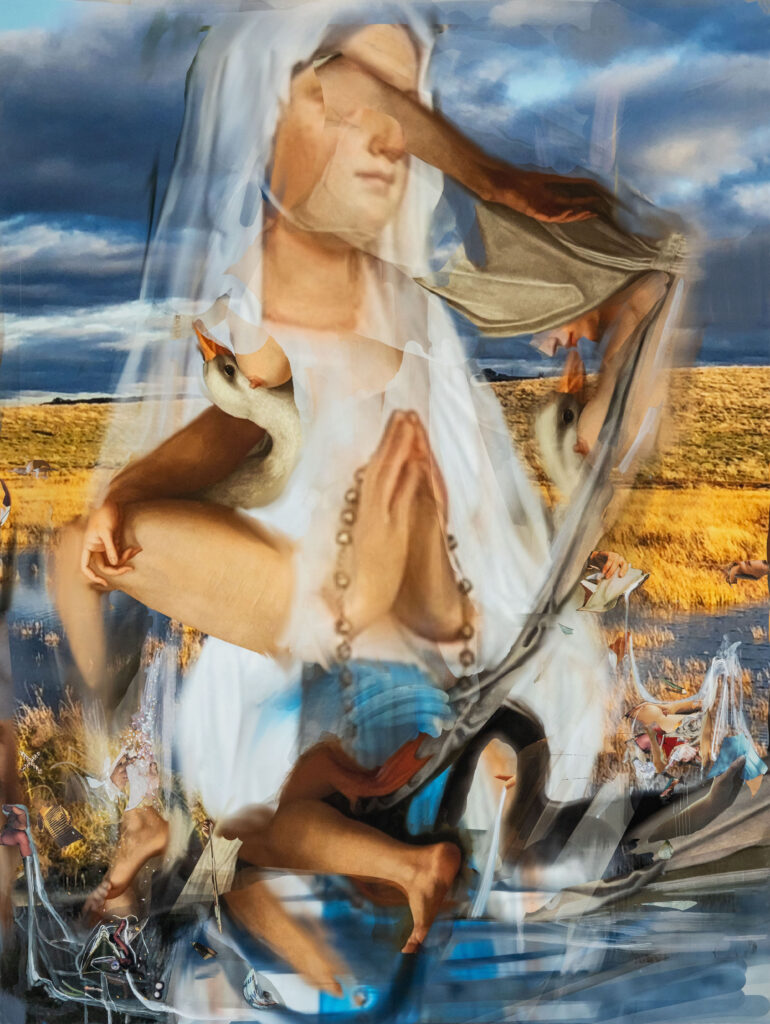
Emerging from alchemical thinking around the union of opposites and later developed through Jungian ideas, it became a way of placing unlikely elements side by side, not to resolve them, but to activate something instinctive and unconscious through friction and surprise. For me, this can feel like placing a sacred or devotional image next to something unstable and bodily, where flesh, shadow or dreamlike material begins to interrupt the surface of the image.
The familiarity of the sacred and the discomfort of the visceral don’t cancel each other out, but instead generate a new emotional language in that collision. I think I’m interested in that tension because it reflects how we experience the world internally, as well as my own lived experience as an Australian-born Maltese artist. Things are rarely fixed or singular; they overlap, interrupt and reshape one another. In my work, I try to hold those states together rather than resolve them, allowing ambiguity to do its own kind of emotional and psychological work.
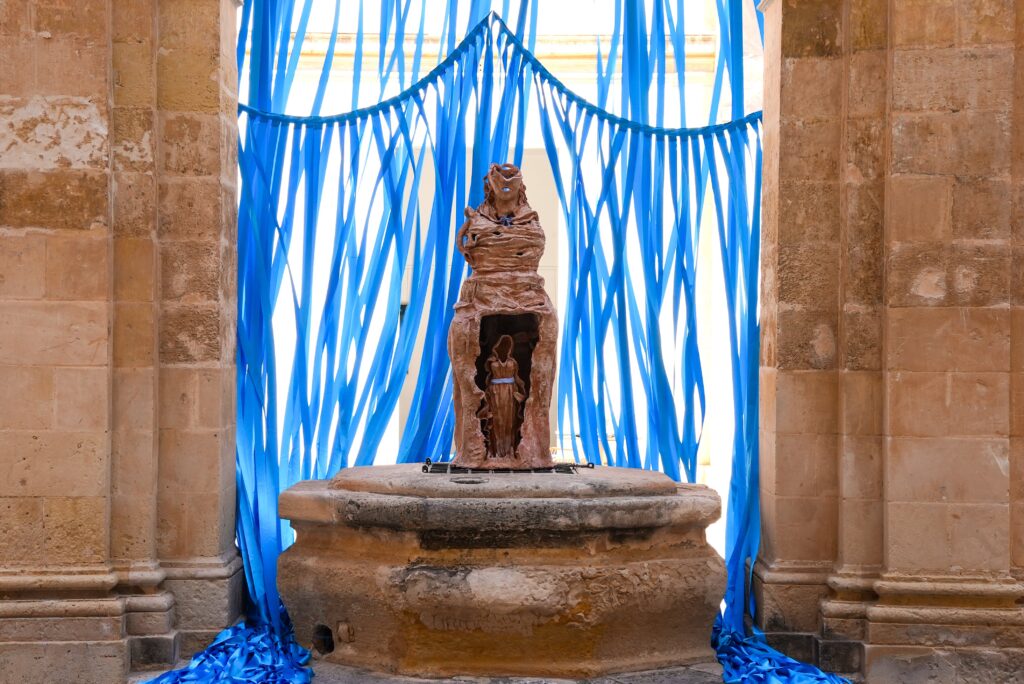
Q7. How do you decide which medium an idea belongs in?
For me, it often feels like the material chooses me rather than the other way around. I don’t usually begin with a fixed decision about medium; instead, I follow the logic of the idea as it unfolds. Some works naturally want to remain as painting, while others demand a more fragmented language through photomontage, printmaking, drawing or mixed media.
I respond to what feels most truthful for the idea in that moment, and the medium becomes part of the thinking process rather than a predetermined choice. Ironically, I sometimes return to the same idea in another medium, almost as a way of re-immortalising it and extending the dialogue in different directions. You have to do what feels right for the work until it fully percolates. For me, it’s a porous process.
Q8. What does photomontage allow you to express that painting alone cannot?
Using photomontage keeps things challenging for me. Photomontage allows me to work with a different kind of truth—one that is more fractured, immediate and layered than painting alone. Photographic fragments already carry a sense of lived reality, memory and documentation, so when I bring them together I’m able to disrupt their original context and reassemble them into something more psychological and dreamlike.
It lets me collapse time, place and identity in a way that feels closer to how memory actually functions, where things are never linear but constantly overlapping and shifting. In that sense, photomontage opens up a space where I can push contradiction, ambiguity and subconscious narrative in a very direct way.
Q9. Color plays a powerful role in your work. What does it allow you to express beyond the imagery?
Colour for me is instinctively arbitrary rather than descriptive, and I use it more as an emotional or atmospheric force than a literal one. It operates as a kind of mood language, guiding the viewer through the psychological tone of the work rather than explaining it. I’m interested in how colour can shift perception, heighten tension or create unexpected harmony between unrelated elements. In that sense, it becomes another way of accessing the subconscious within the image, helping to lead the viewer through feeling rather than fixed meaning.
Q10. What do you think makes a personal story resonate with so many people?
It’s definitely all about being authentic in every respect, while also recognising that everything is relative. There is a strong autobiographical thread in my work, but I try not to make it overly descriptive or literal. Instead, I aim to distil lived experience into fragments, symbols and atmospheres that carry feeling rather than explanation. In that space, the personal becomes a kind of entry point, allowing others to locate their own experiences within it and connect through shared emotional and psychological ground.
For example, something like the grotto, which is rooted in a very real lived experience for me, might be read by a viewer as something entirely different, such as an alien-like womb, a chamber or a seed pod. In return, that openness means it can also hold all of those meanings for me as well, shifting and expanding depending on perspective.
Q11. Looking back, what has challenged you most throughout your journey as a person?
Maybe all of it. But if I’m honest, the most challenging part hasn’t been the practice itself, it’s been how much of my heart I tend to lay on the line in everything I do. I care deeply about people, opportunities and the things I commit to, and that can be both a strength and a challenge. As a person, I’ve had to learn that not everything needs to be controlled or fully understood. Life is constantly shifting, and I’ve come to accept that people, experiences and circumstances are always evolving.
The older I get, the more I appreciate the importance of remaining open, adaptable and present within that uncertainty. So I suppose the real challenge has been finding a balance between vulnerability and resilience, staying true to myself while also protecting my energy. I’m still learning that. Sometimes it means trusting the rhythm of things, embracing the slipperiness of the ride, and learning how to channel that energy rather than resist it.
Q12. After decades of making art, what keeps you curious enough to walk back into the studio and begin again?
The unknown, without question. No matter how many years I’ve been making art, there is always something new to discover about myself, the materials, or the idea I’m pursuing. Every time I enter the studio, I’m stepping into a space of possibility where I don’t quite know what will emerge. There’s also something about meeting my own demons and angels along the way.
The studio remains a place where I can confront, question and better understand different parts of myself. That sense of curiosity, and not having all the answers, keeps the process alive for me. If anything, the longer I practice, the more I realise how much there is still to learn, not only about art, but about myself and my place in the world. In many ways, I’m always dismantling the jigsaw puzzle and reimagining it in new configurations.
Q13. If you could give one piece of advice to artists struggling to trust their own voice, what would it be?
Trust that your voice is already there. The challenge isn’t finding it, but giving yourself permission to listen to it. We’re all influenced by other artists, movements and expectations, but at some point you have to stop looking over your shoulder and pay attention to what genuinely captivates you.
The things you return to repeatedly, the questions you can’t stop asking, and the experiences that have shaped you are often where your most authentic work resides. Most importantly, don’t be afraid of evolving. Your voice isn’t a fixed destination; it’s a living thing that grows and changes alongside you. The more honest you are with yourself, the stronger and more distinctive it becomes.
As we wrapped up our conversation with Louisa, one thing kept sitting with us. That the artists who last are not the ones who found one thing and repeated it forever. They are the ones who kept searching. Kept moving between mediums and materials and questions because no single answer could hold everything they needed to say.
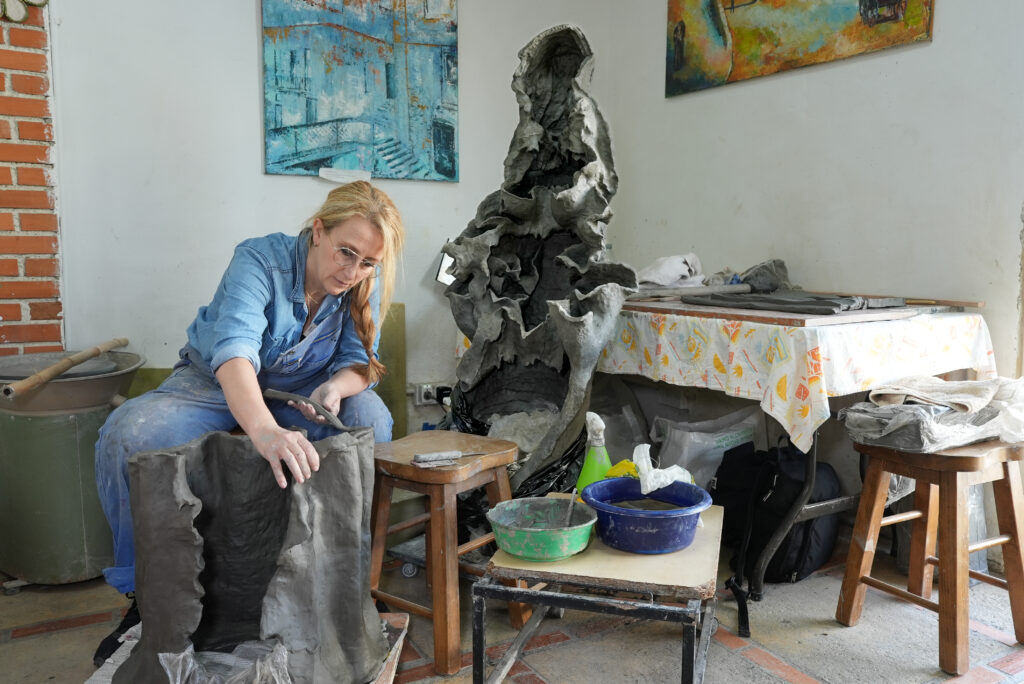
Louisa has been doing that for decades. Painting one day, photomontage the next, ceramics the week after, sculpture when the idea demands a body. And none of that movement has made her practice scattered. It has made it richer.
Because every medium she works in teaches her something that she brings back to all the others. The collage thinking shows up in her paintings. The painting sensibility shows up in her ceramics. Everything cross-pollinates. Everything feeds everything else.
And that is something worth hearing for any artist who has ever been told to pick a lane. That picking a lane is fine if one lane is genuinely enough for you. But if it is not, if your curiosity keeps pulling you sideways into materials and methods that were not part of the plan, that is not a lack of focus.
That is the sign of a practice that is bigger than any single discipline can contain. Louisa trusted that about herself early and it has given her a body of work that is broader and deeper and more surprising than it would have been if she had stayed in one place.
For art lovers and collectors, Louisa’s work carries a psychological depth and a visual complexity that keeps unfolding the longer you live with it. The layered surfaces hold memory and dream and lived experience in the same frame and what you see in them changes as you change. That is the kind of art that grows alongside whoever owns it.
Follow Louisa Chircop through the links below and see her work for yourself.