
This artist’s androgynous figure became the cover of Poland’s most famous Novel I Elen Bezhen
👁 103 Views
At Arts to Hearts, some discoveries stop you completely. Not because they demand your attention, but because they earn it. There is a difference and it is everything. Our Best of the Art World editorial was born from exactly that feeling: the need to seek out artists whose work doesn’t shout to be noticed but pulls you in quietly, gradually, and stays with you in ways you only begin to understand days later.
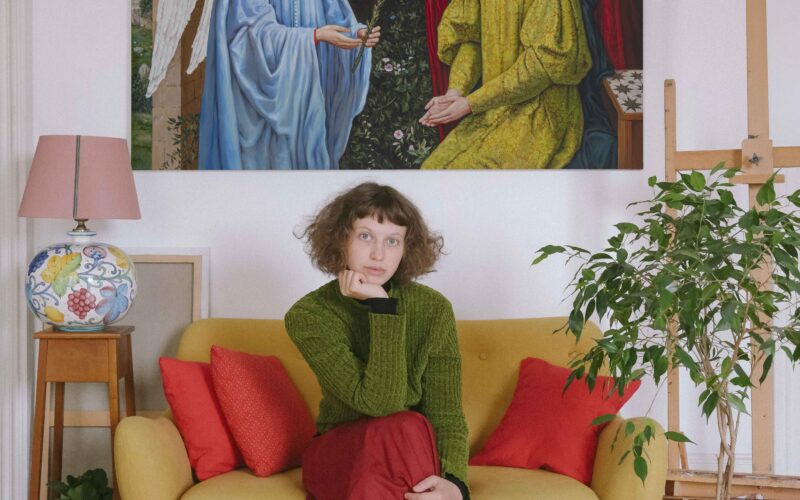
Elen Bezhen is one of those artists. The first time we encountered her work, something shifted. We weren’t rushing past we were looking, really looking, in the way her paintings seem to ask of you.
There is a quality to them that is hard to articulate but impossible to miss, a held breath, a deep stillness, a world caught in a moment that feels both fleeting and eternal all at once.
Elen grew up in the North Caucasus, studied at the Academy of Arts in Moscow, and now makes her paintings in France. Her journey across countries and traditions has shaped a practice that feels rooted in multiple worlds at once.
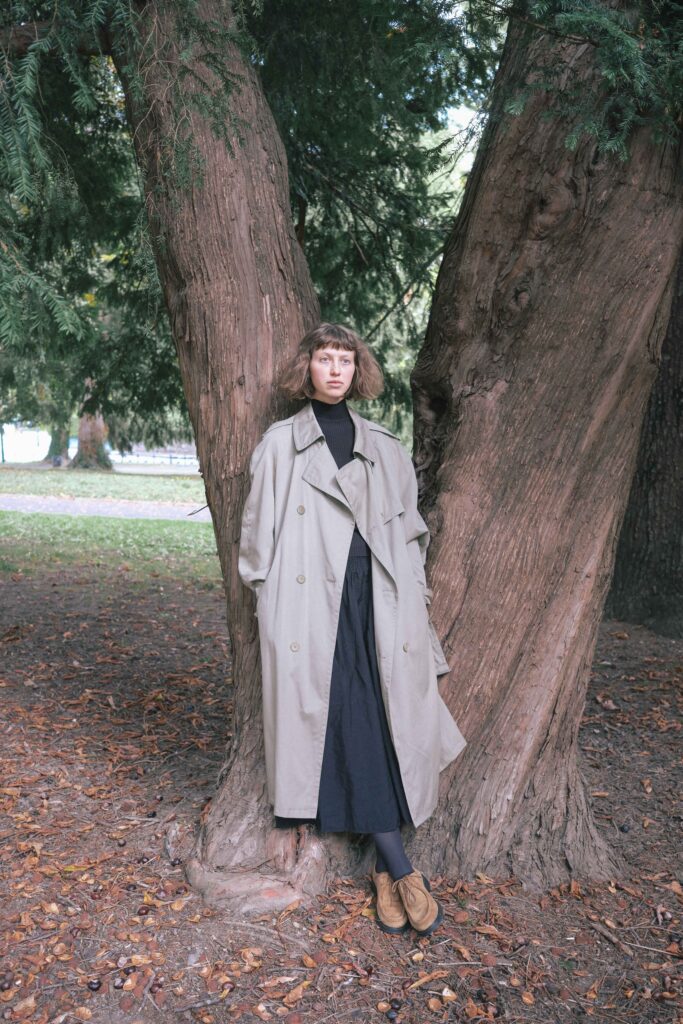
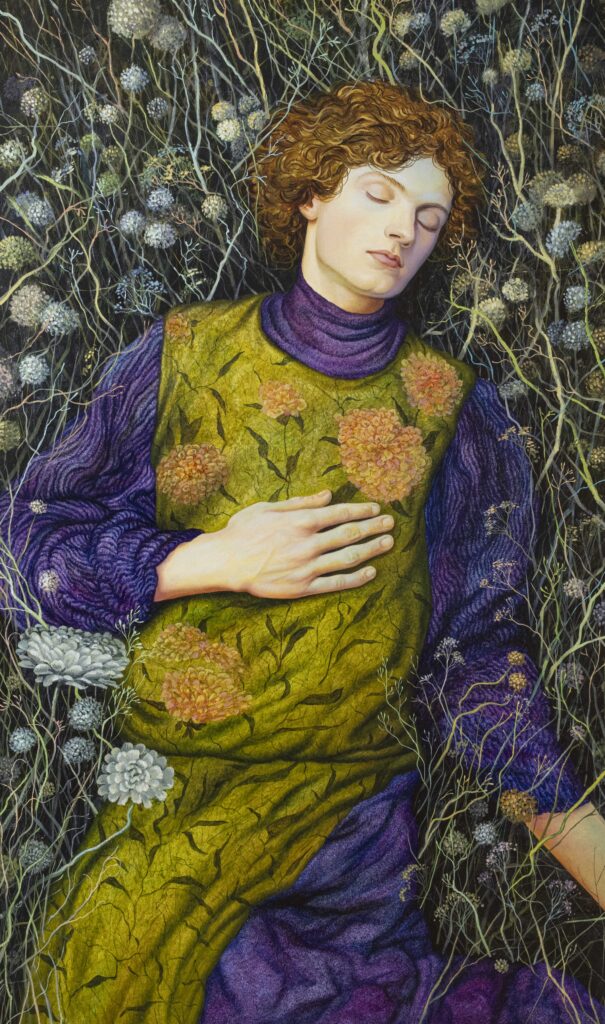
Her paintings bring together women and nature figures surrounded by birds, animals, botanical details, and landscapes that carry the weight of something much older than the canvas they are painted on.
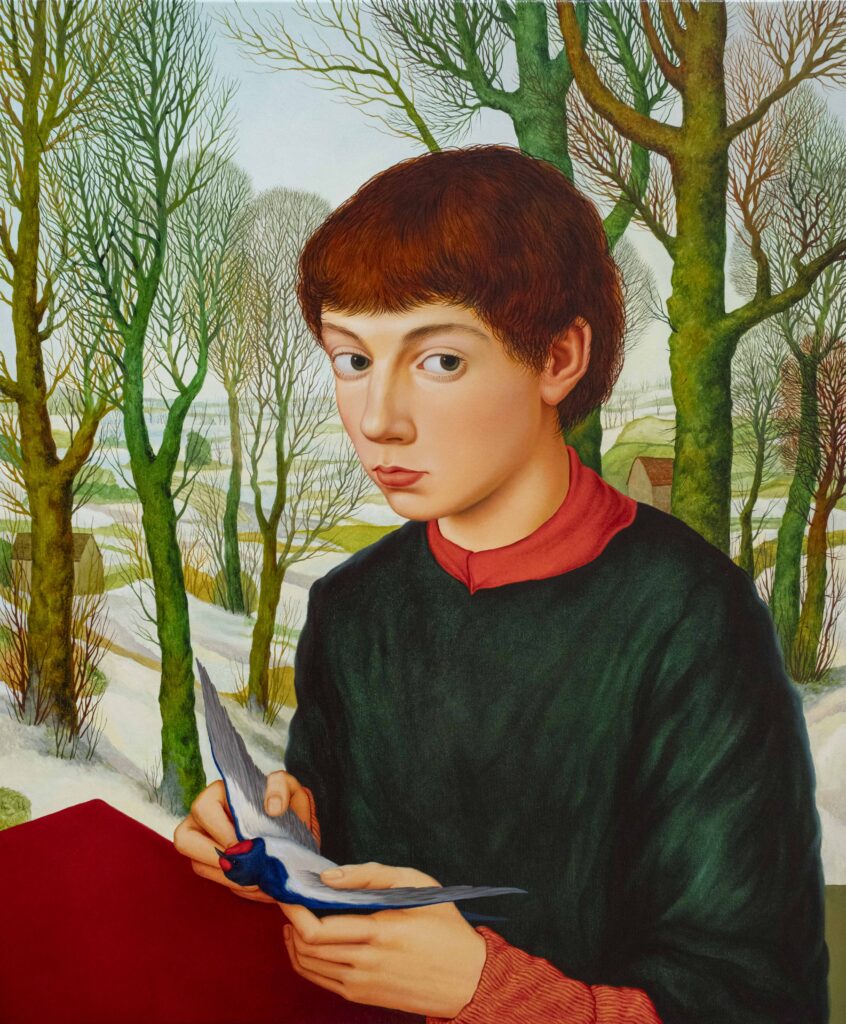
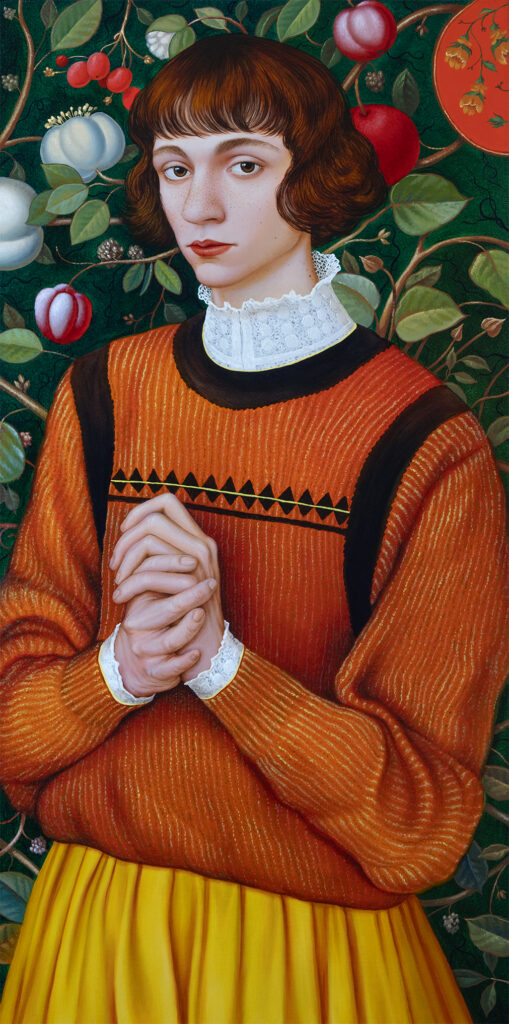
The influence of the Northern Renaissance is present in every layer in the meditative restraint, in the attentiveness to light and surface but what you are looking at is entirely and unmistakably Elen.
She works in grisaille and delicate glazes, building slowly, layer by layer, until the skin glows from somewhere within itself. She stretches her own canvases. She prepares her own grounds. Every part of the process is deliberate. In a world that keeps asking artists to produce more and faster, she has quietly, firmly, chosen otherwise.
Because for Elen, her paintings carry a deeper argument that the distance we have placed between ourselves and the natural world is not progress but loss. Her figures do not pose against nature. They belong to it. And in that belonging is something we have been missing for a very long time.
Let’s get to know Elen through our conversation with her, where she shares the journey that took her from the North Caucasus to Moscow to France, the philosophy behind her slow and deeply intentional practice, and what she believes painting can say about the world that no other language quite can.
Q1. You grew up in the North Caucasus, trained in Moscow, and now paint in France. That’s quite a journey, where does the story of you as an artist actually begin?
My artistic journey began about fifteen years ago in the North Caucasus. At that time I was drawing with pencils in a sketchbook and gradually began to develop an interest in oil painting. These were rather awkward and uncertain attempts to master such a complex medium, but they awakened in me a strong desire to study easel oil painting with masters in an academic environment. For this reason, at the age of nineteen I moved to Moscow.
Q2. The painters of the Northern Renaissance have profoundly influenced your approach. What is it specifically about that era that speaks to you, is it the technique, the philosophy, or something harder to name?
What probably attracts me to the painting of this period is its meditative, contemplative, and restrained quality. There is nothing loud or overtly dramatic in it, yet it carries a strong inner emotional tension. I am also deeply impressed by the attentiveness with which artists of that time observed the world. This is something I clearly feel whenever I look at paintings from that era.
Q3. You work with grisaille and delicate glazes, and speak about paint needing “depth, purity, and plasticity.” Can you walk us through how a painting begins for you from the first mark to knowing it’s finished?
I like to combine different painting techniques within a single work — grisaille, glazing, alla prima, and sometimes freer, almost impressionistic brushwork. I choose a specific technique for each element of the painting. For example, it is important for me to paint the face and hands using grisaille and delicate glazes, as this gives the skin a particular depth and a soft inner glow. Nature, on the other hand, I often paint in alla prima or in a multilayered approach with glazes, because nature itself is more chaotic, and this technique, in my view, better conveys its vitality. The work usually begins with a drawing on paper in the same format as the canvas. Once the composition is fully refined, I transfer this drawing onto the canvas. This method allows me to maintain precision and clarity, so that the lines do not show through the later layers of paint. Then I begin covering the canvas with paint, trying to establish the entire surface in a single session. At this stage it is important for me to preserve the overall relationships between the elements and to work carefully on the transitions from one object to another. After that, the process continues “in sections”: I work separately on the face, hands, clothing, landscape, and other details. This stage can last quite a long time, until I feel that the painting is finished.
For me it is always easy to begin a painting, but much more difficult to finish it. It is important to stop at the right moment so that the painting does not begin to look overworked or exhausted.
Q4. The feminine figure is at the heart of your work. How do you make sure each woman in your paintings feels like a real person and not just a symbol?
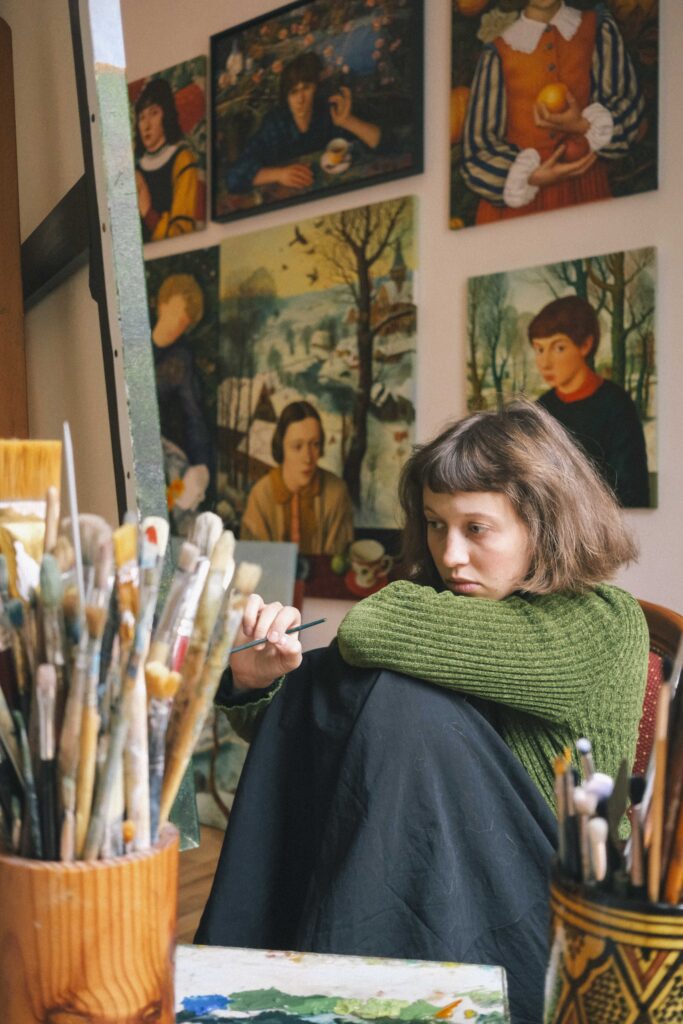
First of all, I paint female portraits because this subject feels closer to me. In a certain sense, I pass each image through myself, so many of them inevitably acquire elements of a self-portrait. Sometimes I use my own reflection in the mirror as an anatomical reference for a pose or facial expression. Often the image emerges from a particular state or feeling that has remained in my memory from the past.
Q5. In The Girl and the Birds, Portrait with a Donkey, Landscape with a Duck, animals keep showing up next to your figures. What do they bring to the painting that a human figure alone can’t?
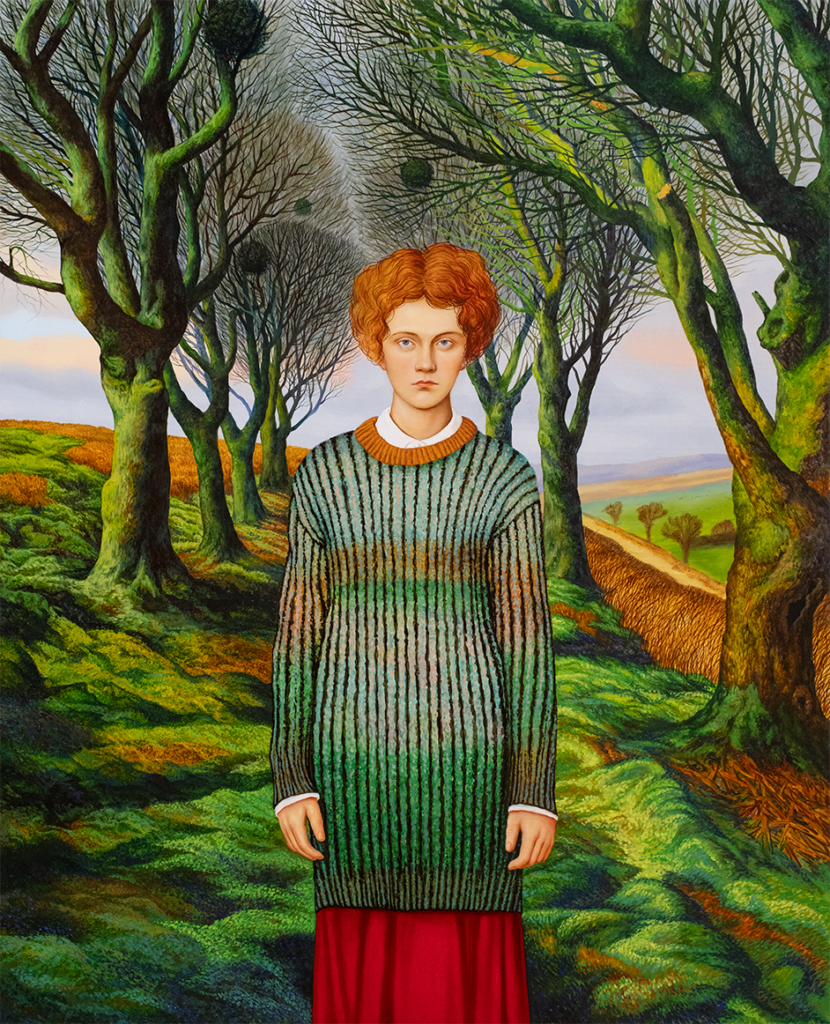
The central element of my work is the human figure in dialogue with nature. It is important for me to show this interaction — the state of a person’s presence within the natural environment and their connection to it. Nature itself has always been a great source of interest and inspiration for me. When I was sixteen, I began to take an interest in entomology and botany. This greatly expanded my perspective and showed me how complex and harmonious this world is at the same time. Yet humans seem to disturb this harmony. Today people are increasingly distancing themselves from nature and separating themselves from it. In my work, I want to remind viewers that this connection is extremely important, because humans are still a part of nature, not something that exists apart from it. That is why I depict people not only against the background of landscapes or plants, but also together with birds and animals.
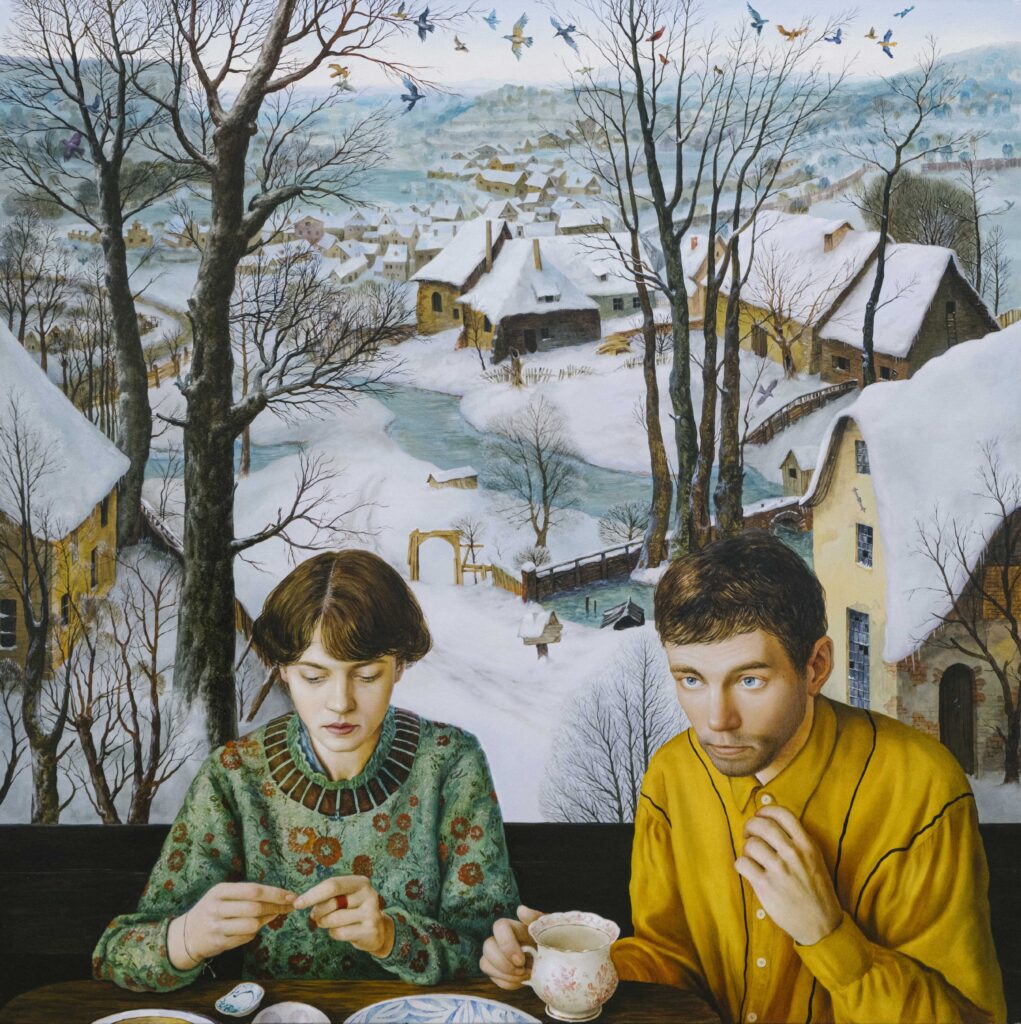
Q6. Your portraits often have this very still, almost breathless quality to them. Is that stillness something you plan, or does it just come from the way you paint?
That is indeed a very accurate observation. I think this quality appears naturally. In many ways it resembles the inner state I find myself in while I am working. At the same time, it is important for me to preserve a sense of contemplation in the portrait — when the person in the painting seems to be observing and attentively listening to the surrounding environment. Often this state appears almost emotionless on the surface, yet it contains a strong inner tension and intensity.
Q7. You’ve talked about painting nature as a way to speak about things like genetic modification and the Anthropocene. How do you approach expressing something so complex through such quiet imagery?
I wouldn’t say that I deliberately hide such complex themes in my paintings. On the contrary, I often find it difficult to find a way to speak about them more clearly within the pictorial image. Sometimes I depict landscapes cut by agricultural fields, or I invent plants that do not actually exist. But is that enough for a viewer to truly notice and recognize these complex themes? Probably not. Nevertheless, this remains an important direction of exploration for me, and I continue searching for ways to speak about it through painting.
Q8. You prepare your own grounds and work with handmade paints. How much does the physical material the oil, the pigment affect what a painting becomes?
During my studies at the Academy of Arts, I prepared my own grounds, ground pigments with oil, and studied the technique of tempera painting, including making egg tempera myself. This was a very valuable experience during my student years, as it helped me better understand the physical nature of painting materials and the process of creating paint itself. Today, however, there is no real necessity to do this. Contemporary art materials are usually of very high quality, and often they are even better than paints prepared by hand, especially when it comes to complex and very hard pigments that are difficult to grind thoroughly into a fine oil paste. What I still do by hand is stretching the canvas on the stretcher and applying several layers of ground. I use ready-made gesso, but the process of preparing the surface is very important to me because it allows me to control the quality of the support and adapt it to the specific needs of each painting. Of course, materials have a strong influence on what a painting ultimately becomes. Some oil paints are transparent and allow for the creation of complex glazing layers, while others are opaquer and work well for building texture. Brushes are just as important, and I use many different types for specific elements within each painting.
Q9. The art world increasingly rewards speed and volume, especially on social media. How do you protect the slowness that classical painting demands?
Yes, I do feel this pressure — the expectation that an artist should produce many works and do it quickly without losing quality. Sometimes I even catch myself thinking that I should work more and faster. At the same time, I understand that it is impossible to achieve real quality in a short period of time. This is especially true in oil painting, where it is often necessary to wait for the previous layer to dry completely before moving on to the next one. In this sense, the very technology of oil painting forces me not to rush. At the same time, this does not prevent me from working on several paintings at once.
Q10. What does success look like to you at this point in your career, is it institutional recognition, the work itself, or something else entirely?
At this stage of my career, it feels like things are developing quite naturally and actively. I participate in art fairs and solo exhibitions, and recently my first monograph, Still Garden, was published. But to be honest, the greatest joy for me is the moment when I manage to find the right image in a painting something that was previously difficult to express. Each time I succeed in doing that, it feels like a real success to me.
Q11. Has a viewer ever interpreted your work in a way that surprised you something you never intended but still felt true?
Yes, there have been a few such cases. For example, one of my paintings, “The Green Garden,” was used for the cover of the Polish edition of Orlando. I often avoid explicit gender markers in my portraits, so viewers sometimes perceive the same figure differently. It is always interesting when people notice this on their own. There was also a more amusing moment when someone pointed out that a figure in one of my paintings had six fingers — something I had completely overlooked while working.
Q12. For a young artist torn between learning classical techniques and finding their own voice, what would you advise?
I would advise not choosing just one path. If someone is interested in both, it is worth pursuing both. Only in this way can you understand what truly matters most to you. In my own practice, I experimented with many forms — video art, installations, land art, even bio art. Over time, I began to see a connecting thread between them, which helped me understand the themes that concern me most. Painting eventually remained the most important form for me. I simply realized that I cannot not do it.
As our conversation with Elen came to a close, we kept returning to something that feels increasingly difficult to find in the contemporary art world, a practice built entirely on conviction.
Not on trend, not on market demand, not on the pressure to produce and post and be seen constantly. Just on the deep, quiet certainty that the work matters, that the process matters, and that slowing down is not a weakness but one of the most powerful choices an artist can make.
And that is exactly what makes Elen so remarkable. In a world that has made speed into a virtue and visibility into a measure of worth, she is choosing to wait. To let layers dry. To look at a painting until she knows, really know, that it is finished. That patience is not just a technical decision. It is a statement.
It is her way of insisting that some things cannot be rushed without being diminished. That beauty, real beauty, the kind that carries weight and changes you, takes time to build. And it is worth every moment of that time.
It is also worth considering how rare it is to find a painter so fluent across multiple traditions without feeling derivative of any of them. The Renaissance is present in her glazes and her stillness. The contemporary is present in her themes and her awareness. A
nd somewhere between the two lives something that belongs entirely to her , a visual language built slowly, tested carefully, and refined until it could not have come from anyone else.
What Elen represents is something the art world needs more of and rewards too rarely the courage to go deep instead of wide, to build slowly instead of producing constantly, to trust the process even when the culture around you is demanding the opposite. That is not just an artistic choice. It is a stance. And the paintings that come from it carry a weight and a presence that simply cannot be manufactured any other way.
Follow Elen through the links below and give her work the time it deserves. You will not regret a single slow moment of it.