

City, Art and Culture: Anukta Mukherjee Ghosh on Portraying Everyday Life

From the boardrooms of corporate leadership to the quiet intimacy of a painter’s studio, Anukta’s journey is one of courage, reinvention, and an unshakeable pull towards creative expression. As an artist who finds beauty in the ordinary, she translates moments, places, and people into visual narratives that are at once personal and universal. Her canvases capture the many Indias within India; everyday scenes infused with hope, resilience, and a deep respect for cultural heritage. Whether portraying the vanishing hand-pulled rickshaw of Kolkata, the quiet strength of women, or the meditative play of colour and form, Anukta’s work offers a reminder that art can both ground us in reality and lift us into reflection.
In this conversation, she opens up about her inspirations, evolving practice, and the emotional currents that shape her art.
Hi Anukta, can you share a bit about your journey? What first drew inspired you and your works?
Painting — and even more so, sketching and doodling has been close to my heart for as long as I can remember. As an introverted child, art became my truest form of self-expression. An avid reader, I would get lost in magazine illustrations and the works of masters like Bikash Bhattacharjee, trying to decode their lines and forms. But coming from a non-artistic family, I never imagined pursuing it professionally. I spent nearly two decades in the corporate world, immersed in administration, leadership development, client relations, P&L management, and business development. It was fast-paced, fulfilling and intellectually rewarding. But about 13 years ago, I began yearning to reconnect with my creative self. I realized we only get one life — and the call to return to art was too strong to ignore. So, I made the shift. In my initial years I enrolled in group art classes under artist Pranab Roy, who rekindled my love for painting. I also completed a 3-year online diploma from the London Art College, graduating with a Certificate of Distinction. It marked the beginning of a new chapter — one where I could finally pursue art with heart and purpose.
How does Kolkata, a city rich in art and culture inspire you as an artist?
Kolkata has played an essential role in what I like to call my ‘rebirth’ as an artist. Though I had a multi-city upbringing — with large parts of my school and work life spent in Delhi and other places — settling in Kolkata allowed me to see the city through fresh eyes. Among Bengalis, there’s a deep reverence for creativity — whether it’s music, poetry, theatre, or visual art. Kolkata, with its old-world charm and strong cultural identity, has been a rich source of inspiration. The hand-pulled rickshaw, for instance — a vanishing icon of the city — has appeared in many of my works in both realistic and semi-abstract styles. This region has a proud artistic lineage, with stalwarts like Jamini Roy, Abanindranath Tagore, Nandalal Bose, Rabindranath Tagore, Ganesh Pyne and presently, Jogen Chowdhury leaving an indelible mark. Institutions like Tagore’s Visa- Bharati University in Shantiniketan have played a crucial role in preserving and nurturing indigenous traditions — a legacy that continues to inspire generations, including mine.
If your studio had to play a song to match your energy, what would it be and why?
I love this question — because music is an inseparable part of my painting process. I almost always have something playing in the background and the playlist usually reflects my mood — ranging from light and playful to deeply spiritual. Sometimes, I even choose music intentionally to match the theme or emotional tone of the piece I’m working on. If I had to pick one song that truly captures my studio’s energy, it would be “Greatest Love of All” by Whitney Houston. It’s a powerful anthem about believing in oneself, about not looking outward for validation, but finding strength and purpose from within. That message resonates deeply with me — both as an artist and as a person.
Looking back at your early work, what would you say has changed the most—your technique, your themes, or your perspective?
In my earlier works, I was drawn to painting things I found beautiful — expressive faces, moments of kindness or joy, or scenes from nature. They were largely representational. Over time, my focus has shifted toward stronger compositions and bold forms. The play of colour has always been central to my practice and while contemporary realism still excites me, I’ve begun exploring more abstract concepts as well. Painting has become increasingly meditative — a way for me to connect inwardly. I find that when I let go of conscious control, my subconscious takes over, and that’s where the magic happens. That said, I still consider myself a work in progress — always evolving, always exploring.
Looking back, is there a piece or series that felt like a turning point in your journey?
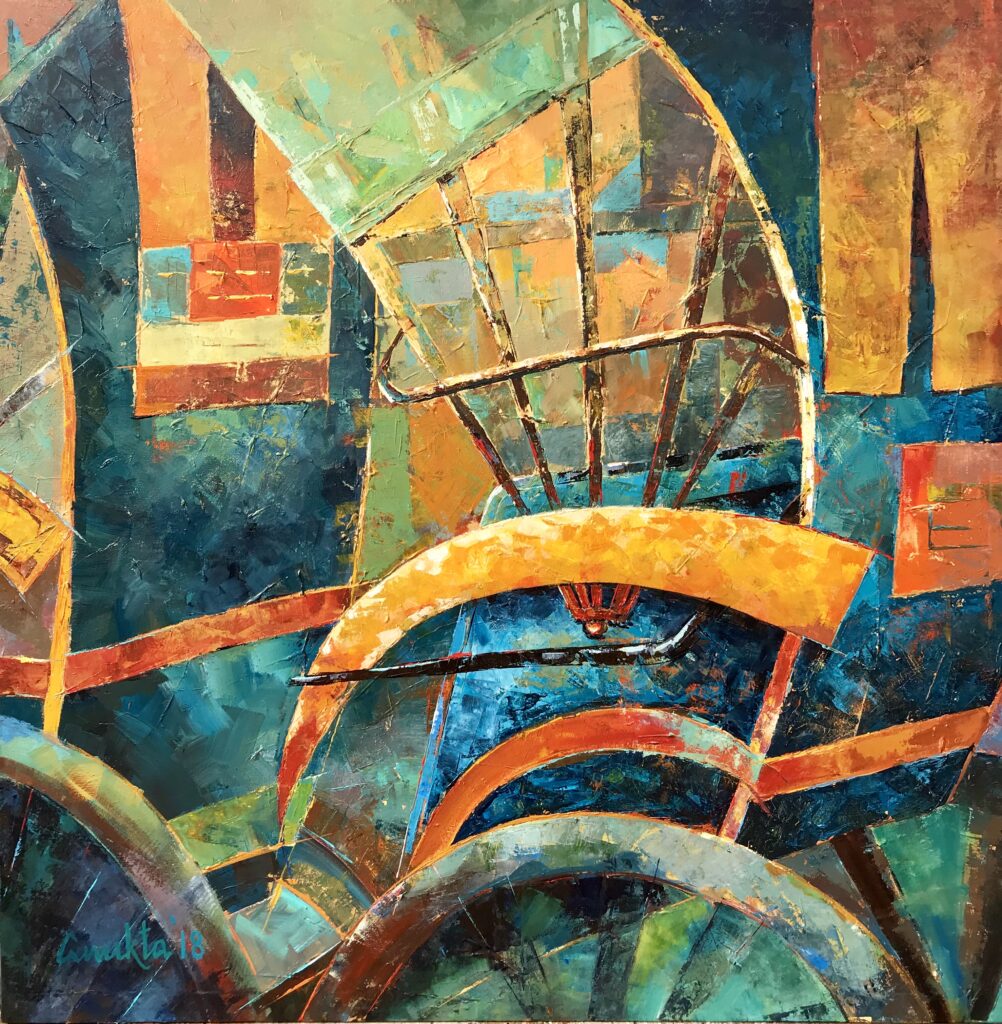
Being a versatile artist, I explore a range of themes, but one that has recurred often is that of hand-pulled rickshaws and the rickshaw pullers. I’ve created over 20 works around this subject. A significant moment came in 2018, when I was invited by the prestigious ITC Hotels group to be part of an art workshop and create a painting that reflected the spirit of Kolkata. I chose my favourite theme for this — a hand-pulled rickshaw — and the large work, rendered in a semi-abstract style using strong lines and form, was created for the public space of the soon-to-be-inaugurated super luxury hotel, ITC Royal Bengal. The painting received much appreciation and became a turning point, opening doors to many more commissions and collectors both within India and abroad.
Does your work specifically reconstruct the narrative of gender politics? Tell us more about it.
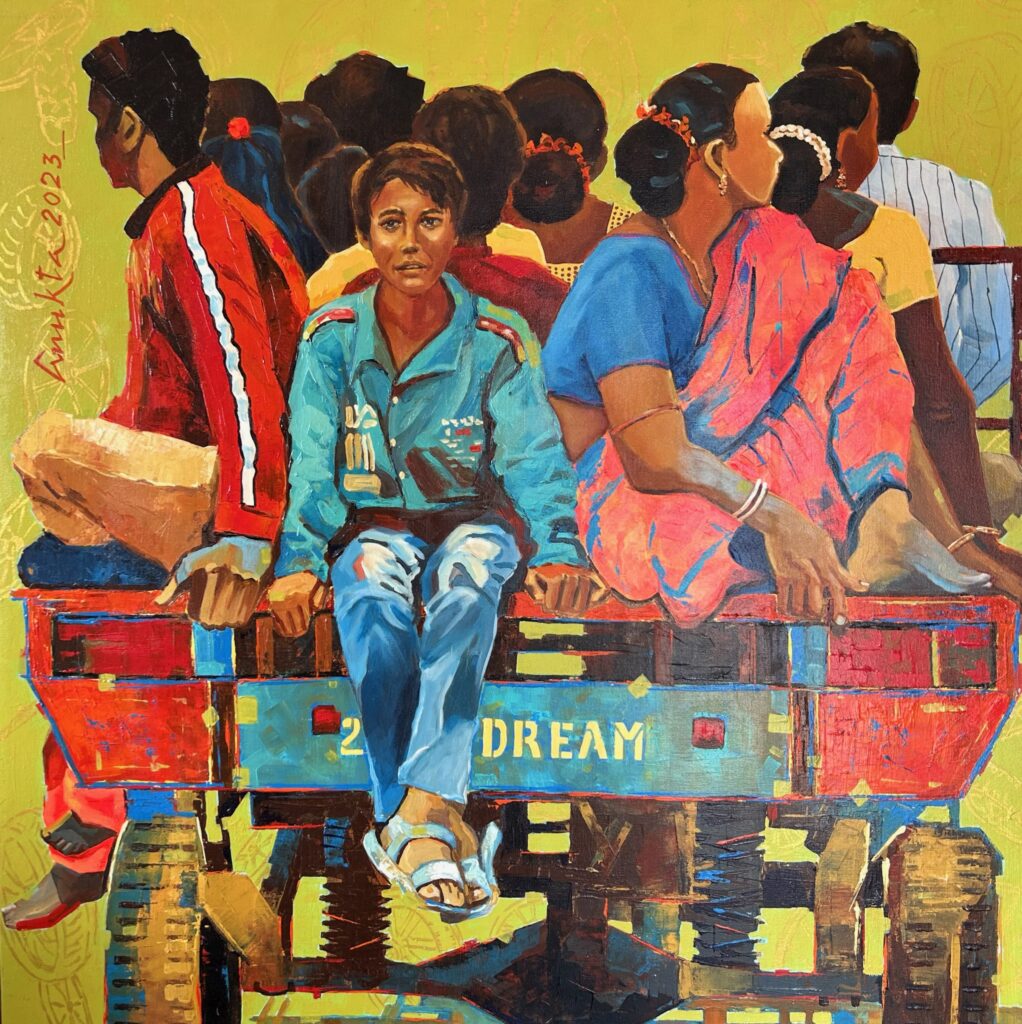
Not all of my work addresses gender politics directly, but many pieces have certainly engaged with those themes. I strongly believe in the multifaceted role of women — as nurturers, creators, professionals, and leaders.
Economic empowerment, in particular, is close to my heart, as it enables women to make independent decisions and contribute meaningfully to society — which remains largely patriarchal. Several of my paintings including — Vande Shakti and Magan — reflect this spirit.
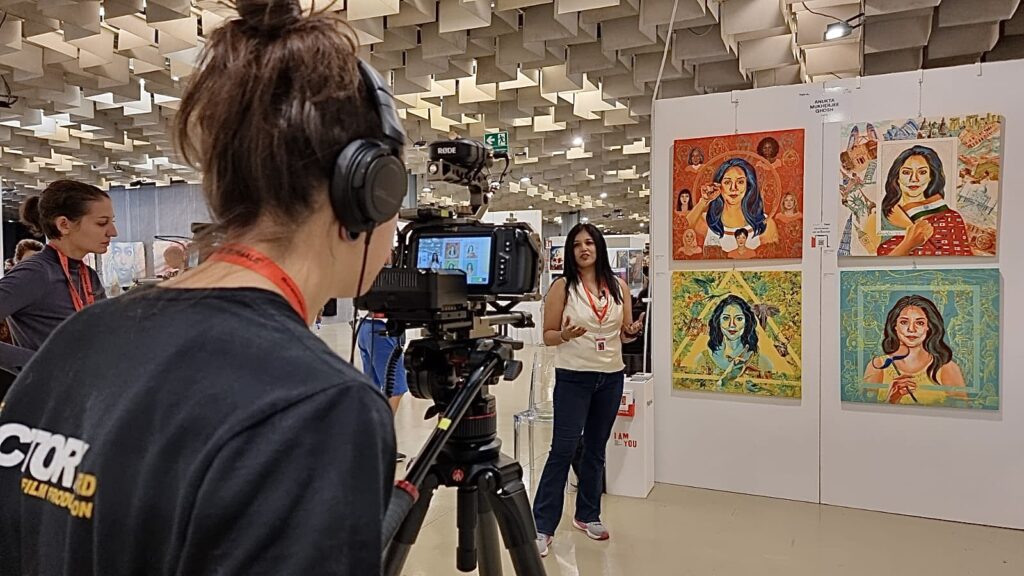
Magan, created in 2016, depicts women immersed in the ecstasy of dance. It was selected by the Government of India as the mascot for the “Womaniya on Government e-Marketplace” initiative, celebrating women’s financial independence and encouraging grassroots entrepreneurship. Two other works — Reflections: Embodiment and Reflections: Sisterhood — were showcased under the theme “I Am You” at the 2023 Florence Biennale XIV. Embodiment challenges gender stereotypes by portraying women in roles traditionally seen as male — astronauts, construction workers, referees, farmers. The message is one of balance and harmony, not division.
Sisterhood, on the other hand, is a deeply personal and collective tribute to women. It explores the invisible threads of empathy and endurance that unite women despite differing circumstances. It is reflection on the spirit of resilience passed down through maternal and societal lines. Among many women depicted, at the centre of the canvas is a woman mid-gesture, anchored, expressive and self-aware. It is my own self portrait, echoing the spirit of womanhood from within – thereby being both a witness and a participant – bearing not only my own emotional legacy but also that of countless others.
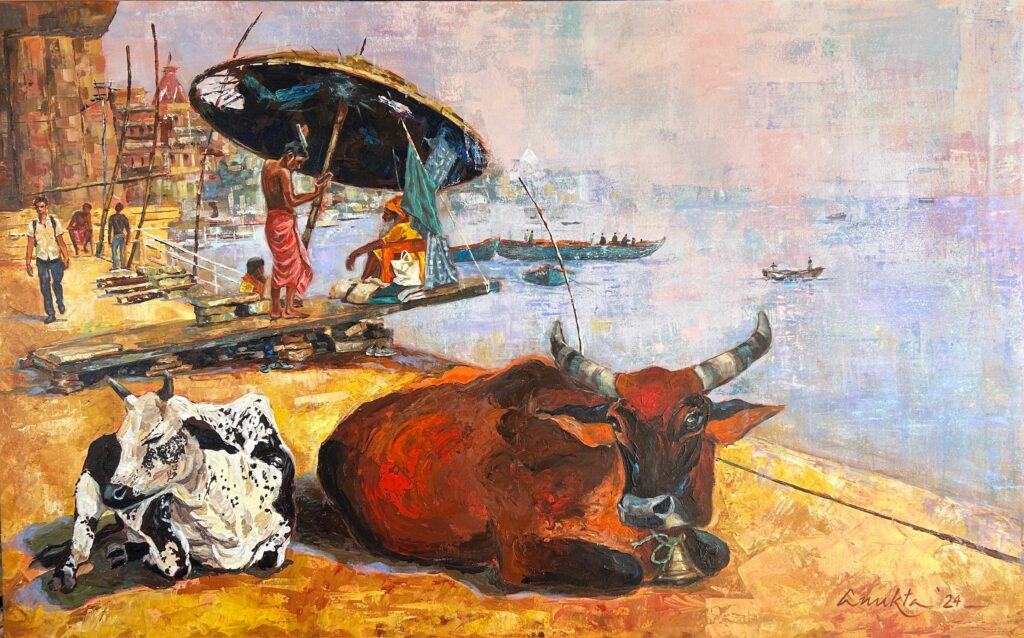
Anukta’s art is, at its heart, an act of seeing not just the obvious, but the layers of meaning that lie beneath. Her willingness to evolve, experiment, and move between mediums speaks to a restless curiosity and a refusal to be boxed in. Whether through the powerful imagery of gender empowerment, the quiet dignity of Kolkata’s streets, or the joyful chaos of her studio, her work tells stories that linger long after the first glance. In a world that often prizes speed over stillness, her paintings invite us to slow down, look deeper, and find beauty in the details that others might overlook.
To learn more about Anukta Mukherjee Ghosh, click the following links to visit her profile.