


From Ancient Myths to Modern Art: 7 Vampire Artworks That Tell the Story
Long before vampires became the stars of blockbuster films, binge-worthy television series, and bestselling novels, they were already captivating artists. For centuries, painters, printmakers, sculptors, and contemporary creators have turned to the vampire as a symbol of far more than blood and immortality. It has represented forbidden desire, heartbreak, fear, power, seduction, and even the darker sides of human nature. Few mythical figures have changed so dramatically, or remained so endlessly fascinating.
What makes the vampire unique is its ability to evolve with every generation. In ancient myths, it appeared as a terrifying demon that preyed on the living. During the Gothic era, it emerged from folklore as a frightening reminder of death and the unknown. By the late nineteenth century, artists began transforming it into a deeply emotional figure, using vampirism to explore love, obsession, and psychological vulnerability. Today, contemporary artists continue to reinvent the vampire, using it to challenge ideas about identity, gender, beauty, colonialism, and modern relationships.
Rather than simply illustrating monsters, these artists have used the vampire to reflect the hopes, fears, and cultural anxieties of their own time. Their works reveal that the vampire has never been just a creature hiding in the shadows, it has always been a powerful metaphor for the complexities of being human.
In this list, we explore seven remarkable vampire artworks that transformed the vampire from an ancient myth into one of art history’s most enduring and endlessly reimagined icons.
Ancient Greek Vase Depicting Lamia (c. 500 BCE) — The Beldam Painter
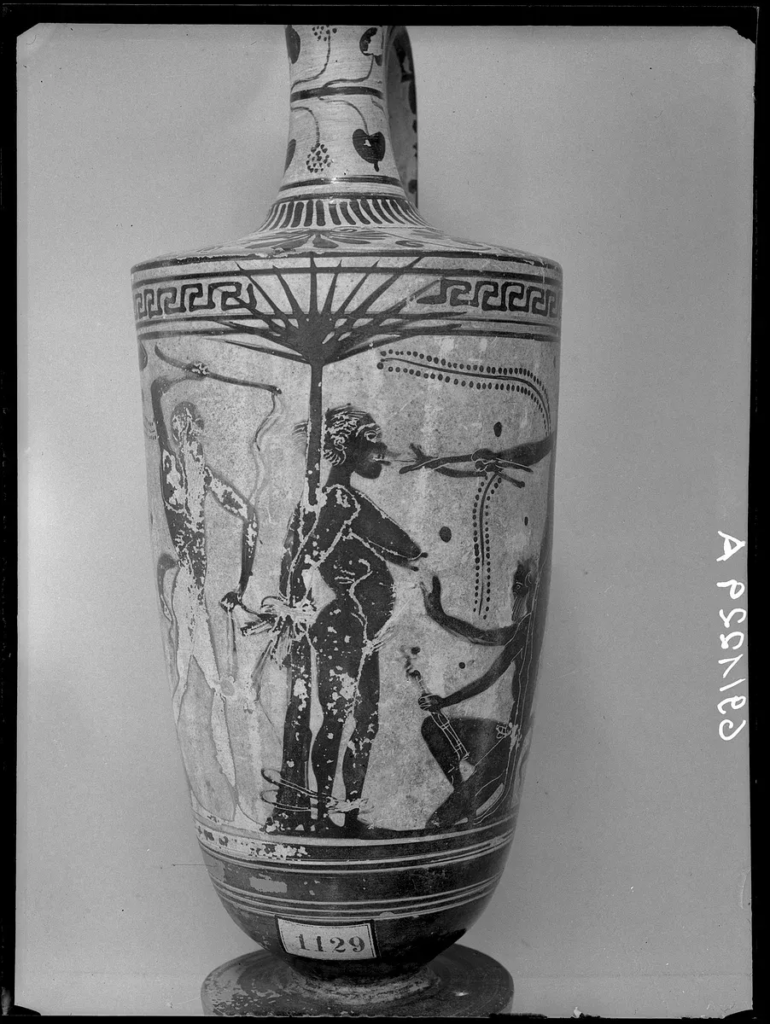
Long before Count Dracula emerged from the shadows of Gothic fiction, the vampire already had a face, one shaped by ancient myth. One of its earliest visual ancestors appears on the Ancient Greek Vase Depicting Lamia, attributed to The Beldam Painter, where one of mythology’s most feared female figures takes shape centuries before the word “vampire” even existed.
Unlike the elegant immortals we know today, Lamia was a creature born from fear, desire, and tragedy. According to Greek mythology, she was once a beautiful woman whose transformation into a child-devouring monster made her one of antiquity’s most haunting legends. On the vase, she is depicted with exaggerated breasts, sharp talons, protruding fangs, and an unnervingly swollen body, features that symbolize an insatiable appetite and a dangerous, seductive power. It is one of the earliest surviving visualizations of a bloodthirsty female figure whose influence can be traced through centuries of vampire mythology.
What makes this artwork extraordinary is not just its age, but the visual language it established. Lamia represents an early exploration of beauty as something both irresistible and threatening. Rather than separating femininity from monstrosity, the artist intertwines the two, reflecting ancient fears surrounding desire, temptation, and the unknown. This duality would later become one of the defining characteristics of vampires in art and literature, from Gothic novels to contemporary reinterpretations.
Viewed today, the vase feels surprisingly modern. It reminds us that the vampire has never been simply a creature of horror, it has always been a metaphor for forbidden desire, power, and vulnerability. Thousands of years before Dracula wandered through Gothic castles or cinema transformed vampires into charismatic antiheroes, artists were already creating images of figures who blurred the boundaries between attraction and terror. In many ways, Lamia stands at the very beginning of that long and fascinating visual history.
Les Vampires (1820) — Berthe

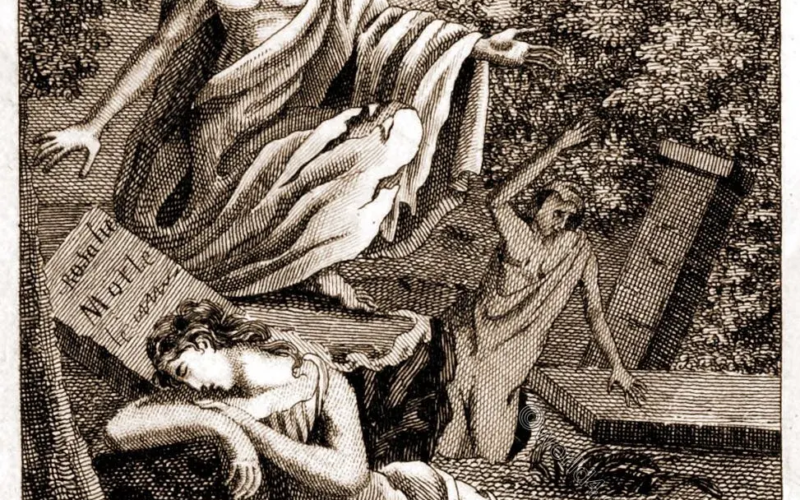
If Lamia introduced the idea of the seductive monster, Les Vampires by Berthe marks the moment the vampire stepped fully into European visual culture. Created in 1820 and published in History of Vampires and Evil Ghosts, the haunting etching arrived during a period when stories of the undead were no longer dismissed as mere folklore. Across Eastern Europe, tales of vampires had sparked genuine fear, leading to grave exhumations, stake-driven rituals, and widespread panic. This artwork captures that unsettling moment when myth felt dangerously close to reality.
The composition is both eerie and theatrical. Draped in flowing burial shrouds, ghostly vampires rise from the earth with an uncanny grace, their elongated forms dominating the scene. Below them lies a lifeless victim slumped against a broken tombstone, while the pale moon casts a cold glow across the cemetery. Rather than relying on dramatic violence, Berthe builds suspense through atmosphere. The sharp hatching, stark contrasts of light and shadow, and desolate landscape create a world suspended between life and death, where every grave seems capable of awakening.
Unlike the seductive vampires popularized in later centuries, these figures are unmistakably monstrous. They emerge not from luxurious castles or candlelit bedrooms but from the soil itself, embodying the terrifying belief that death was not always permanent. The artwork reflects a time when vampires represented humanity’s fear of disease, unexplained deaths, and the unknown forces believed to haunt rural communities.
Today, Les Vampires offers a fascinating glimpse into the origins of Gothic imagery. Long before vampires became tragic lovers or glamorous antiheroes, they were visualized as restless corpses disturbing the natural order. Berthe’s etching preserves that early vision of the undead—one rooted in superstition, mortality, and collective fear, making it one of the earliest and most important artistic milestones in the vampire’s evolution.
Vampire (Love and Pain) (1895) — Edvard Munch
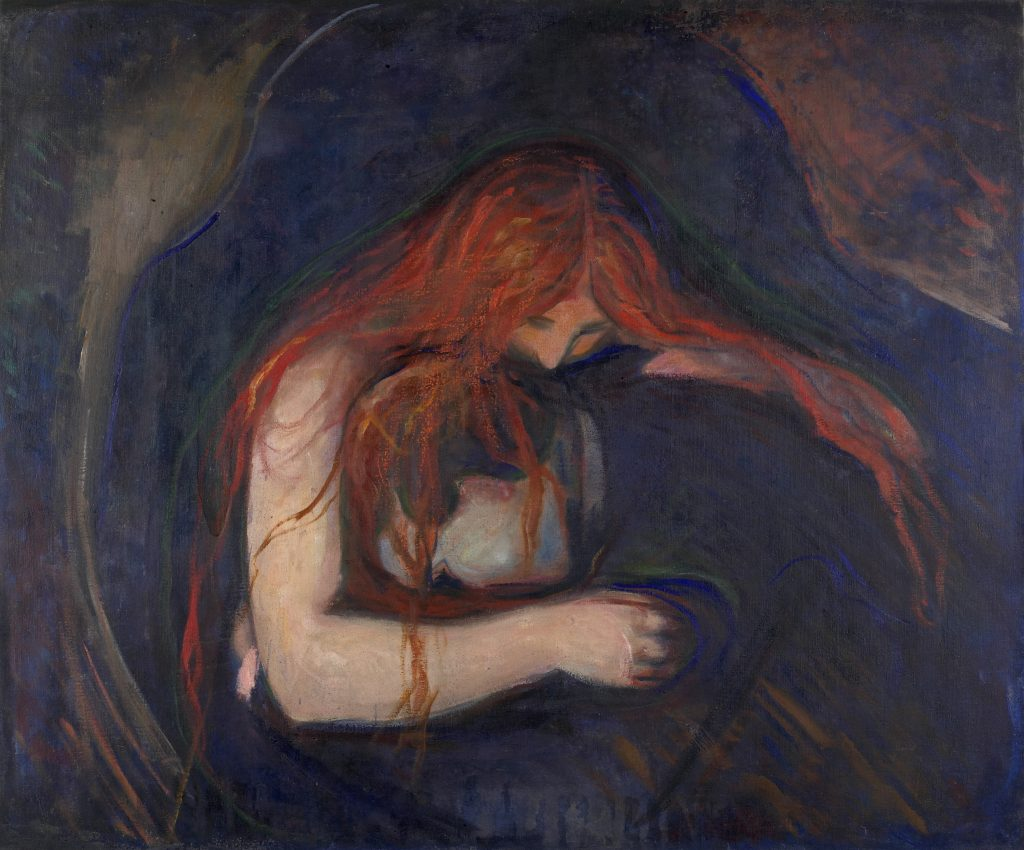
Few artworks have transformed the vampire as profoundly as Edvard Munch’s Vampire (Love and Pain). Painted in 1895, the work contains no fangs, no blood, and none of the familiar Gothic theatrics. Instead, Munch turns the vampire into something far more unsettling: a metaphor for love itself. Originally exhibited under the title Love and Pain, the painting was later nicknamed Vampire because viewers saw the woman as if she were feeding on the man she embraced. Whether Munch intended that interpretation or not, it forever changed the way the vampire could be imagined in art.
At first glance, the scene appears almost tender. A woman with cascading crimson hair leans over a man, wrapping him in an intimate embrace as she buries her face into his neck. Yet the longer you look, the more unsettling the image becomes. Her vivid red hair spills over him like flowing blood, while his pale, slumped body suggests complete surrender. Is she comforting him, consuming him, or both? Munch never provides an answer, leaving the painting suspended between affection and destruction.
This ambiguity is precisely what makes the work so enduring. Rather than portraying vampirism as physical violence, Munch explores emotional dependence, obsession, grief, and the vulnerability that accompanies intimacy. Love becomes something capable of nourishing and draining in equal measure. The vampire is no longer merely a supernatural predator, it becomes a symbol for the invisible ways people can consume one another emotionally.
More than a century later, Vampire (Love and Pain) remains one of the most influential depictions of the undead because it asks a timeless question: how close are love and loss? By replacing horror with psychology, Munch redefined the vampire as an emotional presence rather than a mythical monster, inspiring generations of artists to explore desire, heartbreak, and human relationships through the same haunting lens.
The Vampire (1897) — Philip Burne-Jones
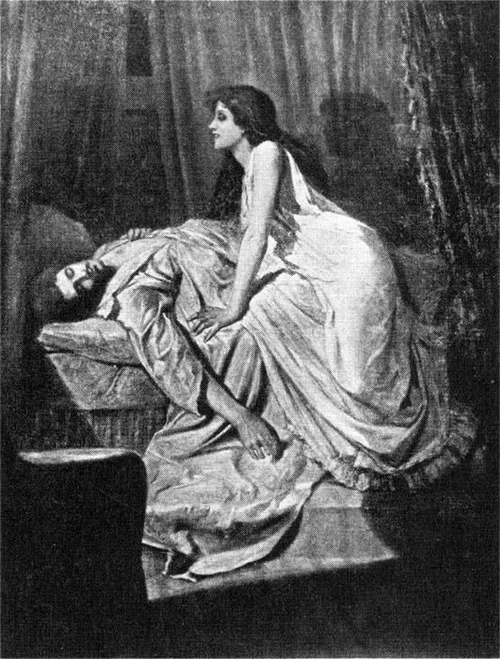
Painted just months before Bram Stoker’s Dracula introduced the world’s most famous vampire, Philip Burne-Jones’s The Vampire captures a different kind of fear, one rooted not in the supernatural, but in desire itself. While the original painting has since been lost, surviving prints reveal an image that became one of the defining visual representations of the Victorian femme fatale, transforming the vampire into a symbol of dangerous attraction and emotional ruin.
The composition is strikingly theatrical. A beautiful woman leans triumphantly over the limp body of a man stretched across a bed, her posture suggesting complete dominance. Rather than depicting a violent attack, Burne-Jones creates psychological tension through body language alone. A dark shadow looms behind the woman, hinting at the hidden menace beneath her elegance. Inspired in part by Henry Fuseli’s The Nightmare, the painting reverses traditional Gothic roles: here, it is the man who appears vulnerable, while the woman becomes the commanding force.
The artwork gained even greater notoriety when it was exhibited alongside Rudyard Kipling’s poem The Vampire, which warned of a man destroyed by his obsession with a beautiful but indifferent woman. Rumors that the painting was inspired by actress Mrs. Patrick Campbell, who had been romantically linked to Burne-Jones, only intensified its scandal and fascination, blurring the line between art, gossip, and cultural anxiety.
More than a Gothic curiosity, The Vampire reflects the shifting attitudes of the late nineteenth century toward female independence, sexuality, and power. The vampire is no longer simply a creature lurking in graveyards; she becomes an irresistible presence capable of consuming lives without ever drawing blood. Together with Dracula, Burne-Jones’s painting helped cement the vampire as one of art’s most enduring metaphors for temptation, obsession, and the complicated relationship between desire and danger.
Vampire (2004) — Marilyn Minter
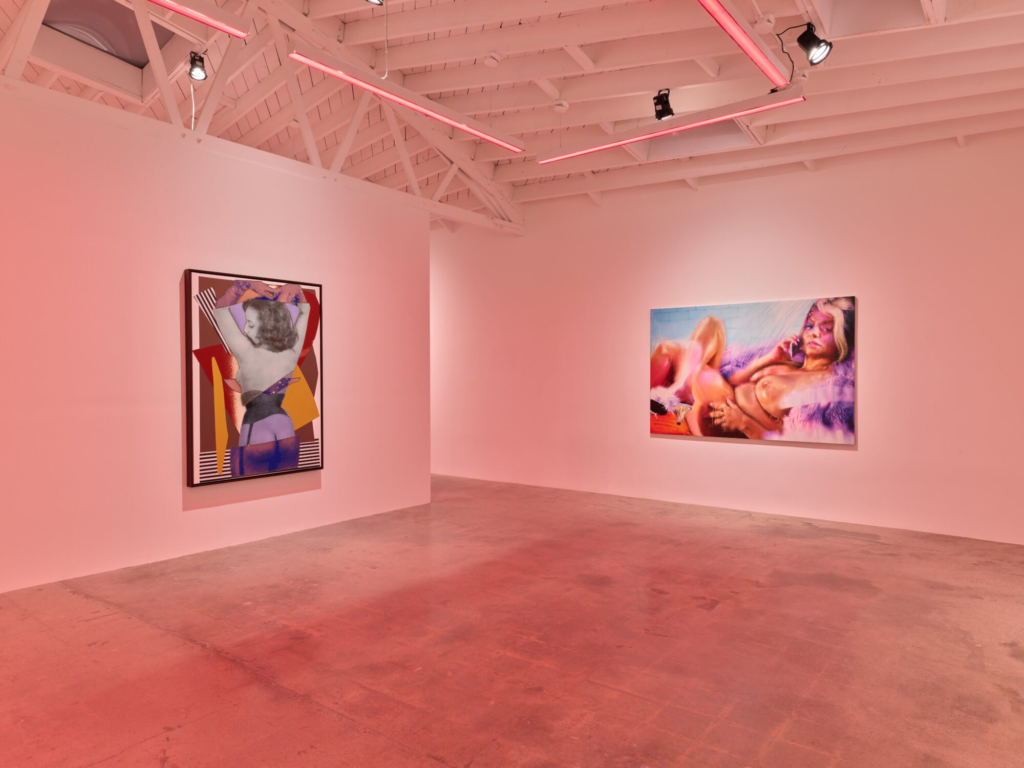
By the early twenty-first century, the vampire had shed much of its Gothic darkness, and Marilyn Minter’s Vampire proves just how dramatically the myth had evolved. Created in 2004, the work replaces haunted castles and shadowy cemeteries with glossy lips, glittering cosmetics, and seductive glamour. Minter transforms one of horror’s oldest monsters into an image that feels at home in the worlds of fashion, advertising, and beauty culture, asking whether desire itself can become a kind of appetite.
The artwork presents an intimate close-up of a mouth coated in shimmering lipstick, with gleaming fangs peeking through stained, crimson lips. At first, the image appears almost luxurious, inviting viewers to admire its rich textures and dazzling surfaces. Yet beneath the glamour lies something unsettling. The vivid red evokes both lipstick and blood, blurring the boundaries between beauty and violence, attraction and danger. Minter deliberately plays with this tension, encouraging us to question why images of excess and seduction can be so irresistibly captivating.
Rather than portraying the vampire as a monstrous outsider, Minter embraces it as a symbol of feminine agency and unapologetic desire. The work later featured in the exhibition Vampire::Mother, which explored the many contradictions imposed on women and femmes, inviting audiences to see them as nurturing and threatening, vulnerable and powerful, all at once. In this context, the vampire becomes less a villain than a figure challenging simplistic ideas about femininity.
What makes Vampire so compelling is how effortlessly it updates centuries of mythology for a contemporary audience. The monster no longer hides in the shadows; it appears beneath bright lights, wrapped in glitter and glamour, smiling directly back at us. Minter reminds us that today’s vampires don’t always announce themselves through horror. Sometimes, they arrive dressed as beauty, desire, and impossible perfection, making them all the more fascinating, and perhaps even more dangerous.
Will You Destroy Me? (2020) — Lindsey Mendick
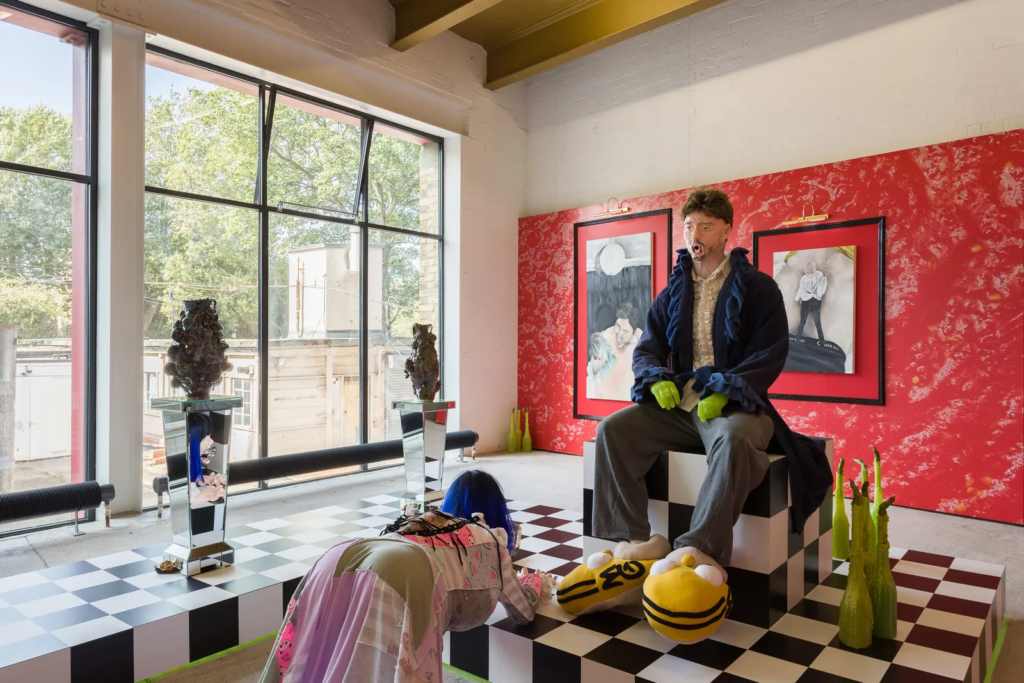
With Will You Destroy Me?, Lindsey Mendick proves that the vampire is no longer just a creature of Gothic fiction, it has become a mirror for modern relationships. Created for her 2020 exhibition of the same name, the series draws inspiration from everything from Buffy the Vampire Slayer to Twilight, using vampires to explore the intoxicating pull of love, obsession, fantasy, and emotional dependence. Instead of asking why we fear vampires, Mendick asks a more uncomfortable question: why are we so drawn to them?
Across paintings, ceramics, and sculptural installations, Mendick embraces the theatrical excess that has always surrounded vampire mythology. Her partner, fellow artist Guy J. Oliver, frequently appears wearing vampire fangs, blurring the line between lover and predator. In one work, he lunges toward her neck in a familiar act of vampiric desire, while elsewhere she kneels at his feet, creating scenes that feel both romantic and unsettling. The exaggerated forms and playful colors soften the horror without diminishing the emotional tension, allowing viewers to recognize fragments of their own relationships within these fantastical encounters.
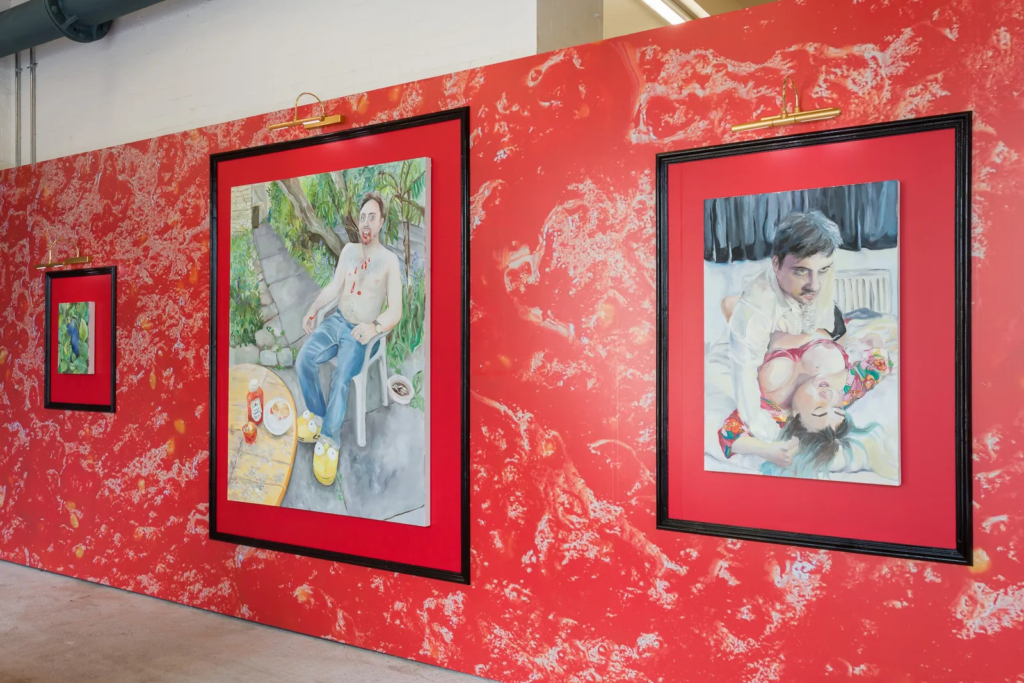
Created during the uncertainty of the pandemic, the exhibition also reflects the ways people escape into fantasy when reality becomes overwhelming. For Mendick, the vampire symbolizes the seductive idea of surrendering completely to another person, the fantasy of being consumed by love, even when that devotion risks becoming unhealthy. The works acknowledge that the line between passion and possession is often far thinner than we would like to admit.
Rather than presenting vampires as immortal villains, Will You Destroy Me? reimagines them as emotional metaphors for contemporary life. Mendick transforms Gothic mythology into something deeply personal, revealing that the most haunting relationships are not always supernatural. Sometimes, the people capable of draining us emotionally are the ones we willingly invite closest, making the vampire feel less like an ancient monster and more like an enduring reflection of ourselves.
Nosferasta (2021) — Adam Khalil & Bayley Sweitzer

The vampire reaches its most radical transformation in Nosferasta by Adam Khalil and Bayley Sweitzer. Rather than retelling a familiar Gothic horror story, the artists use the vampire as a powerful metaphor for colonialism, inherited violence, and the systems that continue to drain people long after history is written. In doing so, they prove that the vampire is no longer simply a supernatural creature, it can also represent political power itself.
The film follows Oba, a Trinidadian artist and musician who is bitten not by the fictional Count Dracula but by Christopher Columbus, turning one of history’s most notorious colonizers into the ultimate vampire. Through this provocative reimagining, Nosferasta suggests that colonialism spreads much like vampirism: by feeding on others, transforming its victims, and leaving behind cycles of exploitation that continue across generations. The story moves between centuries, blending folklore, history, Rastafarian philosophy, and surreal imagery to question how deeply these systems become embedded within identity.
Visually, the work departs from the dark castles and candlelit chambers traditionally associated with vampire tales. Instead, it embraces experimental filmmaking, symbolic imagery, and layered storytelling to create a contemporary mythology that feels as unsettling as it is thought-provoking. Here, blood becomes a metaphor for inherited history, while the vampire embodies invisible structures of domination rather than an individual monster lurking in the shadows.
As the final stop in the evolution of vampire imagery, Nosferasta demonstrates just how adaptable the myth has become. From Lamia’s ancient seduction to Munch’s emotional intimacy and Mendick’s exploration of modern relationships, the vampire has continually reflected society’s deepest anxieties. Khalil and Sweitzer push that idea even further, revealing that the most dangerous vampires today may not be immortal beings at all, but the enduring systems of power that continue to shape the world around us.
From ancient myths and Gothic nightmares to contemporary explorations of love, identity, and power, the vampire has continually evolved through the eyes of artists. Each era has reshaped this enduring figure to reflect its own fears, desires, and cultural conversations. What began as a terrifying supernatural creature has become a powerful symbol, of obsession, seduction, emotional vulnerability, feminine agency, and even political resistance.
These seven artworks show that the vampire has never been confined to horror alone. Instead, it has served as a mirror, revealing the complexities of human nature and reminding us that the most compelling monsters are often the ones that reflect something deeply familiar about ourselves.
Which of these vampire artworks fascinated you the most?
If you enjoyed exploring how artists have reimagined vampires across history, you’ll probably enjoy another fascinating journey through art history. Our feature on famous dog paintings uncovers seven remarkable works that celebrate loyalty, companionship, and the enduring bond between humans and dogs. Read it here: Dog Paintings Every Art Lover Should Know.