


The 8 Most Haunting Stares Ever Captured in Art
Before we notice a painting’s colors, composition, or symbolism, we almost always notice its eyes. A single gaze can stop us in our tracks, inviting us into a story, challenging our assumptions, or leaving us with a feeling we can’t quite explain. Across centuries, artists have understood that the human face, especially the eyes, has the extraordinary ability to communicate emotion without a single word. It is where fear, determination, grief, hope, and vulnerability become instantly recognizable, transcending language, culture, and time.
Some of the most unforgettable moments in art aren’t defined by dramatic landscapes or elaborate scenes, but by a single expression frozen forever. A queen’s unwavering resolve, a mythological figure’s final moment of terror, a prophet wrestling with restrained anger, or a ruler overwhelmed by irreversible regret, these are emotions that continue to resonate because they feel profoundly human. Long after we’ve left the museum or closed the book, it’s often these faces that stay with us.
This collection brings together Most Haunting Stares Ever Captured in Art that carries the emotional weight of the entire composition. Spanning the Renaissance, the Baroque, Romanticism, Realism, and beyond, these paintings and sculptures demonstrate that sometimes the most compelling story an artist can tell isn’t spoken at all, it’s found in a pair of unforgettable eyes.
1. Judith Slaying Holofernes (c. 1620)
The Gaze of Unshakable Resolve
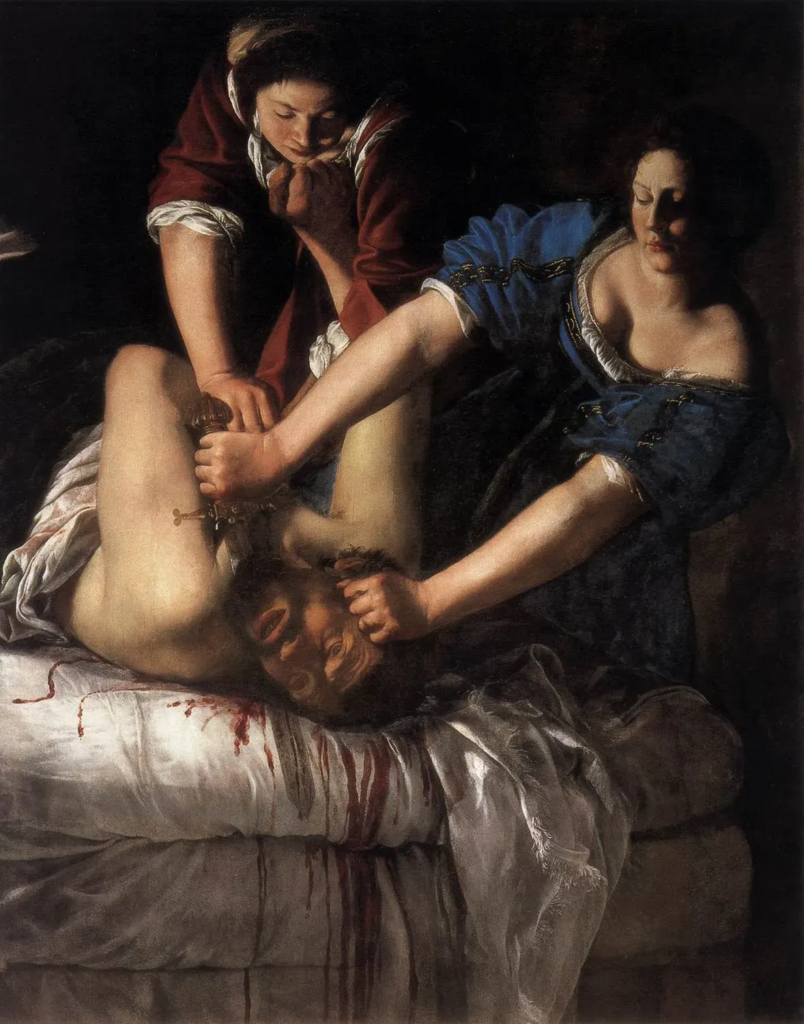
There are countless dramatic moments in art history, but few are as psychologically gripping as the unwavering gaze in Judith Slaying Holofernes. Painted around 1620 during the height of the Baroque period, the work captures the biblical heroine Judith as she, aided by her maidservant Abra, beheads the Assyrian general Holofernes to save her city of Bethulia. Rather than focusing on the aftermath, Gentileschi freezes the action at its most intense moment, when every expression, gesture, and glance carries extraordinary emotional weight.
What makes Judith’s face unforgettable is not rage but resolve. Her eyes remain fixed on the task before her, free of hesitation or panic. While Holofernes twists in terror, Judith’s expression is remarkably controlled, revealing determination rather than cruelty. This emotional restraint heightens the drama, transforming the scene from an act of violence into one of courage, justice, and survival.
The painting also carries profound personal significance. Artemisia Gentileschi was one of the most accomplished women artists of the Baroque era, creating this work after surviving sexual assault and a highly publicized trial that tested both her reputation and resilience. Although scholars caution against reducing the painting solely to autobiography, many see Judith’s steadfast gaze as reflecting the artist’s deep understanding of strength in the face of adversity.
More than four centuries later, Judith Slaying Holofernes continues to captivate viewers because of that single expression. Judith does not look triumphant or vengeful; she looks unwavering. It is this quiet certainty, communicated almost entirely through her eyes, that makes her one of the most powerful figures in Western art.
2. Medusa (1597–1598)
The Face Frozen Between Life and Death

Few works in art history capture a single, irreversible moment as dramatically as Medusa. Painted around 1597–1598 on a ceremonial convex shield commissioned for the powerful Ferdinando I de’ Medici, the work depicts the exact instant after the Gorgon Medusa has been beheaded by the Greek hero Perseus. Rather than showing the battle itself, Caravaggio focuses on the split second when Medusa’s severed head is still horrifyingly alive, eyes wide, mouth open in a silent scream, and snakes writhing around her face.
The power of the painting lies in its startling realism. Caravaggio’s mastery of light and shadow gives Medusa an unsettling physical presence, while the curved surface of the shield creates the illusion that her head is thrusting outward toward the viewer. It’s an effect that makes the encounter feel immediate, almost impossible to escape.
Unlike many earlier depictions that portrayed Medusa as a monstrous creature, Caravaggio emphasizes her humanity. Her expression is one of shock and agony rather than malice, inviting viewers to witness the terrifying realization of her own death. This emotional ambiguity has contributed to the painting’s enduring fascination, prompting centuries of discussion about whether Medusa should be seen as a villain, a victim, or both.
Adding another layer of intrigue, many art historians believe Caravaggio used his own face as the model for Medusa, a theory supported by comparisons with his self-portraits, though it remains unconfirmed. Whether or not this is true, Medusa remains one of the Baroque period’s most unforgettable studies of fear, capturing an expression so vivid that it continues to confront audiences more than 400 years after it was painted.
3. Saturn Devouring His Son (1819–1823)
The Eyes of Madness
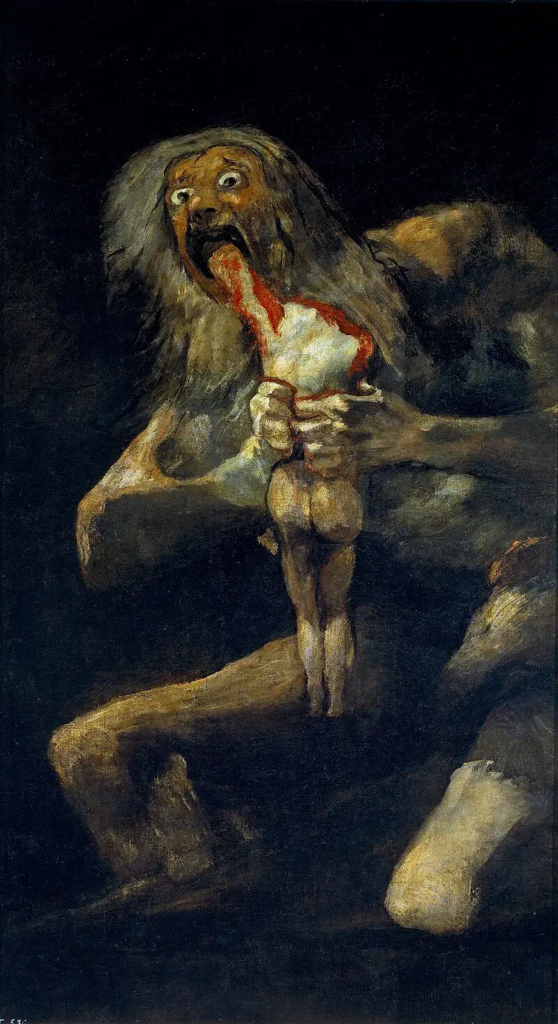
Some paintings disturb because of what they depict. Others linger because of how they make us feel. Saturn Devouring His Son belongs to both categories. Created between 1819 and 1823 as part of Francisco Goya’s haunting Black Paintings series, the work illustrates the Greek myth of the Titan Saturn (Cronus), who consumed his children after learning of a prophecy that one of them would overthrow him. Rather than presenting the myth as a heroic or classical tale, Goya transforms it into an unsettling meditation on fear, violence, and human nature.
The painting’s most unforgettable feature is Saturn’s expression. His bulging eyes, fixed in an almost manic stare, are filled with panic as much as brutality. They suggest a figure consumed by paranoia rather than simple cruelty, a ruler driven to unimaginable violence by the terror of losing power. Unlike traditional mythological paintings that idealize their subjects, Goya strips Saturn of any grandeur, presenting him instead as a desperate, almost animalistic figure trapped by his own fears.
Art historians often interpret the Black Paintings as deeply personal works created during Goya’s later years, when illness, deafness, political turmoil, and disillusionment shaped his worldview. Painted directly onto the walls of his home, these works were never intended for public exhibition, giving them an unusually intimate and psychological character.
More than two centuries later, Saturn Devouring His Son remains one of the most unsettling images in Western art. Its horror extends beyond the act itself to the expression on Saturn’s face, a gaze that reveals not triumph, but the terrifying consequences of fear left unchecked.
4. Ivan the Terrible and His Son Ivan (1885)
The Look of Irreversible Regret

Few paintings capture the devastating aftermath of a single moment as powerfully as Ivan the Terrible and His Son Ivan. Completed in 1885, the monumental work by Ilya Repin depicts the legendary scene in which Tsar Ivan IV, better known as Ivan the Terrible, realizes he has fatally wounded his own son during a violent outburst. Whether the event occurred exactly as portrayed remains debated by historians, but Repin’s painting has become the defining visual interpretation of the story.
At the heart of the composition is Ivan’s face. His eyes are impossibly wide, filled with panic, disbelief, and overwhelming remorse. He clutches his dying son in a desperate embrace, as if sheer force could reverse what has already happened. The horror is not in the violence itself, but in the instant of recognition. Repin masterfully captures the unbearable realization that some actions cannot be undone.
The painting is celebrated for its extraordinary psychological depth. Rather than presenting Ivan as a ruthless tyrant alone, Repin portrays him as a man suddenly confronted with the consequences of his own rage. Every detail, from the blood pooling on the richly patterned carpet to the prince’s calm, fading expression, intensifies the emotional weight of the scene.
Since its first exhibition, the work has sparked controversy for its portrayal of one of Russia’s most infamous rulers. It was censored during the reign of Alexander III and has even been vandalized more than once, underscoring its enduring emotional and political impact. More than a historical painting, Ivan the Terrible and His Son Ivan is a profound study of grief, guilt, and the haunting look of a man who understands his mistake only when it is too late.
5. Moses (1513–1515)
The Weight of Suppressed Anger
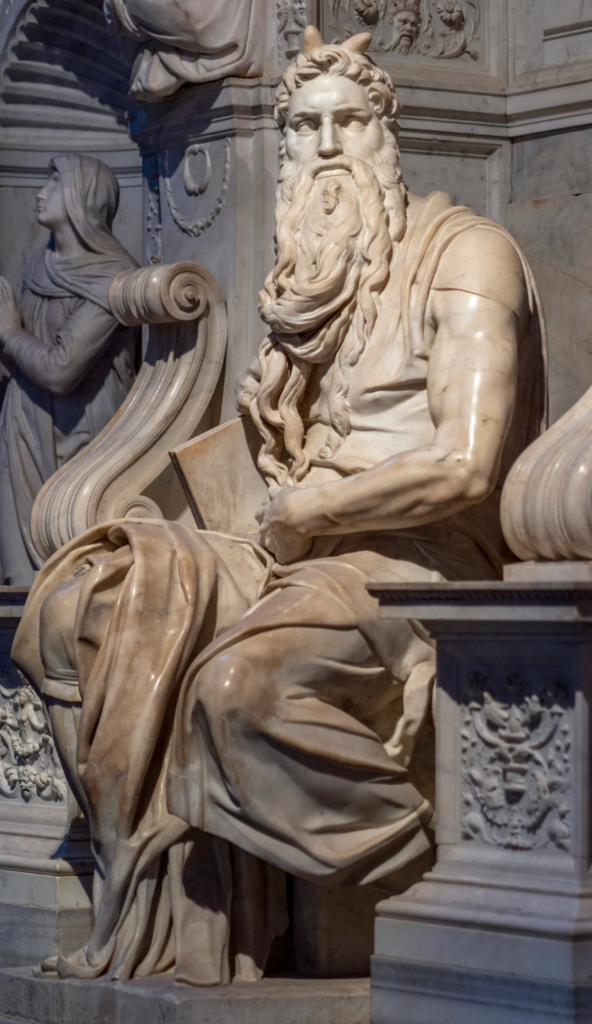
Not every unforgettable stare is born from action. Some draw their power from restraint. Carved between 1513 and 1515 for the tomb of Pope Julius II, Michelangelo’s monumental Moses captures the biblical prophet at a pivotal moment. According to tradition, Moses has just descended from Mount Sinai with the Tablets of the Law and discovered the Israelites worshipping the Golden Calf. The betrayal is immense, yet instead of depicting the prophet in the act of destroying the tablets, Michelangelo immortalizes the instant before his anger is unleashed.
Moses’ piercing gaze is the sculpture’s defining feature. His deeply furrowed brow, sharply focused eyes, and tightly set jaw create an almost unbearable sense of tension. Every muscle appears ready to move, yet nothing has happened, not yet. This suspended moment gives the sculpture its extraordinary psychological force. The emotion is not explosive rage but disciplined self-control, making the figure feel all the more powerful.
Michelangelo’s remarkable ability to transform marble into living flesh is on full display. The flowing beard, intricately carved drapery, and twisting posture suggest movement frozen in time, while the intensity of Moses’ expression invites viewers to imagine the events unfolding just beyond the sculpture.
For centuries, Moses has been admired not only as one of the masterpieces of Renaissance sculpture but also as one of the greatest studies of human emotion. The eyes do not simply express anger, they convey moral conviction, disappointment, and the immense burden of leadership. It is this remarkable balance of strength and restraint that makes Moses’ stare one of the most commanding in the history of art.
6. Mademoiselle Caroline Rivière (1806)
The Quiet Power of an Unspoken Gaze

Not every unforgettable stare in art announces itself with drama. Some leave their mark through stillness alone. Painted in 1806, Mademoiselle Caroline Rivière is one of Jean-Auguste-Dominique Ingres’s most celebrated early portraits, depicting Caroline Rivière, the teenage daughter of a prominent French court official. Although intended as an elegant society portrait, the painting has captivated viewers for generations because of its remarkable emotional ambiguity.
Caroline’s large, luminous eyes immediately draw the viewer in. She gazes directly outward, yet her expression remains almost impossible to define. There is no smile or dramatic gesture to guide our interpretation, only a quiet stillness that feels both serene and haunting. Her porcelain complexion, delicate features, and ethereal presence enhance the portrait’s dreamlike quality, while her gaze seems suspended somewhere between innocence and quiet introspection. It is this mystery that has made the painting so enduring.
Ingres was a master of precision, known for his refined draftsmanship and meticulous attention to detail. Every fold of Caroline’s white muslin dress, every strand of hair, and every subtle transition of light contributes to an atmosphere of remarkable calm. Yet beneath this polished surface lies an emotional depth that continues to intrigue historians and viewers alike. Rather than revealing her thoughts, Ingres leaves space for the viewer’s imagination, allowing each person to discover something different in her expression.
More than two centuries after it was painted, Mademoiselle Caroline Rivière remains one of the most captivating portraits of the Neoclassical era. Its unforgettable gaze reminds us that the most powerful expressions are not always the loudest. Sometimes, a quiet look can linger in our memory far longer than the most dramatic scene.
7. The Desperate Man (c. 1843–1845)
A Portrait of Panic

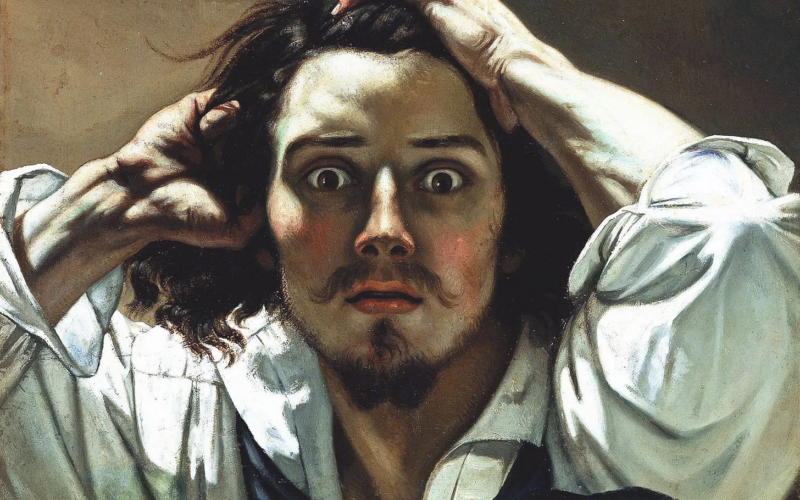
Long before selfies became a way of documenting emotion, Gustave Courbet turned the mirror into a stage for psychological drama. Painted between 1843 and 1845, The Desperate Man (Le Désespéré) is widely believed to be a self-portrait created during the artist’s early twenties. Though little is known about the exact circumstances behind the painting, it stands apart from conventional nineteenth-century portraiture for its startling emotional intensity. Instead of presenting himself with dignity or composure, Courbet offers an image of raw vulnerability.
The first thing viewers notice is the gaze. Courbet’s eyes are wide open, fixed directly on us with an expression that oscillates between fear, disbelief, and desperation. His raised eyebrows, tightly stretched eyelids, and hands gripping his hair amplify the sense of emotional collapse. There is no dramatic background or symbolic setting to distract from the face; every element directs attention to the overwhelming force of human emotion.
Painted during a period when Romanticism still celebrated heightened feeling, the work also hints at the realism that would later define Courbet’s career. Rather than idealizing the human condition, he presents an honest and deeply personal vision of psychological turmoil. The result feels strikingly modern, as though the painting captures a fleeting emotional moment rather than a carefully posed portrait.
Today, The Desperate Man remains one of art history’s most unforgettable self-portraits. Its enduring power lies not in technical virtuosity alone but in its fearless portrayal of inner distress. More than 175 years after it was painted, Courbet’s intense stare still feels immediate, confronting viewers with an emotion that transcends time, culture, and artistic style.
8. Portrait of a Woman Suffering from Obsessive Envy (c. 1822–1823)
A Mind Revealed Through the Eyes
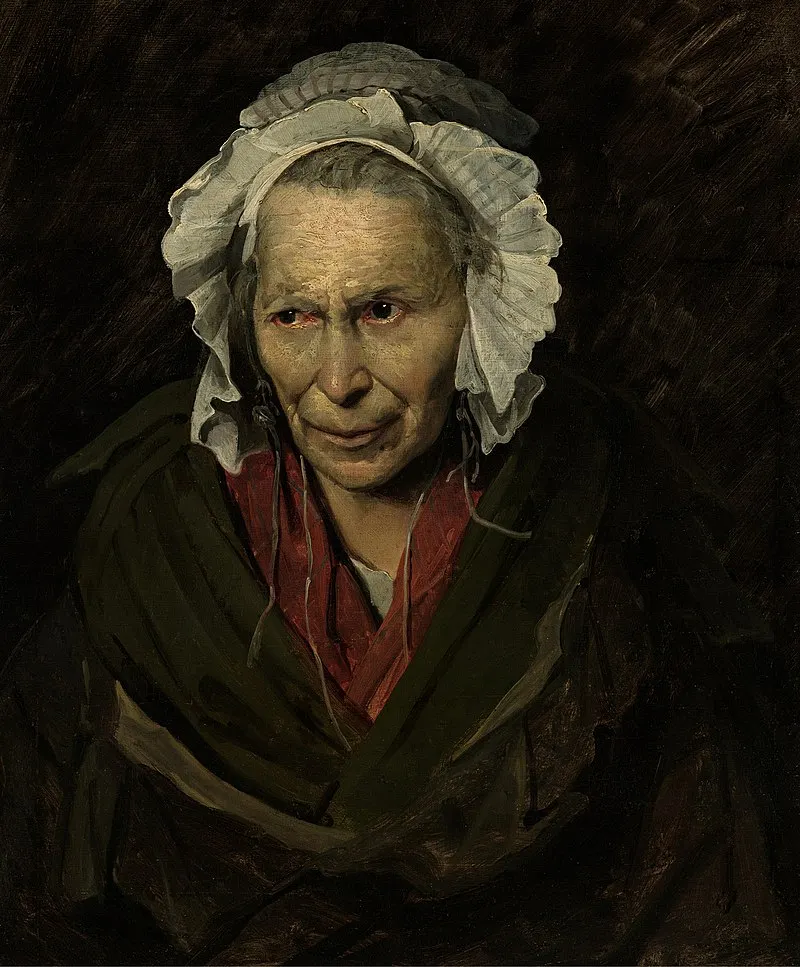
Not every unforgettable stare in art belongs to a hero, a ruler, or a mythological figure. Some are powerful because they offer an unfiltered glimpse into the complexities of the human mind. Painted around 1822–1823, Portrait of a Woman Suffering from Obsessive Envy is one of a series of portraits created by Théodore Géricault depicting patients from a Paris asylum. Rather than sensationalizing mental illness, Géricault approached his subjects with remarkable dignity and empathy, creating portraits that remain deeply moving more than two centuries later.
The woman’s expression is striking in its quiet intensity. Her eyes are fixed somewhere beyond the viewer, as though consumed by thoughts that remain inaccessible to those around her. Her lips are tightly pressed together, her face weary, and her gaze carries a profound sense of isolation. Unlike dramatic expressions of fear or anger, the emotion here unfolds with subtlety. It invites viewers not to witness a single moment of action, but to contemplate an ongoing psychological struggle.
The series was likely created in collaboration with psychiatrist Étienne-Jean Georget, who believed that emotional states could be observed through facial expression. While modern understandings of mental health have evolved significantly since the nineteenth century, Géricault’s portrait remains remarkable for its humanity. He presents his subject not as a curiosity but as an individual whose inner life deserves attention and compassion.
Today, Portrait of a Woman Suffering from Obsessive Envy stands as one of the earliest and most sensitive artistic explorations of psychological emotion. Its unforgettable gaze reminds us that some of the most compelling stories in art are not told through dramatic gestures, but through the quiet expressions that reveal the invisible weight a person carries.
A great work of art can captivate us through color, composition, or technique, but sometimes all it takes is a single look. Across centuries, artists have used the human gaze to communicate emotions that words often cannot, fear, grief, determination, anger, regret, and quiet resilience. Long after we forget the details of a painting or sculpture, it is often the expression staring back at us that remains.
The eight works in this collection span different periods, creative movements, and mediums, yet they share a remarkable ability to make us pause. Whether carved in marble or painted on canvas, these faces remind us that the most powerful stories in art are often told through the eyes. They invite us to witness a fleeting moment of realization, confront uncomfortable truths, or connect with emotions that continue to feel deeply human, even centuries later.
Perhaps that’s why these gazes have endured for generations. They don’t simply ask us to admire an artwork, they ask us to feel something. And in that silent exchange between the subject and the viewer lies one of art’s greatest powers: its ability to make us look a little longer, think a little deeper, and leave with an image we won’t soon forget. Which artwork’s gaze do you find the most haunting?
If these unforgettable works have inspired you to explore more art, don’t miss our curated guide to Art Exhibitions to Experience This July and discover some of the most exciting shows happening around the world right now.