


8 Masterpieces That Find Beauty in Doing Nothing
In a world that celebrates productivity, busyness, and constant achievement, doing nothing often feels like a luxury, or even a guilty pleasure. Yet artists have long recognized that moments of stillness can be just as meaningful as moments of action. Across centuries, painters have captured people resting, daydreaming, lounging, reading, sleeping, and simply existing without urgency. Far from portraying laziness as a flaw, many of these works reveal the emotional, intellectual, and even restorative value of slowing down.
From eighteenth-century thinkers lost in contemplation to modern figures enjoying solitary leisure, these paintings explore the many forms that “doing nothing” can take. Some depict hard-earned rest after labor, while others reflect boredom, introspection, companionship, or the simple pleasure of having nowhere to be. Together, they remind us that life is not measured solely by what we accomplish, but also by the moments we pause.
Here are eight remarkable paintings that Find Beauty in Doing Nothing and transform idleness into something beautiful, thoughtful, and profoundly human.
1. Brooke Boothby (1781) – Joseph Wright of Derby

Long before modern conversations about slowing down and disconnecting, Joseph Wright of Derby painted one of art history’s most memorable portraits of quiet contemplation. His portrait of Brooke Boothby shows the English poet and intellectual reclining casually in a wooded landscape, far removed from the formal poses that dominated eighteenth-century portraiture.
Boothby lies comfortably on the ground, one arm supporting his head while a book rests beside him. Nothing dramatic is happening. There is no grand gesture, no display of power, and no obvious narrative. Instead, the painting captures a moment of thoughtful idleness. The sitter appears completely absorbed in his own reflections, as though the viewer has stumbled upon a private afternoon of reading and daydreaming.
The book is not merely a decorative prop. Boothby was known for his literary interests and admiration for the writings of Jean-Jacques Rousseau. By placing him in nature with a book close at hand, Wright presents contemplation as an intellectual pursuit rather than a sign of laziness. The landscape becomes a space for reflection, where time seems to slow down and the pressures of society momentarily disappear.
What makes the portrait especially striking is its modern feel. Many eighteenth-century portraits celebrated status and achievement, but Brooke Boothby celebrates something quieter: the ability to pause. More than two centuries later, the painting still resonates because it suggests that doing nothing can be a meaningful activity in itself. Sometimes the richest moments are those spent simply thinking, reading, and allowing the mind to wander.
2. Rest at Harvest – François-Alfred Delobbe

Not all forms of doing nothing are born from boredom or leisure. Sometimes rest is something earned, and François-Alfred Delobbe’s Rest at Harvest beautifully captures that distinction. Painted in the nineteenth century, the work depicts a young woman lying in the grass at the edge of a harvested field, her body relaxed after what was likely a long day of labor.
The scene is remarkably simple. There are no dramatic events unfolding, no signs of urgency, and no indication that the figure is about to move. Instead, Delobbe focuses on a fleeting moment of recovery. The woman rests with her head supported by her arm, surrounded by golden stalks and open countryside. The landscape itself seems to participate in her stillness, creating an atmosphere of calm that extends beyond the figure and into the wider scene.
Delobbe was known for his depictions of rural life, and this painting reflects the nineteenth-century fascination with peasant subjects. Yet rather than emphasizing hardship, he highlights a universal human experience: the need to pause. The harvest may be complete for the day, but the painting reminds us that work and rest are inseparable companions.
What makes Rest at Harvest so appealing is its honesty. Unlike images of luxury or aristocratic leisure, this is rest without extravagance. It is the simple satisfaction of taking a break when the day’s responsibilities have been met. Through soft light, gentle colors, and an unhurried composition, Delobbe transforms an ordinary pause into something quietly profound, showing that doing nothing can sometimes be the reward for everything that came before.
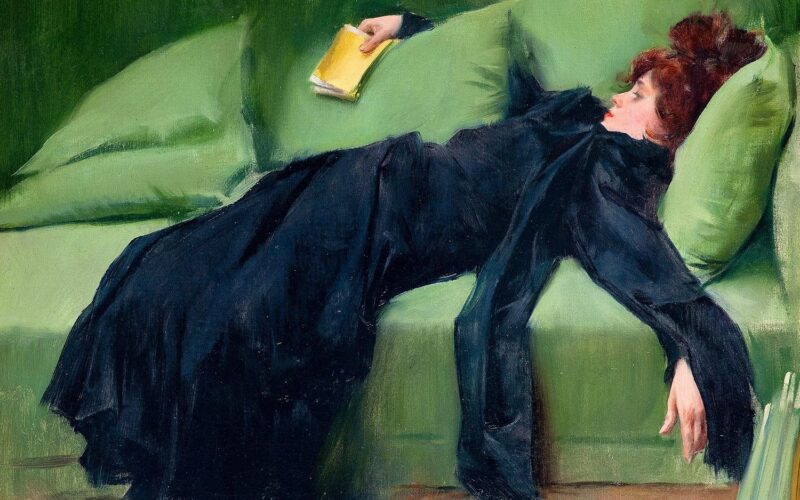
3. Jove Decadent (1899) – Ramon Casas

If Rest at Harvest presents rest as a reward for hard work, Ramon Casas’s Jove Decadent explores a very different kind of inactivity: boredom. Painted in 1899, the work has become one of the defining images of fin-de-siècle decadence, a cultural mood characterized by weariness, disillusionment, and a sense that life’s pleasures had begun to lose their excitement.
The painting depicts a young woman sprawled across a green sofa, dressed in black and holding a book loosely in one hand. She appears completely disengaged. The book is not being read, conversation is absent, and there is no sign of any purposeful activity. Instead, she seems suspended in a state somewhere between thought, fatigue, and indifference. Her pose is so relaxed that it borders on collapse.
Casas, one of the leading figures of Catalan Modernisme, was deeply interested in modern urban life and the psychological states of his subjects. Here, he shifts attention away from action and focuses on mood. The woman’s languid posture and distant expression become the true subject of the painting. Rather than depicting physical exhaustion, Casas portrays emotional and intellectual ennui, a feeling that resonated strongly with many artists and writers at the turn of the twentieth century.
What makes Jove Decadent so compelling today is its familiarity. In an age of endless entertainment and constant stimulation, moments of aimless scrolling, daydreaming, or simply feeling unmotivated can feel surprisingly similar. Casas transforms that universal experience into art, creating a portrait of doing nothing that is both elegant and deeply psychological.
4. In Bed (1892–93) – Henri de Toulouse-Lautrec

Few artists captured private moments with as much sensitivity as Henri de Toulouse-Lautrec. Painted around 1892–93, In Bed offers a quiet glimpse into a world rarely depicted with such tenderness in nineteenth-century art. Rather than focusing on action or drama, Toulouse-Lautrec presents a scene of complete stillness, where time seems to pause altogether.
The painting shows two women lying together beneath soft white sheets. Their faces are turned toward one another, creating a sense of intimacy and comfort. Nothing appears to be happening. There is no conversation, no movement, and no obvious narrative to guide the viewer. Instead, the work invites us to appreciate a fleeting moment of rest and human connection.
Toulouse-Lautrec spent much of his career documenting life in Paris, particularly the performers, dancers, and women who inhabited the city’s cafés and brothels. Unlike many artists of his era, he often portrayed his subjects with empathy rather than judgment. In In Bed, he avoids sensationalism entirely. The focus is not on spectacle but on the simple act of sharing a peaceful moment.
The painting’s warm colors and gentle brushwork reinforce its atmosphere of calm. The figures seem sheltered from the outside world, enclosed within a private space where obligations and expectations temporarily disappear. Their stillness becomes the painting’s emotional center.
What makes In Bed such a powerful exploration of doing nothing is its recognition that rest is not always solitary. Sometimes the most meaningful pauses are shared with another person. Toulouse-Lautrec transforms an ordinary moment into something deeply human, reminding viewers that quiet companionship can be every bit as significant as action.
5. The Dream (1940) – Henri Matisse

Henri Matisse spent much of his career searching for ways to express serenity through art, and The Dream is among his most graceful achievements. Painted in 1940, the work depicts a woman asleep in a chair, her head tilted gently to one side as she drifts into a state beyond everyday concerns. Unlike many paintings that emphasize action or storytelling, The Dream celebrates stillness itself.
At first glance, the composition appears remarkably simple. The sleeping figure occupies the center of the canvas, surrounded by Matisse’s characteristic patterns, flowing lines, and vibrant colors. Yet the painting’s power lies in its ability to transform an ordinary moment into something almost timeless. The woman is not merely resting; she seems completely detached from the demands of the waking world.
Matisse often spoke about wanting his art to provide a sense of balance, calm, and relaxation. He famously compared the ideal artwork to a comfortable armchair—something that could offer viewers peace amid the pressures of modern life. The Dream embodies that philosophy perfectly. Every element of the composition contributes to a feeling of harmony, from the graceful contours of the figure to the rhythmic arrangement of shapes and colors.
What makes this painting especially fitting for a discussion of doing nothing is its complete absence of urgency. There is no productivity, no achievement, and no destination. The subject simply sleeps. Yet Matisse suggests that such moments are not empty or wasted. Instead, they possess their own quiet beauty. In a world that often values constant activity, The Dream reminds us that rest can be both restorative and profoundly meaningful.
6. Nonchaloir (1911) – John Singer Sargent

The very title of John Singer Sargent’s Nonchaloir offers a clue to its enduring appeal. Derived from a French word suggesting indifference, ease, or carefree unconcern, the title perfectly captures the atmosphere of the painting. Created in 1911, the work depicts Sargent’s niece, Rose-Marie Ormond, reclining on a sofa in a pose so relaxed that it seems almost effortless.
Unlike the grand society portraits that made Sargent famous, Nonchaloir feels intimate and unguarded. Rose-Marie stretches across the length of the sofa, dressed in a flowing white gown. Her body appears completely at ease, and there is little indication that she is aware of the viewer’s presence. The result is a portrait that prioritizes mood over status, creating a rare sense of spontaneity within an artist often associated with elegance and formality.
The painting is remarkable for how little actually happens. There is no event, no task being performed, and no dramatic expression to interpret. Instead, Sargent invites viewers to appreciate a moment of pure leisure. The soft fabrics, gentle light, and relaxed posture all contribute to an atmosphere of effortless comfort.
Yet beneath its apparent simplicity lies a subtle challenge to traditional ideas of value and productivity. The subject is doing nothing that could be considered useful or important, and that is precisely the point. Sargent elevates an ordinary pause into something worthy of artistic attention.
More than a century later, Nonchaloir remains captivating because it captures a feeling many people seek but rarely achieve: the freedom to be completely at ease. In celebrating a moment of unhurried relaxation, Sargent reminds us that sometimes the most luxurious activity is doing nothing at all.
7. Four Lane Road (1956) – Edward Hopper

Few artists explored the quiet moments of modern life as masterfully as Edward Hopper. Painted in 1956, Four Lane Road transforms an ordinary roadside scene into a meditation on stillness, solitude, and the passage of time. While many depictions of doing nothing focus on relaxation or leisure, Hopper’s painting introduces something more complex: the feeling of being suspended between action and reflection.
The composition centers on a broad road stretching across the canvas, while a small group of figures occupies the space nearby. Nothing dramatic is taking place. No one appears to be in a hurry, and there is little indication of movement despite the presence of a road designed for travel. Instead, the figures seem caught in a quiet pause, as though life itself has momentarily slowed.
Hopper was fascinated by such moments. Throughout his career, he painted people waiting, sitting alone, gazing from windows, or simply existing in spaces that feel both familiar and strangely detached. In Four Lane Road, that sense of emotional stillness becomes the painting’s defining feature. The road suggests motion and progress, yet the figures remain still, creating a subtle tension between movement and inactivity.
What makes the work particularly compelling is its ambiguity. Are the figures resting, daydreaming, or contemplating their next step? Hopper offers no clear answer. Instead, he allows viewers to project their own experiences onto the scene.
In an age that often equates activity with purpose, Four Lane Road reminds us that pauses have value too. Sometimes doing nothing is not an escape from life but an essential part of understanding where we are and where we are going.
8. The Blue Room (1923) – Suzanne Valadon

Suzanne Valadon’s The Blue Room is one of the most striking and unconventional portrayals of leisure in twentieth-century art. Painted in 1923, the work depicts a woman stretched comfortably across a bed, dressed in striped pajamas, holding a cigarette in one hand and a book in the other. She is not entertaining guests, performing domestic duties, or posing for the viewer. Instead, she is simply enjoying her own company.
At a time when female figures in art were often idealized or presented as passive objects of beauty, Valadon offered something refreshingly different. Her subject appears entirely self-contained. She occupies the space with confidence and ease, unconcerned with how she might be perceived. The result is a powerful image of independence as well as relaxation.
The room itself contributes to the painting’s atmosphere. Rich blue fabrics, patterned textiles, and decorative details create a vibrant environment that feels both intimate and lived-in. Yet despite the visual energy of the composition, the mood remains calm. The woman has nowhere she needs to be and nothing she needs to accomplish. The painting embraces leisure without apology.
Valadon, who began her career as an artist’s model before becoming one of the most respected painters of her generation, often challenged traditional representations of women. The Blue Room is perhaps her clearest statement on the subject. Rather than portraying idleness as wasteful or frivolous, she presents it as an expression of freedom.
As the final work in this collection, The Blue Room offers a fitting conclusion. It suggests that doing nothing is not always about escape or exhaustion. Sometimes it is simply the pleasure of being fully at ease with oneself, a lesson that feels just as relevant today as it did a century ago.
The paintings in this collection show that doing nothing is rarely as simple as it appears. Whether it takes the form of contemplation, relaxation, sleep, boredom, or quiet companionship, stillness has inspired artists for centuries. These works challenge the idea that every moment must be productive, revealing instead that rest can foster reflection, creativity, and a deeper appreciation of the world around us.
From the thoughtful solitude of Brooke Boothby to the confident leisure of The Blue Room, each painting offers a different perspective on what it means to slow down. Together, they remind us that some of life’s most meaningful moments happen when nothing much seems to be happening at all.
Which of these paintings best captures your ideal way of doing nothing?
If these masterpieces have inspired you to look at art more closely, you might also enjoy our tips on how to start an art collection. Whether you’re considering your first purchase or simply curious about collecting, it offers practical tips to help you begin with confidence: https://artstoheartsproject.com/how-to-start-an-art-collection/