





Why do handmade things feel so connected to us?


The conversation that follows offers a quiet look into how Lucia Okanikova found her way to clay and why she continues to build her life around it. What began as a growing fascination while watching other makers work eventually turned into a practice that she learned almost entirely on her kitchen table. She talks about those early attempts, the surprises that came with them, and the patience she had to develop along the way.
Lucia speaks openly about the pull she feels toward handmade work and handbuilding, and why the slower pace suits her. She explains how working directly with the material helps her understand its limits and possibilities, and why she chooses to leave many of her pieces unglazed, allowing the surface to show every trace of the handmade process. Through her stories, we learn how clay reshaped her sense of time, teaching her to step back, wait, and allow things to unfold in their own rhythm.
She also offers her thoughts on why people continue to seek out handmade work in an era of quick production and identical objects. For her, the appeal lies in the traces left by the maker and the quiet connection that forms when someone holds something shaped entirely by human hands. This interview gathers those insights and gives readers a clearer picture of how Lucia approaches her work, what sustains her, and what clay continues to teach her.
Lucia Okanikova is a featured artist in our book, “Art and Woman 2025” You can explore her journey and the stories of other artists by purchasing the book here:
https://shop.artstoheartsproject.com/products/art-and-woman-edition-

My work celebrates the raw beauty of clay and the quiet power of imperfection. I didn’t come to art through formal education or family tradition—it found me, unexpectedly, after the birth of my two children. Drawn to the work of other artists, I eventually felt a deep inner pull to create something of my own. In my ceramics, I explore asymmetry and the natural irregularities of form. I reject the illusion of perfection, embracing the individuality that imperfection reveals. Each vase I shape is a reflection of how I see the human experience—unbalanced, organic, and beautifully imperfect.

1. How did clay first find its way into your life, and what made you want to keep going with it beyond those first few tries?
I didn’t seek clay — clay found me. I feel it as a life path, something my hands might even remember from past lives, because the connection between us is so strong, it’s almost impossible to explain logically. Before I dared to work with clay myself, I could spend hours watching ceramics channels; I was utterly fascinated by it. Where that fascination came from, I have no idea. I felt like I knew the theory, so I bought a kiln and started creating in my own kitchen. That’s when reality hit me — I quickly realised that working with clay is far from as easy as it looks.
I never saw failed attempts as wasted time, but as part of a journey.
Lucia Okanikova

2. Learning everything on your own can be challenging. What helped you stay patient and motivated on the days when things didn’t go as planned?
I used to be a very impatient person. Everything I wanted had to happen immediately. But my approach to clay was different from the start — full of respect and a kind of childlike curiosity about how far I could go. I never saw failed attempts as wasted time, but as part of a journey — a chance to do things differently the next day. Clay became an incredible teacher for me. With it, nothing can be rushed. What keeps me patient is curiosity. I genuinely want to understand how the material reacts and what it needs. And on difficult days, I remind myself why I started — because working with clay makes me feel grounded, present, and alive. That feeling always brings me back.

3. You prefer sculpting by hand instead of using the wheel. What is it about that slower, hands-on process that feels right for you?
Working by hand allows me to truly feel the clay — every curve, every texture, every subtle resistance. It slows me down in the best possible way, letting me listen to the material and respond intuitively. I love that the process is imperfect and intimate. My hands guide the form, but the clay also guides me, and together we discover shapes that couldn’t exist any other way. The wheel is fast, precise, and elegant, but for me, the slower, hands-on approach is where the connection, the emotion, and the story of each piece come alive.
4. Many of your pieces are left unglazed, showing the raw clay. What draws you to that natural finish, and what do you hope people feel when they see or hold those pieces?
Clay in its raw form carries an honesty that I deeply connect with. When left unglazed, it reveals every trace of touch, every imperfection — nothing is hidden. I love that quiet dialogue between the material and the maker; it’s real, tactile, human. I hope people feel a sense of calm and authenticity when they hold my pieces — as if they’re touching something both fragile and strong at once. The raw surface reminds us that beauty doesn’t need to be polished or perfect to be complete.

I didn’t seek clay; clay found me.
Lucia Okanikova
5. Working with clay means waiting, drying, and sometimes starting over. Has that rhythm changed the way you view time or approach everyday life?
Working with clay has completely changed my relationship with time. It taught me patience — not the kind that waits, but the kind that listens. Clay doesn’t rush; it needs to breathe, to rest, to dry at its own pace. I’ve learned to accept that some things can’t be forced. If I try to speed up the process, the piece usually cracks. It’s a quiet reminder that life works the same way — everything unfolds when it’s ready. That rhythm now guides not only my work but also how I navigate everyday moments.

6. In a world full of fast design and factory-made products, why do you think people are still drawn to handmade ceramics?
I think people are searching for something real again. Handmade ceramics carry the presence of a human touch — a slight imperfection, a fingerprint, a feeling. You can sense the time and care that went into it, something that mass production can never replicate. When someone holds a handmade piece, they’re not just holding an object — they’re having a moment, a process, a trace of someone’s hands and thoughts. It’s a quiet connection between two people who may never meet, but still share something deeply human.
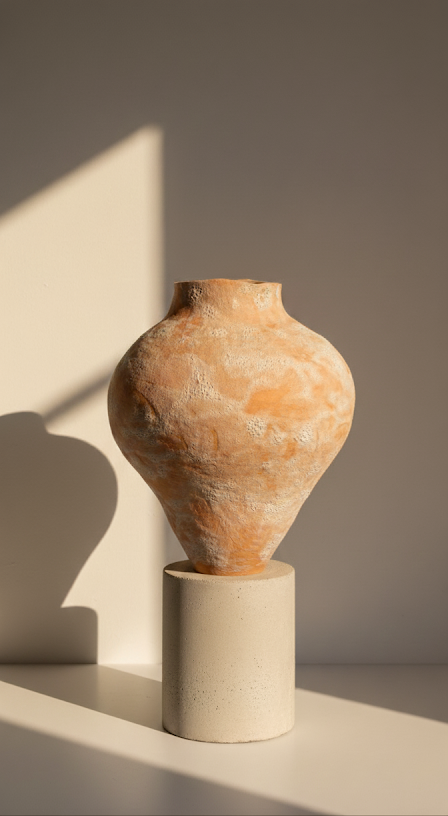
Speaking with Lucia gives a clearer picture of what her work is really about. Her pieces emerge from a hands-on relationship with clay, shaped slowly and left to reveal every mark that occurs along the way.
Through her story, we learn how she followed an unexpected pull toward making things, how she taught herself through trial and patience, and how clay gradually reshaped the pace of her life. What stays with us is the sense that her work comes from paying close attention, staying curious and letting the material move at its natural rhythm.
To learn more about Lucia, click the following links to visit her profile.
Arts to Hearts Project is a global media, publishing, and education company for
Artists & Creatives. where an international audience will see your work of art patrons, collectors, gallerists, and fellow artists. Access exclusive publishing opportunities and over 1,000 resources to grow your career and connect with like-minded creatives worldwide. Click here to learn about our open calls.