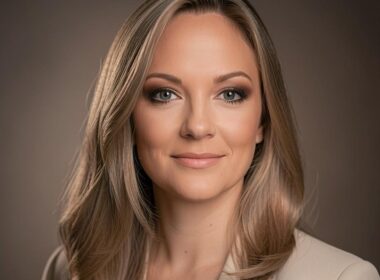
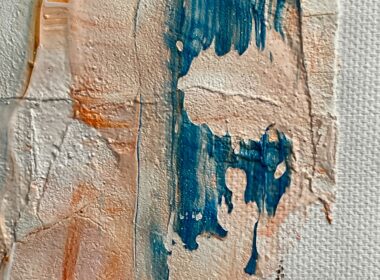


Why Does Nicola Bennett’s Art Feel So Edible?

Colour that tastes. Texture that sings. Emotion you can almost savour, this is the world of Nicola Bennett. Her paintings are a sensory feast, transforming the flavours, sounds, and memories of food into abstract, expressive canvases that engage both the eye and the imagination.
For this week, in our Best of Art World series, we’re honoured to share Nicola’s journey a story that begins at her family dining table, where the aromas, colours, and textures of her mother’s cooking first sparked a lifelong fascination. From early memories of family meals to culinary adventures in France and Italy, Nicola discovered that food isn’t just sustenance—it’s connection, joy, and inspiration. Today, she translates those experiences into painting, exploring the intimate relationship between flavour, colour, and emotion.

Nicola’s work transforms the ordinary into the extraordinary. She approaches each canvas like a recipe, layering marks, textures, and colours with the precision of a chef and the intuition of an artist. Large or small, her pieces carry energy, movement, and a sense of immersion, inviting viewers to experience painting as they experience a memorable meal: rich, surprising, and full of life.
In this feature, we trace Nicola Bennett’s journey from the kitchen to the studio, exploring how she translates the sensory world of food into visual art, creating work that is as generous, playful, and immersive as the meals that first inspired her.
Could you share a little about your background and what first inspired you to explore the connection between food, flavour, and colour in your paintings?
Food has always been a huge part of my life. My mum was a fabulous cook, my happiest family memories are eating together at the dining room table. I learnt pretty early on that food brought people together and that you can make people happy through flavour. In my early twenties I spent time in France and Italy, which were fabulous experiences again confirming preparing and eating food is where happiness can be found. So when I did my masters in Fine Art in 2007 and tutors asked you what lights you up – of course it was food. So I’ve been on this journey of linking food, flavour and colour for a long time.
Cooking and painting both involve transformation. When working in your studio, do you think of your painting process in ways analogous to a recipe, ingredients, layering, timing, letting things rest or develop? How literal is that metaphor for you?
Yes cooking and painting have so much in common. Transformation is a key word, whether that’s ingredients on my kitchen top transformed into a meal or a blank canvas and paint transformed into a meal. Both painting and cooking have the ability to bring pleasure when shared. I use the sounds of cooking to develop my visual language. In particular I focus on the onomatopoeia words in a recipe. For example I wanted to know what the sound of sizzle looked like as a mark. So I have a vocabulary of marks that I use in my work that relate to all action sounds I’ve experienced in my kitchen.

You’ve said some of your largest works feel like they contain “more of you,” that you can make expressive, gestural marks with your whole body. Can you describe what working large feels like physically and emotionally, compared to smaller pieces?
Yes, working large (190 x 430 is my largest canvas) compared to working small (20 x 30cm) require different approaches. The larger works are more physical because with each mark I need to stand back and see how it relates to the painting as a whole. Where as smaller works you can get that distance much more easily. The smaller works remind me more of working with ingredients on my kitchen top, fine motor skills and looking down onto my subject matter. Where as my larger works are on the wall and I’m looking straight at them. I suppose it’s easier to get lost in the surface texture of the larger work because they can fill my vision and they’re often larger than me. They have a presence and a energy that’s big, immersive.

Exhibiting internationally and being represented by a gallery can shift the way artists think about their work. Has external feedback or the art market ever influenced your process, or do you stay strictly guided by your own vision?
I make work purely for myself, even if it’s a commission. I have too, otherwise the work would become lifeless. I can’t force a painting to be something. It has to lead the way, I respond to each of the marks that came before. Each painting evolves the way it’s meant to, I’ve no idea what a painting will look like when I start. So I stay in my own lane, of course I’m influenced by the art I see around me. Impossible not to be. But I feel like the way I work has become something that’s purely me. It took me a long time for my skill to catch up to my aesthetic. But I feel like I’m there now, it’s a continual search for beauty, I often don’t know how to find it. But I know it when I see it.
You’ve spoken about balancing structure and opposites in your compositions line, colour, opacity, and texture. How do you find the point where that balance feels “just right”?
I like to think of it like the perfect meal. But instead of balancing flavour, texture, sweet, sour, salty and umami. I’m balancing the principles of design – line, shape, colour, tone etc. I don’t follow any rules, I follow my gut instincts to what’s ‘right’. I always know when a painting is finished because it’s ready to each with the eyes.

What are some surprising or challenging moments you’ve faced when a painting takes its own direction or doesn’t go as planned?
I never know how long a painting will take. Each one is different. There is no better feeling than a painting going from average to interesting in a short amount of time. Sometimes I get so long in the process when I step back and look at work I’ve done I’m surprised when it’s actually worked (when so many time it doesn’t). I rarely get frustrated these days as I recognise the stage in the painting process when things don’t work and I know I need to stick with it, as I get there in the end. I’ve become incredibly patient over the years.
You describe that colour and flavour are deeply related in your painting, that colour is suggestive in the way flavour is. How do you “translate” flavour into colour? Are there flavours you find hard to render visually, or colours that surprise you in how they evoke taste or smell?
We eat with our eyes all the time, whether thats looking at food photography or a meal we’re about to eat. Our eyes tell us what the flavour might be. Scientists have proven that most people associate red with sweet, black with bitter, green with sour, white with salt. But of course there are many cross overs. I like to play with unpredictable colour palette flavours, so for a while I was turning family dinners blue with blue spirulina powder. So making blue pasta, blue aioli etc. I liked that the confusion of whether it would be sweet or salty. I made a few blue paintings after those cooking experiments. Each painting was like a diary entry that related back to my cooking and eating experience. There’s also little research on the colour of the umami flavour. So I’ve created many works that evoke umami for me. Mostly, I want my work to be rich in colour and therefore rich in ‘flavour’.

Many describe your work as having a “seductive richness.” How intentional are you about the sensual qualities of colour and texture, and how do you want viewers to feel when they encounter your paintings?
I’m drawn to layers because they evoke the feeling of layers of flavour. I don’t set out to make the work seductive, it just happens that way. The viewers response is totally out of my control and I only think about the viewer after the work is made when my paintings are being exhibited. I appreciate for many, my work isn’t about food or flavour, which is fine. I don’t want to control the viewing experience. I’m just happy if my work resonates with someone.
In what ways has your work evolved technically or conceptually since the beginning when you first painted with food-inspired abstraction to where you are now? What skills, techniques, or ways of seeing have changed?
My style and techniques have developed a lot of the last decade. Lots of trial and error. I know I’ll never arrive, I’ll never stop learning. So I see it as continual growth. I hope to paint into my 90’s and I’ll still be learning then. My goal is to make every painting better than the last. So to do that I need to keep pushing. I’ve become particularly sensitive to different qualities of line and I’m in continual search to discover a quality of line that surprises me. I know drawing is a big part of my practice so I want to push that further.
What advice would you give to young or emerging artists who want to explore abstraction and sensory art, but might feel unsure about using colour or everyday ingredients in their work
Make a lot of work, learn by doing. Pay close attention to what you and don’t like. What you like is your neon sign to do more of that thing. Learn, learn, learn – be hungry for knowledge on the kind of art you love. Know that you will never ever stop learning if you’re pushing your work forward. Be comfortable with being uncomfortable. Every single artist (that’s pushing their work forward) struggles to create ‘good’ work. So embrace the difficulty, it’s just part of the process. Don’t wait to feel ‘inspired’ show up and do the work. Success requires patience and consistency.

As our conversation came to a close, we were deeply moved by what Nicola shared:
Cooking and painting both have the power to bring people joy. They transform simple things into something that can be shared
And perhaps that’s what her art truly is a generous act of sharing. Through colours that hum with energy and textures that feel alive, Nicola invites us into her world, where food becomes memory, memory becomes movement, and every brushstroke tastes like home.
When Nicola paints, you can almost hear the sizzle, smell the spice, feel the pulse of flavour in every stroke. Her canvases are alive with movement and memory the visual echo of a life built around taste, family, and transformation.

Her paintings remind us of that creativity, much like cooking, is an act of love one that asks for patience, transformation, and joy. They whisper for us to slow down, to savour, to find beauty not only in what we consume, but in what we create.
Follow Nicola Bennett’s journey and explore how she continues to blend flavour, feeling, and form creating art that nourishes both the senses and the soul.