

How Atmosphere guides her sculptural process | Anna Egle


For our Arts to Hearts Project website, we sat down with Riga-based sculptor Anna Egle, whose career spans over a decade of creating sacred sculptures in the United States, as well as exhibiting across Latvia and Europe. In this conversation, Anna opens up about the experiences that shaped her—from growing up in her parents’ studio to working on monumental bronze figures towering nine meters high.
She talks about the discipline and patience she gained from sacred art commissions, why she moves fluidly between large-scale works and small, intricate pieces, and how atmosphere and spatial harmony guide her decisions in the studio. We also learn how poetry often finds its way into her sculptures, not as an afterthought but as a natural extension of their form, and how performance and music occasionally weave into her practice to bring an added dimension to her work.
Through her words, we get a glimpse into the way she thinks about scale, material, and the impact a sculpture can have on its surroundings. This interview offers an inside look at her approach to creating pieces that feel both grounded in skill and open to new ways of engaging the senses.
Anna Egle is a featured artist in our book, “100 Emerging Artists 2025” You can explore her journey and the stories of other artists by purchasing the book here:
https://shop.artstoheartsproject.com/products/the-creative-process-book

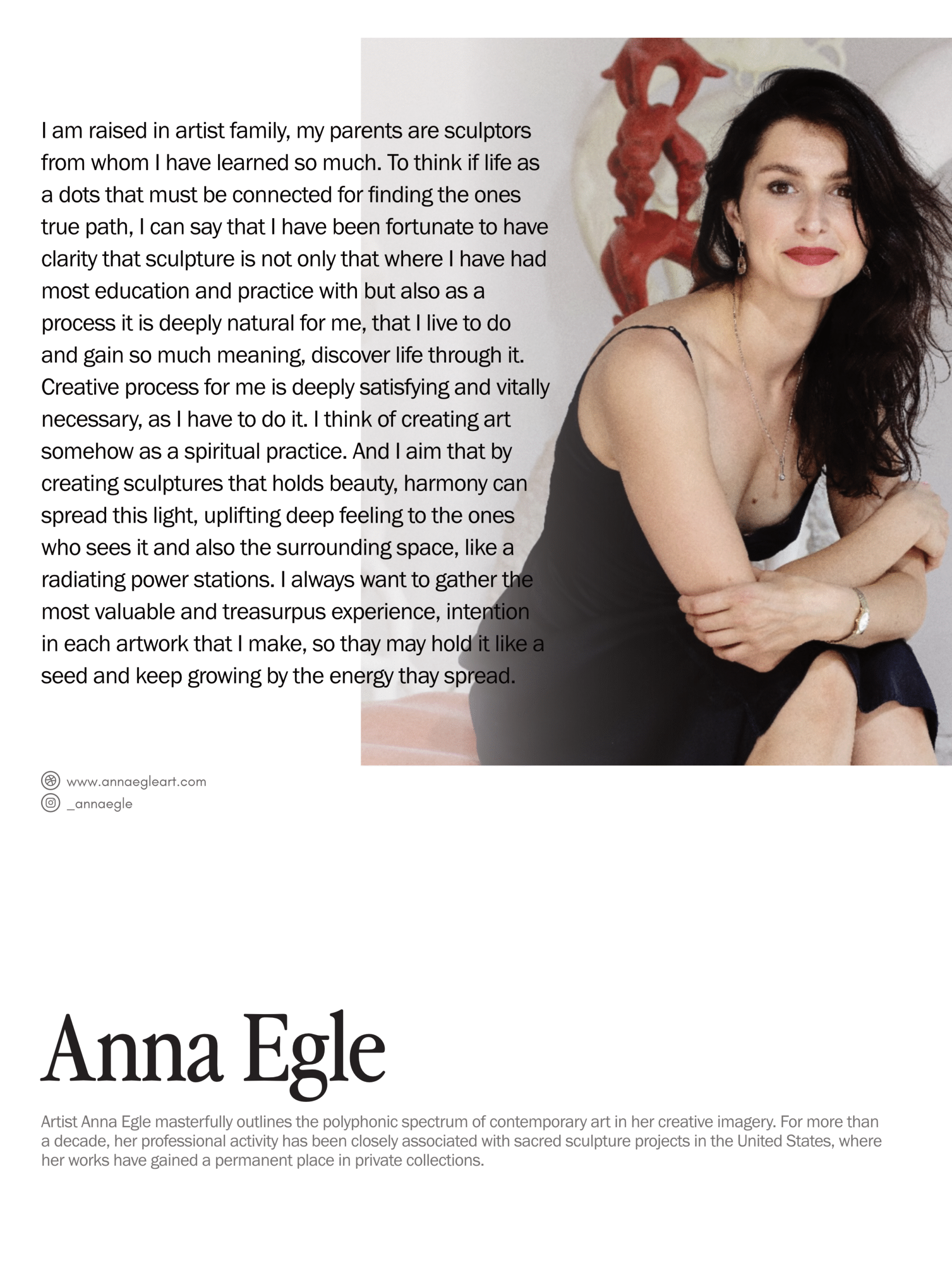
I am Anna Egle (born 1990), a sculptor from Riga. For over a decade, I worked on sacred sculpture projects in the United States, where my works can be found in private collections. My experience in sculpture spans a wide range – from delicate, jewellery-like sculptures to large-scale projects with six and 9-meter-tall clay figures, later cast in bronze. In 2017, I received my master’s degree in sculpture from the Art Academy of Latvia. Since 2011, I have organised solo exhibitions in Latvia and participated in group exhibitions in Latvia and Europe. In my practice, I use various contemporary sculptural materials.
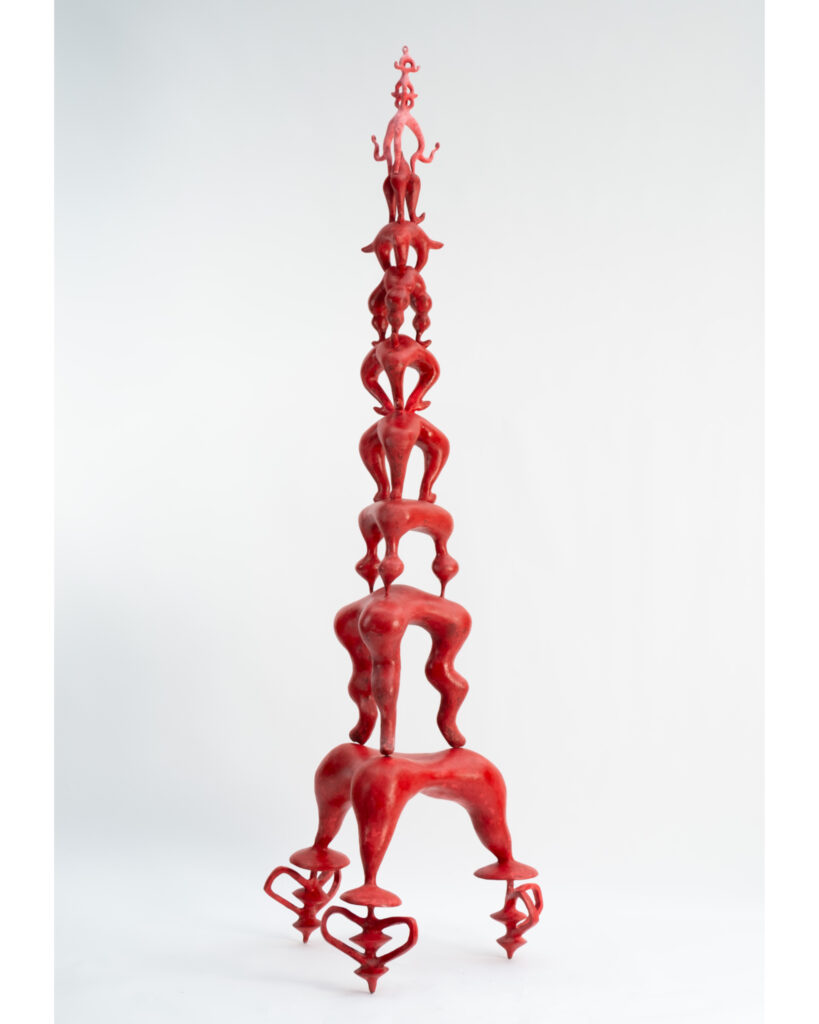
My love of art is inherited from my family. As a child, I lived with the creative processes in my parents’ art studio and experimented with various materials and techniques myself. Currently, I am interested in creating works that enrich and balance the atmosphere of a space. My works are characterised by lightness, simplicity of form, and a light-reflecting texture. I often complement my works with poetic language to deepen their perception. I am also fascinated by other creative techniques, such as performative and musical dimensions, as an extension of the enjoyment of sculptural works. When creating my works, I am discovering the richness of my inner world and the world around me – aspects I didn’t know existed or hadn’t noticed before.
1. You’ve worked on sacred sculpture projects in the U.S. for over a decade—how did that experience shape your approach to scale and meaning in your work?
I believe it has laid the groundwork for what I find meaningful to convey through my sculptures, as well as my artistic skill set. Working with sacred art projects typically involves creating something that is not only perfect in its shapes but also incredibly beautiful and meaningful, which requires significant effort and time, encompassing both sculpting and casting the artwork. So I must say this experience has given me deep insight into how to concentrate and sustain energy for completing something that takes a while. And appreciate the result, the energy that is generated in artwork made by human hands. This kind of artwork has different qualities that will soon most likely be a minority, meanwhile, much more valuable.

2. Your sculptures range from delicate to monumental—what draws you to work across such different sizes and materials?
I love to create monumentally large sculptures. I imagine them in vast natural landscapes where the sky meets the lush green grass, flowers, and ocean. The tiny sculptures are just a mini version of the same process, giving a chance to learn, study and feel the shape and form while working on them more quickly. Interestingly, small-sized sculptures can be even more complicated because they require even more precise attention. I have learned and trained myself through small pieces, focusing primarily on form, shape, the sculpting process, and casting.
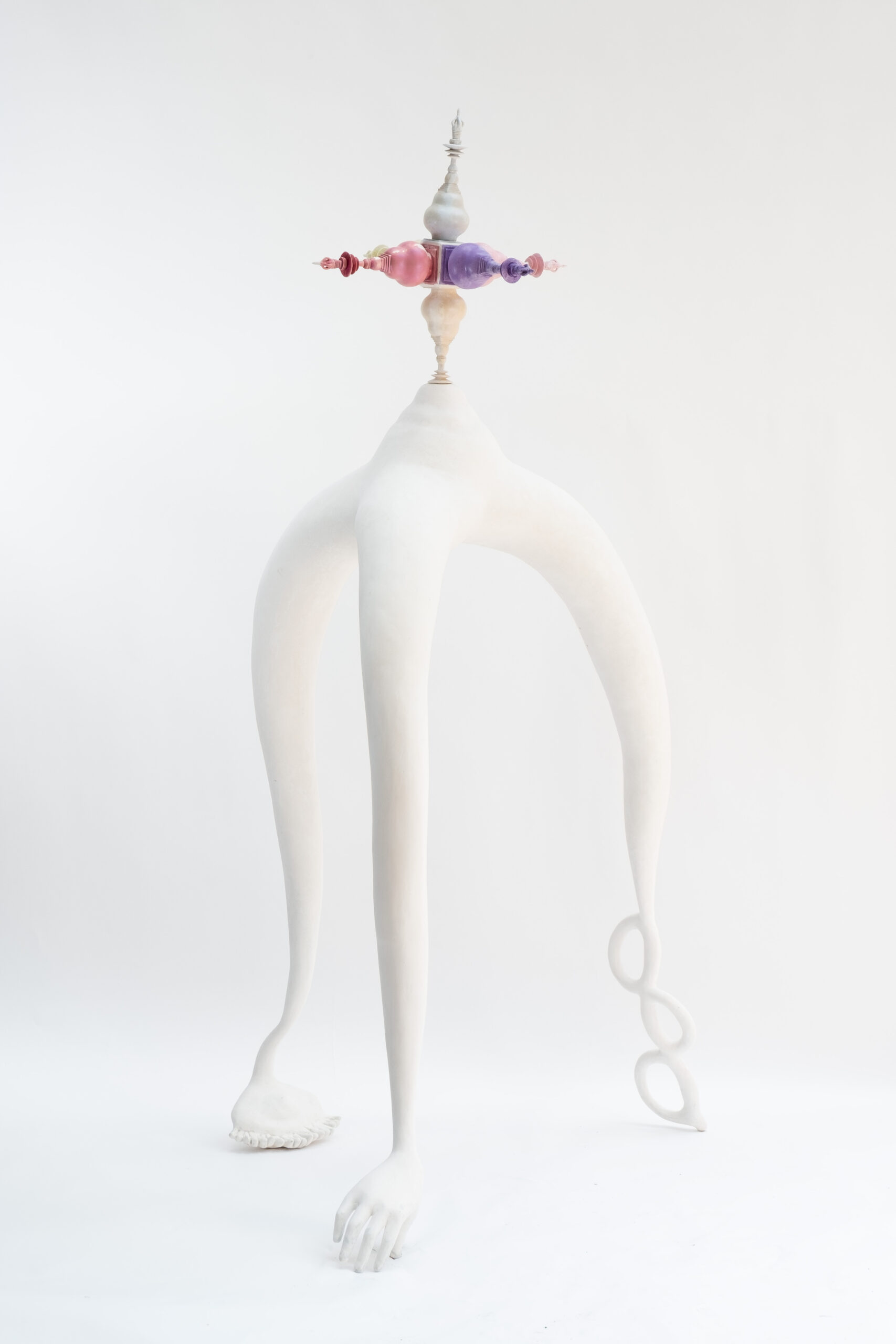
The tiny sculptures are just a mini version of the same process, giving a chance to learn, study, and feel the shape and form while working on them more quickly.
3. You grew up in your parents’ art studio—what parts of that early experience still show up in your process today?
I think I have tried to walk my path. What is still nourishing my practice is the horizon of high-quality, artistic expression that I experienced during my childhood by seeing how my parents worked, and how their working culture was. I can still appreciate that my parents are alive and I can have their honest advice if I ask for it.
4. Lightness and simplicity seem central to your recent work—what role does space or atmosphere play when you’re building a piece?
I believe it is essential to bring more lightness, simplicity, beauty, and harmony into this world. Any object that is taking place in space creates an atmosphere. When I am working on my sculptures I think about what kind of impact to sorrounding space my sculpture would add. How do the shapes resonate? What feeling are they calling out from a viewer? What feeling am I looking for to be expressed? So many factors impact the energy and expression that this solid object-sculpture would radiate.
We can say that by this kind of expression, artwork touches the innermost parts of the being of someone who sees it. For me, my artistic practice is something sacred, as a path and journey of my life’s discoveries. All is inside the sculptural peace – the state of mind, the intention I wished for them, what colours and of course shapes. So space and light have a magnificent meaning for me, even when I start to process and generate the idea.

I think it is necessary to add to this world more lightness and simplicity, beauty and harmony.
Anna Egle
5. You often pair your sculptures with poetic language—how do you know when words need to be part of the work?
This is easy to answer; in most cases, it does not take much effort and comes naturally. I have written accompanying words for my sculptures since the very beginning to express more clearly how I feel about them. The language of the poetry allows me to be freer with impressions and softer with the meaning, avoiding straightforward language. It adds another dimension to the spoken word in the sculpture.
6. You’ve also explored performance and music alongside sculpture—what do those forms give you that static materials might not?
My own experience with performance, particularly Butoh dance and Kum Nye Tibetan relaxation and dancing, has deepened my understanding of how to convey emotions through my sculptures. Music, poetry, and performance all contact different dimensions to our senses, so I love to combine them at the beginning when a new sculpture or series is released at the opening event, to add these kinds of elements and play with them for a more tasteful experience.
Also, I love to think that music or performance at the openings is meant not only for us people attending but for the sculptures themselves, to invite them and celebrate, initiate their coming to a new place. However, it is not always necessary. Like in nature, a simple, large-sized statue can evoke millions of flavours by being surrounded by nature’s simplicity – the gentle breeze that rustles through the leaves of the trees and the ocean that softly lulls, evoking a sense of beauty. Nothing more is needed.

Anna Egle’s sculptures are about creating forms that bring balance, lightness, and harmony to the spaces they inhabit. Her work carries the patience and precision gained from years of sacred art projects, yet remains open to experimentation with scale, material, poetry, and even performance.
From intimate, jewellery-like pieces to monumental works that seem to belong in open landscapes, her practice shows how form, space, and atmosphere can work together to move the viewer. From her journey, we learn the value of sustained dedication, the influence of early creative exposure, and the thoughtful consideration of how art interacts with its surroundings.
To learn more about Anna, click the following links to visit her profile.
Arts to Hearts Project is a global media, publishing, and education company for
Artists & Creatives: An international audience will see your work of art, patrons, collectors, gallerists, and fellow artists: access exclusive publishing opportunities and over 1,000 resources to grow your career and connect with like-minded creatives worldwide. Click here to learn about our open calls.