
When Do You Know It’s Time to Switch Mediums?- Wink K. Moe

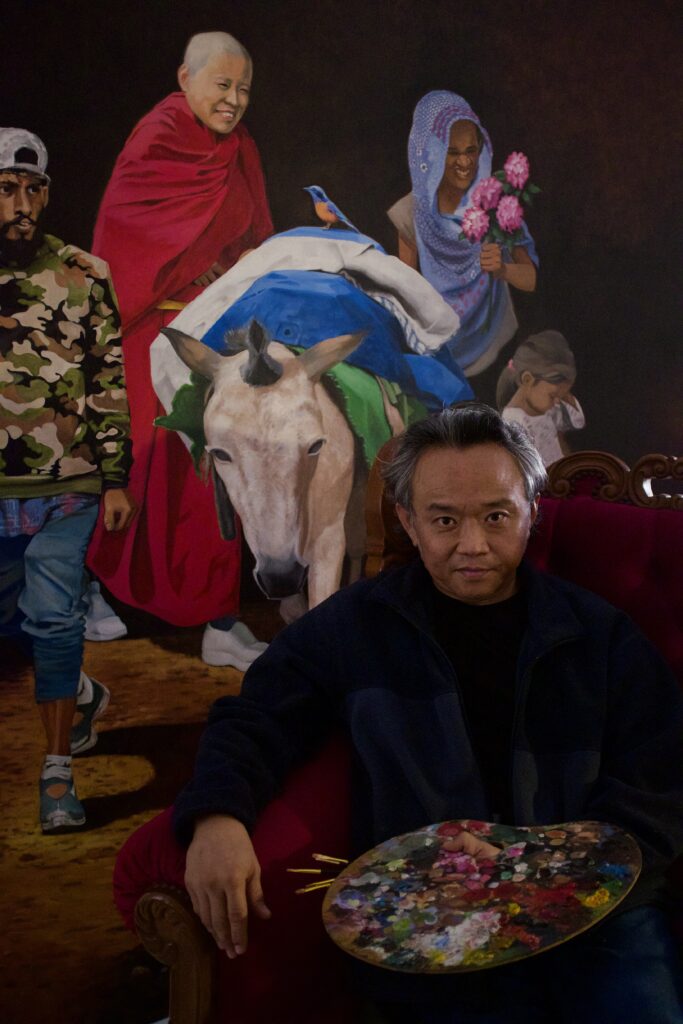
For our Arts to Hearts Project website, we sat down with Wink K(h)ing Moe (b. 2000, Mandalay) to talk about a practice that moves between painting, ceramics, and aerial performance—and keeps circling the same stubborn questions from different angles.
Trained at Chelsea College of Arts (UAL) and shaped by time in Myanmar, Singapore, Taiwan, and London, Wink explores how each medium carries its own logic: painting as a place where the subconscious surfaces, clay as a record of touch and patience, and aerial performance as a negotiation with gravity and risk.
She chases the small ruptures that change how we see: a bioluminescent jellyfish, a crumb of cake, a hairline crack in glaze. Calling herself “an inconsiderable creature in this swarming mass of mankind,” she embraces smallness and intimacy over grand declarations, using every medium to return to the unresolved and in-between.
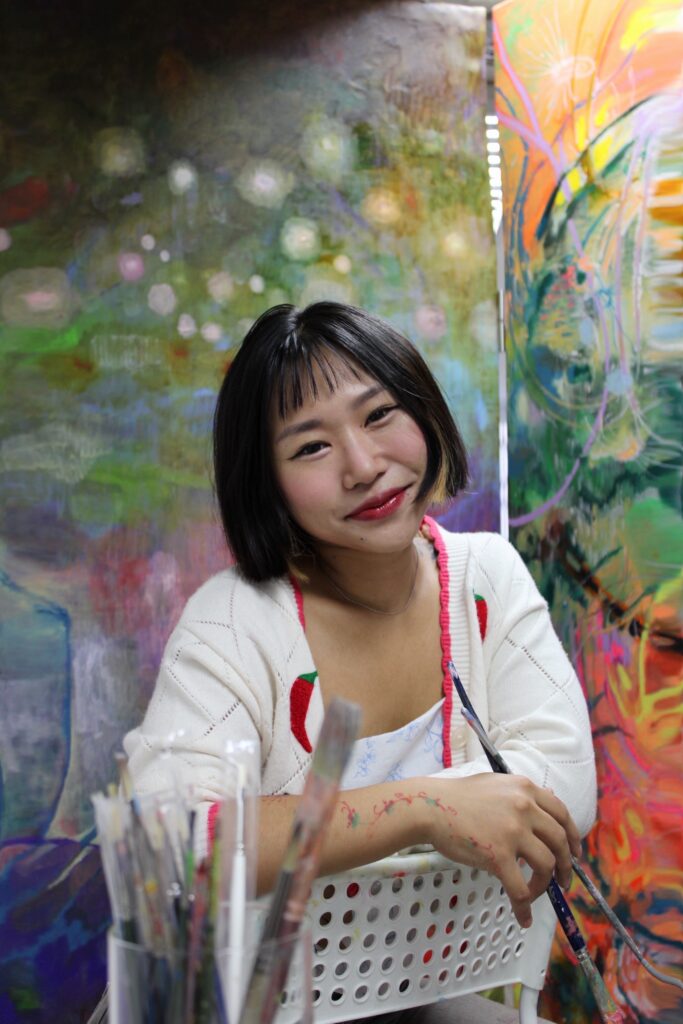
Wink K(h)ing Moe (B. 2000, Mandalay, Myanmar) is an explorer of questions—restlessly drawn to the elusive riddles of the universe she inhabits. From the bioluminescent shimmer of Halitrephes maasi adrift in the deep sea, to the fragile crumb of Proust’s madeleine, to the shifting politics of aesthetics, no mystery is too minute or too immense. She describes herself as “an inconsiderable creature in this swarming mass of mankind, which for a fleeting moment treads upon the surface of the earth.” Yet in this brief passage of time, she discovers endless wonder in the condition of being—of feeling, perceiving, and thinking.
Through painting, ceramics, and aerial performance, Wink attempts to bridge the void, to give form to what she senses is absent in contemporary art. Her practice seeks to occupy the silent intervals, to trace the contours of what remains unsaid, unseen, and unresolved. Of Chinese and Korean ancestry, Wink K(h)ing Moe was born in Mandalay, Myanmar, raised in Singapore, and holds Taiwanese citizenship. In 2019, she moved to London to pursue Fine Arts, graduating from Chelsea College of Arts (UAL) in 2024. While in London, she has been deeply rooted in the city’s ceramics community, developing her practice among its vibrant studios and makers.
1. You describe yourself as “an inconsiderable creature in this swarming mass of mankind.” How does holding that sense of scale shape the way you approach your work?
When I say I’m “an inconsiderable creature in this swarming mass of mankind,” I’m not indulging in self-erasure—it’s a sharpening of perspective. Knowing I’m just one speck in the churn of history relieves me from the burden of trying to make grand, definitive statements. Instead, I can focus on what it feels like to be this speck—alive, sensing, remembering, dreaming.
That sense of smallness pushes me to make work that pays attention to the intimate: the breath caught in porcelain, the fragile crack in oil paint, the silence that hangs between gestures in a performance. I don’t need to claim universality because the universal is embedded in the particular. By accepting my insignificance, I find freedom: to be porous, to listen more closely, to allow the subconscious, memory, and myth to seep into form. If I am a fleeting creature, then my work is my way of saying—this is what it felt like to pass through.
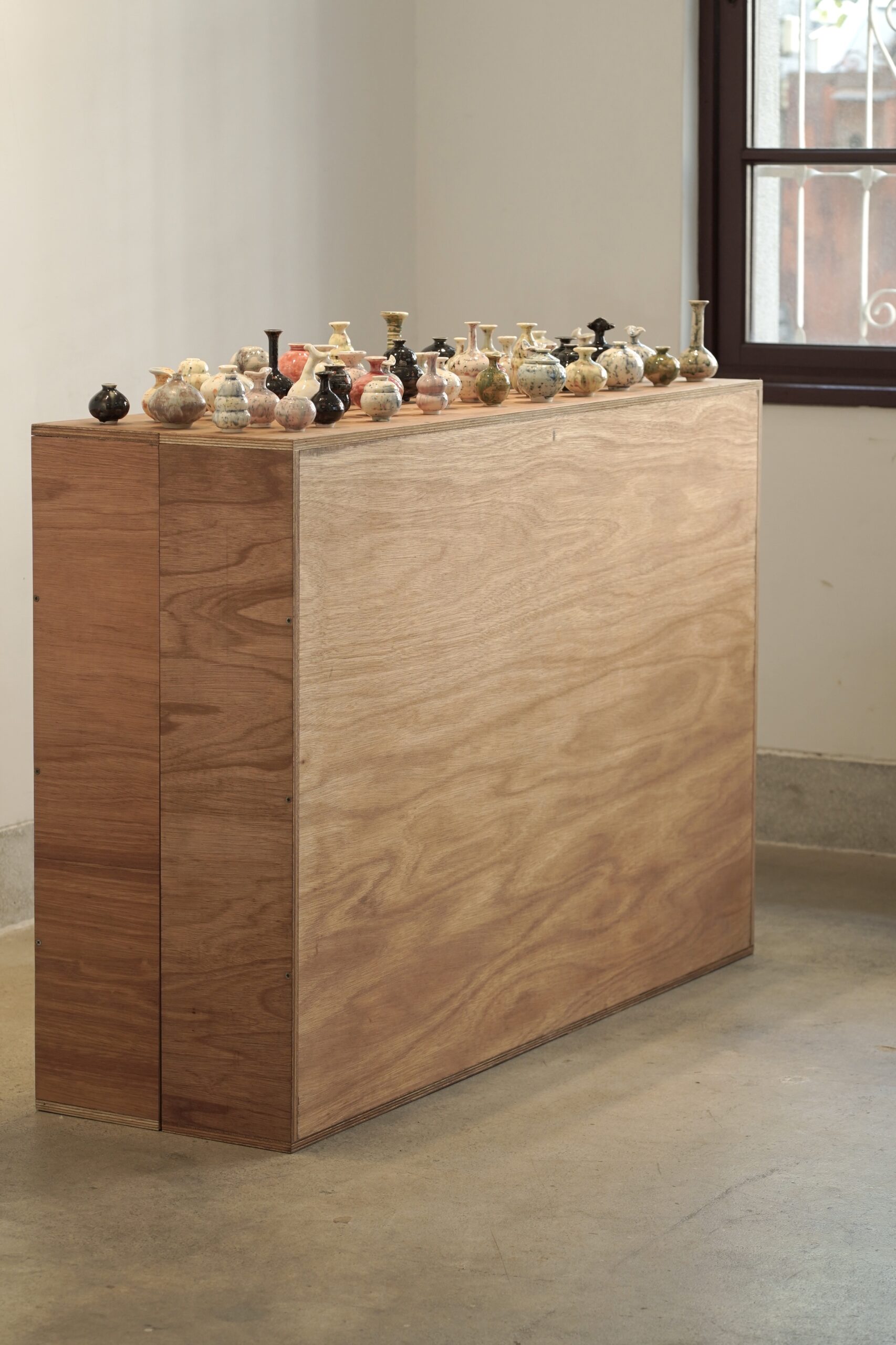
2. Your practice spans painting, ceramics, and aerial performance — three very different forms. What draws you to work across these mediums, and how do they speak to one another in your process?
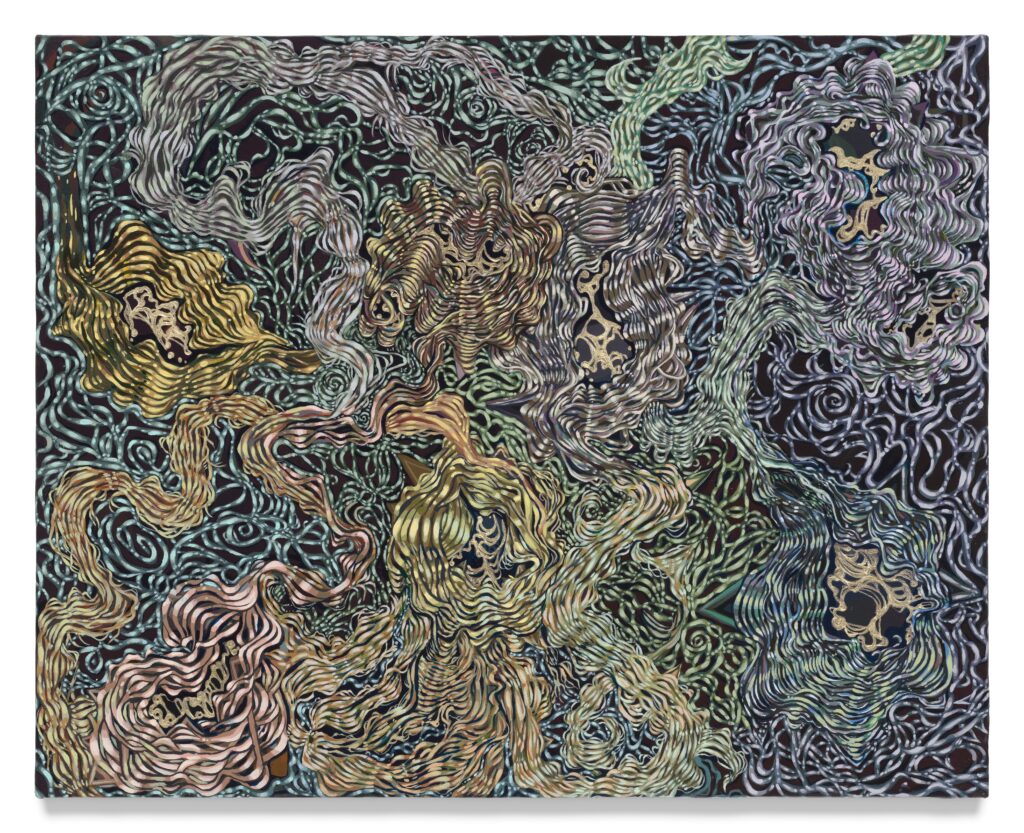
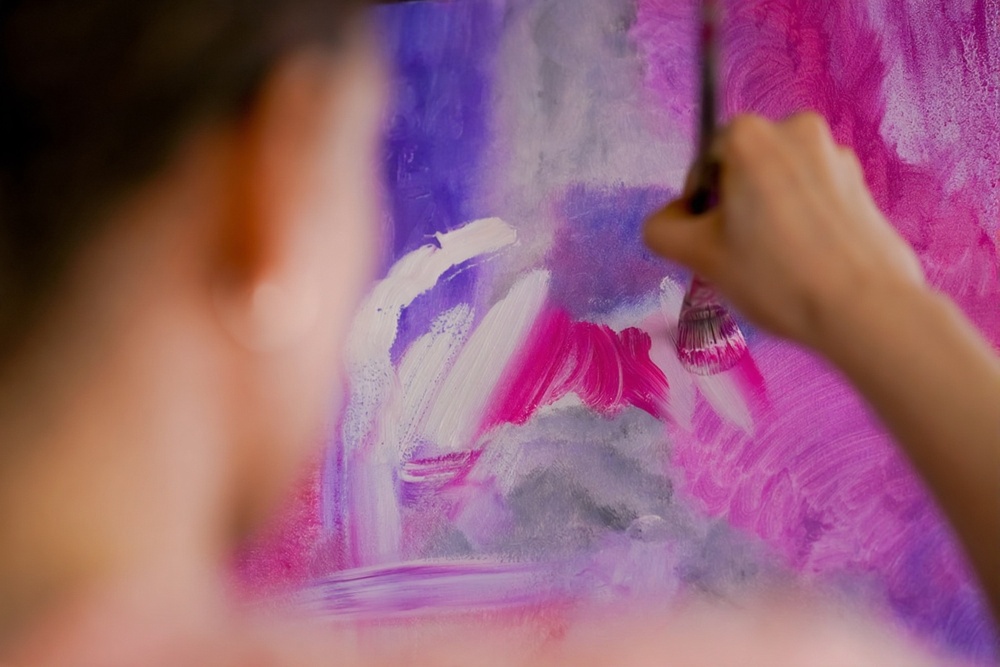
I’m drawn to painting, ceramics, and aerial performance because they each let me approach the same questions from different angles. Painting is where the subconscious emerges—layered, dreamlike, often unresolved. Ceramics grounds me; clay holds every trace of touch, and working with fire teaches me to accept unpredictability. Aerial performance pulls me in the opposite direction: it’s about risk, movement, and negotiating with gravity through the body itself. Though they seem very different, the three practices are in dialogue. They balance one another—stillness and motion, fragility and endurance, reflection and immediacy. For me, moving across mediums isn’t about versatility for its own sake, but about finding the most honest form for an idea, and allowing each practice to fill the gaps the others leave.
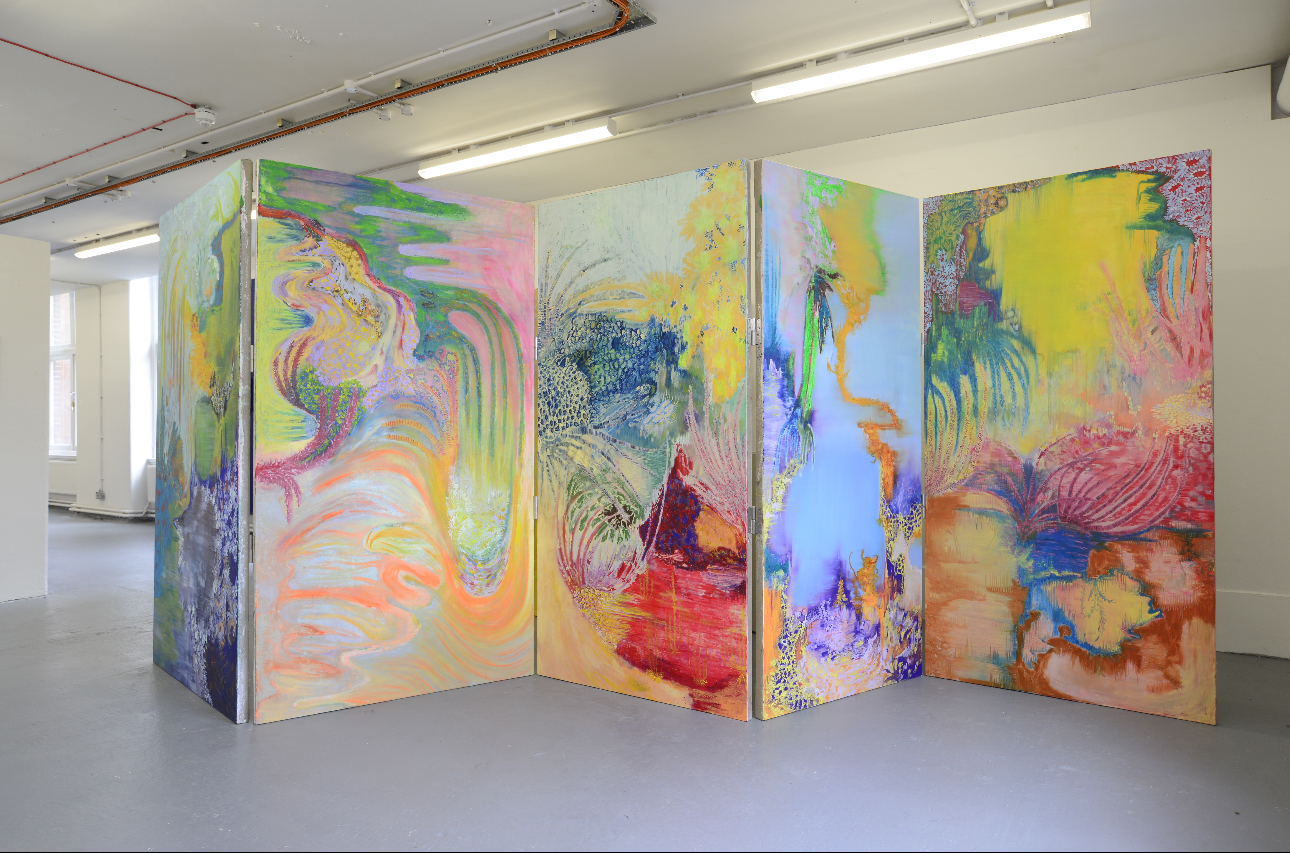
3. You’ve lived in multiple places — from Mandalay to Singapore, Taiwan, and now London. How do these shifting geographies and cultural layers show up in the questions you ask through your work?
Living across those places has made me feel that identity is never fixed—it’s always in negotiation. Mandalay, Singapore, Taiwan, and London each carry its own histories, languages, and rhythms, and I move between them with both belonging and estrangement. That tension—being at once inside and outside—feeds directly into my work. It shows up in the questions I ask: What does it mean to inherit multiple lineages yet feel rootless? How do memory and myth reconfigure themselves when you cross borders? In painting, it becomes fragmented imagery, layered and unresolved. In ceramics, it’s the vessel as both container and absence. In performance, it’s the body suspended between stability and dislocation. The shifting geographies don’t give me answers, but they sharpen the dissonance—and that dissonance becomes the space where my practice lives.
I don’t need to claim universality, because the universal is embedded in the particular.
Wink K. Moe
4. You’ve said your work tries to give form to what’s missing in art today. What, in your view, has gone silent or unnoticed — and how do you go about tracing its outline?
What feels missing in art today is space for the unresolved — for silence, ambiguity, and things that don’t immediately declare themselves. Too often, art is asked to be direct, topical, and instantly legible. But as Jacques Rancière reminds us in The Distribution of the Sensible, the real power of art lies in shifting how we perceive — in expanding what can be seen, said, and felt. In my own practice, I often find myself dissecting what is already found and reconstructing it into a new being by distorting forms and senses.
That act of breaking apart and reassembling is how I open space for the fragmentary, the estranged, the ambiguous. In painting, it might mean allowing an unmarked canvas to carry as much weight as the brushstroke; in ceramics, letting fragility and fracture speak to absence; in aerial performance, suspending the body in a threshold state — neither falling nor grounded. Across these media, I try not to resolve what is missing, but to trace its outline, so that its presence can be felt precisely through its absence. In that way, the familiar is made strange, and the overlooked begins to acquire its own coherence.
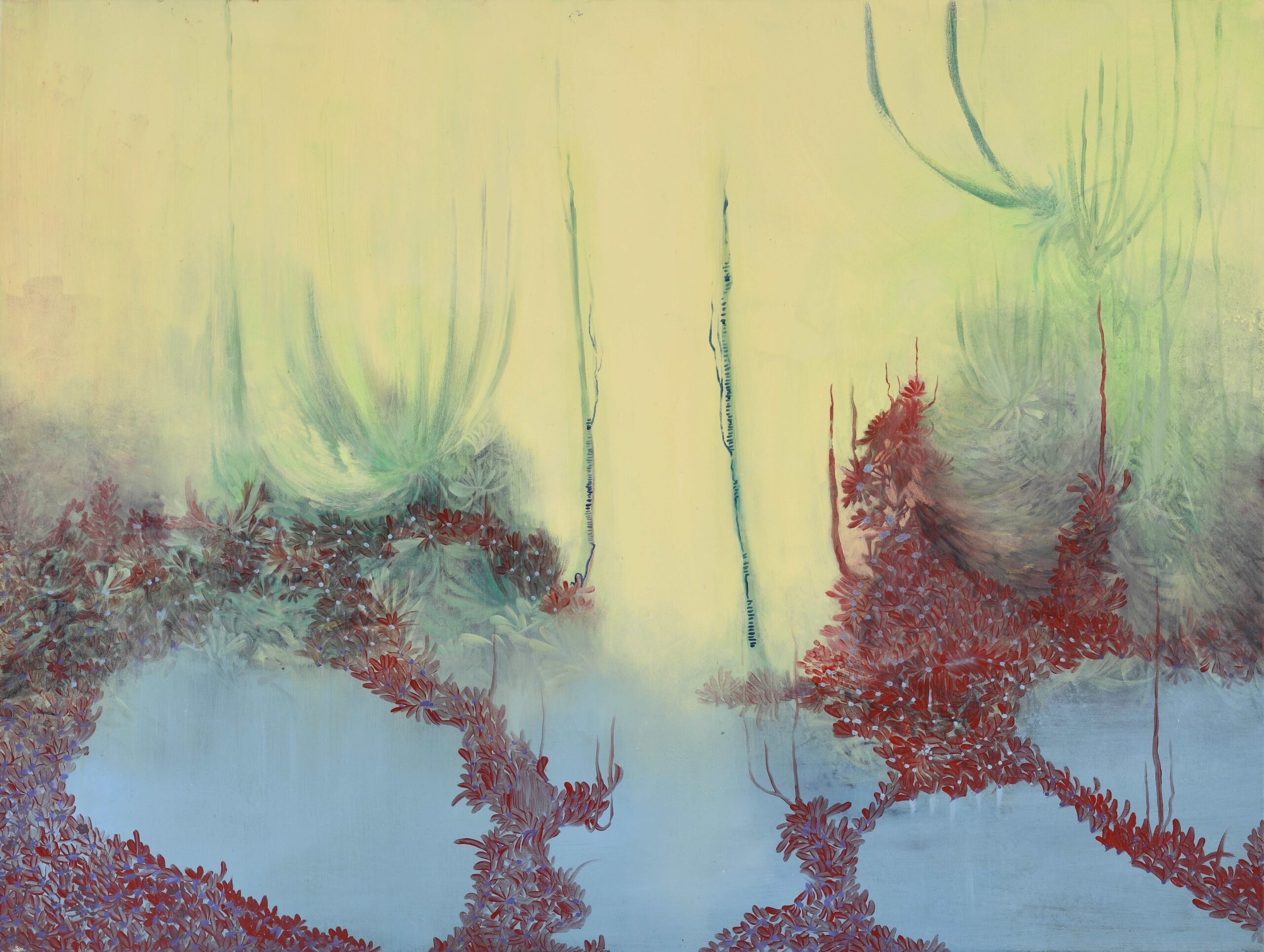
Across these mediums, I try not to resolve what is missing, but to trace its outline, so that its presence can be felt precisely through its absence.
Wink K. Moe
5. Halitrephes maasi and Proust’s madeleine both appear in your biography as very different kinds of wonder. What types of discoveries or observations tend to stop you in your tracks lately?
Lately, what stops me isn’t always something grand or spectacular, but the most minor shifts of perception. It might be the way light fractures across a cracked glaze, or how a word overheard in passing unlocks an old memory. I’m fascinated by those moments when the ordinary tilts and becomes unfamiliar — when something you thought you knew reveals another layer. Halitrephes maasi and Proust’s madeleine are both symbols of that kind of rupture: the jellyfish glowing in the abyss, the pastry crumb opening a whole world of memory. Recently, I’ve been drawn to how absence itself becomes visible — the silence between notes of a song, the pause before a body lets go of the rope in aerial work, the thin line where pigment refuses to hold. Those are the discoveries that stop me: not the monumental, but the delicate fractures that hint at other realities. They remind me that wonder is less about spectacle than about noticing — about seeing how the overlooked or ephemeral quietly rearranges the world.
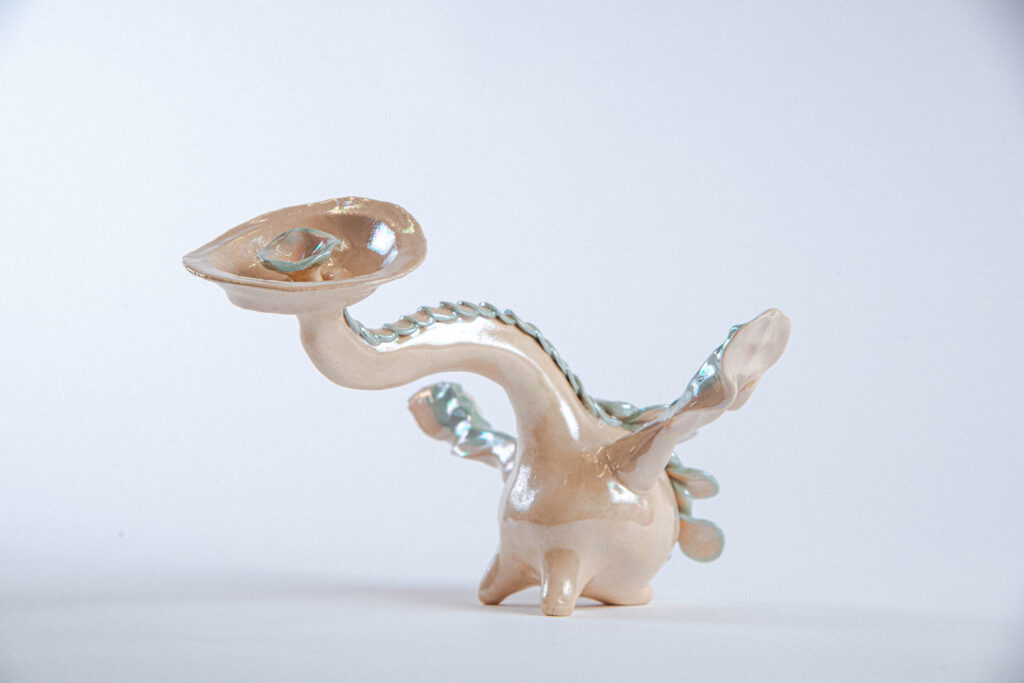
6. You’ve been closely involved in London’s ceramic community. What have those communal spaces taught you, not just about technique, but about time, patience, or the act of creating something with others?
Being part of London’s ceramic community has taught me that clay is never just a material — it’s also a teacher of rhythm, humility, and shared presence. In those communal studios, you learn quickly that clay doesn’t bend to your will; it asks for patience, for slowing down to its own pace. You can’t rush a vessel into being — it collapses if you try. That rhythm seeps into you. Working alongside others, I’ve also realised that making isn’t a solitary act of mastery but a kind of dialogue.
Someone trimming a pot across the table, someone else loading a kiln — their gestures, mistakes, and discoveries become part of your own process. There’s a generosity in that, a quiet reminder that craft is collective even when the object is individual. What stays with me most is the sense of time stretching differently in those spaces: hours dissolving in the repetition of throwing, or the long wait for a firing where the outcome is never entirely yours to control. Ceramics teaches you that beauty is bound up with risk, patience, and letting go — and being in community teaches you that those lessons are lighter when shared.
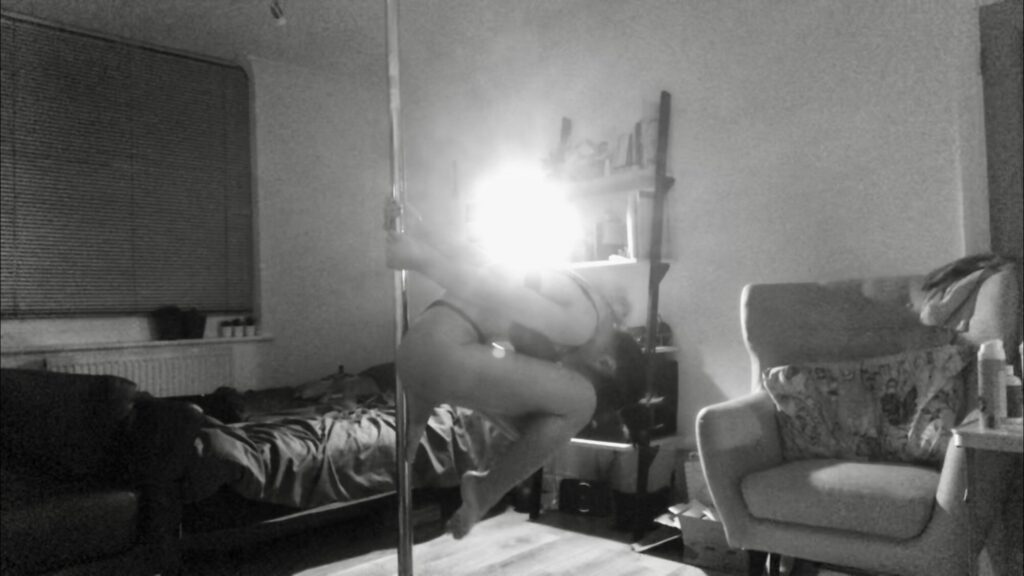
Wink K(h)ing Moe’s work maps the quiet edges of experience. Through painting, ceramics, and aerial practice, she follows small shifts in perception, the pause before movement, the trace of touch in clay, and the space where words fail. Her art is about absence made tangible and about letting the particular carry a broader meaning.
From her path across Mandalay, Singapore, Taiwan, and London, we learned how scale can reset ambition, how patience and community shape craft, and how ideas find their best form when different mediums speak to each other without chasing grand statements.
To learn more about Wink, click the following links to visit her profile.
Arts to Hearts Project is a global media, publishing, and education company for
Artists & Creatives: An international audience will see your work of art, patrons, collectors, gallerists, and fellow artists: access exclusive publishing opportunities and over 1,000 resources to grow your career and connect with like-minded creatives worldwide. Click here to learn about our open calls.