
This American artist uses ash, cement & thread to create textured abstract paintings ┃ Ty Nathan Clark

At Arts to Hearts Project, we have always believed that artists deserve more than just a moment of visibility. They deserve publications that hold their work and their stories with real care. That belief is behind every magazine, every artbook, every award and every edition we put out.
Our 100 Emerging Artists publication came from something specific. We kept meeting artists whose work was extraordinary but who were still in that early stage where the world had not caught up to what they were doing yet. We wanted a space that found them right there, in the middle of becoming, and said we see you and what you are building matters.
It is now in its third edition, curated by Sonia Borell, and every time we put it together we are reminded that emerging does not mean beginner. It means becoming. An artist whose practice is alive and moving and finding itself right now. Some of the artists in this edition are early in their journey.

Others have been making work for years but are only now stepping into a visibility that matches what they have been quietly building. What connects all of them is momentum. The sense that something is happening in their practice right now that was not happening two years ago
Ty Nathan Clark is one of our selected artists in this edition. And his work carries the kind of depth that makes you forget you are looking at something made by someone the art world is still getting to know.
Ty is an American artist who grew up inside art the way some people grow up inside music or language. It was just there. His grandparents’ house in Santa Barbara was filled with sculptures and paintings and art books and poetry and classical records. His uncle was a world-renowned raku artist whose clay-covered jeans and fingertips left an impression on Ty that never went away.
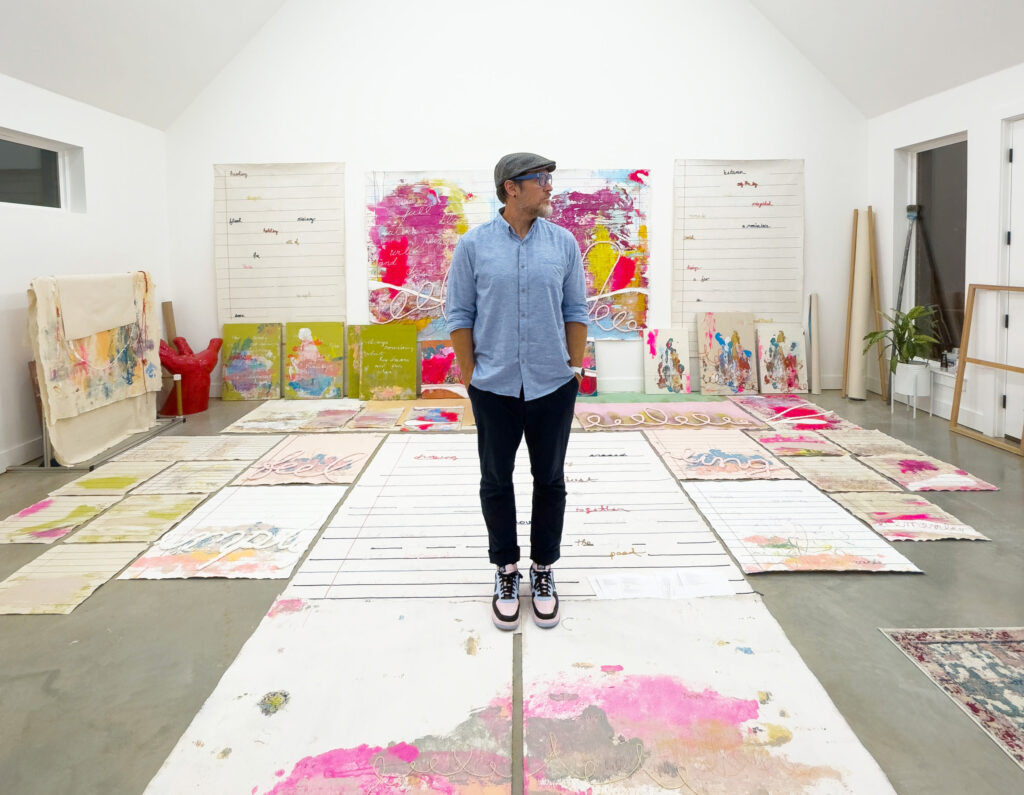
He had his first exhibition at four years old. His mother made a quilt from the invented animals he drew on napkins at the dinner table and it won grand prize at the California State Fair. That is the kind of beginning that does not guarantee anything but tells you that art was never a choice for this person. It was a condition.
He is a painter and a sculptor and a poet and a writer and a filmmaker and a mentor. And those are not separate careers running alongside each other. They are all feeding the same practice. His paintings are abstract but they come from somewhere deeply personal, from faith and healing and trauma and self-discovery and childhood memory and poetry and literature.
He works in bodies of work rather than isolated pieces because he believes an idea needs room to breathe and evolve and become what it is supposed to be over the course of many paintings rather than just one.
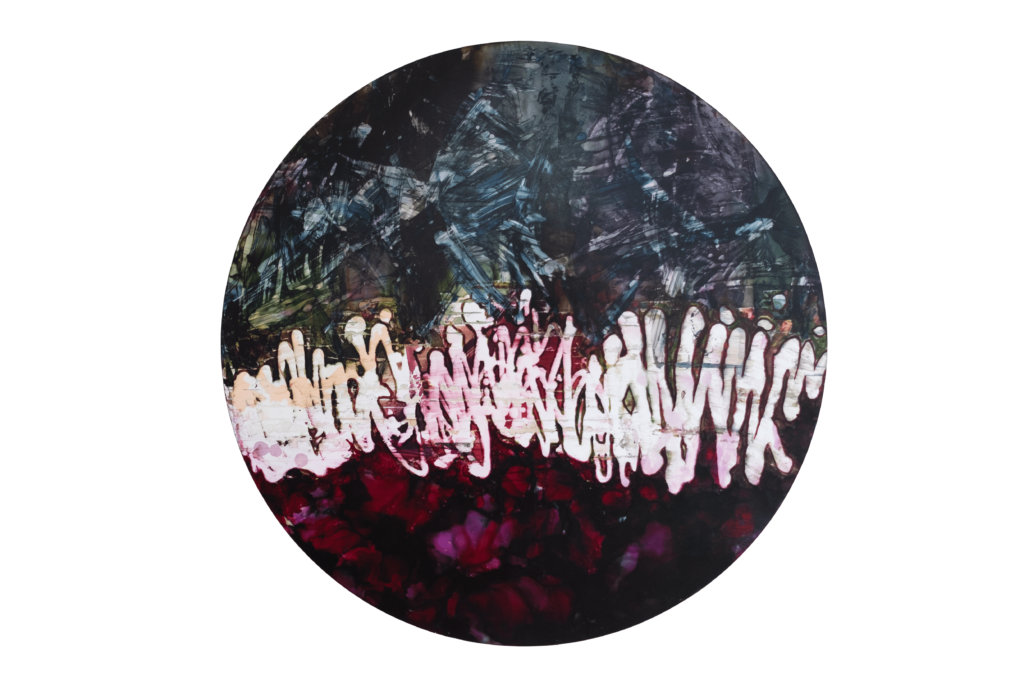
His surfaces are built with materials that most painters would never think to use. Ash, cement, thread, yarn, sawdust, found objects, all mixed into traditional mediums to give the work a texture and a physical presence that you can feel through a photograph even before you stand in front of the actual piece.

Acrylic, conte crayon, oil stick, pastel, colored pencil, graphite, string, and yarn on canvas
68 x 52 inches (172 x 132 cm) & 68 x 52 inches (172 x 132 cm)
(From the series “Memory Lives in the Hand that Writes.”)
He is classically trained. Drawing, painting, clay, sculpture, figurative work, portraits, landscape, still life. He did all of it and he loved all of it. But abstraction is where he landed because for Ty abstraction is the closest thing to poetry he can make on a canvas.
That connection between poetry and paint runs through everything he does and the way he describes it is one of those explanations that makes you understand his work on a completely different level.
Let’s get to know Ty through our conversation with him about growing up with clay under his uncle’s fingernails, why abstraction feels like poetry on canvas, what ash and cement carry into a painting, and why he believes we should all practice remembering more often.
Q1. Can you take us back to the beginning and share how your journey into art first started?
I honestly don’t even remember a day without art. I grew up in a family where my grandparents loved art. My uncle was a world renowned raku artist, so I was around art from a very, very young age. In my grandparents’ house there were sculptures, paintings, art books, poetry books and classical records.
Everything. When I was at their house in Santa Barbara, up behind the botanical gardens, it all felt wrapped up around the arts. It’s honestly all I’ve ever really wanted to do. I had my first art exhibition when I was four years old. My mom made a quilt out of invented animals that I would draw on napkins at the dinner table for the California State Fair, and the quilt won grand prize. So my mom would tell me to say I started making art seriously when I was four years old. (I still have the quilt by the way.)

Q2. How did growing up around artists, especially your uncle Conway “Jiggs” Pierson, shape your creative path?
My uncle, Conway “Jiggs” Pierson. I didn’t really get to spend much time with him, because he died when I was so young. But I have these imprinted memories of him in dried clay coated jeans and a shirt. I remember even seeing clay under his fingertips. Dried clay. That’s probably where the curiosity started. It’s in my DNA. I always drew, I always wrote, I was always making something.
Then into high school I had fabulous art teachers who poured into me. Mario Ferrante, Toby Kovic, Kim Morgan. They were building a passion and a love for art into my soul. Then on into college I had incredible art professors, American sculptor William Catling chief among them, who influenced me intensely. After that came mentors like the renowned Japanese painter Makoto Fujimura, who has shaped me in a deep way. I’ve just always wanted to be in and around art and artists.
Q3. Why does abstraction feel like the right language for exploring healing, faith, and self-discovery?
I’d say these themes are best expressed through any direct narrative that lives within the arts. Abstraction just happens to be what I love. I grew up a classically trained artist, so I’ve done landscape and still life, figure drawing, figurative work, portraits. In drawing, in painting, in clay and sculpture.
And I fell in love with it. I’m a poet too. I love to write. For me, abstraction is the closest thing to poetry I can make on a canvas. Form, color, texture, gesture, all of it reaching to express emotion, feeling, and story.

Acrylic, string and pastel pencil on canvas, 116×75 inches (295 x 190 cm)
(From the series “Of Warm Impermanence”)
Q4. What draws you to creating bodies of work rather than standalone paintings?
When I left the last business I helped start in Austin, Texas, to go into art full time, I really struggled with making individual pieces. Something about them just felt empty. As I started to truly study art and deepen my knowledge, I saw that a lot of artists worked in bodies of work.
The more I sat with that and wrote about it, the more it made sense. A body of work gives the idea time to breathe. Time to be fully fleshed out. From the first piece to the 15th, the first to the 20th, the work shifts and evolves as it goes. Sometimes halfway through, it finally becomes what it’s supposed to be. And then it starts telling you what’s coming next.
Q5. You often use journals, poetry, and literature as starting points. What can writing reveal that painting alone sometimes cannot?
I don’t know if writing can reveal things that painting alone cannot. I think they probably both reveal things on their own. I just happen to love poetry, and I happen to love literature and writing, so it’s always been a major influence for me as an artist. There are times where we really have to search deep for a muse.
Something to inspire us, something to drive us within our work. For me, poetry and literature happen to be a few of those things. Because I’ve written for so long on my own, it’s given me ammunition, things to lean on, stories to tell through my own memories and in my own poetry. I think the poet Rainer Maria Rilke said it best in his book Letters to a Young Poet, giving advice to a young poet.
He writes that “even if you found yourself in a prison where walls let in none of the world’s sounds, wouldn’t you still have your childhood, that jewel beyond all price, that treasure house of memories?
Turn your attention to that and try to raise up the sunken feelings of this enormous past. Your personality will grow stronger, your solitude will expand and become a place where you can live in the twilight where the noise of other people passes by far in the distance.” I work extremely hard to do that through my own writing and my poetry, and then bring it into the canvas.
Q6. What draws you to materials like ash, cement, thread, and found objects that already carry their own histories?
At first, using nontraditional materials was just a search. Things that give texture and body, that help a story fill the canvas with something other than paint. That was the start. How do I evolve as an artist? How can I do things differently, pulling ideas from Arte Povera, the Spanish Informalists, the Ab Ex period, movements from all over the world, to tell my story and share my work? It began there.
Then it went deeper. I found materials that held stories of their own, things I could carry back into traditional mediums and mix in to make work that probably isn’t new, but it speaks differently. (I’m sure it isn’t new.) I’ve stolen a lot from the artists I love. But I’m trying to do it in a way that tells my story better.

Acrylic, ash, string and pastel pencil on canvas, 96 x 72 inches (244 x 183 cm)
(From the series “Of Warm Impermanence”)
Q7. What does texture allow you to express that color or imagery alone cannot?
One of the main things texture does is let a photograph show the depth of a painting. Without it, it’s hard to really see what’s happening in a flat photo. And everything today gets seen as a 2D image first, before anyone stands in front of it in person. So texture helps there. But when you’re chasing poetry on a canvas, paint alone isn’t express it. It just won’t. Different mediums, texture, real thickness, that’s what lets the viewer’s eyes feel a painting instead of just look at it.
Q8. Your work often asks viewers to revisit memories they may have forgotten. Do you think remembering is an act of healing?
I truly do think remembering is an act of healing. The older we get, the more we forget. I think all of us want to remember our childhoods, most of us want to remember our childhoods and the wonderful things that happened to us, the relationships we lose or that move on, family members. There are so many things that fill our lives. Why would we not want to remember them? So if I can help people practice remembering more often, I think it should lead to a more beautiful life in the end.

Q9. In works like The Weight of Silence, are the layers carefully planned, or does the process unfold more intuitively?
(I don’t have a work with that title, but you can put a title from one of my paintings I upload in that space) My process is very intuitive. I don’t plan my paintings or sculptures out before I create. I write about them a lot, whether that’s poetry, essays, general ideas, or themes within a body of work.
But the making is intuitive. I’m building and taking away. Constructing and deconstructing quite a bit. And yeah, it is architectural, in the way a story or a life is built from a foundation to a shell, from the bones of something to the inside that inhabits it, something that may look different in age on the outside. So it’s very intuitive, and the layers are constantly being covered up and at times uncovered.
Q10. What do you think allows your personal experiences to resonate with such a wide audience?
That’s a powerful question. I think what makes a personal narrative universal is honesty. People can see when an artist is being truthful in the work, and when they’re not. The work can speak on its own in a room. It’s powerful when the artist is there talking about it. But the thought, the time, the energy, the spirit poured into a piece, that might be even more powerful once the artist walks away and the work is left alone in a space.

Acrylic, ash, espresso, string, conte crayon and yard on canvas, 38 x 36” inches (96 x 91 cm)
(From the series “Memory Lives in the Hand that Writes.”)
Q11. As your creative career has grown across different roles, how has your definition of success changed?
Success has many definitions. As many as there are people in the world, I believe. To me, it all comes down to the end. How do you go out? How do you invest deeply in the lives of others? How do you leave a legacy of love and inspiration, joy, vulnerability and honesty behind, something that carries on long after you’re gone?
I hope my work does that. I try to pour all of it in, to make the best work I can in everything I touch. So that the day I leave this place, maybe something lasts beyond me.
Q12. You’ve often spoken about patience. What’s the biggest lesson you’ve learned about building a lasting creative life?
Oh, that’s an easy one. The thing that took me the longest to learn was discipline. Building discipline into a routine that gives me the space, the drive, and the repetition of always making in that time. I think that’s one of the biggest foundations for any artist. Doesn’t matter what your routine is, doesn’t matter what your discipline is. It’s finding a disciplined routine for making the work.
Q13. If there is one thing you hope remains constant in your work over the next twenty years, what would it be?
I hope evolution remains constant in my work over the next 20 years. That I still have the drive in me to keep searching for something new. Something different. To keep building on the strengths I have, and to take all my weaknesses, the things I know I still need to learn, and continue to invest time into growing.

Ash, acrylic, pastel pencil, thread on cloth, 62×53 inches (157 x 135 cm)
(From the series “Of Warm Impermanence” )
As we wrapped up our conversation with Ty, the thing that stayed with us is how complete his creative life feels. Not because he has figured everything out but because he has never separated any part of himself from his art. The childhood memories, the poetry, the faith, the trauma, the healing, the classical training, the uncle’s clay-covered hands, the napkin drawings at four years old. All of it went in. Nothing was left outside the studio door.
And that is something we think every artist needs to hear. That your creative practice does not have to be one clean thing. It can be messy and wide and include poetry and film and sculpture and ash and cement and found objects and childhood memories and old songs and grief and joy all living together on the same surface.
The work does not get weaker when you bring more of yourself into it. It gets stronger. Ty’s paintings are proof of that. Every material he adds, every memory he folds in, every layer he builds and scrapes away, it all makes the work hold more life than a painting made from paint alone ever could.
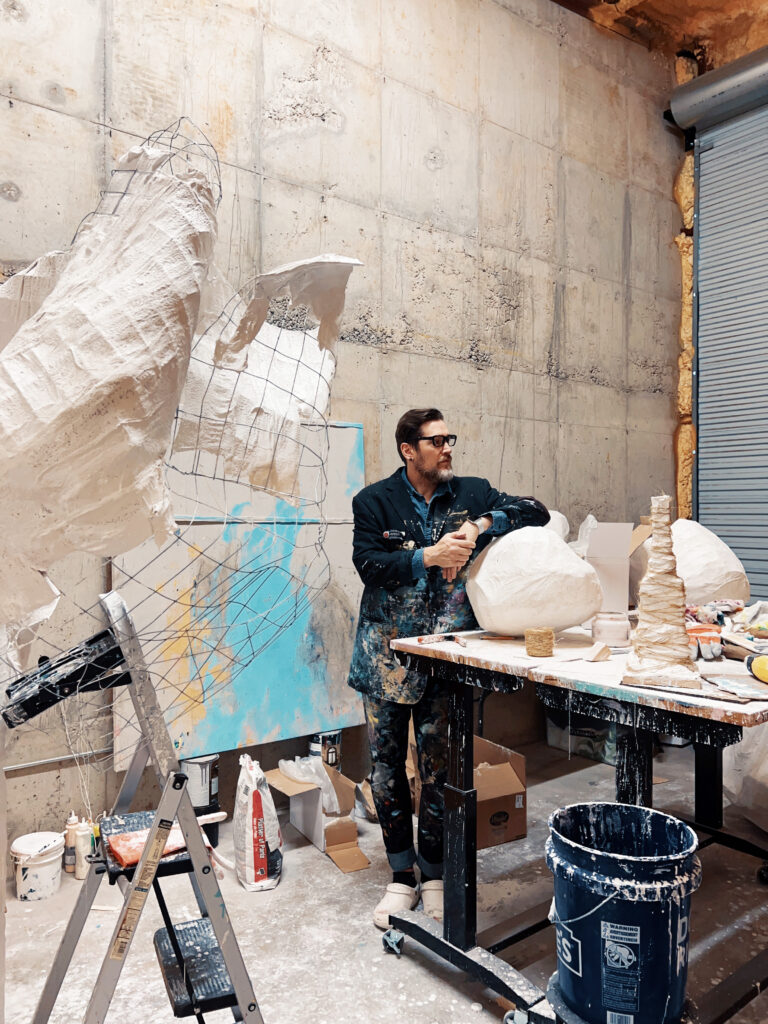
And honestly talking to Ty made us think differently about discipline. We always hear artists talk about inspiration and flow and waiting for the right moment. Ty does not wait for anything.
He shows up every day and makes work whether the moment feels right or not. And over time those quiet unglamorous days in the studio have produced more real work than all the inspired moments combined. That is not something most artists want to admit but it is probably the truest thing about sustaining a creative life that anyone can say.
For art lovers and collectors, Ty’s paintings are the kind of work that makes a space feel more alive the moment they go up. The surfaces hold real physical weight from the ash and cement and thread and sawdust layered alongside the paint and that gives them a presence you can feel from across the room. But the real gift is what happens when you walk closer. Every piece rewards you for looking longer and standing nearer because there is always something in the layers you did not notice the first time.
And because everything Ty brings into the studio, the poetry, the memories, the faith, the materials that already carry their own stories, ends up inside the work, what you are living with is not just a beautiful object. It is something genuinely rich with life. And that richness does not fade. It grows alongside you.
Follow Ty Nathan Clark through the links below and see his work for yourself.