
The Many Faces of the Angel of Death
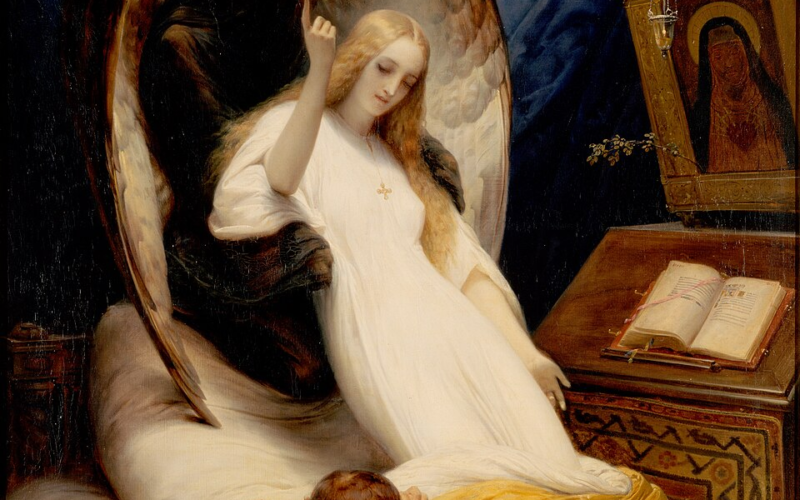
Death has always been one of humanity’s greatest mysteries. No one knows what waits beyond it, yet every culture has tried to imagine its arrival. Sometimes it appears as a hooded skeleton carrying a scythe. Sometimes it comes as a silent shadow slipping through the darkness. And sometimes, it arrives with wings.
Across centuries of art, the Angel of Death has taken on countless forms. It has been painted as a compassionate guide leading souls into the unknown, a divine messenger carrying out biblical judgement, a terrifying force sweeping through entire cities, and even a quiet, almost human presence standing at the edge of life’s final moments. Unlike many symbols in art history, there has never been a single way to picture it. Every artist, every era, and every belief system has imagined the figure differently.
That is what makes these paintings so compelling. They are not simply depictions of death, they are reflections of the fears, faith, and questions of the people who created them. Some artists found comfort in the idea of an angel waiting at the end of life. Others saw only uncertainty, grief, or inevitable judgement. Together, their works reveal how our understanding of mortality has shifted across generations while remaining one of the few subjects artists can never stop returning to.
From Victorian Symbolism and biblical epics to modernist reflections on mortality, these seven extraordinary paintings reveal that the Angel of Death has never been just a harbinger of the end. It has always been a mirror, reflecting how humanity chooses to confront the one mystery none of us can escape.
1. Angel of Death (1880–81) by Evelyn De Morgan
What if Death didn’t arrive as something to fear, but as someone to trust?
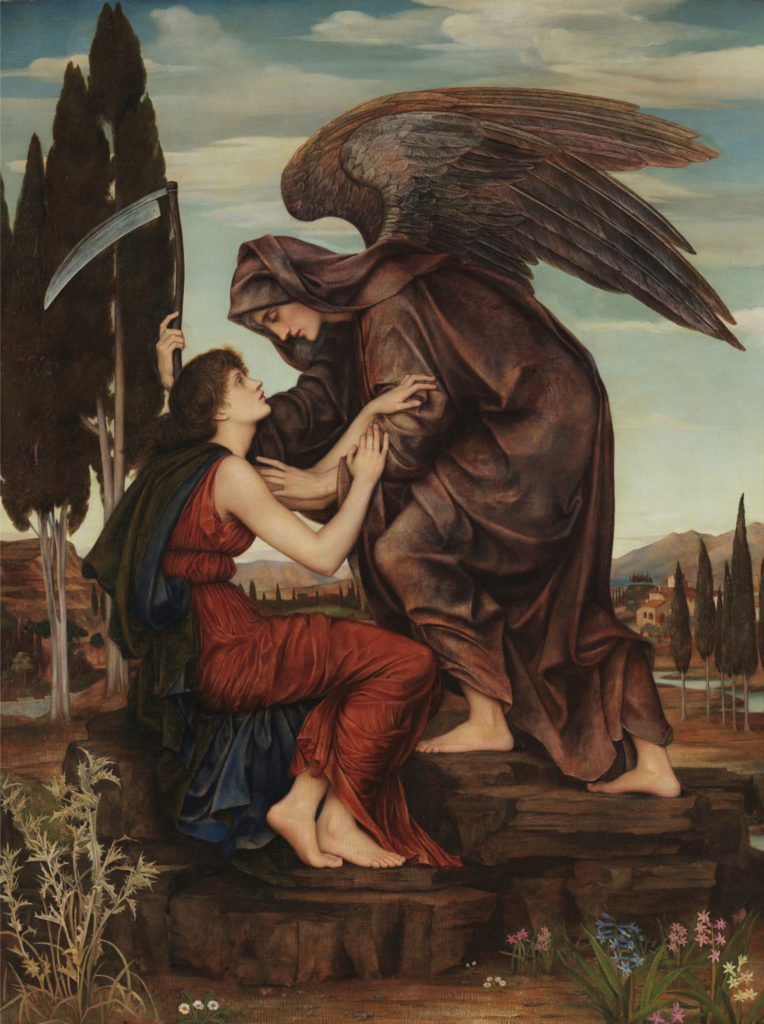
That is the unsettling question Evelyn De Morgan asks in Angel of Death. Instead of the skeletal Grim Reaper familiar from medieval art, she paints a hooded, winged figure who bends gently toward a young woman. The angel carries a scythe, but it is almost secondary to the quiet exchange unfolding between them. There is no struggle, no panic, no dramatic attempt to escape. The woman looks directly at the angel, and the angel meets her gaze with remarkable tenderness.
At first glance, the painting feels almost contradictory. The figure embodies death, yet nothing about the encounter suggests cruelty. The warm earth tones, the peaceful landscape, and the careful closeness between the two figures replace fear with intimacy. Death is not invading the scene, it is simply arriving at the moment it always was meant to.
This compassionate interpretation reflects De Morgan’s lifelong fascination with spirituality. Associated with the late Victorian Symbolist movement, she believed the soul continued beyond physical life, and many of her paintings explore themes of immortality, transcendence, and the unseen world. In Angel of Death, mortality becomes less of a final ending and more of a passage between two states of existence.
That perspective makes the painting surprisingly modern. Even today, we often imagine death as something violent or abrupt. De Morgan instead suggests that it can be quiet, inevitable, and even merciful. The angel doesn’t claim a life through force; it simply offers its hand.
It is a remarkably gentle beginning to a story that other artists would paint very differently. Where De Morgan sees comfort, later painters would see terror, judgement, plague, and grief, proving that the Angel of Death has never belonged to a single imagination.
2. Death and the Maiden (1908) by Marianne Stokes
Not every meeting with Death is dramatic. Sometimes, it is heartbreakingly quiet.
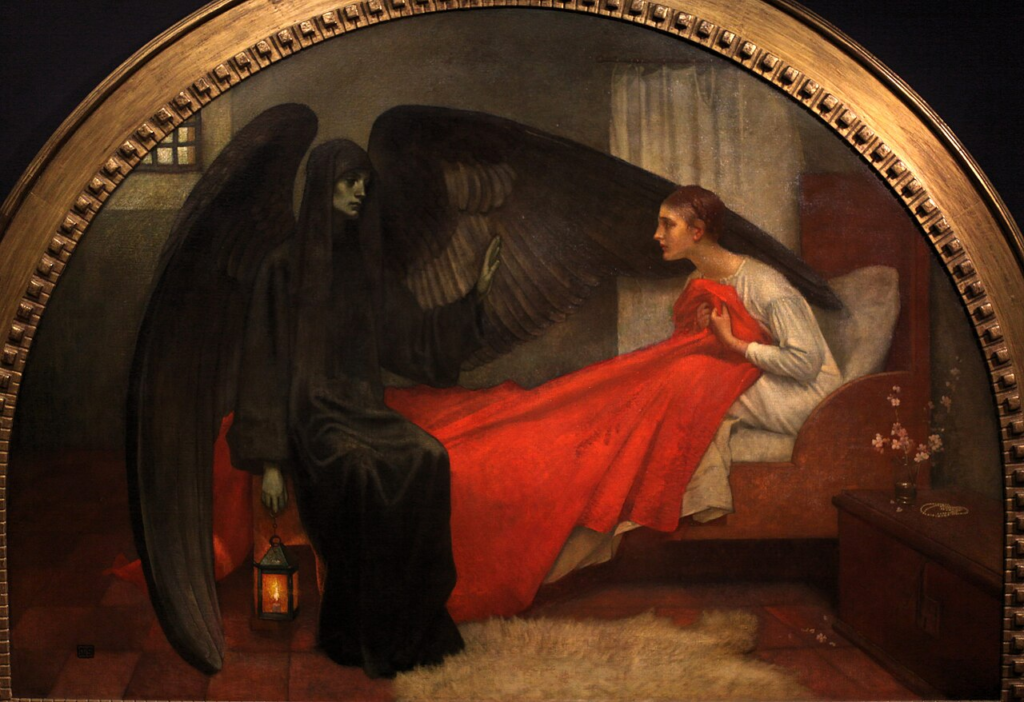
In Death and the Maiden, Marianne Stokes abandons the violence often associated with mortality and replaces it with stillness. A young woman sits upright in bed, wrapped in a vivid red blanket, as a dark-winged figure enters her room carrying a small lantern. There is no chase, no raised weapon, and no visible struggle. The Angel of Death simply waits, its presence filling the room with an almost unbearable silence.
That silence is precisely what makes the painting so haunting.
The black-winged figure is cloaked from head to toe, revealing almost nothing of its identity. Unlike Evelyn De Morgan’s compassionate angel, Stokes’ visitor offers no comforting gesture or reassuring expression. It remains unreadable, neither cruel nor kind. The young woman, however, does not recoil in terror. Instead, she looks toward her visitor with a mixture of fear, curiosity, and reluctant acceptance, as though she understands that this is a meeting that cannot be postponed.
The painting belongs to a long artistic tradition known as Death and the Maiden, a theme that emerged in late medieval Europe and flourished during the Renaissance. These works often portrayed Death confronting a young woman at the height of her beauty, reminding viewers that youth, innocence, and earthly pleasures are fleeting. Stokes reimagines this centuries-old subject with remarkable restraint. Rather than focusing on death’s triumph, she dwells on the deeply human moment just before it.
The lantern held by the angel adds another layer of meaning. Rather than illuminating the room, it seems to symbolise guidance, a light carried through the darkness rather than a warning of doom. Whether the figure has come as a messenger, a guardian, or simply an inevitable visitor is left deliberately unresolved.
That ambiguity is what has allowed Death and the Maiden to endure. It doesn’t tell us what death is. Instead, it captures what it feels like to realise that one day, no matter who we are, there will be a quiet knock at the door that cannot be ignored.
3. The Angel of Death by Richard Tennant Cooper
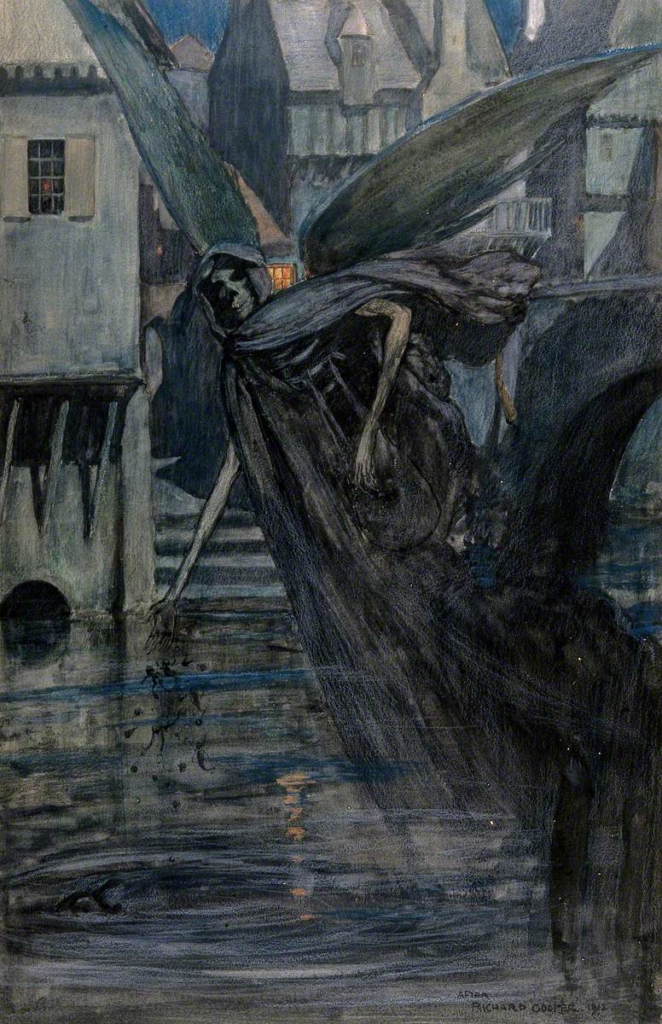
If Evelyn De Morgan painted Death as a guide, Richard Tennant Cooper imagined it as a nightmare descending upon the world.
At first glance, The Angel of Death looks less like a religious figure and more like a creature born from humanity’s darkest fears. Draped in flowing black robes, with skeletal limbs and vast, shadowy wings stretching across the composition, the angel glides silently above a deserted city. Its face is almost swallowed by darkness, revealing little more than the suggestion of a skull. There is no emotion, no mercy, only an overwhelming sense of inevitability.
Unlike many earlier depictions that focus on a single individual confronting death, Cooper expands the scale. His angel is not visiting one person; it looms over an entire city. The empty streets and dim architecture beneath its wings suggest that no one is beyond its reach. Death here is no longer personal, it becomes collective, spreading like an invisible force through a population.
Painted in the early twentieth century, the work reflects an era haunted by epidemics, industrialisation, and the growing anxiety that catastrophe could strike entire communities rather than isolated individuals. Cooper transforms those fears into a supernatural figure that feels almost apocalyptic. The angel does not need to wield a weapon. Its mere presence is enough to signal devastation.
The painting’s muted blues, greys, and blacks amplify this atmosphere of dread. There is little warmth anywhere in the composition. Instead, the angel seems to absorb the light around it, becoming an enormous shadow that eclipses both the city and its inhabitants. Even the water below mirrors the darkness, reinforcing the feeling that there is no escape from its path.
What makes Cooper’s vision so memorable is its ambiguity. Is this angel bringing plague? War? Famine? Or is it simply the physical embodiment of death itself? The painting never answers that question, leaving viewers to project their own fears onto the figure.
Where De Morgan invited us to see Death as compassionate, Richard Tennant Cooper reminds us why generations before us imagined it as something that could darken the sky.
4. The Angel of Death by Carlos Schwabe
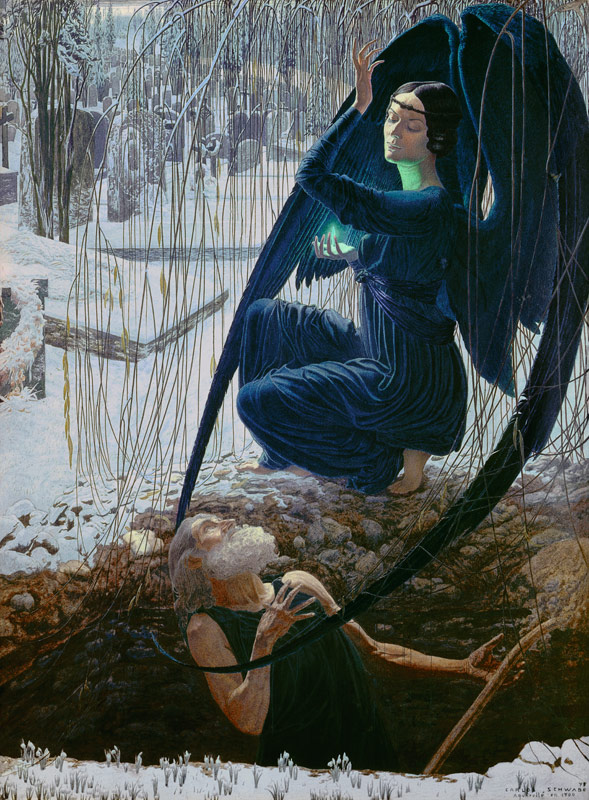
What if the Angel of Death wasn’t terrifying because of what it did, but because it refused to explain itself?
Carlos Schwabe’s The Angel of Death is one of the most enigmatic interpretations of the subject. Unlike Richard Tennant Cooper’s monstrous apparition or Evelyn De Morgan’s gentle guide, Schwabe’s angel exists somewhere in between. Cloaked in darkness, with sweeping wings and an expression that reveals almost nothing, the figure feels neither cruel nor compassionate. It simply is.
Schwabe was one of the leading artists of the Symbolist movement, a group that believed art should evoke emotion, mystery, and spiritual ideas rather than depict reality as it appeared. His paintings are filled with dreamlike figures and allegories, and The Angel of Death is no exception. Rather than illustrating a biblical story or a historical event, he invites viewers into a psychological landscape where meaning is deliberately left open.
The angel dominates the composition, its dark wings wrapping around the scene like a curtain. Yet despite its imposing presence, there is almost no action. The figure doesn’t strike, chase, or threaten. It simply stands, watching. That stillness becomes deeply unsettling. The painting asks us to sit with Death, not as a dramatic event, but as a quiet certainty that cannot be hurried or avoided.
Schwabe also resists making the angel look monstrous. There are no skeletal hands, no blood, no obvious symbols of violence. Instead, the figure possesses an almost otherworldly beauty, reminding us that death has long been imagined as something both feared and strangely sacred. It occupies the space between the earthly and the divine, where human understanding begins to fall away.
Perhaps that’s why the painting continues to fascinate viewers today. It offers no clear answers about what happens at the end of life. Instead, it captures the mystery that has surrounded death for centuries. The Angel of Death remains unreadable, and in that uncertainty lies its greatest power.
After the chaos of Cooper’s plague-like vision, Schwabe shifts the conversation inward. Here, death is no longer a catastrophe sweeping across cities. It becomes a silent presence that asks us one impossible question: what if the unknown is more unsettling than fear itself?
5. The Angel of Death (1851) by Horace Vernet
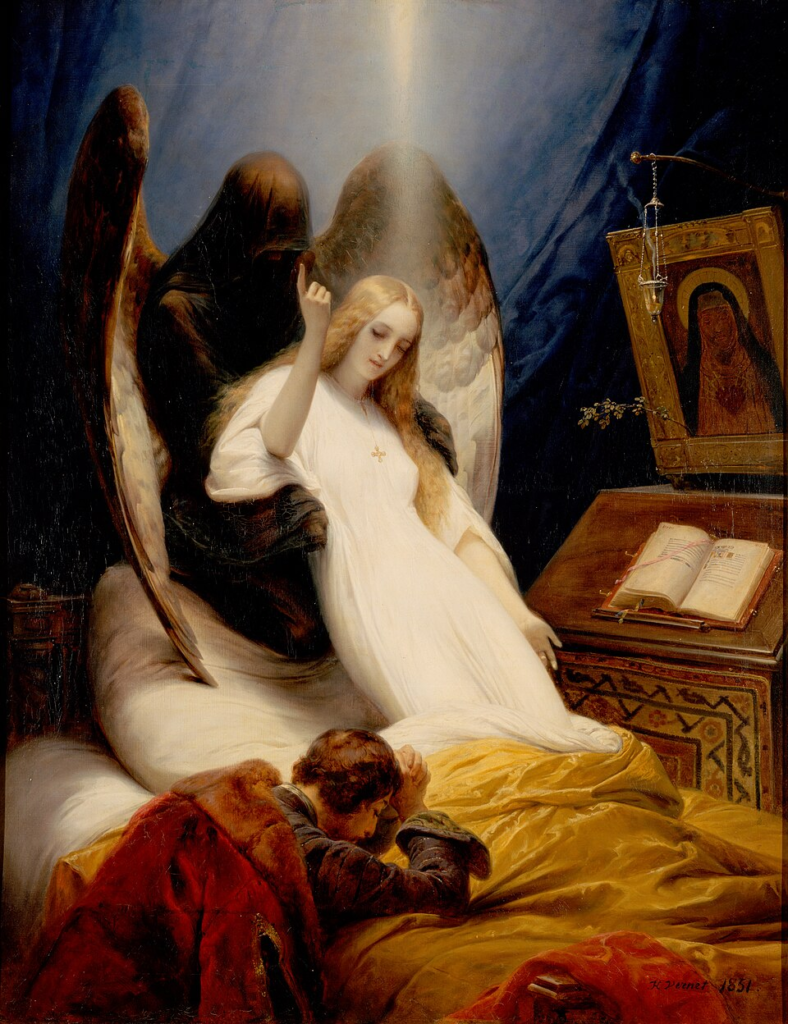
Some artists imagined the Angel of Death as a symbol. Horace Vernet painted it as divine judgement.
Inspired by the biblical story of the tenth plague in the Book of Exodus, The Angel of Death captures the terrifying night when the firstborn of Egypt were struck down before the Israelites’ escape from slavery. It is one of the Bible’s most dramatic and unsettling moments, and Vernet approaches it with all the grandeur of nineteenth-century history painting.
The angel dominates the composition, cutting through the darkness with enormous outstretched wings. Draped in flowing robes, it hovers above the sleeping city with a sword in hand, its movement swift and purposeful. Below, families remain unaware of what is about to unfold, heightening the tension. The viewer knows the tragedy that is about to occur, while the figures within the painting remain suspended in a final moment of peace.
Unlike the mysterious angels painted by Carlos Schwabe or Marianne Stokes, Vernet’s messenger leaves little room for interpretation. This is not Death acting on its own, nor a supernatural creature driven by malice. It is an instrument of God’s will, carrying out a command that has already been set in motion. The painting reflects a long tradition in religious art where angels are neither inherently gentle nor terrifying, they are simply obedient messengers of divine authority.
Vernet heightens the drama through dramatic contrasts of light and shadow. The angel seems to emerge from the darkness itself, illuminated just enough to reveal its immense scale, while the city below glows softly under the night sky. That contrast reinforces one of the painting’s central ideas: divine intervention often arrives without warning, separating the ordinary from the extraordinary in a single moment.
For modern viewers, the work is compelling because it reminds us that the Angel of Death has not always belonged to folklore or fantasy. For centuries, it was understood through scripture, a figure tied to justice, faith, and the belief that life and death ultimately rested in divine hands.
After the psychological mysteries of Symbolism, Vernet brings us back to one of the oldest stories ever told, where the Angel of Death is neither monster nor comforter, but the unmistakable force of destiny itself.
6. Angel of Death (1940) by Paul Klee
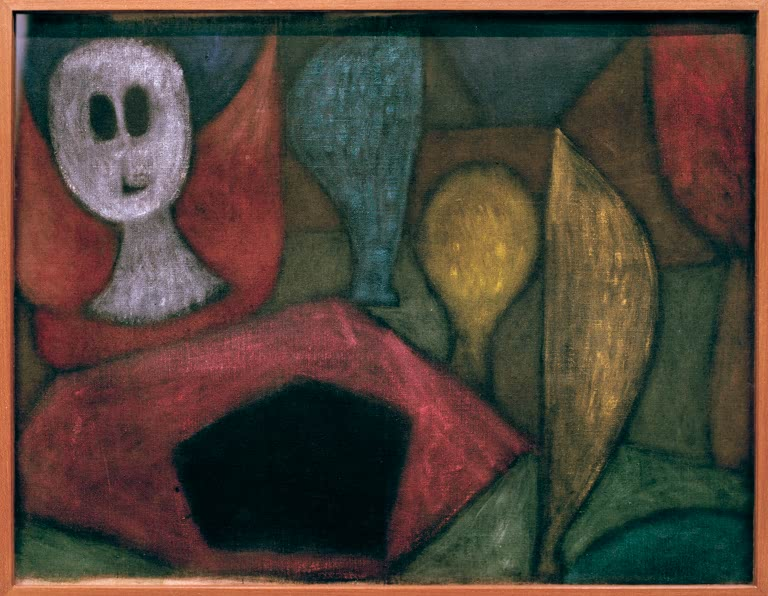
By the time Paul Klee painted his Angel of Death, the world was falling apart, and so was his body.
Created in 1940, just months before the artist’s death, the painting belongs to the final chapter of Klee’s life. He had spent years battling scleroderma, a debilitating autoimmune disease that left him in constant pain and increasingly isolated. Europe, meanwhile, was entering the darkest years of the Second World War. Death was no longer an abstract idea or a biblical allegory. It had become deeply personal.
Unlike the winged angels of earlier centuries, Klee strips the figure down to its bare essentials. There are no flowing robes, no dramatic landscapes, and no signs of divine grandeur. Instead, a ghostly face emerges from a web of simple lines, its hollow eyes and rigid features staring back at the viewer with unsettling calm. The figure feels almost childlike in its simplicity, yet impossible to forget.
That simplicity is deceptive.
Klee had long believed that art should reveal invisible truths rather than imitate reality, and his late works became increasingly symbolic. In Angel of Death, every line feels deliberate, as though the artist was trying to express something that words could never fully capture. The angel is no longer an external visitor arriving at someone’s door. It has become an internal presence, a quiet awareness of mortality that follows us wherever we go.
There’s something strikingly modern about this interpretation. Instead of terrifying us with elaborate symbolism, Klee leaves us alone with a face that refuses to explain itself. The painting doesn’t tell us whether the angel has come to comfort, judge, or take a life. It simply exists, suspended between life and death, certainty and mystery.
Perhaps that is why the work continues to resonate today. It reflects a universal truth that many of the earlier paintings only hint at: before death becomes an event, it becomes a thought. A question. A presence we carry within ourselves.
After centuries of depicting the Angel of Death as a winged messenger descending from above, Paul Klee turned the figure inward. In doing so, he created one of the most intimate, and haunting, visions of mortality in modern art.
7. Angel of Death Kills the Firstborn of Egypt (1865–67) by Ilya Repin
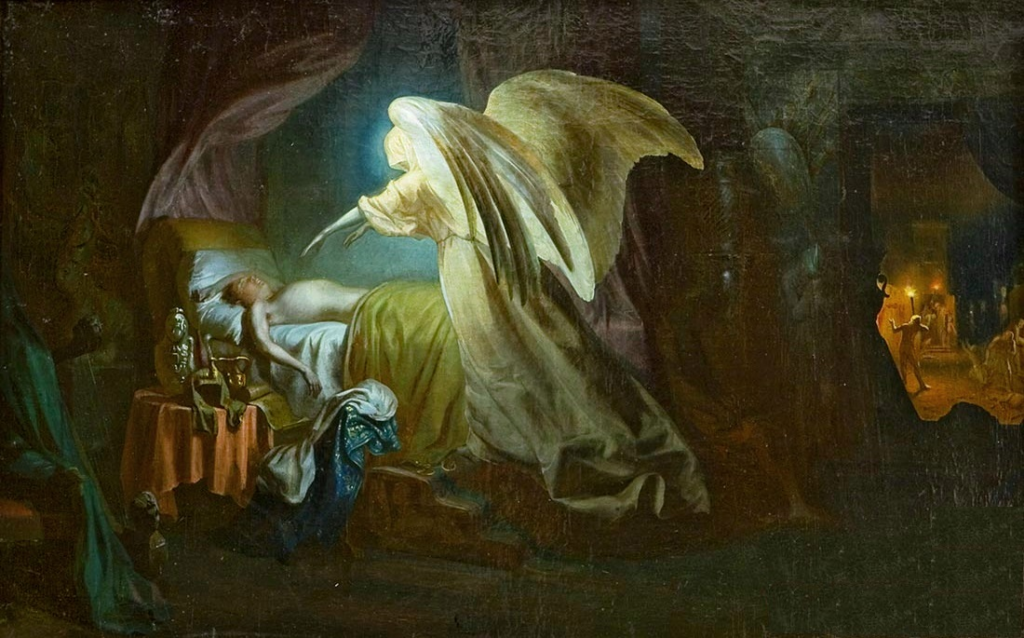
What would it look like if death swept through an entire nation in a single night?
That is the chilling question Ilya Repin confronts in Angel of Death Kills the Firstborn of Egypt. Inspired by the Book of Exodus, the painting depicts the final and most devastating of the Ten Plagues, when the Angel of Death passed through Egypt, claiming the lives of every firstborn before Pharaoh finally agreed to free the Israelites.
Unlike Horace Vernet, who emphasised the angel’s divine authority, Repin focuses on the human cost of the story. The biblical event becomes less about spectacle and more about grief waiting to unfold.
The composition is filled with suspense. The winged angel moves swiftly through the darkness, its luminous robes cutting across the night like an unstoppable force. Below, the city still sleeps. Families remain unaware that their lives are about to change forever. That contrast between peaceful stillness and impending tragedy gives the painting its emotional weight. Repin doesn’t show the aftermath. He captures the final breath before it.
Painted while Repin was still a young artist, the work already reveals the psychological depth that would later define his career. Rather than portraying the angel as monstrous, he presents it as distant and almost impersonal. There is no rage in its face, no pleasure in its task. It simply carries out a destiny that has already been written. That emotional restraint makes the scene even more unsettling, reminding us that history’s greatest tragedies often arrive without warning or explanation.
Light plays a crucial role throughout the painting. The angel seems to radiate an otherworldly glow, standing in stark contrast to the deep shadows enveloping the sleeping city. It is beautiful and terrifying at once, a visual reminder that in religious art, divine power is rarely meant to be comforting.
As the final painting in this journey, Repin brings us full circle. We began with Evelyn De Morgan’s compassionate guide, passed through Symbolist mysteries and modern psychological reflections, and arrive here at one of the oldest narratives associated with the Angel of Death. Yet despite their differences, every artist asks the same enduring question: how do we give a face to something no one truly understands?
Perhaps that is why the Angel of Death continues to haunt art history. It has never been a single figure, but a mirror, reflecting every era’s deepest fears, strongest beliefs, and most profound hopes about what lies beyond the final moment.
Across centuries of art, the Angel of Death has never looked the same twice.
For Evelyn De Morgan, it arrived with quiet compassion. Marianne Stokes imagined a silent visitor whose presence was more unsettling than any act of violence. Richard Tennant Cooper transformed it into a shadow looming over an entire city, while Carlos Schwabe wrapped it in mystery, refusing to tell us whether it was friend or foe. Horace Vernet and Ilya Repin looked to scripture, where the angel became an instrument of divine judgement, and Paul Klee stripped away every traditional symbol until death became little more than a haunting idea staring back at us.
These paintings remind us that the Angel of Death has never been about a single character or a single belief. It changes because we do. Every era has projected its own fears, faith, and questions onto this winged figure, reshaping it to reflect the anxieties of its time. Medieval Europe feared plague. Religious artists explored divine justice. Symbolists searched for spiritual meaning. Modern artists turned inward, asking what mortality feels like rather than what it looks like.
Perhaps that’s why these works continue to captivate us today. They don’t claim to explain death. Instead, they reveal something far more human: our endless desire to understand the one mystery every generation inherits but no generation can solve.
The Angel of Death, then, is more than a figure in art history. It is a reminder that while death may be inevitable, the stories we tell about it are constantly evolving, and in those stories, we often learn just as much about the living as we do about the end of life.
A question for our readers: Which of these interpretations of the Angel of Death stayed with you the most?
If you’re fascinated by the symbols artists have used to explore mortality, mystery, and the human condition, you might also enjoy our article on “The Skull Was Never Just About Death: 8 Hidden Stories in Art,“ where one of history’s most familiar symbols reveals meanings far beyond the macabre.